Tag: Part

  • Mapping Digital Spaces Part II

    Mapping Digital Spaces Part II

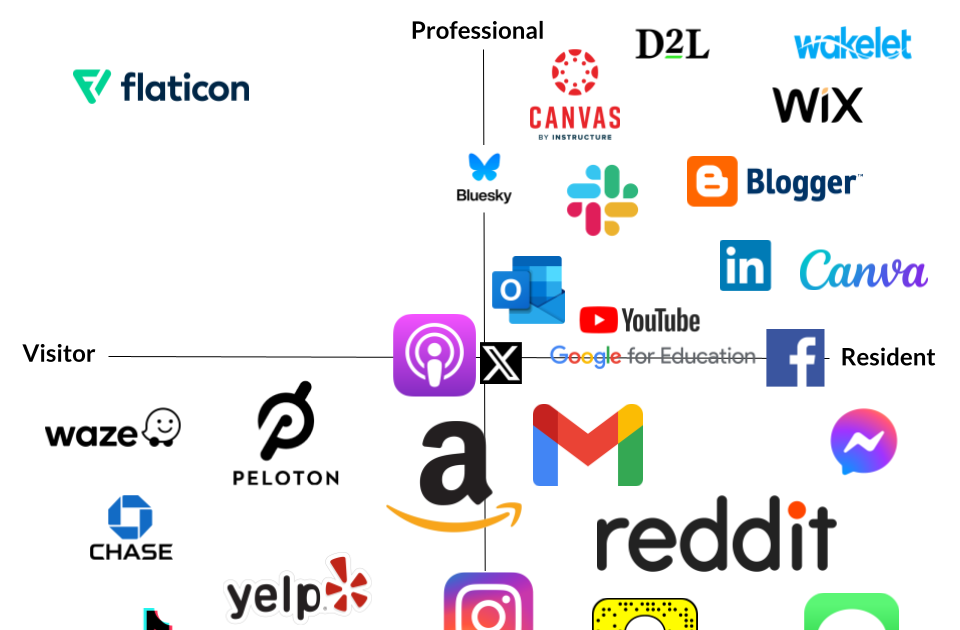
    Back in 2017, I wrote a blog post about how I spent my time online. Using David White’s concept of Visitors vs. Residents, I examined the technology tools and sites I frequented most and reflected on whether I used them professionally or personally. I then categorized them according to White’s idea: 

    • Visitors use technology tools to get a job done quickly. They don’t leave a digital trail or engage with others.
    • Residents regularly interact with others or create with technology while openly sharing parts of themselves, whether names, comments, or resources. 

    At that time, I was in a different role in education as a school-based instructional technology coach. Now, I am still in the field of education, but as the Director of Distance Learning for a community college. The only role that hasn’t changed in those eight years is my role as an adjunct instructor. The assignment to map digital spaces has always been one of my favorites, so this week I decided to join my students and reflect on what has changed and what has remained the same for me. Below is my current map and some thoughts that stood out to me.

    Nicole’s 2025 Digital Map

    • I overwhelmingly have a digital footprint. The vast majority of my map shows that both personally and professionally, I engage with others and leave a digital trace online. 
    • Larger images, such as Gmail, Amazon, Snapchat, Reddit, and podcasts, are applications that dominate much of my time online.
    • Applications such as podcasts, “X” (forever Twitter), Google, and Facebook are used for both personal and professional purposes. I love that these are places I can blend my personas.
    • On the personal visitors’ side, I may have signed up for accounts on these applications, but I do not engage with others or leave a public data trail- I hop on and hop off with a purpose. What may be surprising to some is that TikTok is included in this category. My husband is really the only one who sends me video clips. Otherwise, I don’t use this app much.
    • I struggled to find applications that I visit professionally as a visitor! This tells me that I am very comfortable leaving a digital presence.

    Here is my original map from 2017 and some general observations.

    Nicole’s original map from 2017

    Things that have changed

    • New apps! TikTok and Blue Sky are two examples of applications that became available after my original map was created.
    • RIP old apps! Google+, Wikispaces, and Edmodo played a big role in my professional encounters and are no longer in service.
    • My old map was very balanced- I spent just as much time as a visitor as I did as a resident. 
    • I have a much greater professional residency than I did in 2017!

    Things that have stayed the same

    • Most of the technology applications I used eight years ago remain the same today. Some, such as Fitbit, have been replaced by applications that perform a similar service (in this case, Peloton).
    • I am comfortable with using technology to enhance my professional life and comfortable sharing and engaging with others online.

    To wrap up, I’d like to revisit my blog post from 2017 by restating something I wrote back then that still holds true today: “My map will evolve as my career evolves and my PLN focus changes. For now, I’m happy with the digital presence that I have and knowing that where I go *is* helping me grow.” 

    Source link

  • Higher Education Leadership in Times of Crisis Part II – Edu Alliance Journal

    Higher Education Leadership in Times of Crisis Part II – Edu Alliance Journal

    By Dr. Barry Ryan, September 15, 2025 – In my August 11th article titled ‘Higher Education Leadership in Times of Crisis,” we established that higher education leadership today cannot be solitary work and that effective crisis response requires both internal and external counsel. Now that you’ve assembled (at least thought through) your cast of trusted advisors and recognized the unique leadership demands of your situation, the next critical step is understanding what you’re actually facing—and how to navigate it successfully. Once you recognize that your organization may be entering such a time, there are three key initial questions to ask:

    1. How long can a crisis be expected to last?
    2. What are the effects of crisis on my institution, on my team, on my loved ones, and on me?
    3. What are some healthy and effective ways I can lead during crisis?

    First, how long should I expect a “typical” crisis to last?

    At first blush, it might seem a little silly to ask how long a crisis lasts. After all, isn’t that inherently unpredictable?

    The answer is “yes” and “no.” It may seem a little flippant to say, but the reality is that the length of a crisis depends to a certain degree on how you and those in leadership alongside you respond to it. Your approach and actions may make it longer or shorter than it would have been. Here’s what I mean.

    Ignoring a crisis and hoping that it blows over is actually a potential strategy—although not one that I would recommend in most circumstances. But there are some built-in roadblocks in a university’s life cycle, which is divided largely into annual, semester, or quarter segments. These can act, on their own, as speed bumps or detours that might diminish or change the course of a crisis.  

    For example, a crisis that is being instigated or aggravated by certain individuals might be relieved to some degree on its own by their departure through retirement, transfer, and so on.  Or a financial crisis might be alleviated by the structural limits on certain types of debt that will be paid off, or the inception of certain grants or gifts that are within sight. But these are, unfortunately, uncommon scenarios, and the timing may be unpredictable.

    On a global scale, one might think of Winston Churchill trying to imagine how long World War II might last. As futile as such a task might have been, he did, indeed, play out various scenarios and their likely duration. Although it makes for a great quote and probably captures an important aspect of Churchill’s thinking, he likely did not say, “When you’re going through hell, keep going.” But that’s a good reminder for anyone in crisis.

    To grossly generalize, I have found that most institutional crises last between six months and two years. Why is that? The more acute ones require quicker action, and the result is either a solution that addresses the issues promptly and efficiently, in, say, six months, and you can move on to other things. Or, failing to find a speedy solution may end with you moving on. (And I don’t mean this lightly, but the reality is that moving on is not the end of the world.)

    Why the two-year time frame, on the other end? Because I’ve found that to be about the maximum time frame that a board, or an accreditor, or a creditor, or even a faculty can endure before a solution is reached. Again, the conclusion of the crisis will either leave you in a happier and stronger position in your institution or leave you seeking happiness and a better position somewhere else. But somewhere between six months and two years is what I have found to be the rough lifespan of an intense crisis. (This is barring, of course, a truly existential crisis as a result of which the institution ceases to exist in its current form. But even that drastic of an outcome can easily take two years or more to unfold.)

    Second, what are some of the common effects, and how do you survive them?

    For the sake of argument, let’s say you become aware that you are entering a crisis period, whether or not it eventually proves to be an existential one. How do you survive in the intervening six months to two years?

    Let’s begin with the effects of a continuing crisis on a leader. The crisis can easily become an enormous distraction for someone who already has too much on their plate. The stress that comes with leadership increases in crisis times, with mental, emotional, and even physical effects. Exhaustion can become a daily (and nightly) companion.  Self-doubt creeps in and steals even more of the leader’s resources.

    It sounds trite, but when this happens, don’t forget to take a few deep breaths – physically and metaphorically. 

    Draw up a “non-crisis” item list, i.e., things that still need to be done, but aren’t necessarily at the crisis point. Now start divvying them up between and among your fellow leaders, and to their direct reports when possible. This could be an opportune time to help them grow and develop, as well as ease your load.

    Along with that, begin to excuse yourself from meetings at which your presence is not absolutely necessary. Only you really know which are and which aren’t. You may still need to attend to some that aren’t technically necessary, but that may prove helpful in crisis-related activities. Again, having trusted substitutes sit in for you for a while can be a growth opportunity for them, and also demonstrate that you trust and empower those with whom you work. When it comes to meetings, which can serve to drain you even more, perhaps adopt a practice of only making limited strategic appearances. Make your participation relevant enough and just long enough to establish your presence and help you – and your colleagues – feel like you’re staying in touch.

    Don’t forget to take some days off, or even vacations. Sad but true, don’t make them too long or too far away or somewhere too difficult for you to be reached. You’re probably not really going to relax completely anyway, but you should at least experience some benefit from a change in perspective and place. Frankly, you would do well to consider the health and happiness of your loved ones who’ve been going through this with you, and that they need a break, perhaps even more than you do. After all, you are able to face the crisis more directly, as well as possible enemies, while your loved ones have to suffer vicariously and without the same ability to engage.

    Third, how to lead during a crisis?

    There is no question that crises have deleterious effects on you, your friends and family, but also your colleagues. You undoubtedly have support and supporters (even though they may seem distant), so don’t neglect them. Their fidelity to the institution and its mission – and you – deserves appreciation and acknowledgement, even if only expressed privately. They’re worried about the institution, but also their livelihood and their colleagues as well. 

    When they see you, try not to be the deer in the headlights (a situation that doesn’t usually end well in the wild). Appearing indecisive is uninspiring. But so is being overbearing or angry.

    Try to be yourself as you were before the crisis. Remember to smile, relax the muscles of your face and neck, and ask them about their loved ones, their teaching, or their research. Be human. The thoughtful ones have an idea about what you’re feeling and going through, so it’s okay for them to see you as a human. You don’t have to adopt a fake effervescence, but you should avoid moping.

    Seek impartial counsel. That may, or may not, include colleagues. A small group of confidants is necessary. External friends who have the courage to be honest with you, and also keep complete confidence, can be your best resource to help you gain and keep perspective. They may have higher ed experience, but not necessarily. I have always found that the best counsel comes from folks who have had real challenges, real losses, survived real attacks, and still kept their heads about them. Ones that are “too perfect” are probably not what you need at this point.


    While there is a need for you to seek and obtain trustworthy counsel, you should at the same time try to avoid seeking too much counsel. Bottom line is that you’re a leader and you’re going to have to make difficult decisions. So you should accept counsel, but too much can be confusing and even overwhelming. 

    Look, you’re in a tough position and no matter what you do, some people (possibly including some people you respect and care about) are not going to be thrilled. Sad but true. And some of those feelings may change over time, as they come to a fuller perspective as well.

    My advice to leaders in crisis situations always includes two elements:

    Can you make a decision that allows you to look at yourself in the mirror? 

    Then do what you believe is right and let the chips fall where they may. Period.

    While you are a leader in a profession you may (or may not any longer) dearly love, there IS an “after.”  That may mean continuing in your post-crisis position in the same post-crisis institution, or it may mean more significant changes for you.  If so, take what you’ve learned along to whatever comes next.  Partings are rarely enjoyable, but I recall a very thoughtful young person we had to let go.  His response was remarkable.  “I want to learn from this experience and become better as a result.” When I saw him at another institution a year later, he came up to me and said that’s exactly what had transpired and that he was grateful.

    Your life, and your legacy, are much more than just this current time of crisis within this current institution. Be grateful to those who have earned that gratitude, and remember who you are.


    Dr. Barry Ryan is a seasoned higher education executive, legal scholar, and former president of five universities. He is a senior consultant for the Edu Alliance Group and a legal scholar. With more than 25 years of leadership experience, Dr. Ryan has served in numerous roles, including faculty member, department chair, dean, vice president, provost, and chief of staff at state, non-profit, and for-profit universities and law schools. His extensive accreditation experience includes two terms on the WASC Senior College and University Commission (WSCUC), serving a maximum of six years. He is widely recognized for his expertise in governance, accreditation, crisis management, and institutional renewal.

    In addition to his academic career, Dr. Ryan ​ served as the Supreme Court Fellow in the chambers of Chief Justice William H. Rehnquist and is a​ member of numerous federal and state bars. He has contributed extensively to charitable organizations and is experienced in board leadership and large-scale fundraising. He remains a trusted advisor to universities and boards seeking strategic alignment and transformation.

    He earned his Ph.D. from the University of California, Santa Barbara, his J.D. from the University of​ California, Berkeley, and his Dipl.GB in international business from the University of Oxford.


    Edu Alliance Group, Inc. (EAG), founded in 2014, is an education consulting firm located in Bloomington, Indiana, and Abu Dhabi, United Arab Emirates. We assist higher education institutions worldwide on a variety of mission-critical projects. Our consultants are accomplished leaders who use their experience to diagnose and solve challenges.

    EAG has provided consulting and executive search services for over 40 higher education institutions in Australia, Egypt, Georgia, India, Kazakhstan, Morocco, Nigeria, Uganda, the United Arab Emirates, and the United States.

    Source link

  • We are in the cancel culture part of the tragedy cycle

    We are in the cancel culture part of the tragedy cycle

    First, two children lost their father and a wife her husband. Then people lost their humanity. And now, a nation loses another piece of its soul. This part of the cycle is its own special kind of awful: the cancel culture machine.

    It goes like this: A tragedy happens. Someone reacts by celebrating that tragedy for whatever reason. Then the social media mob comes to demand this person be fired, expelled, or otherwise punished for their views.

    Time and time again, we resort to this mob mentality when tragedy strikes. When Barbara Bush died. When the Queen diedRush LimbaughOtto WarmbierGeorge Floyd. After 9/11. After October 7. The attempted assassination of Donald Trump.

    As free speech advocates, it places us in a painful position. Charlie Kirk’s assassination was an attack on free speech and open discourse. In a free society, we must not be afraid to express our views, no matter how strongly some might oppose them. That’s the point of free speech. But it is precisely for that reason why we must not respond to mockery of Kirk’s assassination by canceling everyone who offends us: because that too creates a society where people are afraid to express themselves.

    Cancel culture ends when we decide that people can be horrifically wrong and still entitled to the grace that enables us all to grow from our worst moments. 

    Among the people targeted in the aftermath of Kirk’s heinous murder include:

    Businesses

    • The Carolina Panthers have fired a PR staffer for social media posts.
    • A DC comic book writer has had her series cancelled for her social media posts.
    • PHNX Sports has fired a staff writer for his posts.
    • The general manager of a burger restaurant in Quincy, Illinois, was fired for a post.
    • A restaurant in Wayzata, Minnesota, said it would review security camera footage and fire any employee seen to have celebrated.
    • Wausau River District has fired their executive director over her social media post.
    • A political contributor to MSNBC was fired over his on-air comments; Cumberland University in Lebanon, Tennessee, subsequently cancelled a scheduled speech.

    Schools and universities

    • The Florida Department of Education has said it would investigate every teacher who makes “disgusting comments” about the tragedy.
    • An assistant dean of Middle Tennessee State University has been fired for a social media post.
    • Naples (NY) Central School District has started a formal investigation of one staff member’s posts.
    • A cheerleading coach from Meridian (ID) High School was fired over a video.
    • A teacher at Ridgeview Elementary School in Lakeside, Florida, has been suspended for her posts.
    • A teacher at Greenville (SC) County Schools was suspended and then terminated for his post after a member of congress called for his firing.
    • A teacher at Lake Norman Charter School in Huntsville, North Carolina, has been placed on leave pending an investigation of his post.
    • A teacher at Gaston County (NC) Schools is under investigation for their post.
    • A teacher at the School District of Lancaster (PA) is facing some action, described as a “personnel matter,” for their posts.
    • A teacher at Lee County (FL) School District is being investigated for their post.
    • The University of Mississippi fired an executive assistant over her post, after a member of the state house said he would vote against continued university funding until her firing.
    • Linden (NJ) Public Schools had to shelter in place after the school received threats because a post was erroneously claimed to have been written by an employee. In reality, the author never worked there.
    • A teacher at Wachusett (MA) Regional School District has been suspended for her social media posts.
    • A teacher at Framingham (MA) Public School District has been suspended for her social media video.
    • A teacher at Vassar (MI) Public Schools has been suspended for her social media posts.
    • A teacher at Oksaloosa (IA) High School has been suspended for his social media post after U.S. Rep. Marionette Miller-Meeks promised to contact the school.
    • A teacher at the Cleveland Heights-University Heights (OH) School District has been suspended for alleged social media posts.
    • A professor at East Tennessee State University has reportedly been suspended after state lawmakers complained about his posts.

    Legislators and government officials

    • The U.S. State Department has warned that it will review the legal status of immigrants who mock the tragedy.
    • U.S. Sen. Marsha Blackburn and U.S. Rep. Andy Ogles have called for the firing of a Cumberland University professor over his post.
    • U.S. Rep. Lauren Boebert has called for the firing of a Colorado Department of Health staffer for a social media post.
    • U.S. Rep. Riley Moore has called on West Virginia University to remove a state lawmaker from a gender equity council based on her posts.
    • A Michigan state senator has demanded a University of Michigan professor be fired for his post.
    • A Virginia state senator has demanded a dean at the Chesterfield School Board be fired for her posts.
    • A Texas state senator has demanded a teacher be fired for liking someone else’s post.
    • A city councilman in Jacksonville, Florida, called for the removal of a city appointee over a now-deleted post.
    • A South Carolina state lawmaker called for the firing of a Clemson University professor over his posts.
    • The Louisiana attorney general is calling for the firing of a New Orleans firefighter for a now-deleted post.
    • The Toledo Fire Department is investigating one firefighter’s post. 

    Have no doubt: There will be more. 

    A website is actively soliciting reports of posts “celebrating Charlie’s death” to preserve them for, presumably, posterity. (Take my word for it or don’t. Linking the website would tend to undermine the larger goal here.)  And in a counter-cancellation remarkable for its willingness to victim-blame, a Tennessee lawmaker has called for all events by Kirk’s organization, Turning Point USA, to be cancelled “out of fear of violence and threat to public safety.” 

    When state lawmakers and officials make demands to employers to fire people for their speech, those demands can violate the First Amendment. When private people and businesses do the same, it undermines the culture of free expression we all want to cultivate. To be clear, a business owner can fire employees for any lawful reason. At times, a misalignment of values or a need to retain customers will be those perfectly legitimate reasons. But performative firings are participation in a cancel culture that undermines American values.

    Violence must never be a response to speech

    America must be an open society where we feel safe to share our ideas in the public square, not just from behind bulletproof glass and bulletproof vests.


    Read More

    None of us are immune to these instincts. Kirk’s organization, Turning Point USA, maintains a Professor Watchlist. As we noted back when it was launched in 2016, the watchlist is protected speech. But as we also noted and predicted, the watchlist has been used to call for sanctions on professors for their protected academic expression, contributing to the scourge of cancel culture. We have opposed those calls, too.

    Governments and lawmakers must do better. The rest of us should do better, too. 

    When someone indulges their worst impulses after a tragedy, we should use our own voices to challenge them. Or if we’re really courageous, we can be like Daryl Davis, a black musician and activist who through love, compassion, and constructive dialogue has convinced dozens of people to leave and denounce the Ku Klux Klan. We should remember we don’t win an argument by ruining someone’s life. We just ruin someone’s life. 

    We are not so fortunate, in this imperfect world, that Charlie Kirk’s murder is the last tragedy we experience. Nor is it the last time that some of us take a moment that calls for compassion and fill it with vitriol. If we (as a society) were to wait for either of those things to stop being true before ending cancel culture, that’s the same as ceding freedom of speech to the assassins and the mobs. 

    Cancel culture ends when we decide that people can be horrifically wrong and still entitled to the grace that enables us all to grow from our worst moments. 


    Source link

  • The Coming Federal Cuts – Part 3: ISED

    The Coming Federal Cuts – Part 3: ISED

    Monday, we looked at the country’s overall financial situation (dire), and yesterday we looked at how cuts of a magnitude of 15% might affect key programs like the Canada Education Savings Program and the Canada Student Financial Assistance Program. Today, we’re going to look at how a 15% cut might affect the Government of Canada’s research subsidies, which in the main are run through the Ministry of innovation, Science and Economic Development (ISED). 

    (I will be speaking about “the tri-councils” as a single funding line; I am aware that the Canadian Institute for Health Research (CIHR) is funded through Health Canada but for this exercise it is easier just to lump them together).

    Let’s start by acknowledging that ISED is a sprawling mess of a department with small programs with very little political protection littered all over the place. I wouldn’t bet the farm on the $12 million “Futurpreneur Canada” making it out of this budget round alive. I also doubt the Universal Broadband Fund is going to continue at $900 million per year. Computers for Schools (sounded great in the 90s, less so now) and Computers for Schools Interns would also be on my endangered list. I suspect that the various regional development funds might be in for an outsized hit as well. All of which is to say that it is possible that the research enterprise – that is, the tri-Councils, the National Research Council (NRC), the Canada Foundation for Innovation (CFI) and all those organizations that get part or all their money through the Strategic Science Fund – might not get hit with a 15% cut. It’s quite possible all these other areas might take an outsized hit and allow the actual science stuff to get off with a lighter cut.

    That said, remember this key point: the budget exercise is not about cutting 15% of funding from where it should theoretically be in three years’ time (the government has a fiscal framework that extends out four or five years). It is about cutting expenditures from a 2024-25 baseline. That means that to get through any previously planned increase in spending, the cuts to existing programs must be more than 15%. 

    This matters for two reasons. First, it is because the government runs its subsidies to electric vehicles manufacturers through ISED. Those subsidies were worth $39M in 2024-25; they were planned to cost $2.1 billion this year and $4.2 billion in 2027-28 (i.e. it’s about half the department’s direct budget spend come two years from now, and about a third of total sci/tech spend if you include the tri-councils). To accommodate that increase while following the letter of the budget reduction request would basically mean requiring the entire department to shut down. That’s probably not happening (though one presumes that Carney’s announcement last week releasing Canadian auto manufacturers from their 20% EV sales target in 2026 might also lead to a reduction in EV subsidies to manufacturers). 

    Second, remember budget 2024? The one where the Liberals promised $1.8 billion in new spending on research and the whole sector cheered with relief? Yeah, well only $75 million went into the budget framework for 2024-25; 87% of that 1.8 billion is backloaded until after spring 2026. So, basically none of it is protected, and it’s all at risk. I wouldn’t be surprised in the least if they just cancelled the whole thing. And then, on top of that, we must worry about what happens to existing programs, and whether they take a 15% hit.

    CIHR transfers about $1.2 billion to Canadian post-secondary institutes each year, while the National Science and Engineering Research Council (NSERC) transfers about $1 billion, and the Social Sciences and Humanities Research Council (SSHRC) transfers about $440 million (although a fair bit of that last one includes combined tri-council projects which administratively run through SSHRC, including – if I am not mistaken – funding for the Canada First Research Excellence Fund). CFI is another $550 million a year or so. NRC is about $1.7 billion per year. The Strategic Science Fund is another $900 million or so, closer to a billion if you include base funding for Genome Canada. Canada Research Chairs are another $300 million. Call it $6.2 billion in total. Required savings to get to a 15% cut is therefore just under $1 billion.

    Where to start?

    Ask most researchers at universities what they would prefer, and the answer is likely that they would eliminate everything except the tri-council funding. Ditch CFI, significantly cut NRC, definitely obliterate the Strategic Science Fund – anything, anything, anything but touch tri-Council grants. I understand the preference, but as I noted last week, this is a monumentally detrimental position for the sector to take. Yes, basic research and the existing grant system are the basis of the existing tenure and promotion system, and as such is naturally dear to those in the system, but almost no one in Ottawa thinks that’s what these systems are for. If we’re going to keep research funding afloat, it’s probably going to be through more spending on things like the Strategic Science Fund.

    I have very little insight into the state of official Ottawa’s current thinking on the relative value of these various programs, but I could imagine three basic scenarios that get us to $1 billion in savings.

    Option 1 is a straight 15% cut across the board. Take out $400 million or so from the granting councils, $80 million from CFI, $250 million from NRC, cut the Strategic Science Fund and Genome Canada to the tune of $150 million or so, and lose about 350 Canada Research Chairs. 

    Option 2 would be the spare the professors approach. Now, you probably can’t spare them entirely, because they are such a big proportion of the overall expenditure, but if you jacked up the cuts to CFI, NRC and Strategic Science to say 25%, you could hold the losses to CRCs and the tri-councils to under $100M. I think this is unlikely, but it is a possible scenario.

    Option 3 would be the hammer the tri-councils approach. Because, as I said, I don’t think they are particularly well-liked at Finance/PMO. This is close to the inverse of option 2; zero cuts to NRC and Strategic Science, keep the CFI cut at 15% and take the rest of the necessary money out of the tri-councils. That would mean a cut of about $800 million or about 30% to council funding.

    And remember, all of this is on top of walking back the measures announced in the 2024 Budget. Ugly doesn’t even begin to cover it.

    To be clear: I suspect it is unlikely that the research area will get a cut of 15%, in part because officials will feel bad about doing serious damage to existing budgets after, I suspect, already taking away the Budget 2024 measures. If I had to guess, I would say that the department will probably come down hardest on regional development subsidies. Nevertheless, the scenarios above are possible even if not probable. Universities should start thinking about what they might mean and how they might cope. 

    Source link

  • The Coming Federal Cuts – Part 2: ESDC

    The Coming Federal Cuts – Part 2: ESDC

    Yesterday, I explained why the federal government now finds itself in a position where it has to cut program budgets by at least 15% just to keep the budget deficit to $50 billion by 2028. Today, I am going to explain how this will play out at Employment and Social Development Canada (ESDC), which plays a major role in funding for skills and education in Canada, mainly through the Canada Education Savings Program (CESP) and the Canada Student Financial Assistance Program (CSFAP).

    Now, just a note at the start. It is vanishingly unlikely that the feds will actually look for 15% savings in every program. The 15% rule is for the Department as a whole, and ESDC is one big mother of a department. It includes all sorts of programs including EI (which in theory is exempt from cuts), and child care.

    So, let’s start with CESP, which delivers about a billion dollars a year via matching grants to parents saving for their kids’ education via Registered Education Savings Plans (RESPs). This program doesn’t allow for a lot of nuance in cutting. The program gives out about $1.1 billion a year in Canada Education Savings Grants (CESGs), roughly 85% of which goes on a basic 20 cent-to the dollar match rate and about 15% of which goes to “additional” (i.e. higher) matching rates for lower-income Canadians (A-CESGs). It also runs the Canada Learning Bond Program, which is another roughly $150 million per year which is a non-matching grant of up to $2000 to children from low-income backgrounds to start their educational savings.

    There are basically four options here:

    1) The government could cut program spending across the board by 15%. That is, it could lower the base CESG matching rate from 20% to 17%, and A-CESG payment rates for lower income contributors to 26.5% and 34% from the current 30% and 40%. That would save about $150 million/year. It could also reduce the CLB payout to $1700.  

    2) The government could eliminate the A-CESG pieces entirely and go with a flat 20% coverage. That’s a pretty quick way to a 15% reduction.

    3) The government could axe the CLB. Again, a very quick way to get close to 15% reduction.

    4) The government could hold the A-CESG and CLB harmless and reduce the CESG base rate even further, to about 15%.  

    Now, personally, I think CESG probably comes out of this unscathed – that is, a 0% cut – because it’s one of the most popular government programs in existence. But these options give you a sense of what cuts might be, if applied uniformly across the department.

    (Yes, there are also presumably some savings to be made on the personnel side, but it’s a pretty simple and lean program – if you could get savings equal to even 0.5% of total expenditures from that, I’d be shocked).

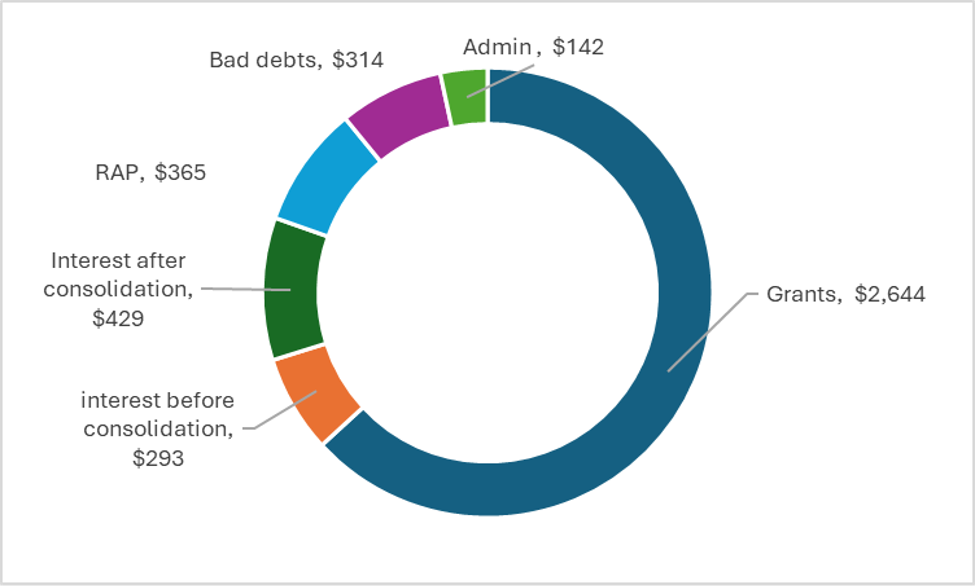
    Let’s now head over to CSFAP spending and see how that might fare. It’s a bit more complex than CESG so it’s worth looking at its basic cost-structure. Using data from the CSFAP’s 2023 Actuarial report, it’s possible to look at overall direct program costs, as shown below in Figure 1. Technically, this is not a full state of program costs because there’s another billion or so in “alternative payments” to jurisdictions that do not participate in the CSFAP (i.e. Quebec, Nunavut and the NWT). But since this sum is calculated as a fraction of direct programs, we can more or less ignore them here – a 15% cut of the direct costs automatically translates through to a 15% cut in alternative payments as well. And our target number – given that CSFAP direct expenses are about $4.2 billion – would be about $628 million.

    Figure 1: Major areas of CSFAP spending, in millions, 2023-24

    So where do you carve out that much money from CSLP? Well for starters we could and should get rid of the $429 million we spent eliminating interest on loans after graduation. These subsidies do nothing for access; rather, they boost the incomes of middle-class 20–30-year-olds who have already finished school. And it is not a long-standing program. It is, in fact, a quite recent thing, announced by then-finance minister Chrystia Freeland in 2023 when the Liberals were desperately trying to throw a bone to house-poor urban twenty-somethings who at the time were threatening to vote not-Liberal. Now cutting this wouldn’t be a straight $429 million savings – loss of that subsidy would likely lead to increases in bad debt and Repayment Assistance program (RAP) charges somewhat. So, let’s call that a $350M win.  

    Where to find the other $275 million? Not administration: most of the admin money is tied up in payments to provinces for running the front end of the program or to the National Student Loans Service Centre (an outsourced agency which resides over by Square One in Mississauga for running the back end), neither of which can easily be changed in the short term. Maybe you could lose a couple of million in staff costs but not much more. Very little you can do about bad debts either.  RAP and interest subsidies before consolidation could be made less generous. In particular, the income threshold for access to RAP could be brought back down from the current $45K (roughly – it depends on family size) to say $38K, and interest during school could be brought up from zero to the current inflation rate or the government rate of borrowing (i.e. somewhere between 2 and 2.5%). I don’t have access to detailed financial figures on this, but my guess is that the RAP measure might save $50M or so; in-school interest might get you $100M.

    That still doesn’t quite get us to the required $625 million, so the only option left here is to start hacking away at grants. A straight cut in the maximum grant would be the easiest way to cut costs; bringing that down from $4200/year to, say, $3500/year would reduce spending by something along the lines of $400M/year. Another and more likely option would be for the feds to copy what Doug Ford did when he wanted to contain student aid costs – change grant eligibility criteria in such a way as to make grants harder to obtain. The obvious way to do this, I think, would be to change the rules for dependent/independent student status (i.e. the point at which students are considered to no longer get money from their parents) so that it took students five years to reach such independent status instead of four. I am not exactly sure how much that would save, but I’d wager it would be a minimum of a quarter-billion. 

    So, your menu of cut options for cutting CSFAP is, essentially:

    Bring back interest after graduation $350 million
    Admin $3-5 million
    Reduce RAP threshold to $38K $50 million
    Introduce in-school interest of 2.5% $100 million
    Cut maximum grants by $700/year $400/million
    Change definition of independent student $250 million

    (To be clear here, I am guessing a bit on some of these numbers. Intelligently, I hope, but they are guesses. Don’t take the numbers here as gospel. And if any friends at CSLP want to correct me, please do!)

    If it were me, to get to (roughly) the required $625 million I’d bring back interest after graduation – or introduce an equal-to-government-rate-of-borrowing interest rate for the entire life of the loan, which probably ends up with similar savings – and change the definition of independent students. Neither are pleasant but these are the ones that would probably affect access the least.  

    (Again, the Liberals may choose not to cut anything in CSFAP, because hey this is an income security program of a sort, and if we’re obsessing about “affordability” – but that just means cuts elsewhere in the portfolio will be larger).

    Of course, ESDC is much more than these two programs. Take a gander at the full list of programs the programs the Ministry runs (I make it about fifty if you include everything). A lot of those are scattered skills initiatives like Youth Employment and Skills, Indigenous Skills and Employment Training, the Skills and Partnership Fund, Skills for Success Program, the Innovative Work-integrated Learning Initiative. I have no idea what most of these do exactly, nor is it easy to access any budget data about them. But let’s put it this way – few of these programs have a particularly large policy constituency to back them up. My guess is that cuts across these programs will be significantly higher than 15% and some of them may cease to exist altogether.  

    Enough for today.  Tomorrow we’ll do research funding.

    Source link

  • The Coming Federal Cuts – Part 1

    The Coming Federal Cuts – Part 1

    The biggest thing everyone is going to be talking about this year – barring another university doing a surprise Laurentian – is the set of federal cuts coming down the pike. They are big. And they are nasty. So, it’s worth understanding exactly the scale of what is heading in our direction. This is going to be a three-parter. Today, I will talk about the overall size of the cuts to come, and on Tuesday and Wednesday I will talk about how this will affect the two ministries that have the most to do with post-secondary education: Employment and Skills Development Canada (ESDC, tomorrow) and Innovation, Science and Economic Development Canada (ISED, Wednesday).

    So: we don’t know the exact scope of the budget cuts the government is contemplating. What we do know is the following:

    Preliminary budget figures for Fiscal 2024-25 show that the government of Canada posted a budget deficit of $43.2 billion on revenues of $495B, program expenses of $480B, debt charges (that is, interest on existing debt) of $54B and actuarial losses of $4B. We didn’t have a budget this spring, but spending projections for 25-26 from the 2024-25 budget show a projected deficit of $39 billion on revenues of $515B, program expenses of $496B, debt charges of $55B and actuarial losses of $2B.

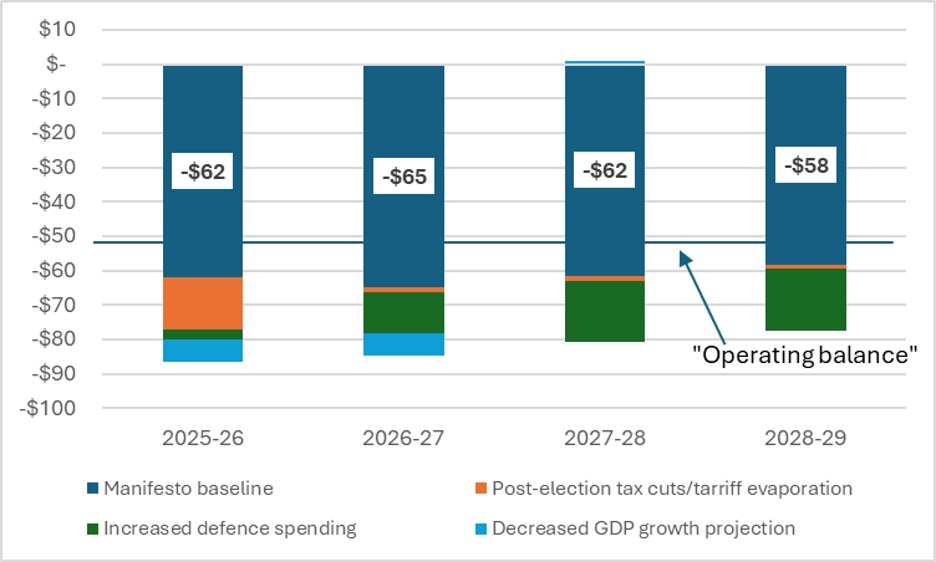
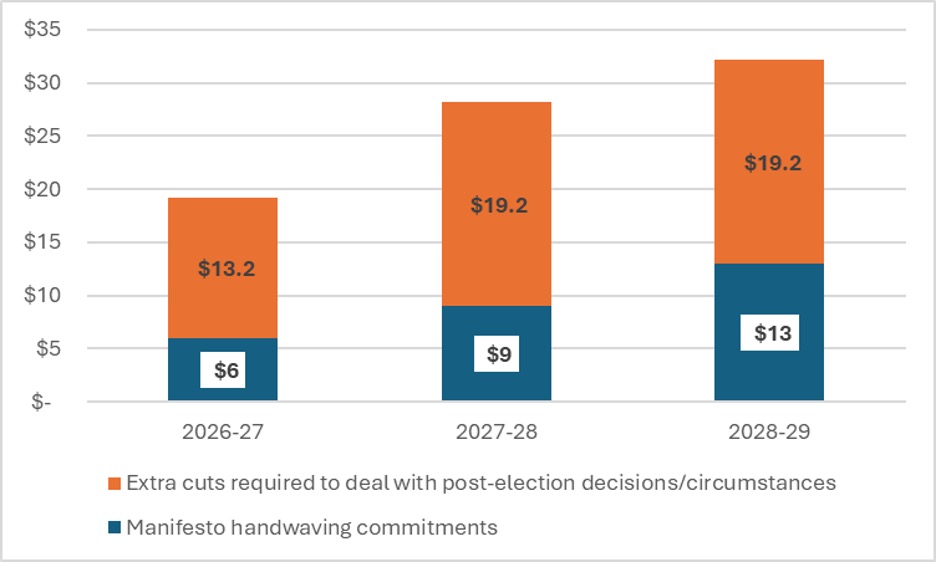
    The Liberal Manifesto for election 2025 planned deficits of $60 billion or so right through to 2028-29. Its fiscal plan was basically i) existing spending commitments, ii) 30-odd billion in new spending and tax cuts and iii) tiny revenue changes, plus $20 Billion or so in counter-tariffs for 2025-26. (Yes, they also promised “savings from increased productivity” – otherwise known as “frantic handwaving” – of $6B, $9B and $13B in fiscal years ’27, ’28 and ’29. I am excluding them here but will return to them in a sec).

    Figure 1: Government of Canada fiscal picture according to the Liberal manifesto, minus the handwaving, in Billions.

    (The foregoing might all sound strange to those of you who recall Carney making pledges about balanced budgets. But, of course, as I pointed out back here, he never actually promised that. He promised balanced operating budgets, that is budgets with an only vaguely defined “capital spending” netted out. By a complete coincidence, the Liberal platform claimed the government spent roughly $50 billion in capital, so basically the government is already basically in balance.  Neat trick, but not sure bondholders will see it that way. I digress.)

    Since the election, a few things have happened. Counter-tariffs are not collecting anything like the $20 billion forecast, we ditched the Digital Services Tax in a futile attempt to get the Americans to be nicer to us, and, most importantly of all, the prime minister promised to up defense spending by about $18 billion over the next four years in order to reach 2% of GDP by 2028. That means the actual fiscal picture, before any handwaving about savings, looks like this:

    Figure 2: Government of Canada fiscal picture, according to the Liberal Manifesto, minus the handwaving, including proposed spending and tariffs since April 28, in Billions.

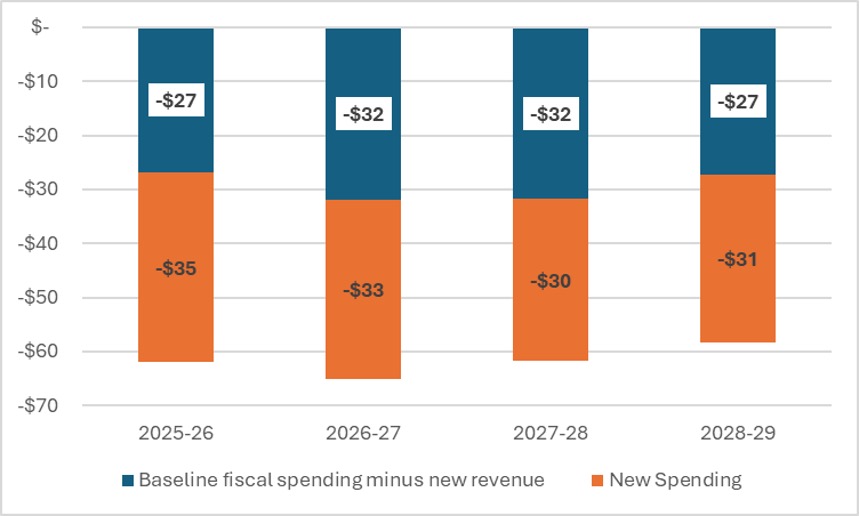
    As you can see, we are a lot further away today from “operating balance” (i.e. a $50B deficit) than we were when Carney was elected. And this is where the handwaving/cuts come into play. So, let’s start thinking about how much money it would take to keep us at “operating balance”. In Figure 3, we see that by 2028-29, we are looking at about $32 Billion in cuts. The handwaving “efficiencies” in the Liberal manifesto were meant to cover just $13 billion of that, leaving another $19.2 billion or so to be made up, somewhere, somehow.

    Figure 3: Cuts Required Just to Keep the Government of Canada at Operating Balance (i.e. a $50B deficit), By Source, in Billions.

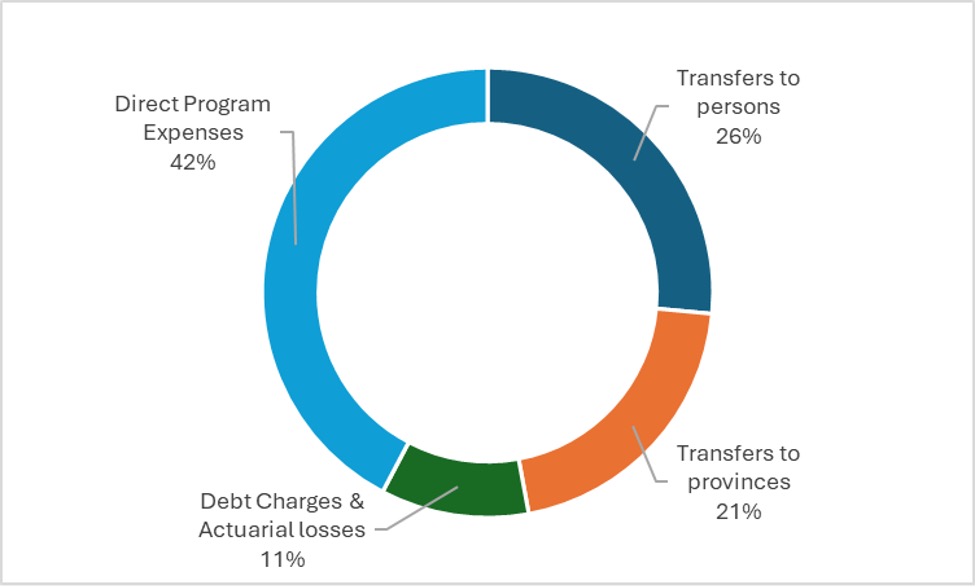
    I said “somewhere”, but there isn’t much mystery here. As Figure 4 shows, you divide government spending into four categories: debt charges (which the government has to pay regardless), transfers to provinces (which Carney has promised he won’t touch), transfers to individuals (ditto) and then “program spending”. As Figure 4 shows, the first three areas make up 58% of total spending. That means that the last area, program spending, is going to take up the entirety of these cuts. In 2025-26, program spending is estimated at $227 billion; a $32 billion cut to that equals an overall reduction in program spending of 14% by 2028. (Coincidentally, this was more or less exactly the size of the program cuts in the “savage” 1995 budget – $7 billion phased in over three years on a base budget of about $52 billion. Government grew back, as you can see.)  

    Figure 4: Government of Canada Expenditures by Category, 2025-26

    It’s worth being careful here. Overall program spending is $227 billion, but $46 billion of that is currently being spent on defense and housing, two areas that are almost certainly immune to cuts given the government’s overall priorities. Excluding these two fields from cuts means that the field of “cuttable” programs shrinks to $181 billion, and the size of the cuts required to meet the $50 billion target balloons to 17.7%.  

    This brings us to the program review that has been going on in Ottawa since July. Recall that Minsters were asked to bring forward scenarios that involved cuts of 7.5% for next year, 10% the year after that and 15% the year after that. Many thought initially that these numbers were deliberately overdone so that big cuts could be made in some departments so as to shield other departments from having to do the same. Now I am not so sure. That 15% target is awfully close to the 17% overall target the Liberals need to hit just to keep the deficit at $50 billion, and so I am starting to think that in fact the cuts might not be dispersed unequally between departments. They might really need 15% from everybody – and then some.

    There are a couple of alternatives of course that could lessen the blow. For instance, while Carney promised not to cut transfers to provinces, to my knowledge he never ruled out cutting the rate of growth of transfer payments (currently about 5% per year, across CHT, CST and equalization combined). Slash that in half and you’ve got yourself another $8 billion to play with by 2028, thereby reducing by a quarter the required amount of program cuts. Something similar could be achieved by de-indexing pensions for a couple of years. Or, unlikely as it seems, the Government could actually increase taxes (elbows up requires some sacrifices, no?). But, absent those measures, I think we need to seriously brace for impact. These cuts are real, they are huge, and even if they don’t hit this fall (it’s not impossible that the alleged fall budget might actually just be the usual fall economic statement under another name), they are for sure going to hit in early 2026.

    The question, really, is, what needs to be saved? What should the sectors’ priorities be? I’ll discuss that over the next two days.

    Source link

  • How the manufactured narrative of “failure” is distracting us from resolving the systemic problems holding back the study of Modern Languages – Part One.

    How the manufactured narrative of “failure” is distracting us from resolving the systemic problems holding back the study of Modern Languages – Part One.

    Author:
    Vincent Everett

    Published:

    This post was kindly written by Vincent Everett, who is head of languages in a comprehensive school and sixth form in Norfolk. He blogs as The Nice Man Who Teaches Languages at https://whoteacheslanguages.blogspot.com.

    We have to bring an end to the Culture Wars in “Modern Foreign Languages” in England. Since 2019 we have been convulsed in an internecine political fight over whether our subject is about Communication or Intellectual Conceptualisation. Of course, it’s both. The same goes for Literature, Linguistics, Content Integrated Language Learning (CLIL), and Culture. Likewise, we can encompass transactional travel language, personal expression, professional proficiency, creative or academic language. Teachers have all of these on their radar, and make decisions on how to select and integrate them on a daily basis.

    Our subject benefits from the richness of all these ingredients, and to privilege one or to exclude others, is to make us all the poorer. Teachers work in the rich and messy overlap between Grammar and Communication, engaging with pupils at every stage through their encounters with and progression through another language.

    Meanwhile, we have allowed the culture wars to allow us to be distracted from the very real problems facing our subject. The first is unfair grading at GCSE. The allocation of grades in languages is harsher than in their other subjects. Above a grade 3, this widens to a whole grade’s difference compared to a subject like History.

    The narrative that it is harder to succeed in languages is accurate. Not because of the difficulty of the course content or the exams, but because of the determination of the allocation of grades. It’s not accurate to say that this is a reflection of pupils’ progress or the quality of teaching compared to other subjects. That calibration has not been made. In fact, grades are not calibrated one subject to another. The only calibration that is made, is to perpetuate grading within the subject year on year.

    This was most famously set up in advance when we moved to a new GCSE in 2018. The unfair grading of the old GCSE was carefully and deliberately transferred across to the new GCSE. So pupils taking the new course and the new exam, even though it was proposed to be a better course and a better exam, had no chance of showing they could get better grades. Furthermore, where under the old A-G grading system, the difference between languages and other subjects had been around half a grade, the new 9-1 grading meant that the difference in the key area of grades 4 and above, was now stretched to a whole grade, because of the way the old grades were mapped onto the new ones.

    The lower grades given out in languages are a strong disincentive for take up at GCSE. There is the accurate narrative that pupils will score a lower grade if they pick languages, which acts as a deterrent not only for pupils, but also for schools. One way to score higher in league tables is to have fewer pupils taking MFL. There is also the inaccurate narrative that this is a reflection of the pupils’ own ability, the nation’s ability, or the quality of teaching. The allocation of grades is a historical anomaly perpetuated year-on-year, not a reflection of actual achievement.

    This is the biggest issue facing modern languages. It would also be the easiest to fix. Grade boundaries in other subjects are used in order to bring standards in to line. If an exam is too easy  or too hard, and many pupils score a high mark or a low mark, the grade boundaries are used to make sure the correct number of pupils get the grade. Except, that is, in modern languages, where the thresholds are used to make sure that grades are out of line with other subjects. Imagine if languages grades were allocated in line with other subjects, would there be a clamour of voices insisting they should be made more difficult?

    There is a very real danger of misinterpreting this manufactured narrative of “failure” in languages. It features in every report or proposal, but often instead of identifying it as an artificial anomaly, it is used to diagnose a deficit and prescribe a solution. Often this is a solution taken from the culture wars, ignoring the fact that schools and teachers are already expertly blending and balancing the elements of our subject.

    Unfair grading at GCSE is the greatest of our problems, and the easiest to sort out. In Part 2, I shall look at the trickier question of what happens post-16.

    Source link

  • Avoiding Work Has Always Been Part of College. This Is New.

    Avoiding Work Has Always Been Part of College. This Is New.

    In a recent piece in The New Yorker, “What Happens After AI Destroys College Writing?,” Hua Hsu tells a story that will be familiar to anyone working in higher education: students wrestling—to varying degrees—about when and how to use generative AI tools like ChatGPT in the completion of their schoolwork.

    There is a range of approaches and opinions among students—as there must be, as students are not a monolith—but Hsu centers the piece around “Alex,” an NYU student with a future goal to become a CPA who makes extensive and, to his mind, strategic use of these tools in various aspects of his life, including in writing the emails he exchanged with Hsu to arrange the interview for the piece.

    Alex walks Hsu through his use of Claude to first crunch an article on Robert Wedderburn (a 19th-century Jamaican abolitionist) into a summary, and then, when the summary was longer than he had time to absorb before class, to reduce it to bullet points that he then transcribed into a notebook since his professor didn’t allow computers in class.

    In a more elaborate example, Alex also used it to complete an art history assignment rooted in a visit to a museum exhibition, where he took pictures of the works and wall text and then fed it all into Claude.

    His rationale, as told to Hsu, was “I’m trying to do the least work possible, because this is a class I’m not hella fucking with.”

    At the end of the article, we check in with Alex on his finals. Alex “estimated he’d spent between thirty minutes and an hour composing two papers for his humanities classes,” something that would’ve taken “eight or nine hours” without Claude. Alex told Hsu, “I didn’t retain anything. I couldn’t tell you the thesis for either paper hahhahaha.”

    Hsu then delivers the kicker: “He received an A-minus and a B-plus.”

    I mean this without offense to Hsu, an accomplished writer (New Yorker staff writer and author of the best-selling memoir Stay True) and professor at Bard College, but the piece, for all its specifics and color, felt like very old news—to me, at least.

    The transactional mindset toward education, something I’ve been writing about for years, is on perfect display in Alex’s actions. Generative AI has merely made this more plain, more common and more troubling, since there aren’t even any hoops to jump through in order to fake engagement. Alex is doing nothing (or nearly so) and earning credits from New York University.

    On reflection, though, the story of Alex is even older than I thought, since it was also my story, particularly the line “I’m trying to do the least work possible,” which was very much my experience for significant chunks of my own college experience from 1988 to 1992.

    I earned quite a few credits in my time for, if not doing nothing, certainly learning nothing. Or not learning the subject for which I’d earned the credits, anyway.

    How could I blame a student of today for adopting the attitude that I lived by? With my own students, when I was teaching college, I often made hay from my lackluster undergraduate performance, talking about how I skipped more than 70 percent of my class meetings second semester of freshman year but still received no grade lower than a B.

    In the article, Hsu remarks that “None of the students I spoke with seemed lazy or passive.” The students “worked hard—but part of their effort went to editing out anything in their college experiences that felt extraneous. They were radically resourceful.”

    I, on the other hand, at least when it came to the school part of college, was resolutely lazy and largely passive, except when it came to making sure to avoid courses I was not interested in—essentially anything outside of reading and writing—or that had a mode of assessment not suited to my skills.

    My preferred structure was a lecture or lecture/discussion with in-class essay exams and/or short response papers geared to specific texts. Exams and research papers were to be avoided, because exams required studying and research papers required … research.

    If you let me loose on a reading or a few chapters from a textbook, I had no trouble giving something that resembled a student doing college, even though the end result was very much akin to Alex’s. I didn’t retain anything.

    But hindsight says I learned a lot—or learned enough, anyway, through the classes I was interested in and, perhaps more importantly, the noncurricular experiences of college.

    While there are some similarities between my and Alex’s mindset vis-à-vis college, there is a significant difference. Alex appears to be acting out of an “optimization” mindset, where he focuses his efforts on what is most “relevant,” presumably to his future interests, like employment and monetary earnings.

    I, on the other hand, majored in the “extraneous experiences.” I was pretty dedicated to the lacrosse club, showing up for practice five days a week with games on the weekend, but I also recall a game day following my 21st birthday when I was so hungover (and perhaps still drunk) that you could smell the alcohol oozing from my pores. My shifts in the midfield were half the length of my line mates’.

    (That was the last time I got that drunk.)

    I recall a contest at my fraternity where the challenge was to gain the most weight within an 18-hour period, during which we stuffed ourselves with spaghetti, Italian bread, chocolate pudding and gallons of water until we were sick and bloated. Another time we ground through an entire season of Nintendo Super Tecmo Bowl football over the span of a few days, skipping class if you had a matchup that needed playing. We had a group of regulars who gathered in my room to watch All My Children and General Hospital most weekdays. I am the least successful of that crew by a fair stretch.

    I know that I took courses in economics, geography, Asian studies and Russian history where, like Alex, I retained virtually nothing about the course material even days after the courses, when I crammed for a test or bs’ed my way through a paper to get my B and move on to what I wanted to spend my time on.

    From my perspective as a middle-aged person whose life has been significantly enhanced by all the ways I dodged schoolwork while I was in college, including spending inordinate amounts of time with the woman to whom I have been married for 25 years this August, I would say that missing out on those classes to make room for experiences was the right thing to do.

    (Even though I had no understanding of this at the time.)

    Will Alex look back and feel the same?

    So many questions that need exploring:

    Would Alex be as appalled by my indigence, my failure at optimization, as I am by his ignorance?

    Have we lost our belief that we as humans have agency over this world of technology?

    Is Alex actively deskilling himself, or am I failing to develop the skills necessary for surviving in the world we’ve made for students like Alex?

    I wonder if Alex and I have different definitions of what it is to survive.

    Source link

  • Corruption, Fraud and Scandal at Los Angeles Community College District, Part 2 (LACCD Whistleblower)

    Corruption, Fraud and Scandal at Los Angeles Community College District, Part 2 (LACCD Whistleblower)

    [Editor’s note: The first installment of Corruption, Fraud and Scandal at Los Angeles Community College District is here.]

    “HR has been weaponized against our faculty for speaking out and complaining about
    discrimination.” This was a public comment made by Los Angeles Community College District
    Academic Senate President Angela Echeverri at the March 2025 Meeting of the LACCD Board
    of Trustees.

    Echeverri’s remarks were not isolated either and were echoed by Deborah Harrington (California
    Community Colleges’ Success Network Executive Director), “Our HR leadership is not living up
    to the standards that we deserve. Our members remain quite frustrated.” More reporting can be
    read in Pierce College student newspaper ‘The RoundUp’ and LACCD Youtube Live-Streamed
    meetings.

    These accusations come three years after longtime administrator Annie G. Reed (Annie Goldman
    Reed) left her position as Omsbudsman/Associate Dean of Students at Los Angeles Valley
    College was promoted to Interim Dean of Employee and Labor Relations collecting an annual
    salary of $284,935.00 in pay and benefits in 2022 according to Transparent California last year of
    reporting.

    A survey of public records including news articles, lawsuits, accreditation complaints, and emails
    to show that Annie G. Reed has a long history of this sort of behavior across multiple LACCD
    campuses – going back to the 2000s. 

    In an October 27, 2010 article ‘Grade Grievances Give Students Voice’ by Lucas Thompson in
    ‘The Los Angeles Valley Star’ Annie G. Reed is quoted as cautioning students against using their
    rights to challenge unfair grades stating, “It’s worthwhile if a student really thinks they have the
    proof to forward with the process . . . It’s their right to, [but] we don’t encourage frivolous
    [cases], because that’s a waste of college resources.” 

    The article further quoted disgraced ex-College President Sue Carleo who left the institution in
    2013, with the College finances in the red and on Warning Status with the Accreditation
    Commission of Junior and Community Colleges. Carleo warned that students should simply
    view mis-grading as “Human Error.” (https://archive.org/details/cavgchm_002210/mode/2up?
    q=Annie+Reed+LAVC)

    When the ACJCC placed Los Angeles Valley College on Accreditation Warning it cited multiple
    standards violations and specifically;

    College Recommendation 5:

    To fully meet the Standards, the college should ensure that records of complaints are
    routinely maintained as required by the Policy on Student and Public Complaints Against
    Institutions
    (Standards II.B.2, II.B.2.c, II.B.3.a, II.B.4)

    This came after Annie G. Reed failed to have student records or complaints available for
    inspection to the visiting Accreditation Team.

     Three years later Reed was again in hot water when a student filed an Accreditation Complaint in
    June 2016, specifically documenting multiple faculty members in the Los Angeles Valley
    College Media Arts Department engaging in fraud and deceptive practices – supported by sixty
    pages of documentation.

    The complaint further stated that Reed refused to facilitate student complaints as was her role
    and threatened action for ‘disrupting the peace of the campus’ by making complaints. This was
    followed by a second accreditation complaint by another student regarding the same issues and a
    student Facebook Group discussing issues.

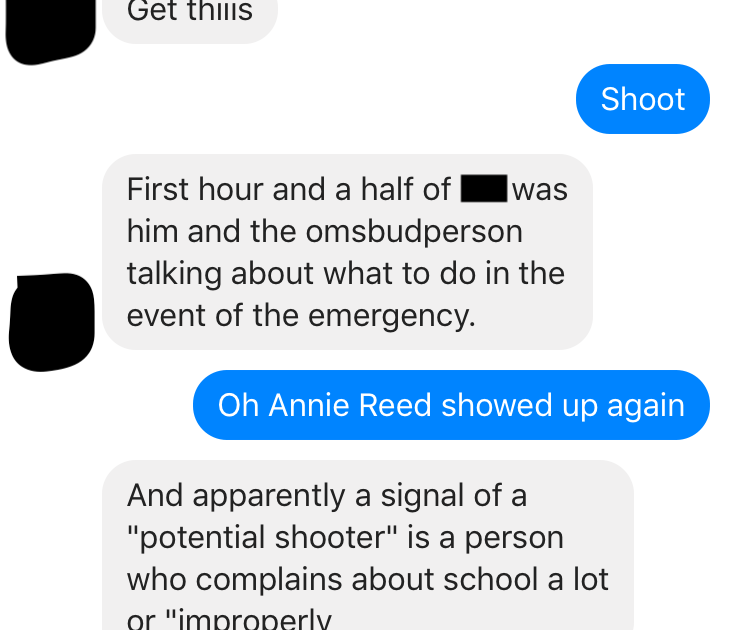
    Reed’s response was to suspend the first student running a smear campaign that he was potential
    active shooter citing the complaints he brought, suspend a thirty-year old single mother in the
    Facebook Group for Academic dishonesty after she forgot to have a college transcript from when
    she was eighteen-years old sent to LAVC, and then threatened the second student who brought an
    Accreditation Complaint for vandalizing school property.

    [Below: Text exchange between LACCD students alleging that administrator Annie Reed created a smear campaign against them.]

    Student 1 was suspended for a year (though not expelled by the Board of Trustees after
    investigation) a semester short of graduating. Student 1 would have earned six associate degrees
    and eight occupational certificates. Student 2, was ordered to pay a substantial amount of
    financial aid back to the college as “restitution.” Several months later, she was subjected to a
    reversal of hours by LAVC Grant Director Dan Watanabe in the Media Arts Department, for a
    campus job she worked and ordered to pay back several thousand dollars. Student 3 ended up
    going to Los Angeles City College to take final classes needed to graduate and was nearly
    refused graduation by Department Chair Eric Swelstad.

    These actions also happened right before and after LAVC Media Arts Faculty Eric Swelstad,
    Chad Sustin, Adrian Castillo, Dan Watanabe, and LAVC President Erika Endrijonas lobbied the
    LACCD Board of Trustees to approve construction of a new Media Arts Building that was later
    reported by The Los Angeles Times to be a massive racketeering scheme – Aug 4, 2022, Teresa
    Watanabe, ‘Corruption and fraud beset long-delayed L.A. Valley college theater project, lawsuit
    alleges.’ (https://www.latimes.com/california/story/2022-08-04/corruption-alleged-in-long
    delayed-la-valley-college-theater-project) 

    These actions mirrored the treatment of a student who sued LAVC’s Media Arts Department in
    2009, alleging the same type of fraud and misconduct by nearly all the same Department Faculty.

    Enrique Caraveo vs Los Angeles Valley College, Eric Swelstad, Joseph D’Accurso, Arantxia
    Rodriguez, Dennis J. Reed among others. Filing Date: 05/18/2009 (https://unicourt.com/case/ca
    la2-enrique-caraveo-vs-los-angeles-valley-college-et-al-621337)

    In that case, Caraveo stated:

    46. When plaintiff complained about the above referenced matters, Swelstad and other Valley
    College officials retaliated against plaintiff by refusing to grant him a Certificate and creating a
    hostile learning environment for him in class.

    47. On or around June 2007 plaintiff satisfied the requirements to get a Cinema Arts Production
    Certificate (“Certificate”) at Valley College.

    54. On or about October 2008, Swelstad denied plaintiff the certificate via a letter even though
    plaintiff has fulfilled the requirements to get the Certificate.

    55. On or about October 13, 2008, plaintiff notified Delahoussaye and Reed that plaintiff had
    fulfilled all requirements for the Certificate and that they should take care of the matter as soon
    as possible. On or about October 13, 2008, Yasmin Delahoussaye and Dennis Reed denied
    request.”

    Dennis Reed, was at the time the Dean over the Media Arts Department and the husband of
    Annie G. Reed. Dennis Reed was later profiled in LAist Magazine on April 27, 2016 article ‘Jerk
    Driver Who Ran Cyclists Off Glendale Road Charged With Assault, Lying To Police’ (https://
    laist.com/news/justice-delivered-almost)

     More to the point – Dennis Reed also oversaw a grant program at Los Angeles Valley College
    Media Arts Department known as IDEAS – Institute for Developing Entertainment Arts and
    Studies at LAVC. The Grant was run by Dan Watanabe. (https://archive.org/details/
    cavgchm_002241/mode/2up?q=Annie+Reed+LAVC)

     Watanabe was also named in the Accreditation Complaint for Wage Theft, Improper use of funds
    and fraud in the successor grant ICT Doing What Matters, due to the college receiving Grant
    Money but immediately eliminating the curriculum the grant application said they would provide
    and like Caraveo’s complaint not providing in class training or labs. The complaints to
    Accreditation and the LACCD Personnel Commission by students also questioned the legitimacy
    of a number of professional experts, including Robert Reber – who was listed as both a ‘student
    worker’ and ‘professional expert’ in 2008. Student 1 further provided evidence to both that Dan
    Watanabe had asked him to falsify his resume claiming fictitious jobs and cited an employee in
    the LAVC Payroll office as being behind it (that employee immediately denied it and Student 1
    refused).

    Dennis Reed had also spent years lobbying for the approval of the VACC building –
    unsuccessfully.

    In short, Annie G. Reed’s retaliation and cover-up in 2016, may have been to help realize her
    husband’s failed building project as well as preemptively shutdown any investigations or audits
    that might trigger further scrutiny regarding how the IDEAS Grant was administered under his
    time as area Dean.

    Reed’s behavior of covering up abusive behavior towards members of the LACCD Community
    was also not limited to retaliation against students.

    In 2017, then LACCD Board President Andra Hoffman accused former Board President Scott
    Svonkin of abusive behavior and demanded sanctions. According to an article in the Los Angeles
    Daily News, ‘LA Community College board postpones sanction hearing vote against former
    4
    president’ August 28, 2017, Annie G. Reed again inserted herself into the matter to cover-up for
    Svonkin.

    “The allegations do not strike me as related to governing and seem best suited for mediation,”
    said Annie Reed, a district employee for 22 years and a representative of Teamsters Local 911. “I
    don’t ever recall a time, or a place, where he has treated his colleagues poorly.”

    Others disagreed, including two former women board members who did not speak at the
    downtown meeting.

    They said Hoffman’s critics — who they said weren’t present during the abuse — had a tendency
    to blame the victim, while ignoring Svonkin’s allegedly brusque treatment of employees.”
    (https://www.dailynews.com/2017/07/13/la-community-college-board-postpones-sanction
    hearing-vote-against-former-president/)

    Her behavior is further documented in a series of lawsuits against the LACCD District. 

    Filed October 03, 2024 Dr. Christiana Baskaran (Plaintiff), Linda Silva; Dr. Ruth Dela Cruz,
    Dr. Adriana Portugal, vs LACCD (including defendant Annie Reed). (https://trellis.law/doc/
    219882998/complaint-filed-by-dr-christiana-baskaran-plaintiff-linda-silva-plaintiff-dr-ruth-dela
    cruz-plaintiff-et-al-as-to-los-angeles-community-college-district-defendant-board-trustees-los
    angeles-community-college-district-defendant-los-angeles-c)

    “[other defendants] Annie Reed to discriminate against female faculty and staff, refused to
    investigate immediately or to take preventative action. Then Defendants and EMPLOYER
    DEFENDANTS retaliated against PLAINTIFFS and others to try and prevent them from
    complaining to authorities. When PLAINTIFFS opposed these illegal practices, they continued
    to retaliate against them.”

    24. As set forth herein, ALL Defendants were officers, agents. Defendants and directly or
    indirectly used or attempt to use their official authority or influence for the purpose of
    intimidating, threatening, coercing, commanding, or attempting to intimidate, threaten, coerce, or
    command PLAINTIFF and others for the purpose of interfering with the right of that person to
    disclose to an official agent matters within the scope of this article. EMPLOYER
    DEFENDANTS aided and abetted MARY GALLAGHER, ARMANDO RIVERA-FIGUEROA,
    ANN HAMILTON, JAMES LANCASTER, JOCELYN SIMPSON, JIM LANCASTER, ANNIE
    REED and Victoria Friedman District Complaince Officer, Genie-Sarceda-Magruder Interim
    Director Office for Diversity, Equity and Inclusion, Rick Von Kolen to violate this statute.

    28. . . .Dr Hamilton admitted to other illegal activity such as planting drugs on employees to
    destroy their reputation and get them fired. Dr Silva filed a grievance against Dean Hamilton to
    try and get her to stop the illegal activity, the union did nothing. 

    32. Ms. Silva complained to Human Resources filed a title IX complaint, made a report to the
    police and was retaliated against.

    Filed October 19, 2023 Sara Adams, An Individual VS California Institute of Technology,
    California Corporation. (https://trellis.law/case/23stcv25556/sara-adams-an-individual-vs
    california-institute-technology-california-corporation)

    “21. On April 7, 2023, Mr. Wu continued to report the pay disparity to Annie Reed, Upon
    information and belief, Annie Reed is Caltech’s Employee and Organizational Development
    Consultant (Human Resources Department). 

    22. Annie Reed spoke about the report of pay disparity to Ofelia Velazquez-Perez, Caltech’s
    Senior Director, Total Rewards and Director of Employee and Organizational Development
    (Employee Relations).”

    Filed March 08, 2021, Mitra Hoshiar, an individual, Plaintiff, v. Los Angeles Community
    College District, (https://trellis.law/case/21stcv08950/mitra-hoshiar-vs-los-angeles-community
    college-district-an-unknown-entity)

    “28. On December 3, 2015, PLAINTIFF then filed a discrimination complaint against Sheri
    Berger (“Berger”), VP of Academic Affairs, and Fernando Oleas (“Oleas”), Pierce Union
    President. During PLAINTIFF meeting with Dean Barbara Anderson (“Anderson”) at
    Anderson’s office on June 10, 2015, Berger and Oleas stopped by and started making remarks of
    PLAINTIFF’s accent for reading the graduates’ names on the ceremony with a non-American
    accent.

    29. Thereafter, On December 11, 2015, in meeting with Dean Annie Reed in conjunction with the
    non-collegiality investigation Walsh, Union Grievance Rep and Oleas stopped by at
    PLAINTIFF’s office in order to prevent PLAINTIFF from Union Representation. They made
    PLAINTIFF to Barbara Anderson, whom was PLANTIFF’s chosen union rep and request for
    Anderson to not join the meeting because Walsh and Oleas had to choose who could be the union
    representation in the meeting.

    30. Based on what had transpired on December 11, 2015, on December 14, 2015, Plaintiff filed a
    Whistleblower/Retaliation Complaint at the District’s Complaint at the District’s Compliance
    Office against Walsh, Oleas, and McKeever (department and union delegate), and other members
    of her department. No action was taken by the Compliance Office.

    Annie G. Reed’s, current interim Dean of Labor and Employee Relations, has been involved in
    covering up wrongdoing in the Los Angeles Community College District for decades. Her targets
    have involved employees, students, faculty, and even a trustee. And so far has never been held
    accountable.

    Multiple stories were published on newswire IndyBay, the news outlet branch of the San
    Francisco Bay Area Independent Media Center between 2023 and 2024. They were then
    scrubbed (along with other stories) over the weekend of May 18, 2025.

    Recently, newly appointed Chancellor, Dr. Alberto J. Roman has been alerted to Ms. Reed’s
    disturbing history – it remains to be seen whether he will take corrective action, or continue to
    6
    keep around the same problematic individuals that resulted in his predecessor’s resignation after
    a vote of no-confidence by the LACCD Academic Senate.

    (To be continued…) 

    Source link

  • New Jersey City University takes key step to become part of Kean University

    New Jersey City University takes key step to become part of Kean University

    Dive Brief:

    • New Jersey City University is set to become part of nearby Kean University after the two public institutions signed a letter of intent Thursday to combine by June 2026. The merger would be subject to accreditor and regulatory approvals.
    • Under the plan, Kean would assume NJCU’s assets and liabilities and operate the institution as “Kean Jersey City,” the universities said. Executive oversight would fall to Kean’s president, who would appoint a chancellor to lead Kean Jersey City. NJCU will have some representation on Kean’s board of trustees, per the letter.
    • NJCU signaled in March that it planned to pursue a merger with Kean after past years of budgetary struggles and a directive from a state-appointed monitor to find a financial partner.

    Dive Insight:

    In Thursday’s release, Kean and NJCU said that their combination would “preserve NJCU’s mission of serving first-generation, adult and historically underserved students while advancing Kean’s role as the state’s urban research university and a newly designated R2 research university.” 

    Luke Visconti, chair of the NJCU’s trustee board, said Thursday’s letter of intent “provides an important framework for the detailed discussions that will follow.” 

    Still to come are full due diligence, a definitive agreement and a detailed outline for combining the two public universities. That process will be collaborative and “rooted in student and community engagement” so that the merger with Kean celebrates the two “distinct cultures” of the universities, NJCU Interim President Andrés Acebo said in a statement. 

    According to the institutions, an integration planning team with representatives from both universities will begin work immediately, coordinating with New Jersey’s state higher education office. The two universities will develop shared services agreements to streamline operations and boost student success, officials said. 

    Kean is the larger institution of the two, with 13,352 students in fall 2023, which was down by 5% from five years prior, according to federal data.  NJCU, meanwhile, had 5,833 students in 2023, down 10.8% from the year before and 27% lower than 2018 levels. 

    NJCU’s enrollment declines have contributed to its recent financial turmoil. A little over three years ago, the university declared a full-blown financial crisis after heavy spending on real estate expansions, student services and scholarships failed to reverse its enrollment slowdown and enlarged the university’s expenses.

    In 2023, the state comptroller’s office issued a scathing report that accused administrators of failing to fully inform NJCU’s board of the dire financial state, and which also suggested the university “likely” broke federal law by using emergency pandemic funding for an existing scholarship program. 

    Since then, Acebo has taken the reins, and the state has appointed a monitor to help ensure NJCU rights its finances and operations. State lawmakers also provided $17 million in critical stabilization funding to the institution.  

    In November, Fitch Ratings lifted the university’s outlook from negative to stable, citing “significant progress toward achieving fiscal balance despite continued pressure on student enrollment.”

    Source link