Tag: participation

  • The PM’s announcement on higher level participation is a win for the HE sector

    The PM’s announcement on higher level participation is a win for the HE sector

    You could read “abolishing the 50 per cent participation target” as a vote of no-confidence in higher education, a knee-jerk appeal to culturally conservative working-class voters. But that would be both a political/tactical mistake and a fundamental misreading of the policy landscape.

    To recap: in his leader’s speech to Labour Party Conference on Tuesday, Prime Minister Keir Starmer announced that two thirds of people under 25 should participate in higher level learning, whether in the form of academic, technical, or work-based training, with at least ten per cent pursuing technical education or apprenticeships by 2040.

    So let’s start by acknowledging, as DK does elsewhere on the site, that the 50 per cent participation target has a totemic status in public discourse about higher education that far outweighs its contemporary relevance. And, further, that party conference speeches are a time for broad strokes and vibes-based narrativising for the party faithful, and soundbites for the small segment of the public that is paying attention, not for detailed policy discussions.

    An analysis of Starmer’s speech on Labour List suggests, for example, that the new target signals a decisive break with New Labour, something that most younger voters, including many in the post-compulsory education sector, don’t give the proverbial crap about.

    True North

    What this announcement does is, finally, give the sector something positive to rally around. Universities UK advocated nearly exactly this target in its blueprint for the new government, almost exactly a year ago, suggesting that there should be a target of 70 per cent participation in tertiary education at level four and above by 2040. Setting aside the 3.333 percentage point difference, that’s a win, and a clear vote of confidence in the post-compulsory sector.

    Higher education is slowly recovering from its long-standing case of main character syndrome. Anyone reading the policy runes knows that the direction of travel is towards building a mixed tertiary economy, informed if not actively driven by skills needs data. That approach tallies with broader questions about the costs and financing of dominant models of (residential, full time) higher education, the capacity of the economy to absorb successive cohorts of graduates in ways that meet their expectations, and the problematic political implications of creating a hollowed out labour market in which it it is ever-more difficult to be economically or culturally secure without a degree.

    The difference between the last government and this one is that it’s trying to find a way to critique the equity and sustainability of all this without suggesting that higher education itself is somehow culturally suspect, or some kind of economic Ponzi scheme. Many in the sector have at times in recent years raged at the notion that in order to promote technical and work-based education options you have to attack “university” education. Clearly not only are both important but they are often pretty much the same exact thing.

    What has been missing hitherto, though, is any kind of clear sense from government about what it thinks the solution is. There have been signals about greater coordination, clarification of the roles of different kinds of institution, and some recent signals around the desirability of “specialisation” – and there’s been some hard knocks for higher education providers on funding. None of it adds up to much, with policy detail promised in the forthcoming post-16 education and skills white paper.

    Answers on a postcard

    But now, the essay question is clear: what will it take to deliver two-thirds higher level learning on that scale?

    And to answer that question, you need to look at both supply and demand. On the supply side, there’s indications that the market alone will struggle to deliver the diversity of offer that might be required, particularly where provision is untested, expensive, and risky. Coordination and collaboration could help to address some of those issues by creating scale and pooling risk, and in some areas of the country, or industries, there may be an appetite to start to tackle those challenges spontaneously. However, to achieve a meaningful step change, policy intervention may be required to give providers confidence that developing new provision is not going to ultimately damage their own sustainability.

    But it is on the demand side that the challenge really lies – and it’s worth noting that with nearly a million young people not in education, employment or training, the model in which exam results at age 16 or 18 determine your whole future is, objectively, whack. But you can offer all the tantalising innovative learning opportunities you want, if people feel they can’t afford it, or don’t have the time or energy to invest, or can’t see an outcome, or just don’t think it’ll be that interesting, or have to stop working to access it, they just won’t come. Far more thought has to be given to what might motivate young people to take up education and training opportunities, and the right kind of targeted funding put in place to make that real.

    The other big existential question is scaling work-based education opportunities. Lots of young people are interested in apprenticeships, and lots of higher education providers are keen to offer them; the challenge is about employers being able to accommodate them. It might be about looking to existing practice in teacher education or health education, or about reimagining how work-based learning should be configured and funded, but it’s going to take, probably, industry-specific workforce strategies that are simultaneously very robust on the education and skills needs while being somewhat agnostic on the delivery mechanism. There may need to be a gentle loosening of the conditions on which something is designated an apprenticeship.

    The point is, whatever the optics around “50 per cent participation” this moment should be an invigorating one, causing the sector’s finest minds to focus on what the answer to the question is. This is a sector that has always been in the business of changing lives. Now it’s time to show it can change how it thinks about how to do that.


    Source link

  • The fifty per cent participation target is no more. Again.

    The fifty per cent participation target is no more. Again.

    Dare we say he felt the hand of history on his shoulder?

    In his Labour Party Conference speech Prime Minister Keir Starmer set a new participation target for participation in education at level 4 and above (including higher education, further education, and some apprenticeships) for young people. He said:

    Two thirds of our children should either go to university or take on a gold standard apprenticeship

    As subsequently briefed, the target (which replaces, somehow, the old 50 per cent target from the Blair years) relates to higher skills, either through university, further education or taking on a gold standard apprenticeship. It will include at least ten percent of young people pursuing higher technical education or apprenticeships that the economy needs by 2040, a near doubling of today’s figure.

    Alongside a restatement of recent further education policies (£800m extra into funding for 16-19 year olds in FE next year, and measures to make FE “world class”) Starmer couched the target in the language of “respect”, drawing on the now familiar tale of his father, the toolmaker.

    Because if you are a kid or a parent of a kid who chooses an apprenticeship, what does it say to you? Do we genuinely, as a country – afford them the same respect?

    The numbers now?

    We don’t really have the data at hand to judge progress against the target to date – we would imagine a new measure would be developed. The press release points to the most recent data we have relating to participation in any level four education before the age of 25 (CHEP-25 “all level four”): around half of the cohort that turned 15 in 2012-13 (and thus might have entered university in 2015-16) participated in the kind of provision the prime minister talked about. As this cohort turned 25 in 2022-23, we do not yet have data for future cohorts.

    In the last two recruitment cycles (2024, and 2025) 37 per cent of 18 year olds in England entered university directly from school via UCAS. This equates to 240,510 young people in 2024 and 249,780 in 2025 – out of an England domiciled 18 year old population of 650,710 in 2024 and 675,710 in 2025.

    In contrast just 15,085 adults (19+) participated in-year in provision at level four or above in the further education and skills sector during 2023-24. And there were 100,490 higher (level 4) apprenticeship starts in the same year.

    The uncancellable target

    It was originally proposed by Tony Blair during his 1999 leader’s address to conference that the government should have:

    a target of 50 per cent of young adults going into higher education in the next century.

    And this plan was reiterated in the 2001 manifesto, and the promise maintained in both 2005 and 2010 :

    It is time for an historic commitment to open higher education to half of all young people before they are 30, combined with increased investment to maintain academic standards.

    The original target date was 2010, but by 2008 then universities minister John Denham had already conceded that this target would not be met. And it was not met under a Labour government.

    It was never universally popular – in 2009 the CBI made a high profile call to drop the 50 per cent aspiration. Under Coalition Prime Minister David Cameron, then Business Secretary Vince Cable was the first of many to formally cancel the target. On 12 October 2010 he told the House of Commons that:

    We must not perpetuate the idea, encouraged by the pursuit of a misguided 50% participation target, that the only valued option for an 18-year-old is a three-year academic course at university. Vocational training, including apprenticeships, can be just as valuable as a degree, if not more so

    Which you’d imagine would be the end of it, a non-binding (it never featured in legislation) aspiration set by the previous administration rejected by a new minister.

    Cancel culture

    As the magic figure approached (the goal was achieved in 2019) the general disapproval of the long-scrapped target shifted into outright hostility. By 2017 Nick Boles (remember him?) was not outside the political mainstream in saying:

    The policy of unbridled expansion has now reached its logical conclusion.

    All to no avail. By 2020 the ever-thoughtful Gavin Williamson seemed he was making it into a personal vendetta:

    When Tony Blair uttered that 50 per cent target for university attendance, he cast aside the other 50 per cent. It was a target for the sake of a target, not with a purpose… As Education Secretary, I will stand for the forgotten 50 per cent.

    While former universities minister Chris Skidmore was characteristically a little more measured in his critique. Just about the only politician willing to stick up for the idea was Tony Blair himself, who in 2022 backed calls for 70 per cent of young people to enter higher education.

    By this point, Rishi Sunak had become Prime Minister, and was telling the 2023 Conservative conference that:

    As he renewed another familiar attack on “rip off degrees”. This brought about a robust response from Keir Starmer as leader of the opposition:

    I never thought I would hear a modern Conservative Prime Minister say that 50 per cent of our children going to university was a “false dream”. My Dad felt the disrespect of vocational skills all his life. But the solution is not and never will be levelling-down the working class aspiration to go to university.

    If anything, Starmer missed the opportunity at that stage to point out the volume of vocational going on in universities – but that probably speaks to the polling and public perception of “universities” that reinforces the challenge the sector has in surfacing it all.

    Delivery, delivery, delivery

    Targets and aspirations are all very well, but you would expect a government as focused on “delivery” as our current one to have a clear plan to drive up participation. And though welcome, the previously announced funding for further education is not it.

    Driving up participation to such a level is far beyond what can be achieved by tweaks around apprenticeship incentives or even the roll-out of the (surprisingly unpopular) Lifelong Learning Entitlement. We are promised more details about how it’s going to work in the forthcoming post-16 education white paper.

    History tells us that the majority of any increase in participation at level 4 will come from the efforts of our universities, through new courses and innovative delivery modes. And this will take participation in higher education far above the 50 per cent target.

    Source link

  • To make real progress on widening participation in higher education, we need a new mission

    To make real progress on widening participation in higher education, we need a new mission

    The promise of higher education as a pathway to opportunity has never been more important, or more precarious.

    While overall university participation has reached record levels, this headline figure masks a troubling reality: where you’re born in England increasingly determines whether you’ll ever set foot on a university campus. And even once students do get their foot in the door, they might not have the support system in place – financially as well as academically – to succeed and thrive.

    It is in this context that the UPP Foundation has today published the concluding paper in its widening participation inquiry. Mission Critical: six recommendations for the widening participation agenda is our attempt to fill in the gaps that the government left in its opportunity mission around widening participation, and to provide targets and mechanisms by which it can achieve success in this area.

    Doing “getting in” right

    For years, the biggest single aim of widening participation work has been “getting in” – ensuring that young people from disadvantaged backgrounds are supported to attend university, most often by undertaking a bachelor’s degree as a residential student. The aim of growing participation has come under political scrutiny in recent years and is no longer an accepted mission across the political spectrum.

    But as our inquiry’s earlier papers highlight, there remains significant gaps in participation. Although more young people are going to university than ever before, there are stark disparities in the rates at which young people from different parts of the country attend university. If we believe, as I do, that talent is not simply concentrated in London and the South East, then by implication if opportunity is spread out more evenly, participation in higher education needs to grow.

    That’s why our first recommendation is a “triple lock” widening participation target. This includes a gap of no more than ten percentage points between the highest and lowest regional HE participation rates; plus a 50 per cent floor for progression to HE at 18-19 across all regions; and a target for 70 per cent of the whole English population to have studied at level 4 or above by the age of 25, as advocated by Universities UK. Meeting these targets will ensure that “getting in” really is for everyone.

    Onwards and upwards

    But this is not enough in isolation. The people we spoke to in Doncaster and Nottingham made it clear that “getting on” and “getting out” are equally important parts of the widening participation struggle – with the cost of learning a major barrier to full participation in university life.

    With that in mind, we’re calling for the restoration of maintenance loans to 2021 real-terms levels by the end of the decade, as well as additional maintenance grants for those eligible for free school meals in the last six years.

    We also want universities that are currently spending millions of pounds on bursaries and hardship funds to put that money towards outreach in the most challenging cold spots, as well as ensuring that the wider student experiences that undergrads cherish are available to all. That’s why it makes sense for a proportion of the proceeds from the proposed international student fee levy, if introduced, to be ring fenced to support an expanded access and participation plan regime, prioritising disadvantaged students from cold spot backgrounds.

    Revitalisation

    Finally, widening participation needs to address the short-term mindset that grips young people both before and during their time at university.

    Young people are more mindful of their finances than ever before, with many opting out of university in favour of a job in places where graduate careers are scarce and those who do choose to attend keeping one eye on their present and future earnings even before they’ve graduated.

    If we are to revitalise the widening participation agenda, we have to bring employability to the fore, both by reconfiguring the Office for Students’ B3 metric on positive student outcomes and by bringing employers into the design and outputs of university study. There are already fantastic examples of this working in practice across the sector, such as at London South Bank’s energy advice centre and Bristol University’s career- and community-oriented dental school. It’s time for the sector to pick up these ideas and run with them.

    The young person in Doncaster with the same grades and aspirations as their counterpart in Surrey faces not just different odds of getting to university, but different expectations about what’s possible. When we fail to address these disparities, we’re not just perpetuating inequality, we’re actively weakening the economic foundations that the whole country depends on.

    What our new report offers is a chance to refocus the widening participation agenda around a series of ambitious but achievable targets. Getting in, getting on and getting out are all crucial parts of the higher education cycle, especially for those who otherwise wouldn’t attend. If the government want to take their widening participation priorities seriously, all three aspects need to take their place in the sun.

    Source link

  • Widening participation should stretch beyond convenient local universities

    Widening participation should stretch beyond convenient local universities

    Secondary schools, particularly those in regions with a high density of higher education providers, are inundated with offers of university outreach initiatives.

    Meanwhile university widening participation and schools liaison teams, acting (in England) on the principles of their respective access and participation plans (APPs), channel their efforts towards regions, schools, and demographics currently underrepresented in their institution.

    The result is a substantial duplication of effort and resources from institutions competing within the HE marketplace.

    Variety pack

    The typical set of university partnerships for many schools appears to be a local Russell Group university, a local post-92 university, and the designated Oxford and/or Cambridge link college for their region.

    Encounters with local universities may be facilitated by a Uni Connect partnership, although a recent evaluation revealed inconsistencies in the extent to which partnerships offered a ‘joined up’ approach to locally targeted outreach. Local universities are undoubtedly convenient. Campus visits require minimal travel time and costs, and widening participation teams may have a strong knowledge of local issues and individual schools.

    However, relying on the convenience of local institutions both reinforces the tendencies amongst applicants in many regions to stay close to home for university without considering other options, and risks perpetuating undermatch amongst when local universities do not provide a suitable academic match. For example, the Uni Connect East Anglia partnership, neaco, includes the University of Cambridge, Anglia Ruskin University, the University of East Anglia, and several others.

    There exists a large gap between the ABB entry requirements for Engineering at UEA compared to the A*A*A asked for at Cambridge. Students with predicted grades within this gap have a substantial risk of undermatching if they narrow their options in line with the Uni Connect parameters.

    Three at the point of use

    The three-tiered university outreach provision, sometimes partially supported by Uni Connect, goes some way towards achieving Gatsby Benchmark 7:

    encounters with further and higher education appropriate to the needs of each pupil

    Yet it seems unlikely that three universities could represent the diverse spectrum of HE offerings across the country, nor truly provide a good match for every pupil.

    There are two issues to address here: firstly, that locally-targeted outreach should not be solely conducted by local universities; and secondly, that universities must balance their widening participation and recruitment priorities to avoid duplication of resources and overwhelming target schools.

    A university, admittedly with the resources to do so, can offer informed and meaningful regionally-targeted outreach despite not being located in the immediate vicinity of target schools. I am a long-standing proponent of the Oxbridge Link Area scheme, which provides schools with a point of contact at each university, and encourages WP practitioners to develop knowledge about and relationships with stakeholders in specific UK regions.

    Most recently, I teamed up with the charity Aspire Liverpool for the latest iteration of the Magdalene College Liverpool Event – a day of super-curricular exploration for 700 Year 10 pupils led by academics and Student Ambassadors, held in Liverpool’s St George’s Hall.

    From Cambridge to Merseyside

    One of the comments I receive most from pupils when I visit schools in Merseyside and North Wales is that they are surprised, but pleased, that a representative from Cambridge showed up for them. In the case of the Liverpool event, my team arrived determined to show the pupils that a coachload of busy academics took the time to travel to Liverpool, because we think these pupils are worth investing time and resources in, and have the potential to apply to competitive universities should they choose to. With a recruitment hat on, I’m keen to continue to develop the institutional memory amongst our target schools of being the college and university who can be relied upon to deliver high-quality locally-targeted outreach provision.

    Working with Aspire Liverpool helps us to target those schools which haven’t historically engaged with our outreach programmes, and helps to address the second issue I put forward, regarding the risk of duplication of outreach offerings from multiple universities. Attempting to collaborate with universities targeting similar groups of students can result in competition for recruitment. Whilst I have rarely delivered activities in partnership with, for example, the University of Liverpool or the University of Oxford, I liaise with their respective WP teams to develop an understanding of what activities students may be receiving from other providers, and to avoid clashes between the dates of our flagship events.

    Universities are often more comfortable collaborating with third-sector organisations such as The Brilliant Club, if they can demonstrate quality and value, as promised by successful applicants to the recent Equality in Higher Education Fund. Such organisations can help to scale up activities which are challenging for a single university WP team to provide, such as the attainment-raising initiatives promised in many Access and Participation Plans.

    So, where do we go from here?

    How can students be presented with a sufficiently wide range of HE options to increase their likelihood of finding a suitable academic match, whilst avoiding the duplication of effort and resources by each individual HE provider? The UCAS Outreach Connection Service, launched to UCAS advisers in 2024, may go some way towards highlighting the range of opportunities available, and allowing teachers to point students in the right direction towards potentially suitable universities and courses.

    And potential reforms to Uni Connect may establish a more defined strategic purpose for the partnerships, and perhaps space in the calendar to deliver campus visits or residentials for other partnerships’ target schools. Without overwhelming students by the sheer number of HE options available, it is doing them a disservice by not making them aware of the range of choices both in their home region and beyond.

    It remains crucial to understand the local contexts in which students are making their university choices, and is the responsibility of WP teams to set aside their recruitment angle to some extent, to provide opportunities for students to engage with multiple universities in their search for the perfect match.

    Source link

  • How commuter students show up in new access and participation plans

    How commuter students show up in new access and participation plans

    When the Office for Students included commuter students in the Equality of Opportunity Risk Register (EORR), it recognised the risk that commuter students may not always get the same experience as their “traditional” residential peers.

    The second wave of access and participation plans (APPs) for 2025–26 to 2028–29 have slowly been published and in the wake of the EORR’s inclusion of commuter students, we’ve got a better sense of the steps providers are taking to make the experience more equitable.

    Taking Universities UK’s member list as the sample and searching variations of the phrase “commuting student” in the currently available wave two APPs, 44 out of 81 APPs (at the time of writing) referred to commuter students in some form.

    Sometimes this was a simple statement of demographics, for example, “over 86 per cent are commuters,” or a statement of intention – “increase… work with commuting and mature students.” Other plans detailed comprehensive work to reduce inequities with various interventions, projects and additional research to undertake.

    Some plans referred to commuters broadly in a literature review but did not link this to their local contexts, and as such were not included in our analysis.

    Definitions

    As part of our ongoing series about commuter students, convened with Susan Kenyon at Canterbury Christ Church University, one challenge when discussing support for commuters is working out if everyone is talking about the same thing.

    The EORR sets out that commuter students referred to students “based on the distance or time [students] take to travel from their accommodation to their place of study” – but it then goes on to note there are many definitions, referencing both time and distance and the fact of not having re-located for university.

    In the absence of a sector-wide definition, providers have had to work this out themselves.

    The majority of plans that referenced a definition identified commuters as students whose home address matches their term time address, who had been recruited locally or still lived in their family home. Some plans used a distance to identify commuters, for example 15+ miles into their main campus base. When using distance as a criteria it opens up the possibility of a commuting student also being a student who has relocated to university but lives further away due to cost and housing pressures.

    As we’ve seen earlier in the series, there are differences in the experience based on those who chose to commute versus those who do so out of necessity.

    St Mary’s University in Twickenham explored using the Office of the National Statistics’ Travel to Work Areas maps to define commuters and setting an average travel time of 15 minutes or more (using public transport) from a term time address. They explicitly noted they had investigated the impact of using different definitions of commuter students when analysing student outcomes which led them to identifying commuters as their sixth risk category.

    When identifying commuters in APPs, ten plans went into detail about the intersecting characteristics of this demographic of students. One provider noted that “commuter students are more likely to be Asian, black or from IMD Q1+2 than non- commuter students” – this is something Kulvinder Singh looked at earlier in the series. There were several links between the association of being a commuter and being from an underrepresented group such as a mature student, carer or from a geographical area of deprivation.

    One provider interrogated whether being a commuting student was a direct factor on student outcome metrics and opted that it, in fact, coincided with other risk factors.

    Mind the gap

    For plans that had identified a risk to the commuter student experience, a brief thematic analysis suggests continuation, completion and student outcomes metrics were most prevalent in the sample followed by cost (and transport costs) and its subsequent impact on belonging.

    A lack of flexible timetabling was highlighted several times as a structural challenge for commuting students and plans honed in on the preciousness of commuters’ time.

    Bridging the gap

    Many universities plan to implement student centric timetables to tackle barriers to engagement and include plans to inform students as early as possible about scheduled classes. Flexible modes of learning, better communication methods and early timetables then further reduces peak-travel commuting costs, easing financial pressures.

    A handful of universities offer pre-arrival events and bursaries, aimed at improving commuter student access. At Manchester Metropolitan University, for example, an introductory module to support students preparing for university was particularly valued by commuting students.

    Interventions also emphasised the importance of space, with providers reviewing physical and virtual facilities, creating dedicated spaces to study and relax and improving the visibility of existing commuter spaces. The University of York’s APP suggested a provision of subsidised accommodation on campus to support commuters to engage in evening and social events.

    Peer mentoring programmes, social prescribing, and the creation of commuter student networks are examples of belonging-based interventions. York St John University’s plan proposed social opportunities each month and drop-ins for commuters to be held as often as weekly on campus.

    Many plans recognised a need to better understand the commuter student population. This often manifested as a commitment to engage or set up working groups and projects. Some providers viewed additional research as a first step toward supporting commuters, while others built on existing work and recognised that ongoing consultation offered the best way to deliver support.

    As many of these plans have started to, counting commuters, recognising their experience is geographical and making them visible is the first step to service design with commuter students in mind. Our series has been exploring ways to support their experience through making space, pedagogy, data, shifting institutional thinking and transport agendas that may inspire providers ready to take the next step.

    This blog is part of our series on commuter students. Click here to see the other articles in the series.

    Source link

  • The End of Participation Growth

    The End of Participation Growth

    One of the things that I find extremely worrying about higher education policy these days is that we’ve simply stopped talking about increasing access to the system. Oh, sure, you will hear lots of talk about affordability, that is, making the system cheaper—and hence arguments about the correct level of tuition fees—but that’s not the same. Even to the extent that these things did meaningfully affect accessibility (and it’s not at all clear that they do), no one phrases their case in terms of access anymore. We don’t care about outcomes. And I do mean no one. Not students, not governments, not institutions. They care about money, cost, all sorts of things—but actual outcomes with respect to participation rates of low-income students? At best, they are a rhetorical excuse to mask regressive spending policies which benefit the rich.

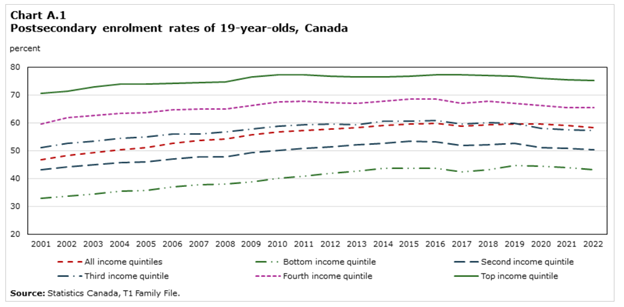
    This is a problem because it now seems as though the process of widening access, a project which began after World War II and has been proceeding for seven decades. And yet, as some recently-released Statistics Canada data shows, participation rates are now actually in decline in Canada. And it’s mainly because growth at the bottom has stalled.

    Below is the chart StatsCan released last month. It shows the post-secondary enrolment rate for 19-year-olds, which I will henceforth refer to as the “part rate” or “participation rate,” both for the entire population (the dotted red line) and by income quintile.

    Now, the first thing you may notice is that there are some pretty big gaps between the participation rates of youth from rich and poor families; the top quintile does not quite attend at double the rate of the lowest quintile, but it’s close. And you might be tempted to say, “Hey, I’ve taken Econ 101—That must be because of tuition fees!” Except, no. These kinds of part-rate disparities are pretty common internationally, regardless of tuition fees. Here are postsecondary enrolment rates by income quintile from the United States, which, on the whole, has higher fees than Canada:

    And here’s a similar chart from Poland, which mostly offers education tuition-free:

    And here’s one from France, where public universities are tuition-free but students are increasingly heading to the fee-paying private sector:

    I could go on, country-by-country, but I will spare you and instead point you to this rather good paper doing a cross-national analysis across over 100 countries by OISE’s Elizabeth Buckner. Trust me, it’s the same story everywhere.

    But let me point out what I think are the two important points in that chart. The first is that the red dotted line, which represents the participation rate of all 19-year-olds, basically plateaued back in about 2014, the first year it broke the 59% and is currently headed downwards. This is a huge change from the previous period, 2000-2014, when overall participation rates rose from 46% to 59%. First growth, now stagnation.

    The second is that during the growth period, the biggest strides were being made at the bottom end of the income scale. The part rate gap between top and bottom quintiles fell from 38 percentage points in the early 2000s to about 32 percentage points in 2014, even as part rates for the wealthiest quintile increased. That is to say, more of our growth came from the bottom than from the top. That’s good! But the growth stopped across all income quintiles and went gently into reverse for the top four income quintiles.

    Now, you might think that it’s not a bad thing that participation rates peaked, that maybe we were in a situation where we were overproducing postsecondary graduates, etc. Who knows, it’s possible. I don’t know of any evidence that would suggest that 57-59% of the youth population is some kind of hard maximum, but if stipulating that such a maximum exists, then it might well be in this range.

    But since it’s quite clear that this overall plateauing of participation is happening entirely by way of freezing educational inequality at substantial levels, being OK with the present situation means being OK with major inequalities, and in any democracy which wishes to remain a democracy, that’s not really OK. It is true that, as I noted earlier, disparities are the global norm, but that doesn’t mean you don’t keep up the struggle against stasis. It might be the case that there is some kind of “natural barrier” to keep the country’s PSE part rate at 57-59%, but in what world does a “natural barrier” keep those rates at 75% for rich kids and 43% for poor kids?

    Increasing access overall and narrowing rich-poor access gaps is incredibly difficult. If it were as simple as making tuition free, we’d have it licked in no time, but countries with free tuition don’t have noticeably narrower part rate gaps than those that charge fees. Achieving these gaps requires a whole suite of policies to narrow educational achievement gaps as well as financial ones, to offer young people a variety of flexible program types rather than an inflexible academic monoculture and to ensure that advice and support exist for students not lucky enough to be able to access the kinds of cultural capital available to the top quintile.

    As I say, achieving success in this area is very difficult: solutions are neither easy nor quick. But what makes the problem even more intractable is ignoring it the way we are doing right now. Are we a country that actually cares about equal opportunity? Or is that just a myth to which we genuflect when we wish to pretend to be more socially progressive than Americans? I lean towards option #2 but would be overjoyed to be proven wrong.

    Source link

  • Access and participation is a political question

    Access and participation is a political question

    The question of how we drive access to and participation in higher education among non-traditional groups is intimately linked to the broader question of why we are doing it.

    Accordingly, there are different approaches across the UK. Whereas in the English system the focus is on outreach (partnerships between universities and schools), in Scotland and Wales there is a lot more interest in measuring and shaping university recruitment from underrepresented groups.

    From a purely instrumental perspective there is clearly value in doing both. It is entirely possible that universities and schools could be doing more to encourage able young people to consider universities, and that there are barriers and complexities within the admissions and recruitment process (not to mention the financial, social, and academic challenges of being a student once you get in) that could be usefully addressed.

    The politics of why different approaches have emerged in different places are fascinating. At first though, you might think that a right-of-centre approach would be tied in with the economic benefits of maximising workforce skills and a left-of-centre ideology might be considering utility beyond income generation. Or – for that matter – that the right would foster individual aspirations with the left focused on societal needs.

    But it actually seems to come down to how you think people become intelligent.

    Hardwired

    In his recent book Hayek’s Bastards, Quinn Slobodian characterises the world view of what we might loosely call the postmodern right as “hard borders, hard money, and hardwired human nature”. It’s clearly a politics of status anxiety – but more specifically it has a bearing on higher education policy.

    By “hardwired human nature”, Slobodian is pointing towards something that – at one outer extreme – underpins the confusing resurgence of beliefs in eugenics. These are beliefs in the primacy of nature (your genetic heritage) over nurture (the conditions under which you matured) in developing personal attributes, some of which may be described as “intelligence”. Actual scientists tend to agree that both nature and nurture are likely to have a bearing on your life chances, and empirical evidence tends to back this up. But this comes with a huge asterisk, in that it is very difficult to unpick the two experimentally or with any degree of accuracy.

    If your personal viewpoint tends towards nature, it makes sense to argue that too many people are going to university in that there will be some people that will “naturally” not be able to benefit from the experience. You could point to a declining graduate premium (the “extra money” a graduate will earn over the course of their life) or a lower proportion of graduates working in “graduate jobs” if you wanted evidence that we are currently educating people to degree level who are not able to benefit from it.

    That’s not to say that such evidence is compelling – a sustained and welcome rise in the value of the national minimum wage and rapid changes in the kinds of jobs graduates (and everyone else, for that matter) do offer a counternarrative that sees such “declines” as evidence of a more equitable society and the value of jobs beyond salary or personal benefit.

    Tell them that it’s human nature

    As a sector that is explicitly setting out to improve the skills and life chances of young people, most people working in education tend to lean towards nurture as the major contributing factor to observed intelligence. From this position stems any number of initiatives that aim to make university study accessible, livable, and achievable to people who would not have otherwise gotten involved. If anyone can benefit from university education, surely the right thing to do is to help them.

    From a nature perspective this all looks very odd. Sure, there may be some people who don’t usually go to university that might benefit from such schemes – but applications are merit based anyway. You get in by getting good grades, or interviewing well, or having a good portfolio. When we start flexing these requirements, don’t we devalue the entire experience? Isn’t higher education what we need to be offering the top end of an intelligence hierarchy?

    This might also have to do with the quality of our tools. How confident can we be that the tests we have are indicative either of innate talent or the potential to benefit from education? Indeed, there is cause to wonder whether intelligence itself is measurable (IQ tests being a superb measure of a person’s ability to complete IQ tests, A levels being a great indicator of how middle class your background is).

    If we think our standard entry requirements are perfect, the focus should be on supporting people (both in terms of capability and aspiration) to achieve these before they apply to university. Indeed, recent English system efforts in widening participation have focused on programmes that do things like this (schools partnerships for example) rather than contextual admissions (where students from particular backgrounds are given different entry requirements reflecting their life chances thus far).

    Other peoples children

    Politically, contextual admissions are controversial because of where they sit on the nature and nurture spectrum. They explicitly recognise the difficulties that some groups face in achieving the standard requirements, and modify these requirements (alongside offering additional support).

    The pushback on this seems to me to be because of the perception that university education – or education at certain kinds of university – is a scarce resource (perhaps it once was, but the last few UCAS cycles suggest otherwise). If people who do not hold traditional entry qualifications are allowed to enter universities, it stands to reason that others that do hold the qualifications may not be able to.

    So we are back to status anxiety, in that the perception is that some young people who would otherwise be almost guaranteed access to a prestigious university may no longer have such access, and the addition of students with other backgrounds will change the experience (in academic, or – frankly – social ways) for the traditional students that do get there.

    I say “perception” because in the main the expansion of many high tariff universities has been such that the idea of anyone with the right grades being unable to get in is not the threat that it once was. Again, to be blunt, there always will be people disappointed and confused about not getting into Cambridge, Oxford, medical school, or the more selective conservatoires.

    The recent Universities UK and Sutton Trust statement on contextual admissions is about clarifying and documenting practices and processes – both to help those who may benefit access what schemes exist, and to reassure those with concerns about the validity of such programmes. It won’t assuage all the concerns, but shedding light on the issue can only help. Of course, for some the mere existence of such schemes – or any suspicion that universities should be encouraged to run them – will be anathema.

    Enough?

    The elephant in this particular room is, of course, the capacity of the economy to absorb graduates. I’ve often heard it argued that there are simply too many graduates – both in terms of how this “crowds out” the benefits of being a graduate in the job market, and in terms of whether we really need all those graduates to do the jobs they are doing.

    For me, this reaches across to the hard borders end of modern right-wing political thought. If you think lots of people in online newspaper comment sections are upset about too many graduates, just ask them about how many immigrants we have! We import a vast number of graduates from overseas (and, indeed, overseas students) in order for them to take on graduate roles in the UK economy. NHS staff are the obvious example, but there are demands everywhere – from heavy engineering to biosciences, from the creative industries to staff working in professional sports.

    And a highly skilled workforce is a more productive, and thus more valuable, workforce. The economics are clear.

    There are wider benefits too. Graduates tend to be healthier and happier, meaning less pressure on public services. They disproportionally work in public services that benefit us all. They are more likely to develop high value innovations and scientific breakthroughs. More likely to start successful companies that employ others. They are generally paid more – so they spend more. They raise the value of property and businesses in their locality. They commit less crime.

    Employers, then, are generally pretty keen on access to graduates. Policy makers, and the rest of us, probably should be too. The choice appears to be more UK people going to university or more immigration – the meaningful policy conversation becomes around what people study when they get there.

    Source link

  • The UPP Foundation is launching a new inquiry into widening participation to support the government’s opportunity mission

    The UPP Foundation is launching a new inquiry into widening participation to support the government’s opportunity mission

    Twenty-five years on from Blair’s target for 50 per cent of young people to go to higher education, the Labour Party set out a new ambition to “break down barriers to opportunity.”

    The opportunity mission articulates a multi-generational challenge: to make sure that children and young people can get on, no matter what their background; to change Britain so that a child’s future earnings are no longer limited by those of their parents; and to make Britain one of the fairest countries in the OECD. It is a fundamentally important challenge, and one that will be years in the undertaking.

    Widening participation in higher education plays a huge part in this mission, and it is for that reason that the UPP Foundation has announced a major new inquiry into the future of widening participation and student success. We have launched this inquiry by publishing a short “state of the nation” summary of the key issues in 2025. Because while success in the opportunity mission would transform the shape of British society, Labour is all too aware of the differences between the optimism of Blair’s famous 50 per cent pledge and the markedly different political and economic circumstances Keir Starmer’s government finds itself in now.

    A changed landscape

    Universities and schools face significant headwinds when it comes to dismantling the gaps students face when looking to get in and get on. The HE sector is facing well-publicised and unprecedented financial challenges, with the recent rise in fees doing nothing to alleviate pressure amid rising costs. With institutions contemplating restructuring moves and the government no closer to outlining a solution for widespread mounting deficits amid heavy fiscal weather, it is hard to see universities or the government finding much bandwidth for widening participation in the near future.

    There is also no equivalent target or metric that captures the challenge in quite the same way as Blair’s. This is understandable. Part of the reason no similar metric presents itself is because widening participation is now seen as multidimensional: not just focused on access to university, but also continuation rates, graduate outcomes, and less easily quantifiable measures of success, such as student belonging and participation in the immersive elements of the student experience.

    With the number of commuter students rising to reflect different learning patterns and pathways in a diverse student population, student living arrangements are also a major part of this puzzle. As the Secretary of State alluded to prior to the general election in an address to Universities UK, modern widening participation must reach out to more of those coming from nontraditional backgrounds, and those pursuing non-linear pathways through higher education.

    A wider view of widening participation means we need a more nuanced understanding of how access to university varies along socioeconomic, geographical and other demographic lines. As today’s report outlines, the difference in progression rates to higher education between students eligible for free school meals and their peers has widened to 20.8 per cent – the highest on record. Young people in London are significantly more likely to progress to higher education than their counterparts in the North East. The continuation gap between students from the most and least advantaged backgrounds now sits at 9.4 percentage points, having increased from 7.5 in 2016–17. As one of many charities operating in this space, we come face-to-face with the scale and scope of this disadvantage gap time and again. Equality of opportunity is still some way off.

    As well as this, some are schools struggling to do as much as others to support access to HE. Polling in our new report finds that 75 per cent of teachers in London expect at least half of their class to progress to higher education, compared to just 45 per cent in the North West and Yorkshire and the North East. Similarly, 75 per cent of teachers in Ofsted Outstanding schools thought that more than half their class would progress to HE, compared to just 35 per cent in schools rated as Requires Improvement or Inadequate.

    Although the Secretary of State said in a letter to heads of institution in November 2024 that expanding access and improving outcomes for disadvantaged students was her top reform priority in HE, the long list of challenges facing this government poses the risk that widening participation becomes a footnote to the geopolitical crisis.

    What we’re doing

    Despite the difficult environment facing both universities and the government, we think this agenda is too important to be put on the back burner. We hope our inquiry will help to establish new collective goals for widening participation and student success for the years ahead.

    The current moment provides a significant opportunity to interrogate the ways in which access and participation, student finance, student experience on campus, careers guidance, and student belonging intersect. It is in the context of this opportunity that the UPP Foundation, supported by Public First, is launching this inquiry, which aims to establish a new mission for widening participation.

    Following the introductory paper, we will publish two investigations, the first focusing on the persistent widening participation problems latent in “cold spot” areas of England, and the second exploring how the university experience differs based on students’ living arrangements and economic backgrounds, with poorer students often receiving a secondary experience that contributes to lower continuation and completion rates. Cumulatively, they will shed light on what meaningful widening participation really looks like to those who need it most, and what levers can be pulled to realise this vision.

    This inquiry comes at a crucial moment. We want to help the sector, the Office for Students and the government by setting out a series of evidence-based goals, recommendations and policies which could help make the broader vision a reality, while recognising “the art of the possible” in an era of fiscal restraint. Through these recommendations we hope to see the rhetoric of the opportunity mission and the Secretary of State start to become reality.

    Source link

  • Diversifying medicine by widening participation

    Diversifying medicine by widening participation

    Medicine is an elite profession, traditionally dominated by white, male, middle- or upper-class people, frequently from medical families.

    In 2014, the Medical Schools Council (MSC) created a Selection Alliance (SA), and published Selecting for Excellence (SfE), to address inequities in access to medical degrees in the UK for those from “widening participation” backgrounds.

    Fostering Potential: 10 years on from Selecting for Excellence , published in December of 2024, reports on progress made, with welcome achievements that are testament to the commitment of the community. The report rightly notes that focus on widening access has meant support for diverse students once they commence studies has been neglected.

    Recently, medical student activism – #LiveableNHSBursary , and #FixOurFunding – have highlighted the peculiar funding situation medical students find themselves in , and the financial pressures they experience during their studies.

    Fostering Potential asserts that WP needs to be reconceptualised away from a deficit framing of individuals as lacking ambition or aptitude to excel, to understanding lack of participation as the product of systemic and institutional failures around inclusion. For me, one of the main barriers to success for students from a disadvantaged socio-economic background studying medicine is the degree was designed and developed for a financially comfortable student. Its current structure excludes students from diverse backgrounds, and part of this is financial.

    The earnings gap

    One might argue that the financial hardship experienced by student medics is the temporary cost of what will become a lucrative career. However, once qualified, doctors from a lower socio-economic background will experience an average class pay gap of £3,640. This means their degree is both harder won and less remunerative.

    Current research and initiatives on financial barriers to success mostly treat money as a discernible object that can be quantified. It is a thing we either have enough of, or not; something we earn for ourselves as individuals. Hence proposed solutions tend to focus on maximising individual students’ abilities to earn alongside studies, while recognising that lack of time due to part-time work or caring responsibilities means some students cannot take advantage of extracurricular career development opportunities.

    I find this contradictory and suggest it misses a key point – money is also a relationship; it shapes our experiences of the world far beyond how much we have. It is a condition of success, not a result of it. Developing support for a student from a financially disadvantaged background should be informed by research that explicates how poverty impacts students’ opportunities to learn and exploit the advantages higher education allegedly offers.

    A student’s-eye-view

    I lead a project at Lancaster Medical School called Medicine Success, providing funds to mitigate the hidden costs of a medical degree for students from diverse backgrounds – purchasing a stethoscope, professional attire and funding the compulsory elective.

    Five years of project evaluation data reveal much about the role money plays in students’ sense of belonging and success. A student’s-eye-view of the degree reveals how unexpected its hidden costs are, how difficult it is to cover the cost of living and studying without financial support, and how choices about career development are constrained by cost. Further, the data shows students with scarce resources are keenly aware of how wealth is a vector of exclusion and inequity shaping their experience of the degree differently to their wealthier peers:

    Receiving these funds made a massive difference as it took me by surprise how much of a financial burden studying at university was. It seems that every aspect of it requires you to spend money that you don’t have and I feel at times it’s not all inclusive (2nd year, 2024)

    Their evaluations of the funding show that money transforms our lived experience of the world, and in turn, shapes our thoughts and feelings. They explain how scarcity can impact mental health and mental bandwidth, and the funding alleviates financial anxiety and paid-work commitments so they may focus on their studies.

    But it means more than just being able to afford essentials, it means being able to participate equally and with pride in their degree in comparison to their wealthier peers. This directly impacts self-esteem and addresses feelings of unworthiness or lack of belonging.

    A good example of this is the professional attire fund:

    I know professional attire might not seem serious but not having the right attire when it’s necessary leads me to overthink about how I’m dressed and feeling insecure during sessions. It’s often to the point where instead of focusing on learning I can’t help but to think about my appearance. (1st year, 2020)

    It is well-established that class can be read through a multitude of symbols. Respondents describe how their “lower” social status feels revealed through clothing, making them feel insecure in the learning environment. Students relate having their cheap and tired-looking clothes pointed out to them by peers, others worried about wearing the same outfit every day and what that said about their finances, while some feel that their patients have less respect for their opinion when they don’t present well-dressed. Meanwhile, ill-fitting clothing and shoes also interfere with the ability to focus on studies, causing pain and making long shifts additionally exhausting.

    Widening participation initiatives that focus on belonging from a social, cultural or academic skills perspective miss this crucial element – money. One student articulates a point made repeatedly by many of their peers:

    Funds like these make students like myself feel more heard and seen and gives us the opportunity to come from a lower socio-economic background and not feel as if we don’t belong here simply due to lack of finance. It gives us the confidence and the ability to work hard for what we want as we know there is always support available for students like us. (1st year, 2022)

    Recipients of Medicine Success funding attest that financial support levels the playing field with their more privileged peers in numerous, significant, and yet, subtle ways. Providing financial support is essential to make the learning environment, social activities, and career development accessible to students from all backgrounds. Belonging is in part financial; you can’t participate fully without money.

    Wider Context

    Recent reports show that the government is making a loss on student loans due to higher interest rates . This means private lending institutions are making a profit from the scheme funded by tax-payers and graduate repayments. In Why We Can’t Afford the Rich, Andrew Sayer explains that our current political system “supports rentier interests, particularly by making the 99 per cent indebted to the 1 per cent” , in which wealthy people are less likely to earn money through paid work, but accrue wealth through financial activities. The student loans scheme is one example.

    Higher education is presented as a means of social mobility, while extracting wealth into a financial sector that shores up its and its investors power. It does so by making already poor people pay to access education but without the conditions to participate fully. The promise of breaking the cycle of poverty with a university degree is so powerful that it deflects attention from what is really happening, despite extensive evidence that education has yet to prove itself as a solution to class inequalities. For these reasons, even with WP policies, HE has financial injustice embedded within it, resulting in deleterious effects on students’ mental health, degree experiences and outcomes.

    I see this as an example of “financial trauma,” defined by Chloe McKenzie as “the cumulative effect of being required to experience economic violence, financial abuse, financial shaming, and/or (chronic) financial stress to attain or sustain material safety”.

    Social mobility is a problematic term; it requires individual people to increase their position in an established hierarchy that is itself integral to maintaining socioeconomic inequality. This is why I welcome the MSC’s push to reconceptualise improving participation as a systemic issue, not one focussed on changing individuals to fit into the status quo. At the same time, we must apply this thinking to financial barriers to success, by recognising that money is far from a private issue but a matter of justice.

    Source link

  • Five keys to success in Evaluation Capacity Building for widening participation

    Five keys to success in Evaluation Capacity Building for widening participation

    Evaluate, evaluate, evaluate is a mantra that those engaged in widening participation in recent years will be all too familiar with.

    Over the past decade and particularly in the latest round of Access and Participation Plans (APP), the importance of evaluation and evidencing best practice have risen up the agenda, becoming integral parts of the intervention strategies that institutions are committing to in order to address inequality.

    This new focus on evaluation raises fundamental questions about the sector’s capacity to sustainably deliver high-quality, rigorous and appropriate evaluations, particularly given its other regulatory and assessment demands (e.g. REF, TEF, KEF etc.).

    For many, the more exacting standards of evidence have triggered a scramble to deliver evaluation projects, often facilitated by external organisations, consultancies and experts, often at considerable expense, to deliver what the Office for Students’ (OfS) guidance has defined as Type 2 or 3 evidence (capable of correlative or causal inference).

    The need to demonstrate impact is one we can all agree is worthy, given the importance of addressing the deep rooted and pervasive inequalities baked into the UK HE sector. It is therefore crucial that the resources available are deployed wisely and equitably.

    In the rush for higher standards, it is easy to be lured in by “success” and forget the steps necessary to embed evaluation in institutions, ensuring a plurality of voices can contribute to the conversation, leading to a wider shift in culture and practice.

    We risk, in only listening to those well placed to deliver large-scale evaluation projects and communicate the findings loudest, of overlooking a huge amount of impactful and important work.

    Feeling a part of it

    There is no quick fix. The answer lies in the sustained work of embedding evaluative practice and culture within institutions, and across teams and individuals – a culture that imbues values of learning, growth and reflection over and above accountability and league tables.

    Evaluation Capacity Building (ECB) offers a model or approach to help address these ongoing challenges. It has a rich associated literature, which for brevity’s sake we will not delve into here.

    In essence, it describes the process of improving the ability of organisations to do and use evaluation, through supporting individuals, teams and decision makers to prioritise evaluation in planning and strategy and invest time and resources into improving knowledge and competency in this area.

    The following “keys to success” are the product of what we learned while applying this approach across widening participation and student success initiatives at Lancaster University.

    Identify why

    We could not have garnered the interest of those we worked with without having a clear idea of the reasons we were taking the approach we did. Critically, this has to work both ways: “why should you bother evaluating?” and “why are we trying to build evaluation capacity?”

    Unhelpfully, evaluation has a bad reputation.

    It is very often seen by those tasked to undertake it as an imposition, driven by external agendas and accountability mandates – not helped by the jargon laden and technical nature of the discipline.

    If you don’t take the time to identify and communicate your motivations for taking this approach, you risk falling at the first hurdle. People will be hesitant to invest their time in attending your training, understanding the challenging concepts and investing their limited resources into evaluation, unless they have a good reason to do so.

    “Because I told you so” does not amount to a very convincing reason either. When identifying “why”, it is best you do so collaboratively and consider the specific needs, values and aspirations of those you are working with. To those ends, you might want to consider developing a Theory of Change for your own ECB initiative.

    Consider the context

    When developing resources or a series of interventions to support ECB at your institution, you should at all times consider the specific context in which you find yourself. There are many models, methods and resources available in the evaluation space, including those provided by organisations such as TASO, the UK Evaluation Society (UKES) or the Global Evaluation Initiative (BetterEvaluation.org), not to mention the vast literature on evaluation methods and methodologies. The possibilities are both endless and potentially overwhelming.

    To help navigate this abundance, you should use the institutional context in which you are intending to deliver ECB as your guide. For whom are you developing the resources? What are their needs? What is appropriate? What is feasible? How much time, money and expertise does this require? Who is the audience for the evaluation? Why are they choosing to evaluate their work at this time and in this way?

    In answering these and other similar questions, the “why” you identified above, will be particularly helpful. Ensuring the resources and training you provide are suitable and accessible is not easy, so don’t be perturbed if you get it wrong. The key is to be reflective and seek feedback from those you are working with.

    Surround yourself with researchers, educationalists and practitioners

    Doing and using evaluation are highly prized skills that require specific knowledge and expertise. The same applies to developing training and educational resources to support effective learning and development outcomes.

    Evaluation is difficult enough for specialists to get their heads around. Imagine how it must feel for those for whom this is not an area of expertise, nor even a primary area of responsibility. Too often the training and support available assumes high levels of knowledge and does not take the time to explain its terms.

    How do we expect someone to understand the difference between correlative and causal evidence of impact, if we haven’t explained what we mean by evaluation, evidence or impact, not to mention correlation or causation? How do we expect people to implement an experimental evaluation design, if we haven’t explained what an evaluation design is, how you might implement it or how “experimental” differs from other kinds of design and when it is or isn’t appropriate?

    So, surround yourself with researchers, educators and practitioners who have a deep understanding of their respective domains and can help you to develop accessible and appropriate resources.

    Create outlets for evaluation insight

    Publishing findings can be daunting, time-consuming and risky. For this reason, it’s a good idea to create more localised outlets for the evaluation insights being generated by the ECB work you’ve been doing. This will allow the opportunity to hone presentations, interrogate findings and refine language in a more forgiving and collaborative space.

    At Lancaster University, we launched our Social Mobility Symposium in September 2023 with this purpose in mind. It provided a space for colleagues from across the University engaged in widening participation initiatives and with interests in wider issues of social mobility and inequality to come together and share the findings they generated through evaluation and research.

    As the title suggests, the event was not purely about evaluation, which helped to engage diverse audiences with the insights arising from our capacity building work. “Evaluation by stealth,” or couching evaluative insights in discussions of subjects that have wider appeal, can be an effective way of communicating your findings. It also encourages those who have conducted the evaluations to present their results in an accessible and applied manner.

    Establish leadership buy in

    Finally, if you are planning to explore ECB as an approach to embedding and nurturing evaluation at an institutional level (i.e. beyond the level of individual interventions), then it is critical to have the buy in of senior managers, leaders and decision makers.

    Part of the why for the teams you are working with will no doubt include some approximation of the following: that your efforts will be recognised, the insights generated will inform decision making, the analyses you do will make a difference, and will be shared widely to support learning and sharing of best practice.

    As someone who is supporting capacity building endeavours you might not be able to guarantee these objectives. It is important therefore to focus equal attention on building the evaluation capacity and literacy of those who can.

    This can be challenging and difficult to control for. It depends on, among other things: the established culture and personnel in leadership positions, their receptiveness to new ideas, the flexibility and courage they have to explore new ways of doing things, and the capacity of the institution to utilise the insights generated through more diverse evaluative practices. The rewards are potentially significant, both in supporting the institution to continuously improve and meet its ongoing regulatory requirements.

    There is great potential in the field of evaluation to empower and elevate voices that are sometimes overlooked, but there is an equal and opposite risk of disempowerment and exclusion. Reductive models of evaluation, preferencing certain methods over others, risk impoverishing our understanding of the world around us and the impact we are having. It is crucial to have at our disposal a repertoire of approaches that are appropriate to the situation at hand and that fosters learning as well as value assessment.

    Done well, ECB provides a means of enriching the narrative in widening participation, as well as many other areas, though it requires a coherent institutional and sectoral approach to be truly successful.

    Source link