

I used to get nostalgic attending Conservative Conferences in Manchester. Being shouted at by far-left protestors reminded me of my time as a right-of-centre student union hack in the early 1990s.
Just like the early 2020s, the early 1990s was a period when an unpopular Conservative administration was limping towards the end of its time in office. Trying to persuade other Manchester-based students to veer right rather than left was a challenge that guaranteed abuse. In one instance, someone kicked away one of my crutches (after I broke my ankle trying to high jump…). That still seems an odd way to convince me of the superiority of their views. There were lighter moments too, as when a fresher muddled up the Conservation Society with the Conservative Association. There are only so many times ‘Do you go out in the field?’ can be answered with ‘We help out at local by-elections.’
This year, however, any abuse of passers-by was reserved for Labour’s Liverpool shindig, where a motley and shouty selection of anti-ID card, anti-abortion and anti-Israel protestors were in need of a Strepsil or two. Depressingly, I heard one protestor shout at a conference delegate who supported ID cards, ‘I bet you went to university.’ Even Steve Bray gave the Tories a miss this year, though his portable speakers were blasting away in Liverpool. (A friend suggested we should ask him where his extremely loud portable sound system came from … ‘Steve Bray as sponsored by Richer Sounds’?)
If there was nostalgia to be had at the Conservative Conference, it was for the 1970s. There were multiple screenings of Margaret v Ted – An inconceivable victory, in which Michael Portillo narrated the story of Thatcher’s victory in the Conservative leadership election of 1975. There were various fringe meetings on ‘why nothing works’ that also recalled the 70s, especially when held in the shadow of the old Free Trade Hall, where 49 years ago the Sex Pistols played their most famous gig (though Anarchy in the U.K. had yet to join the setlist). The problem for the Tories is that change takes time, so the state of public services in 2025 has more to do with past Conservative Governments than the Labour one elected in 2024 – and everyone knows it.
HEPI is non-partisan, always keen to publish views from across the political spectrum. That’s why we attended both the Conservative and Labour Conferences and why we are weighing up whether to go to Reform’s Conference next year. But I started this blog with shouty abuse because it links to the theme of HEPI’s fringe event held in conjunction with the University of Sussex, the University of Manchester and Goldsmiths, University of London: ‘How can universities best win back public support’.
Our speakers had different answers to this important question.
There weren’t half as many events on higher education in Manchester as there were the previous week in Liverpool. But one other organisation that made the effort was the King’s College Policy Institute, which hosted a panel on ‘What is the Conservative approach to higher education and skills integration?’ in which I took part.
It wasn’t entirely clear if the title was referring to the Conservatives’ past, present or future policies but, for my take, I pointed out their early years in office after 2010 included a well-defined set of policies built around:
(As readers may know, I worked on these areas before joining HEPI in 2014, so declare an interest in them.)
I went on to note the biggest problems facing our system of post-compulsory learning are not actually in higher education. The OECD’s recent Education at a Glance, which HEPI helped to launch, showed we have a high participation rate, a low drop-out rate and excellent graduate outcomes (on average), whether we are talking about employment, wages or health. But it also showed terrible (average / relative) outcomes for those who leave school with only GCSEs or equivalent.
I ended my remarks by pleading with the Conservative Party to strive towards a ‘three Bs strategy’. By this, I meant focusing on the half of the population doing much worse educationally: Boys. For every 54 young women that make it to higher education, only 40 young men do so. Yet Minister after Minister and Government after Government have failed to adopt a dedicated focus on the scandal of male underachievement.
I also suggested a future Conservative Government should focus on Bilingualism or at least inculcating a Bare familiarity with a language other than English. Language learning has declined catastrophically since a second language stopped being compulsory at Key Stage 4 (GCSE-level) around 20 years ago. The idea then was that primary school language learning would be bolstered and lots of secondary school pupils would voluntarily enrol for a language GCSE or two. But it has not worked out like that: there are now more A-Levels taken in PE than in French, German and Classical Languages combined. It seems ironic that a factor nudging people towards Brexit was one of Tony Blair’s education policies.
My third B is ‘BTECs’ and similar, which the last Conservative Government and the current Labour one have been trying to kill slowly. Yet T-Levels and A-Levels are not right for everyone and much of the recent progress in widening participation in higher education has been among BTEC students.
So most people who have considered the question, including Professor Becky Francis (who is overseeing the Curriculum and Assessment Review), agrees there should be a third way. Last week’s Labour Conference has left people expecting a brand new vocational qualification alongside As and Ts, producing a policy already confusingly labelled V-A-T (as if VAT were popular …). But the floor is littered with politicians’ attempts to design new vocational qualifications (GNVQs, diplomas etc). This approach is far from guaranteed to succeed: indeed, unless the errors of the past are meticulously avoided, the new approach will be more likely to fail than to succeed.
That surely gives His Majesty’s Official Opposition a duty to scrutinise the current Government’s approach and provides a possible opportunity for them to rebuild a reputation for being knowledgable, moderate and competent. Yet as I file this piece, news is coming in that the Leader of the Opposition will instead opt to focus her main Conference speech on Wednesday on kicking universities and promising to slash the number of university places. This will be accompanied by a promise of more apprenticeships … but they said that in government yet presided over a reduction.
It is almost as if someone believes saying, ‘Vote Conservative and we will stop your child(ren) from going to university’ could be a vote winner.
As multiple fringe events showed, when it comes to higher education the Labour Conference was very busy, with notably more vice-chancellors in attendance than in days of yore.
My Conference sojourn started on Saturday with a trip to Liverpool’s famous Cavern Club to watch the brilliant in-house Beatles tribute band. At the time, I mused about which fab-four song might best sum up the next few days. ‘Taxman’ perhaps?
(If you drive a car) I’ll tax the street
(If you try to sit) I’ll tax your seat
(If you get too cold) I’ll tax the heat
(If you take a walk) I’ll tax your feet
In fact, when it came to higher education, the big news was a giveaway rather than a new tax. I’ll always remember where I was when Margaret Thatcher resigned as Prime Minister (in the Manchester University Students’ Union shop). Perhaps education policy wonks will similarly always remember where they were when they heard maintenance grants were on their way back (albeit for a second time – they were last reintroduced in the mid-2000s before being abolished a decade later).
In my case, I was with dozens of others in a fascinating HEPI fringe event on students’ cost of living, chaired by my colleague Rose Stephenson and featuring Alex Stanley (NUS), Gavan Conlon (London Economics) and Nic Beech (University of Salford). This came hot on the heels of two other HEPI fringe events – one on public opinion and higher education featuring a bevy of vice-chancellors and another with Cambridge University Press and Assessment on ‘Quality Matters’.
It was no surprise the news about maintenance grants won a spontaneous round of applause. It reminded me of the cheer I got during a speech to the University of Derby in 2016, when I read out the breaking news that UKIP’s Leader had just stood down (‘Nigel Farage resigns’, the Guardian reported, ‘after “achieving political ambition”’).
In both instances, the initial reaction was premature. Brexit was not the end of Faragism and it quickly became clear in Liverpool that the return of maintenance grants is not quite what it first seemed either.
Bridget Phillipson’s tweet announcing the change said:
Access to our colleges and universities shouldn’t just be for a wealthy few.
That’s why I’m bringing back maintenance grants for those who need them most.
Labour is ambitious for all our young people, no matter their background. I’m putting our values into action.
Most people who have calculated the cost of reintroducing grants have assumed it would cost something in the region of £2 billion a year. However, Ministers plan to fund the new grants via the proposed levy on international students’ fees, which is expected to raise around £600 million. So entitlement to the new means-tested grants will, it turns out, be limited by students’ course choice. You will be quids in only if you are studying what the politicians want you to study.
As I noted at the King’s College London Policy Institute fringe meeting on Wednesday afternoon, funding the new grants from the new levy may seem like clever politics, at least inside Number 10 and the Treasury and also perhaps by anyone seeking election as the Labour Party’s Deputy Leader.
Students and vice-chancellors have been desperate for grants to return and rightly so – for the reasons why, see our recent report on a Minimum Income Standard for Students with TechnologyOne and Loughborough University. But the levy / tariff / tax on international students is hated by those same students and vice-chancellors, putting them in something of a bind when it comes to responding to the Government’s announcement.
Not only do international students typically come from countries that are poorer than the UK, but they are already subsidising UK research and the teaching of domestic students. Now they are expected to contribute towards the day-to-day living costs of poorer home students too (just so long as those UK students are studying courses deemed to be of most economic value). Just how broad do Ministers think international students’ shoulders are?
Many of them come from wealthy backgrounds but some do not have very deep pockets and none is obliged to study in the UK rather than elsewhere. So our higher education institutions are unlikely to be able to pass on the full 6% without seeing a drop in demand.
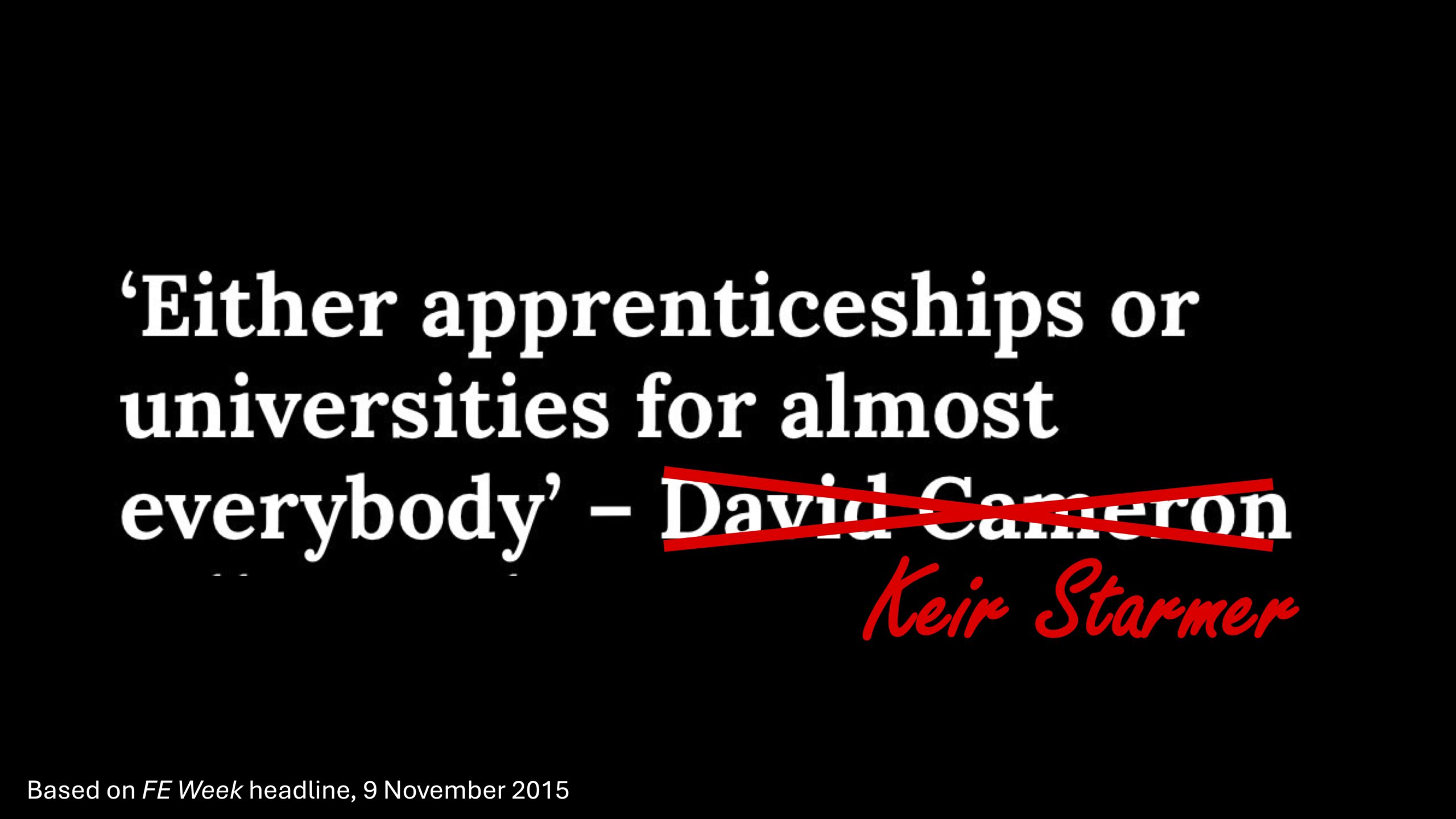
It was great to witness so many backbench Labour MPs, like Alex Sobel, Daniel Zeichner, Abtisam Mohamed and Dr Lauren Sullivan, advocating for UK universities across the conference fringe programme. But more generally, there were parts of the Conference that felt flat as well as parts that were presumably in line with what the organisers wanted – including the Leader’s big set-piece speech. Starmer’s big reveal was the rejection of the ancient 50% target for young people’s participation in higher education in preference for a new target ‘That two-thirds of our children should go either to university… Or take a gold standard apprenticeship.’
The Prime Minister would be unlikely to welcome the comparison but this reminded me of nothing so much as David Cameron’s pledges as Prime Minister. In 2013, for example, Cameron said: ‘I want us to have as a new norm the idea that in school, everybody, everyone who can, either takes that path on to university, or takes that path on to an apprenticeship. You should be doing one or the other.’
The challenge is not coming up with such commitments; it is delivering them. Fewer adults are doing apprenticeships now than when David Cameron spoke, despite the introduction of an Apprenticeship Levy. Perhaps Starmer can succeed where Cameron and his successors failed…
At the end of the Conference, I was left feeling the biggest omission compared to past Labour Conferences was a clear and broad narrative about His Majesty’s Official Opposition: the Conservative Party. If the choice facing the country really is between ‘division’ and ‘decency’, as Keir Starmer says, then might not the best way to defeat division be, as with Le Pen in France or the AfD in Germany, for centre-right and centre-left parties to act together?
If Tony Blair and William Hague can work together, surely this is not impossible? But – and this is a personal opinion only – I left Liverpool wondering if the main problem for today’s Labour leadership is that they have spent the last 15 years making such strong criticisms of their bedfellows in the mainstream centre of British politics that they are unable to admit they may now need to work with the centre-right to stave off their worst fears.
Then again, perhaps today’s Tory Party also cannot see that the opposite of division is not so much ‘decency’ (however much we might want that) as collaboration. We’ll find out for certain next week as the policy caravan moves across the north-west to Manchester for the Conservative Party Conference. Do come to HEPI’s event there if you can – it is outside the secure zone so no expensive pass is needed.
The City of Liverpool has the biggest single collection of Grade One listed buildings than any other English city outside London and it was named the European Capital of Culture in 2008. A football mecca, it also boasts a plethora of museums, including the World Museum, the International Slavery Museum, the Museum of Liverpool, Tate Liverpool and the Merseyside Maritime Museum.
It is also an interestingly quirky place, which harbours some amazing public toilets (you read that right). For example, if you ever happen to drop into the Philharmonic Dining Rooms in the Georgian Quarter, feel free to admire the famous Grade I-listed urinals in their pink marble splendour.
And then, there is the deservedly famous Mersey Beat. Liverpool and The Beatles, these are words that go together well.* The Liverpudlian group are considered the best-selling band in music history, hailed as pioneers who revolutionised the music industry and popular culture.
In summary, Liverpool is a ‘blast’ in more ways than one: a city which does not shy away from its heritage, a city with so much to offer culturally, but also a windy city open to the strong maritime winds gusting from the docks. Which may be why the French translation of the 1964 Beatles film A Hard Day’s Night is Les Quatre Garçons Dans Le Vent, a French colloquial idiom for their growing popularity – which, when translated word-for-word, awkwardly reads as ‘the four boys in the wind’.
* ‘these are words that go together well’ are lyrics from the 1965 Beatles song Michelle (Lennon/McCartney).

When the Coalition Government for which I worked tripled tuition fees for undergraduate study to £9,000 back in 2012, it was a big and unpopular change. But it represented a real increase in support for higher education that led to real increases in the quality of the student experience, with improvements to staffing, facilities and student support services.
Because the fee rise shifted costs from taxpayers to graduates via progressive student loans, it enabled another fundamental change: the removal of student number caps in England. No longer would universities be forced to turn away ambitious applicants that they wanted to recruit. It was the final realisation of the principle that underlined the Robbins report of 1963: ‘courses of higher education should be available for all those who are qualified by ability and attainment to pursue them and who wish to do so.’ A higher proportion of students enrolled on their first-choice place. (It never ceases to amaze me how many people wish to return to a world in which your children and mine have unwarranted obstacles reimposed between them and attaining the degree they want.)
But back in 2012, no one in their wildest dreams thought the new fee level would be frozen for most of the next decade and more. After all, the fee rise was implemented using the Higher Education Act (2004), which had enabled Tony Blair to introduce the current model of tuition fees, and the Blair / Brown Governments to raise fees each year without any fuss.
Yet the political ructions caused by introducing £9,000 fees in 2012 made policymakers timid. Towards the end of the Conservatives’ time in office, Ministers bizarrely sought to make a virtue of their pusillanimity. Even as inflation was biting, the Minister for Higher Education (Rob Halfon) said raising fees was ‘not going to happen, not in a million years’.
The result has been a crisis in funding for higher education institutions that has changed their priorities. Top-end universities have looked to increase their income via more and higher (uncapped) fees from international students – hardly surprising, when an international student taking a three-year degree is worth £69,000 a year more than a home student! They have also sought to tempt UK students away from slightly less prestigious institutions.
Meanwhile, newer universities have been even more entrepreneurial. Limited in their ability to recruit lots of international students, they have instead shifted towards franchising, whereby other organisations pay them for the privilege of teaching their degrees.
Universities in the middle have had a particularly tough time. Most notably, many universities originally founded in the expansionary post-Robbins environment are struggling today. (It has been suggested that the tie-up between Kent and Greenwich is partly borne of necessity.) Plus with no fees for home students, Scottish universities have been hurting even more than those elsewhere.
Even though recruiting more people from overseas and large-scale franchising have helped some institutions to keep the wolf from the door, Ministers have condemned both. The UK Home Office want fewer international students and England’s Department for Education have promised new legislation to tackle the growth in franchising. (Six months ago, Bridget Phillipson wrote in the Sunday Times, ‘I will also bring forward new legislation at the first available opportunity to ensure the Office for Students has tough new powers to intervene quickly and robustly to protect public money’.)
No British university has ever gone bust but, as financial advisers know, the past can be a sorry guide to the future. When asked, Ministers say they would accept the closure of a university or two. But a university is usually a big local employer, a big supporter of local civic life and a source of local pride – and money. Most have been built up from public funds.
Closing a university would not just risk local upset. It would reduce confidence, including among those who lend to universities, and could even risk a domino effect, as people lose faith in the system as a whole, thereby putting the reputation of UK education at risk. So there are good reasons why, for example, Dundee University is currently being bailed out, even if it comes with a distinct whiff of moral hazard.
Students are hurting just as much as institutions. Contrary to the expectations of years gone by, the proportion of school leavers proceeding to higher education is barely rising. There is likely more than one cause, including negative rhetoric about universities from across the political spectrum and a false sense that degree apprenticeships for school leavers are plentiful.
Perhaps most significantly, maintenance support for students is nothing like enough. There are three big problems.
As a result, according to the HEPI / Advance HE Student Academic Experience Survey, over two-thirds of students now undertake paid employment during term time, often at a number of hours that negatively affects their studies. These students are limited in their ability to take part in extra-curricular activities, for they are time poor as well as strapped for cash.
An increase in maintenance support is long overdue, just as an increase in tuition fees for home students is long overdue. But we could also perhaps help students help themselves by providing better information in advance about student life. In particular, given the epidemic of loneliness among young people, we should remind them that you are more likely to be lonely if your room is plush but you do not have enough money left over for a social life than if your living arrangements are basic but your social life is lively.
The Government came to office claiming to have a plan for tackling the country’s challenges. But more than a year on, the fog has not cleared on their plans for higher education. Patience is now wearing gossamer thin. As Chris Parr of Research Professional put it on Friday, ‘Still we wait.’ As far as we can discern from what we know, it seems universities will be expected to do more for less – on civic engagement, access and economic growth.
Higher education institutions have made it clear, including through Universities UK’s Blueprint, that they are keen to play their part in national renewal. But it is not only the financial squeeze that limits their room for manoeuvre. Political chaos as well as the geography of Whitehall threaten the institutional autonomy that has been the key ingredient of UK universities’ success.
Unlike in the past, there are different regulators, Ministers and Departments for the teaching and learning functions of universities on the one hand and their research functions on the other, meaning coordinated oversight is missing. The latest machinery of government changes risk another dog’s dinner, as ‘skills’ continue to bounce around Whitehall, newly residing for now (but who knows for how long) in the Department for Work and Pensions. Meanwhile, the Department for Science, Innovation and Technology is thought to have less regard for university-based research than for research conducted elsewhere, at least in contrast to the past.
Moreover, each of the two Ministers with oversight of higher education institutions (Baroness Smith and Lord Vallance) are newly split across two Whitehall departments, with one foot in each. This sort of approach tends to be a recipe for chaos. (As I saw close up during my own time in Whitehall, split Ministers usually reside primarily in just one of their two departments, the one where their main Private Office is situated.)
The choice now is clear. If Ministers want to direct universities more than their predecessors, then they need to fund them accordingly. But if Ministers want universities to play to their own self-defined strategies in these fast-changing times, then they should reduce the barriers limiting their capacity to behave more entrepreneurially.
Former education opposition spokeswoman Sarah Henderson has broken rank with her party after she pushed for a flat indexation cap on Labor’s student debt-slashing Bill.
Please login below to view content or subscribe now.