
Tag: passes

  • Ban on trans women in women’s sports passes the House

    Ban on trans women in women’s sports passes the House

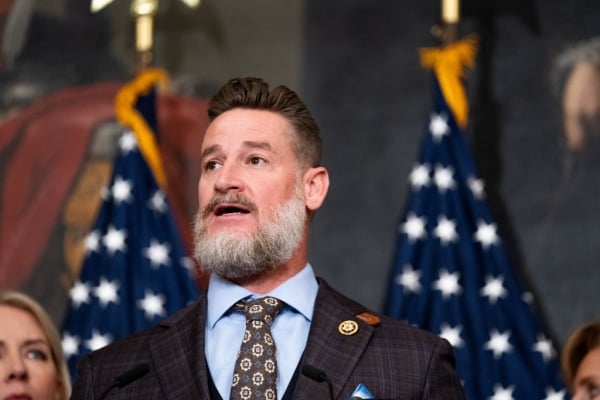
    Representative Greg Steube, a Florida Republican, speaks at a press conference following the passage of his Protection of Women and Girls in Sports Act in the House of Representatives.

    Allison Robbert/AFP via Getty Images

    The House of Representatives voted 218 to 206 to pass a bill that would unilaterally ban trans women from competing in women’s sports Tuesday. The votes were nearly split along party lines, but two Democrats, Henry Cuellar and Vicente Gonzalez, both from Texas, voted for the bill.

    Sponsored by Representative Greg Steube, a Florida Republican, the legislation dubbed the Protection of Women and Girls in Sports Act, is the latest attempt in Congress to keep trans women off women’s sports teams and builds on efforts in the states to restrict the participation of transgender students in sports that align with their gender identity. Last Congress, identical legislation from Steube passed the House but didn’t move forward in the Democratic-controlled Senate.

    Now, Republicans hold the majority in both the House and the Senate, making it far more likely that this iteration will be more successful. In nearly half of the country, trans women are banned from playing women’s sports at the K-12 or higher education level, but the legislation would take those bans nationwide.

    Passing the bill was a top priority for House Republican leadership, who included it on a list of 12 pieces of legislation to be considered first when the new session of Congress kicked off earlier this month. Its place of prominence seems to indicate that Republican leadership will prioritize rolling back or restricting the rights of transgender people, whom Republicans have often put at the center of a culture war.

    Republicans and President-elect Donald Trump have criticized the Biden administration’s effort to amend Title IX of the Education Amendments of 1972 to prevent blanket bans that prohibit transgender students from participating in sports consistent with their gender identity. Last month, the Biden administration scrapped that proposal.

    Under the bill, institutions that receive federal funding would be prohibited from allowing “a person whose sex is male to participate in an athletic program or activity that is designated for women or girls.” It defines sex as being based on “a person’s reproductive biology and genetics at birth,” though it doesn’t expound upon how an institution would tell. The bill does not prevent trans men from playing on men’s teams.

    Anti-trans activists argue that allowing individuals assigned male at birth to play on women’s sports teams opens cis women athletes up to being injured by athletes who are more naturally powerful due to their physiques. There is sparse research on if this is true; however, the few studies that do exist haven’t backed up the idea that trans women retain significant advantage over athletes assigned female at birth.

    Supporters of the legislation—including some cis female athletes, like Riley Gaines, who have competed alongside and against trans athletes at the collegiate level—also argue that trans women take spots on women’s teams, going against Title IX’s promise of equal opportunity, and that it is uncomfortable for cisgender female athletes to share close quarters, like locker rooms, with individuals assigned male at birth.

    Representative Tim Walberg, the Michigan Republican who chairs the House Education and the Workforce Committee, echoed these sentiments in his argument on the House floor Tuesday.

    “Mr. Speaker, kicking girls off sports teams to make way for a biological male takes opportunities away from these girls,” he said. “This means fewer college scholarships and fewer opportunities for girls. It also makes them second-class citizens in their own sports and puts their safety at risk.”

    Some people who agree that trans women should not play on women’s teams say they broadly support transgender individuals but see it as unfair for them to take spots on women’s teams. But Steube took a different approach. When he announced the bill earlier this month, he quoted President-elect Donald Trump’s promise that “under the Trump administration, it will be the official policy of the United States government that there are only two genders—male and female.”

    Meanwhile, Democrats and LGBTQ+ advocates argue that trans women should have the opportunity to play sports—which have been shown to improve outcomes and mental health for youths across the board—on the team that matches their gender.

    “Transgender students—like all students—they deserve the same opportunity as their peers to learn teamwork, to find belonging and to grow into well-rounded adults through sports,” said Representative Suzanne Bonamici, an Oregon Democrat, on the House floor. “Childhood and adolescence are important times for growth and development, and sports help students form healthy habits and develop strong social and emotional skills. Sports provide meaningful opportunities for kids to feel confident in themselves and learn valuable life lessons about teamwork, leadership and communication. Teams provide a place for kids to make friends and build relationships.”

    Bonamici and other democrats dubbed the bill the “Child Predator Empowerment Act” and argued it wouldn’t make schools safer for students. In fact, she said that the vague language in the bill about what defines the male sex could lead to invasive examinations.

    “There is no way this so-called protection bill could be enforced without opening the door to harassment and privacy violations. It opens the door to inspection, not protection, of women and girls in sports,” she said. “Will students have to undergo exams to prove they’re a girl? We are already seeing examples of harassment and questioning of girls who may not conform to stereotypical feminine roles; will they be subject to demands for medical tests and private information? That’s intrusive, offensive and unacceptable, especially from a party of limited government.”

    Source link

  • One day after FIRE lawsuit, Congress passes changes to filming permits in national parks

    One day after FIRE lawsuit, Congress passes changes to filming permits in national parks

    On Wednesday, FIRE and the National Press Photographers Association filed lawsuit challenging the arbitrary and unconstitutional laws that require Americans to apply for a permit and pay costly fees before exercising their right to film in national parks. The very next day, the U.S. Senate passed a bill addressing these same issues. The bill now goes to President Biden, who is expected to sign it in a huge victory for filmmakers — and for the First Amendment.

    Currently, filmmakers must obtain a permit and pay a fee if they intend to later profit from their footage in national parks, even if they are using the same handheld camera or phone that a tourist would use. Permits are routinely denied for arbitrary and unpredictable reasons, making it difficult for people like documentary filmmakers, press photographers, and wedding videographers to earn a living. Under the EXPLORE Act, that changes. 


    WATCH VIDEO

    The EXPLORE Act, championed in the Senate by West Virginia Democrat Joe Manchin and Wyoming Republican John Barrasso, does several things to fix the constitutional problems with the permit scheme that FIRE is challenging. First, so long as the filming takes place where the public is allowed, doesn’t impact other visitors or damage parks resources, and involves five or fewer people, no permit is required. Second, no permit is required simply because the filmmaker intends to make a profit. Third, no permit is needed to film activities that are already allowed in the park. And fourth, the EXPLORE Act makes clear that when the National Park Service has already approved an event like a wedding to take place in a national park, no additional permit is needed to film or photograph the special occasion.

    After filing, FIRE and NPPA took the story to the media and to Capitol Hill. FIRE looks forward to seeing this bill become law.

    Source link

  • House Passes Bipartisan Retirement Savings Bill – CUPA-HR

    House Passes Bipartisan Retirement Savings Bill – CUPA-HR

    by CUPA-HR | April 4, 2022

    On March 29, the U.S. House of Representatives passed H.R. 2954, the Securing a Strong Retirement Act of 2021, by an overwhelmingly bipartisan vote of 414-5. The bill includes many provisions to boost individual retirement savings and expand coverage to better access retirement savings programs.

    The bill includes several provisions that would impact employer-sponsored retirement programs. Notably, the bill would make enrollment in newly created 401(k) and 403(b) plans mandatory for eligible employees beginning in 2024. Employers with 10 or fewer employees or those that have been in business for fewer than three years would be exempt from this requirement, and employees would be able to opt out of the program. Additionally, the bill requires employers to allow part-time employees to participate in 401(k) plans if they work at least 500 hours per year after two years working for the employer — a decrease from the previously required three years.

    The bill will also allow employers to make matching contributions to the 401(k), 403(b) or SIMPLE IRA account of employees who are paying off student loans and do not contribute enough to their accounts to receive a full employer match.

    In addition to the provisions related to employer plans, the bill also has provisions for individual workers. The bill allows older workers to make bigger contributions to their retirement accounts than is currently allowed. Specifically, individuals aged 62-64 would be able to contribute an extra $10,000 for 401(k) plans and other programs and $3,000 for SIMPLE plans per year to such accounts beginning in 2024. These “catch-up” contributions would be required to be made after taxes.

    The bill now heads to the Senate where it will need to pass with 60 votes to overcome the filibuster. Given the bipartisan support in the House, the bill could receive similar support from both parties, but it is unclear when and how the Senate will vote.

    CUPA-HR will keep members apprised as this bill moves through the Senate.


    Source link

  • House Passes Bills to Protect Older Job Applicants and Strengthen Domestic Violence Prevention and Survivor Support Services – CUPA-HR

    House Passes Bills to Protect Older Job Applicants and Strengthen Domestic Violence Prevention and Survivor Support Services – CUPA-HR

    by CUPA-HR | November 9, 2021

    On October 26 and November 4, 2021, the House of Representatives passed H.R. 2119, the Family Violence Prevention and Services Improvement Act of 2021, and H.R. 3992, the Protect Older Job Applicants (POJA) Act of 2021, respectively. Both bills passed by a close bipartisan vote — the former by a vote of 228-200 and the latter 224-200 — and are supported by President Biden.

    POJA Act

    As originally written, the POJA Act amends the Age Discrimination in Employment Act of 1967 (ADEA) to extend the prohibition of limiting, segregating or classifying by employers of employees to job applicants. The bill comes after recent rulings in the Seventh and Eleventh Circuit Courts of Appeals that allow employers to use facially neutral hiring practices, which some have accused of being discriminatory against older workers. As such, the POJA Act amends the ADEA to make clear that the disparate impact provision in the original statute protects older “applicants for employment” in addition to those already employed.

    Before the final vote on the bill, the House also adopted an amendment to the POJA Act that would require the Equal Employment Opportunity Commission to conduct a study on the number of job applicants impacted by age discrimination in the job application process and issue recommendations on addressing age discrimination in the job application process.

    Family Violence Prevention and Services Improvement Act

    The Family Violence Prevention and Services Improvement Act amends the Family Violence Prevention and Services Act to reauthorize and increase funding for programs focused on preventing family and domestic violence and protecting survivors. One provision addressing higher education authorizes the Secretary of Health and Human Services to now include institutions of higher education among the entities eligible for departmental grants to “conduct domestic violence, dating violence and family violence research or evaluation.”

    Both the Family Violence Prevention and Services Improvement Act and the POJA Act now face the Senate where passage is uncertain as both require significant support from Republicans to bypass the sixty-vote filibuster threshold.

    CUPA-HR will keep members apprised of any actions or votes taken by the Senate on these bills.


    Source link

  • House Passes Bill to Increase Workplace Protections for Nursing Mothers – CUPA-HR

    House Passes Bill to Increase Workplace Protections for Nursing Mothers – CUPA-HR

    by CUPA-HR | October 26, 2021

    On October 22, 2021, the House of Representatives passed H.R.3110, the Providing Urgent Maternal Protections (PUMP) for Nursing Mothers Act. The bill passed by a bipartisan vote of 276-149 and was supported by business groups such as the U.S. Chamber of Commerce and advocacy organizations, including the American Civil Liberties Union.

    As originally written, the PUMP for Nursing Mothers Act amends the Fair Labor Standards Act (FLSA) to expand access to breastfeeding accommodations in the workplace for lactating employees. The bill builds upon existing protections in the 2010 Breaktime for Nursing Mothers Act by broadening breastfeeding accommodations and workplace protections to include salaried employees exempt from overtime pay requirements under the FLSA as well as other categories of employees currently exempt from such protections, such as teachers, nurses and farmworkers. It also clarifies that break time provided under this bill is considered compensable hours worked so long as the worker is not completely relieved of duty during such breaks, and it ensures remedies for nursing mothers for employer violations of the bill.

    Before the final vote on the bill, the House also adopted two additional amendments to the PUMP for Nursing Mothers Act that would:

    • Direct the Government Accountability Office (GAO) to conduct a study on compliance among covered employers, including employee awareness of their rights and proposals to improve compliance; and
    • Direct the Comptroller General of GAO to conduct a study on what is known about the racial disparities that exist with respect to access to pumping breastmilk in the workplace and submit to Congress a report on the results of such study containing such recommendations as the Comptroller General determines appropriate to address those disparities.

    The House-passed bill now moves to the Senate where it is unknown whether or not the bill will garner enough support from Republicans to bypass the sixty-vote filibuster threshold needed to pass.

    CUPA-HR will keep members apprised of any actions or votes taken by the Senate on this bill.


    Source link