In the global education sector, we have spent much of the last two years looking at artificial intelligence through a defensive lens. The conversation has been dominated by concerns over academic integrity and the perceived threat to traditional assessment. However, as we look at the challenges facing UK higher education in 2026 – chief among them student retention and the widening attainment gap – it is time to shift our perspective.
What if AI isn’t the problem, but a vital part of the solution?
New independent research by Dr Rebecca Mace SFHEA, titledEthical AI in Higher Education: Boosting Learning, Retention and Progression, provides a data-backed argument for this shift. By analyzing over 8,000 data points from diverse UK institutions, the report reveals that when AI is used as a formative “learning partner,” it creates a “stabilising scaffold” that keeps students in school and helps them thrive.
The “equalising effect” on attainment
For international and domestic students alike, the leap to university-level academic writing can be daunting. Dr Mace’s research found that formative AI feedback has a powerful “equalising effect”. While writing scores improved across the board, the most rapid gains were seen among lower-performing students.
The research tracked measurable improvements in core academic areas for students using Studiosity AI for learning:
Text analysis: +10.98 points
Scientific reports: +7.18 points
Essays: +6.72 points
This isn’t about AI writing for the student; it’s about the student using feedback to master “academic code-switching” – the ability to translate their ideas into the formal language of their discipline.
A roadmap for retention
Retention is the “holy grail” for university leaders today. The Mace report identifies a direct positive correlation between the use of Studiosity formative AI for learning and student persistence.
The data suggests that learning is an iterative process. Students who engaged with the tool showed consistent progress over time, with six submissions appearing to be the “sweet spot” where academic standards become internalised. For a student who might be struggling in silence at 2:00am, having an ethical, 24/7 feedback loop provides the confidence to keep going rather than dropping out.
From guilt to growth
Perhaps the most revealing part of the study is the psychological impact on students. Many reported feeling a sense of “guilt” when using AI, even for legitimate study support, due to a lack of clear institutional guidance. This “low-trust culture” is counterproductive.
As university leaders, you have an opportunity to validate ethical AI use. By providing students with approved, pedagogy-first tools, we move them away from the “gray areas” of the internet and back into a structured, supported learning environment.
Take the next step
The evidence is clear: ethical AI is no longer a luxury or a risk to be managed – it is a strategic necessity for any institution serious about student success and social mobility. I invite my colleagues across the sector to dive into the data and see how these findings can be applied to your own student success strategies.
About the author: Isabelle Bambury is the managing director UK and Europe at Studiosity. Isabelle has over 20 years’ experience in the education sector, before Studiosity as regional director for Study Group where she led both the UK/Europe and Russia/Central Asia teams. Prior to this, Isabelle held key roles at Cambridge Education Group and Kaplan International, moving into the private sector in 2005 after beginning her career as a secondary school teacher.
About Studiosity: Support and Validate. Studiosity is writing feedback and assessment security that helps educators and leadership support students and validate learning outcomes, and unlike police & punish detection technology, Studiosity helps protect degree value, pedagogically and ethically.
In my recent article for The PIE, I reflected on how Canada’s international education system has been moving through a period of turbulence and uncertainty, highlighting the compounding effects of the past several years, abrupt policy shifts, uneven communication, and ongoing immigration challenges that have created instability and eroded trust among students, families and global partners.
This second piece builds on that discussion. Canada’s international education sector continues to navigate a turbulent period, one that is reshaping how institutions, students, and communities make decisions today and plan for tomorrow.
Yet within this turbulence lies an opportunity: to chart a clearer, more deliberate path forward that restores confidence and strengthens Canada’s global role. There is no simple fix, but by examining how other countries and Canadian provinces have approached similar challenges, we can begin identifying the building blocks of a more stable, coordinated and sustainable strategy.
If Canada is to navigate this moment and rebuild stability and credibility, it must move beyond reactive decision-making. What is needed is a clear, long-term framework, one grounded in evidence, predictable investment, and collaboration across governments, institutions, employers and communities. Lessons from Germany, New Zealand and British Columbia demonstrate that more deliberate and sustainable approaches are not only possible, but necessary.
Lessons from Germany’s model
Germany provides a compelling example of how international education can be integrated into a broader national economic and demographic strategy. While the contexts differ, Germany’s constitutional division of responsibility for education between the federal government and the Länder is in many ways similar to Canada’s federal–provincial structure, making its approach worth examining. One important distinction is tuition: in most regions, international students pay minimal or no fees, reflecting a long-term view that the real return on investment comes from decades of workforce participation and tax revenue rather than short-term tuition income.
A 2025 study by the German Economic Institute, commissioned by the German Academic Exchange Service, found that the 79,000 international students who began degree programs in 2022 could generate between €7.36 billion and €26 billion in lifetime net fiscal gains for the public sector coffers. Even under conservative projections, public investment in international students pays for itself within two to five years after graduation. International graduates could offset up to 20% of Germany’s projected GDP slowdown due to demographic change over the next decade.
While Canada’s policy environment, tuition structures, and labour market integration differ, this illustrates what can be achieved with a coordinated national framework that aligns higher education with workforce needs.
A key part of this approach is the Campus Initiative for International Talents and the FIT program. These initiatives fund universities to prepare students for academic life, support their integration, and connect them with employers before and after graduation. They also invest in expanded career services, targeted retention programs and partnerships with industry to ensure smoother transitions into the labour market. Critically, this is made possible by predictable, multi-year federal funding, allowing institutions to sustain, refine and scale initiatives over time while sharing lessons across the sector.
New Zealand’s managed growth approach
New Zealand offers another instructive model, one that is still in its early stages but marks a shift from previous approaches. Following a period of post-pandemic recovery, the government launched the International Education Going for Growth strategy in 2025, setting a ten-year target to nearly double the sector’s economic contribution by 2034. Rather than relying on abrupt changes, the plan outlines growth from 83,700 in 2024 to 119,000 by 2034 and double the sector’s value from NZ$3.6 billion to NZ$7.2 billion. The plan takes a phased approach, tying growth to quality, sustainability and alignment with workforce needs.
Recent reforms include increasing in-study work limits from 20 to 25 hours per week, extending work rights to all tertiary exchange and study abroad students, and introducing a six-month post-study work visa for vocational graduates who do not qualify for longer-term rights. The government is also exploring easier access to multi-year visas. These measures aim to strengthen links between study, work experience, and skilled migration, while maintaining education quality and managing community impacts.
The path forward is about tackling root causes through careful, well-designed policy that extends beyond surface-level fixes
The strategy recognises the sector’s wider economic, social, cultural, and innovation-related value, and calls for closer coordination between education providers, employers, and industry. It also seeks market diversification beyond China and India, with targets to raise New Zealand’s profile globally and move more prospective students to rank it among their top three choices.
It’s interesting to see New Zealand’s sector leaders pairing an ambitious growth target with a deliberate, measured pace. Their emphasis on balancing enrolment growth with infrastructure, regional distribution and public support offers important lessons for other countries including Canada as we rethink our own approach to rebuilding and re-imagining international education in a way that is both sustainable and socially supported. While too early to measure outcomes, Going for Growth shows how long-term targets, coordinated reforms and predictable policy can build stability, avoiding the uncertainty that comes with abrupt changes.
British Columbia’s Approach
Closer to home, British Columbia has begun moving toward a more managed approach to international education one that offers useful reference points for other provinces to consider as they navigate similar pressures. The framework is designed to address key challenges: aligning enrolment with institutional and community capacity, encouraging more diversified student markets, connecting recruitment more closely to housing and student supports, and strengthening quality assurance to protect students and institutional reputation. More information on the province’s approach can be found in its Public Post-Secondary International Student Enrolment Guidelines, Education Quality Assurance framework, and requirements for multi-year institutional international education strategies.
This approach is still evolving, but it signals a shift away from reactive measures toward more deliberate, longer-term planning. The broader takeaway across all three cases – Germany’s coordinated national investment, New Zealand’s managed growth plan, and British Columbia’s emerging provincial framework – is not that any has found the perfect solution, but that more thoughtful, workable approaches are possible even within a federal system like Canada’s. The path forward is less about adding new barriers and complexity, and more about tackling root causes through careful, well-designed policy that extends beyond surface-level fixes.
A path forward for Canada
Canada requires a deliberate course correction, one that is precise in its objectives, strategic in its design and anchored in robust evidence. This entails moving beyond reactive decision-making toward a coherent framework that establishes clear long-term goals, calibrates enrolment to institutional and community capacity, and embeds international education as a core pillar of national economic, demographic and innovation strategies.
Achieving this demands sustained, structured coordination between federal, provincial and institutional partners, underpinned by transparency, reliable data and clearly defined performance metrics.
As Canada looks ahead, several key aspects should guide the development of a stronger, more sustainable international education strategy:
1. Transparency & accountability
Prioritise transparency by publishing timely, detailed data on study permit allocations, approval rates and processing times to enable evidence-based planning.
Streamline compliance processes by redesigning the Provincial Attestation Letter process to remove unnecessary steps while maintaining accountability and integrity.
Recognise sector diversity by applying policies that reflect institutional differences in size, mission, and track record, using a risk-based approach to oversight.
2. Integration & coordination
Integrate policy planning across education, immigration and labour market needs so that international students are viewed as future members of Canada’s workforce and communities.
Establish a national roundtable that brings together governments, institutions, employers and communities to coordinate talent, skills and immigration strategies (as recommended by many groups across Canada CBIE, UniCan, CICan).
3. Student success & retention
Invest in student success by funding housing, mental health services, and academic supports that benefit both domestic and international learners, while creating clear residency pathways to encourage long-term retention.
Adopt multi-year funding models for programs that link education with workforce integration, ensuring stability and continuity, similar to Germany’s FIT program.
4. Narrative & public confidence
Reset the narrative by communicating the shared benefits of international education: sustaining academic programs, expanding opportunities, strengthening research capacity and contributing to Canada’s innovation ecosystem.
Build public trust by showing that investments in international education are not a zero-sum trade-off with domestic priorities, but a shared investment in Canada’s prosperity, global competitiveness and community vitality.
Canada at a crossroads
Canada is at a crossroads. The past 20 months have exposed the cost of reactive, fragmented policy: instability for students, institutions and communities. The “building the plane while flying it” approach cannot continue. This is also a moment of opportunity. Canada can create a transparent, predictable and collaborative international education system, one that recognises students not as temporary visitors, but as future citizens if they choose to stay, or as global ambassadors for Canada: skilled professionals, community builders and partners in strengthening our place in the world.
Germany’s integration of higher education into its national skilled labour strategy and New Zealand’s long-term managed growth plan both demonstrate that it is possible to balance integrity, economic benefit and student success. British Columbia’s recent steps show that proactive, well-planned policy is possible within Canada’s governance structure, and that each province can develop its own approach tailored to its specific context, priorities and capacity
In a rapidly changing geopolitical environment, how Canada engages globally, attracts and retains talent, and integrates education with long-term national goals will shape its economic and social future. Canada can choose to lead with vision and strategy or watch as others secure the global talent, partnerships and influence that we have allowed to slip away.
Unveiled at the UK-Saudi Arabia GREAT Futures Leadership Summit in London, the announcement reflects the summit’s mission to drive cooperation across business, education, and innovation.
EP, part of the GEDU group, has already established campuses across the UK, Europe, North America, the Middle East, and Australia and now aims to support Saudi Arabia in fulfilling its future visions.
As EP operates under the Global Institute of Entrepreneurship Training Institute (GIE), which is licensed by Saudi Arabia’s Technical and Vocational Training Corporation (TVTC), this new venture will deliver internationally accredited English language programs with a focus on outstanding teaching and student support.
EP’s Riyadh campus offers a wide range of programs, from Classic English courses for adults and teens to more intensive study options designed to accelerate progress. The portfolio also includes business management and leadership training, IELTS preparation, classes that focus on speaking, and weekend clubs for younger learners.
Tom Buckley, CEO of EP, described the move as a pivotal milestone for the organisation, as it establishes EP in what is a high-growth global market.
“EP empowers learners with world-class language education, and we’re thrilled to be bringing this offering to Saudi Arabia” Tom Buckley, English Path
“EP empowers learners with world-class language education, and we’re thrilled to be bringing this offering to Saudi Arabia,” said Buckley.
Buckley stressed that the Kingdom represents one of the world’s rapidly growing education markets, highlighting the role of private sector investment in supporting the government’s 2030 Vision strategy, which places a strong emphasis on developing education and student mobility.
“We at EP and GEDU are also proud to be collaborating with leading Saudi private and government organisations, strengthening our mission to empower learners and contribute to the Vision 2030 goals. Vision 2030 places a strong emphasis on education, and we share this ambition to make Saudi Arabia a magnet for education at all levels, and global student mobility.”
“The strong collaboration we have seen at the UK-Saudi Arabia GREAT Futures Leadership Summit is critical to future developments across key sectors, and will bring mutual benefits to both the UK and the Kingdom in both the short and long term,” explained Buckley.
“Our ambition as a group extends beyond just ourselves – we want to partner with other institutions to help them bring their education offerings to the Kingdom, and offer pathway programmes to other universities around the world.”
By Professor Lisa-Dionne Morris, Professor of Public & Industry Understanding of Capability Driven Design in the School of Mechanical Engineering, and Engagement Champion for the EPSRC EDI Hub+ at the University of Leeds.
Preparing the next generation of female international design engineers requires more than the delivery of technical content. It necessitates a systemic, institution-wide approach that equips graduates with the attributes, knowledge, resources, skills, and confidence to navigate a professional landscape that is rapidly changing and, in many cases, still being defined for future careers. The increasing global demand for roles in areas like sustainable product design, AI-integrated manufacturing, inclusive user interface systems, and human-centred engineering is underpinned by the foundational importance of STEM, making the empowerment of women designers and engineers in these fields crucial for driving innovation and achieving sustainable development goals. These emerging sectors demand not only technical competence but also a blend of creativity, emotional intelligence, and social awareness that diverse females in STEM demonstrate.
Universities play a vital role as critical enablers and a resource. This extends beyond curricula to the people, processes, and environments that scaffold student growth, from technical staff and personal tutors to administrative teams and peer mentors. The university must therefore shift its conceptualisation of employability from curriculum-contained instruction to community-wide responsibility.
Barriers and Micro-inequities
For female design and engineering graduates, these ecosystems are even more consequential. While overt discrimination may be declining, micro-barriers, such as imposter syndrome, limited visibility of role models, cultural dissonance and inaccessible resources, continue to affect women disproportionately. The intersectionality of race, disability, and socioeconomic status further compounds these challenges.
Support mechanisms such as inclusive wellbeing services, financial assistance schemes, mentoring networks, and accessible technical environments serve as critical interventions. These do not merely reduce dropout risk; they transform educational experiences and enhance graduate outcomes.
Beyond KSA: Towards the ACRES Model
Traditional employability frameworks such as the KSA model (Knowledge, Skills, Abilities) focus primarily on individual traits. While helpful, such models risk overlooking the social, ethical, and emotional dimensions necessary for future engineering practice. In response, I propose the ACRES framework — a holistic model centred on:
A – Adaptability: Developing the capacity to respond flexibly to change
C – Collaboration: Cultivating skills in teamwork and interdisciplinary cooperation.
R – Resilience: Building psychological robustness through reflective learning
E – Empathy: Encouraging emotional intelligence through inclusive design challenges
S – Social Responsibility: Engaging students with ethical, civic, and sustainability issues.
These attributes are more than ideals; they represent the design specifications for the modern engineer.
Educational Practice in Action
Design engineering programmes across the UK are embedding these competencies through interdisciplinary projects, challenge-based learning, studio-based learning, sustainability modules, and community-based partnerships. At the University of Leeds, in the Faculty of Engineering and Physical Sciences, for example, students engage in industry-informed design briefs, receive feedback from career mentors, and co-produce portfolios that reflect both technical ability and human-centred thinking.
Such practices are not incidental, they are fundamental. The preparation of women designers and engineers is a collective act; it is the result of intentional, inclusive, and collaborative university cultures that nurture talent through both “seen and unseen” interventions.
The university must function not only as a centre of instruction but as a dynamic support system, enabling intersectionality such as first-generation, women, disabled, and underrepresented female students to flourish in STEM to become graduates. When we invest in raising future-ready women designer and engineers, we are not merely producing graduates, we are shaping leaders, changemakers, and innovators for careers that, in many cases, are yet to be invented.
As an enrollment manager or a vice president of academic affairs, or even a leader in student affairs, you might think, “Why should I care about gathering data from our current student population? That’s Institutional Research’s job.” But if you care about the health of your institution, if you care about keeping your students enrolled to graduation and if you care about showing your students you care about them as individuals, then regularly assessing student motivation and student satisfaction is an activity that should be on your radar. Intentionally using that data to improve the lives of your students and to identify key challenges for the college should be a priority for every member of the institutional leadership team.
You may know that assessing student satisfaction is important, but you need to get others on board on campus.
“If the WHY is powerful, the HOW is easy.” –Jim Rohn
Student-level data: Motivational assessments
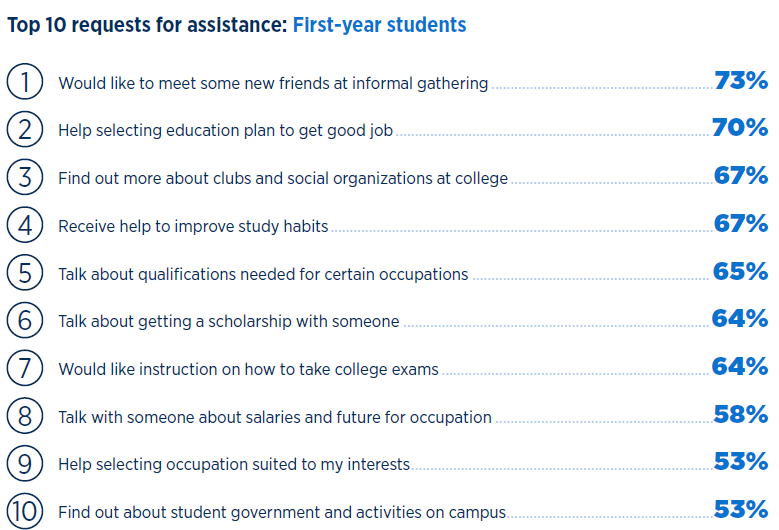
Understanding what students need to be successful as they first enter your institution is a powerful way to begin building connections and showing students you care about them. Providing them with the services that they say they want and need to be successful will put you in the best position to serve students in the way they want to be served. In the recently published 2025 National First-Year Students and Their Motivation to Complete College Report, we identified the top 10 requests for support by incoming first-year students, based on the nearly 62,000 responses to the College Student Inventory in the fall of 2024:
Among first-year students’ top ten requests for assistance, we found themes of connection and belonging, career assistance, academic support, and financial guidance. These top 10 have remained fairly consistent over the last few years.
When campuses are aware of what incoming students need in the aggregate, institutional resources can be targeted to support these services. And when campuses, specifically advisors, know what individual students have self-identified as desired areas of support, guidance can be provided directly to the students most in need of and most receptive to receiving assistance.
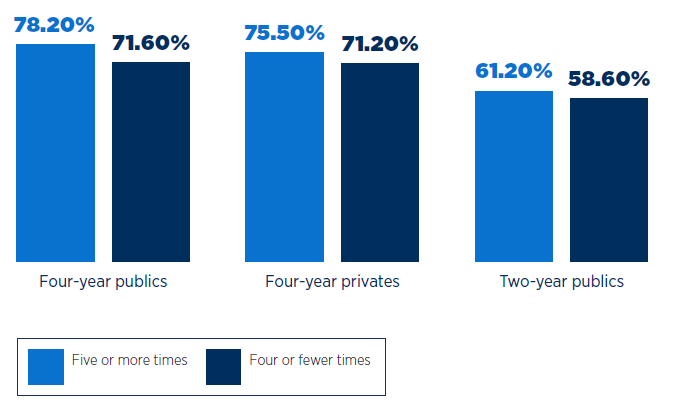
While campuses can see a 1% improvement in student retention within the first year of implementing a motivational assessment, we have found that campuses that are assessing student motivation on a consistent basis over multiple years are most likely to see retention levels improve.(We recognize that motivation data alone doesn’t lead to improved retention, but the student-level data is an important component of institutional retention efforts.) The impact of consistently assessing student motivation with the RNL Retention Management System (RMS):
Data based on a February 2025 RNL review of reported retention rates 2015-2024 in IPEDS for client institutions using one or more of the instruments in the RNL Retention Management System.
The bottom line on why you should care about assessing individual student motivation
Asking students as they enter your institution what they need shows that you care about their experience. Using that data to build relationships between advisors and students lays the foundation of one of the most important connections students can have with your institution. Guiding students to the specific service or support they seek puts you in the best position to engage your students in meaningful ways. Ultimately, serving your students in the ways they need will make your institution more likely to retain those students.
What are the needs, challenges, and priorities for first-year college students? Find out in the National First-Year Students and Their Motivation to Complete College Report. You will learn their attitudes on finishing college, top areas of assistance, desire for career assistance, and more.
Knowing what students value across all class levels at your institution can provide the student voice in your data-informed decision-making efforts. Assessing student satisfaction is another way to show students you care about them, their experience with you, and what matters to them. Aligning your resources with student-identified priorities will reflect a student-centered environment where individuals may be more likely to want to stay.
Student satisfaction data from across your student population can inform and guide your institutional efforts in multiple ways:
Student success and retention activities: Identifying your top priorities for response so you are working on high-importance, low-satisfaction areas from the student perspective.
Strategic planning: Incorporate the student voice into your long-term planning efforts to stay aligned with where they want to see you make investments.
Accreditation: Document your progress year over year as part of a continuous improvement process to show your regional accreditor that you are paying attention and responding to students (and not just when it is time for re-affirmation!).
Recruitment: Highlight your high-importance, high-satisfaction strengths to attract students who will care about what you can offer.
To assist institutions with building the case for student satisfaction assessment on their campuses, we have developed two brief videos (under two minutes each), one talking about why assess satisfaction and why work with RNL specifically. My colleague Shannon Cook also hosted a 30-minute webinar that is available on demand to dive deeper into the why and how of assessing student satisfaction.
Satisfaction data provides valuable perspectives for every department on campus, identifying areas to celebrate and areas to invest more time, energy, and resources. Campuses that respond to what their students care about have reported seeing satisfaction levels increase and graduation rates improve. Most institutions we work with assess student satisfaction at least once every two or three years and then use the intervening months to explore the data through demographic subpopulations and conversations on campus, take action in high-priority areas, and communicate back with students about what has been done based on the student feedback. These ongoing cycles put institutions in the best position to create a culture of institutional improvement based on the student voice.
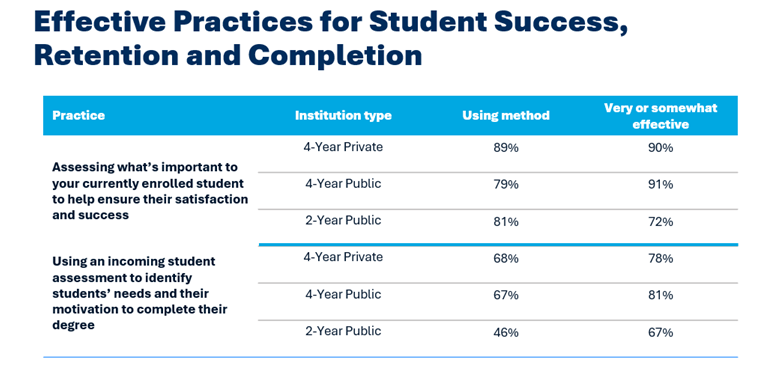
Student motivation and satisfaction assessments are effective practices
The impact of assessing student motivation and student satisfaction on institutional graduation rates has been documented with numerous studies over the years.
It is important to be aware that just gathering the data will not magically help you retain students. It is the first step in the process, following these ABCs:
Assess the needs with student and institutional level data collection
Build a high impact completion plan to engage students from pre-enrollment to retention to graduation, taking action based on what students say
Connect students to campus resources that best match their needs and will increase their likelihood to persist and complete and Communicate about what you are doing and why as improvements are made.
Contact me if you would like to learn more about assessing student motivation and student satisfaction on your campus.
I’ll be the first in my family to earn a college degree, and that’s something I hold very close to my heart.
My family and I moved to the United States in 2014. We chose Memphis as our second home to start fresh and build a better future.
When I graduated high school in 2020, I decided to join the Army Reserve so I could work full-time to help support my family financially. Along the way, my parents always reminded me of the importance of a college degree. Honestly, I struggled with the decision between choosing work over school.
That changed when I discovered the University of Memphis Global (UofM Global) where I could earn my degree 100% online from an accredited, nationally recognized Carnegie R1 university. The flexibility of the program made it possible to balance work, life, and education. Once I enrolled, I knew I made the right choice.
As an online student, I stayed involved with campus life through career fairs and joining student organizations like the Society of Human Resource Management. I wanted to get the most out of my college experience and connect with people who shared my passion for HR.
Last November, I deployed to Kuwait, with a month left of fall semester. Thanks to the support and structure of UofM Global, I was able to finish strong, even making the Dean’s List. I’m taking four classes while serving on active duty, and I’m proud to say I’ll be graduating in May.
Being able to serve my country, support my family, and earn my degree means the world to me. I feel ready to take on whatever comes next.
The pressures on higher education leaders and their institutions have intensified with the new U.S. presidential administration’s agenda. We all became familiar with uncertainty as a result of the pandemic, but this new series of policy mandates and legal challenges creates an even more ambiguous environment. Higher education’s basic foundations, operating systems, cultures, values and structures are being challenged, which implies systemic change may be required.
Leading systemic change is difficult enough in a less demanding environment. In this one, higher ed leaders will need tools and resources that can help them strategically chart a path through the chaos. They will need advice about how to adapt and continue important work that may be challenged by current executive orders, as well as advice about how to navigate the sheer volume of those orders.
Leaders can be more successful adapting and strategizing if they do so in ways that honor their unique contexts. Context variously creates opportunities or presents barriers that influence the actions leaders may take. Therefore, it is important for leaders to step back for a few moments and “get on the balcony,” as Ronald A. Heifetz, Marty Linsky and Alexander Grashow put it.
While many leaders may not think they have the time to do this, it is critically important they take the time to understand the complexities of the current situation so as not to overreact, react too quickly or react incorrectly. For example, a leader responding to a recent executive order may move quickly to announce program and office closures, but without time to consider options and understand context, this quick action may have a greater negative impact than some other, more strategic approach, one that does not compromise institutional integrity.
Leaders may also find they have levers available to them that are important to identify and use strategically. For example, partnerships with donors or grant opportunities are great levers to not only achieve strategic priorities but also provide relief for shortfalls that may result from the current political climate.
One way leaders can “get on the balcony” is to dive into their context and ask key questions with their leadership teams. This analysis will illuminate aspects of the leadership landscape that perhaps weren’t fully realized, highlight opportunities and fill in the details of challenges they are facing. Important categories of context to analyze are institutional mission; campus culture; politics, leadership and governance; human capital and capacity; physical, financial and technological resources; and externalities.
The final category of externalities may be of particular relevance right now. This category refers to anything happening outside the university, from local community issues to state and federal policies. It goes beyond state appropriations and budgets to include social, political and economic factors. As leaders consider their external environment, here are some questions they can use to help them identify opportunities for and barriers to change, as well as levers they can use to inform the actions they can take:
Are there state or federal policies or programs that are related to the change you are trying to achieve?
What initiatives, organizations or businesses in your community might have a stake in this change?
If your campus is public or part of a state system, are there messages, policies and priorities that can be drawn on to support changes?
Is your campus a member of a national association that has initiatives you might participate in that will help you advance your change or gain momentum and support?
Are there state, federal or philanthropic organizations that have grant programs aligned with your change goals? Do you have any major donors that can be engaged in your change project to support your goals?
Let’s see how this exploration might help leaders chart a strategic path forward through the current climate of chaos and uncertainty. Leaders might identify some challenges with respect to their state or federal policy environment that present barriers. For example, in states that have defunded diversity efforts, universities have less funding to accomplish their goals of creating more inclusive environments to serve all students. However, they may find an opportunity to participate in a national project sponsored by an association that provides them the time and space to reconfigure their structures and programs in ways that would still allow them to reach their goals.
By thinking through the philanthropic landscape, institutional leaders might find that there are donors who share a passion for inclusivity and thus can be cultivated as supporters of programmatic initiatives. Leaders might also undergo a search to identify possible grants or foundation funders that align with campus goals. These types of funding mechanisms are useful levers for creating a change agenda that allows for continuation of the mission despite the initial challenges.
Identifying the opportunities and barriers is the first step towards strategic action. Let’s dive into the next step by looking closely at leader “moves.” If we focus on the opportunity of participation in a national project aimed at inclusion, that will involve several moves to ensure success.
For example, the selection of a team charged with taking on this task is critically important, and getting the right set of individuals may involve thinking differently than usual. Given the current environment, it might make sense to ensure there is legal expertise on the team. It may also be especially important to assure those who are asked to lead that they will have the support of institutional leaders. Sense making and learning is another important area for action: giving people information and helping them know what is possible in the current environment is an essential leadership move at the moment.
There are likely advocacy and political moves that also need to be made to set the stage on campus or within the state to garner additional support or prepare for potential backlash. Finally, for the team’s work to be sustained in the long term, leaders might think ahead to how they can sustain or scale the programmatic, cultural and/or structural outcomes that are achieved during the initiative at a time when national leaders question the nature of the work. In the current environment, staff and faculty may also have fears that need to be addressed before they commit to this work over the long term.
More information and examples can be found in our recently published “The Change Leadership Toolkit for Advancing Systemic Change.” Whatever leaders do, they must keep moving forward even though the headwinds might be strong. Delaying action may only create larger problems that are even more intractable or insolvable. Responding too quickly may also result in irreparable and unnecessary damage that may be difficult to recover from down the road. Systemic change takes time and process and most of all requires a thoughtful, strategic and focused approach tailored to the goals and environment in which leaders are operating.
The process and example provided above just skim the surface of the deliberate kind of work higher education leaders have to do in today’s climate as they assess their contexts, take advantage of levers and opportunities, and identify key moves they will need to make to ensure successful adaptation. We hope that this essay introduces leaders to a process they can use to inform their actions so they can keep calm and carry on.
Susan Elrod is the former chancellor and professor emeritus of Indiana University South Bend. She studies higher education systemic change and is actively engaged in helping campus leaders build capacity to create more strategic, scalable and sustainable change.
Adrianna Kezar is the Dean’s Professor of Leadership, Wilbur-Kieffer Professor of Higher Education and director of the Pullias Center for Higher Education at the University of Southern California.
If families looking to relocate to “top destinations” such as the US and Canada choose the right program for their children, they may be granted permanent residency as domestic students or even graduate from their chosen institution as residents or citizens, according to Tess Wilkinson, director of education services at Henley & Partners Education in the UK.
“We’re now seeing a real uptick in the types of families who are now becoming aware that there is an option for them,” she told The PIE News.
“For families looking at relocating, there can be real gains in the amount of fees they spend on education in places like Canada,” she explained. “They can they can save [up to] $150,000 on fees.”
The sheer number of clients asking for assistance in this area signals that education is swiftly becoming “one of the key drivers for people looking at second residences to citizenships”, she added.
Henley & Partners refers to itself as a “global leader in residence and citizenship by investment”. Its education arm, Wilkinson explained, helps to “advise transnational families who are looking for global education solutions”.
Working with families all over the world with children and adults of all ages – from K-12 to those seeking master’s degrees or MBAs – it “assists them to find the right match”, taking into account children’s individual needs and the types of residency or citizenship that may become available to its clients through educational opportunities.
“We can advise on all the top-tier destinations. So we have a family, for instance, who are considering the UK, the US and Australia and they’re putting in applications for all three countries,” Wilkinson shared.
We’re now seeing a real uptick in the types of families who are now becoming aware that there is an option for them Tess Wilkinson, Henley & Partners Education
With immigration policies in key markets such as the UK, the US, Canada and Australia shifting all the time, Wilkinson acknowledged that it “is not something that is simple”.
But she said that, with expertise across a number of key markets, Henley & Partners can provide families with education counsellors to help match children to institutions that suit them best, as well as help with applying to universities or summer programs.
The ‘big four’ international education destination countries are all seeing turbulence in their respective markets. Some of these restrictive policies are having an impact on students’ ability to study in the countries, hindering them from securing post-graduate residency in their chosen destination.
Australia and Canada are both subject restrictions on international students, while UK universities’ international departments have been blighted by a crackdown on overseas students’ ability to bring their families into the country with them.
Tess Wilkinson will be speaking at The PIE Live Europe at the PIEx Power Up Expanding horizons: accessing global education & opportunity via investment migrationon March 11 at 16:00. Tickets are available online here.
Hancy Maxis spent 17 years incarcerated in New York prisons. He knew that he needed to have a plan for when he got out.
“Once I am back in New York City, once I am back in the economy, how will I be marketable?” he said. “For me, math was that pathway.”
In 2015, Maxis completed a bachelor’s degree in math through the Bard Prison Initiative, an accredited college-in-prison program. He wrote his senior project about how to use game theory to advance health care equity, after observing the disjointed care his mom received when she was diagnosed with breast cancer. (She’s now recovered.)
When he was released in 2018, Maxis immediately applied for a master’s program at Columbia University’s Mailman School of Public Health. He graduated and now works as the assistant director of operations at Montefiore Medical Center in the Bronx. He helped guide the hospital’s response to Covid.
Maxis is one of many people I’ve spoken to in recent years while reporting on the role that learning math can play in the lives of those who are incarcerated. Math literacy often contributes to economic success: A 2021 study of more than 5,500 adults found that participants made $4,062 more per year for each correct answer on an eight-question math test.
While there don’t appear to be any studies specifically on the effect of math education for people in prison, a pile of research shows that prison education programs lower recidivism rates among participants and increase their chances of employment after they’re released.
Hancy Maxis spent 17 years incarcerated in New York prisons. He now works as the assistant director of operations at Montefiore Medical Center in the Bronx. Credit: Yunuen Bonaparte for The Hechinger Report
Plus, math — and education in general — can be empowering. A 2022 study found that women in prison education programs reported higher self-esteem, a greater sense of belonging and more hope for the future than women who had never been incarcerated and had not completed post-secondary education.
Yet many people who enter prison have limited math skills and have had poor relationships with math in school. More than half (52 percent) of those incarcerated in U.S. prisons lack basic numeracy skills, such as the ability to do multiplication with larger numbers, long division or interpret simple graphs, according to the most recent numbers from the National Center for Educational Statistics. The absence of these basic skills is even more pronounced among Black and Hispanic people in prison, who make up more than half of those incarcerated in federal prisons.
In my reporting, I discovered that there are few programs offering math instruction in prison, and those that do exist typically include few participants. Bard’s highly competitive program, for example, is supported primarily through private donations, and is limited to seven of New York’s 42 prisons. The recent expansion of federal Pell Grants to individuals who are incarcerated presents an opportunity for more people in prison to get these basic skills and better their chances for employment after release.
Alyssa Knight, executive director of the Freedom Education Project Puget Sound, which she co-founded while incarcerated, said that for years, educational opportunities in prison were created primarily by people who were incarcerated, who wrote to professors and educators to ask if they might send materials or teach inside the prison. But public recognition of the value of prison education, including math, is rising, and the Pell Grant expansion and state-level legislationhave made it easier for colleges to set up programs for people serving time. Now, Knight said, “Colleges are seeking prisons.”
Related: Interested in innovations in higher education? Subscribe to our free biweekly higher education newsletter.
Jeffrey Abramowitz understands firsthand how math can help someone after prison. After completing a five-year stint in a federal prison, his first post-prison job was teaching math to adults who were preparing to take the GED exam.
Fast forward nearly a decade, and Abramowitz is now the CEO of The Petey Greene Program, an organization that provides one-on-one tutoring, educational supports and programs in reading, writing and now math, to help people in prison and who have left prison receive the necessary education requirements for a high school diploma, college acceptance or career credentials.
The average Petey Greene student’s math skills are at a fourth- or fifth-grade level, according to Abramowitz, which is in line with the average for “justice-impacted” learners; the students tend to struggle with basic math such as addition and multiplication.
“You can’t be successful within most industries without being able to read, write and do basic math,” Abramowitz said. “We’re starting to see more blended programs that help people find a career pathway when they come home — and the center of all this is math and reading.”
Abramowitz and his team noticed this lack of math skills particularly among students in vocational training programs, such as carpentry, heating and cooling and commercial driving. To qualify to work in these fields, these students often need to pass a licensing test, requiring math and reading knowledge.
The nonprofit offers “integrated education training” to help students learn the relevant math for their professions. For instance, a carpentry teacher will teach students how to use a saw in or near a classroom where a math teacher explains fractions and how they relate to the measurements needed to cut a piece of wood.
“They may be able to do the task fine, but they can’t pass the test because they don’t know the math,” Abramowitz said.
Math helped Paul Morton after he left prison, he told me. When he began his 10.5 years in prison, he only could do GED-level math. After coming across an introductory physics book in the third year of his time in prison, he realized he didn’t have the math skills needed for the science described in it.
He asked his family to send him math textbooks and, over the seven years until his release, taught himself algebra and calculus.
The recent expansion of federal Pell Grants to individuals who are incarcerated presents an opportunity for more people in prison to get these basic skills and better their chances for employment after release. Credit: Helen H. Richardson/The Denver Post via Getty Images
“I relentlessly spent six hours on one problem one day,” he said. “I was determined to do it, to get it right.”
I met Morton through the organization the Prison Mathematics Project, which helped him develop his math knowledge inside prison by connecting him with an outside mathematician. After his release from a New York prison in 2023, he moved to Rochester, New York, and is hoping to take the actuarial exam, which requires a lot of math. He continues to study differential equations on his own.
The Prison Mathematics Project delivers math materials and programs to people in prison, and connects them with mathematicians as mentors. (It also brings math professors, educators and enthusiasts to meet program participants through “Pi Day” events; I attended one such event in 2023 when I produced a podcast episode about the program, and the organization paid for my travel and accommodations.)
The organization was started in 2015 by Christopher Havens, who was then incarcerated at Washington State Penitentiary in Walla Walla. Havens’ interest in math puzzles, and then in algebra, calculus and other areas of mathematics, was ignited early in his 25-year- term when a prison volunteer slid some sudoku puzzles under his door.
“I had noticed all these changes happening inside of me,” Havens told me. “My whole life, I was searching for that beauty through drugs and social acceptance … When I found real beauty [in math], it got me to practice introspection.”
As he fell in love with math, he started corresponding with mathematicians to help him solve problems, and talking to other men at the prison to get them interested too. He created a network of math resources for people in prisons, which became the Prison Mathematics Project.
The group’s website says it helps people in prison use math to help with “rebuilding their lives both during and after their incarceration.”
But Ben Jeffers, its executive director, has noticed that the message doesn’t connect with everyone in prison. Among the 299 Prison Mathematics Project participants on whom the program has data, the majority — 56 percent — are white, he told me, while 25 percent are Black, 10 percent are Hispanic, 2 percent are Asian and 6 percent are another race or identity. Ninety-three percent of project participants are male.
Yet just 30 percent of the U.S. prison population is white, while 35 percent of those incarcerated are Black, 31 percent are Hispanic and 4 percent are of other races, according to the United State Sentencing Commission. (The racial makeup of the program’s 18 female participants at women’s facilities is much more in line with that of the prison population at large.)
“[It’s] the same issues that you have like in any classroom in higher education,” said Jeffers, who is finishing his master’s in math in Italy. “At the university level and beyond, every single class is majority white male.”
He noted that anxiety about math tends to be more acute among women and people of any gender who are Black, Hispanic, or from other underrepresented groups, and may keep them from signing up for the program.
Sherry Smith understands that kind of anxiety. She didn’t even want to step foot into a math class. When she arrived at Southern Maine Women’s Reentry Center in December 2021, she was 51, had left high school when she was 16, and had only attended two weeks of a ninth grade math class.
“I was embarrassed that I had dropped out,” she said. “I hated to disclose that to people.”
Smith decided to enroll in the prison’s GED program because she could do the classes one-on-one with a friendly and patient teacher. “It was my time,” she said. “Nobody else was listening, I could ask any question I needed.”
In just five months, Smith completed her GED math class. She said she cried on her last day. Since 2022, she’s been pursuing an associate’s degree in human services — from prison — through a remote program with Washington County Community College.
In Washington, Prison Mathematics Project founder Havens is finishing his sentence and continuing to study math. (Havens has been granted a clemency hearing and may be released as early as this year.) Since 2020, he has published four academic papers: three in math and one in sociology. He works remotely from prison as a staff research associate in cryptography at the University of California, Los Angeles, and wrote a math textbook about continued fractions.
Havens is still involved in the Prison Mathematics Project, but handed leadership of the program over to Jeffers in October 2023. Now run from outside the prison, it is easier for the program to bring resources and mentorship to incarcerated students.
“For 25 years of my life, I can learn something that I wouldn’t have the opportunity to learn in any other circumstances,” Havens said. “So I decided that I would, for the rest of my life, study mathematics.”
Contact editor Caroline Preston at 212-870-8965 or [email protected].
The Hechinger Report provides in-depth, fact-based, unbiased reporting on education that is free to all readers. But that doesn’t mean it’s free to produce. Our work keeps educators and the public informed about pressing issues at schools and on campuses throughout the country. We tell the whole story, even when the details are inconvenient. Help us keep doing that.
For example, at the age of 22, compared with the general population, care leavers and those who have ever been in care are four times less likely to enter higher education – 14 per cent of care-experienced people versus 56 per cent of the general population. Of those care leavers who do make it into higher education, 18 per cent drop out, more than double the withdrawal rate of their peers in the general population.
And it’s not just care leavers who experience unequal outcomes. The research looked more widely at anyone with experience of children’s social care – a group that is around 20 times larger than the care leaver population – and found stark inequalities in their access to and experience of higher education compared not only to the general population, but also compared to those eligible for free school meals. For example, “children in need” are two to three times less likely to attend higher education than the general population.
These results suggest that the experience of children’s social care has a lasting impact on educational prospects, and that the needs of affected young people are not being met by the current support system. Although the findings are perhaps not surprising, they are still shocking. Our report aims to act as a call to action for universities, policymakers and those seeking to close equality gaps in higher education.
Routes to an unlevel playing field
Not only is there an uphill struggle to the higher education “playing field” for those who have been in care, once there, the playing field itself is far from level. The data shows that getting those with experience of children’s social care into university is only the first challenge to address, and the high dropout rate demonstrates that targeted work is required to improve retention and support systems.
Care leavers – and others with experience of children’s social care – often take alternative routes to university. Over one-third (36 per cent) of care leavers take a vocational pathway, compared to just 13 per cent of the general population, and they are more likely to start university later in life rather than at the traditional age of 18. This suggests that the traditional academic pipeline does not serve them effectively, and that policymakers should aim to support these alternative pathways and set strategies for recruiting mature learners.
Care leavers and entry rates
There are some differences between those with experience of children’s social care overall and care leavers specifically. Although care leavers have poorer outcomes on most measures, care leavers have a relatively high entry rate at age 18/19, compared to other groups who have experienced children’s social care.
This could be due to a higher level of support being made available for this group in the transition from post-16 settings to higher education, reinforcing the importance of targeted interventions.
Accommodation outside of term time
Accommodation is another crucial area where care-experienced people are at a disadvantage, often without a stable home to go to during the term breaks. We need closer collaboration between local authorities and higher education providers to ensure they are collectively meeting their duty of support to care-experienced learners, and especially care leavers where the state has a corporate-parent responsibility.
This is one clear area where more joined-up working is needed to help ensure that care-experienced students have somewhere suitable to stay when universities close their doors outside of term time.
The people within the statistics
It is also important to note that many with experience of children’s social care enter higher education and thrive. As with all statistical reports, focusing on averages, however derived, risks missing the many important exceptions. That is, some individuals succeed despite the relatively long odds of doing so, and we should not interpret statistical results in a causal or absolute way.
We hope, in particular, that Virtual School Heads – a regional role that acts as a headteacher for all children with a social worker within a particular local authority – will find the research helpful when working on the strategic goal of improving educational inclusion and participation for care-experienced children and young people.
A call for change
The research underscores the fact that universities – including more selective or prestigious institutions – should rethink their approach to recruiting and supporting those with experience of children’s social care.
We outline some of the ways to support these groups – by recruiting mature learners, those from vocational pathways, and by strengthening retention strategies. One possible idea, previously suggested by the Social Market Foundation, is that providers could be offered an additional £1,000 for each care leaver they recruit as a “student premium”, beyond existing accommodation support. At TASO, we want to see higher education providers evaluating their interventions to attract and support those with experience of children’s social care, so we can start to build a picture of what works to benefit these students.
Our report makes it clear: universities, policymakers and local authorities must work together to ensure that those with experience of children’s social care are not left behind. The challenges they face in accessing and completing higher education are not inevitable but significant and targeted support is required to change the status quo. If higher education is a vehicle for social mobility, the continued focus on underrepresented groups – including those with experience of children’s social care – is vital.