

Tag: Patriotic

  • Trump’s push for ‘patriotic’ education could further chill history instruction

    Trump’s push for ‘patriotic’ education could further chill history instruction

    High school history teacher Antoine Stroman says he wants his students to ask “the hard questions” — about slavery, Jim Crow, the murder of George Floyd and other painful episodes that have shaped the United States. 

    Now, Stroman worries that President Donald Trump’s push for “patriotic education” could complicate the direct, factual way he teaches such events. Last month, the president announced a plan to present American history that emphasizes “a unifying and uplifting portrayal of the nation’s founding ideals,” and inspires “a love of country.” 

    Stroman does not believe students at the magnet high school where he teaches in Philadelphia will buy this version, nor do many of the teachers I’ve spoken with. They say they are committed to honest accounts of the shameful events and painful eras that mark our nation’s history.

    “As a teacher, you have to have some conversations about teaching slavery. It is hard,” Stroman told me. “Teaching the Holocaust is hard. I can’t not teach something because it is hurtful. My students will come in and ask questions, and you really have to make up your mind to say, ‘I can’t rain dance around this.’” 

    Related: Become a lifelong learner. Subscribe to our free weekly newsletter featuring the most important stories in education. 

    These are tense times for educators: In recent weeks, dozens of teachers and college professors have been fired or placed under investigation for social media posts about their views of slain 31-year-old conservative activist Charlie Kirk, ushering in a slew of lawsuits and legal challenges

    In Indiana, a portal called Eyes on Education encourages parents of school children, students and educators to submit “real examples” of objectionable curricula, policies or programs. And nearly 250 state, federal and local entities have introduced bills and other policies that restrict the content of teaching and trainings related to race and sex in public school. Supporters of these laws say discussion of such topics can leave students feeling inferior or superior based on race, gender or ethnicity; they believe parents, not schools, should teach students about political doctrine.

    “It has become very difficult to navigate,” said Jacob Maddaus, who teaches high school and college history in Maine and regularly participates in workshops on civics and the Constitution, including programs funded by the Sandra Day O’Connor Institute. Almost 80 percent of teachers surveyed recently by the institute say they have “self-censored” in class due to fear of pushback or controversy. They also reported feeling underprepared, unsupported and increasingly afraid to teach vital material.

    After Kirk’s death Trump launched a new “civics education coalition,” aimed at “renewing patriotism, strengthening civic knowledge, and advancing a shared understanding of America’s founding principles in schools across the nation.” The coalition is made up made up almost entirely of conservative groups, including Kirk’s Turning Point USA, whose chief education officer, Hutz Hertzberg, said in a statement announcing the effort that he “is more resolved than ever to advance God-centered, virtuous education for students.” 

    So far, no specific guidelines have emerged: Emails to the Department of Education — sent after the government shut down — were not returned. 

    Related: Teaching social studies in a polarized world 

    Some students, concerned about the shifting historical narratives, have taken steps to help preserve and expand their peers’ access to civics instruction. Among them is Mariya Tinch, an 18-year-old high school senior from rural North Carolina. “Trump’s goal of teaching ‘patriotic’ education is actually what made me start developing my app, called Revolve Justice, to help young students who didn’t have access to proper civic education get access to policies and form their own political opinions instead of having them decided for them,” she told me. 

    Growing up in a predominantly white area, Tinch said, “caused civic education to be more polarized in my life than I would like as a young Black girl. A lot of my knowledge in regard to civic education came from outside research after teachers were unable to fully answer my questions about the depth of the issues that we are taught to ignore.”

    Mariya Tinch, a high school senior in North Carolina, at the 2025 Ready, Set, App! competition (second from left). She developed an app to help students get access to policies and form their own political opinions. Credit: Courtesy of Mariya Tinch

    Other students are upset about federal cuts to history education programs, including National History Day, a 50-year-old nonprofit that runs a history competition for some 500,000 students who engage in original historic research and provides teachers with resources and training. Youth groups are now forming as well, including Voters of Tomorrow, which has a goal of building youth political power by “engaging, educating, and empowering our peers.” 

    Related: What National Endowment for the Humanities cuts mean for high schoolers like me

    There will surely be more attention focused on the founders’ original ideals for America as we approach the 250th anniversary of the signing of the Declaration of Independence this July. Some teachers and groups that support civics teachers are creating resources, including the nonprofit iCivics, with its “We can teach hard things — and we should” guidelines.

    How all of these different messages resonate with students remains to be seen. In the meantime, Jessica Ellison, executive director of the nonprofit National Council for History Education is fielding a lot of questions from history teachers and giving them specific advice.

    “They might be anxious about any teaching that could get them on social media or reported by a student or parent,” Ellison told me, noting the strategy she shares with teachers is to focus on “the three S’s –— sources, state standards and student questions.” 

    Ellison also encourages teachers to “lean into the work of historians. Read the original sources, the primary sources, the secession documents from Mississippi and put them in front of students. If it is direct from the source you cannot argue with it.”
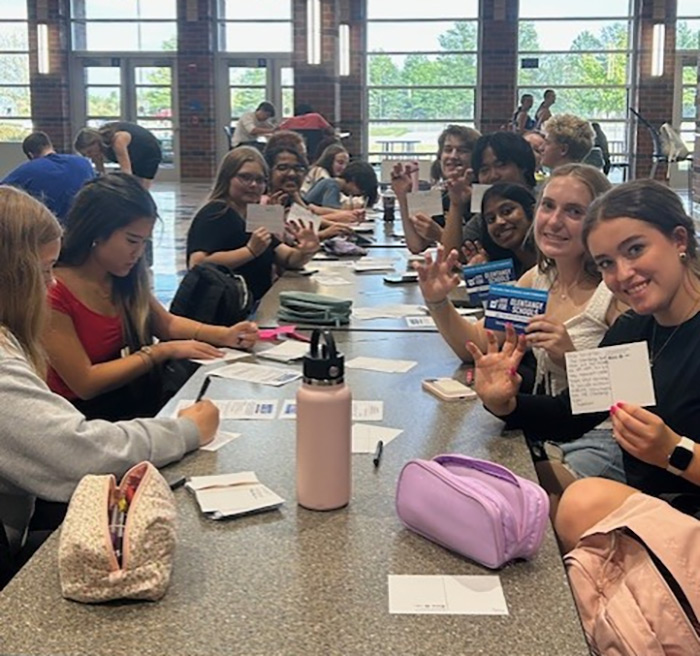
    In September, students at Berlin High School in Delaware, Ohio, participated in a sign creation and postcard campaign for a levy on the ballot. Credit: Courtesy Michael LaFlamme

    Michael LaFlamme has his own methods: He teaches Advanced Placement government and U.S. history at Olentangy Berlin High School outside of Columbus, Ohio, where many of his students work the polls during elections to see up close how voting works. They learn about civics via a participatory political science project that asks students to write a letter to an elected official. He also encourages students to watch debates or political or Sunday morning news shows with a parent or grandparent, and attend a school board meeting.

    “There is so much good learning to be done around current events,” LaFlamme told me, noting that “it becomes more about community and experience. We are looking at all of it as political scientists.”

    For Maddaus, the teacher in Maine, there is yet another obstacle: How his students consume news reinforces the enormous obstacles he and other teachers face to keep them informed and thinking critically. Earlier this fall, he heard some of his students talking about a rumor they’d heard over the weekend. 

    “Mr. Maddaus, is it true? Is President Donald Trump dead?” they asked. 

    Maddaus immediately wanted to know how they got this false news. 

    “We saw it on TikTok,” one of the students replied — not a surprising answer, perhaps, given that 4 out of 10 young adults get their news from the platform.

    Maddaus says he shook his head, corrected the record and then went back to his regularly scheduled history lesson. 

    Contact editor in chief Liz Willen at [email protected].

    This column about patriotism in education was produced by The Hechinger Report, a nonprofit, independent news organization focused on inequality and innovation in education. Sign up for the Hechinger newsletter.
    The Hechinger Report provides in-depth, fact-based, unbiased reporting on education that is free to all readers. But that doesn’t mean it’s free to produce. Our work keeps educators and the public informed about pressing issues at schools and on campuses throughout the country. We tell the whole story, even when the details are inconvenient. Help us keep doing that.

    Join us today.

    Source link

  • ED Wants Grants to Advance “Patriotic Education”

    ED Wants Grants to Advance “Patriotic Education”

    The Trump administration has made another move that historians say is an attempt to sanitize American history, but one the administration argued is necessary to ensure students have respect for the country.

    On Wednesday, Education Secretary Linda McMahon outlined a new plan for how her department would promote “patriotic education” by adding it to the list of priorities that can drive decisions for discretionary grants, including those that support programs at colleges and universities.

    “It is imperative to promote an education system that teaches future generations honestly about America’s Founding principles, political institutions, and rich history,” McMahon said in a statement about the new proposal. “To truly understand American values, the tireless work it has taken to live up to them, and this country’s exceptional place in world history is the best way to inspire an informed patriotism and love of country.”

    According to the proposal, which is open for public comment until Oct. 17, “patriotic education” refers to “a presentation of the history of America grounded in an accurate, honest, unifying, inspiring, and ennobling characterization of the American founding and foundational principles”; examines “how the United States has admirably grown closer to its noble principles throughout its history”; and advances the “concept that commitment to America’s aspirations is beneficial and justified.”

    McMahon’s other priorities for grant funding include evidence-based literacy, expanding education choice, returning education to the states and advancing AI in education.

    With this latest proposal, the department wants to focus “grant funds on programs that promote a patriotic education that cultivates citizen competency and informed patriotism among and communicates the American political tradition to students at all levels.” That could include projects geared toward helping students understand the “founding documents and primary sources of the American political tradition, in a manner consistent with the principles of a patriotic education,” according to the proposal.

    ‘Narrow Conception of Patriotism’

    However, professional historians who have read the proposal told Inside Higher Ed that the department’s patriotic education push is a politically motivated power grab.

    “I agree that American history should be presented with accuracy and honesty, based on solid historical evidence, and doing so does inspire people,” said Sarah Weicksel, executive director of the American Historical Association. “But the department’s priority statement has a narrow conception of patriotism and patriotic education.”

    She said that’s especially evident given the Trump administration’s numerous other policy changes aimed at presenting a version of American history that downplays or ignores the darkest parts of the country’s past, such as race-based slavery, the disenfranchisement of women and African Americans, and codified racial segregation.

    “That context tells us that the administration is interested in telling an uncomplicated celebration of American greatness,” Weicksel said. “Doing that flattens the past into a set of platitudes that are not rooted in the broader historical context, conflicts, contingencies and change over time that are central to historical thinking.”

    In March, Trump issued an executive order entitled “Restoring Truth and Sanity to American History,” prohibiting federal funding for exhibits or programs that “degrade shared American values, divide Americans based on race, or promote programs or ideologies inconsistent with Federal law and policy.” That prompted a review of all exhibits hosted by the Smithsonian Institution and the National Park Service, both of which have since removed multiple artifacts that don’t support Trump’s patriotic history push, including several that underscore the brutality of slavery.

    And as the 250th anniversary of the nation’s founding approaches, the government is in the process of planning commemorative civic education initiatives that advance its definition of patriotic history. To make that happen, it’s largely drawing on the input and expertise of conservative scholars and groups.

    The Education Department recently awarded $160 million in American history and civics grants for seminars for K–12 educators and students related to the Declaration of Independence anniversary next year. The agency didn’t specify which institutions got the money but previously said it would give priority to colleges and universities with “independent academic units dedicated to civic thought, constitutional studies, American history, leadership, and economic liberty,” which critics describe as conservative centers.

    In remarks at an event hosted by the Federalist Society and the Defense of Freedom Institute on Wednesday, McMahon criticized the state of civics education for students, citing a statistic that only 41 percent of young people say they love America.

    “That means the balance doesn’t love America,” she said. “Why don’t they love America? Why aren’t they proud to be Americans? It’s because they don’t know America. They don’t know the foundations, they don’t know the real history of our country … It’s really important that we teach respect for our flag, that we teach respect for our country.”

    While she did acknowledge that the Education Department can’t directly control curriculum, she noted that the department can use funding to encourage the types of education or programs it wants to see.

    The Education Department also announced Wednesday that it’s launching a coalition of 40 groups—including the conservative Heritage Foundation, Turning Point USA, Hillsdale College and the American First Policy Institute—to spearhead the America 250 Civics Education Coalition, which is “dedicated to renewing patriotism.” (McMahon chaired the American First Policy Institute before she became secretary.)

    “We celebrate Lincoln for his greatness in recalling the nation to the principles of its birth, the principles of the Declaration of Independence, the most beautiful political document in history,” Hillsdale president Larry Arnn said in a statement about the coalition. “It is time to repeat his work and the work of Jefferson and the Founders. We will work together to learn those principles, and for the love of them we will have a grand celebration.”

    ‘Pure Politics’

    But Weicksel with AHA said the government’s directives to omit parts of American history in classrooms, museums and other public spaces will undermine the public’s agency. “If citizens don’t have access to a historically accurate understanding of the past, how will they use that past to chart a new path for the future?”

    David Blight, a professor of history and Black studies at Yale University, said he interprets the department’s emphasis on patriotic education as “pure politics.”

    “It’s the politics of trying to use history to control people, including children, young people, the people who teach it, the people who write curriculum and the state legislatures that will design this stuff,” he said. “The government is trying to be a truth ministry.”

    While there have been other movements to control how the country remembers its history—including by U.S. senator Joseph McCarthy in the 1950s and the United Daughters of the Confederacy in the late 19th and early 20th centuries—Blight said these moves by the Trump administration are more powerful.

    “We’ve never had this come right from the White House, with the power of the executive branch and their control over so much money,” he said, urging educators to voice their opposition. “When federal money depends on pure ideology, we’re in very deep trouble, and that’s what they’re saying. That’s not even close to a democratic society.”

    Source link