Tag: Pause

  • Abrupt Pause, Unpause of Grants Doesn’t End NIH Funding Woe

    Abrupt Pause, Unpause of Grants Doesn’t End NIH Funding Woe

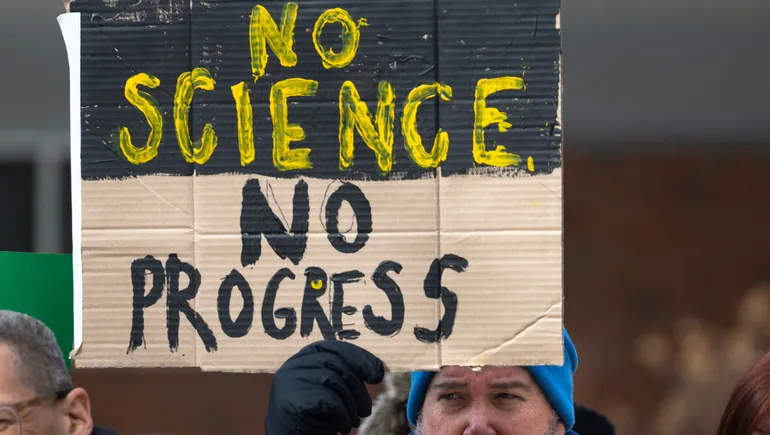
    The Tuesday night news quickly sowed alarm among researchers: Media outlets reported that the Trump administration had stopped the National Institutes of Health from funding any new grants. The Wall Street Journal wrote that “certain grants that are up for renewal” were also cut off, and STAT, along with other outlets, later confirmed that reporting.

    The newspaper reported that the Office of Management and Budget was blocking these billions of dollars in research funding for the rest of the fiscal year, which ends Sept. 30. After that, the dollars would return, unspent, to the Treasury. This nationwide halt to grants stemmed from an OMB footnote in a budget document, the Journal reported, adding that “the fourth quarter of the fiscal year is typically the busiest for grant-giving institutes at the NIH.”

    Inside Higher Ed reviewed screenshots of an email from an NIH employee saying, “Research grant, R&D contract, or training awards cannot be issued during this pause.” The funding halt would’ve meant an end to new research to help find and improve cures and treatments for diseases as well as stanched the flow of federal dollars to already financially beleaguered universities and labs nationwide.

    “This is undeniably an unforced error, since this will not only harm current and future American patients, but the disruptive and chilling effect of this sudden holding back of promised funds will further jeopardize the future of the American medical research enterprise,” Association of American Universities president Barbara R. Snyder said a statement Tuesday.

    But before the night was over, the Trump administration appeared to reverse course. In an updated article citing unnamed sources, the Journal reported that unnamed “senior White House officials intervened.” (OMB is part of the executive branch.) The Journal said officials at the Health and Human Services Department, which includes NIH, fought the pause for days, but OMB only relented after the newspaper published its initial story Tuesday.

    In response to Inside Higher Ed’s written questions and interview requests about the situation Wednesday, the White House and HHS both sent the same statement from an HHS spokesperson: “The programmatic review is over. The funds are out.”

    One OMB spokesperson posted on X that OMB had been “waiting for more information from NIH” before releasing the funds.

    The NIH is one of the largest sources of funding for research at colleges and universities, and it touts itself as the “largest single public funder of biomedical and behavioral research in the world.” Tuesday night’s controversy wasn’t the first—and likely won’t be the last—upheaval that this crucial agency has faced under the Trump administration.

    From grant cancellations to the White House proposal to slash the agency’s budget by 40 percent for the next fiscal year, institutions and researchers have seen the flow of NIH grant money stymied. Atop all this, the reportedly now-abandoned move by OMB to stop grant awards highlights continuing concerns about the fate of the grant dollars that the NIH still hasn’t given out this current fiscal year.

    Since Trump took office, the NIH has awarded fewer grants compared to previous years, multiple analyses have found. A former NIH official estimated to Science that at least $6 billion of the agency’s $48 billion budget could be sent back. In a higher estimate, Sen. Patty Murray, the top Democrat on the Senate Appropriations Committee, said in a statement that what OMB reportedly tried to do before reversing course Tuesday “would choke off approximately $15 billion in funding that would otherwise go to institutions across the country.”

    A nongovernment official familiar with the NIH appropriations process told Inside Higher Ed that, within a sample of major universities surveyed, institutions are down 20 to 48 percent in NIH award and renewal funds compared to the same time last year.

    The official, who requested anonymity to maintain relationships with people within the administration, said Wednesday that there’s been “a very, very slow spend at NIH, even prior to last night’s fire drill.” The official said they don’t think NIH has ever had to push out so much remaining money in such a short time, and there’s “a very small amount of NIH staff left to allocate those funds.”

    Heather Pierce, senior director for science policy at the Association of American Medical Colleges, told Inside Higher Ed that Tuesday’s news “caused a real concern across the research enterprise very quickly. This is a community that has seen not just threats but actual damaging changes to the typically stable federally funded research grants take place overnight, or even faster.

    “By any measure, the pace of grant funding is a fraction of what it has been in any other year, and that includes grant renewals, that includes new funding opportunities,“ Pierce added. “And the pace with which grant applications are reviewed and awarded is far below what we’ve seen in the past, and that includes applications that were submitted a long time ago that have already been scored and gotten very competitive scores that would be expected to be funded.”

    Joanne Padrón Carney, chief government relations officer for the American Association for the Advancement of Science, said the reported freeze “just reinforced the current mood among researchers that the future of scientific research at NIH is still in question and could change at a moment’s notice, but also that this isn’t just about NIH. This cloud of uncertainty hovers over other agencies as well, such as the National Science Foundation.”

    Carney added that “the head of the Office of Management and Budget has made public his interest in reducing spending and reducing the size of government and using what tools that he is able to use to do that.”

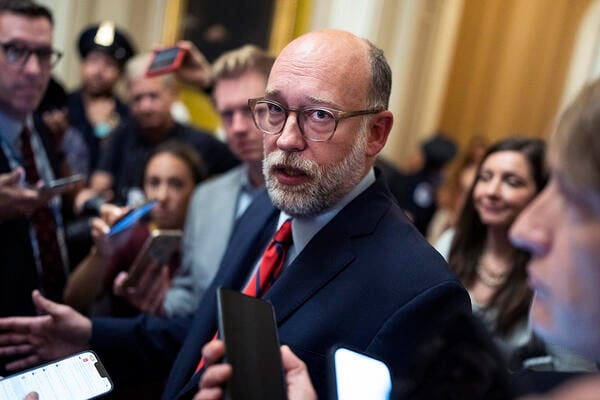
    Russell Vought, head of OMB, hasn’t sworn off using rescission legislation, which can be passed with a simple majority in both chambers of Congress, to take back already appropriated funds during a fiscal year. NPR also reported that he’s called Congress’s spending bills “a ceiling … not a floor.”

    Murray, who represents Washington State, previously warned that the Trump administration’s use of such legislation to claw back funds already appropriated for this fiscal year—like it recently did for public broadcasting money—could scuttle consensus on the budget for next fiscal year.

    Carney attributed the slowdown in NIH grants to multiple factors, including the regular change in presidential administrations, Congress adopting a continuing resolution instead of a budget for this fiscal year and the Trump administration’s executive orders and other actions.

    “It’s like throwing sand into the machine,” Carney said. She said her association is pleased “that the funding will continue to flow, but it’s still unknown whether that flow of funds will be in drips or will be full stream, and we only have two months left until the end of the fiscal year.”

    Some Senate Republicans recently called on NIH and OMB to send more money out the door, as directed in the continuing resolution Congress passed in March.

    “We are concerned by the slow disbursement rate of [fiscal year 2025] NIH funds, as it risks undermining critical research and the thousands of American jobs it supports,” the senators wrote in a letter to OMB. “Suspension of these appropriated funds—whether formally withheld or functionally delayed—could threaten Americans’ ability to access better treatments and limit our nation’s leadership in biomedical science. It also risks inadvertently severing ongoing NIH-funded research prior to actionable results.”

    Tuesday night’s controversy came as some Republican members of Congress have joined Democrats in opposing the president’s proposal to gut the NIH’s funding for fiscal 2026. The Senate Appropriations Committee is meeting today, and it’s set to unveil how much it plans to send NIH next fiscal year.

    Carney said, “The U.S. is considered a global leader in biomedical research and medical discoveries, and we can’t afford to lose opportunities for advancing new discoveries and therapies and treatments for diseases that affect millions all over the world.

    “So when it comes to Alzheimer’s or cancer or infectious diseases, this is about hope,” she said. “It shouldn’t be about politics.”

    Source link

  • Trump administration appeals pause on Education Department cuts to SCOTUS

    Trump administration appeals pause on Education Department cuts to SCOTUS

    This audio is auto-generated. Please let us know if you have feedback.

    UPDATE: June 6, 2025: The U.S. Department of Justice asked the U.S. Supreme Court on Friday for an immediate pause on a court order that the U.S. Department of Education reinstate nearly 1,400 employees fired during a mass workforce reduction in March. The Justice Department’s appeal calls the lower court’s order an “unlawful remedy” and says the injunction “causes irreparable harm to the Executive Branch.”

    Dive Brief:

    • A federal appeals court on Wednesday rejected the Trump administration’s motion for a stay in a lawsuit challenging the dismantling of the U.S. Department of Education, effectively halting — at least temporarily — efforts to reduce the agency’s workforce and transfer some education responsibilities to other federal departments.
    • The administration had argued it could still carry out the statutory requirements of the Education Department, even with a workforce cut in half. But the 1st U.S. Circuit Court of Appeals disagreed, saying it saw “no basis” that a lower court erred in concluding that task seemed “impossible.”
    • The ruling was the latest in a series of legal developments concerning Trump administration reforms at the Education Department. Trump, U.S. Education Secretary Linda McMahon and many Republican lawmakers are attempting to eliminate what they say is federal overreach and inefficiencies in education.


    Dive Insight:

    The lawsuit at the center of the ruling was filed in March by 20 Democratic-leaning states and the District of Columbia. They sued the Education Department, Trump and McMahon two days after the agency announced mass workforce reductions. That challenge was combined with a similar lawsuit from public school districts in Massachusetts and education labor unions. 

    A federal district judge last month issued a preliminary injunction halting the workforce reductions temporarily. That ruling also prohibited the Education Department from transferring management of the federal student loans portfolio and special education management and oversight to other federal agencies. 

    In Wednesday’s decision denying a motion for a stay, the three-judge panel said the Education Department has not shown “that the public’s interest lies in permitting a major federal department to be unlawfully disabled from performing its statutorily assigned functions.” 

    The Trump administration also argued that it is being forced to return staff whose services are no longer needed. The 1st Circuit, however, said its reading of the preliminary injunction shows no specific number or deadline for returning employees who were part of the reduction in force.

    “We do not see how complying with those aspects of the injunction imposes a burden on the government, no less one that is ‘extraordinary,’” the court said.

    Source link

  • NIH cuts remain on hold as judge extends temporary pause

    NIH cuts remain on hold as judge extends temporary pause

    This audio is auto-generated. Please let us know if you have feedback.

    A federal judge extended an emergency restraining order Friday against the National Institutes of Health, temporarily preventing the agency from making massive cuts to indirect research funding. 

    The restraining order bars NIH from implementing a 15% cap on indirect cost reimbursement and requires the agency to file regular status reports confirming disbursement of funds. U.S. District Judge Angel Kelley, a Biden appointee, is considering a more permanent injunction against NIH’s plan after nearly two hours of oral arguments Friday. 

    NIH unveiled the new policy earlier in February. Historically, institutions negotiate their own indirect cost reimbursement rates with the agency, with an average of 27% to 28%. The change was met swiftly with multiple lawsuits, including by higher education groups and 22 state attorneys general. The cases were considered together at the hearing Friday.

    Several universities have already frozen hiring and taken other budgetary measures amid the NIH funding uncertainty, despite Kelley’s initial pause on the funding cap. 

    The funding for indirect costs — also known as facilities and administrative, or F&A, costs — covers a wide array of staffing and infrastructure for research activity.

    “Indirect costs are the backbone of IHEs [institutions of higher education] research programs and cover everything from utilities to facilities and equipment maintenance to payroll for faculty and staff to compliance programs, hazardous waste disposal, and more,” 22 state attorneys general said in their original request for a temporary restraining order on NIH. “They quite literally keep the lights on.”

    Brian Lea, an attorney for NIH, said at Friday’s hearing that money saved by cutting and capping F&A funding would be “ploughed into” funding for research costs. However, in a Feb. 7 post from the agency on the social media site X, NIH said the funding cap “will save more than $4B a year effective immediately.” 

    Asked by Kelley about the post, Lea said that it was “at best a misunderstanding” of NIH’s guidance.

    Plaintiffs attorneys argued that the F&A cap violates federal laws and regulations, pointing out that Congress passed an appropriations bill during President Donald Trump’s first term that prohibits modifications to NIH’s indirect cost funding. 

    Lea maintained that NIH’s guidance was compliant with regulations and statutes and within the “broad discretionary power of the executive branch” to allocate funding. 

    Attorneys for the plaintiffs further argued that an injunction was necessary to prevent “immediate and irreparable” harm, pointing to numerous universities that have detailed how their research, budgets and infrastructure would suffer from the cap. An official at Yale University, for example, said in court papers that the NIH rate cap could threaten the viability of many of its ongoing clinical trials for medical research.

    “It is not hyperbole to say that, absent immediate injunctive relief, Plaintiff States’ IHEs will face catastrophic financial consequences, which could result in layoffs and furloughs, research program closures, financial defaults, and disruptions to clinical trials, potentially jeopardizing people’s lives and health,” the attorneys general said in their motion, filed earlier in February. 

    Lea questioned whether harms such as funding losses were irreparable, suggesting that they could be undone later through private funding or operational adjustments.

    As the case winds on, NIH has laid off more than 1,000 employees, according to press reports.

    Source link

  • From Pause to Progress: Predictors of Success and Hurdles for Returning Students

    From Pause to Progress: Predictors of Success and Hurdles for Returning Students

    Title: Some College, No Credential Learners: Measuring Enrollment Readiness

    Source: Straighterline, UPCEA

    UPCEA and StraighterLine carried out a survey to examine the driving factors, obstacles, preparedness, and viewpoints of individuals who started but did not finish a degree, certificate, technical, or vocational program. This population, according to the National Student Clearinghouse Research Center, has grown to 36.8 million, a 2.9 percent increase from the year prior. A total of 1,018 participants completed the survey.

    Key findings related to respondents’ readiness to re-enroll include:

    • Predictive factors: Mental resilience, routine readiness, a positive appraisal of institutional communication, and belief in the value of a degree strongly predict re-enrollment intentions.
    • Academic preparedness: A majority of respondents (88 percent) feel proficient in core academic skills (e.g., reading, writing, math, critical thinking), and 86 percent feel competent using technology for learning tasks.
    • Financial readiness: More than half (58 percent) believe they cannot afford tuition and related expenses, while only 22 percent feel financially prepared.
    • Career and personal motivations: The top motivators for re-enrolling include improving salary (53 percent), personal goals (44 percent), and pursuing a career change (38 percent).
    • Beliefs in higher education: Trust in higher education declines after stopping out. While 84 percent of those who had been enrolled in a degree program initially believed a degree was essential for their career goals, only 34 percent still hold that belief. Additionally, just 42 percent agree that colleges are trustworthy.
    • Grit readiness: Four in five respondents feel adaptable and persistent through challenges, and 71 percent say they can handle stress effectively.
    • Flexibility and adaptability: Three-fourths of respondents are open to changing routines and adjusting to new environments.
    • Learning environment: Half of respondents report having access to a study-friendly environment, but 11 percent report not having such access.
    • Time management: Nearly two-thirds are prepared to dedicate the necessary time and effort to complete their education.
    • Support systems: About three in every five respondents receive family support for continuing education, but only 31 percent feel supported by their employers.

    Key findings related to enrollment funnel experiences include:

    • Preferred communication channels: When inquiring about a program, 86 percent of respondents like engaging via email, 42 percent through phone calls, and 39 percent via text messages, while only 6 percent want to use a chatbot.
    • Timeliness and quality of communication: A majority (83 percent) agree or strongly agree that the communication they received when reaching out to a college or university about a program was timely, and 80 percent found it informative.
    • Enrollment experience: Among those who re-enrolled, 88 percent found that the enrollment process was efficient, 84 percent felt adequately supported by their institution, and 78 percent found the process easy.
    • Challenges from inquiry to enrollment: Nearly one-third (31 percent) encountered difficulties with financial aid support, 29 percent experienced delays in getting their questions answered, and 21 percent reported poor communication from the institution.

    Click to read the full white paper.

    —Nguyen DH Nguyen


    If you have any questions or comments about this blog post, please contact us.

    Source link