Tag: people

  • Young people from deprived areas can’t afford to consider university

    Young people from deprived areas can’t afford to consider university

    Should the economic fortunes area you grew up in have an impact on your chances of attending university?

    There has always been a stubborn connection between 18 year old participation rates and your (UK) region of residence.

    Currently UCAS data tells us that 18 year olds living in London are more likely than not to go on to attend university, whereas in the North East just 29.9 per cent will get there.

    Can’t get there from here

    And in many parts of the UK the proportion of 18 year olds getting to university has stagnated (or even dropped over recent years), as the population of 18 year olds has expanded.

    [Full screen]

    If you are concerned about left-behind parts of the UK, this is something that should concern you. It’s widely acknowledged that graduates are key to levelling up a region, and a surprisingly large number of graduates return to their home area (at least in the short term) after graduation.

    Costs not culture?

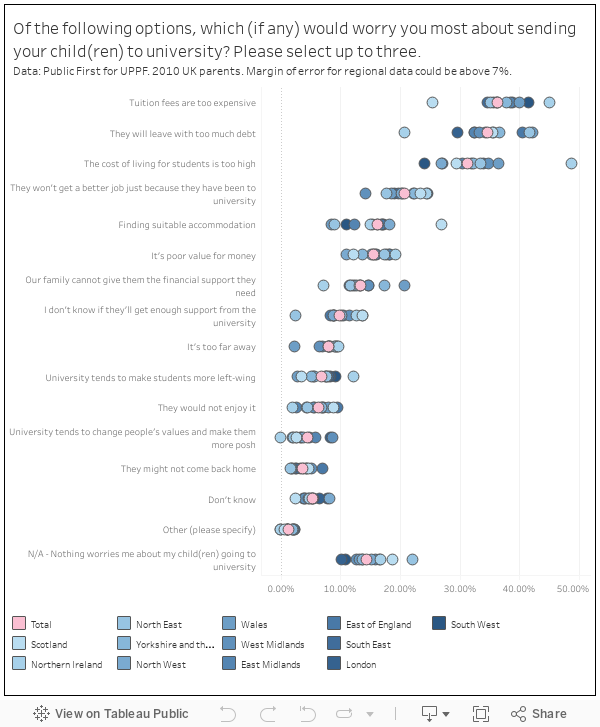
    The counter argument to that is very often cultural – the idea that going to university changes a person, and dilutes the essence of what makes (frankly) a deprived area a deprived area. Polling from Public First for the UPP Foundation (which is kicking off an inquiry into the state of widening participation in higher education) happily suggests that this is not an attitude prevalent among UK parents.

    [Full screen]

    What does worry parents is the sheer cost of study – both in terms of tuition fees (36 per cent cite this as a top three reason to be concerned about their children attending university) and living costs (31 per cent). The overall level of debt on graduation is the other big one (35 per cent).

    But that’s not to say that there are not other reasons – number four in the list is the idea that “they won’t get a better job just because they have been to university” (particularly prevalent in London), number six is “poor value for money” (an East Midlands, North East, and Northern Ireland prevalence). The size of the sample makes the regional splits difficult to draw accurate conclusions from, but the trends are interesting.

    What teachers said

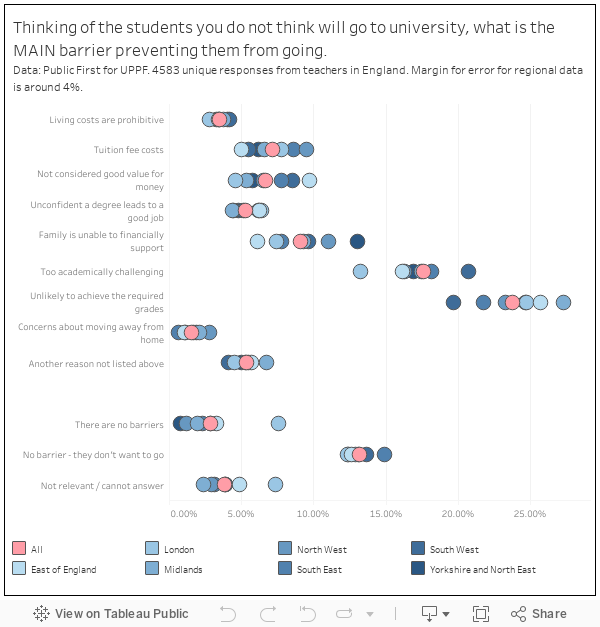
    Teachers are a primary source of information about higher education – happily UPPF also commissioned Public First to look at what teachers felt were the barriers to participation, and there are (some) regional splits.

    [Full screen]

    The question here focuses on why teachers don’t expect some pupils to go to university – we are looking across all types of schools at the top of secondary education. Here we see that the big barriers are academic – teachers tend to feel that students are unlikely to get the required grades (24 per cent) or to rise to the academic challenge (18 per cent). And this is true across all English regions.

    Notably prevalent in the North East and Yorkshire (combining two standard, ILTS1, regions) is the idea that the family will be unable to support a student. In that region this was cited by 13 per cent of teachers – enough to feel concerning, but similar to the proportion that simply don’t want to go to university (again note that the margin of error will be high with small subsamples).

    Your chances are variable

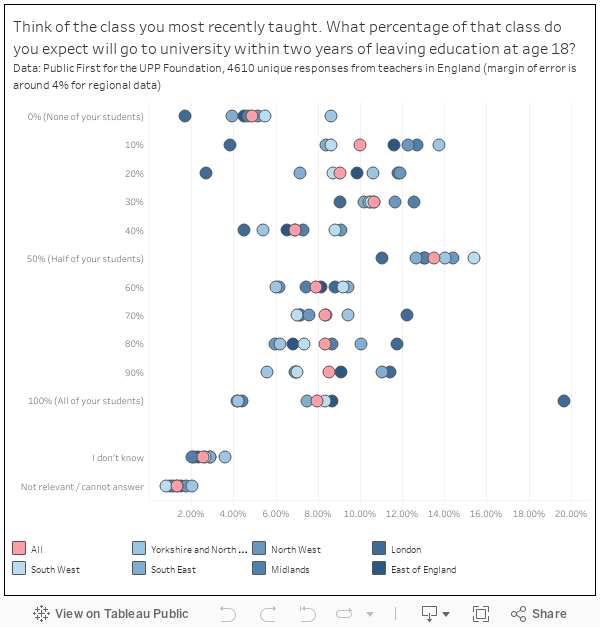
    Twenty per cent of teachers in London feel like all of the last class they taught will go on to university – just four per cent of teachers in the North West, North East, and Yorkshire had similar confidence. Indeed 14 per cent of teachers in the North East and Yorkshire felt that only 10 per cent of their class would go on to university. As you might expect, the modal answer for most regions was “about half” of pupils – the North East and Yorkshire is the only exception.

    [Full screen]

    This, then, is what access and participation in the north is up against. Attainment and capacity is an issue everywhere, and one that the access and participation regime in England attempts to address via collaboration between universities and schools – something that also contributes to aspiration.

    But aspiration and attainment count for little when parents and teachers are agreeing that for many in the UK’s most deprived areas university study simply is not affordable. And though participation among disadvantaged groups is improving – disadvantaged areas continue to struggle.

    Source link

  • There are real people underneath the labels we attach

    There are real people underneath the labels we attach

    When I first arrived in Dundee, I anticipated an academic journey that would challenge my perspectives and expand my knowledge.

    What I didn’t foresee was how profoundly it would transform my understanding of identity and belonging, compelling me to reexamine my sense of self and my place in broader societal structures.

    Having moved from India to pursue a Master of Education (MEd) in the UK, this journey not only offered a world-renowned education but also a deeply personal exploration. I encountered labels—both explicit and implicit—that reshaped how I viewed myself and how others perceived me.

    A year after graduating, with distinction, this reflection examines the unintended consequences of such labels, navigating an evolving sense of identity and belonging, and how higher education institutions could approach identity.

    The weight of new labels

    In India, my identity felt clear and unchallenged. Growing up in a community where cultural and national homogeneity was the norm, I seldom encountered the complexities of navigating diverse cultural spaces.

    As a proud citizen, I had always viewed myself through a singular lens—an educator, a parent, and a lifelong learner.

    Yet, upon arriving in the UK, I gradually found myself assigned new labels: “South Asian,” “brown,” “BAME,” or “non-native English speaker.”

    These descriptors, while often used to acknowledge diversity, and well-intentioned, created a sense of “otherness” I had never felt before.

    They carried with them an uneasy sense of stereotyping relating to cultural norms, economic motivations, or professional capabilities, overshadowing my individuality and the intentionality behind my journey. Or so it seemed to me.

    This was shaped by my specific circumstances. I hadn’t come to the UK fleeing hardship or seeking greener pastures. After over two decades of a successful career, my journey was a deliberate choice to grow and challenge myself within a global academic system.

    Nevertheless, I found myself viewed through a lens that reduced my presence to that of a “brown immigrant” – a categorization laden with assumptions I neither recognized nor accepted as my own.

    Becker’s (1963) labelling theory, as detailed in his seminal work Outsiders, highlights how societal labels can shape individuals’ self-perceptions and interactions. For instance, being termed a “non-native English speaker” undermined my confidence, despite my strong command of the language. I became acutely self-conscious of my speech and writing, scrutinizing every phrase and mannerism.

    Similarly, whilst being classified – for diversity reporting purposes – as “BAME”—a term that homogenized diverse ethnicities—diminished my unique identity as Indian. Condensing the diversity of a vast continent like Asia, and beyond, into a single category overlooked its rich individuality and distinct experiences.

    At 48 years of age, with significant professional and personal capital, this phase felt like a rebirth, requiring me to relearn how to approach daily interactions, meet people, and manage emotions in an unfamiliar environment.

    As a parent, I grappled with the tension between fiercely guarding my child in this new space and allowing her to grow freely as her own person. These dilemmas became an integral part of my journey, shaping my reflections on belonging. However, through these challenges, I discovered that cultural exchange offered a path to understanding identity and belonging.

    Balancing cultures and shared humanity

    One of the most enriching aspects of my time in the UK was finding harmony between embracing new cultures and retaining my distinct and individual, Indian identity. While cultural disconnections were inevitable, moments of connection highlighted opportunity and potential.

    Simple acts, like sharing Ayurvedic home remedies with colleagues or discovering the vegetarian version of haggis and tatties—a Scottish dish that reminded me of flavours from Indian cuisine – sparked conversations, and mutual appreciation and understanding. Such experiences underscored the universality of care and the connections that form through everyday activities or practices.

    Collaborative projects were equally transformative. A group initiative to design an innovative education program with a focus on MOOCs brought together diverse perspectives shaped by educational systems in Uganda, Ghana, Sri Lanka, India, and the United States. Engaging authentically with these cultures helped me realize that my identity wasn’t being erased—it was evolving.

    This drew me to the conclusion that labels no longer seemed like barriers but also served as bridges. Interacting with domestic students further revealed our shared passions for equitable education and learner well-being, reinforcing the commonality of human experiences and aspirations.

    Such moments emphasized that despite our differences, shared humanity forms the foundation of genuine connection and collaboration.

    Celebrating individuality in academic spaces

    Higher education institutions play a crucial role in shaping how identity and belonging are experienced. As an International Postgraduate student, I found value in lectures exploring diverse educational philosophies from thinkers like Confucius, Paulo Freire, bell hooks, Ivan Illich, and Sugata Mitra, alongside predominantly Western curricula.

    These discussions offered a balanced perspective and inclusive learning environment, aligning with culturally responsive teaching (Gay, 2010) and ensuring students saw their identities reflected in education. Similarly, initiatives like the University of Edinburgh’s Global Citizenship Initiative and Kingston University’s Inclusive Curriculum Project provide platforms for students to share their unique experiences.

    Labels like “South Asian”, “BAME”, or “Global South” can serve as useful starting points for addressing systemic inequities but risk oversimplifying diverse experiences and perpetuating stereotypes. Institutions should creatively rethink these categorizations to highlight individuality.

    Platforms like self-identification surveys, narrative-sharing workshops, intercultural initiatives, peer-support groups, and reflective writing can foster mutual understanding, empathy, and respect. Staff training in dialogic engagement and curricular reforms can further nurture inclusivity.

    Tinto’s Leaving College: Rethinking the Causes and Cures of Student Attrition (1993) underscores how academic and social integration are pivotal in fostering a sense of belonging, which thrives when institutions celebrate individuality and embrace diversity as a strength.

    Moving beyond labels

    For me, this journey has been one of rediscovery. As I walked across the stage at my graduation ceremony, surrounded by peers from around the world, I felt an overwhelming sense of belonging.

    I realized my journey was not just about academic achievement; it was about embracing a deeper, more inclusive understanding of identity. Engaging authentically with new cultures doesn’t mean losing oneself—even under a label—but rather gaining dimensions to one’s sense of self.

    My reflections are a reminder for myself, and perhaps the broader global society that shared experiences cultivate a true community where individuals feel recognised and valued. Identity evolves, but the need for acceptance and respect as a person remains constant.

    Higher education must create spaces where individuality is honoured, differences are embraced, and restrictive labels are thoughtfully reevaluated. By doing so, institutions can harness the richness of diversity—not only to enrich learning experiences but also to dismantle stereotypes and foster a deeper sense of unity within our global community.

    Source link

  • Podcast: REF people and culture, spending review, apprenticeships

    Podcast: REF people and culture, spending review, apprenticeships

    This week on the podcast universities failing to promote diversity will face funding cuts – so said The Times. We chat through the controversy building around the REF.

    Plus we look at what the sector is asking for in the spending review, and consider the government’s push for lower-level, shorter apprenticeships.

    With Shitij Kapur, Vice Chancellor and President at King’s College London, Jess Lister, Director (Education) at Public First, Debbie McVitty, Editor at Wonkhe and presented by Mark Leach, Editor-in-Chief at Wonkhe.

    Read more:

    Universities UK submits to spending review

    The barriers that must be removed for degree apprenticeships to meet NHS workforce targets

    Higher education institutions have invested time, effort and money in level 7 apprenticeships

    Societies that are humane are thoughtful about promoting equality, diversity and inclusion

    Predictably bad education


    Source link

  • Another way of thinking about the national assessment of people, culture, and environment

    Another way of thinking about the national assessment of people, culture, and environment

    There is a multi-directional relationship between research culture and research assessment.

    Poor research assessment can lead to poor research cultures. The Wellcome Trust survey in 2020 made this very clear.

    Assessing the wrong things (such as a narrow focus on publication indicators), or the right things in the wrong way (such as societal impact rankings based on bibliometrics) is having a catalogue of negative effects on the scholarly enterprise.

    Assessing the assessment

    In a similar way, too much research assessment can also lead to poor research cultures. Researchers are one of the most heavily assessed professions in the world. They are assessed for promotion, recruitment, probation, appraisal, tenure, grant proposals, fellowships, and output peer review. Their lives and work are constantly under scrutiny, creating competitive and high-stress environments.

    But there is also a logic (Campbell’s Law) that tells us that if we assess research culture it can lead to greater investment into improving it. And it is this logic that the UK Joint HE funding bodies have drawn on in their drive to increase the weighting given to the assessment of People, Culture & Environment in REF 2029. This makes perfect sense: given the evidence that positive and healthy research cultures are a thriving element of Research Excellence, it would be remiss of any Research Excellence Framework not to attempt to assess, and therefore incentivise them.

    The challenge we have comes back to my first two points. Even assessing the right things, but in the wrong way, can be counterproductive, as may increasing the volume of assessment. Given research culture is such a multi-faceted concept, the worry is that the assessment job will become so huge that it quickly becomes burdensome, thus having a negative impact on those research cultures we want to improve.

    It ain’t what you do, it’s the way that you do it

    Just as research culture is not so much about the research that you do but the way that you do it, so research culture assessment should concern itself not so much with the outcomes of that assessment but with the way the assessment takes place.

    This is really important to get right.

    I’ve argued before that research culture is a hygiene factor. Most dimensions of culture relate to standards that it’s critically important we all get right: enabling open research, dealing with misconduct, building community, supporting collaboration, and giving researchers the time to actually do research. These aren’t things for which we should offer gold stars but basic thresholds we all should meet. And to my mind they should be assessed as such.

    Indeed this is exactly how the REF assessed open research in 2021 (and will do so again in 2029). They set an expectation that 95 per cent of qualifying outputs should be open access, and if you failed to hit the threshold, excess closed outputs were simply unclassified. End of. There were no GPAs for open access.

    In the tender for the PCE indicator project, the nature of research culture as a hygiene factor was recognised by proposing “barrier to entry” measures. The expectation seemed to be that for some research culture elements institutions would be expected to meet a certain threshold, and if they failed they would be ineligible to even submit to REF.

    Better use of codes of practice

    This proposal did not make it into the current PCE assessment pilot. However, the REF already has a “barrier to entry” mechanism, of course, which is the completion of an acceptable REF Code of Practice (CoP).

    An institution’s REF CoP is about how they propose to deliver their REF, not how they deliver their research (although there are obvious crossovers). And REF have distinguished between the two in their latest CoP Policy module governing the writing of these codes.

    But given that REF Codes of Practice are now supposed to be ongoing, living documents, I don’t see why they shouldn’t take the form of more research-focussed (rather than REF-focussed) codes. It certainly wouldn’t harm research culture if all research performing organisations had a thorough research code of practice (most do of course) and one that covers a uniform range of topics that we all agree are critical to good research culture. This could be a step beyond the current Terms & Conditions associated with QR funding in England. And it would be a means of incentivising positive research cultures without ‘grading’ them. With your REF CoP, it’s pass or fail. And if you don’t pass first time, you get another attempt.

    Enhanced use of culture and environment data

    The other way of assessing culture to incentivise behaviours without it leading to any particular rating or ranking is to simply start collecting & surfacing data on things we care about. For example, the requirement to share gender pay gap data and to report misconduct cases, has focussed institutional minds on those things without there being any associated assessment mechanism. If you check out the Higher Education Statistics Agency (HESA) data on proportion of male:female professors, in most UK institutions you can see the ratio heading in the right direction year on year. This is the power of sharing data, even when there’s no gold or glory on offer for doing so.

    And of course, the REF already has a mechanism to share data to inform, but not directly make an assessment, in the form of ’Environment Data’. In REF 2021, Section 4 of an institution’s submission was essentially completed for them by the REF team by extracting from the HESA data, the number of doctoral degrees awarded (4a) and the volume of research income (4b); and from the Research Councils, the volume of research income in kind (4c).

    This data was provided to add context to environment assessments, but not to replace them. And it would seem entirely sensible to me that we identify a range of additional data – such as the gender & ethnicity of research-performing staff groups at various grades – to better contextualise the assessment of PCE, and to get matters other than the volume of research funding up the agendas of senior university committees.

    Context-sensitive research culture assessment

    That is not to say that Codes of Practice and data sharing should be the only means of incentivising research culture of course. Culture was a significant element of REF Environment statements in 2021, and we shouldn’t row back on it now. Indeed, given that healthy research cultures are an integral part of research excellence, it would be remiss not to allocate some credit to those who do this well.

    Of course there are significant challenges to making such assessments robust and fair in the current climate. The first of these is the complex nature of research culture – and the fact that no framework is going to cover every aspect that might matter to individual institutions. Placing boundaries around what counts as research culture could mean institutions cease working on agendas that are important to them, because they ostensibly don’t matter to REF.

    The second challenge is the severe and uncertain financial constraints currently faced by the majority of UK HEIs. Making the case for a happy and collaborative workforce when half are facing redundancy is a tough ask. A related issue here is the hugely varying levels of research (culture) capital across the sector as I’ve argued before. Those in receipt of a £1 million ‘Enhancing Research Culture’ fund from Research England, are likely to make a much better showing than those doing research culture on a shoe-string.

    The third is that we are already half-way through this assessment period and we’re only expected to get the final guidance in 2026 – two years prior to submission. And given the financial challenges outlined above, this is going to make this new element of our submission especially difficult. It was partly for this reason that some early work to consider the assessment of research culture was clear that this should celebrate the ‘journey travelled’, rather than a ‘destination achieved’.

    For this reason, to my mind, the only thing we can reasonably expect all HEIs to do right now with regards to research culture is to:

    • Identify the strengths and challenges inherent within your existing research culture;
    • Develop a strategy and action plan(s) by which to celebrate those strengths and address those challenges;
    • Agree a set of measures by which to monitor your progress against your research culture ambitions. These could be inspired by some of the suggestions resulting from the Vitae & Technopolis PCE workshops & Pilot exercise;
    • Describe your progress against those ambitions and measures. This could be demonstrated both qualitatively and quantitatively, through data and narratives.

    Once again, there is an existing REF assessment mechanism open to us here, and that is the use of the case study. We assess research impact by effectively asking HEIs to tell us their best stories – I don’t see why we shouldn’t make the same ask of PCE, at least for this REF.

    Stepping stone REF

    The UK joint funding bodies have made a bold and sector-leading move to focus research performing organisations’ attention on the people and cultures that make for world-leading research endeavours through the mechanism of assessment. Given the challenges we face as a society, ensuring we attract, train, and retain high quality research talent is critical to our success. However, the assessment of research culture has the power both to make things better or worse: to incentivise positive research cultures or to increase burdensome and competitive cultures that don’t tackle all the issues that really matter to institutions.

    To my mind, given the broad range of topics that are being worked on by institutions in the name of improving research culture, and where we are in the REF cycle, and the financial constraints facing the sector, we might benefit from a shift in the mechanisms proposed to assess research culture in 2029 and to see this as a stepping stone REF.

    Making better use of existing mechanisms such as a Codes of Practice and Environment and Culture data would assess the “hygiene factor” elements of culture without unhelpfully associating any star ratings to them. Ratings should be better applied to the efforts taken by institutions to understand, plan, monitor, and demonstrate progress against their own, mission-driven research culture ambitions. This is where the real work is and where real differentiations between institutions can be made, when contextually assessed. Then, in 2036, when we can hope that the sector will be in a financially more stable place, and with ten years of research culture improvement time behind us, we can assess institutions against their own ambitions, as to whether they are starting to move the dial on this important work.

    Source link

  • The people who live where nickel is mined

    The people who live where nickel is mined

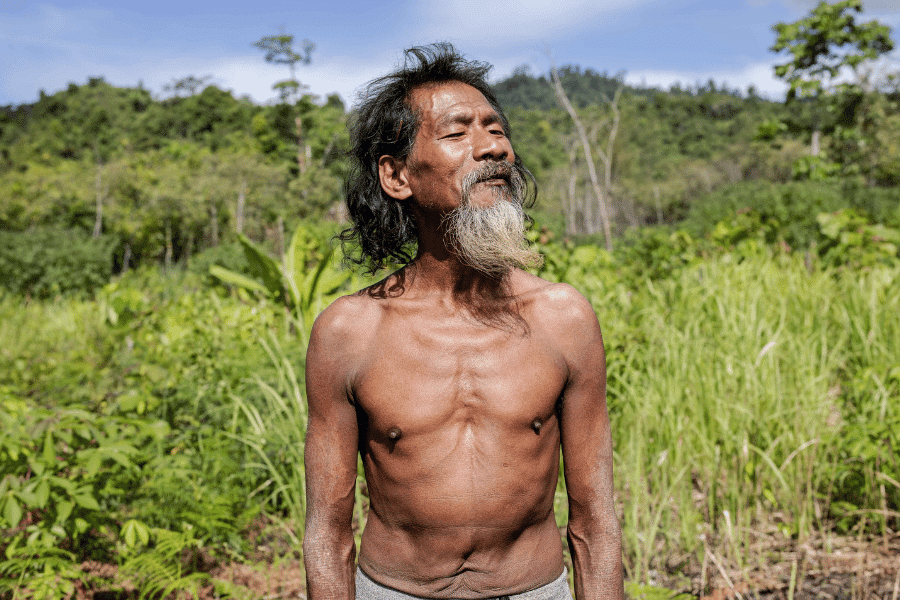
    Etus Hurata, 56, and Tatoyo Penes, 64, gather sago, a starch found in tropical palm, in the forest near the Kali Meja River with bamboo sticks and machetes. They will process the sago they collect into daily food ingredients.

    Daniel Totabo, 27, meanwhile, hunts for Sogili, a type of eel, in the middle of the fast-flowing river.

    According to data from Survival International, 300 to 500 O’Hongana Manyawa people still reside in the forested interior of the island of Halmahera. The tribes have never had direct contact with people outside the forest.

    But mining companies have already taken over increasing parts of their forest. The latest research data from the Association of Indigenous Peoples Defenders of Nusantara reports 21 matarumah (lineages) of this tribe inhabit the entire Halmahera mainland. One matarumah usually consists of 4–5 heads of families.

    Nickel dredging projects in the corners of Halmahera have disrupted their lives. Based on observations on digital maps, there are at least four mining companies operating within a 50–100 kilometers radius of the forests inhabited by indigenous peoples. This number is likely to increase in the next few years as global demand for nickel continues to increase.

    “If it continues like this, the forests in Halmahera will be destroyed,” Sumean said. “The trees will be cut down and the animals will be driven out and die because their homes have been completely cleared. Then where will we live?”

    Moving people to make way for mines

    The Indonesian government has tried to resettle people in other hamlets and villages, like Dodaga Village where Sumean lives. But supporting facilities such as health, economy and education built there are often inadequate. And for a people who lived nomadically, moving from forest to forest, it is difficult to adapt to land and houses in a village.

    “The house is very hot during the day and very cold at night because it uses a zinc roof. It is different from a leaf roof that can adjust to the season,” Sumean said. “We did get a house, but maybe they forgot that we also must find our own food every day.”

    As a result, the indigenous community largely abandoned Dodaga Village. It is now inhabited by immigrants from outside the area.

    Some are pinning their hopes on Tesla which seemed to take a firm stand for Indigenous peoples in its 2023 Impact Report published in May 2024. The electric car manufacturer owned by Elon Musk says it is pushing for a no-go zone for mining system or a mining-free area that can protect the rights of uncontacted Indigenous peoples such as O’Hongana Manyawa.

    The UK-based nonprofit organization Survival International has said that this concept could provide fixed boundaries for the industrial sector and any mining company so that they do not pass through the living space of indigenous peoples.

    But until now, the company has not provided any follow-up regarding the development of the concept in the report. Tesla says it uses around 13% of nickel ore from Indonesia and that energy transition is almost impossible without these nickel supplies. Moreover, they predict that nickel production in Indonesia will continue to increase along with the increasing demand for electric vehicles in the global market.

    The multinational corporations moved in.

    Travel six hours by road from Dodaga Village and the beautiful, green and dense Halmahera plains begin to change shape as the highway reaches the Indonesia Weda Industrial Park (IWIP) located along Weda Bay. In Lelilef Sawai Village, coal-fired power plants and nickel smelters stand where the forest once stood. Thick smoke from chimneys billow without pause.

    This industrial area began operating in 2020 through development carried out by PT Weda Bay Nickel, a joint venture between state-owned company PT Aneka Tambang and Strand Minerals which was initially formed in 1998.

    The two parties then also attracted French mining company Eramet and Chinese stainless steel company Tsingshan Holding Group. Over time, Tshingsan and Eramet took full control of the project. This area, included in the Indonesia’s National Strategic Project since November 2020, is predicted to attract investment worth U.S. $15 billion

    The mountainous area on the north side of IWIP has long been known to be rich in nickel reserves. The world’s nickel needs are predicted to increase drastically by 60% by 2040 to meet carbon reduction requirements of the Paris Agreement.

    While sales of electric vehicles have slowed in the United States and Europe, it is projected that half of all new cars sold in China will be electric. China, Europe and the United States represent the largest markets for electric vehicles, collectively accounting for approximately 95% of all sales in 2023.

    Un-environmental side effects of an environmental push

    The carbon footprint of the nickel smelting in Indonesia could negate much of the carbon reductions the e-cars promise. In addition to the smoke coming out of a total of 12 new coal-fired power plants there, deforestation activities are also clearly visible.

    Seen from satellite imagery monitoring, queues of trucks carrying materials snake along the road. Dozens of heavy equipment are also digging the hills next to it. This view will be visible up to 10 kilometers away.

    Geospatial analysis research conducted by Climate Rights International and the AI ​​Climate Initiative at the University of California, Berkeley revealed that nickel mining activities throughout the island of Halmahera have destroyed 5,331 hectares of tropical forest that act as absorbers of greenhouse gases.

    The industrial area currently employs around 43,000 employees. They are housed in huts built not far from the smelter and power plant chimneys. The huts are built close together with very limited ventilation in each room. In some places, garbage is left to pile up in the open space. The grass and plants growing around it are also covered in road dust.

    The massive deforestation that has taken place, mostly in the upstream areas of large rivers, has increased the risk and frequency of flooding.

    Danger from flooding

    JATAM, an organization that advocates for communities affected by the mining industry, reported that between 2020 and 2024, floods with a height of more than one meter occurred more than 12 times. In the summer of 2024, a flood in the Weda Bay mining area submerged seven villages, sending some 1,670 residents into temporary tents.

    Flood waters completely covered the home of Ahmad Kruwet, 62, a transmigrant from Tegal who now lives in Woe Jarana Village, Central Weda. “I think this is the effect because the forest upstream has been cut down until it is completely gone,” he said.

    Ahmad added that changes in the quality of the groundwater around his house made it unsafe to use. Since the industrial park started operating, he has had to buy gallons of water to meet his daily drinking water need.

    Meanwhile, in Lukolamo Village, Central Halmahera, cocoa farmer Adrian Patapata, 64, also saw a change in the quality of his water, which became smelly and colored.

    “Before, the water in our house was still clean and fresh,” he said “We drank this water. After the mine came here, the water could no longer be used. Let alone for drinking, we couldn’t even bathe.”

    Now he and his family make sure they are prepared for the next flood. They will run to the tent on the hill behind his village where there is a new post set as an initial mitigation site for flood victims.

    Health suffers near nickel plants.

    Mining activities and the disasters that occurred also have physical and health consequences. Beside Adrian, Juni Nadira Patapata, 9, was scratching her feet which looked blistered as result of being submerged in the floodwater for too long. In addition the local health center has been seeing an increase in upper respiratory infections in areas near the industrial areas, mostly in children and the elderly, but some mine workers as well.

    In January 2024 the center saw 174 cases. That increased to 345 in July. He has special attention for them, because every day almost 40% of patients who come to the health center are workers.

    Data from Eramet shows that the company plans to mine around 6,000 hectares of the total area of ​​Weda Bay Nickel’s 45,065-hectare concession over a 25-year period.

    Currently, as many as 2,000 hectares of land and forest have been exploited, both for the construction of new smelters and for mining activities.

    Mining activities in the industrial area and massive deforestation around it have also damaged the ecosystem of agricultural land and plantations owned by residents who live not far from there. Many farmers have experienced crop failures because the plants they planted died or sickened due to declining water and soil quality. Others were lost in the flooding.

    In his plantation in the Trans Kobe area, Adrian saw coconut and chocolate trees that he had cared for destroyed by the flood.

    For many years he has maintained a 5.5-hectare plantation planting cocoa, coconuts, nutmeg and a fuzzy fruit called langsat. “Before the mud flood like now, I could even plant bananas and sweet potatoes. Now I can’t anymore,” he said.

    Adrian said floods occurred even before the logging and nickel extraction but the puddles of water and sand that rose to the surface of would recede quickly. The mud that now inundates his garden takes longer to recede, and inhibits plant growth.

    “When it is already flooded and muddy like this, the roots absorb too much water,” he said. “Now it is just left like that, the children are also lazy to clean the garden because not much is growing anymore.”

    Meanwhile, the same situation is also seen on the coast. The expansion carried out by mining companies coupled with the contamination of liquid waste and heavy metals from the ferronickel processing smelter also polluted the estuary, beach and Weda Bay areas where fishermen would catch fish every day.

    Pollution enters the sea water.

    One day, Hernemus Takuling left his fishing boat abandoned on the beach. Although it was a good season for fishing, the waves were too high and fierce and he was reluctant to fish on the beach. Hundreds of meters from where he stood, a pipe from the smelter was discharging waste into the sea, turning the water around the beach brownish yellow.

    Now, Hernemus and most fishermen on the coastal villages directly adjacent to the industrial park must travel farther to get better quality fish without exposure to hot water radiation from the waste disposal.

    Some even fish as far as other islands. “Now, I rarely fish here,” Hernemus said. “Usually, I take the closest boat up to four kilometers from the end of the beach because there the condition of the fish caught is much better.”

    He leaves every day at 4 AM and returns around 3 PM. In one day, he might only get a few fish with an average weight of just one kilogram. “Now I need more time and energy just to catch fish,” he said. “Moreover, I must buy diesel for boat fuel. When I get fish, it’s sometimes hard to sell. In the end, I just eat it alone with my family at home.”


    Three questions to consider:

    1. How is nickel mining and processing affecting the Indigenous people of Indonesia?
    2. What is being proposed to help the people who live near nickel plants?
    3. Do you think the benefits from electric cars outweigh the damage done from mining the needed metals?


    Source link

  • Data Show Women and People of Color Have Lower Representation Among the Highest-Paying Higher Ed Professional Jobs – CUPA-HR

    Data Show Women and People of Color Have Lower Representation Among the Highest-Paying Higher Ed Professional Jobs – CUPA-HR

    by CUPA-HR | July 17, 2024

    New research from CUPA-HR on the state of the professional workforce in higher education shows that women and people of color are not only being paid less than White men in the same position, but also are less likely to hold higher-paying positions.

    CUPA-HR’s research team analyzed data from the Professionals in Higher Education Survey, a comprehensive data source that collects salary and demographic data on more than 293,000 professionals in 409 positions from approximately 985 higher ed institutions, to evaluate representation and pay equity for women and professionals of color from 2016-17 to 2023-24.

    The Findings

    Women and people of color have lower representation among the highest-paying professional jobs. Women and people of color have lower representation among six-figure (i.e., paid more than $100,000) jobs in comparison to all other professional jobs. White men held 40% of six-figure jobs but held 28% of jobs paying less than $100,000.

    Pay equity has improved slightly for women over the past eight years, but women of most races/ethnicities are still paid less than White men. Except for Asian women, women of all other examined races/ethnicities were paid less than White men in 2023-24.

    Over the past eight years, the representation of people of color increased among higher ed professionals; the increase in the representation of women of color was more than double the increase in the representation of men of color. The representation of people of color increased from 22% of professionals in 2016-17 to 26% of professionals in 2023-24. During this time, women of color had more than two times the increase in their representation than did men of color (26% increase for women versus 10% increase for men).

    Older women experience greater pay gaps than younger women. Women over age 42 had larger pay gaps relative to White men than did women age 42 or younger.

    Explore the interactive graphics and read the full report, The Higher Ed Professional Workforce: Composition and Pay Equity by Gender and Race/Ethnicity From 2016-17 to 2023-24.


    Source link

  • Data Show Women and People of Color Aren’t Advancing to Higher Faculty Ranks at the Same Rate as White Men – CUPA-HR

    Data Show Women and People of Color Aren’t Advancing to Higher Faculty Ranks at the Same Rate as White Men – CUPA-HR

    by CUPA-HR | May 2, 2024

    New research from CUPA-HR on the state of the faculty workforce in higher education shows that despite some growth in representation among tenure-track women and faculty of color in new hires, advancement to higher faculty ranks remains a barrier. What’s more, these promotion gaps are found in every faculty discipline.

    CUPA-HR’s research team analyzed data from the Faculty in Higher Education Survey, a comprehensive data source that collects salary and demographic data by tenure status, rank, and faculty discipline, to evaluate representation and pay equity for women and faculty of color from 2016-17 to 2022-23.

    In addition to the finding that women and faculty of color are not being promoted to senior faculty ranks at the same rate as White men, the data also show that women, Black, and Hispanic or Latina/o faculty are better represented in non-tenure-track than in tenure-track positions, and that pay gaps in non-tenure-track positions persist for these groups. Combined with the fact that these groups are less likely to be promoted to higher ranks in tenure-track positions, the result is that a substantial segment of faculty, primarily women and people of color, are employed in positions that pay lower salaries throughout their careers.

    Other Findings

    Tenure-track faculty positions are on the decline. There has been a decline in tenure-track positions and a corresponding increase in non-tenure-track positions over the past seven years. In 2016-17, tenure-track roles accounted for 73% of faculty, but by 2022-23, this proportion fell to 66%, with a marked increase in non-tenure-track positions over the last two years. Additionally, the percentage of new tenure-track assistant professor hires dropped in recent years, indicating a trend toward more new non-tenure-track hires.

    The representation of women and people of color in tenure-track faculty positions is increasing, yet challenges remain. There was a notable increase in the representation of tenure-track (TT) women and faculty of color from 2016-17 to 2022-23. In 2022-23, more than one-fourth (26%) of TT faculty were people of color. This marks a 28% increase over the span of seven years, compared to 2016-17, when faculty of color constituted closer to one-fifth (21%) of all TT faculty. However, the growth in racial/ethnic representation still lags when compared to the demographic composition of U.S. doctoral degree holders. Further, despite strides toward pay equity for tenure-track faculty of color, White women in tenure-track positions still face persistent pay gaps in 2022-23.

    Explore the interactive graphics and read the full report, Representation and Pay Equity in Higher Education Faculty: A Review and Call to Action.


    Source link

  • Celebrate International Day of People With Disabilities on December 3 – CUPA-HR

    Celebrate International Day of People With Disabilities on December 3 – CUPA-HR

    by CUPA-HR | November 30, 2021

    In 1992, as part of its focus on promoting the well-being of people with disabilities, the United Nations called for an international day of celebration for people with disabilities. Held on December 3 each year, International Day of People With Disabilities is a day to recognize and learn from the experiences of those with disabilities and for organizations to show support and take action to create more diverse and inclusive communities.

    In recognition of the day, we’re sharing some inspiring articles and blog posts highlighting the work of HR pros to create more inclusive campuses and workplaces.

    Additional resources: 

    CUPA-HR ADA Toolkit
    Creating Inclusive Communities Project


    Source link