Tag: Personal

  • My Posts from Jarche’s Personal Knowledge Mastery Workshop – Teaching in Higher Ed

    My Posts from Jarche’s Personal Knowledge Mastery Workshop – Teaching in Higher Ed

    As part of participating in Harold Jarche’s Personal Knowledge Mastery workshop, we were given lessons and activities three times a week for six weeks. I had been blogging perhaps once or twice a year for a while now, never feeling like I had found my voice with those posts. Doing that much sharing via the written form seemed daunting, yet I had a strong suspicion that the discipline would pay off. I was not wrong at all on that front.

    Here are the various posts I wrote, along with an overview of the concepts explored in each one.

    01 – Getting Curious About Network Mapping

    Great insight lies in visualizing and analyzing the relationships that surround our work and learning. Networks are fundamental lenses for how we connect, influence, and grow.

    Key themes:

    • Network mapping and the difference between strong ties and weak ties (and how both kinds are essential to a thriving learning network).
    • The habit of giving first and nurturing relationships as network fuel.

    Quote:

    “Most intuitive notions of the “strength” of an interpersonal tie should be satisfied by the following definition: the strength of a tie is a (probably linear) combination of the amount of time, the emotional intensity, the intimacy (mutual confiding), and the reciprocal services which characterize the tie.” — Mark S. Granovetter (1973)

    Both strong and weak ties are vital to our learning.

    02 – Let’s Get Curious

    Allowing ourselves to wonder opens up our capacity to learn, connect, and co-create more deeply.

    Key themes:

    • Sparking curiosity means we tap into a power well beyond certainty (as illustrated so well through this beloved clip from Ted Lasso).
    • The world of work is increasingly complex; the very skills that matter now include creativity, imagination, empathy and curiosity.

    Quote:

    “The skills required to live in a world dominated by complex and non-routine work requires — creativity, imagination, empathy, and curiosity.” — Harold Jarche

    Stay curious, widen our lenses, and lean into the discomfort of not-knowing as the gateway to meaningful growth.

    03 – Connecting Birds, Grief, and Communities

    Grief, networks, and belonging are deeply intertwined in shaping the places where we learn, grow, and support one another.

    Key themes:

    • The isolation that grief can bring creates a powerful invitation to community when we’re willing to show up with vulnerably.
    • Communities (using Mastodon) and how we sustain communities when the baskets we placed our eggs in (platforms, networks) change or disappear and what that means for our learning ecosystems (I didn’t write about this in the post, but many say the answer is federated networks)

    Quote:

    “If we put our metaphorical eggs in one basket and something happens to that basket, there’s no putting Humpty Dumpty back together again.” — Bonni Stachowiak

    Invest in communities that embrace complexity, invite connection across networks, and hold space for both loss and belonging.

    04 – Engaging with Intentionality and Curiosity

    As I reflected on intentionality this week, I realized that showing up with purpose—not just going through the motions—significantly shapes what I notice, how I respond, and who I become in the process.

    Key themes:

    • Intentionality helps clarify why something matters and helps resist the pull of the urgent and focus on the important.
    • Analyzing who Harold Jarche follows on Mastodon offered an opportunity to reflect on my aims for the network.

    Quote:

    “Show up for the work.” — Bonni Stachowiak

    Jarche also gave some examples of the practices on which PKM is built upon, such as narrating our work and sharing half-baked ideas.

    05 – Scooping Up Adulting and the Benefits of Being Curious

    Moving through life’s messy, liminal spaces requires curiosity, humility, and movement.

    Key themes:

    • The relevance of the Cynefin framework in helping us learn in the complex domain.
    • The value of formal and informal communities and open knowledge and formal knowledge networks as our learning ecology.
    • Curiosity as a pathway through liminality: staying attuned to what is becoming.

    Quote:

    “In a crisis it is important to act but even more important to learn as we take action.” — Harold Jarche

    This Learning in the Complex Domain post by Jarche is likely the most important one for me to revisit from all that I read throughout these six weeks, as I’m still struggling to understand the Cynefin framework.

    06 – Why Isn’t RSS More Popular By Now?

    It’s still wild to me that RSS isn’t as common as navigating websites.

    Key themes:

    • A well-curated set of feeds via an RSS aggregator turns passive reading into active sense-making.
    • RSS remains undervalued in the age of algorithmic feeds, yet when we control our own feed-ecosystem we reclaim agency over where our attention goes.

    Quote:

    However, I’m picky about my reading experience and have gotten particular about being able to read via Unread on my iPad and navigate everything with just one thumb. — Bonni Stachowiak

    I was also glad to learn from Jarche about subscribing to Mastodon feeds and hashtags via RSS, though I haven’t experimented with that much, yet, since the Tapestry app does a lot of that for me.

    07 – Can You Keep a Secret?

    Understanding the frameworks behind our media tools unlocks far deeper insights than simply reacting to what comes our way.

    Key themes:

    • Exploring Marshall McLuhan’s Media Tetrad helped me see every medium as doing four things: extending, retrieving, obsolescing, and reversing.
    • Applying the tetrad to the smartphone made visible how it extends access and connection, obsolesces older single-purpose devices, retrieves communal spaces, and reverses into distraction and isolation when pushed too far.
    • This kind of analysis invites me to pause, notice, and interrogate the media I use daily rather than assume they’re neutral or benign.

    Quote:

    “The reversals are already evident — corporate surveillance, online orthodoxy, life as reality TV, constant outrage to sell advertising. The tetrads give us a common framework to start addressing the effects of social media pushed to their limits. Once you see these effects, you cannot un-see them.” — Harold Jarche

    Analyzing these media tools heps us choose how to engage with them, rather than passively being shaped by them.

    08 – Fake News Brings Me to an Unusual Topic for this Blog

    It is critical to engage in ways to increase the likelihood of us being able to identify fake news. .

    Key themes:

    • The articulation of four primary types of fake newspropaganda, disinformation, conspiracy theory, and clickbait — as outlined by Harold Jarche.
    • How propaganda intentionally spreads ideas to influence or damage an opposing cause; disinformation deliberately plants falsehoods to obscure truth.
    • The persistence of conspiracy theories despite lacking evidence, and how clickbait uses sensationalism to manipulate attention and action.

    Quote:

    Misinformation implies that the problem is one of facts, and it’s never been a problem of facts. It’s a problem of people wanting to receive information that makes them feel comfortable and happy. – Renée DiResta, as quoted in El País

    Our identities get so wrapped up in what we believe, it can be so challenging to consider how we might be part of combating fake news in our various contexts.

    09 – From Half-Baked to Well-Done: Building a Sensemaking Practice

    It can be so generative to share thoughts before they’re polished and this openness fuels learning, creativity, and connection.

    Key themes:

    • Half-baked ideas make space for iteration: they invite others in, rather than presenting a finished product that shuts conversation down.
    • Sharing early thinking helps me stay curious, flexible, and less attached to being “right.”
    • When we release ideas in progress, we give our networks something to build on, remix, or nudge in new directions.

    Quote:

    If you don’t make sense of the world for yourself, then you’re stuck with someone else’s world view. — Harold Jarche

    Let ideas be emergent rather than complete so that learning can unfold collaboratively.

    10 – The Experts in My Neighborhood

    Jarche introduces us to various PKM roles for this topic.

    Key themes:

    • Our learning ecosystems benefits from curating a diverse set of experts to help navigate complexity.
    • Through my PKMastery practices (bookmarking, sense-making, sharing), I can engage with expert ideas over time.
    • The real value comes not from one “expert,” but from a network of thinkers whose disagreements and different perspectives stretch our own thinking.

    Quote:

    “Writing every day is less about becoming someone who writes, and more about becoming someone who thinks.” — JA Westenberg

    The value of PKM is in curating many voices, cultivating a “neighborhood” of experts to follow, listen, question, and to build a rich, networked sensemaking practice rather than rely on single voices alone.

    11 – Network Weaving as an Antidote to Imposter Syndrome

    Turning toward connection can be one of our strongest antidotes to imposter syndrome.

    Key themes:

    • Network weaving reframes “Do I belong here?” to “Who can I bring together?” — shifting the energy from proving my worth to creating belonging.
    • Connecting people, ideas, and stories becomes my purpose: not to be the smartest person in the room, but to serve as a bridge, curator, and connector.
    • Vulnerability matters: acknowledging I don’t have all the answers, but inviting others to learn out loud anyway.

    Quote:

    A triangle exists between three people in a social network. An “open triangle” exists where one person knows two other people who are not yet connected to each other — X knows Y and X knows Z, but Y and Z do not know each other. A network weaver (X) may see an opportunity or possibility from making a connection between two currently unconnected people (Y and Z). A “closed triangle” exists when all three people know each other: X-Y, X-Z, Y-Z. – Valdis Krebs

    This reminder feels like fuel for the next leg of my PKMastery journey — leaning into weaving networks as practice not just for growth, but for belonging and shared strength.

    12 – I Can See Clearly Now The Frogs Are Here

    Growth often comes not from jumping to answers but from staying curious, experimenting, and traveling alongside fellow learners.

    Key themes:

    • Fellow seekers offer empathy, solidarity, and space to wrestle with ideas, often more supportively than experts alone.
    • As described by Harold Jarche, combining curiosity with connection can help transform seekers into knowledge catalysts, nodes in our networks who learn, curate, and contribute meaningfully.
    • Innovation and insight often emerge through playful experiments (half-baked ideas) from the beginner’s mind held by seekers.

    Quote:

    Your fellow seekers can help you on a journey to become a Knowledge Catalyst, which takes parts of the Expert and the Connector and combines them to be a highly contributing node in a knowledge network. We can become knowledge catalysts — filtering, curating, thinking, and doing — in conjunction with others. Only in collaboration with others will we understand complex issues and create new ways of addressing them. As expertise is getting eroded in many fields, innovation across disciplines is increasing. We need to reach across these disciplines. — Harold Jarche

    Seeking is not a sign of weakness, but as a source of collective curiosity, connection, and growth.

    13 – What Happens When We Start Making the Work Visible

    There is strength in making invisible processes and decisions visible.

    Key themes:

    • When we narrate our work, we open up pathways for real-time collaboration and shared learning rather than one-way transmission.
    • Narration allows for experimentation: sharing work in progress de-commodifies knowledge.
    • It shifts the emphasis from polished deliverables to ongoing learning — not just focusing on the final product, but how we got there, and what we learned along the way.

    Quote:

    The key is to narrate your work so it is shareable, but to use discernment in sharing with others. Also, to be good at narrating your work, you have to practice. — Harold Jarche

    Narrating our work offers a window into our process of learning.

    14 – No Frogs Were Actually Harmed in Describing Systems Thinking

    As I reflected on systems thinking, I found myself returning to how challenging (and how necessary) it is to see beyond events and into the structures that shape them. Revisiting Senge’s The Fifth Discipline reminded me just how often we can slip into reacting instead of zooming out to notice patterns.

    Key themes:

    • How easy it is to fall into organizational “learning disabilities,” like assuming I am my position rather than part of a larger whole.
    • Chris Argyris describes the phenomenon of “skilled incompetence,” where groups of individuals who get super good at making sure to prevent themselves from actually learning.
    • The invitation to practice systems thinking collectively, not just individually.

    Quote:

    You can only understand the system of a rainstorm by contemplating the whole, not any individual part of the pattern. – Peter Senge

    Sitting with this reminded me that lest we fall victim to skilled incompetence, we need to continually nurture the humility and curiosity to keep looking wider, deeper, and more generously at the forces shaping our organizations and our work.

    15 – Asking as a Way of Knowing: PKM Embodied By Bryan Alexander

    The potential for adding value through PKM helps make our contributions much richer when paired with curiosity, generosity, and intentional sharing.

    Key themes:

    • PKM isn’t just about what I read or bookmark — it’s about how I transform that input through asking questions, sense-making, and offering what I learn into shared spaces.
    • Public sharing (through podcasting, writing, conversation) complements private learning — the two together deepen meaning and foster connection.
    • Adding value” can look like holding space for others’ learning — asking curious questions, offering resources, and modeling openness rather than trying to prove expertise.

    Quotes:

    Every person possessing knowledge is more than willing to communicate what he knows to any serious, sincere person who asks. The question never makes the asker seem foolish or childish — rather, to ask is to command the respect of the other person who in the act of helping you is drawn closer to you, _likes you better_ and will go out of his way on any future occasion to share his knowledge with you. — Maria Popova

    It was great getting to see this all in action, through a dinnertime conversation with Bryan Alexander.

    16 – The Gap

    Fear and self-doubt often keeps us from beginning and from recognizing how much value we hold even before we “arrive.”

    Key themes:

    • There’s often a gap between where we are now and where we want to be — but that gap doesn’t diminish the worth of what we’re already learning and creating.
    • True learning requires embracing vulnerability: pursuing new practices.
    • Public sharing matters: showing work in progress reminds me (and others) that learning is ongoing and that we don’t need to wait until we’re “expert enough” to contribute something meaningful.

    Quote:

    “The biggest gap is between those doing nothing and those doing something.” — Tim Kastelle

    Commit to practice, to sharing, and to staying open to becoming someone who learns out loud.

    17 – Walking With PKM: Reflections From Six Weeks of Practice

    Stepping away from busyness — even just to wander — creates the space for real insight and creative thinking.

    Key themes:

    • Walking becomes a practice of reflection: giving my brain space to wander and surface ideas.
    • Learning isn’t always quantifiable.
    • The value in a consistent PKM practice allows me to my own capacity to notice, wonder, and ultimately learn.

    Quote:

    Creative work is not routine work done faster. It’s a whole different way of work, and a critical part is letting the brain do what it does best — come up with ideas. Without time for reflection, most of those ideas will get buried in the detritus of modern workplace busyness. — Harold Jarche

    PKM is part discipline, part letting go of the busyness, and part listening to whatever emerges.

    18 – The Last Step Toward the First Step

    “Mastery” is not an endpoint, but a habitual practice of learning, sharing, and growing.

    Key themes:

    • Value lies not in perfection, but in consistency: the small acts of sharing half-baked ideas and imperfect work.
    • What I do contributes to a larger learning ecosystem: by sharing what I learn, I contribute to collective sense-making and encourage others to do the same.

    Quote:

    It is not being in the know, but rather having to translate between different groups so that you develop gifts of analogy, metaphor, and communicating between people who have difficulty communicating to each other. — Ronald Burt

    The real power of PKM shows up not at the end, but in the consistent rhythm of seeking, sensing, and sharing.

    Source link

  • Why institutions must protect personal academic tutoring at all costs

    Why institutions must protect personal academic tutoring at all costs

    Join HEPI for a webinar on Thursday 11 December 2025 from 10am to 11am to discuss how universities can strengthen the student voice in governance to mark the launch of our upcoming report, Rethinking the Student Voice. Sign up now to hear our speakers explore the key questions.

    This blog was kindly authored by Dr Gary Jones, Dean of Student Success and Experience, Scholars School System, Dr Steve Briggs, Director of Learning, Teaching and Libraries, University of Bedfordshire, Professor Graeme Pedlingham, Deputy Pro-Vice Chancellor for Student Experience, University of Sussex, Dr David Grey, UKAT Chief Executive Officer and Professor Abigail Moriarty, Pro Vice-Chancellor Education & Students, University of Lincoln.

    A recent analytic induction study (Grey & Bailey, 2020) defined personal academic tutoring in UK higher education as a “proactive, professional relationship between student and tutor sustained throughout the entire student journey.” This partnership involves “dialogue, metacognition, and a structured programme of activities” aimed at fostering student agency, self-efficacy, independent learning, and career and future goals.

    Personal academic tutors play a crucial role by supporting students to “assimilate to the university environment”, facilitating learning and decision-making, reviewing progress, and providing essential information. They enhance both academic ability and emotional well-being through holistic support during one-to-one or group meetings at key academic moments. Personal academic tutors are described as “knowledgeable, approachable, helpful, patient, caring, reliable and non-judgmental” staff members who possess the skills to actively listen, instruct, and advise. They play a crucial role in supporting student success and outcomes.

    HE size and shape is changing

    The increasingly perilous position of economic sustainability in the UK higher education sector has meant that a growing number of institutions are instigating reviews of their ‘size and shape’. In turn, many providers face some tough decisions around what should be prioritised. We anticipate that multiple university senior leadership teams may review academic workload plan allocations during the 2025/26 academic year to ensure that academic staff time can be optimised. As such, consideration may be given to changing time allocations to prioritise teaching preparation and delivery, assessment, and research over personal academic tutoring. We argue that teaching and research should not be treated as more important than personal academic tutoring when allocating time. Nor should teaching and research time be reduced in favour of personal academic tutoring. Rather, we argue for equivalency and that time allocation for personal academic tutoring is an activity institutions should seek to protect, not cut. 

    The value of university education has become a sharper and often more critical question in media narratives, as well as for people considering studying in higher education. With the increasing cost of living and studying at university, the question of how universities can make the benefits to students as visible as possible is understandably at the forefront of many of our minds. We argue that personal academic tutoring is a critical part of achieving this through a strategic, purposeful, proactive, and student-centred approach that is informed by data rather than risking falling into a reactive approach.

    The impact and benefit of personal academic tutoring

    Personal academic tutoring plays a fundamental role in enhancing attainment and impacts the Office for Students’ metrics, which determine institutional success (such as the Teaching Excellence Framework, National Student Survey and Postgraduate Taught Experience Survey). Effective tutoring can be measured in many ways, but not least of these is the positive benefits for helping students to stay on course and be successful, directly supporting those key B3 continuation and completion rates. Effective personal academic tutoring is therefore a virtuous circle for improving student outcomes and experience, and can help give direct evidence of value to both current students and potential applicants.

    Meaningful individualised relationships that encompass the entirety of a student’s learning journey are fostered through effective personal academic tutoring.  Successful tutors nurture a sense of belonging and mattering, aid in navigating the complexities of the higher education study experience, cultivate vital analytical and transferable skills, and impact student career aspirations and employability. At its best, personal academic tutoring transcends traditional teaching methods by facilitating purposeful, structured interactions outside of learning, empowering student agency and promoting the holistic development of all students. As highlighted by NACADA, teaching beyond the curriculum and discipline can help to bring together and contextualise students’ educational experiences in terms of extending aspirations, abilities and lives beyond campus boundaries and timeframes.  

    Academic workload planning and personal academic tutoring

    A recent UKAT senior leaders’ network group meeting provided a forum for discussions regarding allocating dedicated resources for personal academic tutoring in universities. Here, we explored the variation and inconsistencies across the sector regarding how universities operate their personal academic tutoring in terms of academic workload planning. Members reported that across institutions, resource allocation was often determined locally but was driven by central university policy. As the group engaged in thought-provoking dialogue, a critical question emerged: If we genuinely value the importance of learning beyond the traditional subject curriculum, why is personal academic tutoring often not prioritised to the same extent as other activities in the initial stages of academic workload allocation?

    The case for a personal academic tutoring first mindset

    Recognising there are institutional differences, possible common ways of addressing this challenge were discussed, considering the aforementioned financial constraints facing the HE sector. Abi presented to attendees a cup metaphor for academic workload planning based on her previous work. This suggests that, given the significance of personal academic tutoring on student outcomes, personal academic tutoring time should be the first thing built into an academic’s workload plan. She noted, however, that this is often not the case and time allocation for personal academic tutoring may be the last thing added into the workload ‘cup’ (behind teaching, assessment and research), in turn causing the cup to overflow and damaging the significance associated with personal academic tutoring. There was an overwhelming consensus that we should all adopt a personal academic tutoring first ethos in terms of academic workload planning. Accordingly, we encourage readers who will be undertaking academic workload plan reviews over the coming months to reflect on how they allocate personal academic tutoring time, particularly if personal academic tutoring has not historically been the first pour into the workload cup.

    Source link

  • Winners of the Best Personal Academic Websites Contest 2025

    Winners of the Best Personal Academic Websites Contest 2025

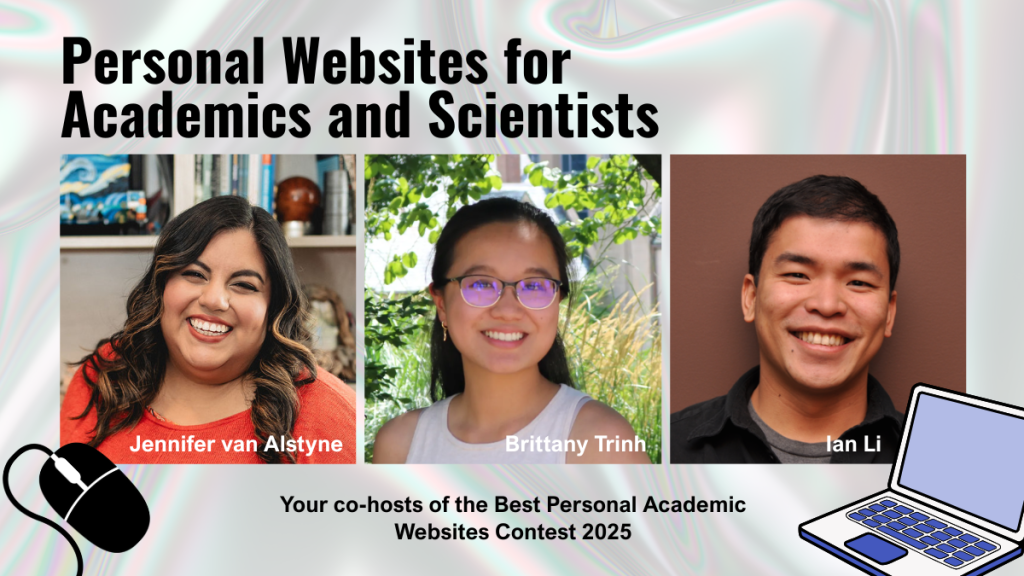
    Congratulations to the winners of the 2025 Best Personal Academic Websites Contest hosted by Jennifer van Alstyne, Brittany Trinh, and Ian Li. This contest celebrates great examples of academic websites from people in Higher Education.

    About the Awards

    Congratulations to this year’s award winning academic websites!

    Hi there, I’m Jennifer van Alstyne. This is our 3rd Best Personal Academic Websites Contest. This page celebrates the 2025 award winners. We hope their websites help inspire people around the world to create space for themselves online. Please share these award winning websites with a friend you think should have a website too.

    There are 12 award winners in this year’s contest. In a year we’ve had more entries than ever before, these academic website stood out. Each of the award winners in this year’s contest received a perfect score from the judges.

    While their websites may grow and change with them over time, these award winning academic websites deserve to be celebrated for the work they’re already doing to share their story. Thank you.

    Best wishes,
    Your Contest Co-Hosts

    Jennifer van Alstyne of The Social Academic
    Brittany Trinh of the Beyond Your Science Podcast
    Ian Li, PhD of Owlstown

    What you’ll find on this page

    Check out the award winning websites

    Read what inspired people to create their website

    Find what the judges thought

    Resources to help you create a website of your own

    Subscribe for when the contest re-opens in 2026

    To each person who entered their website into the Contest, thank you. Thank you for creating that space for yourself online. Thank you for being open to sharing it with people. I’m so glad your website is in the world.

    Would you like feedback from the judges on your website? We’re happy to share our thoughts with you if you’d find it helpful. Each person who entered the 2025 contest can request feedback from the judges. Email Jennifer van Alstyne at [email protected]

    The Best Personal Academic Websites Contest was open for entries from April 22, 2025 and closed on August 15, 2025. It will reopen for entries in 2026.

    Want to hear about next year’s contest? Subscribe to The Social Academic.

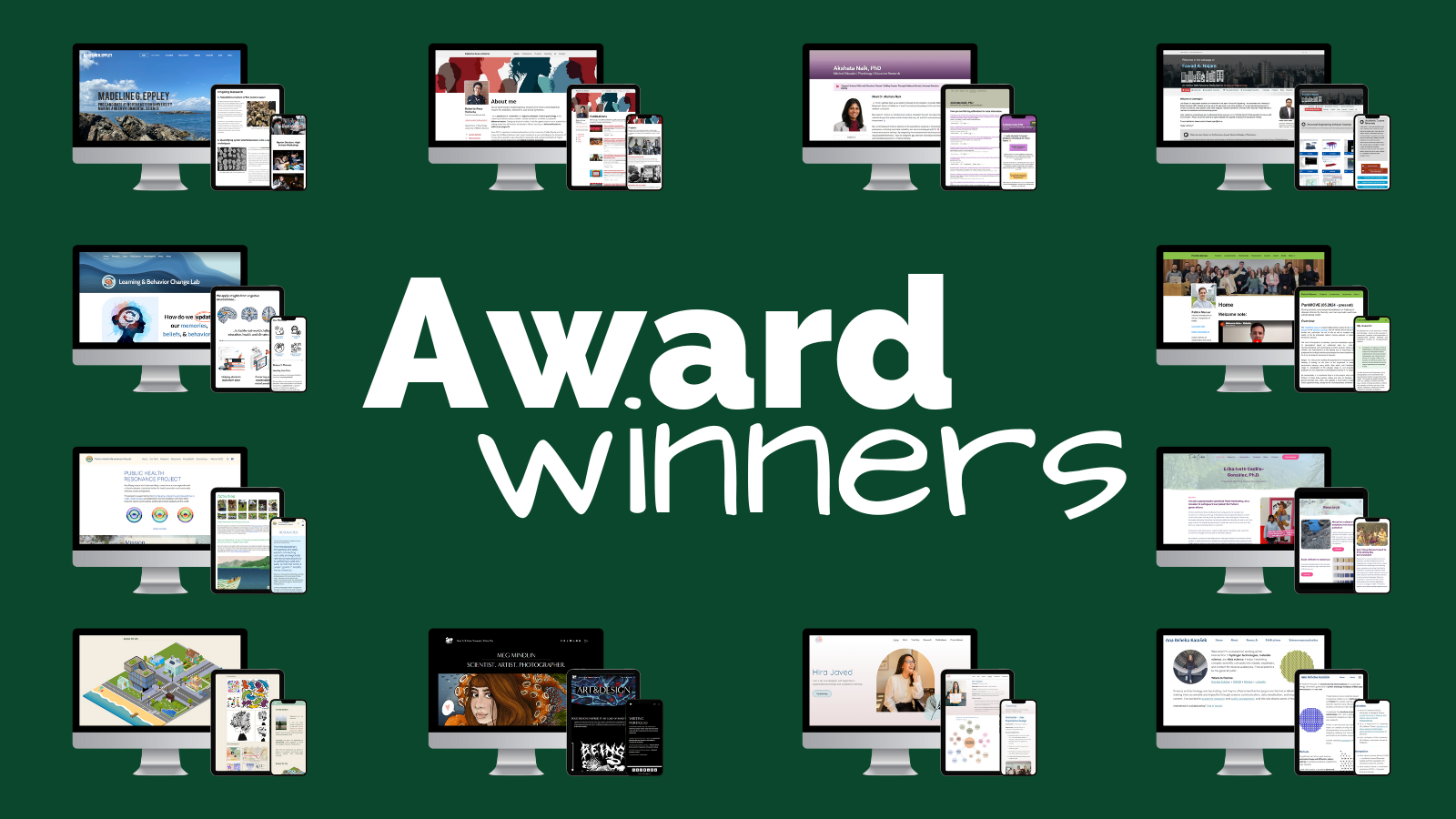
    2025 award winners of the personal academic websites contest hosted by Jennifer van Alstyne of The Social Academic. On this graphic are 12 award winning websites from this year's entries.

    Madeline Eppley and Dr. Roberta Rosa Valtorta (tied)

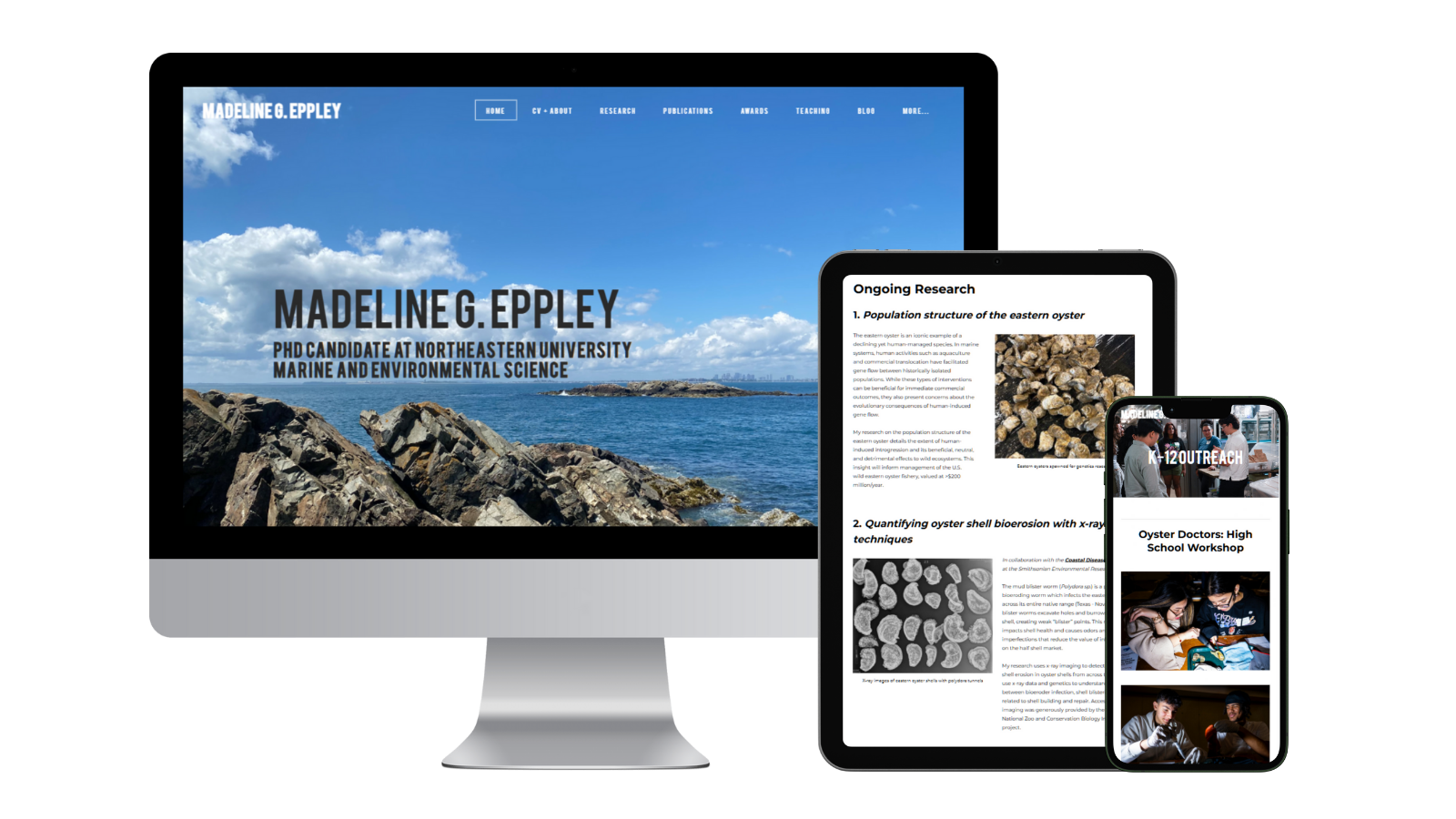
    Madeline Eppley Website on Desktop (homepage), Tablet (Research page), and Mobile (Outreach page) screens
    https://www.madeline-eppley.com/

    Madeline Eppley

    “I made my website because I feel there is a substantial gap in science communication training for graduate students and the broader field of biology. I graduated undergrad in 2020 when a lot of networking and resources went virtual. During this really pivotal stage in my career development, I needed to develop better digital presence and science communication skills to keep pace with the rising importance of networking in virtual academic spaces (e.g. virtual conferences and social media). Through this process, I ended up finding my current PhD position on social media, and also built a digital network that made me feel more connected to the science community online.”

    —Madeline Eppley

    Notes from the judges

    Jennifer van Alstyne: A visually engaging story-rich website. I hope Madeline’s website inspires people to take more photos because it makes such a difference. For instance, there’s a lot of content on this website, but it doesn’t feel overwhelming. While the top menu is initially hard to read, when I start scrolling there’s contrast. I like how Madeline’s research page shares ongoing research and completed research.

    Brittany Trinh: I love Eppley’s website, from the bio to all the photos of the field research. On the homepage, Eppley makes her passion for research and science communication clear, as well as her future goals. The research page explains the importance and impact for each research project and specifies which projects are ongoing or completed. Looking at her website, I am now inspired to go update my own website and incorporate more science in it! 

    Ian Li: Eppley’s website is well-organized and provides a lot of details on what inspires her work and the results of her research. She also describes her outreach to college and high school students. Her blog has lots of stories about her research and experience on the field.

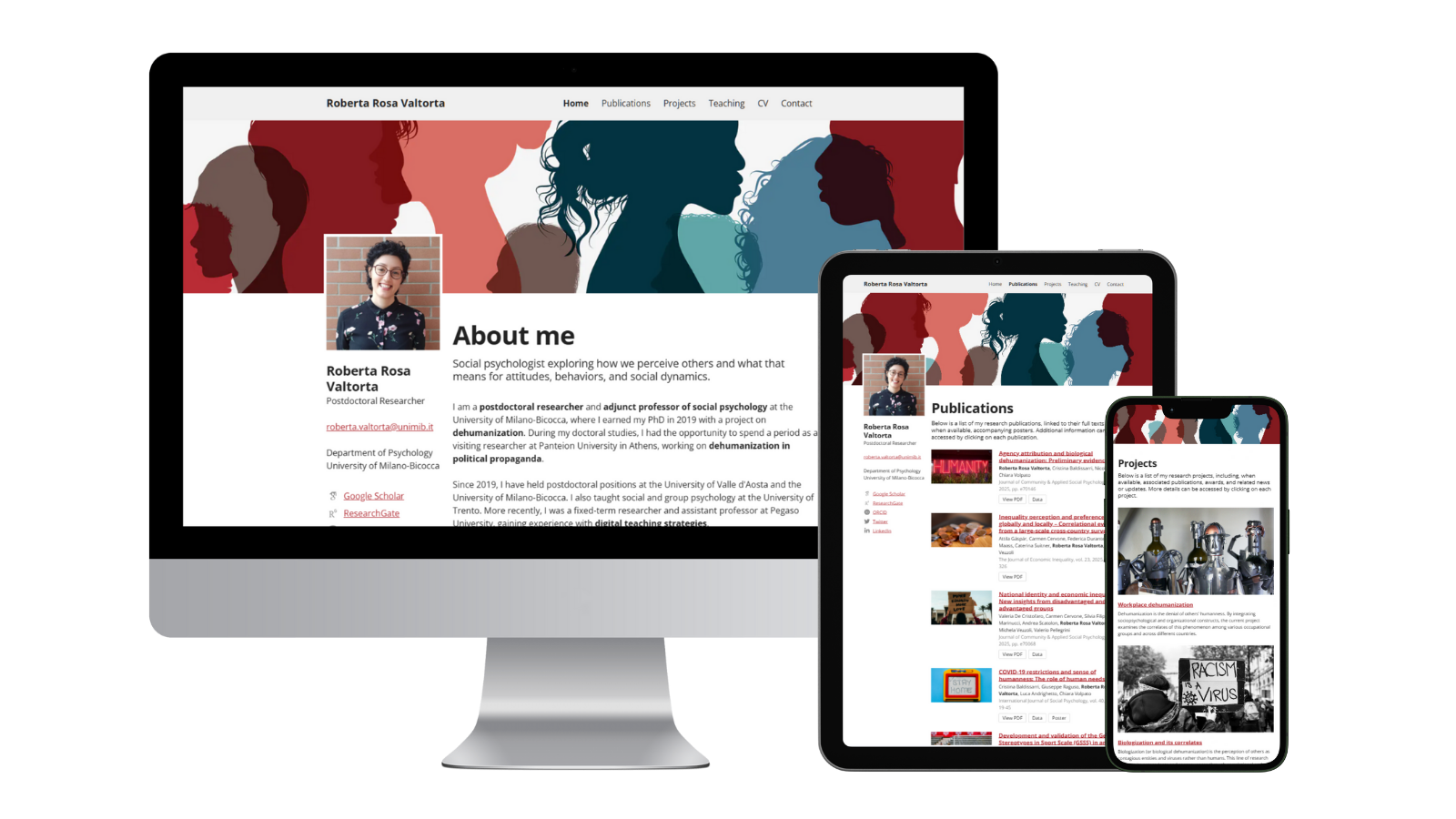
    Dr. Roberta Rosa Valtorta Website on Desktop (homepage), Tablet (Publications page), and Mobile (Projects page) screens
    https://robertavaltorta.research.st/

    Dr. Roberta Rosa Valtorta

    “I created my personal academic website for several reasons. First, to have one central place where all my work, publications, and projects are collected, making it easier for potential collaborators and anyone interested in my research to find accurate, up-to-date information. Second, to maintain control over my online presence, so that people searching for me don’t just find scattered pieces of information in different places. And finally, for a more personal reason: research can sometimes test self-esteem due to its competitiveness and constant pressure. Having a space where everything I have done is brought together helps me remember who I am, my roots, and the progress I have made.”

    —Dr. Roberta Rosa Valtorta

    Notes from the judges

    Jennifer van Alstyne: A thoughtful use of space on an Owlstown website. Dr. Valtorta has an expansive portfolio of publications, projects, and teaching. This website also shares teaching values, such as ways courses contribute to the United Nations Sustainable Development Goals (SDGs). From downloadable syllabi to accessible data, this is a great academic website example.

    Brittany Trinh: Valtorta’s website is great example of what you can do with an Owlstown website! The project pages include an overview, related awards, and related publications, which makes it easier to understand the impact of the research. The teaching pages provide a summary about the classes taught so we can understand the topics covered and importance of the course.

    Ian Li: This is such a great example of an academic website. It is well-organized. Projects are described with related publications, Publications and courses are summarized well. Her intro describes her passion for her research and points to the development of her work. She also shares a blog that is regularly updated. She also provides information in both English and Italian, which widens the reach of her work.

    Back to the list of award winners

    Owlstown Website Award

    Dr. Akshata Naik

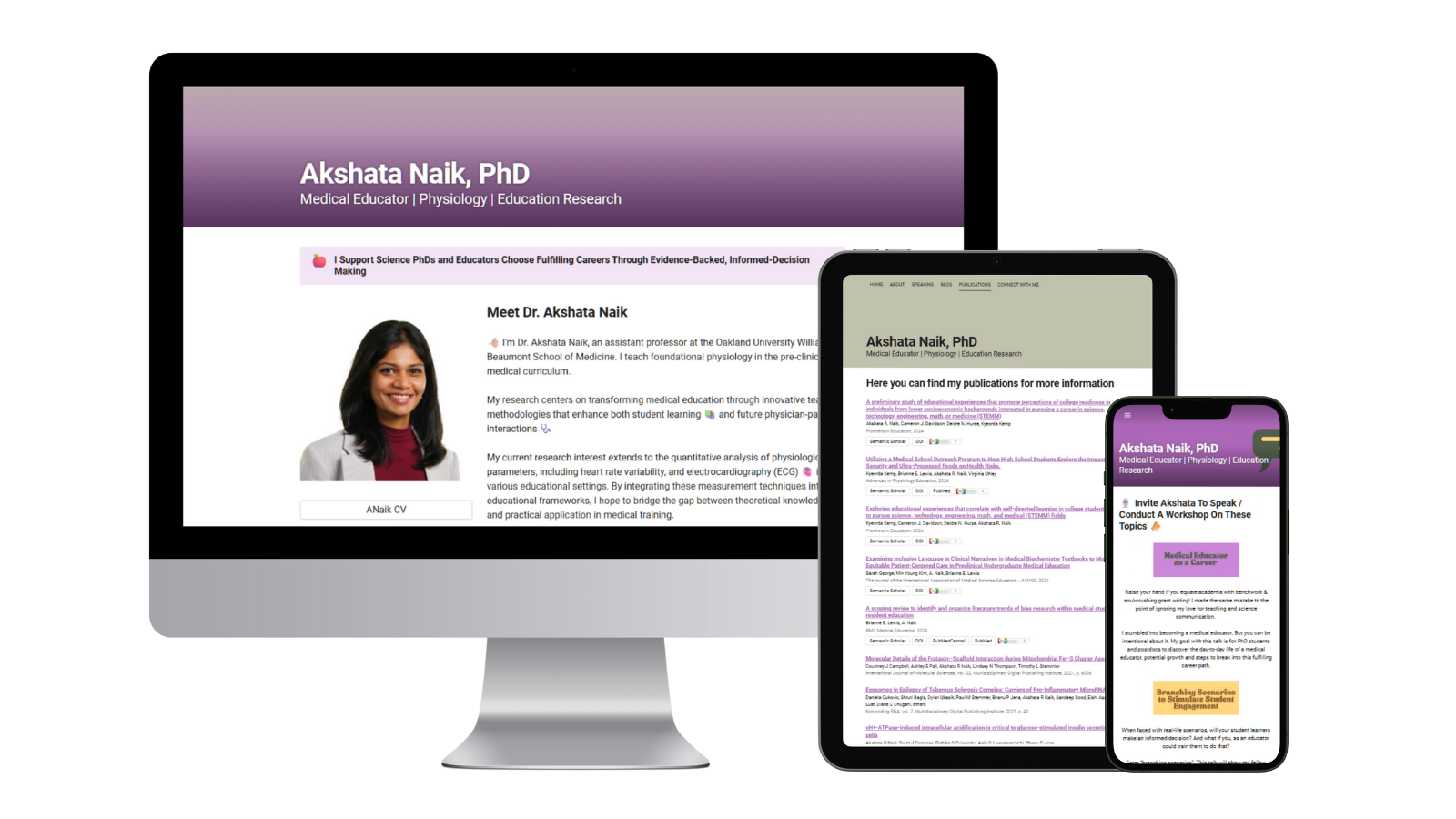
    Akshata Naik Website on Desktop (homepage), tablet (publications page) and mobile (speaking page) screens
    https://www.anaikowl.com/

    Dr. Akshata Naik

    “I thrive on creativity! Science communication, teaching and new research ideas keep me going. So I wanted to create an online space to portray my work for networking with folks similar to my interests, and importantly serving the broader community via outreach. And being an academician is a good enough reason for building a digital presence as it strategically aligns with my tenure and promotion goals by amplifying the impact of my work beyond traditional boundaries.”

    —Dr. Akshata Naik

    Notes from the judges

    Jennifer van Alstyne: I get such a sense of personality from an Owlstown website. This is great. Publications with abstracts make a difference. The buttons, like ‘Get to know me’ stand out as a lovely way to be approachable. The ‘Generated using Canva AI’ disclosure on an image on the blog feels thoughtful (and like the kind of information people appreciate even if they don’t use AI art themselves). The use of emojis in the middle of sentences isn’t ideal for accessibility, and is something I’d recommend revising.

    Brittany Trinh: Naik does a great job on her Owlstown website sharing what she does and why she does it. My favorite page is her Speaking page because it highlights the different talks she has and shares more of her story.

    Ian Li: Naik’s website is a great example of an Owlstown website. It’s very organized with information about herself, her publications, and her speaking engagements. She also shares a blog.

    Dr. Fawad Ahmed Najam

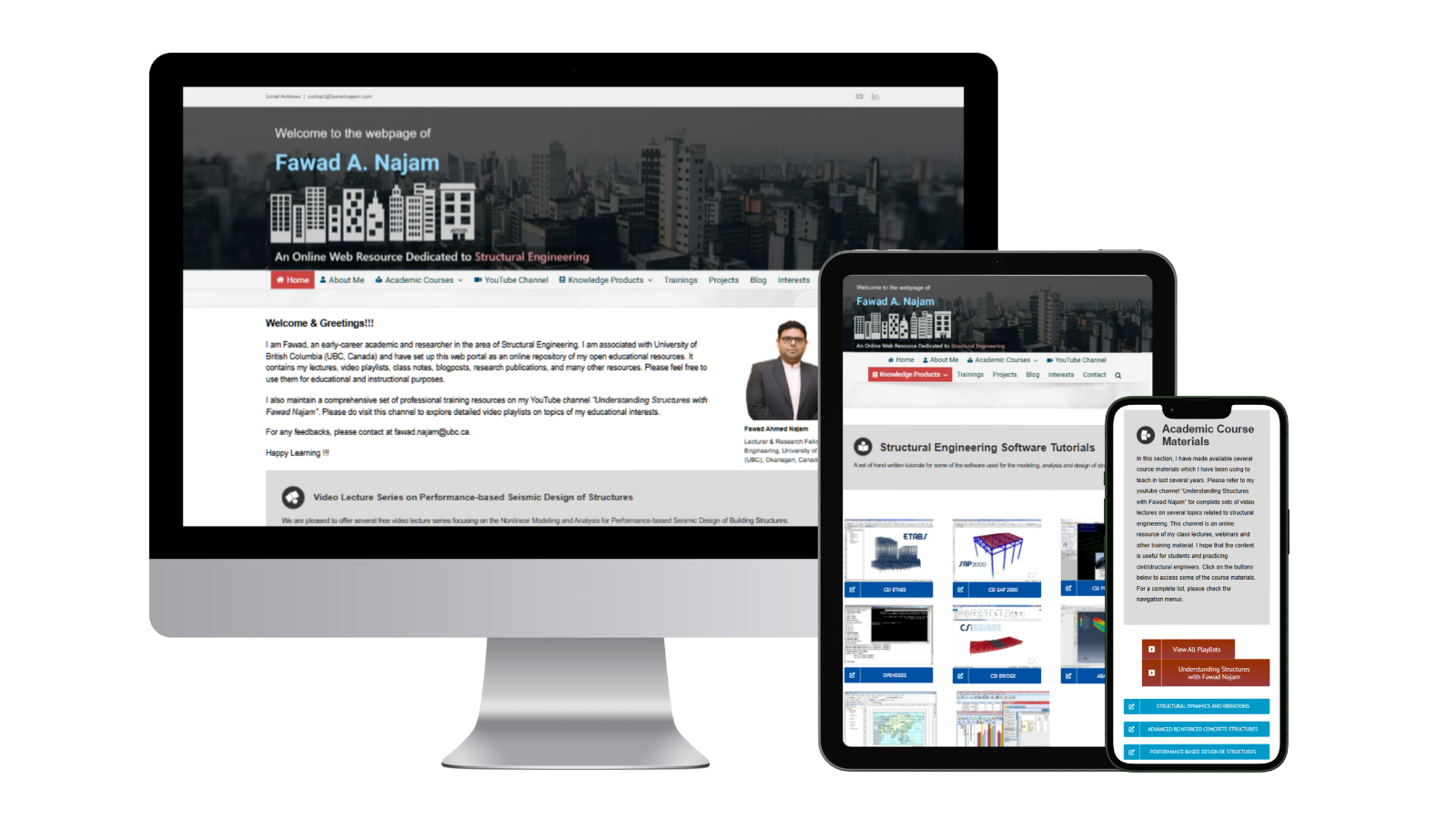
    Fawad Ahmed Najam Website on desktop (homepage), tablet (Tutorials page), and mobile (academic courses page) screens
    https://fawadnajam.com/

    Dr. Fawad Ahmed Najam

    “I am an educator in the field of structural and earthquake engineering. I originally created my website to make structural and earthquake engineering concepts more accessible to my students, fellow educators, and professionals. My goal was to share open educational resources, interactive tools, and practical examples (I use in classroom) with a wider audience. Knowing that it is making a difference and inspiring others means a lot to me.”

    —Dr. Fawad Ahmed Najam

    Notes from the judges

    Jennifer van Alstyne: A wealth of resources made accessible through this online space and good organization. While I don’t love the rotating icons for accessibility, every page of this website has videos, articles, blogs, and data to help people. I hope this website inspires people to consider: what do I already have that can help my students I’m open to sharing online?

    Brittany Trinh: Najam’s website is jam-packed with resources for his courses. His website is well organized and the content is probably super helpful to his students and others who are interested in structural engineering!

    Ian Li: If you want to learn about structural engineering, Najam’s website is the place to go. It is well-organized and has pages for course materials, YouTube videos, links to publications and resources.

    Back to the list of award winners

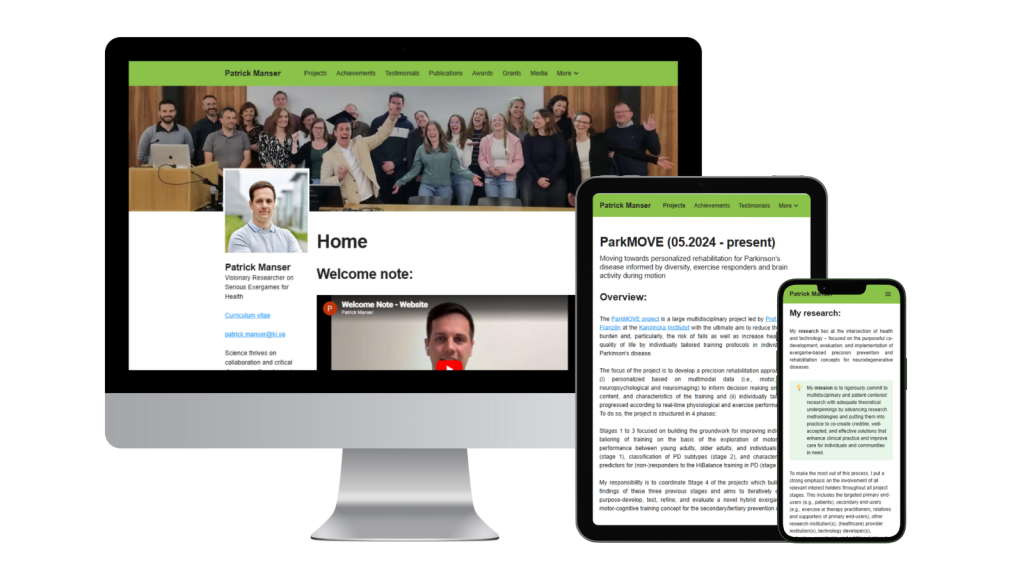
    Dr. Patrick Manser

    Patrick Manser website on Desktop (homepage), tablet (research project page), and mobile (homepage) screens
    https://www.patrick-manser.com/

    Dr. Patrick Manser

    “I created my personal academic website to make my collaborative research more accessible, with the aim of fostering transparency, promoting interdisciplinary dialogue, and broadening the dissemination of knowledge. By sharing my work openly, I hope to spark new connections and collaborative efforts that not only advance science but also translate research into meaningful improvements in healthcare and community-based health promotion.”

    —Dr. Patrick Manser

    Notes from the judges

    Jennifer van Alstyne: What a great welcome note video! I love it. That stood out because it was simple and invites folks to explore areas of the website. I felt like if I didn’t explore anywhere else, the video shared what, why and invited folks to get in touch. This website has far more on it than expected. While it’s mostly text-based with few visuals, it’s clear, easy to read, and well organized. I hope this website inspires people to consider video. Ooh, and requesting testimonials for their website too.

    Brittany Trinh: Manser’s website is very extensive regarding his research and how it has been highlighted in media. Additionally, he includes many stats regarding his academic contributions in many different areas such as awards, grants, peer review, and more. 

    Ian Li: Manser’s website is full of information on his research work: publications, courses taught, media, grants, etc. He also provides short descriptions for every item, so you have an introduction to the item. It’s a great example of how an academic website can serve as a portfolio.

    Back to the list of award winners

    Best Research Lab or Group Website

    Dr. Allie Sinclair and Dr. Tetine Sentell (tied)

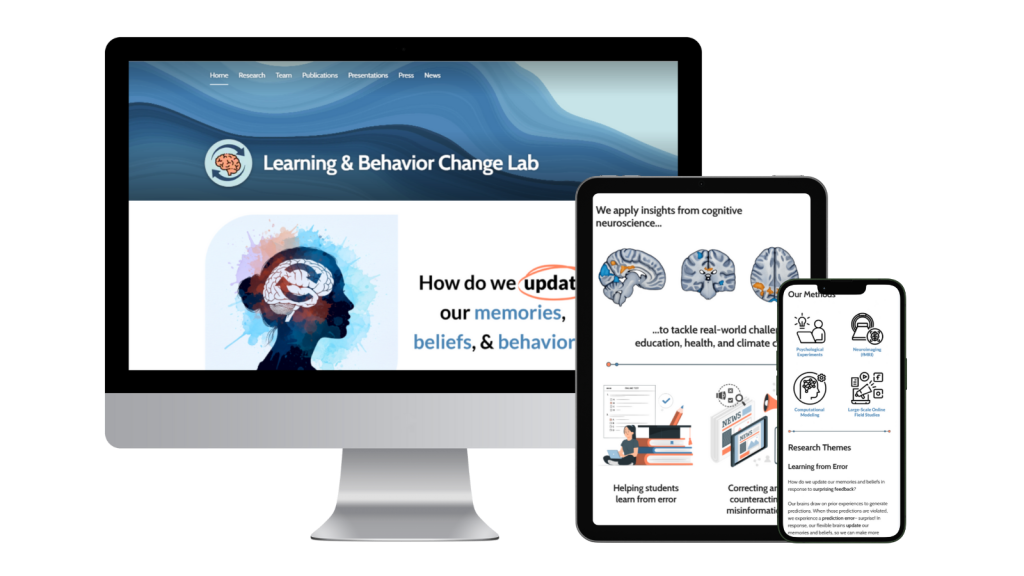
    Dr. Allie Sinclair | Learning & Behavior Change Lab website on desktop, tablet, and mobile screens
    https://www.sinclairlab-rice.com/

    Dr. Allie Sinclair | Learning & Behavior Change Lab

    “I was excited to make this website for my new lab, as I’ll be starting a faculty position at Rice University next year. I’ve spent many years dreaming of starting my own lab, although the exact vision has evolved over time. Now that the official website is ready, it finally feels real! I was motivated to create a fun and informative website this summer because I will be recruiting people to join my lab over the next year. I made the website with Owlstown, which made it easy to build and customize. I especially appreciated the features geared toward academics, like searching PubMed to find your publications and adding Altmetric badges.”

    —Dr. Allie Sinclair

    Notes from the judges

    Jennifer van Alstyne: Scroll down the homepage of this website and you have a great sense of what their research is about. Words, graphics, and illustration shares the story, and we’re then invited to explore the research and team. Folks are getting so creative with their Owlstown sites. I like the illustrations. There’s a lot of info for folks who are considering joining the lab which shares it’s recruiting for Fall 2026. Cats, Lara Croft and Moxie the cats have their own space on the team page. Yes. I’m so into this.

    Brittany Trinh: This is one of the best stylized Owlstown websites that I’ve seen. I love the cohesion of the color schemes in the visuals. I liked how they organized the research areas into three separate topics and had a link to the related publications. The publications page has the filter function so we can find papers related to a specific topic more easily.

    Ian Li: This is a great example of a lab website. You get a comprehensive understanding of what the lab does. Research projects are summarized and linked to relevant papers. There’s also links to media appearances and collaborators. Plus, the website is beautifully done with graphics and well-chosen colors.

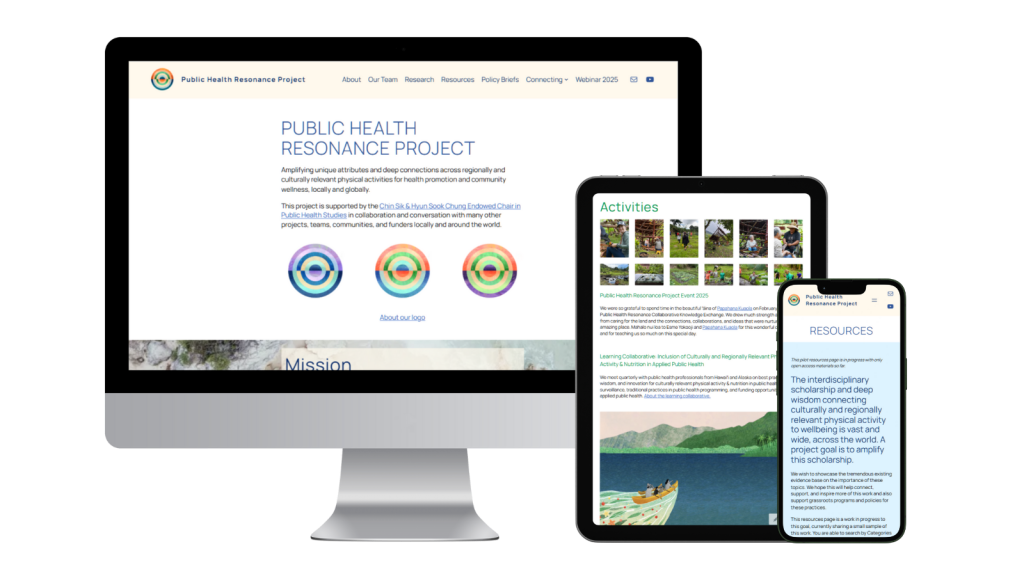
    Dr. Tetine Sentell Public Health Resonance Project Website on Desktop, Tablet, and mobile screens
    https://phresonance.com/

    Dr. Tetine Sentell | Public Health Resonance Project

    “Our interdisciplinary public health research collaboration is working together to help build the evidence base for regionally and culturally relevant physical activity for public health promotion. This work is designed to help connect and build this evidence base for public health promotion to produce actionable results for individuals, advocates, and communities to improve health outcomes and health equity. We wanted a beautiful and well-organized website to share information to support this goal. We plan to keep building on this website as the project continues and have been grateful to Jennifer van Alstyne for her support to make this possible!”

    —Dr. Tetine Sentell

    Notes from the judges

    Jennifer van Alstyne designed this website. She did not judge this entry.

    Brittany Trinh: This website is very well organized on their research page. Additionally, I love the use of real photos of the group in action in the field or at different events. It adds a personal flair to the website that makes it unique!

    Ian Li: This website is a great example of a lab website. It has full descriptions of lab members, research projects, lab activities, and outreach. It shares links to media and conference appearances. You get a detailed picture of what the lab does.

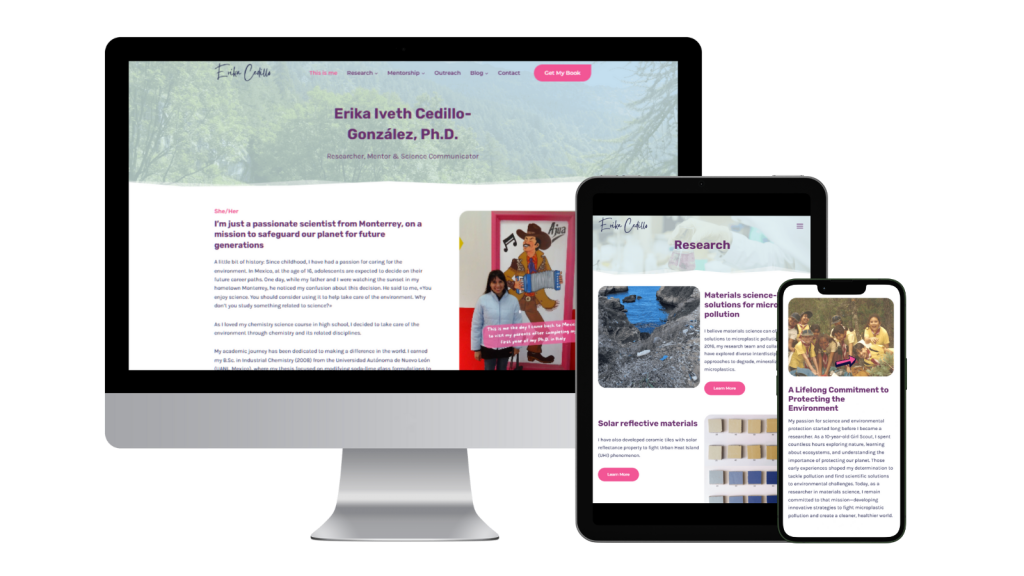
    Dr. Erika Iveth Cedillo-González

    https://erikacedillo.com/

    Dr. Erika Iveth Cedillo-González

    “I built my academic website to share what university profiles never did: my passion for research, my path as a mentor, and my dedication to protecting our planet. I believe each person in Academia carries a unique and inspiring journey that led them to science. A personal academic website offers the perfect space to share such story and remind others that research is also deeply human.”

    —Dr. Erika Iveth Cedillo-González

    Notes from the judges

    Jennifer van Alstyne: Personal and professional with pops of color. This website shares Dr. Erika Iveth Cedillo-González’ passion for science. It has science communication that invites the general public to learn and engage. There’s clarity not only on what the research is about, but how it impacts people. Accessible communication without sacrificing the science, in this website you get both.

    Brittany Trinh: I love how Cedillo tells her story of how she became a scientist and how it informs her research right from the start on her homepage. I also love that she has a blog for the Spanish-speaking ECR community, which serves as a resource and ties into her purpose and mission.

    Ian Li: The story of Cedillo’s work really comes together on this website. Her bio shows what inspires Cedillo, then her research shows how inspiration resulted in findings, then her outreach shows how she spreads her research to the broader community.

    Back to the list of award winners

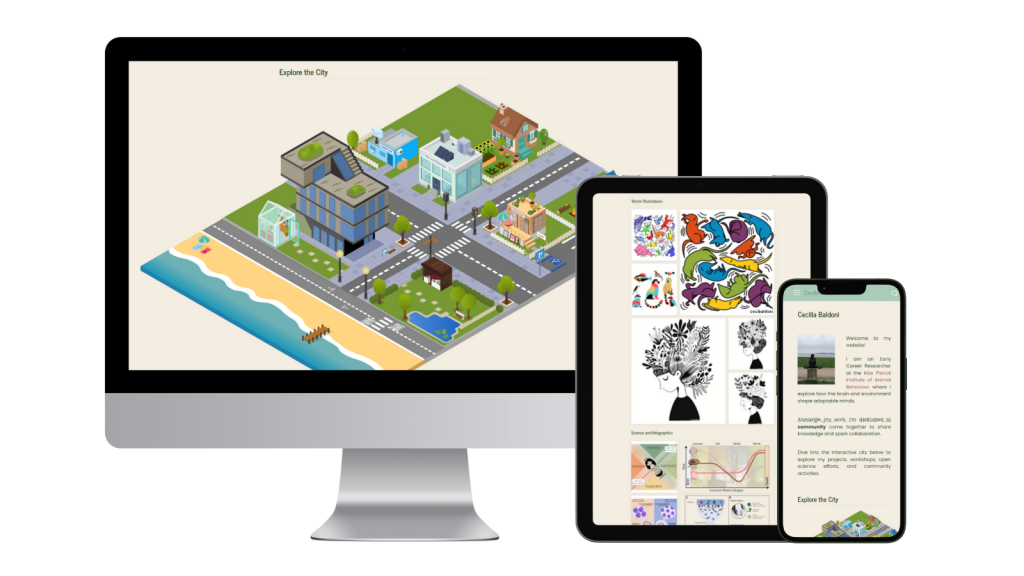
    Dr. Cecilia Baldoni

    Cecilia Baldoni GitHub website on desktop, tablet, and mobile screens
    https://cecibaldoni.github.io/

    Dr. Cecilia Baldoni

    “I was looking for a new fun way to express my creativity, and learn new ways to code and use version control!”

    —Dr. Cecilia Baldoni

    Notes from the judges

    Jennifer van Alstyne: Wow. I love the homepage interactivity. The blog post on Sketchnoting was great and the photos had captions. The Shrews page was visually engaging. I wish the text were a bit bigger (it felt like a lot of negative space on the text side). I’m obsessed with the Projects > Illustrations page. What a cute title page for their dissertation! Go explore this website. I hope it helps you imagine what’s possible for sharing your story too.

    Brittany Trinh: My favorite page is the Shrews webpage. As you scroll down the story and research unfold, and it’s a very unique way to share their research findings.

    Ian Li: The website has a bunch of interesting interactive elements. The Shrew’s page is a great example of how research can be presented in an interactive manner which elevates the understanding of the work. Baldoni also shares her slides which are viewable directly on the browser. Also, the city-like navigation on the front page.

    Back to the list of award winners

    Best Use of Art / Visuals

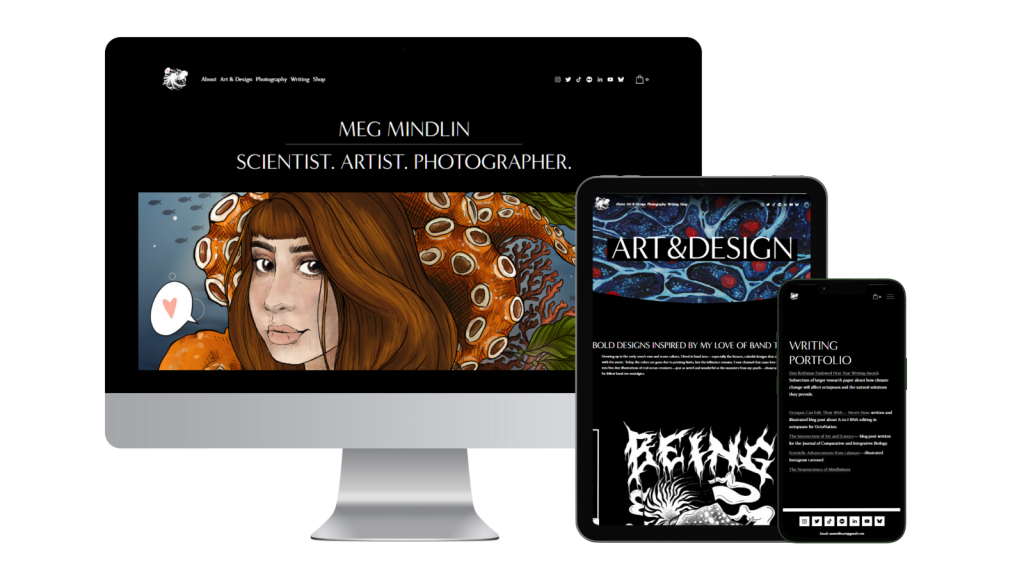
    Meg Mindlin

    Meg Mindlin graduate student website on desktop, tablet, and mobile screens
    https://www.megmindlin.com/

    Meg Mindlin

    “I’ve always had a website for my art portfolio, and as I was about to enter the real world, post graduate school, I saw no reason to not also utilize my website for my scientific endeavors. Especially with a budding career as a science communicator.”

    —Meg Mindlin

    Notes from the judges

    Jennifer van Alstyne did not judge Meg Mindlin’s website for this contest.

    Brittany Trinh: I love this website so much! It is a great example of how to incorporate your science and entrepreneurial ventures, while tying it together with your personal story! It is now my inspiration to update my own website.

    Ian Li: The illustrations and photography on this website are awesome. It’s a great example of visual communication of science.

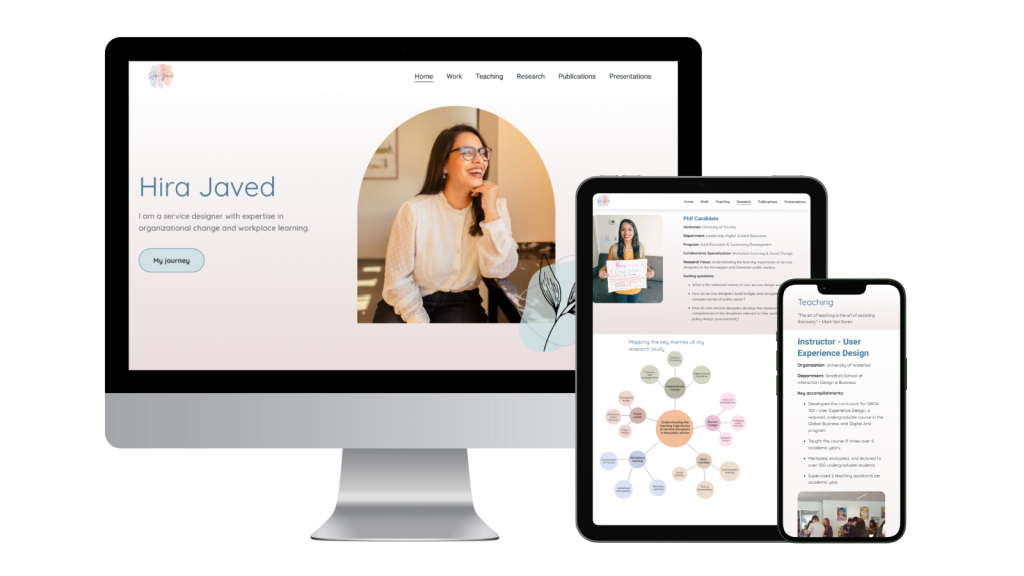
    Hira Javed

    Hira Javid phd student website on desktop, tablet, and mobile screens
    http://www.hirajaved.com

    Hira Javed

    “I made this website to tell the story of my non-linear, multidisciplinary career trajectory. It was an excellent reflective exercise for me.”

    —Hira Javed

    Notes from the judges

    Jennifer van Alstyne: This felt like a great portfolio website. A professional, resume-esque website without apology. I love that. The graphics are informative, visually engaging, and are thoughtful uses of color throughout the website. I wish that the My Journey section were built into the website rather than graphics. This section is beautiful, but the graphics make it less accessible. A favorite part of this website is the Presentations page where there’s a photo from each conference or event. That’s the dream.

    Brittany Trinh: I love the color palette and cohesion between the illustrations. I also like how Javed’s resume is color-coded and organized- it’s a creative way to showcase your experience, which you can only do on a website, and not in your resume.

    Ian Li: The coordination of the colors between the background, fonts, and graphical elements is really well done. The design serves the presentation of the Javed’s research projects, teaching, and presentations.

    Back to the list of award winners

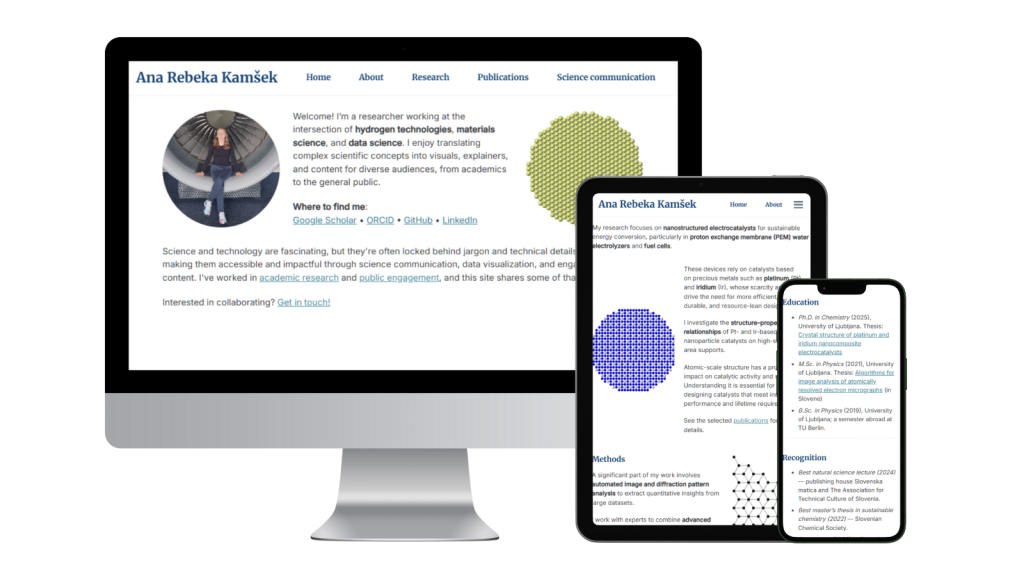
    Dr. Ana Rebeka Kamšek

    Ana Rebeka Kamšek science communication website on desktop, tablet, and mobile screens
    https://kamsekar.github.io/

    Dr. Ana Rebeka Kamšek

    “As a researcher interested in science outreach, I noticed my work was spread across platforms. People who searched for my scientific papers rarely saw what I wrote for the public, and the mix of English and Slovenian further split my audience. I wanted a home where visitors could find everything I’m proud of, regardless of language or format. A personal website felt right, and the Best Personal Academic Websites Contest nudged me to make it happen.”

    —Dr. Ana Rebeka Kamšek

    Notes from the judges

    Jennifer van Alstyne: Dr. Ana Rebeka Kamšek starts her website by sharing her value “I believe in making them accessible and impactful through science communication, data visualization, and engaging digital content.” This website does exactly that. You don’t need a huge website to share your story. A few figures, photos, with thoughtful text that considers what to say and how to share it.

    Brittany Trinh: I like that Kamsek’s publications page includes a short overview and takeaway from the papers, instead of relying just on the abstract. Additionally, the papers, related news highlights, and codes are linked for easy access.

    Ian Li: I really liked that Kamsek grouped her papers and described the relevance of each grouping. She also listed the related papers and linked to them. This made it easier to understand her work in context. She did something similar in the Science Communication page.

    Back to the list of award winners

    Thank you!

    Congratulations again to the award winners. We appreciate you.

    Don’t miss next year’s contest when it opens. Subscribe to The Social Academic blog.

    The form above subscribes you to new posts published on The Social Academic blog.
    Want emails from Jennifer on building your online presence? Subscribe to her email list.
    Looking for the podcast? Subscribe on Spotify.
    Prefer to watch videos? Subscribe on YouTube.

    The Best Personal Academic Websites Contest is brought to you by Jennifer van Alstyne, Brittany Trinh, and Ian Li.

    Source link

  • What to Do When Presidents Face Personal and Political Attacks

    What to Do When Presidents Face Personal and Political Attacks

    When a crisis strikes, college and university presidents and chancellors are asked to balance competing priorities in real time: protecting students, reassuring faculty, and staff, addressing trustees and communicating with stakeholders, including the public and other key partners. All while trying to be the role model and stay on mission as best as possible.

    While each crisis has distinctive characteristics, these situations never unfold in a vacuum. Today, they are happening as the value of higher education is being questioned, policymakers are sharpening their scrutiny, and financial pressures are forcing tough choices across campus communities. Moreover, our fast, fragmented information environment doesn’t just shape crises. It can, in effect, create them, manufacturing controversy where little existed.

    Strong crisis communications are not just about surviving the alarming hours, days or weeks of a crisis. They are about preserving trust and protecting reputation–which inevitably connects with revenue–thereby positioning the institution to lead credibly into the future.

    We were heartened when attending a recent annual, on-the-record convening of college presidents and journalists at the Press Club in Washington, DC, last month. Campus leaders showed up and readily expressed renewed energy for their roles and prospects for what remains the world’s most admired higher education system. These higher ed leaders gathered voluntarily (yes, voluntarily) to share specific examples of today’s campus environment, dispel some of the current higher ed narratives and inform the media–without defensiveness or naiveté–of the impact on their immediate communities and beyond.

    We cannot recommend engaging in such public conversations highly enough, as a means of building goodwill and busting myths. After all, the best crisis “response” begins long before any crisis occurs.

    Preparing before the crisis

    Presidents should ensure their teams are equipped with:

    • Clear, values-based messaging. A well-defined set of institutional values, articulated consistently (and easily located on public-facing websites), gives everyone a steady reference point. Do students, faculty, staff, families, alumni, neighbors and legislators know what the university stands for during times thick and thin?
    • Scenario planning and tabletop exercises. Running through potential crises, from student protests to cybersecurity breaches, helps identify weaknesses in protocols and message discipline. Exercises also clarify roles so that when a real situation arises, the team knows who speaks, who decides and who executes.
    • Designated spokespeople, prepared with media training. While a president may become the voice in a crisis, other leaders, such as a provost, communications official or dean of students, must be ready to carry the message.

    Leading during the crisis

    During the heat of a crisis, your guiding stars are simple: safety and support for your people. Accuracy, speed and transparency will matter most. Keep the following principles in mind:

    • Respond promptly, but don’t speculate. Silence creates a vacuum, but premature statements can backfire or harm. Even a short acknowledgment, such as “We are aware of the situation and will share updates as we confirm details,” signals attentiveness and concern.
      This playbook paid off during the pandemic for William & Mary, when President Katherine A. Rowe gathered input from the university’s subject-matter experts early on and established credible public health and safety approaches.
    • Center your people, not your process. Your stakeholders need to hear about safety, support and accountability before they hear about the college’s committees or investigations coming together. Prioritize action coupled with compassion. Even 20 years later, we remember the example of Scott Cowen, president of Tulane University during Hurricane Katrina, and the trust built due to his people-first approach. During the pandemic, Colgate University President Brian Casey modeled people-first leadership by moving into student housing to better understand students’ experiences and guide the campus through an especially challenging time.
    • Communicate consistently across channels. Students, families and alumni are likely to first encounter your messages (or off-base, inaccurate versions of this news) on social media, while others may hear news via email, during town halls or staff meetings. Coordinated, consistent language is critical for accuracy and credibility.
    • Engage trustees and legislators early. Surprises erode trust. One university president we admire follows the “No surprises” rule, crisis or no crisis. Keep key stakeholders briefed, even if details are evolving. A healthy president-board relationship, or the opposite, can easily become apparent during a crisis.

    The all-important post-crisis phase

    Too many falter by assuming that once any headlines fade, the crisis is behind them. In fact, the post-crisis period is where reputations are refined and strengthened. Presidents should treat this phase as an opportunity for reflection, accountability and rebuilding confidence.

    • Conduct a candid after-action review. What worked? What didn’t? Invite honest feedback from leadership, communications staff and key campus partners. A president who once worked at NASA introduced that agency’s practice of conducting a “hotwash,” the immediate, constructive, after-action review at her university.
    • Fix what needs improvement. Based on what you learn from the after-action review, consider who among your team demonstrated they are best suited for crisis situations. Determine who will stand in when these individuals are away or temporarily unreachable. Have a backup plan for the backup plan, including communications tools ranging from analog to digital. Cybersecurity breaches happen, as do power outages. Consider engaging external expertise to audit your policies and practices before, yes, the next crisis.
    • Follow up with your community. Students, faculty, staff, families and alumni will remember how your institution followed through. Report on the status of (non-confidential) investigations, share policy changes and highlight steps taken to prevent recurrence. Determine the cadence and keep to it, for communication containing substantive updates. Demonstrating accountability reinforces trust.
    • Reconnect the crisis to the institution’s mission. For example, if the issue involved free speech, show how new steps align with the university’s now-broader commitment to inquiry and dialogue. If it involved safety, emphasize your institution’s improved duty of care.
    • Strengthen external relationships. Use the post-crisis time to meet with legislators, donors and alumni leaders. Transparency about what happened and how the university has responded often earns respect over time, potentially turning doubters into advocates. The word potentially is deliberate here, in that this work can be challenging, it may take years and we need to be realistic about what is feasible. Is there common ground to be found? Are we seeking to please a few at the expense of the many?

    The special case of manufactured crises

    While the principles of communication are consistent across all crises, a manufactured crisis—one designed to harm a leader through disinformation—requires a different approach. Unlike a natural disaster or an institutional mistake, these situations are orchestrated attacks. Their primary purpose is not to address a problem but to create one. They become personal, understandably taken to heart. Leaders must steel themselves, identify key allies to clarify misinformation, and draw from resources in the “bank of goodwill” built during their presidency. Always easier said than done, yet the challenge for any leader in such circumstances is to not become the crisis.

    Why it matters more than ever

    Higher education’s current reputational challenges heighten the stakes. Campus leaders cannot afford to treat crisis communications as a tactical exercise. Instead, crisis communications should be integrated into a broader strategy for sustaining trust in the institution and, by extension, in the value of higher education itself.

    Handling a crisis can demonstrate an institution’s resilience, values and leadership. It can show students and families that the university is committed to their safety and success. It can show legislators that higher education takes accountability seriously. And it can remind the broader public that colleges and universities remain vital engines of knowledge, opportunity and community—even in turbulent times. You may have heard this beautiful phrase before, but remember and repeat: Higher education builds America.

    Crises will come. Presidents cannot control exactly when or how. By preparing in advance, leading with compassion and clarity in the moment and taking ownership in the aftermath, leaders can turn adversity into an opportunity to strengthen their institution’s credibility and standing. All of higher education stands to benefit from such examples of leadership.


    If you have any questions or comments about this blog post, please contact us.

    Source link

  • Personal Websites for Academics and Scientists Livestream

    Personal Websites for Academics and Scientists Livestream

    This livestream is part of the Best Personal Academic Websites Contest 2025, the 3rd annual contest hosted by Jennifer van Alstyne of The Social Academic, Brittany Trinh of the Beyond Your Science Podcast, and Ian Li creator of Owlstown, a free academic website builder.

    Join us for this informal chat about websites for academics in 2025. Some questions we cover:

    • What are your options for making your website?
    • What makes for the best website examples for academics?
    • How can I have a website fast (like today even)?
    • What should people prioritize when telling their story on their website?
    • What makes for the best portfolio websites (and what can go on them)?

    Your contest co-hosts are back with another live to support your academic website project. Whether you’re a professor, researcher, scientist, postdoc, graduate student, independent scholar, you deserve space online.

    This year’s Best Personal Academic Website Contest also supports the websites of research labs and research groups.

    Check out our past livestream, the Set Up Your Website event.

    Here are resources from Ian Li of Owlstown, Brittany Trinh Creative, and The Academic Designer LLC to help you make your website.

    Our goal is to help as many people as possible. Please share with your friends 💌

    Check out Brittany’s recent appearance on The Social Academic where we chat about research lab websites.

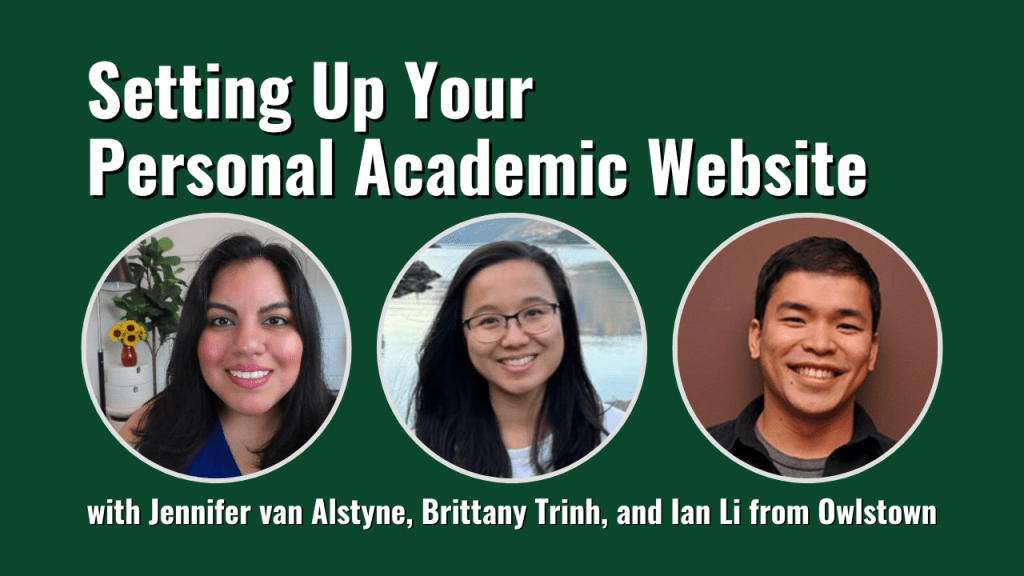
    Setting Up Your Personal Academic Website with Jennifer van Alstyne, Brittany Trinh, and Ian Li from Owlstown
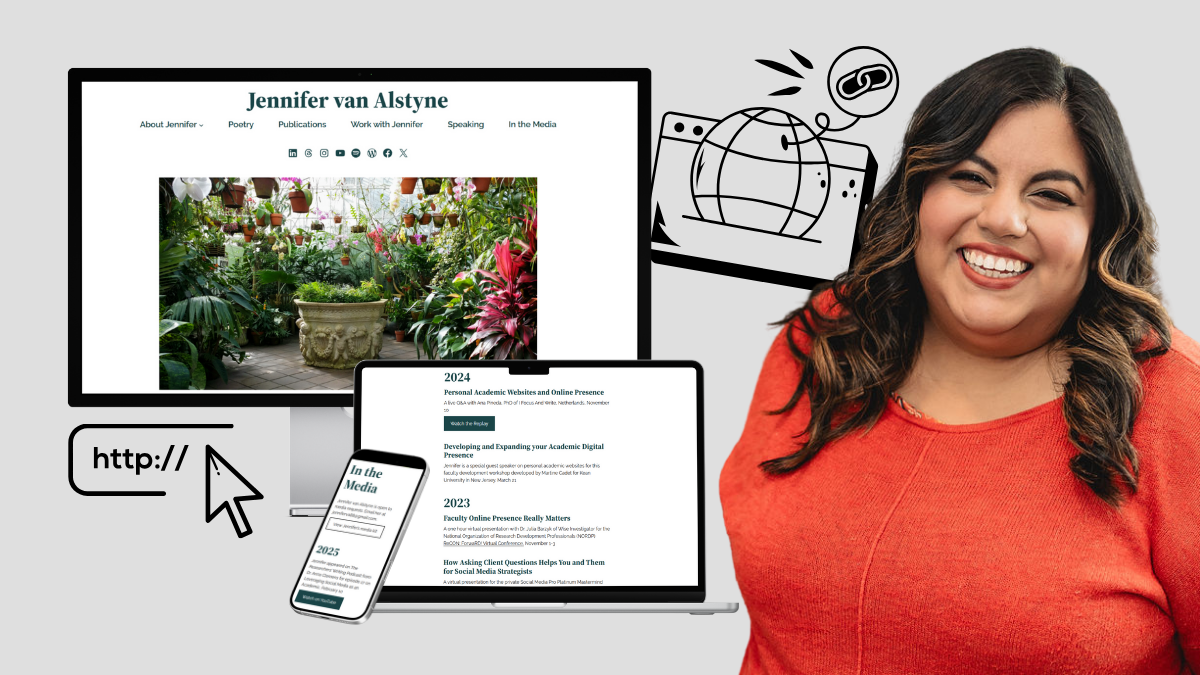
    Jennifer van Alstyne and her personal academic website on desktop, laptop, and phone screens.
    An open laptop that reads "Website" with arrows pointing this way. Next to the laptop are books held up by a bookend of a person holding up t he books.
    Owlstown mascot, a yellow owl with glasses waving
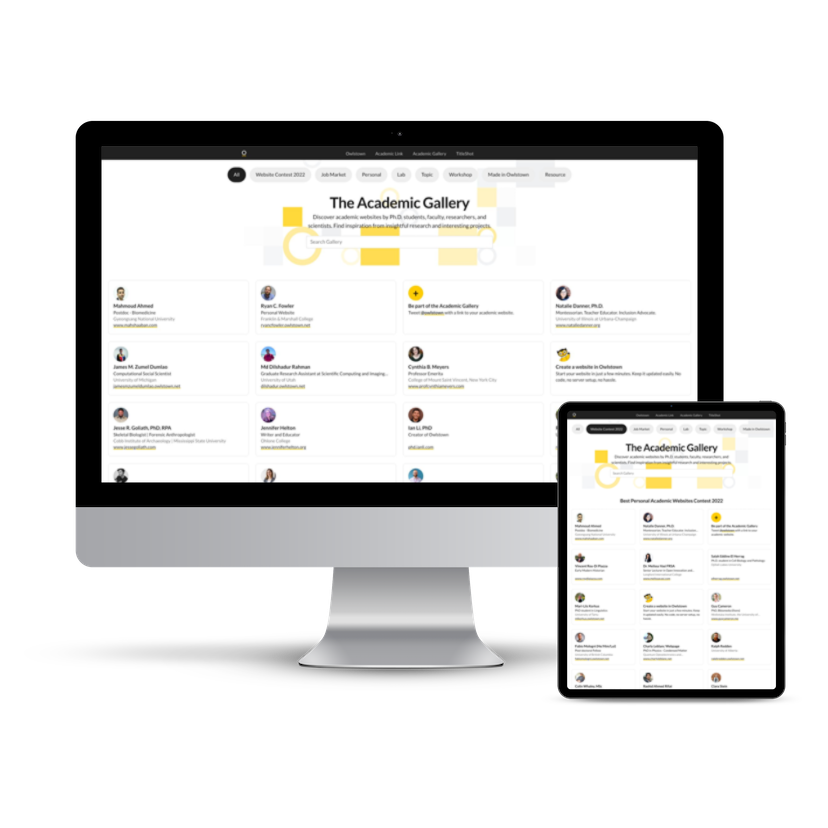
    Screenshots of The Academic Gallery from Owlstown on a desktop monitor and tablet screen
    Brittany Trinh
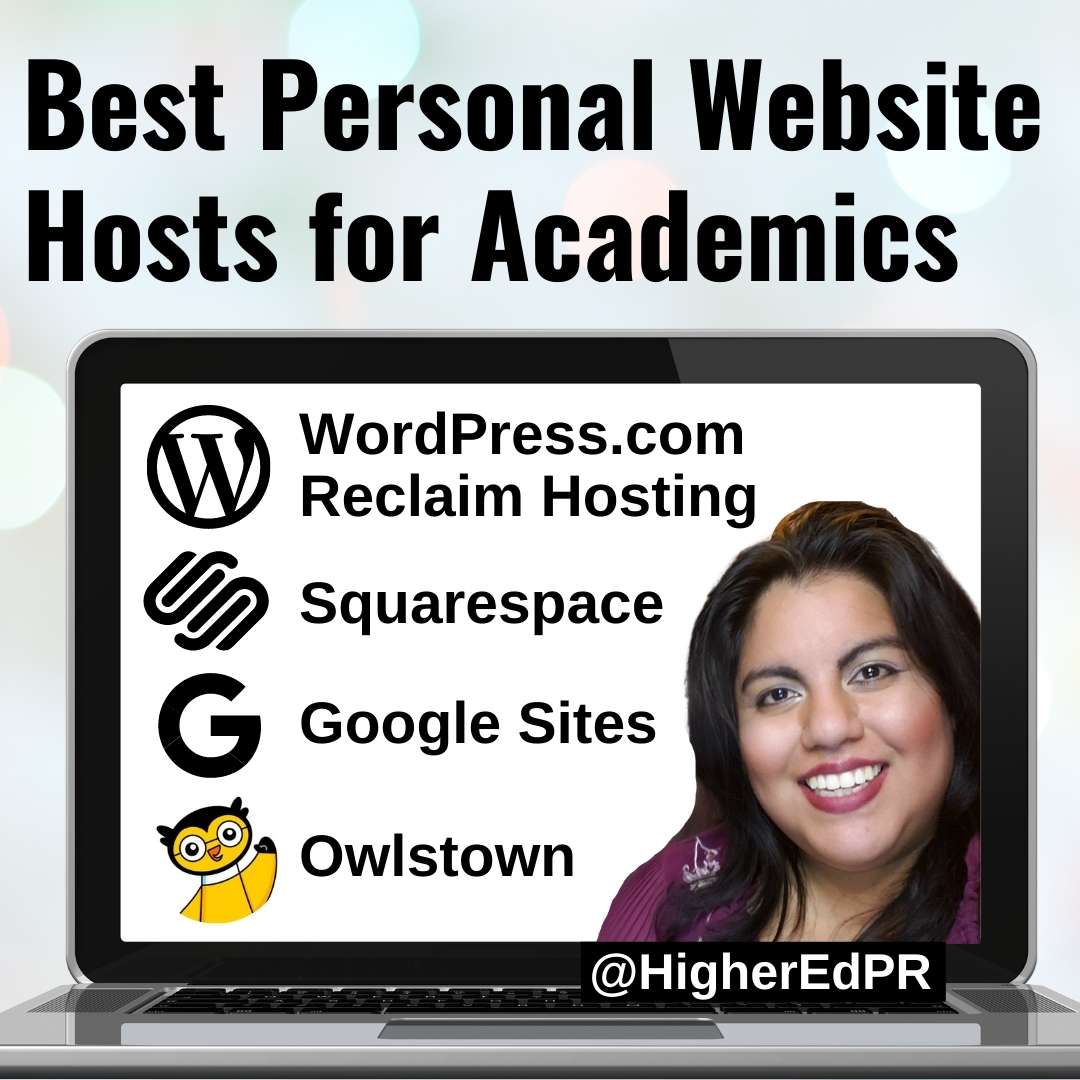
    Best Personal Academic Website Hosts Graphic: WordPress .com or Reclaim Hosting, Squarespace, Google Sites, Owlstown

    Source link

  • Own Your Narrative: Why Personal Branding Matters for University Leaders

    Own Your Narrative: Why Personal Branding Matters for University Leaders

    Many university leaders are uneasy about the idea of personal branding. It can feel self-promotional, even uncomfortable – and it’s often a concept that jars with their personal values, the culture of their institution, and indeed their perception of how higher education itself operates.

    However, personal branding should not be about ego or marketing. It’s about clarity, authenticity, and trust. In an environment where leadership visibility, credibility, and alignment with institutional values are increasingly scrutinised, shaping how you’re understood by others isn’t merely helpful, it’s essential.

    So, while we’re a bit uncomfortable with the term, personal brand, we think it’s extremely important for aspiring university leaders to think about how they go about developing one for themselves.

    Personal branding – it’s not just what you say about yourself

    It’s perhaps worth reflecting on what Jeff Bezos has said in this context because it’s helpful:

    “Your brand is what other people say about you when you’re not in the room.”

    Your title and role may open doors, but it’s your values, your expertise and your contribution that leave a lasting impression. Personal brand is the space you occupy in other people’s minds: your colleagues, students, and external connections. In today’s digital world, you are visible in search results, social feeds, LinkedIn and other platforms. If you’re not actively shaping your own narrative, others will do it for you – forming opinions and perceptions that may not be accurate or aligned with your values.

    Why should personal branding matter for aspirational university leaders?

    Thinking about your personal branding allows you to control the narrative. Essentially, if you don’t shape your story, someone else will. It allows you to build trust and credibility authentically. This is vital, we all know that a consistent, values-led brand is consonant with reliability in times of change. Where there is so much information out there, it can be a strong signal among confusion and noise. It also gives you a better handle on future-proofing your career.

    Executive search companies, partnerships, board appointments all begin with discovery, and if you can’t be found, you can’t be considered. Distilling your experience and expertise beyond the role you’re in now makes moves to other roles easier. People do their homework on you, they want to know what kind of person you are, not necessarily the nitty gritty detail (although bad social media lingers) but to know that you are real. And it’s not always about a positive career trajectory to the next job. In these times your role might be at risk, and you might need to consider your next position, even beyond your current role, institution and sector.

    This is about developing a personal mark, but it’s worth noting that an authentic personal brand also benefits your institution. Visible leaders attract talent and partnerships, and can draw top academics, high-calibre students, and external funders. People will engage because of what you stand for in terms of your values and your impact. And got right, it will help your students, staff, external connections and the public to be more confident about your vision and your decisions.

    Equally important, a clear and visible personal brand enables you to communicate more effectively – an essential skill for building strong teams, driving change, and leading through crisis. You are future-proofing yourself, becoming a trusted authority, so that you are known for more than just your job title and credentials. 

    It starts with how you present yourself in meetings, working groups, committees, stakeholder meetings, even corridor conversations and incidental interactions.

    Articulating your expertise beyond your job title

    To be able to develop your personal brand, you need to ask yourself several questions and answer them honestly. And bear in mind that ‘showing up’ is not showing off, you can’t make a difference if you’re invisible!

    Truly understand what your goals are: who you are trying to help, and what positive difference do you want to make? Understanding your reason for doing what you do makes being visible that much easier.

    1. Do I want to make a positive difference?
    2. What do I want to change and how?
    3. What do I want to be known for?
    4. Who do I want to help?

    Ask yourself these questions in the context of what you want to change or influence, such as Leadership & Change Management; Equity, Diversity & Social Mobility; Research Impact & Knowledge Exchange; Student Experience & Wellbeing; The Future of Work & Skills. These should, of course, be significant topics that reflect what you want to be known for and the people or communities you aim to support.

    Before you can become an authority on your topic, you need to have a proven track record of success in that area. Your credibility is built not just on what you say, but on what you’ve delivered; your demonstrable achievements and real impact that others can recognise and rely on. Without this foundation, personal branding risks sounding empty or a promissory note rather than coming from a position of authority and authenticity.

    When you are speaking to others about what you are doing, it is helpful to reflect on how you should structure what you say. Make sure, for example, that you’re clear about defining the issue: speak directly to the challenges your audience faces (e.g. navigating grant applications, improving departmental culture); position the challenges. Share frameworks, tips, or toolkits you’ve developed, and humanise your advice – weave in a short anecdote or lesson learned, for example.

    Do these things in the context of people you might be able to support by being more visible: students and research students, people more junior, and those wanting to get into HE, particularly those from minoritised backgrounds. Essentially, leadership isn’t just about climbing, your role should be to hold the ladder down for others.

    Practical Tips

    To help you maximise your impact – here are some ideas:

    1. Digital Footprint Audit

      • Search Yourself: Google your name in incognito mode. Note the top 10 results.
      • Review Social Profiles: Ensure consistency of photo, headline, and bio across LinkedIn, Twitter, ResearchGate, etc.
      • Clean Up: Archive or delete outdated posts or profiles that conflict with your current values.

      2. Think about Content, Calendar & Cadence

      • Plan regular outputs (blog posts, LinkedIn articles, micro-posts) aligned to your expertise, but don’t worry if you can’t maintain a consistent frequency right away.
      • It is important that they are insightful, add value and contribute.
      • Use simple tools (e.g. Trello or a shared spreadsheet) or agentive AI to track ideas, deadlines, and performance.

      3. Collect Metrics & Evaluation

      • Engagement: Likes, comments, shares on social platforms.
      • Opportunities: Invitations to speak, consult, sit on panels or boards.
      • Search Trends: Monitor Google Analytics (if you host a blog) or LinkedIn analytics for profile views and keyword searches.

      4. Network Activation

      • Identify, say, 10 key contacts (internal & external) each quarter to reconnect with.
      • Offer value first. Be gracious and share – share an article, congratulate them on their achievement, propose a brief call.
      • Leverage your network to co-author articles, co-host webinars, or nominate others for awards.

      And avoid:

      • Oversharing: While transparency is good, avoid extraneous personal detail that can detract from your message.
      • Inconsistency: Mixed messaging erodes trust. Align every post and presentation with your core values.
      • Neglecting Offline Presence: A strong digital brand should be backed up by consistent behaviour in meetings and events.
      • Ignoring Feedback: Listen to comments, direct messages, and 360-degree reviews to refine your approach.

      What Leaders Say

      Professor Shân Wareing, Vice-Chancellor and CEO, Middlesex University

      People are always going to draw conclusions from what they see you do, so you always need to be aware of that. I don’t use personal brand with the goal of ‘selling’ me. However, I do want to consistently communicate important and specific aspects of how I work – such as that I care about other people’s growth – and I try to align all my social media and other communications with that message.”

      Professor Simon Biggs Vice Chancellor and President, James Cooke University

      Senior leaders represent their organisation externally. A strong personal brand helps amplify and align their values with the organisation in public forums, industry discussions, and policy advocacy. Personal branding signals what a leader stands for ethically, strategically, and culturally. It helps align teams and attract talent who resonate with that leadership style.

      Professor Theo Farrell, Vice-Chancellor, Latrobe University, Australia

      I think aspiring leaders need to think carefully about the kind of leader they want to be – and this will involve reflecting on their own values, the ambitions they have for the organisation or unit they lead, and their aspiring leadership journey. For me, personal brand is simply the outward expression of this leadership ethos and style. It is expressed in communications, including social media, and also in every interaction with people inside and outside the organisation. Being consistent with your personal brand, in everything you do is important for authentic leadership. In terms of social media, the goal is to communicate your values. Being consistent is obviously important. At the same time, my experience is one of posting fewer personal reflections and more corporate content as I have become more senior, and in these senior roles increasingly represent my organisation.

      And finally

      Leadership and personal branding are inseparable in today’s higher education landscape. Your brand is not a luxury. It’s your strategic asset made up of your values, your story, your impact on others and ultimately your legacy.

    Source link

  • Best Personal Academic Websites Contest 2025

    Best Personal Academic Websites Contest 2025

    Entries to the 3rd Best Personal Academic Websites Contest are now open. We’re excited to celebrate your website! Enter now.

    Entries are open through August 15, 2025 at 11:59pm Pacific Time. Winners will be announced here on The Social Academic blog in November 2025.

    Thank you for helping us share this contest!

    I’m Jennifer van Alstyne of The Academic Designer LLC. My friends Brittany Trinh and Ian Li of Owlstown and I are teaming up again to bring you this professional development contest for

    • Faculty
    • Professors
    • Researchers
    • Scientists
    • Postdocs
    • Grad students
    • Independent researchers

    This is the 3rd annual Best Personal Academic Websites Contest. Each year, it’s inspired people like you from around the world to create space for yourself online. And to celebrate the hard work you’ve put into your website project. I’m excited that we’re back again in 2025 to celebrate your website.

    This contest is now open. Entries are free. The form takes just a couple of minutes to complete.

    Fill out this form to enter your website in the contest.

    We want to recognize the hard work you’ve put into your personal academic or scientist website.

    There will be awards in multiple categories. Here’s what you get if you win an award

    • A line on your CV
    • A digital badge for your LinkedIn profile and website
    • Be featured as a top academic website in the winner’s announcement and on social media
    • Bragging rights

    This event was recorded live on Zoom on August 1, 2023 at 6pm Pacific Time, hosted by Jennifer van Alstyne @HigherEdPR, Brittany Trinh @BrttnyTrnh, and Dr. Ian Li of Owlstown @Owlstown

    A live conversation series for 2025 is coming soon. Stay in the loop when you subscribe to The Social Academic blog:

    Here are resources from Ian Li of Owlstown, Brittany Trinh Creative, and The Academic Designer LLC to help you make your website. Our goal is to help as many people as possible. Please share with your friends.

    Hi, I’m Jennifer van Alstyne. I’m happy to answer your question.
    [email protected]

    Please help us share the 2025 Best Personal Academic Websites Contest. Thank you!

    Enter the 2025 Best Personal Academic Websites Contest.

    Source link

  • Teachers need support to understand what’s needed in the UCAS personal statement

    Teachers need support to understand what’s needed in the UCAS personal statement

    Our recent paper found substantial misalignment between state-school teachers and university admissions staff on what makes a high-quality UCAS personal statement.

    In our study, 409 state school teachers were presented with ten paragraphs from UCAS personal statements and asked to select between two pieces of feedback. One ‘correct’ feedback was provided by an admissions tutor, and the one ‘incorrect’ feedback was supplied by another teacher. These paragraphs and feedback were all real-world examples derived from Steven Jones’ (2016) study, used as part of Causeway Education’s pre-training programme for state school teachers.

    We found:

    • There was significant misalignment between teachers and admissions staff. In only 56.5% of cases did teachers select the ‘correct’ feedback response.
    • There are a number of pervasive myths regarding the UCAS personal statement. Teachers had a dual tendency to:
    1. Advise for the incorporation of personal content that aimed to demonstrate a holistic view of the student rather than course-related competencies; and
    2. Suggest reducing content that demonstrated course-related knowledge and skills.

    To give one example, teachers were presented with the paragraph below and asked to choose between two pieces of feedback: (1) Strong reasons backed up by detailed examples; and (2) Too much detail; doesn’t give a sense of the student as an individual. The first of these is from an admissions tutor and the second from a teacher in Jones’ (2016) work.

    My main reason for wanting to study Japanese is because I enjoy studying complex grammar rules to see how languages come together. This is why I chose to undertake Latin at A-Level as I enjoy translating pieces of complex texts. Analysing writers techniques in presenting ideas and characters is also interesting, in particular how Tacitus in Annals I, presents Tiberius as an unsuitable emperor by often comparing him to his father Augustus, an emperor who was deemed ‘an upholder of moral justice’.

    In 58.4% of cases teachers selected the first ‘correct’ answer, and 41.6% selected the ‘incorrect’ second answer.

    These findings should not be interpreted as a criticism of teachers. In the context of studies finding a considerable lack of transparency on how universities use the UCAS personal statement (Fryer et al., 2024), the burden of responsibility for misalignment falls primarily on universities. Without clear and transparent guidance, this misalignment between teachers and admissions staff is inevitable.

    There is an important opportunity to address this situation, as many universities will currently be in the process of updating their public-facing guidance in response to the upcoming UCAS personal statement reform. The shift to three short questions for the 2025-26 application cycle and the corresponding need to update guidance present universities with an opportunity to address and counter the misalignments noted in our paper.

    To support this goal, our paper contains a table of key implications (Table 5, pp.14-15), which can be downloaded directly from this link.

    We hope this is of practical use to admissions staff in updating and developing guidance on the UCAS personal statement. We contend that this new guidance, alongside transparent explanations of how the personal statement is used in selection decisions, is crucial to enable UCAS’s reform to widen participation and address inequalities.

    This blog is based on a paper ‘Investigating the alignment of teachers and admissions professionals on UCAS personal statements’ by Tom Fryer, Anna Burchfiel, Matt Griffin, Sam Holmes and Steven Jones. Due to its time-sensitive nature, the paper has been published as a preprint, and therefore has not yet been subject to peer-review.    

    The table summarising the implications for public-facing guidance is available for download here.  

    Source link

  • UConn faculty member allegedly used funds for personal travel

    UConn faculty member allegedly used funds for personal travel

    A University of Connecticut faculty member has been charged with first-degree larceny after allegedly using more than $58,000 of university and grant funds for personal expenses and travel, including a trip to Disney World, The Hartford Courant reported.

    Sherry Lynn Zane, who is listed on the UConn website as a professor-in-residence of women’s, gender and sexuality studies, allegedly took 19 trips, “of which 17 were identified as potentially having unreported personal travel or lacking the sufficient documentation to support the purpose of business travel,” according to a report by UConn’s director of university compliance, Kimberly Hill.

    The compliance office referred the case to UConn police after receiving an anonymous report about Zane’s travel, which allegedly included seven trips to Belfast, Ireland, where her daughter had recently moved. According to the report, she was reimbursed for some of the travel through a grant provided to UConn by the Mellon Foundation.

    “Dr. Zane expensed trips where there were no actual planned business activities and then provided information or created documentation after the fact to justify the expenses incurred by the University,” the report said. “Dr. Zane also provided misleading or false information to the University on the travel request forms she submitted for the majority of these trips. In these circumstances, Dr. Zane’s actual activities while traveling were distinctly different and off-topic from the agreed-upon purpose.”

    Zane remains on administrative leave pending the completion of the university’s disciplinary process.

    Source link

  • The Power of Personal Storytelling in Higher Education Leadership

    The Power of Personal Storytelling in Higher Education Leadership

    When I became president of the University of La Verne in 2011, I often shared the story of why I was drawn to this role—and why it resonated so deeply with my family’s values. My husband and I were committed to raising our daughters in a community that embraced inclusivity, service, and the transformative power of education. These were not just abstract ideals; they were principles we wanted to live by and instill in our children. And sharing this connection wasn’t just about explaining my leadership—it was about building trust and fostering relationships across campus.

    Today, as higher education leaders face unprecedented scrutiny—from political attacks on academic freedom and diversity efforts to growing public skepticism about the value of a college degree—this kind of authenticity and connection is more critical than ever. Our institutions are being challenged to prove their relevance and align their missions with the needs of diverse and sometimes skeptical communities. In this climate, personal storytelling offers a powerful way to build bridges, humanize our roles, and reaffirm the values that define higher education. In navigating the complexities of our current environment, storytelling is not just a leadership tool—it’s a leadership imperative.

    Why personal storytelling matters

    Building authentic relationships: Personal stories bridge the gap between leaders and campus communities. Sharing your experiences, challenges, and successes makes your role more relatable and human. When leaders share stories authentically, we foster trust and encourage deeper connections with our students, faculty, alumni, donors, and other stakeholders. A compelling story has a way of bringing people together, sparking that feeling of connection through common experiences.

    Inspiring action and change: Stories are powerful motivators. They show how education can transform lives, encouraging students to pursue their dreams, sparking innovation among faculty, and connecting with alumni and donors. At the University of La Verne’s annual Scholarship Gala, I used to share my mother’s story—how, as an immigrant, she stayed committed to education despite countless challenges. When she, her two older sisters, and their parents first immigrated to the United States from Czechoslovakia, they had to build a new life, learn a new language, and adapt to new customs. My grandfather would bring used tires to their home, where the family would cut them into small squares and sew them together to create doormats. He sold these mats door-to-door, and the money they earned not only supported their daily life but was also saved so that my mother could attend nursing school.

    Each year following my story, students would respond with their own incredible stories of resilience. Those moments didn’t just inspire greater scholarship donations—they raised awareness about the challenges that so many students face, underscoring just how vital access to education really is.

    Shaping institutional culture: Personal stories are a big part of what shapes a university’s identity, creating a sense of inclusion, resilience, and shared values. Early on in my time at the University of La Verne, a board member told me why the university—her alma mater—meant so much to her and why she chose to give back as a donor and leader. She often spoke about how she and her husband met while attending La Verne, and that they both loved the supportive and inclusive environment at the university. Then one of her children enrolled, and a particular professor took him under his wing and helped him with his academic career. She felt La Verne was always there when she and her family needed support.

    Her story stuck with me, and I shared it often as an example of how personal connections can inspire others to support the university’s mission. By encouraging storytelling like this, we brought our community closer together and reinforced our shared purpose.

    Engaging with diversity: Every story brings something unique to a campus community. When we make room for diverse voices, we naturally build stronger connections and a sense of belonging. Serving on the board of Antioch University, I’ve had the privilege of hearing a wide range of students and faculty share their experiences—some inspiring, some challenging, all meaningful. These moments are a great reminder of how much we gain when we listen to and learn from each other.

    Strategies for Effective Storytelling

    Connect stories to the institution’s mission: Personal stories are powerful, but they work best when they connect back to the institution’s goals. I once attended a university event where the president’s stories, while memorable, didn’t really support the message of the institution—they overshadowed it, leaving the audience entertained but not necessarily inspired about the university’s future. It’s a good reminder that storytelling should always reinforce the mission and build confidence in what lies ahead.

    Balance sharing with relevance: Finding the right balance between personal and professional storytelling is key. Oversharing can make people uncomfortable or distract from your message. A story might be heartfelt, but if it’s too detailed, the audience might lose track of why it matters. The best approach is to share meaningful anecdotes that highlight your points while keeping your audience and the setting in mind.

    Maintain honesty and humility: The best stories come from a place of honesty and humility—they build credibility and trust. Think about great leaders: the ones who acknowledge the contributions of others tend to connect more than those who focus on their own achievements. On the flip side, self-congratulatory stories can feel off-putting and even break trust with the audience. Keep it grounded, which always resonates better.

    Avoid unethical exaggeration: Stretching the facts or making up stories can seriously damage trust. And people can usually tell when a story isn’t genuine, whether it’s because of over-the-top details or a lack of authenticity in the delivery. It’s important for leaders to stay honest, sharing meaningful details without straying from reality. In today’s world, where fact-checking is everywhere, even small inconsistencies can hurt your credibility—and by extension, the reputation of your institution. Keep it real, and your message will always carry more weight.

    Repetition without redundancy: Repeating key messages can really help drive them home, but it’s all about balance. When you tell the same story to different audiences, it can show consistency and authenticity, which is great. But if you overdo it, people might start to tune out, feeling like they’ve heard it too many times. We all recycle our favorite speeches and stories when we speak often, and that’s fine as long as we’re mindful of keeping it fresh. A thoughtful approach to storytelling means your message stays powerful without losing its impact.

    ************

    Personal storytelling is one of the most powerful tools leaders in higher education have at their disposal. When done right, it builds trust, inspires action, and strengthens the sense of community. Sharing authentic stories helps connect audiences to the mission and values of an institution, creating a shared sense of purpose and vision.

    As higher education continues to navigate challenges like public skepticism and political scrutiny, storytelling offers a way to highlight the transformative power of education. It allows us to address concerns with honesty and integrity, while keeping the focus on the positive impact education has on individuals and society. Reaching beyond the academy, these stories help build connections with the wider community—and ideally, around the world—showing how education shapes lives and strengthens society.


    dotEDU Global Voices

    This December, ACE will feature a special podcast series, dotEDU Global Voices, which will spotlight personal stories from accomplished international women university presidents. These leaders share their unique challenges, insights, and strategies, offering authentic and inspiring perspectives on leadership.

    The series builds on my book, Spotlighting Female Leadership: Strategies, Stories, Perspectives, which highlights the journeys of ten accomplished university presidents. To learn more, download the book here and tune into the podcast for further inspiration.

    Episode 1: Trailblazing Leadership in Turkey: Gülsün Sağlamer

    Episode 2: Discovering Your Leadership Path: Sue Cunningham

    Episode 3: Changing History at Colegio de México: Silvia Giorguli


    If you have any questions or comments about this blog post, please contact us.

    Source link