Tag: Phoenix

  • Phoenix Education Partners, FAFSA Fraud, and the Familiar Dance of Blame

    Phoenix Education Partners, FAFSA Fraud, and the Familiar Dance of Blame

    When Phoenix Education Partners (PXED) CEO Chris Lynne publicly blamed the U.S. Department of Education for missing fraud in FAFSA applications—fraud that allowed the University of Phoenix to enroll individuals engaged in financial-aid misconduct—he likely hoped to redirect scrutiny away from his own shop. Instead, the maneuver sent up a flare. For many observers of the for-profit college sector, it felt like the return of a well-worn tactic: deflect, distract, and deny responsibility until the heat dies down.

    The pivot toward blaming the Department of Education does not merely look defensive; it echoes a pattern that helped bring down an entire generation of predatory schools. And it raises a simple question: why is PXED responding like institutions that have something to hide?


    The Old Script, Updated

    The University of Phoenix, under PXED’s ownership, carries not just a long memory of investigations and settlements but a structural DNA shaped by years of aggressive enrollment management, marketing overreach, and high-pressure tactics. When the industry was confronted with evidence of systemic abuses—lying about job placement, enrolling ineligible students, manipulating financial-aid rules—the typical industry defense was to claim that problems were caused by bad actors, by misinterpreted regulations, or by a sluggish and incompetent Department of Education.

    Those excuses were not convincing then, and they ring even more hollow now.

    If individuals involved in financial-aid fraud managed to slip into the system, an institution with PXED’s history should be the first to strengthen internal controls, not pass the buck. Schools are required under federal law to verify eligibility, prevent fraud, and monitor suspicious patterns. Pretending that ED is solely responsible ignores the compliance structure PXED is obligated—by statute—to maintain.

    Why Blame-Shifting Looks So Suspicious

    Instead of demonstrating transparency or releasing information about internal controls that failed, PXED’s leadership has opted for a public relations gambit: blame the regulator. This raises several concerns.

    First, shifting responsibility before releasing evidence suggests that PXED may be more focused on reputational management than on institutional accountability. If the organization’s processes were sound, those facts would speak louder—and more credibly—than an accusatory press statement.

    Second, the posture is déjà vu for people who have tracked the sector for decades. Corinthian Colleges, ITT Tech, Education Management Corp., and Career Education Corporation all blamed ED at various stages of their collapses. In each case, deflection became part of the pattern that preceded deeper revelations of systemic abuse.

    When PXED’s CEO adopts similar rhetoric, observers reasonably wonder whether history is repeating itself—again.

    Finally, PXED’s argument undermines trust at a moment when the University of Phoenix is already under skepticism from accreditors, policymakers, student-borrower advocates, and the public. Instead of strengthening compliance, PXED’s messaging signals defensiveness. Institutions with nothing to hide usually take a different approach.

    The Structural Issues PXED Doesn’t Want to Discuss

    PXED acquired the University of Phoenix with promises of modernization, stabilization, and responsible stewardship. But beneath the marketing, core challenges remain:

    A business model dependent on federal aid. The more a school relies on federal dollars, the stronger its responsibility to prevent fraud—not the weaker.

    A compliance culture shaped by profit pressure. For-profit education has repeatedly shown how financial incentives can distort admissions and oversight.

    A credibility deficit. PXED took over an institution known internationally for deceptive advertising and financial-aid abuses. Blaming ED only magnifies the perception that nothing has fundamentally changed.

    A fragile regulatory environment. With oversight tightening and student-protection rules returning, PXED cannot afford to gesture toward the old for-profit playbook. Doing so suggests they are trying to manage optics instead of outcomes.

    What Accountability Would Look Like

    If PXED wanted to demonstrate leadership rather than defensiveness, a different response was available:

    • Conduct and publish a full internal review of financial-aid intake processes
    • Outline steps to prevent enrollment of fraudulent actors
    • Acknowledge institutional lapses—and explain how they occurred
    • Invite independent audits rather than blaming federal partners
    • Demonstrate an understanding of fiduciary obligations to students and taxpayers

    This is the standard expected of Title IV institutions. It is also the standard PXED insists they meet.

    A Familiar Pattern at a Familiar Institution

    Every moment of pressure reveals something about institutional culture. PXED’s choice to immediately fault the Department of Education—without presenting evidence of its own vigilance—suggests that the company may still be operating according to the old Phoenix playbook: when in doubt, blame someone else.

    But in 2025, the public, regulators, and students have seen this movie before. And they know how it ends.

    Sources
    U.S. Department of Education, Federal Student Aid Handbook
    Senate HELP Committee, For-Profit Higher Education: The Failure to Safeguard the Federal Investment and Ensure Student Success
    Federal Trade Commission, University of Phoenix Settlement Documents
    U.S. Department of Education, Program Review and Compliance Requirements
    Higher Education Inquirer archives

    Source link

  • Apollo Wants Investors to Buy Back the University of Phoenix. They Shouldn’t. (David Halperin)

    Apollo Wants Investors to Buy Back the University of Phoenix. They Shouldn’t. (David Halperin)

    Having failed to complete deals to sell the troubled giant for-profit University of Phoenix to major state universities in Arkansas and Idaho — after people in those states got cold feet — the school’s owner, private equity behemoth Apollo Global Management, just before the holiday weekend announced an initial public offering for the school. 

    Phoenix’s parent company had been publicly traded until AGM and two other firms took the company private in 2017. Now they have gone back to Wall Street to re-sell the school to investors. 

    But should investors want to buy this operation? The presence of the heavily-advertised University of Phoenix in the college market has been bad for U.S. students, taxpayers, and the economy, because it has led many students to enroll in a school that often deceives people, and often leaves students with heavy debts and without the careers they sought — when they could be using taxpayer support and their own money to enroll in better value programs. 

    Moral and macro-economic concerns aside, it’s not even clear that buying Phoenix will be good for investor bottom lines. 

    The University of Phoenix, which has received tens of billions from federal taxpayers for student grants and loans — at times more than $2 billion in a single year — has faced numerous law enforcement investigations and actions for its deceptive recruiting of veterans, military service members, and other students across the country.

    Most notably, in 2019, Phoenix reached a record $191 million settlement with the Federal Trade Commission, which claimed the school had lured students with false claims about partnerships with major employers. Phoenix ran ads falsely indicating that the school had deals with companies including AT&T, Yahoo!, Microsoft, Twitter, and the American Red Cross to create job opportunities for its students and tailor school programs for such jobs, when that was not the case. The deceptive claim went to the heart of prospective students’ motivations for enrolling. Andrew Smith, then the Director of the FTC’s Bureau of Consumer Protection, said at the time of the agreement, “Students making important decisions about their education need the facts, not fantasy job opportunities that do not exist.”

    And last year California’s attorney general reached a settlement with Phoenix to resolve allegations that the school’s aggressive recruitment tactics directed at military students violated consumer protection laws. 

    The now almost entirely online school did a two-year dance with the University of Idaho that drew immense criticism from lawmakers, executive branch officials, newspaper editorial boards, and others in that state before the deal was finally called off in June.

    Bloomberg reported earlier this year that an IPO might value the University of Phoenix operation, which had $810 million in revenue for 2023-24 (81 percent of that from federal taxpayer dollars), at $1.5 billion to $1.7 billion. And the new Trump administration has signaled in multiple ways that it is reducing protections for students against predatory college abuses, a development that may make investors more willing to buy a piece of a school like Phoenix.

    But new federal legislation requires schools to provide some financial value for students. Also, state attorneys general, who have curbed and even slayed a number of for-profit giants over a decade, are watching; the media understands this issue, as it did not in the last wild west era fifteen years ago; and more potential students are wary after a generation of abuses.

    So it may end up being much tougher to thrive in the predatory college business than some might think. 

    Source link

  • The University of Phoenix IPO

    The University of Phoenix IPO

    Apollo Global Management and Vistria have an offer only a pig would consider: the Phoenix Education Partners IPO.

    Touted by Morgan Stanley, Goldman Sachs, Bank of Montreal, Jefferies, and Apollo Global Securities, the offering of Phoenix Education Partners brings the University of Phoenix (UoPX) back to public markets—but few fans remain in the audience.


    A Decade of Decline: From Expansion to Erosion

    In the early 2000s, UoPX was hailed as a pioneering force in adult education—cozy campuses near freeway exits and an advanced online infrastructure for working learners earned praise. Its founder John Sperling was seen as visionary.

    But by 2010 enrollment had already begun plummeting after reaching nearly 470,000 students, and the school’s academic quality and recruiting ethics were under the microscope. Critics decried “The Matrix,” a perverse scheme where recruiters were aggressively incentivized to push enrollments—no matter the cost.

    By 2018, more than 450 locations had shuttered, enrollment was down by approximately 80%, and half the remaining sites were no longer accepting new students. Even Hawaii, Jersey City, Detroit, and other major cities were on the closure list.


    Regulatory Fallout: Lawsuits, Settlements, and Borrower Defenses

    From the early 2010s onward, UoPX saw an avalanche of legal scrutiny. In 2019, the FTC leveled a $191 million settlement against it for misleading advertising, including deceptive claims about job placement and corporate partnerships.

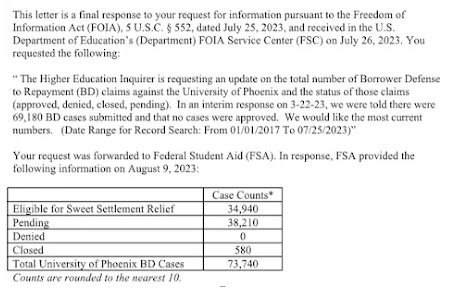
    By late 2023, 73,740 borrower-defense claims had been filed by former students under federal programs. Many of these were settled under the Sweet v. Cardona class action, with estimates of the university’s potential liability ranging from $200 million to over $1 billion. Meanwhile, nearly one million debtors owed a combined $21.6 billion in student loans—about $22,000 per borrower on average.

    Another flashpoint: UoPX agreed to pay $4.5 million in 2024 to settle investigations by California’s Attorney General over military-targeted recruiting tactics.


    The Ownership Unicorn: Apollo, Vistria, and Political Backing

    After Apollo Global Management and the Vistria Group acquired UoPX in 2016, the school became a commodified unit in a larger private equity portfolio. The deal brought in figures like Marty Nesbitt, a political insider, as chairman—signaling strategic power play as much as financial management.

    Vistria’s broader stable included Risepoint (previously Academic Partnerships), meaning both UoPX and OPM entities were controlled by one private-equity firm—drawing criticism for creating a “for-profit, online-education industrial complex.”


    The IPO Circus: “Pigs on Parade”

    Enter the Phoenix Education Partners IPO, steered onto the market with all the pomp of a carnival but none of the substance. The front-line banks—Morgan Stanley, Goldman Sachs, BMO, Jefferies, Apollo Global Securities—are being paid handsomely to dress up this distressed asset as a growth opportunity.

    But here’s what those colorful floats hide:

    • Collapse, not comeback. Enrollment and campus infrastructure have withered.

    • Debt, not opportunity. Nearly a million debt-laden alumni owe $21.6 billion.

    • Liability, not credibility. Borrower defense claims and state investigations continue to mount.

    • Profit, not public good. Ownership is consolidated in private equity with political access, not academic mission.

    This is a pig in parade attire. Investors are being asked to cheer for ribbon-cutting and banners, while the mud-stained hooves of exploitative business models trudge behind.


    The HEI Verdict

    This IPO isn’t a pivot toward better education—it’s a rebrand of an exploitative legacy. From aggressive recruitment of vulnerable populations (“sandwich moms,” military servicemembers) to mounting legal liabilities, the University of Phoenix remains the same broken system.

    Investors, regulators, and the public must not be dazzled by slick packaging. The real story is one of failed promises, students carrying lifelong debt, and private equity cashing out. In education, as in livestock, parades are meant to show off—just make sure you’re not cheering at the wrong spectacle.


    Sources

    • Higher Education Inquirer. Search: University of Phoenix

    • Higher Education Inquirer. “The Slow-Motion Collapse of America’s Largest University” (2018)

    • Higher Education Inquirer. “University of Phoenix Collapse Kept Quiet” (2019)

    • Higher Education Inquirer. “Fraud Claims Against University of Phoenix” (2023)

    • Higher Education Inquirer. “University of Phoenix Uses ‘Sandwich Moms’ in Recruiting” (2025)

    • Higher Education Inquirer. “What Do the University of Phoenix and Risepoint Have in Common?” (2025)

    • Federal Trade Commission. “FTC Obtains $191 Million Settlement from University of Phoenix” (2019)

    • Sweet v. Cardona Settlement Documents (2022–2023)

    • California Attorney General. “University of Phoenix to Pay $4.5 Million Over Deceptive Military Recruiting” (2024)

    Source link

  • Higher Education Inquirer continues to follow IPO/sale of University of Phoenix

    Higher Education Inquirer continues to follow IPO/sale of University of Phoenix

    On March 6, 2025, Apollo and Vistria publicly announced a possible IPO or sale of the University of Phoenix.  These companies have been trying to sell the University of Phoenix since 2021, but there have been no takers. The owners claim the school is worth $1.5M to $1.7M, but we (and experts we know) are skeptical, given the financials we have seen so far. The University of Phoenix was previously on sale for about $500M-$700M but the University of Arkansas System, the State of Idaho, and apparently other colleges declined the offers. 

    The University of Phoenix offers subprime education to folks,
    historically targeting servicemembers, veterans, and people of color. While some students may profit from these robocollege credentials, one wonders what
    these workers actually learn. The current student-teacher ratio at the
    University of Phoenix, according to the US Department of Education, is
    132 to 1.   

    In 2023 we made a Freedom of Action (FOIA) request to the US Department of Education (ED) to get Phoenix’s most recent audited financials. In March 2025, more than 20 months later, we were provided with a 35-page report, audited by Deloitte, with numbers from 2021 and 2022. 

    This month the Higher Education Inquirer followed up with a Freedom of Information request with the ED to obtain more up-to-date financial numbers for the University of Phoenix. We hope they will be responsive and timely enough to get the word out to the public.   

    Source link

  • U of Idaho President Seems To Temper His Cheerleading for U of Phoenix Purchase (David Halperin)

    U of Idaho President Seems To Temper His Cheerleading for U of Phoenix Purchase (David Halperin)

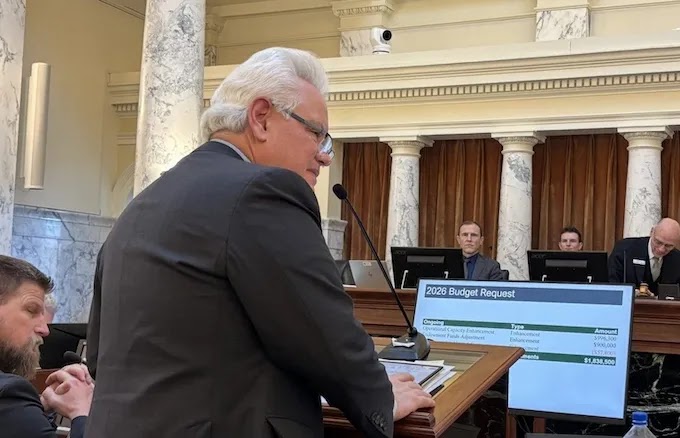
    In testimony Monday before a joint committee of the Idaho
    legislature, University of Idaho president C. Scott Green seemed a
    little less committed to the deal he has relentlessly touted for more
    than a year and a half — for his school to buy, for $685 million, the
    huge for-profit University of Phoenix from private equity giant Apollo
    Global Management.

    According to Idaho Education News, Green said the next move was Apollo’s. “We’re waiting to hear what they would like to do,” Green said.

    Green’s plan has been thwarted again and again, with negative votes in the Idaho legislature, a successful court challenge by the state’s attorney general, criticism from the state treasurer, and sharp scrutiny from news outlets in the state.

    The Green school deal has assumed that operation of Phoenix would
    bring millions in new revenue to fund his university. But it ignores
    that running a for-profit college, one that has repeatedly gotten in trouble with law enforcement,
    would be a tremendous challenge: If Green pushed to end Phoenix’s
    predatory practices and improve student outcomes, it probably would
    start losing money, because predatory practices, coupled with high
    prices and low spending on education, have made up the school’s secret
    sauce. But if Green allowed the deceptive conduct to persist, the school
    could face more legal peril. And, whatever route he took, Green’s
    school might end up assuming massive liability for student loan debt the
    government has cancelled based on past abuses at Phoenix.

    At its peak, Phoenix was the largest for-profit college in the
    country and got upwards of $2 billion a year in federal student aid,
    while boasting dismal graduation rates and high levels of loan defaults.

    Last summer, the University of Idaho and Apollo agreed to a one-year extension of their purchase deal. That arrangement expires June 10. Meanwhile Apollo has the right to talk with other potential buyers.

    Apollo already has sent Idaho $5 million to cover the school’s
    high-priced legal and consulting fees in connection with the deal, and
    it has agreed to pay up to $20 million to Idaho if the deal falls
    through.

    Green told the legislature that $20 million would cover his school’s
    costs with perhaps $2 to $3 to spare. “I think we’re well-protected,” he
    boasted.

    Kind of. Green, whose background is in corporate management and
    finance, could potentially walk away without losing money for the
    school. But he has tied up state university, executive, legislative, and
    judicial resources for many hundreds of hours jousting over an effort
    that would keep alive a predatory school that has buried thousands of
    graduates in debt they can’t afford to repay, while wasting billions in
    federal taxpayer dollars, when that time could have been focused on the
    real challenges of state higher education.

    If Idaho can’t work out a deal, Apollo may run out of options to dump
    the school, and this taxpayer-funded multi-billion dollar disgrace may
    at last be put down.

    [Editor’s note: This article originally appeared on Republic Report.] 

    Source link