Tag: pick

  • At Nassau CC, Rejected Presidential Pick Prompts Lawsuit Threat

    At Nassau CC, Rejected Presidential Pick Prompts Lawsuit Threat

    Trustees at Nassau Community College are poised to file a lawsuit after the State University of New York’s Board of Trustees denied their presidential pick.

    At a special meeting on Sunday, the Nassau Community College Board of Trustees unanimously voted to allow the board chair to file a lawsuit challenging the SUNY board’s decision, with one board member absent, Newsday reported. Earlier this month, SUNY trustees voted unanimously, with three members absent, to reject Maria Conzatti, who has run the college as interim or acting president for almost four years. A SUNY official told Newsday it was the first time the system’s board disapproved a presidential nominee.

    The resolution voted on asked that Conzatti’s appointment by Nassau Community College’s board be “disapproved” with no further explanation.

    “SUNY is committed to excellent leadership for all of our campuses and the success of our students, and we will vigorously defend ourselves against any frivolous lawsuit,” a spokesperson for the system said in a statement to Inside Higher Ed.

    The college’s Student Government Association also passed a measure on Monday expressing “gratitude and appreciation” for Conzatti while also acknowledging the SUNY board vote and encouraging the college to “conduct an equitable, transparent and expeditious search for a new permanent president.”

    The conflict comes amid broader tensions between the college’s faculty union and the administration over the consolidation of academic departments and a union contract that expired in August, among other issues. The union sued the college last year arguing the elimination of 15 department chairs violated state regulations, but a judge dismissed the case. The union has since appealed.

    Nassau has also reported less-than-optimal student outcomes in recent years. It has the lowest two-year graduation rate and second lowest three-year graduation rate among community colleges in the SUNY system, 9.4 percent and 23.6 percent respectively.

    Source link

  • AI Teaching Learners Today: Pick Your Pedagogy

    AI Teaching Learners Today: Pick Your Pedagogy

    University budgets across the country are broken. Overall revenue and accumulated financial support appear to be declining for a wide variety of reasons.

    New funding policies, administrative reorganizations such as those at the Department of Education, lean fiscal times for states, diminished regard for higher learning, fewer requirements for degrees among employers hiring for entry-level positions and the impact of artificial intelligence all come together to reduce the pool of new students, tuition revenues and grants. As a result, new initiatives are stifled unless they show promise to immediately reduce costs and generate new revenue.

    The cost of developing, designing and teaching classes is often largely determined by the faculty and staff costs. Long-running lower-division classes at some universities may be taught by supervised teaching assistants or adjunct faculty whose salaries are lower than tenure-track faculty’s. However, we are now confronted with highly capable technologies that require little to no additional investment and can bring immediate revenue positive opportunities. Each university very soon will have to determine to what extent AI will be permitted to design and deliver classes, and under what oversight and supervision.

    However, few of us in higher ed seem to realize that such technologies are freely available today. The tsunami of new and improving AI technologies has inundated us over the past three years so quickly that many in academe have not been able to keep up.

    Case in point is the rapidly expanded and enhanced AI app. We know them by the names Gemini, ChatGPT, Claude and a few others that we tried out in 2023 or 2024. Early on, they were deficient in many ways, including hallucinations and a strictly limited number of words you could put into a prompt. That has largely changed, though hallucinations can still happen—which is why it is good practice to compare prompts submitted at multiple sites, as has been suggested previously in this column.

    AI is now capable of teaching higher learners in a highly sophisticated way. Given a thoughtful, detailed prompt, it is able to implement most of the proven pedagogical approaches, many of which are unknown to our teaching faculty. It is able to dig more deeply into a topic with more recent data than many of the faculty members are using. It can interpolate, extrapolate and pursue conjectures to their statistical conclusions, revealing unexpected outcomes. It can be friendly, supportive, patient and also challenging at the appropriate times.

    My point is that the prompt today can be a most powerful teaching tool that can consistently create a robust, engaging learning environment. It can even offer material through a variety of pedagogies. A well-written, detailed prompt can be the equal of many of our teaching assistants, adjunct faculty and, yes, full-time faculty members who have not been deeply trained in effective pedagogy and current practice.

    Let’s test out one of these technologies right now!

    This one below, shared by the “There’s an AI for That” newsletter, provides an online tutor to teach students using an assortment of time-tested technologies and pedagogies. The first step begins with merely a prompt, albeit not a short one. The Interactive Learning Tutor is a virtual instructor that runs on the leading frontier AI app models (Gemini, ChatGPT and Claude). Most interesting is not only the vast range of topics it is prepared to deliver, but the range of pedagogies it will enable at the request of the learner. So, the learner can pick their pedagogy rather than being subject to the designer’s and instructor’s choice of teaching and learning methods.

    This prompt turns AI into a dual-role system that first helps learners choose the most effective study techniques for their subject, then switches into live teaching using those chosen methods. In Navigator Mode, the system gathers details about what the user wants to learn and how they prefer to learn it, then presents a curated set of three to five evidence-based methods from its catalog. Each method is explained in depth, with strengths, limitations, step-by-step applications and concrete examples tied to the user’s subject. It also suggests learning archetypes, outlines pitfalls and fixes, creates an integrated action plan, and provides tools like reflection prompts, comparison tables, and pathways matrices to help learners see their options clearly.”

    This is a highly qualified virtual teaching assistant, eager and well prepared to take on the task of teaching an individual in an online tutorial or class. Imagine 30 students, with a week or so initial orientation, running this app to achieve specified learning outcomes in an engaging, interactive way. The materials provided in the individual tutorial could be augmented through a syllabus of supplementary readings, reference materials and periodic assessments leading up to a final project or paper to be submitted individually or by groups in the class. The prompt and app take over the most important role of engaging and guiding the student in ways proven to be successful.

    So, let’s give this a road test! Step one is to copy the 1,112-word prompt that begins with and ends with . Paste this into the input box of your chosen AI app and press enter. After a brief moment for processing, the app will reply with an invitation to share the topic about which you would like to learn. This would be defined by the instructor of the course along with the learning outcomes for the class. As an enthusiastic learner who is going to attend an outdoors bluegrass music festival today, I typed in, “I want to learn about bluegrass music, including how it evolved, its popularity, the geographic range of its performance, the instruments used and cultural impact.” Including such learning outcomes will streamline the process for later assessments.

    Gemini replied, “That’s a fantastic topic! Bluegrass music has a rich history and a vibrant culture. We can definitely break down its evolution, instruments, and cultural impact.” Gemini went on to write,

    Now, to help me suggest the best learning methods for you, could you tell me a bit about how you prefer to learn? For example, when you’re trying to understand something new, do you find it helps to:

    • Discuss it and ask lots of questions?
    • Organize information visually, maybe with timelines or diagrams?
    • Listen to examples (like different songs) and connect them back to the concepts?
    • Try to explain it to someone else to make sure you’ve grasped it?

    Gemini also offered a personalized action plan to set the schedule.

    Integrated Action Plan

    • Immediate Actions (First 1-2 Hours): Use the Socratic method to generate a list of foundational questions about bluegrass. Use dual coding to create a simple timeline of major events (e.g., Bill Monroe forms the Blue Grass Boys, Earl Scruggs joins, the Newport Folk Festival).
    • Medium-Term Actions (First Week): Use the Storytelling method to weave those timeline events into a narrative about the birth of the genre. Pick one specific concept (e.g., “the high lonesome sound”) and use the Feynman technique to explain it in your own words.
    • Long-Term Actions (Ongoing): Continue to build out your visual library (dual coding) with instrument diagrams and regional maps. As you learn more, continuously refine your core story (Storytelling) and test your understanding of complex subtopics (Feynman technique).

    Further details were shared by Gemini in table format to ensure that the learner understood the different approaches. Then it gave me, the learner, the chance to affirm that I wanted to blend those modes. And then we were off and running.

    This format seems ideal to prototype just-in-time certificate programs, over-demand programs where insufficient numbers of faculty are readily available and other instances where time or finances may not permit full design and teaching staffing. Carefully monitor each student by asking them to share their exchanges with the app. Be vigilant to protect the learner’s FERPA rights. Use secure methods for quizzing and other assessments. Compare the outcomes to other such classes and gather feedback from the participating learners. Modify the original prompt to meet your needs and refine the results for the next offering.

    Source link

  • HBCUs Await Trump’s Pick to Lead White House Initiative

    HBCUs Await Trump’s Pick to Lead White House Initiative

    President Donald Trump issued an executive order in April promising to “elevate the value and impact” of the country’s historically Black colleges and universities—in part by selecting an executive director for the White House Initiative on HBCUs and a President’s Board of Advisors on HBCUs.

    But four months later, eight months into his second term, these roles remain unfilled.

    Some HBCU advocates say months-long waits are business as usual for these positions, and they remain confident in Trump’s support for HBCUs. Others worry that HBCUs lack their most direct line of communication to the White House at a time of rapid-fire higher ed policy changes.

    Since the 1980s, the executive director of the HBCUs initiative, established by President Jimmy Carter, has been responsible for advocating for HBCUs’ federal policy interests. The President’s Board of Advisors offers guidance to government officials about how to better support and strengthen these institutions.

    Appointees serve as HBCUs’ “in-house advocates,” said Ivory A. Toldson, a professor of counseling psychology at Howard University and editor in chief of The Journal of Negro Education. He served as deputy director of the White House Initiative on HBCUs from 2013 to 2015 and as executive director from 2015 to 2016 under former president Barack Obama. The director and board have historically sought out federal funding and partnership opportunities for these institutions and “made sure that executive-level priorities were shaped in a way that understood the needs of HBCUs.”

    Toldson said there are likely to be “missed opportunities” for HBCUs during the limbo period before an executive director is chosen. He said it’s easy for federal agencies, like the National Science Foundation or the National Institutes of Health, to overlook smaller HBCUs for grants when no one is there to champion them.

    “By them not having representation within the federal government, it becomes difficult for them to advocate effectively for their needs,” he said.

    Robert Palmer, chair of the education department at Howard, said he worries HBCUs don’t have their “earpiece” to the Trump administration at a time when policy shifts, such as upcoming changes to the student loan program, will affect HBCU students.

    The unfilled roles are “quite concerning,” Palmer said. “It almost makes you wonder, is it a priority for him? Because that’s what it signals—that it’s not a priority.”

    Mixed Views

    Other HBCU advocates don’t see a problem. Lodriguez Murray, vice president of public policy and government affairs at the United Negro College Fund, which represents private HBCUs, said he isn’t troubled by the wait because organizations like his have still been able to have “high-power and high-level discussions” with the White House and Department of Education.

    “We’ve been able to get every concern addressed. We’ve been able to get every email returned. We’ve been able to get every meeting request handled,” he said. “The house is not burning down for us. And I have seen no lack of continuity and engagement on our issues at the highest levels.”

    He said it’s more meaningful to him that Trump issued an executive order reaffirming the White House Initiative on HBCUs within his first 100 days and fully funded HBCUs in his proposed budget. He’d also rather the administration take its time to pick “the right individuals” to fill these roles.

    “There have been many individuals who have had the role of executive director of the White House initiative on HBCUs [who] have fallen below what the expectations are of this community,” Murray said. “And so, if the White House is attempting to find the right person to meet a moment and to meet expectations, that’s fine with me.”

    Trump’s pick for executive director during his first term, speaker and consultant Johnathan Holifield, was met with mixed reactions by HBCU supporters because of his lack of prior experience with these institutions. Former president Obama also received criticism for some of his executive director choices, including multiple interim appointments between permanent directors.

    Murray said he’s hoping for someone “with the president’s confidence” who can help bring Trump’s plans to support HBCUs to fruition and who can simultaneously “speak truth to power and express to the president the concerns of HBCUs.”

    For Toldson, “institutional knowledge of HBCUs” and an “apolitical” approach will be critical to a new executive director’s success to avoid HBCUs getting mired in the anti-DEI crusade besieging other higher ed institutions.

    “Regardless of who’s in office, we need representation, and I think that the right representation would be able to balance the needs of the HBCU community with the broader direction of the government,” Toldson said.

    Mounting Anticipation

    Harry Williams, president and CEO of the Thurgood Marshall College Fund, which represents public HBCUs, said the amount of time it takes for presidents to fill these roles has varied historically. HBCUs have often waited months for these appointments, so the current timeline isn’t out of the ordinary, he said. Former president Joe Biden didn’t officially name an executive director until February 2022, a little over a year after his inauguration.

    Still, a long wait “creates uncertainty, and it creates anxiety,” Williams said.

    “We’ve gotten good information that this is something that will happen, but the timing of it has always been the challenge,” he added. TMCF is reassuring campuses that the administration plans to fill these positions, “but we don’t know exactly when.”

    David K. Wilson, president of Morgan State University, said he and other HBCU presidents are eager to get started on making the promises in Trump’s executive order a reality. They were glad to see the order call on federal agencies, businesses and foundations to partner with and invest more in HBCUs.

    Wilson said he hopes to see these positions filled soon “so that we can begin to express directly to the White House what some of the opportunities are for continued investment in these institutions.”

    “All of them will return unbelievable dividends to the nation,” he added.

    Wilson noted that Howard University recently regained Research-1 status, the coveted Carnegie Foundation classification for universities with very high research activity. Other HBCUs, including Morgan State, are poised to follow in the coming years. He wants to see appointees in place who can help maintain that momentum.

    “We can’t wait to see now what this next era of HBCU investments under the Trump administration will look like,” he said. “We were on a roll, and now the question is, can we roll faster?”

    Source link

  • Weekend Reading: From AI prohibition to integration – or why universities must pick up the pace

    Weekend Reading: From AI prohibition to integration – or why universities must pick up the pace

    • This HEPI guest blog was kindly authored by Mary Curnock Cook CBE, who chairs the Dyson Institute and is a Trustee at HEPI, and Bess Brennan, Chief of University Partnerships with Cadmus, which is running a series of collaborative events with UK university leaders about the challenges and opportunities of generative AI in higher education.

    Are universities super tankers, drifting slowly through the ocean while students are speedboats, zipping around them? That was one of the most arresting images from the recent Kings x Cadmus Teaching and Learning Forum and captured a central theme running through the Forum: the mismatch between the pace of technological and social change facing universities and the slow speed of institutional adaptation when it comes to AI.

    Yet the forum also highlighted a fundamental change in how higher education institutions are approaching AI in assessment – moving from a reactive, punitive stance to one of proactive partnership, a shift from AI prohibition to integration. As speaker after speaker acknowledged, the sector’s initial approach of trying to detect and prevent AI use has been shown to be both futile and counterproductive. As one speaker noted, ‘we cannot stop students using AI. We cannot detect it. So we have to redefine assessment.’

    From left to right: Mary Curnock Cook, Professor Andrew Turner, Professor Parama Chaudhury, Professor Timothy Thompson. Source: Cadmus

    This reality has forced some institutions to completely reconceptualise their relationship with AI technology in order to work with the tide rather than against it. Where AI was viewed as a threat to academic integrity, educators are beginning to see it as an inevitable part of the learning landscape that calls for thoughtful integration, not least so that students are equipped for change and the AI-driven workplace. For example, Coventry University has responded by moving its assessment entirely to a coursework-based approach, except where there are Professional, Statutory and Regulatory Body (PSRB) requirements, and explicitly allows the use of AI, in most cases, to assist. 

    Imperial College’s approach exemplifies this new thinking with its principle of using AI “to think with you and not for you.” This approach recognises AI as a thinking partner rather than a replacement for human cognition, fundamentally changing how universities structure learning experiences. The shift requires moving from output-focused assessment to process-based evaluation, where students must demonstrate their thinking journey alongside their final products.

    Like many universities, Imperial is also concerned about equity of access to AI. As a baseline it offers enterprise access to a foundational LLM with firewalled data, Copilot, which ringfences the data within the institution. But it also has a multi-LLM portal pilot, which includes ChatGPT, Claude, Copilot, Gemini and DeepSeek, acting as an AI sandpit to help instil a culture of thinking of the LLMs as different tools to be experimented with – users can switch between them and ask them the same question to see the variation in results. Meanwhile, LSE has partnered with Anthropic to offer all students free access to Anthropic’s Claude for Education, which helps students by guiding their reasoning process, rather than simply providing answers.

    Practical implementation challenges

    This transition to integration requires practical frameworks that many institutions are still developing. A speaker voiced the sector’s uncertainty as: ‘We do not know the next development – we didn’t see this one coming.’ This unpredictability leads to what was termed ‘seeking safety in policy’ – a tendency to over-regulate when the real need is for adaptive frameworks.

    The challenge of moving beyond traffic light systems (red/amber/green classifications for AI use) emerged repeatedly. These systems, while intuitive, often leave educators and students in the ambiguous amber zone without clear guidance: ‘everyone falls in the middle. You cannot do the red stuff but how do you enforce that? What do we really mean by the green stuff?’ Instead, some institutions are moving towards assessment-specific guidance that explicitly states when and how AI can be used for each task.

    Cultural and systemic transformation

    This technological shift demands profound cultural change within institutions. As one participant observed, ‘Culture change is being driven by students. Academics may not want to change but they no longer have a choice if they’re getting assessments written by AI – or they don’t know if the assessments are written by AI’. The pace of student adoption is outstripping institutional adaptation, creating tension between established academic practices and emerging student behaviours – those speedboats and super tankers again.

    However, while the magnitude of the challenge calls for institutional-scale change and moving beyond individual innovations to systemic transformation, super tankers don’t turn quickly.

    Strategic approaches to change at scale

    Several institutions shared their successful strategies for managing large-scale change. The key appears to be starting with early adopters and building momentum through demonstrated success. As Cadmus founder Herk Kailis noted, change champions are: ‘the best people who are keeping the sector evolving and growing – and we need to get behind them as there aren’t that many of them.’ Imperial’s approach of appointing ‘AI futurists’ in each faculty demonstrates how institutions can systematically seed innovation while maintaining a connection to disciplinary expertise.

    Another speaker observed that successful change requires ‘recognising the challenges and concerns of academic colleagues, bringing them together, supporting colleagues in making the changes they want.’ At Maynooth University, incentives for staff, such as fellowships and promotion pathway changes, rather than mandates, draws on the notion that ‘you can’t herd cats but you can move their food’.

    Cross-institutional collaboration

    The forum emphasised that institutional change cannot happen in isolation. The complexity of stakeholder groups – from faculty leads to central teams to students and student-facing services – requires sophisticated engagement strategies. As one participant noted about successful technology implementation: ‘Pilots don’t work if they are isolated with one stakeholder group. You need buy-in from all the groups.’

    The call for sector-wide collaboration extends beyond individual institutions to include professional bodies, regulatory frameworks and quality assurance processes – QA must also keep up with the pace of change. PSRBs, in particular, were singled out as a blocker to change.

    International networking is also important. For example, UCL is working with Digital Intelligence International Development Education Alliance (DI-IDEA) from Peking University, which is experimenting with AI in education in innovative and accelerated ways.

    Building sustainable change

    Perhaps most importantly, the forum recognised that sustainable institutional change requires long-term commitment and resource allocation, and this imperative could arguably not have come at a more difficult time for many HE institutions. The observation that ‘There’s never been a greater need and appetite from staff to engage with this at a time when resourcing in the sector is a real problem’ highlights the tension between ambition and capacity that many institutions face.

    However, the success stories shared – such as Birmingham City University’s Cadmus implementation saving 735.2 hours of academic staff time while improving student outcomes – demonstrate that institutional change, while challenging, can deliver measurable benefits for both educators and learners when implemented thoughtfully and systematically.

    Three recommended actions from the forum

    1. Address systemic inequalities, not just assessment design

    Research from the University of Manchester shared at the conference showed that 95% of differential attainment stems from factors beyond assessment itself – cultural awareness, digital poverty, caring responsibilities and lack of representation.

    Action: Take a holistic approach to student success that addresses the whole student experience, implements universal design principles, and recognises that some students are ‘rolling loaded dice’ in the academic game of privilege. Don’t assume assessment reform alone will solve equity issues.

    2. Reduce high-stakes assessment

    Traditional exam-heavy models risk perpetuating inequalities and don’t reflect workplace realities. Multiple lower-stakes assessments can support deeper learning and may be more equitable.

    Action: Systematically reduce reliance on high-stakes exams in favour of diverse and more authentic assessment methods. This helps to address both AI challenges and equity concerns while better preparing students for their futures.

    3. Co-create with students as partners

    Students are driving the pace of change – they are already using AI. They need to be partners in designing solutions, not just recipients of policies.

    Action: Involve students in co-designing assessments, rubrics and AI policies. Create bi-directional dialogue about learning experiences and empower students to share learning strategies. Build trust through transparency and genuine partnership.

    Source link

  • College Students Pick up Pickleball for Community, Wellness

    College Students Pick up Pickleball for Community, Wellness

    Like many elements of a college student’s life, sports and physical activities are tied to trends.

    In the early 2000s, young adults led the way in out-of-the-box fitness fads, including Zumba dance fitness and Quidditch—now called quadball. Nowadays, college students are more drawn to Pilates, hot yoga and rock climbing, but lately one trend dominates all: pickleball.

    The Sports and Fitness Industry Association (SFIA) found that pickleball is the fastest-growing sport in America, with the number of players growing 233 percent in three years; every age group has seen increased participation. Young adults (ages 25–35) now make up the largest share of participants at 2.3 million players, according to SFIA.

    Behind the trend: Mark Chang, an associate professor at SUNY Brockport, is currently researching young people’s interest in pickleball. Chang’s initial screening survey of students from SUNY Brockport found multiple factors motivate participation.

    “They want to master some kind of skill, they want to win some kind of game and they want to be connected and engage socially,” Chang said.

    One of the reasons pickleball is so popular is because it’s relatively easy to engage in, featuring a smaller court than tennis, low-budget equipment and simple rules. Pickleball is most often played in doubles and doesn’t require high levels of exertion, making it a social and low-intensity sport.

    Students who have experience playing tennis, racquetball or similar sports are also more likely to play because of the similarities, Chang said.

    Social media may play a role in driving student participation because it gives them a connection point with other peers online, Chang said, but students more commonly cited goals like maintaining health, learning something new and having fun with friends.

    Funding fun: As demand grows, colleges are building pickleball courts to accommodate student preferences and encourage them to be physically active. The University of the Pacific was the first college to open a pickleball and padel complex in 2024.

    In the last 12 months, Arkansas Tech University, Eastern Mennonite University, Eastern Illinois University, Columbus State University, Wright State University, Penn State University, Duke University, Troy University, the University of Alabama, Tulane University and Baylor University have all announced plans to open, create or renovate spaces to accommodate pickleball players.

    Alabama spent $1.6 million to put in 10 new pickleball courts at the tennis facility, which the vice president of student life Steven Hood told AL.com was in response to recreation trends.

    “These courts appeal to a broad demographic, even some of our students who may not be as familiar with fitness and recreation,” Hood said. “It’s a great opportunity to connect and engage students promoting physical activity.”

    Nationally, the number of pickleball courts has also exploded, growing 55 percent year-over-year in 2024. As of this year, the USA Pickleball court location database identifies 15,910 courts.

    Most campuses with pickleball courts provide racquets and balls at no cost to students, faculty or staff through recreation offices.

    Survey Says

    A 2023 Student Voice survey by Inside Higher Ed and College Pulse found 57 percent of college students want to work on getting more exercise and 43 percent want to spend more time outside.

    When asked how their campus could improve, 23 percent of students said their campus wellness facilities or wellness class offerings could be better. By comparison, 27 percent said their college wellness facilities were satisfactory and 26 percent said fitness class offerings were also done well.

    Promoting student success: Pickleball offers several opportunities for student well-being on campus. Pickleball club membership unites students of similar interests, providing a space for physical activity and community belonging and connection.

    USA Pickleball lists 212 collegiate pickleball clubs across the country, from the University of Alaska Fairbanks to Colby College in Maine and Florida’s University of Miami, and almost every state in between. As of 2024, the University of Florida had over 400 members in its pickleball club, up from 200 in 2022. Cornell University launched a student pickleball club in 2024, which has 200 pickleballers participating each week.

    Students can also profit financially from their involvement in pickleball. After winning the collegiate pickleball championship, the University of Virginia’s pickleball club evolved into a five-person student-run business to manage name, image and likeness deals. Students at Utah Tech University can also receive scholarships for competing in pickleball tournaments or holding a leadership position in the club.

    Additionally, pickleball spaces have driven student interest in recreational facilities at some institutions. Whittier College had its inaugural intramural pickleball season this past fall, adding to the college’s four other intramural sports, as well as a staff-versus-student kickball game. Columbus State University leaders hope involvement in pickleball translates to student participation in intramural sports leagues or tournaments.

    Campus pickleball tournaments also promote community engagement. The University of Southern Indiana’s Alumni Pickleball Tournament introduced students to mentors, encouraging engagement on campus.

    Source link

  • USF Ditches Search Firm That Helped U of Florida Pick Ono

    USF Ditches Search Firm That Helped U of Florida Pick Ono

    Bryan Bedder/Stringer/Getty Images

    The University of South Florida has dropped SP&A Executive Search as the firm leading its presidential search, The Tampa Bay Times reported Tuesday. The move comes after the Florida Board of Governors rejected the candidate that SP&A had helped the University of Florida pick for its top job: former University of Michigan president Santa Ono, whom the UF board unanimously approved.

    Ono’s rejection came after conservatives mounted a campaign opposing him, citing his past support of diversity, equity and inclusion and his alleged failure to protect Jewish students.

    After that failed hire, Rick Scott, a Republican U.S. senator representing Florida, blamed SP&A, telling Jewish Insider that the firm didn’t sufficiently vet Ono.

    SP&A describes itself on its website as a “boutique woman- and minority-owned executive search firm.” Scott Yenor—a Boise State University political science professor who resigned from the University of West Florida’s Board of Trustees in April after implying that only straight white men should be in political leadership—highlighted that description in an essay he co-wrote, titled “How did a leftist almost become president of the University of Florida?”

    “We can only speculate about how the deck was stacked,” Yenor and Steven DeRose, a UF alum and business executive, wrote. “SP&A colluded with campus stakeholders, especially faculty, when they were retained. Together, they developed the criteria necessary to hire a Santa Ono.”

    They also pointed out that SP&A was leading the USF search. SP&A didn’t respond to Inside Higher Ed’s requests for comment Wednesday.

    USF didn’t provide an interview or answer written questions. In a June 20 statement, USF trustee and presidential search committee chair Mike Griffin said the university was now using the international firm Korn Ferry.

    “We value the expertise of our initial search consultant and thank them for their engagement,” Griffin wrote.

    Source link

  • Senate Dems Grill Trump’s Pick to Lead Civil Rights Office

    Senate Dems Grill Trump’s Pick to Lead Civil Rights Office

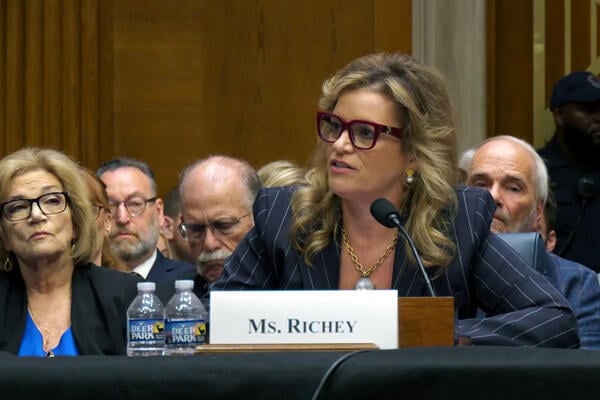
    Kimberly Richey, a Florida education official, made her case Thursday about why she should lead the Education Department’s Office for Civil Rights, pledging “unwavering” support of the administration’s priorities such as protecting Jewish students.

    “Should I be confirmed as assistant secretary for civil rights, I will proudly be joining an administration that will not allow students to be intimidated, harassed, assaulted or excluded from their institutions,” she said in her opening remarks.

    But repeatedly throughout the hearing, Democratic senators interrogated her on how she plans to address a massive backlog in complaints—which one senator said has more than doubled since Trump took office, to 25,000—with a reduced staff.

    “This administration has fired more than half of the staff at OCR, and President Trump is now asking, in his budget, to slash that by $49 million next year, so explain to me how those firings and that funding cut will help reduce that backlog? I want to understand how you’re going to square that circle,” Sen. Patty Murray, a Democrat from Washington, asked early on in the hearing.

    Richey mostly avoided answering the questions, arguing that she had not yet assumed the role of assistant secretary and, therefore, had no say in the recent changes to OCR.

    “As a nominee, I do not have access to information with regard to the decisions that are being made at the department,” Richey responded. “I’m not in communication with OCR leadership or the secretary. One of the reasons why this role is so important to me is because I am always going to advocate for OCR to have the resources it needs to do its job. I think that what it means is I’m going to have to be really strategic, if I’m confirmed, stepping into this role, helping come up with a plan where we can address these challenges.”

    Several others doubled down on Murray’s line of questioning, including Sen. Andy Kim, a New Jersey Democrat, who asked Richey if antisemitism was getting worse in America. When she said it was, he questioned how cutting OCR staff is conducive to fighting antisemitism on college campuses. She reiterated her answer to Murray’s question, saying, “I can’t explain or provide information on decisions I wasn’t involved in.”

    Richey was one of four people who testified Thursday before the Senate Health, Education, Labor and Pensions Committee. She and the nominee for deputy secretary of education, Penny Schwinn, fielded the bulk of the committee’s questions as lawmakers pressed for answers about the OCR’s operations and priorities, proposed budget cuts, and the president’s plans to dismantle the Education Department. The senators didn’t vote on whether to advance the nominations to the Senate floor; that step will likely occur at a later meeting.

    Richey is currently senior chancellor for the Florida Department of Education and has twice served in OCR before, including a brief stint as acting secretary of civil rights at the end of Trump’s first term and the beginning of Biden’s presidency. Her confirmation hearing comes months after the Trump administration slashed more than half of OCR’s staff, including shuttering seven of the 12 regional offices dedicated to investigating complaints. The office has also reportedly begun prioritizing opening cases regarding trans women athletes and antisemitism since Trump’s second term began, letting other cases pile up and go unaddressed, according to multiple news reports.

    In the confirmation hearing, Richey expressed strong support for those causes, stressing that she led OCR when it investigated one of the federal government’s earliest cases against a school for allowing a trans woman to play on a women’s sports team.

    “I’m certainly committed to vigorously enforcing it and continuing to pursue these cases,” she said.

    In response to a different question, though, she did say that OCR would investigate certain complaints of discrimination related to gender identity and sexual orientation—an answer that appeared to incense Republican senator Josh Hawley of Missouri.

    “I want to be crystal clear on this—I think it’s a very dangerous thing to start allowing this into Title IX, which, as you know, it is a landmark statute, it is vitally important, and it has been under attack for four long years,” he said, asking her to confirm that OCR will “go after” colleges and universities that allow trans women to play women’s sports.

    He also warned Richey that she should “rethink” her position that OCR can investigate discrimination based on gender identity.

    Sen. Angela Alsobrooks, a Democrat from Maryland, pressed Richey on whether she would continue OCR’s new system of prioritizing cases regarding antisemitism and trans athletes, asking if all forms of discrimination should be treated with equal importance.

    Richey told Alsobrooks she does believe “it’s important to vigorously enforce all of the federal laws that OCR is responsible for enforcing.” Later in the hearing, she noted that Education Secretary Linda McMahon is “prioritizing” removing trans women from women’s athletics, and she plans to do the same if confirmed.

    Schwinn, who was formerly Tennessee’s commissioner of education, received most of the panel’s questions about the Trump administration’s efforts to dismantle the education department. In response a question from Sen. Jim Banks, an Indiana Republican, about what steps would be required to dismantle the department, she stated that she “would certainly work, if confirmed, with the secretary and with Congress on any actions related to the role of the department” and that she believes in equipping states with legislation and funding that will help them improve their own educational systems.

    “A department or an agency in the federal government is not going to change the outcomes of students—the teacher in the classroom is going to teach the standards that are approved by that state. The parent is the parent of that child. What we need to do is ensure we’ve created a system that is going to drive outcomes,” she said. “That is not going to happen from the federal government, whether there is a Department of Education or not.”

    Source link

  • Trump attacks DEI; faculty pick between silence, resistance

    Trump attacks DEI; faculty pick between silence, resistance

    Republicans in red states have been attacking diversity, equity and inclusion in higher education for years. But when Donald Trump retook the White House and turned the federal executive branch against DEI, blue-state academics had new cause to worry. A tenured law professor in the University of California system—who wished to remain anonymous for fear of retaliation and harassment—said they read one of the executive orders that Trump quickly issued on DEI and anticipated trouble.

    “Seeing how ambiguous it is with respect to how they are defining diversity, equity and inclusion, and understanding that the ambiguity is purposeful, I decided to take off from my [university website] bio my own specialty in critical race theory, so that I would not be a target either of the [Trump] administration or of the people that they are empowering to harass,” the professor said.

    The professor said they also told their university they’re not interested in teaching a class called Critical Race Theory for the rest of the Trump administration. They said they faced harassment for teaching it even before Trump returned to the presidency. “A lot of law schools also have race in the law classes, we have centers that are focused on race,” the professor said. “And so all of these kinds of centers and people are really, really concerned—not just about their research, but really, again, about themselves—what kind of individualized scrutiny are they going to get and what’s going to happen to them and their jobs.”

    Given all that, self-protection seemed important. “Things are going to get much worse before they get better,” the professor said, adding that “people are very scared to draw attention to their work if they’re working on issues of race. People like me are pre-emptively censoring themselves.”

    Other faculty, though, say they’re freshly emboldened to resist the now-nationalized DEI crackdown. One with tenure declared it’s time to “take it out and use it.” Inside Higher Ed interviewed a dozen professors for this article, including some at institutions that have seen changes since Trump’s return to office, to see how the crackdown is, or isn’t, affecting them and their colleagues. Their responses range from defiance to self-censorship beyond what Trump’s DEI actions actually require, but all share concern about what’s yet to unfold.

    Diversity, Equity and Confusion

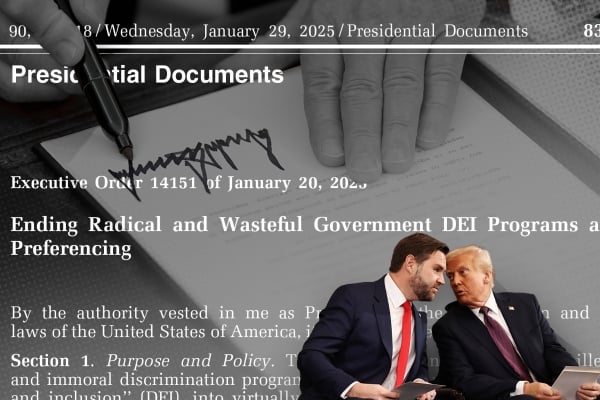
    Trump’s efforts to eradicate DEI began on Inauguration Day, with the returning president issuing an executive order that called for terminating “all discriminatory programs, including illegal DEI” across the federal government. The dictate went on to state that these activities must be stamped out “under whatever name they appear.”

    That order didn’t specifically mention higher education, but the one Trump signed the following day did. It directed all federal agencies “to combat illegal private-sector DEI” programs, demanding that each agency identify “potential civil compliance investigations”—including of up to nine universities with endowments exceeding $1 billion.

    That was Week One. Week Two began with news of a DEI-related funding freeze whose scope was simultaneously sweeping and confusing. A White House Office of Management and Budget memo told federal agencies to pause grants or loans. The office said it was trying to stop funding activities that “may be implicated by the executive orders,” including DEI and “woke gender ideology.”

    Federal judges swiftly blocked this freeze. The Trump administration rescinded the memo. Nevertheless, the White House press secretary wrote on X that “This is NOT a rescission of the federal funding freeze.”

    The White House didn’t respond to a request for comment for this article. While college and university DEI administrators and offices may feel the brunt of the anti-DEI crusade as these positions and entities are eliminated, the campaign could also cast a pall over faculty speech and teaching.

    “This administration does not seem to care about the Constitution or about the existing law,” the anonymous law professor said, adding that “I think, unlike ever before in my own lifetime, I don’t feel safe or secure or I don’t feel the safety of the Constitution in the way that I have in the past.”

    Vice President JD Vance has called professors “the enemy.” The professor said this “has really empowered a lot of civil society to see us as the problem.”

    But Jonathan Feingold, an associate professor at the Boston University School of Law who’s on the cusp of earning tenure and says he’ll continue to teach critical race theory, is counseling against what he and others have called “anticipatory obedience” to Trump.

    “What I am seeing anecdotally reported across the country is universities either scrubbing websites or even potentially shuttering programs or offices,” Feingold said. But he said of the Jan. 21 anti-DEI executive order that “with respect to DEI, there is nothing in it that I see that requires universities to take any action. It certainly is rhetorically jarring and should be understood as a threat, but I don’t see anything that should compel institutions to do anything.”

    “The executive order does not define what Trump is saying is unlawful,” Feingold said. He noted it “almost always is attaching to DEI the term ‘illegal’ or ‘unlawful’ or ‘discriminatory’—which, I believe, is a recognition that DEI-type policies of themselves are not unlawful.” He said the order “rehearses the same racist-laden, homophobic-laden, anti-DEI talking points that the Trump administration loves to go to, but, if you read it closely, it reveals that even the Trump administration recognizes that under existing federal law, most of the DEI-type programs that universities have around the country are wholly lawful.”

    The bottom of that executive order also lists a few carve-outs that may limit the impact on classrooms. The exceptions say the order doesn’t prevent “institutions of higher education from engaging in First Amendment–protected speech,” nor does it stop educators at colleges and universities from, “as part of a larger course of academic instruction,” advocating for “the unlawful employment or contracting practices prohibited by this order.”

    While Feingold said the order doesn’t have teeth, he nevertheless thinks “it’s a very, very dangerous moment right now for faculty members to do their job because the administration is making very clear that it is not OK with any political opposition.” But, he said, “Voluntary compliance is a foolish strategy, given that Trump has telegraphed that he views an independent, autonomous higher education as an enemy. And so I think it’s foolish to think that scrubbing some words on a website are going to satiate what appears to be a desire to suppress any sort of dissenting speech.”

    Still, scrubbing is happening.

    Scrubbing Words

    A few days after Trump’s executive orders, Northeastern University, also in Boston, changed the page for its Office of Diversity, Equity and Inclusion to instead say “Belonging at Northeastern.” Northeastern spokespeople didn’t explain to Inside Higher Ed why the institution took this step; its vice president for communications said in a statement that “while internal structures and approaches may need to be adjusted, the university’s core values don’t change. We believe that embracing our differences—and building a community of belonging—makes Northeastern stronger.”

    In an interview with Inside Higher Ed, Kris Manjapra, the university’s Stearns Trustee Professor of History and Global Studies, declined to speak specifically to what’s happening at Northeastern “because I just don’t have a clear sense of what’s happening.” But, nationally, Manjapra said, “We are witnessing a series of challenges to academic freedom” and witnessing the rise of “what seems to be a fascist coalition, and we are clearly seeing the beginning of reprisals against different institutions that are essential to the functioning of democracy.”

    “Although the current language of the attack is being framed as the crackdown on DEIA,” Manjapra said, using the longer initialism for diversity, equity, inclusion and accessibility, he said he thinks that’s a “shroud” for what will likely “become a wider attack on the very foundations of what we do at universities—fundamentally, the practice of scientific inquiry and pursuit of ethical reflection.” He also said there’s a larger “attack on democracy and on civil society” in the offing.

    “Part of my research has been on the context of German-speaking Europe, and what was happening in the 1920s, in the 1930s, in Germany, and it’s chilling to see patterns from the past return—especially the attack on universities and on free speech and on books,” Manjapra said.

    But he said he’s not being chilled; quite the opposite. “The only change that may happen is that I will just be speaking more boldly,” Manjapra said. He said this is “an attack on the very essence of our purpose as academics. And in the face of that attack, the only thing that can be done is to face it head-on.”

    In the Midwest, a Republican-controlled state that already cracked down on DEI now appears to be going further, according to one faculty member. An untenured Iowa State University assistant professor—who said he wished to remain anonymous for fear of exposing colleagues to retaliation and for fear of colleagues limiting their future communication—said he attended a town hall meeting for his college last week after Trump’s executive orders. While state legislators had already banned DEI offices across Iowa’s public universities, the assistant professor said his dean now said more action was required.

    “Our directive is to eliminate officers and committees with DEIA missions in governance documents and remove language from strategic plan documents about DEIA objectives, and plans for both those are underway across the university,” the professor said. He said, “We know from state politics that state legislators and the governor’s office are going to be looking for workarounds, so they’re not just interested in the literal language, they’re going to be looking probably to see if there’s any way that people are trying to linguistically skirt the specific requirements.”

    The professor said his dean guessed “we have something like two weeks to make these changes.” In an emailed response to Inside Higher Ed’s questions, an Iowa State spokesperson said simply that the university “continues to work with the Iowa Board of Regents to provide guidance to the campus community on compliance with the state DEI law,” without mentioning any role Trump’s recent actions may be playing.

    As for his own teaching, the Iowa professor said, “I don’t intend to change my own curriculum.” He said, “There are classes that I regularly teach that the current content of which would almost certainly get me into trouble.” He said, “I’m asking myself now, ‘What would I be willing to lose my job for?’ and, ‘What would our administrators and university leadership be willing to lose their jobs for?’”

    On Thursday, a communications officer for the Georgia Institute of Technology’s School of Interactive Computing sent out an email saying that “Georgia Tech communicators, including myself, have been directed to delete all content that contains any of the following words that are in the context of DEI from any Georgia Tech affiliated website,” including “DEI,” all the words that make up DEI, “inclusive excellence” and “justice.”

    “Unfortunately, this will result in the deletion of dozens of stories that I and previous communications officers have written,” he wrote. He also said that the faculty hiring page had been taken down and would remain down until faculty and staff “submit new copy” for that page.

    Faculty shared this communication online, expressing concerns and debating what it meant. Dan Spieler, an associate psychology professor at Georgia Tech, said the threats of universities not getting research grant funding “has the potential to blow a massive hole in Georgia Tech’s budget—a massive hole in, like, everyone’s budget.” So, he said that, among administrators, “my guess is that there’s a lot of discussion about how do we stay off the radar, how do we keep the grants flowing?”

    (In an emailed statement to Inside Higher Ed, a Georgia Tech spokesperson said, “As a critical research partner for the federal government, Georgia Tech will ensure compliance with all federal and state rules as well as policies set by the Board of Regents of the University System of Georgia to continue accelerating American innovation and competitiveness. Efforts to examine and update our web presence are part of this ongoing work.”)

    At institutions with weak faculty governance such as Georgia Tech, Spieler said, “administrators will largely have free rein, at least in the first pass” for deciding how to respond. But, when it comes to his own teaching, he said, “I’m not going to change a goddamn thing, because I have tenure and if you don’t take it out and use it once in a while, then, you know, what’s the point?”

    “I think we’re going to find out who truly was actually interested and committed to ideals like diversity, equity and inclusion, and who was just paying lip service to it,” he said.

    Dànielle DeVoss, a tenured professor and department chair of writing, rhetoric and cultures at Michigan State University—which made headlines over canceling and then rescheduling a Lunar New Year event after Trump retook the presidency—said, “I think we’re in the midst of a deliberate, strategic campaign of generating fear and anxiety.” She suggested faculty and administrators may have to respond to Trump’s DEI crackdown differently.

    “I suspect university-level messaging has to be much more nuanced,” DeVoss said. “I mean, we’re a public institution. Individual faculty and academic middle managers like myself have, I think, more wiggle room to be activists and advocates. But our top-level administration, their responsibility is to protect our institution, our funding, our budgets.” However, she said, “faculty have academic freedom, and of course freedom of speech, protecting our individual actions.”

    Source link