Tag: picture

  • Can you picture your story on a big screen?

    Can you picture your story on a big screen?

    Some people would rather watch movies than read news articles.

    The thing is, an awful lot of movies came out of news articles. Consider the entire Fast & Furious movie franchise, starring Vin Diesel and my personal movie favorite Michelle Rodriguez (shout out!). It revolves around people who race souped up cars on city streets.

    The idea of the first movie started with an article by journalist Ken Li, after he saw someone steal a car in New York and that spurred him to investigate the underground world of street racing. Someone at Universal Studios saw the article and bought the rights to it. 

    Or consider the Tom Cruise movie Top Gun, about a cocky U.S. Navy pilot. The idea for that came from a story in California magazine about Navy pilots.

    How can all this help an aspiring journalist? Well, thinking about your news story as the movie that might be commissioned from it is a way of seeing the story. So how do you go about doing that?

    Visualize your story

    First, think of the characters in your story. Who are the central actors involved? Who is the Vin Diesel or Tom Cruise in your story? 

    Who does the problem you are exploring affect? Who is causing it or standing in the way of solutions? Who are the people trying to solve or mitigate the problem? In journalism, the basic story structure is Who, What, Where, When and Why. The characters are the Who of the story. 

    The most compelling movies (and news stories) revolve around conflict: What are the stakes? In Fast & Furious, one of the main conflicts is the role of Brian O’Connor, who starts out as an FBI agent investigating the car racers and then becomes loyal to them. 

    Movie scripts revolve around turning points: What could change the course? What steps are being taken to solve or mitigate the problem you are exploring? What are people or corporations or governments or organizations doing that could worsen the situation? This is the What of the story. 

    Then think about the setting: Where is the crisis playing out? The original Fast & Furious took place in Los Angeles. Top Gun took place at a naval base in San Diego, California. This is the Where of the story. 

    Finally, what drives your story is the motivation of the characters: Why do they take the actions they do? 

    In Top Gun, Tom Cruise’s character is motivated by the death of his friend Goose to be the best pilot he can be. In Fast & Furious, Vin Diesel is motivated by the death of Michelle Rodriguez’s character to seek justice. 

    Actions and motivations

    Death is a common motivation in movies — the killing of John Wick’s dog triggered one of the most successful movie franchises out there. But for non-fiction news stories, there can be all kinds of motivations: parents wanting to get their kids into good schools, communities wanting to fight crime in their neighborhoods, governments wanting to end homelessness. 

    In news stories this is the Why of the story. Why does some corporation build a plant in your community? Why does some NGO oppose a development proposal? What’s their reason and motivation?

    So now try this: Think of a problem around you that you want to explore. It could be about anything from climate change, to mental health or inequities in sports or education. Start by noting down the Who (actors), What (what’s at stake), When, Where (setting) and Why (the motivations of the characters). Then turn this into a few paragraphs as if you’re writing for a news site. 

    Start with a hook: It should be something interesting or important. Why is this a big story? Why should people care? Then summarize in one paragraph the whole story. What’s the overall problem? Where is it happening and when, how did it start, what is causing it and who is it affecting? 

    Next, slowly work through each of those elements — the who, what, where, when, how and why. There is the meat of your story. Finally, talk about what’s next. What are the solutions or mitigations happening or proposed?

    Who knows? You might get your story published and down the line a Hollywood or Bollywood producer calls you up. Now, isn’t that motivation to write a news story? Just make sure you have a good agent.


    Questions to consider:

    1. How can seeing your story as a movie help you report and write it?

    2. If your life played out as a movie, what would be the central theme?

    3. Think about the most important thing you are doing these days. What motivates you to do it?



    Source link

  • Graduate outcomes should present a bigger picture

    Graduate outcomes should present a bigger picture

    September marks the start of the next round of Graduate Outcomes data collection.

    For universities, that means weeks of phone calls, follow-up emails, and dashboards that will soon be populated with the data that underpins OfS regulation and league tables.

    For graduates, it means answering questions about where they are, what they’re doing, and how they see their work and study 15 months on.

    A snapshot

    Graduate Outcomes matters. It gives the sector a consistent data set, helps us understand broad labour market trends, and (whether we like it or not) has become one of the defining measures of “quality” in higher education. But it also risks narrowing our view of graduate success to a single snapshot. And by the time universities receive the data, it is closer to two years after a student graduates.

    In a sector that can feel slow to change, two years is still a long time. Whole programmes can be redesigned, new employability initiatives launched, employer engagement structures reshaped. Judging a university on what its graduates were doing two years ago is like judging a family on how it treated the eldest sibling – the rules may well have changed by the time the younger one comes along. Applicants are, in effect, applying to a university in the past, not to the one they will actually experience.

    The problem with 15 months

    The design of Graduate Outcomes reflects a balance between timeliness and comparability. Fifteen months was chosen to give graduates time to settle into work or further study, but not so long that recall bias takes over. The problem is that 15 months is still very early in most careers, and by the time results are published, almost two years have passed.

    For some graduates, that means they are captured at their most precarious: still interning, trying out different sectors, or working in roles that are a stepping stone rather than a destination. For others, it means they are invisible altogether, portfolio workers, freelancers, or those in international labour markets where the survey struggles to track them.

    And then there is the simple reality that universities cannot fully control the labour market. If vacancies are not there because of a recession, hiring freezes, or sector-specific shocks, outcomes data inevitably dips, no matter how much careers support is offered. To read Graduate Outcomes as a pure reflection of provider performance is to miss the economic context it sits within.

    The invisible graduates

    Graduate Outcomes also tells us little about some of the fastest-growing areas of provision. Apprentices, CPD learners, and in future those engaging through the Lifelong Learning Entitlement (LLE), all sit outside its remit. These learners are central to the way government imagines the future of higher education (and in many cases to how universities diversify their own provision) yet their outcomes are largely invisible in official datasets.

    At the same time, Graduate Outcomes remains prominent in league tables, where it can have reputational consequences far beyond its actual coverage. The risk is that universities are judged on an increasingly narrow slice of their student population while other important work goes unrecognised.

    Looking beyond the survey

    The good news is that we are not short of other measures.

    • Longitudinal Education Outcomes (LEO) data shows long-term earnings trajectories, reminding us that graduates often see their biggest salary uplift years into their careers, not at the start. An Institute for Fiscal Studies report highlighted how the biggest benefits of a degree are realised well beyond the first few years.
    • The Resolution Foundation’s Class of 2020 study argued that short-term measures risk masking the lifetime value of higher education.
    • Alumni engagement gives a richer picture of where graduates go, especially internationally. Universities that invest in tracer studies or ongoing alumni networks often uncover more diverse and positive stories than the survey can capture.
    • Skills data (whether through Careers Registration or employer feedback) highlights what students can do and how they can articulate it. That matters as much as a job title, particularly in a labour market where roles evolve quickly.
    • Case studies, student voice, and narratives of career confidence help us understand outcomes in ways metrics cannot.

    Together, these provide a more balanced picture: not to replace Graduate Outcomes, but to sit alongside it.

    Why it matters

    For universities, an over-reliance on Graduate Outcomes risks skewing resources. So much energy goes into chasing responses and optimising for a compliance metric, rather than supporting long-term student success.

    For policymakers, it risks reinforcing a short-term view of higher education. If the measure of quality is fixed at 15 months, providers will inevitably be incentivised to produce quick wins rather than lifelong skills.

    For applicants, it risks misrepresenting the real offer of a university. They make choices on a picture that is not just partial, but out of date.

    Graduate Outcomes is not the enemy. It provides valuable insights, especially at sector level. But it needs to be placed in an ecosystem of measures that includes long-term earnings (LEO), alumni networks, labour market intelligence, skills data, and qualitative student voice.

    That would allow universities to demonstrate their value across the full diversity of provision, from undergraduates to apprentices to CPD learners. It would also allow policymakers and applicants to see beyond a two-year-old snapshot of a 15-month window.

    Until we find ways to measure what success looks like five, ten or twenty years on, Graduate Outcomes risks telling us more about the past than the future of higher education.

    Source link

  • More comprehensive EDI data makes for a clearer picture of staff social mobility

    More comprehensive EDI data makes for a clearer picture of staff social mobility

    Asking more granular EDI questions of its PGRs and staff should be a sector priority. It would enable universities to assess the diversity of their academic populations in the same manner they have done for our undergraduate bodies – but with the addition of a valuable socio-economic lens.

    It would equip us more effectively to answer basic questions regarding how far the diversity in our undergraduate community leads through to our PGT, PGR and academic populations, as well as see where ethnicity and gender intersect with socio-economic status and caring responsibilities to contribute to individuals falling out of (or choosing to leave) the “leaky” academic pipeline.

    One tool to achieve this is the Diversity and Inclusion Survey (DAISY), a creation of Equality, Diversity and Inclusion in Science and Health (EDIS) and the Wellcome Trust. This toolkit outlines how funders and universities can collect more detailed diversity monitoring data of their staff and PGRs as well as individuals involved in research projects.

    DAISY suggests questions regarding socio-economic background and caring responsibilities that nuance or expand upon those already in “equal opportunities”-type application forms that exist in the sector. DAISY asks, for example, whether one has children and/or adult dependents, and how many of each, rather than the usual “yes” or “no” to “do you have caring responsibilities?” Other questions include the occupation of your main household earner when aged 14 (with the option to pick from categories of job type), whether your parents attended university before you were 18, and whether you qualified for free school meals at the age of 14.

    EDI data journeys across the sector

    As part of an evolving data strategy, UCAS already collects several DAISY data points on their applicants, such as school type and eligibility for free school meals, with the latter data point is gaining traction across the university sector and policy bodies as a meaningful indicator for disadvantage.

    Funders are interested in collecting more granular EDI data. The National Institute for Health and Care Research (NIHR), for example, invested around £800 million in the creation of Biomedical Research Centres in the early 2020s. The NIHR encouraged the collection of DAISY data specifically on both the researchers each centre would employ and the individuals they would research upon, in the belief (see theme four of their research inclusion strategy) that a diverse researcher workforce will make medical science more robust.

    The diversity monitoring templates attached to recent UKRI funding schemes similarly highlight the sector’s desire for more granular EDI data. UKRI’s Responsive Mode Scheme, for example, requires institutions to benchmark their applicants against a range of protected characteristics, including ethnicity, gender, and disability, set against the percentage of the “researcher population” at the institution holding those characteristics. The direction of travel in the sector is clear.

    What can universities do?

    Given the data journeys of UCAS and funding bodies, it is sensible and proportionate, therefore, that universities ask more granular EDI questions of their PGRs and their staff. Queen Mary began doing so, using the DAISY toolkit as guide, for its staff and PGRs in October 2024, alongside work to capture similar demographic data in the patient population involved in clinical trials supported by Queen Mary and Barts NHS Health Trust.

    While we have excellent diversity in our undergraduate community, we see less in our PGR and staff communities, and embedding more granular data collection into our central HR processes for staff and admissions processes for PGRs allows us to assess (eventually, at least, given adequate disclosure rates) how far the diversity in our undergraduate population leads through to our PGT, PGR and academic population.

    Embedding the collection of more granular EDI data into central HR and admissions systems required collaboration across Queen Mary’s Research Culture, EDI, and HR teams, creating new information forms and systems to collect the data while ensuring it could be linked to other datasets. The process was also quickened by a clinical trials unit in our Faculty of Medicine & Dentistry who had piloted the collection of this data already on a smaller scale, providing a proof of concept for our colleagues in HR.

    EDI data and the PGR pipeline

    Securing the cooperation of our HR and EDI colleagues was made easier thanks to our doctoral college, who had already incorporated the collection of more granular EDI data into an initiative aimed at increasing the representation of Black British students in our PGR community: the STRIDE programme.

    Standing for “Summer Training Research Initiative to Support Diversity and Equity”, STRIDE gives our BAME undergraduate students the opportunity to undertake an eight-week paid research project over the summer, alongside a weekly soft skills programme including presentation and leadership training. Although the programme has run annually since 2020 with excellent outcomes (almost 70 per cent of the first cohort successfully applied to funded research programmes), incorporating more granular EDI questions into the application form for the 2024 cohort of 425 applicants highlighted intersectional barriers to postgraduate study faced by our applicants that would have been obscured had we only collected basic EDI data.

    Among other insights, 47 per cent of applicants to STRIDE had been eligible at some point for free school meals. This contrasts with our broader undergraduate community, 22 per cent of whom were eligible for free school meals. Some 55 per cent of applicants reported that neither of their parents went to university, and 27 per cent reported that their parents had routine or semi-routine manual jobs. Asking questions beyond the usual suite of EDI questions allows us here to picture more clearly the socio-economic and cultural barriers that intersect with ethnicity to make entry into postgraduate study more difficult for members of underrepresented communities.

    The data chimed with internal research we conducted in 2021, where we discovered that many of the key barriers to our undergraduates engaging in postgraduate research were the same as those who were first in family to go to university, namely lack of family understanding of a further degree and lack of understanding regarding the financial benefits of completing a postgraduate research degree.

    Collecting more granular EDI data will allow us to understand and support diversity that is intersectional, while enabling more effective assessment of whether Queen Mary is moving in the right direction in terms of making research degrees (and research careers) accessible to traditionally underrepresented communities at our universities. But collecting such data on our STRIDE applicants makes little sense without equivalent data from our PGR and academic community – hence Queen Mary’s broader decision to embed DAISY data collection into its systems.

    The potential of DAISY

    As Queen Mary’s experience with STRIDE demonstrates, nuancing our collection of EDI data comes with clear potential. Given adequate disclosure rates, collecting more granular EDI data makes possible more effective intersectional analyses of our PGRs and staff across our sector, and helps understand the social mobility of our PGRs and staff with more nuance, leading to a clearer image of the journey that those from less privileged social backgrounds and/or those with caring responsibilities face across our sector.

    More broadly, universities will always be crucial catalysts of social mobility, and collecting more granular data on socio-economic background alongside the personal data they already collect – such as gender, ethnicity, religion and other protected characteristics – is a logical and necessary next step.

    Source link

  • A picture is worth a thousand words — unless a college district bans it

    A picture is worth a thousand words — unless a college district bans it

    As Chief Dan George of the Tsleil-Waututh Nation aptly noted, “What you do not know, you will fear. What one fears, one destroys.” Unfortunately, the Los Rios Community College District of greater Sacramento, California, has an overly restrictive policy that risks making this a grim reality.

    In an effort to respect Native American remains, the district enacted a broad “moratorium” — essentially a complete ban — on faculty and students displaying “images and reproductions of Native American human remains.” Even if well-intentioned, this policy creates some predictably absurd results that severely limit educational opportunities and make professors think twice before signing up to teach Native American history.

    Sure, professors could dryly describe the objects in question rather than show their students images and replicas. But that approach is about as effective — and as likely to capture students’ attention — as merely describing the roundness of a globe or the wryness of Mona Lisa’s smile.

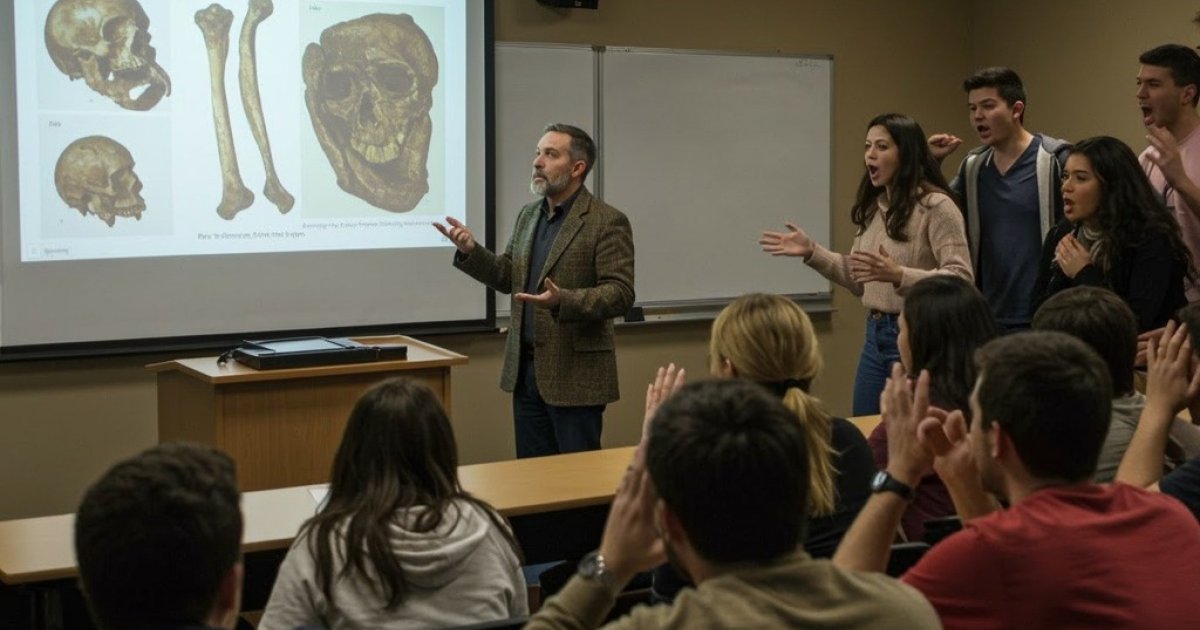
    Take, for instance, the near-complete skeleton of a teenage girl who researchers named Naia, and who died while cave diving for water about 13,000 years ago. Naia’s skeleton has much to teach students, but thanks to the district’s ban, educators are now prohibited from using similar images of incredible archeological finds.

    The First Amendment — which binds public colleges and districts like Los Rios — forbids such broad, content-based restraints on teachers instructing their students. 

    Courts have repeatedly held that the First Amendment protects faculty expression that is “related to scholarship or teaching” or “germane to the classroom subject matter,” including showing photographs that are relevant to the course material. Even more fundamentally, the First Amendment protects the display and communication of photos, videos, and recordings, provided there is no issue with intellectual property rights. But in LRCCD’s blatant overreach, the district doesn’t even try to make an argument about copyright protections.

    What is left is an unconstitutional policy that drastically dulls the learning process. Sure, professors could dryly describe the objects in question rather than show their students images and replicas. But that approach is about as effective — and as likely to capture students’ attention — as merely describing the roundness of a globe or the wryness of Mona Lisa’s smile. Visuals are a vital learning aid, and a blanket ban on educational images is a disaster for academic freedom and student learning.

    While it’s tempting to justify a ban as showing respect for Native American tribes, shunning these images is a funny way to show respect. Universities can best show respect by teaching about Native American cultural heritage using images and replicas. In any case, the government’s desire to show respect to a minority group doesn’t allow it to ban speech about that group.

    Nor can the district justify the policy by appealing to the federal Native American Graves Protection and Repatriation Act or its California counterpart, which deal with the identification and repatriation of Native American remains or cultural items — not images or replicas. To its credit, Los Rios admits as much, even if it confusingly claims that the moratorium is “part of the District’s compliance” with NAGPRA. 

    Fortunately, there have been calls for reform. After we wrote to the district about this issue in August and yet again in October, the district Academic Senate released the draft of a new policy that leaves replicas and images out of any bureaucratic review process. FIRE attorney Daniel Ortner helped along this process by testifying in favor of the draft before the DAS. 

    But there’s a major roadblock holding up this promising new policy: FIRE was recently informed by Cosumnes River College Academic Senate President Jacob Velasquez that the district won’t change its existing policy until it gets the go-ahead from the district’s tribal partners. In other words, the ban on images and replicas is here to stay unless the district and its partners change their minds. 

    FIRE recently wrote to the district a third time, calling for an end to this speech-stifling policy. Until it listens, it’s lights out for free speech and academic freedom at the Los Rios Community College District.

    Source link