This audio is auto-generated. Please let us know if you have feedback.
Dive Brief:
Democratic leaders in Connecticut are proposing a new state graduate student loan program to fill a vacuum created by the federal lending pullback built into Republicans’ massive spending bill.
That plan would expand the reach of the Connecticut Higher Education Supplemental Loan Authority, using up to $20 million of its funds to create the loan program, according to a press release. It also calls for $10 million in state funding.
The program could reach over 2,000 students in its initial phase, a CHESLA official said at a press conference Wednesday. The chairs of the General Assembly’s education committee plan to introduce andpush for the proposal in the upcoming session.
Dive Insight:
The federal bill set to take effect in July, dubbed the One Big Beautiful Bill Act, will bring sweeping changes to the federal student loan system, with the largest impacts landing on graduate students and programs.
The new law sunsets the Grad PLUS loan program, which allows graduate students to borrow up to the cost of attendance.When it launched 20 years ago, Grad PLUS was the largest new student aid program in decades.
Along with the program’s end, OBBBA sets new caps on annual and total borrowing. Federal loans will max out at $100,000 for graduate students and double that for professional students.
Just who is considered a graduate or professional student is no small financial matter, and one that regulators are mulling.The U.S. Department of Education plans to propose regulations that would exclude some health professions — including nursing,occupational therapy and physician associates — from the definition of “professional” that carries a higher loan cap.
Much uncertainty hangs over the federal loan changes and could put pressure on states to engineer their own solutions, as Connecticut is considering.
“We can ensure that students have the ability to become a doctor or scientist or a nurse or an educator and have their career choice determined by their drive and their talent — not the size of their bank account,” Rep. Gregg Haddad, co-chair of the state House’s Higher Education and Employment Advancement Committee, said at a press conference Wednesday.
Haddad and others estimate Connecticut graduate students currently receive $90 million in Grad PLUS loans, leaving a large financing gap in the state once the program ends.
The plan to create a state-level loan program would use CHESLA’s existing infrastructure and bond authority, while state funding could make loans more affordable, said Josh Hurlock, deputy director of CHESLA, at the press conference.
“The plan is not to just replace the Grad PLUS program,” Hurlock said. “The goal is to provide a more affordable financing option for Connecticut graduate students.”
Democrats control both chambers of Connecticut’s legislature as well as the state’s executive branch.
Where states don’t create their own lending programs, graduate students could be forced into the private lending market to make up shortfalls in federal loans.
Currently, private lenders play a “minimal” role in the market, researchers with the Federal Reserve Bank of Philadelphia’s Consumer Finance Institute said in a recent analysis.
The study found that 28% of graduate student borrowers in recent years took out loans over the cap levels set by OBBBA. Of those, 38% had either subprime credit scores or no score at all, meaning they would struggle to borrow in the private sector without a co-signer.
Those students could also face higher interest rates and less generous terms from private lenders compared to loans from the federal government, the researchers pointed out.
Connecticut officials alluded to this possibility when announcing their proposal.
“These arbitrary ceilings do not reflect the reality of rising tuition, and they’ll force students to turn to a predatory private market for lenders that will impose higher interest rates with fewer protections,” Haddad said.
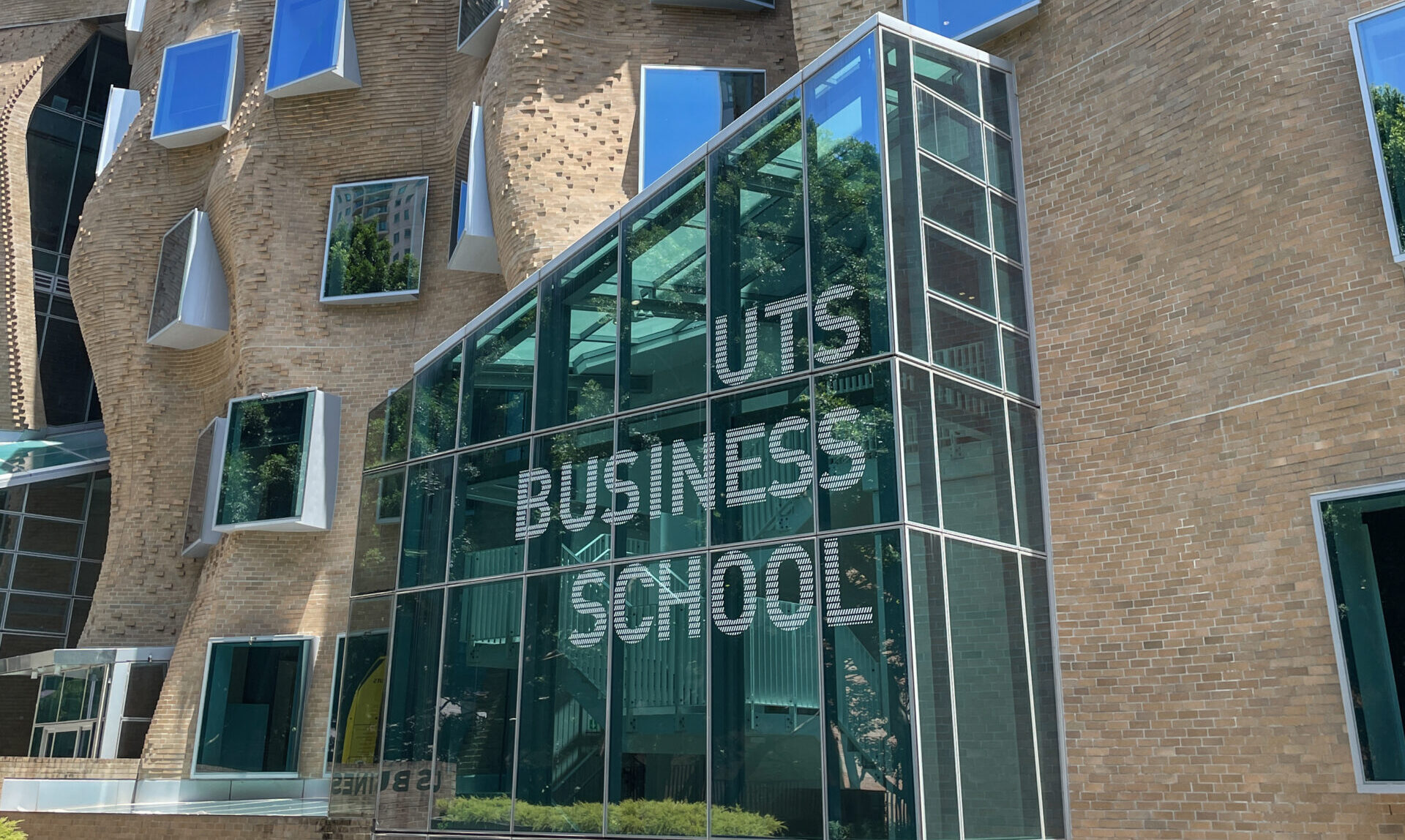
The University of Technology Sydney (UTS) vice-chancellor has been asked whether he would consider an alternative restructure plan written by his own academics, at a NSW government hearing on Friday.
Please login below to view content or subscribe now.
Dr Lily Rosewater designs websites, brand assets, and has a service for social media on demand at her company, Pitch Science. I knew she’d be a great expert to share with you. She joins me live from Australia to talk about what it means to be a visible expert for scientists and researchers.
Lily is an expert for scientist websites, social media, and branding through her company, Pitch Science. What about you? What would it mean to be more visible as an expert yourself? We talk about how many academics are known in their communities, but hidden online. Are you one of the HiddenExperts™? Whether it’s been intentional for you or not, you may want people to find you and your research online. Lily can help you too.
This interview will be also be shared on Spotify soon.
Bio
Dr Lily Rosewater is a science communicator, neuroscientist, and founder of Pitch Science. Armed with experience in both scientific research and digital marketing, Lily helps life science organisations and individual scientists share their brilliant ideas with the public to produce meaningful change.
Lily Rosewater, PhD
At Pitch Science, she turns science into stories through her purposeful, strategic, and human-centred online science content. Lily’s branding and website design services transform HiddenExperts™️ into VisibleExperts, so that scientists and science brands are ready to guide online conversations and get their work seen by those who matter. She is also empowering scientists to do science communication themselves and extend their reach beyond traditional academic channels with science communication training sessions and her Pitch Lab community. Because the more research expertise is shared online, the more it benefits everyone.
Pitching compelling storylines and sources are the crux of any public relations strategy. In the higher education digital marketing space, we at Archer Education leverage the expertise of professors from our partner institutions to help increase the school’s visibility, student enrollment, thought leadership, and brand awareness.
Professors make excellent sources for stories through unmatched expertise and experience in their respective fields, but without the correct messaging and communication strategy, this opportunity could be missed.
In this article, we’ll go over how to write a media pitch in higher education and review the most common types of media pitches.
What Is a Media Pitch?
Media pitches in higher education are strategic communications sent to journalists, editors, or media outlets to promote faculty expertise, research, or institutional initiatives. These pitches typically highlight faculty insights on current events, groundbreaking studies, or thought leadership in their field.
These pitches are particularly key to faculty promotion because they enhance visibility, establish credibility, and position faculty as subject matter experts. Media coverage can lead to invitations for speaking engagements, collaborative research opportunities, and increased citations — all of which contribute to professional advancement for the faculty member and enhanced institutional reputation.
How to Create Your Media Pitch
Before we dive into best practices, tips, and examples of PR pitching, let’s go over some of the basics of how to structure a media pitch. Creating a set standard for yourself and your team will not only streamline the process and allow you to be as efficient as possible, but it will also ensure consistency amongst your team and allow for smooth training programs.
Select the Right Type of Journalism Lead
Before you even start writing a pitch, you want to make sure you find a lead that will entice whoever you are reaching out to. The lead is the angle into your story that makes everything relevant. You can look for two types of leads that are applicable throughout journalism:
A news peg is a trending story or topic in the news that relates to what you’re pitching. For example, leveraging a political debate or a new medical study that was just released. This allows you to hook the reader with a relevant and widespread story.
A time peg represents an upcoming date or event. For example, anniversaries of days like 9/11 or Hurricane Katrina, days or weeks dedicated to specific causes like “Health IT Week” or “Mental Health Awareness Day,” or even months like “Breast Cancer Awareness Month.”
These types of dates and events can be easily leveraged for PR purposes as media outlets will often shape content around significant or relevant time pegs. In order to keep track and take advantage of these dates, it’s helpful to create and consistently update an internal editorial calendar with your team.
Develop Your Pitch Structure
Below is the basic outline/structure you should consider when writing a media pitch:
As mentioned above, start with the lead. This should be the first thing the reporter or editor reads. An enticing lead that is relevant to their beat will ensure they continue through your pitch.
The second part is your call-to-action. This is the action you want your audience to take. Whether it is writing a product review, publishing a piece of content, or conducting an interview, it’s important to make your intention here as clear as possible.
Next comes your value proposition. This is a key piece of the puzzle as it will be the meat of the pitch; this is where you can showcase the value of what you are offering and why they should be interested in it. It is essential in differentiating yourself from the hundreds of other pitches they receive.
The last piece of the pitch is your conclusion. This is a straightforward recap that includes a recap of the call-to-action and a thank you.
Use the Right Subject Line for Your Pitch Email
Subject lines are the first and sometimes only thing that a media contact will see — often determining whether they will even bother to open your email or not. Ensuring that your subject line is clear, concise, and enticing is critical. According to Omeda, subject lines with 20 characters or fewer achieve the highest open rates, averaging 29.9%. Open rates decline to 17.3% for subject lines between 20 and 124 characters.
Interestingly, subject lines exceeding 174 characters see a slight recovery in open rates, averaging around 23%. However, due to potential display issues and the risk of being cut off, it’s generally recommended to keep subject lines concise. Prioritizing brevity ensures better visibility across various devices and enhances the likelihood of engagement.
While creating a subject line that produces an “open” should always be the goal, you should make sure to avoid using “click-bait” phrasing as a tactic to draw in the recipient, as this is considered unprofessional. The last thing you want to do is mislead your audience or appear spammy.
How to Pitch the Media: Communication Strategies
Now that you understand the basics on how to write and structure a media pitch, let’s cover some media pitching strategies that can lead to greater success.
Use Timely Stories and Research
Don’t deprive yourself of using relevant news pegs or research as your hook for your pitch. It’s no secret that the media lives off of news pegs, trending topics, and new research to tell their stories. To increase the chances of someone showing interest in your pitch, it’s important to make their job as easy as possible. It’s a good idea to spell out the story for them so that your source or story fits in seamlessly with trending news topics and their target audience’s interests.
Reporters and editors receive hundreds of pitches every day, so providing them with a story that their readers will be interested in and offering sources to help supplement that story will make them more compelled to move forward with the conversation.
Along these same lines, always try to include hyperlinks to any research or statistics that you reference in your pitch. You don’t want them to shy away from expressing interest or continuing the conversation simply because they don’t have time to do the legwork to track down the sources themselves.
Know the Reporter’s Beat
You can have the best pitch in the world, but if it doesn’t align with the reporter’s beat (the types of stories they cover), then it will provide no use or value to them. In fact, it will only blatantly show that you are sending out mass email distributions and aren’t doing the appropriate research and legwork before pitching them. While it’s not always realistic or feasible, personalize pitches whenever possible and mention any related articles that they recently wrote.
Keep it Concise and Know Your Story
As previously mentioned, media contacts receive hundreds of pitches a day. If you’re lucky enough to get yours opened, the worst thing that someone with very little time can be confronted with is an unnecessarily long pitch. Find out how to say everything that you need to say in a paragraph or less (with rare exceptions). The more specific and focused you can be, the better. It’s also crucial to understand and communicate the story you’re trying to tell and how it aligns with the larger media trends yet provides a unique angle to the storyline.
Follow Up Is Key to Media Pitching
Following up on initial email pitches is one of the most crucial elements of the pitching process. This is where most of your interest and responses will come from, so ensure that you schedule reminders to follow up.
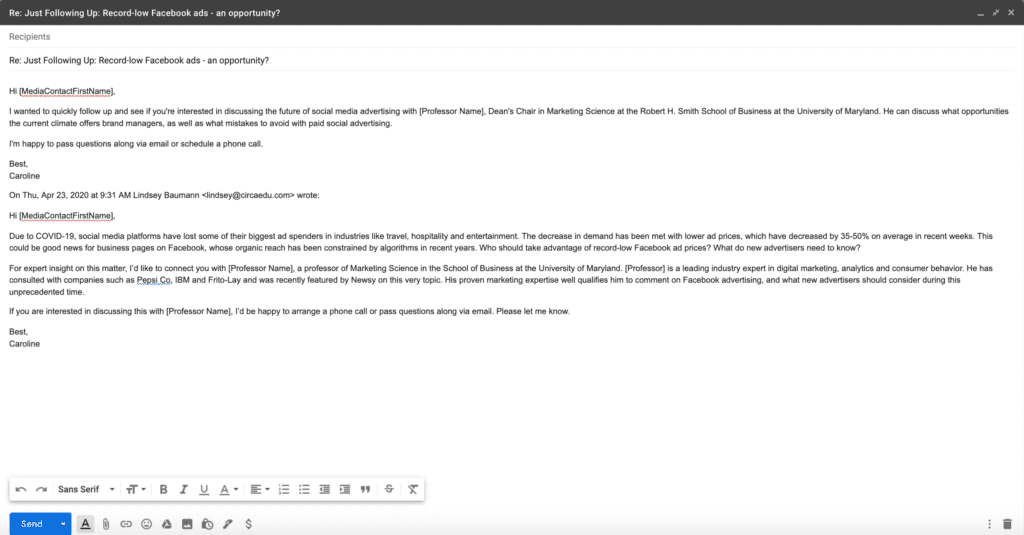
Generally, it’s appropriate to wait about one week until you send follow-ups out; this will ensure that the media contact has sufficient time to get through their emails and respond if they are planning to. If the story is incredibly time-sensitive, you can follow-up a bit sooner. Similarly, if it is not a time-sensitive story at all, then waiting a little longer than a week can be a good strategy. Just be sure to include your original pitch at the bottom of your follow-up email to help jog the recipient’s memory and provide more context.
Media Pitch Examples
Now that you have the information that you need to be successful with your pitch writing, here are some real-life examples of media pitches and pitch letters that our team sent to the media.
1. Cold Pitch
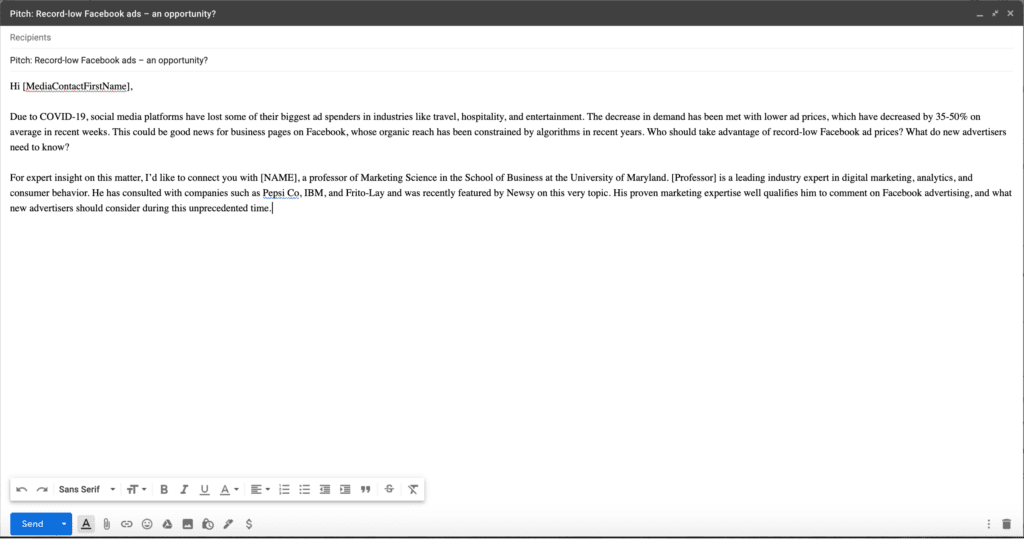
A cold pitch is an unsolicited email or message sent to a journalist or media outlet with whom there is no prior relationship. It typically introduces a faculty member’s expertise or research in hopes of securing media coverage.
2. Pitch for Established Contact/Relationship
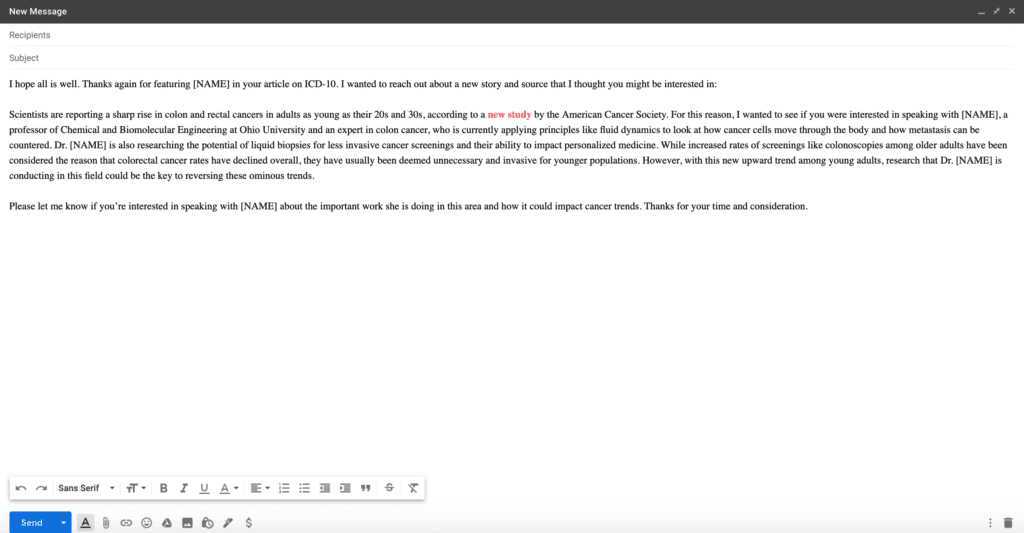
This type of pitch is sent to a journalist or media contact with whom a relationship already exists. It builds on past interactions, making it more likely to be well received and result in coverage.
3. Personalized Pitch
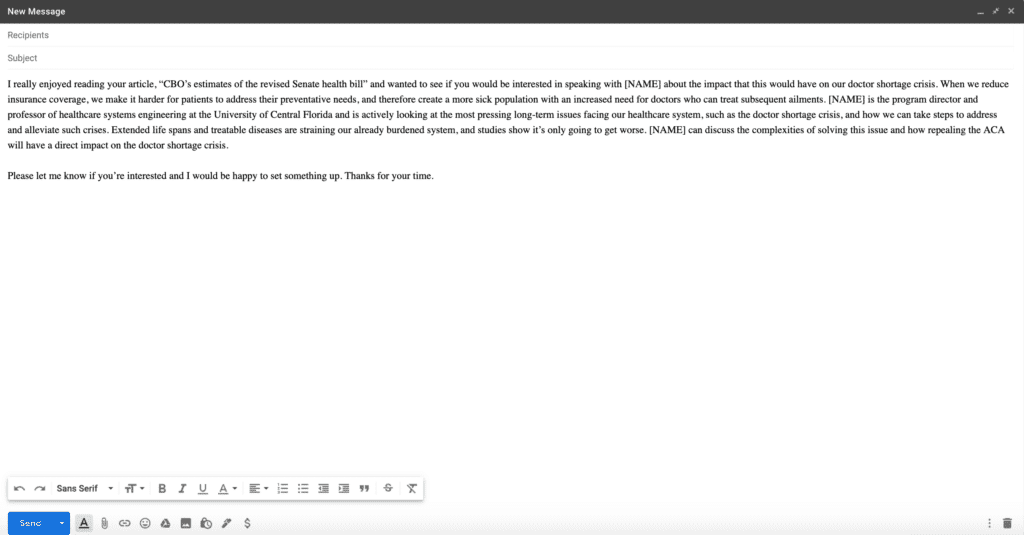
A personalized pitch is tailored specifically to a journalist’s interests, past work, or the needs of their publication. It demonstrates a clear understanding of their audience and increases the chances of engagement.
4. Follow-Up Pitch
A follow-up pitch is sent after an initial pitch to reinforce interest, provide additional details, or remind the recipient about the story idea. It’s essential for maintaining momentum and increasing response rates.
How to Write Media Pitches That Consistently Convert
In today’s media landscape, consistent PR exposure is essential for faculty members looking to establish themselves as thought leaders and elevate their institution’s brand. At Archer Education, we specialize in crafting strategic media pitches that align with timely news cycles, ensuring professors and researchers receive the visibility they deserve. Whether through cold outreach, leveraging existing media relationships, or personalized pitches, we help faculty secure media placements that enhance their credibility, attract prospective students, and showcase their expertise to a broader audience.
Our experience in higher education marketing allows us to effectively position faculty members in conversations that matter, increasing opportunities for interviews, guest articles, and thought leadership features. Don’t let valuable media opportunities go untapped — connect with us today to develop a custom PR strategy that amplifies your faculty’s impact and strengthens your institution’s reputation.
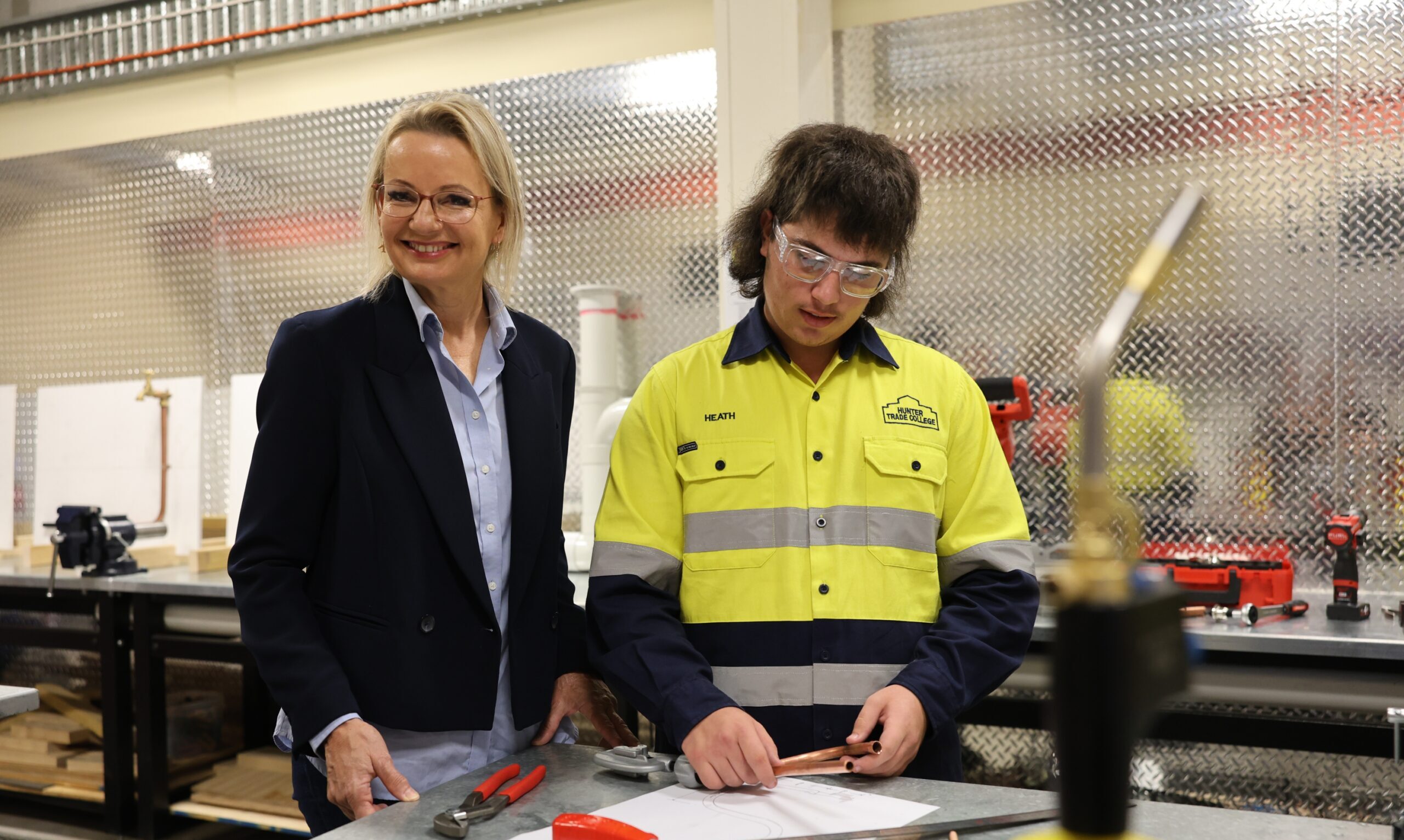
Sussan Ley with a student at Hunter Trade College in Telarah, New South Wales. Picture: Richard Dobson
A Coalition government would invest $260m to get more high school students to take up trades instead of pursuing university, it has been announced, after it indicated it would cut the Labor’s fee-free TAFE program..
Please login below to view content or subscribe now.
The Coalition would scrap Australian Tertiary Education Commission (ATEC) and have an independent tribunal decide vice-chancellor pay, opposition education spokeswoman Senator Sarah Henderson told universities on Wednesday.
Reinstating the 50 per cent pass rate rule and significantly capping overseas students to inner-city Sydney and Melbourne unis are also top of the list.
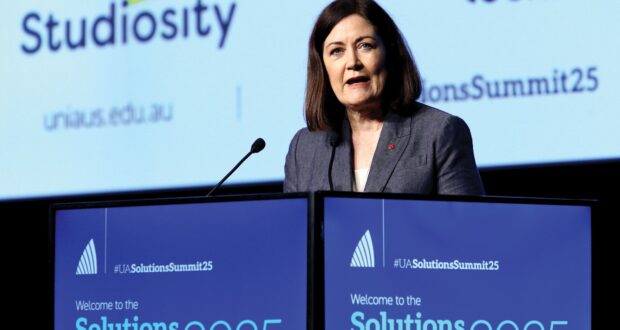
The senator outlined her party’s priorities for the first time at the Universities Australia Solutions Summit, a meeting of university leaders, which also facilitated discussion within the sector about current issues.
The Coalition is adamant that “Australian students must come first” in every decision universities make, but that direction would come from vice-chancellors and a regulator, not government policy, she said.
“To put students first, universities must be governed by strong and principled leaders who run their institutions efficiently, transparently and with integrity,” she said.
“Universities must be able to operate with certainty and plan for the long term, free from day-to-day government intervention and policy chaos; overseen by a tough and feared regulator, which enforces the highest standards when required.”
An LNP government will cancel the establishment of ATEC, and instead the Tertiary Education Quality Standards Agency (TEQSA) would be the responsible regulator.
“This is another layer of education bureaucracy and a significant cost which will not take our universities forward. It certainly does not add value to students,” she said.
Senator Henderson said things like scholarships and student support funds, which ATEC has been tasked with reviewing, is work for government and ministers.
“The ATEC tells us this government doesn’t know what to do.There’s no proper understanding of its role, no legislation. And yet it is set to commence in three months time,” she said.
“The hard work you would expect a government to undertake is being sent to the Commission.“
Her party would assess changes to funds such as theHigher Education Partnerships and Participation Program and the Indigenous Students Support Fund by asking the following questions: “Do they support quality of teaching and learning? Labour market needs? Equity access so all Australians can aspire to university education? Student completion rates and employment outcomes?”
The LNP previously announced it would increase the number of Commonwealth-supported places for medial students by 100 in 2026 and 2027, and by 150 from 2028, an Accord-recommended policy.
The party has not changed its position on Job-Ready Graduates, she said, but it will review the funding arrangement.
Although the senator welcomed the Universities Accord final report’s recommendations, she said the Albanese government has unfairly placed the burden of reform onto individuals and universities.
She said Education Minister Jason Clare has “outsourced much of the heavy lifting” to Accord chair Professor Mary O’Kane and her panel.
She also said universities should not bear the burden of means-testing students, in other words, evaluating whether a student is eligible for government support regarding the Commonwealth prac payment.
“Consider, for instance, the prac payments: discretionary grant programs where you are being asked to means-test students. Universities are not Centrelink offices,” she said.
“We understand that universities are big and complex organizations, but they have not enjoyed a strong track record always in supporting students. Too many times students have been left high and dry.”
She also said TEQSA has not done enough to protect women from sexual violence on campus or Jewish students and staff from anti-Semitism.
“A Dutton government would adopt zero-tolerance of anti-Semitism on university campuses. We will not wait for universities to act in their own time,” she said.
The senator told universities they need to do more to stop anti-Semitism on campuses. Picture: UA
“We expect all universities to fully cooperate with the new dedicated anti-Semitism Task Force, led by the Australian Federal Police and other agencies.”
All Australian vice-chancellors agreed on a definition of anti-Semitism on Wednesday. While the senator said she appreciated the vice-chancellors agreement, the Coalition would require unis to adopt the International Holocaust Remembrance Alliance’s definition, which is a more robust framework and definition, she said.
The Coalition would implement a national higher education code to prevent and respond to anti-Semitism and establish a judicial inquiry into anti-Semitism at Australian universities, she announced.
“We will leave no stone unturned, including amending the Fair Work Act if necessary.”
Another LNP priority is to reinstate the 50 per cent pass rate rule, she said.
“We don’t believe there are enough safeguards to protect struggling students from leaving university with no qualification and a large student debt,” she said.
The Accord final report recommended removing the rule as a “priority action”. The rule says students who failed over half of their studies weren’t eligible for a HECS-HELP loan and had to pay upfront.
Theoretically, the rule was supposed to protect young people from acquiring debt with no qualifications, aimed at students who are possibly ill-placed to be at university.
Practically, the Accord panel found the rule disproportionately affected students from First Nations, low socioeconomic and other underrepresented or educationally disadvantaged backgrounds, who are more likely to fall behind in university due to external circumstances.
Later on Wednesday in his National Press Club address, UA chief executive Luke Sheehy said bringing back the rule would be detrimental to students in equity cohorts, which the Accord and the Labor government have been trying to help become qualified for economic reasons.
“It would be devastating. Our universities were very displeased and upset with the 50 per cent rule when it came in because it undermines the autonomy of our world class teachers and educators at our universities to support students in their own universities,” he said.
“I always worry about mandated policies from one central point in Canberra, made without proper consultation. It’s such a blunt rule. And we will be asking again for the Coalition to reconsider that.”
Vice-chancellor salaries would be set by the Remuneration Tribunal, not university boards, under a Dutton government.
“In this cost-of-living crisis, the current situation, frankly, does not meet the pub test,” she told the audience.
The senator would also back an “Australian universities performance index”, a website accessible to the public that provides measurements of an institution’scompletion rates, student satisfaction, course quality and cost.
“As a parent, I can attest to the complexity of navigating the university system for school leavers or those seeking to reskill or upgrade their qualifications,” she said.
“Just working out to which course to apply [for] is a challenge. So rather than judge universities on the research dollars they generate, which drives international students and global rankings, let’s focus on home-grown performance.
“This reform will drive up competition, lift teaching standards and ensure students make informed choices about their education.”
While both major parties plan to bring down the number of international students studying in Australia, the Coalition’s cap would be harsher than a Labor government’s, and would focus on getting overseas students out of cities, where two-thirds of them reside, and into the regions.
She echoed a speech delivered by veteran businesswoman and University of Technology Sydney chancellor Catherine Livingstone on Tuesday: universities haven’t been listening to community concerns about the “perceived impact of immigration on housing availability and affordability.’’
“We persist with offering opaque and inflated claims about [universities’] direct impact,” Senator Henderson said.
“[The current number of international students] is not good for our country or for the education outcomes of Australian students. We need to get the balance right. Every country has a responsibility to run its migration program in the national interest.”
She said more information about a Coalition overseas student policy will be announced in the next few weeks.
The LNP is disheartened about the lack of commercialisation of research, the senator said, which will be “put back on the agenda,” fostering more collaboration between universities and industry to boost student experience and job-readiness.
It will also reinstate ministerial discretion to allAustralian Research Council grant programs, in contrast to the current government which has control of only some research grants,.
By doing so, the government has“absolved itself of its responsibility to safeguard precious taxpayer funds in the interest of all Australians.”
“Under our Westminster system of government, the buck stops with the government of the day, and not an unelected board,” she continued.
“Universities matter. But universities that are run in the best interests of students really matter.
“If I am given the honor of being the next Minister for Education, I look forward to working closely with you with certainty, not ambiguity, to share in this crucial mission.“
The chair of the Australian Universities Accord is to lead the yet-to-be-established Australian Tertiary Education Commission, Education Minister Jason Clare revealed on Wednesday night.
Please login below to view content or subscribe now.