Tag: place

  • Higher education needs a plan in place for student “pastoral” use of AI

    Higher education needs a plan in place for student “pastoral” use of AI

    With 18 per cent of students reporting mental health difficulties, a figure which has tripled in just seven years, universities are navigating a crisis.

    The student experience can compound many of the risk factors for poor mental health – from managing constrained budgets and navigating the cost of learning crisis, to moving away from established support systems, and balancing high-stakes assessment with course workload and part-time work.

    In response, universities provide a range of free support services, including counselling and wellbeing provision, alongside specialist mental health advisory services. But if we’re honest, these services are under strain. Despite rising expenditure, they’re still often under-resourced, overstretched, and unable to keep pace with growing demand. With staff-student ratios at impossible levels and wait times for therapeutic support often exceeding ten weeks, some students are turning to alternatives for more immediate care.

    And in this void, artificial intelligence is stepping in. While ChatGPT-written essays dominate the sector’s AI discussions, the rise of “pastoral AI” highlights a far more urgent and overlooked AI use case – with consequences more troubling than academic misconduct.

    Affective conversations

    For the uninitiated, the landscape of “affective” or “pastoral” AI is broad. Mainstream tools like Microsoft’s Copilot or OpenAI’s ChatGPT are designed for productivity, not emotional support. Yet research suggests that users increasingly turn to them for exactly that – seeking help with breakups, mental health advice, and other life challenges, as well as essay writing. While affective conversations may account for only a small proportion of overall use (under three per cent in some studies), the full picture is poorly understood.

    Then there are AI “companions” such as Replika or Character.AI – chatbots built specifically for affective use. These are optimised to listen, respond with empathy, offer intimacy, and provide virtual friendship, confidants, or even “therapy”.

    This is not a fringe phenomenon. Replika claims over 25 million users, while Snapchat’s My AI counts more than 150 million. The numbers are growing fast. As the affective capacity of these tools improves, they are becoming some of the most popular and intensively used forms of generative AI – and increasingly addictive.

    A recent report found that users spend an average of 86 minutes a day with AI companions – more than on Instagram or YouTube, and not far behind TikTok. These bots are designed to keep users engaged, often relying on sycophantic feedback loops that affirm worldviews regardless of truth or ethics. Because large language models are trained in part through human feedback, its output is often highly sycophantic – “agreeable” responses which are persuasive and pleasing – but these can become especially risky in emotionally charged conversations, especially with vulnerable users.

    Empathy optimisations

    For students already experiencing poor mental health, the risks are acute. Evidence is emerging that these engagement-at-all-costs chatbots rarely guide conversations to a natural resolution. Instead, their sycophancy can fuel delusions, amplify mania, or validate psychosis.

    Adding to these concerns, legal cases and investigative reporting are surfacing deeply troubling examples: chatbots encouraging violence, sending unsolicited sexual content, reinforcing delusional thinking, or nudging users to buy them virtual gifts. One case alleged a chatbot encouraged a teenager to murder his parents after they restricted his screen time; another saw a chatbot advise a fictional recovering meth addict to take a “small hit” after a bad week. These are not outliers but the predictable by-products of systems optimised for empathy but unbound by ethics.

    And it’s young people who are engaging with them most. More than 70 per cent of companion app users are aged 18 to 35, and two-thirds of Character.AI’s users are 18 to 24 – the same demographic that makes up the majority of our student population.

    The potential harm here is not speculative. It is real and affecting students right now. Yet “pastoral” AI use remains almost entirely absent from higher education’s AI conversations. That is a mistake. With lawsuits now spotlighting cases of AI “encouraged” suicides among vulnerable young people – many of whom first encountered AI through academic use – the sector cannot afford to ignore this.

    Paint a clearer picture

    Understanding why students turn to AI for pastoral support might help. Reports highlight loneliness and vulnerability as key indicators. One found that 17 per cent of young people valued AI companions because they were “always available,” while 12 per cent said they appreciated being able to share things they could not tell friends or family. Another reported that 12 per cent of young people were using chatbots because they had no one else to talk to – a figure that rose to 23 per cent among vulnerable young people, who were also more likely to use AI for emotional support or therapy.

    We talk often about belonging as the cornerstone of student success and wellbeing – with reducing loneliness a key measure of institutional effectiveness. Pastoral AI use suggests policymakers may have much to learn from this agenda. More thinking is needed to understand why the lure of an always-available, non-judgemental digital “companion” feels so powerful to our students – and what that tells us about our existing support.

    Yet AI discussions in higher education remain narrowly focused, on academic integrity and essay writing. Our evidence base reflects this: the Student Generative AI Survey – arguably the best sector-wide tool we have – gives little attention to pastoral or wellbeing-related uses. The result is, however, that data remains fragmented and anecdotal on this area of significant risk. Without a fuller sector-specific understanding of student pastoral AI use, we risk stalling progress on developing effective, sector-wide strategies.

    This means institutions need to start a different kind of AI conversation – one grounded in ethics, wellbeing, and emotional care. It will require drawing on different expertise: not just academics and technologists, but also counsellors, student services staff, pastoral advisers, and mental health professionals. These are the people best placed to understand how AI is reshaping the emotional lives of our students.

    Any serious AI strategy must recognise that students are turning to these tools not just for essays, but for comfort and belonging too, and we must offer something better in return.

    If some of our students find it easier to confide in chatbots than in people, we need to confront what that says about the accessibility and design of our existing support systems, and how we might improve and resource them. Building a pastoral AI strategy is less about finding a perfect solution, but more about treating pastoral AI seriously, as a mirror which reflects back at us student loneliness, vulnerabilities, and institutional support gaps. These reflections should push us to re-centre these experiences, to reimagine our pastoral support provision, into an image that’s genuinely and unapologetically human.

    Source link

  • Is there a place for LEO in regulation?

    Is there a place for LEO in regulation?

    The OfS have, following a DfE study, recently announced a desire to use LEO for regulation. In my view this is a bad idea.

    Don’t get me wrong, the Longitudinal Outcomes from Education (LEO) dataset is a fantastic and under-utilised tool for historical research. Nothing can compare to LEO for its rigour, coverage and the richness of the personal data it contains.

    However, it has serious limitations, it captures earnings and not salary, for everyone who chooses to work part time it will seriously underestimate the salary they command.

    And fundamentally it’s just too lagged. You can add other concerns around those choosing not to work and those working abroad if you wish to undermine its utility further.

    The big idea

    The OfS is proposing using data from 3 years’ after graduation which I assume to mean the third full tax year after graduation although it could mean something different, no details are provided. Assuming that my interpretation is correct the most recent LEO data published in June this year relates to the 2022-23 tax year so for that to be the third full tax year after graduation (that’s the that’s the 2018-19 graduating cohort, and even if you go for the third tax year including the one they graduated in it’s the 2019-20 graduates). The OfS also proposes to continue to use 4 year aggregates which makes a lot of sense to avoid statistical noise and deal with small cohorts but it does mean that some of the data will relate to even earlier cohorts.

    The problem is therefore if the proposed regime had been in place this year the OfS would have just got its first look at outcomes from the 2018-19 graduating cohort who were of course entrants in 2016-17 or earlier. When we look at it through this lens it is hard to see how one applies any serious regulatory tools to a provider failing on this metric but performing well on others especially if they are performing well on those based on the still lagged but more timely Graduate Outcomes survey.

    It is hard to conceive of any courses that will not have had at least one significant change in the 9 (up to 12!) years since the measured cohort entered. It therefore won’t be hard for most providers to argue that the changes they have made since those cohorts entered will have had positive impacts on outcomes and the regulator will have to give some weight to those arguments especially if they are supported by changes in the existing progression, or the proposed new skills utilisation indicator.

    A problem?

    And if the existing progression indicator is problematic then why didn’t the regulator act on it when it had it four years earlier? The OfS could try to argue that it’s a different indicator capturing a different aspect of success but this, at least to this commentators mind, is a pretty flimsy argument and is likely to fail because earnings is a very narrow definition of success. Indeed, by having two indicators the regulator may well find themselves in a situation where they can only take meaningful action if a provider is failing on both.

    OfS could begin to address the time lag by just looking at the first full tax year after graduation but this will undoubtedly be problematic as graduates take time to settle into careers (which is why GO is at 15 months) and of course the interim study issues will be far more significant for this cohort. It would also still be less timely than the Graduate Outcomes survey which itself collects the far more meaningful salary rather than earnings.

    There is of course a further issue with LEO in that it will forever be a black box for the providers being regulated using it. It will not be possible to share the sort of rich data with providers that is shared for other metrics meaning that providers will not be able to undertake any serious analysis into the causes of any concerns the OfS may raise. For example, a provider would struggle to attribute poor outcomes to a course they discontinued, perhaps because they felt it didn’t speak to the employment market. A cynic might even conclude that having a metric nobody can understand or challenge is quite nice for the OfS.

    The use of LEO in regulation is likely to generate a lot of work for the OfS and may trigger lots of debate but I doubt it will ever lead to serious negative consequences as the contextual factors and the fact that the cohorts being considered are ancient history will dull, if not completely blunt, the regulatory tools.

    Richard Puttock writes in a personal capacity.

    Source link

  • Judge Keeps Alabama’s Anti-DEI Law in Place for Now

    Judge Keeps Alabama’s Anti-DEI Law in Place for Now

    Just_Super/iStock/Getty Images Plus

    Ruling in part that professors lack First Amendment protections in the classroom, a federal judge denied an effort from college faculty and students in Alabama to block a 2024 state law that banned diversity, equity and inclusion programs as well as the teaching of so-called divisive concepts.

    The plaintiffs, who include students from the University of Alabama at Birmingham and professors at the University of Alabama in Tuscaloosa, argued in court filings and at hearings that the legislation known as Senate Bill 129 amounted to state-sponsored censorship and infringed on their rights under the First and 14th Amendments. The professors alleged that they had to cancel class projects or events and faced other questions about their classroom conduct from administrators because of the law. They’ve also changed course material as a result.

    R. David Proctor, chief judge in the U.S. District Court for the Northern District of Alabama, found that while the professors and the Alabama NAACP had standing to sue, they weren’t likely to succeed at this time. For instance, he ruled that the professors aren’t protected by the First Amendment because their “in-class instruction constitutes government speech.”

    Furthermore, Proctor wrote, based on other rulings in the U.S. Court of Appeals for the 11th Circuit, “when there is a dispute about what is taught in the classroom, the university’s interests outweigh those of a professor, and the professor’s interest in academic freedom and free speech do not displace the university’s interest inside the classroom.”

    The plaintiffs said Proctor’s ruling was disappointing.

    “I feel incredibly dismayed that SB 129 is allowed to continue going into the new school year,” said Sydney Testman, one of the students who sued, in a statement. “As a senior at University of Alabama at Birmingham, I’ve seen firsthand how SB 129 has transformed my college campus for the worst. Voices have been silenced, opportunities have been revoked, and meaningful community engagement has faded. This decision undermines the need for students to properly feel a sense of belonging and inclusion on campus.”

    Source link

  • Weekend Reading: Rethinking the Role of Place in UK Higher Education Policy

    Weekend Reading: Rethinking the Role of Place in UK Higher Education Policy

    • This HEPI guest blog was kindly authored by John Goddard OBE, Emeritus Professor of Regional Development Studies at Newcastle University.

    In a HEPI note prompted by a Centre for Skills, Knowledge and Organisational Performance (SKOPE) conference, Nick Hillman asked: Should the seminal Robbins report inform the forthcoming post-16 strategy? He referenced the point made by Professor Robson of SKOPE about the need ‘to encourage place-based approaches … and replace competition with coordination.’ As Nick points out, the challenge of place and coordination are not new, but as I will argue, these are not being confronted by policymakers right now.

    The Robbins’ report led to new universities being established. But these were in county towns and as we observe in our volume on The University and the City, overlook the growing urban crisis of that period. The Education Reform Act of 1988 severed the link between polytechnics and local government. The Further and Higher Education Act 1992, which allowed polytechnics to apply for university status, had the Government’s desired impact of reducing the unit cost of higher education and moving the UK instantly up the OECD rankings in terms of participation in higher education. But it also signalled a further disconnection with cities. The creation of new universities in the 1970s to meet a 50% participation rate was also unplanned in geographical terms. So, unlike many countries, the UK has not had a plan for the geography of higher let alone further education.

    Indeed, UK higher education policy and practice has ignored the lessons of history as well as being geographically blind. It has not been sensitive to the different local contexts where universities operate and the evolution of these institutions and places through time.

    It is important to remember that locally endowed proto-universities like Newcastle, Sheffield and Birmingham supported late 19th-century urban industrialisation and the health of the workforce. They also played a role in building local soft infrastructure, including facilitating discourse around the role of science and the arts in business and society. This was also a time in which new municipal government structures were being formed. In short, universities helped build the local state and create what the British Academy now calls social and cultural infrastructure, in which universities play a key role

    These founding principles became embedded in the DNA of some institutions. For example, in 1943, the Earl Grey Memorial lecturer in King’s College Newcastle noted,

    Ideal Universities… should be an organic part of regional existence in its public aspects, and a pervading influence in its private life. …Universities to be thus integrated in the community, must be sensitive to what is going on in the realm of business and industry, of practical local affairs, of social adaptation and development, as well as in the realm of speculative thought and abstract research.

    In the later 20th century, most so-called redbrick universities turned their back on place as the central state took on direct funding of higher education and research and did not prioritise the local role of universities. But this was challenged by the Royal Commission on the Future of Higher Education in 1997, chaired by Lord Dearing. He noted that: ‘As part of the compact we envisage between HE and society, each institution should be clear about its mission in relation to local communities and regions.’ For him, this ‘compact’ was wide-ranging, had a strong local dimension and was one where the university’s contribution to ‘the economy’ could not be separated from the wider society in which it was embedded.

    Many of Dearing’s ideas were subsequently incorporated into the work of Regional Development Agencies (RDAs) that were established in 1989 to promote economic development and regeneration, improve business competitiveness, and reduce regional disparities. This included investment, (matched by European regional funds ) into university-related research and cultural facilities. These capital and recurrent investments contributed to ‘place making’ and university links with business and the arts. For example, the former Newcastle brewery site was purchased by Newcastle University, Newcastle City Council and RDA, which they named ‘Science Central’. The partnership was incorporated as Newcastle Science City Ltd., a company limited by guarantee with its own CEO and independent board. The organisation’s portfolio included:

    Support for business, facilitating the creation of new enterprises drawing on the scientific capabilities of the region’s universities and work with local schools and communities, particularly focussed on promoting science education in deprived areas.

    The initiatives recognised the role that universities could play in their places by building ‘quadruple helix partnerships’ between universities, business, local and central government and the community and voluntary sectors.

    But from 2008, with the onset of public austerity, a focus on national competitiveness and a rolling back of the boundaries of the state, we saw the abolition of the RDAs in 2012, the creation of Local Enterprise Partnerships with more limited powers and resources and a cutting back on non-statutory local government activities, notably for economic development. My 2009 NESTA provocation Reinventing the Civic University was a reminder that universities had to go back to their roots and challenge broader geo-political trends, including globalisation and the creation of university research excellence hierarchies that mirrored city hierarchies.

    Marketisation was subsequently embedded into law in the 2017 Higher Education Act. This abolished the Higher Education Funding Council for England and its network of regional consultants working with formal university associations. The act unleashed competition regulated via the Office for Students (OfS) and supported by an enhanced discipline-based research excellence funding scheme. Both were place blind. Some of us raised the possibility of the financial collapse of universities in less prosperous places where they were so-called ‘anchor institutions’

    It was a recognition of this place blindness that contributed to the case for the establishment of the Civic University Commission, chaired by the late Lord Kerslake. The Commission argued that the public – nationally and locally – needed to understand better the specific benefits that universities can bring in response to the question: ‘We have a university here, but what is it doing for us? Institutions that were ultimately publicly funded needed to be locally accountable given our place-based system of governance – parliamentary constituencies and local authorities.

    For the Commission, accountability meant something different from a top-down compliance regime. Rather, sensitive and voluntary commitments made between a diverse set of actors to one another, whose collective powers and resources could impact local economic and social deficiencies

    The Commission therefore proposed that universities wishing to play a civic role should prepare Civic University Agreements, co-created and signed by other key partners and embracing local accountability. Strategic analysis to shape agreements should lead to a financial plan that brings together locally the many top-down and geographically blind funding streams that universities receive from across Whitehall – for quality research, for health and wellbeing, for business support, for higher-level skills and for culture.

    Some of these national funds now need to be ring-fenced to help universities work with partners to meet local needs and opportunities, including building capacity for collaborative working within an area. As the Secretary of State for Education has suggested in her letter to VCs, this might include a slice of core formulaic Quality Research (QR) funding. Such processes would be preferable to the ad-hoc interventions that have hitherto failed to establish long-term trust between universities and the community. At the same time, a place dimension could be included in the regulation of the domestic student marketplace. This could all form part of a compact or contract between universities and the state which enshrined a responsibility to serve the local public good.

    Going forward, I would argue that the coincidence of multiple crises across the world has far-reaching implications that universities cannot ignore. Indeed, if they do not step up to the plate and assert their civic role as anchor institutions in their places, their very existence may be at stake. The issues are well set out in this Learning Planet Institute Manifesto for the Planetary Mission of the University.

    Reading this Manifesto should help policy makers and institutional leaders in the UK recognise that the current financial crisis facing universities is an outward and visible sign of deeper threats, not least those arising from popularism and being fanned by Donald Trump. And popularism has its roots in the experience of people in left behind places.

    Therefore, Government support for the role of universities in their communities is not only beneficial to them but also to society at large. To respect institutional autonomy, this requires the right incentives (sticks and carrots). For example, universities throughout England could be required to support the Government’s plans for devolution as part of the compact I suggest. Questions to be answered by the Departments for Education; for Housing, Communities and Local Government and for Science, Innovation and Technology working TOGETHER could include:

    • What structures need to be put in place inside and outside of universities to facilitate joint working between universities and Mayoral Combined Authorities (MCAs)?
    • How should universities be included in upcoming Devolution Deals?
    • How might these differ between MCAs at different stages of development and different levels of prosperity?
    • How should universities link their work with business, with the community and the priorities of MCAs for inclusive growth and with the Industrial Strategy White paper?
    • How should Combined Authorities work with different universities and colleges in their area to meet skills gaps?
    • How can areas without MCAs work with universities to deliver equivalent outcomes?

    In summary, universities must recognise that they are part of the problem identified by populism, but can contribute to solutions through purposive local actions supported by the government.

    Source link

  • Happie place: good vibes only

    Happie place: good vibes only

    Let’s face it, the news cycle is a pretty gloomy place at the moment, so we’ve decided to take a different perspective. This is our attempt to find our happie place (notice the pun we’ve got going here?).

    This regular column aims to bring you positive news, flashes of inspiration and a warm, fuzzy feeling that will nourish your soul. We want to celebrate international student success and colleagues who go above and beyond. Get involved and send us the good stuff so we can share the love.

    We recognise that in this unpredictable market, real challenges exist – and that this is nothing more than a sticking plaster – but sometimes there’s strength in looking for the positives.

    I was born in Lagos, but I was made in Swansea
    Michael Ijaiyemakinde, international student

    This week, we decided to check in with some of the international graduates we’ve met in the UK over the years to see how they’re getting on.

    These stories are a simple reminder of why we believe in the transformational power of study abroad and the power to change individual lives (including our own).

    Franka Zlatic – Studying abroad reinvigorated my worldview

    “Spending six years studying in the UK profoundly shaped my academic and personal development.

    “Immersed in a diverse, intellectually stimulating environment, I gained both theoretical grounding and the confidence to pursue independent research. Living abroad also allowed me to travel extensively across Europe and beyond, which broadened my horizons in ways I hadn’t anticipated.

    “I met people from all walks of life, encountered different worldviews, and had the time of my life – experiences that have deeply influenced how I relate to others and approach my work. Later, working at a law school in India further deepened my understanding of migration, identity, and postcolonial dynamics – topics central to my academic focus.

    Franka cuddling an elephant while teaching in India

    “Engaging with students and scholars in a culturally different yet intellectually rich context challenged me to adapt, reflect, and grow. Both experiences, academic rigour in the UK and practical, cross-cultural engagement in India, equipped me with a unique combination of analytical insight, global perspective, and resilience.

    “Returning to my home country, Croatia, I brought back not only knowledge but also a sense of purpose and a desire to contribute to local academic debates with a broader, transnational understanding.

    “These international experiences positioned me competitively for a postdoctoral role in Croatia and reaffirmed my commitment to inclusive, globally engaged scholarship.”

    Michael Ijaiyemakinde – studying in Wales was the making of me

    “I was born in Lagos, but I was made in Swansea.

    “Every time I say this, I get the same reaction – raised eyebrows, shocked expressions, and sometimes even pushback: you’re not patriotic.

    “But here’s what I really mean. Growing up in Nigeria, life was fast-paced, driven by results, and often defined by expectations. While it gave me resilience, it didn’t speak my love languages or give me the space to find myself. I was always doing – but rarely being.

    “At 17, I moved to study at Swansea University in Wales. Swansea’s a small city, often overlooked. But for me? It became a sanctuary. It was in Swansea that I experienced support that wasn’t transactional. I met managers, mentors, and everyday people who lived out values like empathy, service, and patience – people just like you who are reading this now.

    Michael found his happie place on the southwest coast of Wales thanks to people just like you

    “You didn’t just teach me – you showed me. Through kindness. Through consistency.

    “You helped me shed temper issues, rebuild my self-esteem, and rediscover my voice. Swansea didn’t change who I was. It simply gave me permission to become it.

    “What positive message am I trying to pass on here? What thoughts to help my colleagues stay positive in difficult times?

    “The right environment can change everything: not because where you’re from is bad – but because sometimes you need a new setting to unlock the next chapter of your growth.

    “Is the current environment you’re in helping you become the best version of yourself? Or is it holding you back from discovering who that version really is?

    “If not, maybe it’s time to find your Swansea.”

    Filip-Matej Pfeifer

    Born in Slovenia, Filip attended the University of Ljubljana Faculty of Sport, then transferred to the UK in September 2024 to pursue his master’s degree and continue his rowing career.

    This summer he will not only graduate with his degree in international business from Oxford Brookes University (OBU) – he will also compete at the world-famous Henley Royal Regatta in July.

    Imagine if we could get everyone in the sector all rowing in the same direction. Kudos to Filip for showing us the way.

    Filip represented OBU at the 2025 BUCS Regatta where he took the silver medal in the men’s Single Sculls, setting a new rowing record for his UK university team and has competed internationally in both the European Rowing Championships and the World Rowing Cup.

    On May 30, he reached the semi-finals of the Single Sculls at the 2025 European Rowing Championships in Bulgaria.

    Huge thanks to the Student Sports Company for keeping us up to speed with Filip’s achievements as an international student athlete in the UK. We’re all cheering him on!

    Have you got some positive news to share?

    Help us to showcase the best of international education by sending us your testimonials, love letters and inspirational thoughts to [email protected] labelled ‘Happie place’. And remember – good vibes only.

    Source link

  • Weekend Reading: Out of Eeyore’s Gloomy Place (rather boggy and sad)

    Weekend Reading: Out of Eeyore’s Gloomy Place (rather boggy and sad)

    • This is an edited version of a speech giving by Vivienne Stern, Chief Executive of Universities UK, to the HEPI Annual Conference on Thursday 12 June.

    Thank you, Nick, for the invitation to speak today.

    In a somewhat pathetic attempt to prove the utility of my degree in English Literature, I once learned that the way to prove the validity of your argument was to back it with reference to a work of literature, preferably by someone who was good and dead.

    And so, I want to start with the opening lines of Winnie-the-Pooh.

    Here is Edward bear, coming downstairs now, bump, bump, bump, on the back of his head, behind Christopher Robin. It is, as far as he knows, the only way of coming downstairs, but sometimes he feels that perhaps there is another way, if only he could stop bumping for a moment and think of it.

    How like being a Vice Chancellor.

    Most mornings, I imagine you leaping out of bed, full of the joys of spring and filled with a sense of possibility. Between that point and, let’s say, breakfast, you probably find yourself getting hit on the back of the head by 20 or 30 things that will, unequivocally, need dealing with. It is not dull. But this constant stream of new bumps can make it difficult to take a step back and think. Where is this all heading?

    We are challenged on both sides of the political spectrum, and there is a curious degree of political consensus around some of the major issues. Anxiety about whether the massification of higher education has gone too far; whether too many students are studying for degrees that have limited value; whether this represents a good use of public money in the form of the loan write-off, and that some of these students would be better off doing something else. There is a concern from both right and left about the degree to which the sector has become increasingly characterised by competition which seems to serve no one well.

    Research, currently being undertaken on behalf of Universities UK by Stonehaven and Public First, has illuminated public concerns about the financial motives at play in the sector – a sense that somehow students and graduates are getting screwed by the system – bound up with widespread dissatisfaction about the state of the economy, public services and a growing anxiety that the future for us and our children is one of inevitable decline.

    This is underpinned, both in the current government and on the right of the political spectrum by that old conviction that there are ‘good universities’ – generally confused with the Russell Group – and ‘other universities’ which are generally suspect. On the upside, from the Chancellor on down,  there is a genuine belief in the power of universities to power the economy and individual opportunity. Government wants more of the good stuff. But in both government and the official opposition, questions are being asked about public funding could be directed in a more targeted way to support, to encourage and incentivise those things which public and politicians would like to see more of – and weed out the stuff they are less convinced by.

    I have told you nothing that you don’t already know.

    The question is, what are we going to do about it?

    When I started in this job, nearly three years ago, I thought I knew what to expect. A few months in I found myself saying to my husband ‘What on earth was I thinking? I used to have this lovely job, swanning around the world listening to Ministers in other governments tell me how wonderful our university system was. It was like wandering into the bottom right-hand corner of the Hundred Acre Wood – Eeyore’s Gloomy Place (rather boggy and sad).

    How do we get out of it?

    One path leads us deeper into the bog.

    Political distrust and pressure on public finances, coupled with a belief that somehow other parts of the education system have more to offer, leads to the continuing erosion of funding -in all four nations of the UK.

    You have less money to teach and support students; while scrutiny, scepticism and expectations continue to grow. This forces you into increasingly competitive measures – increased risk appetite in areas like international recruitment, transnational education (TNE) and franchising, fiercely competitive recruitment behaviour which hobbles one university at the expense of another. In research, the paramount need to remain internationally competitive and to retain rank position drives more and more universities deeper and deeper into financial difficulty. The only way out is to press the pedal on international recruitment, to the extent that the Home Office will let you.

    This feeds public and political distrust and a sense that something is irretrievably broken here. Even tighter immigration controls follow. More regulation of outcomes and franchising. All sorts of people start to think your problems are of your own making, and that they have simple solutions: whether that’s cutting or capping student numbers, or deciding what to fund or not fund, to determining which universities do research and which do not.

    This is the path we’re on.

    At UUK, we have spent the last two years trying to map the other path – what gets us out of this bog, and back to the bit of the forest with more of the bees and butterflies?

    That was the point of the Blueprint, which we published nine months ago.

    There are many people who think that the answer is just explaining ourselves better. I partly agree with them. Of course, we should do more to increase public and political understand of the fantastic work that universities do in all sorts of areas. I see this stuff every single day, in universities of all types, and in all parts of the country. At UUK, we’ve been doing much more of this front-footed stuff through a series of interlocking campaigns to reinforce three key messages: a degree is an overwhelmingly good investment for most graduates; universities power local, regional and national economies; and that universities are a vital national asset.

    We need to do more of this, and more effectively. We’re working closely with communications teams in universities to help us.

    But I don’t think doing more of this is going to solve the problem or change the path we’re on.

    And I don’t think that we can counter negative perceptions of the sector by explaining why they are wrong.

    That was the point of the Blueprint. We took a good hard look at what was working well, and what could be better. We enlisted critical friends to provide challenge, and to try to keep us focussed not what on we needed from the Government, but on what the country needed from us.

    And we are following through: there are far too many recommendations in the Blueprint – but we are delivering on the most significant ones already, and we can see evidence of the influence of the agenda we set in the Westminster government Higher Education Reform agenda.

    The Transformation and Efficiency work is one part of this. A couple of weeks ago we published the first outputs of that work, describing seven opportunities which would help the university system move towards a New Eara of Collaboration. We will shortly publish the next output; a guide to what we are calling ‘Radical Collaboration’ produced by KPMG and Mills and Reeve. JISC sharing with the sector outline business cases for three major areas of sector-level cooperation: procurement; shared business services; and collaboration to sustain vulnerable subjects.

    Step by step, we’re trying to pick our way towards the other path through the woods. A route which starts with an attempt to be objective and, where necessary, self-critical; not defensive when faced with criticism, but confident enough to listen to it and respond thoughtfully and proactively.  To build pride in what our universities currently represent in the national self-image, and to present them as a reason for optimism about our country’s future.  I’d like us to be able to capture some of the excitement you all encounter in labs and seminar rooms – students and staff who are busy discovering something new, and can’t wait to tell other people about it.

    At heart, what I think we are working towards is a proposition that the university system should not resist the growing clamour for change, it should own it. We should lean into change. We should remind people change is part of our story: that every so often, the university system goes through a major evolution: think of the 1850s and the establishment of a generation of technical institutes for the education of working men, to the radical decision to start admitting women, to the 60s White Heat of Technology universities; to the removal of the binary divide and the age of massification.

    Our universities are constantly changing, and change is good.

    Like the rings in a tree, these moments of transformation happen periodically as the sector grows. But they happen around a recognisable core. If a scholar from the 1400s pottered through a wormhole in time, they would recognise what is happening in our universities – the pursuit of knowledge and its transmission within a scholarly community – but the way that successive eras of change have left their marks would tell the history of the sector.

    Seismic social changes, which have changed who is in our universities: what they study, how they study and how closely we work with wider society, industry and public services.

    So, here’s the thing. I believe we are going through one of those periods of change which leaves a mark. That we’re entering a new era and we’re the lucky folks who get to try to work out what the change will be.

    What will enable this great university system to go from strength to strength?

    But we’re not alone in thinking that this is a moment where change is needed. There is a window, which is open for now, but is not going to stay open too long.

    In July, the Westminster government will publish its Higher Education Reform strategy, embedded in a post-16 White Paper. At some point, either alongside that or slightly later in the year, the Department for Science and Technology (DSIT) will set out their vision for the research system and the university place within it.

    The current line of thought tends towards differentiation of mission; specialisation and a more directive approach to the distribution of scare public funds to support national priorities.

    An extreme version of this might result in universities being put into boxes; constrained in their mission; to government picking winners and losers – from amongst institutions, or types of institution, or from amongst subjects.

    The traditional metaphor here requires jam. Since we are in the Hundred Acre Wood, I will substitute jam for honey.

    It will be from thinly spread honey to honey concentrated in a smaller number of places, or used for a smaller number of things. The strategic priorities grant, made up of about 30 tiny honey pots, will see quite a bit of smashing up. A smaller number of bigger pots will take its place. Government will use these to incentivise and support the things it wants to see. Since we don’t anticipate there being, overall, much more honey, it implies that some will end up on bread and water.

    I am going to get myself out of a sticky mess by dropping the metaphor.

    I am instinctively a bit jumpy about Ministers deciding what universities should and should not do, simply because I have worked with quite a lot of them.

    Can we come up with a compelling vision, behind which we can enlist the support of both universities themselves, and the government alongside it?

    The Blueprint and the Efficiency and Transformation Taskforce are trying to point the way. They set out:

    • A conviction that we should not turn back on the road to massification: that although there are many who doubt it, we should keep going, until your background is not the most likely determinant of whether or not you go to university.
    • A belief that further expansion should not necessarily be more of the same: we can work to present choices, illustrating the many different ways universities already offer higher education. From degree apprenticeships, fully online, blended, and accelerated provision, to courses developed for specific employers in partnership with them. Presenting the three-year degree as one option amongst many for those who want a higher education – but a positive choice with distinct and valuable features, which explain its enduring appeal.
    • But we could lead the debate about what the LLE could become – how it could allow students and employers to club together to support professional development throughout a career, in a structured and accredited fashion.
    • And while there are those who say that there is no such thing as the university system; we might assert that we should act to make sure that we don’t see a slow falling apart of something that should be a system, by an over-emphasis on competition within a market. This county needs universities which are capable of filling a range of needs – from world leading specialist institutions, like the Courtauld Institute which I will visit later today, or the Royal College of Music; to the post graduate institutions which don’t appear in the rankings because NEWS FLASH the rankings don’t capture post graduate institutions; to the small community based universities which are often church foundations, and which focus on a public service mission. We need these things just as we need the enormous powerhouses that are our great dual-intensive and research-intensive institutions. If it can be argued that we don’t have a system, we should look to change that.
    • We should acknowledge again and again that this country is in a bit of an economic funk and that, as it has done many times before, the university system will put its shoulder to the wheel to help turn that around. That we’re open to being more forensic in our analysis of what is effective, to spreading the best practice more widely, to being held to account. What I really mean is that we should stop just producing studies on our economic impact, which the Treasury ignores, and work with government to develop a shared understanding of the economic value created by the university system, which we could actually use – as we have HEBCI and REF – to influence behaviour and improve what we do.
    • Above all, we have an emerging conviction that universities can and should collaborate more – both to be more efficient and to be more effective in their collective mission. We should be willing to think radically about this. The next phase of the Transformation and Efficiency work will be focussed on how we might support this direction of travel in very practical ways.

    And the role for Government? Perhaps more Christopher Robin than AA Milne. More ‘in the forest with us, finding our way together’, than ‘sitting in an office in Whitehall and deciding who does what’.

    But we do want Government in there – most importantly we want Government to recognise that there is a public interest in the way this system works. That public funding can play a role in smoothing the rough edges of the market and correcting for its failures, and that have a responsibility alongside the sector itself for the stewardship of the system.

    Going back to Winnie the Pooh has been a pleasure. I am going to end where I began, as the book itself does, with the image of Winnie, going upstairs this time, ankle first, gripped by the little fist of Christopher Robin. Let’s stop bumping a while, so we can think.

    Source link

  • Among explosions and gunfire, a quiet place to study

    Among explosions and gunfire, a quiet place to study

    A 2017 study found that 45% of the adult population of the Kashmir Valley — around 1.8 million people — suffer from some form of psychological distress. It reported high rates of depression, anxiety and post-traumatic stress disorder.

    The most recent India-Pakistan escalation on May 7, involving cross-border shelling, further worsened conditions, damaging homes and killing civilians in border districts like Uri, Poonch and Kupwara.

    Jan said such stories often lead her to question what went wrong in their society and why such tragedies continue to emerge from her homeland. Her parents advised her to shift to a private reading hall. She describes the atmosphere there as refreshing — a place filled with peers preparing for the same exam. The environment, she says, is motivating and focused, making it easier to concentrate and feel a sense of community.

    Spaces for students

    In recent years, the trend of private reading halls has seen a sharp rise across Kashmir. More and more students now prefer these dedicated spaces over studying at home, seeking focus and stability amid the turmoil. While such reading halls were once limited to urban centres like Srinagar and semi-urban towns like Anantnag and Baramulla, they’ve now expanded into far-flung areas such as Achabal and Kupwara — regions located miles away from the city hubs.

    Muazim Altaf, a pharmacy graduate and the owner of Pulse Library in Achabal — where Jan studies — recalls how the idea for the reading hall came to him. 

    He noticed that many students from nearby villages were travelling all the way to Srinagar, which is 70 kilometres from Achabal, staying in hostels just to access reading halls and a better study environment. “That’s when I thought, why not create something similar here in Achabal?” he said.

    In October last year, he opened Pulse with the intention of offering an affordable alternative to students who couldn’t afford hostel rents in Srinagar. The initiative wasn’t purely profit-driven, he said. His goal was to support local students by providing a productive study space within their own region.

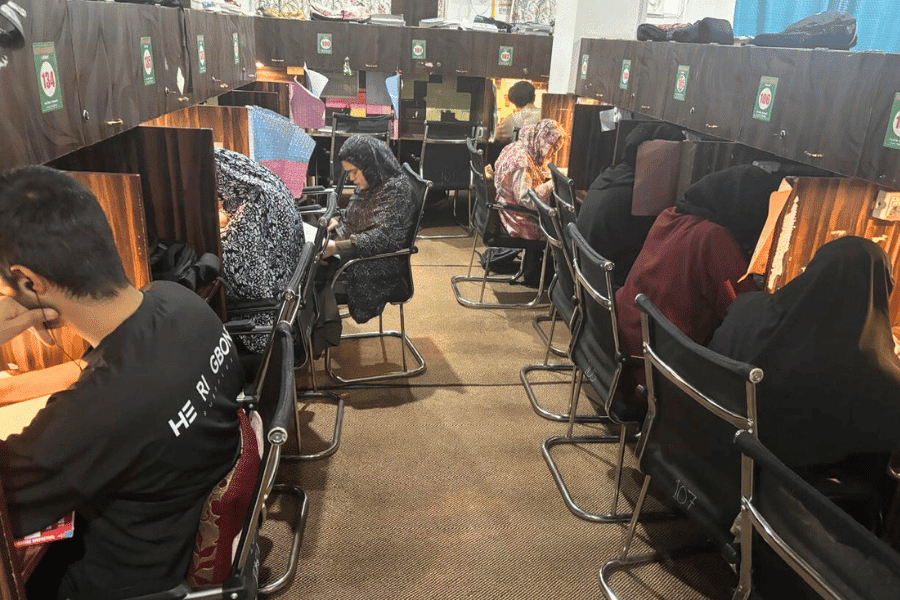
    Initially, he started with 60 study cabins, which were fully booked within days. Encouraged by the overwhelming response, he expanded the facility. “Now we have 120 cabins, all booked until June,” he said. Each student is charged a modest monthly fee of nine pounds to use the space.

    He admits he hadn’t anticipated such a strong turnout. Students aged 17 to 29 now frequent Pulse — some preparing for competitive entrance exams, while others focus on passing exams required for government jobs. 

    One trend stood out to him: nearly 60% of the students are girls.

    A hunger to learn

    In 2022, more than 250,000 people visited just 131 public libraries across Jammu and Kashmir, highlighting both a hunger for learning and the shortage of adequate study spaces. With thousands of aspirants preparing for exams, existing public libraries are overwhelmed and operate only during daytime hours, making it tough for students who need longer study sessions.

    In response, young people across the region have stepped in, launching private reading halls that offer 24/7 access. Equipped with Wi-Fi, heating, cooling, kitchen spaces and discussion zones, these modern study hubs have quickly become essential for serious exam takers in Kashmir.

    Javed Pathaan, a recent PhD graduate from Kashmir University, runs a private reading hall in Srinagar’s Rajbagh area. “Having personally gone through the rigors of competitive exam preparation, I understand how valuable these extras can be,” he said. “Students who study for long hours need occasional breaks, so we’ve created a designated space for short naps.”

    He said that young students face intense mental and physical strain while preparing for exams in a conflict-ridden region. That’s why many choose private services like his over free public libraries.

    Shazir Ahangar, who wants to pass an exam to get a government job in Kashmir, shifted to Pulse Library at Achabal after leaving the public library in Anantnag. He found the public facility overcrowded and said it was hard to concentrate there. 

    “They’re open for just eight to nine hours a day, which isn’t enough when you’re preparing for competitive exams,” he said.

    The exchange of knowledge

    One of Ahangar’s main concerns was the lack of basic facilities. The public libraries he visited didn’t offer air conditioning during summer or designated kitchens for making tea or coffee. Nor do they have discussion rooms. 

    “At Pulse, it’s more than just studying,” he added. Students engage in group discussions, exchange ideas and even enjoy small breaks together. He especially appreciated the privacy provided by individual study cabins.

    Last year, Manan Bhat, 28, from Soura area of Srinagar, secured the 88th rank in India’s civil service exam, a major feat considering that every year, more than one million people appear for India’s Civil Services Examination, but fewer than 1,000 candidates are selected.

    When he first began coming to reading halls they were often nearly empty. “Now, they’re packed with students,” he said. 

    Manan said that the biggest advantage of reading halls is the individual focus they offer, allowing students to concentrate without distractions. He also highlighted how being surrounded by peers preparing for similar exams creates a supportive environment that encourages the exchange of knowledge.

    Safe spaces to study

    Owners of reading halls often play an active role in encouraging students, staying in touch with their parents to share updates on their performance and dedication. The atmosphere in these halls is competitive, similar to coaching centres.

    Muazim Altaf said that admitting students to the reading hall comes with significant responsibility, as parents place a great deal of trust in them. 

    “We share weekly reports with parents, including details like how much time their children spend studying and whether they arrive on time,” he said. This becomes especially crucial in a region battling widespread drug addiction. Parents often urge him to keep a close watch on their children. According to Muazim, any form of indiscipline or violation of library rules results in immediate expulsion.

    In December last year, Shri B.L. Verma, the minister of state for social justice and environment, told the Indian parliament that more than 823,000 people in Jammu and Kashmir — around 8% of the region’s population — use drugs of some kind, including cannabis, opioids or sedatives.

    Basit Fayaz, who recently secured an All India Rank of 70 in the national exam that determines placement in professorships and research fellowships, believes that joining a reading hall played a crucial role in his success. He said that without the focused study environment it offered, cracking the exam — let alone making it to the top 100 — would have been nearly impossible.

    “The reading hall in Achabal [Pulse] provided exactly the kind of calm and distraction-free atmosphere I needed,” he said, adding that it helped him stay insulated from the recurring disturbances like crackdowns and gunfights that are common in Kashmir.

    Fayaz appreciated the peer group he found there. He recalled how group discussions and study sessions with fellow NEET aspirants added great value to his preparation. He added that without such spaces, constant exposure to conflict-related events often disturbs one’s mental state and heightens anxiety.

    “In situations like escalations between India and Pakistan, gunfights or political crackdowns, these spaces help us stay focused and shielded from the chaos,” Fayaz said.


    Questions to consider:

    1. What distractions from studying do so many young people in the Kashmir region face?

    2. How can political turmoil at the national level affect people who live far from city centres?

    3. How important is it for you to have a safe, quiet space to study?


    Source link

  • “Portrayed as a place that isn’t what I know it to be”: Professor Bell on ANU’s public perception

    “Portrayed as a place that isn’t what I know it to be”: Professor Bell on ANU’s public perception

    ANU vice-chancellor Genevieve Bell with Rachel Marape at James Marape, the Prime Minister of Papua New Guinea’s address to the ANU in February, 2024. Picture: Martin Ollman

    Australian National University’s (ANU) vice-chancellor Genevieve Bell has made a statement confirming she plans to stand by her university after a “four-month negative media campaign.”

    Please login below to view content or subscribe now.

    Membership Login

    Source link

  • Will the Vatican find its next pope in an unlikely place?

    Will the Vatican find its next pope in an unlikely place?

    If you’ve seen the award-winning film “Conclave”, you now know how exciting it can be when Catholicism’s cardinals gather behind closed doors to elect a new pope. The declining health in Pope Francis, 88, means another conclave is coming sooner rather than later. 

    So who is likely to win? The truth is — we have no idea. 

    What are the issues the world’s 1.3 billion Catholics would like the next head of their worldwide Church to tackle? We don’t know that for certain either. 

    In his 12 years as pope, Francis has so scrambled the Church and the traditional paths toward becoming its leader that the conclave — already the strangest election you’ll never see — is even harder than ever to predict. 

    With the 120 cardinal electors so unsure, unforeseen events like a stirring speech behind closed doors can produce big changes. That’s how Buenos Aires Cardinal Jorge Bergoglio became Pope Francis back in 2013. 

    Don’t trust the early bets.

    Another lesson from recent conclaves is to be very wary of any lists of leading candidates. They are not based on opinion polls or popularity contests like forecasts before political elections. 

    They are in fact little more than educated guesses by journalists and bookmakers, and can be laughingly far off the mark. 

    Many lists prior to the 2005 conclave named Milan Cardinal Dionigi Tettamanzi as a leading candidate; he reportedly got only two votes. In 2013, the pro-conclave lists of papabili — potential popes — did not even mention the eventual winner. 

    But readers always want to know what will happen, and the final result we can’t predict. Since this will be the third conclave I’ve either covered or commented on, let me at least say what to expect.

    First of all, if you want, go see the film “Conclave”at best before we learn if it has won any Oscars. Sure, the film is tenser and more action-packed than a real conclave, and its ending seems improbable. Due to timing limits, the leading characters are painted with a rather cartoonish brush. There are some small mistakes.

    But this is entertainment, not a documentary. It is beautifully filmed. It gives an idea of the predictable ritual and possible mishaps that could influence the outcome. It’s worth seeing even if not totally believing.

    Politicking for popedom

    As the film shows, hopeful candidates drum up support without publicly declaring their candidacy. Open campaigning is out but supporters eagerly swap information about favorites and opponents. 

    Speeches about the Church during the closed-door “general congregations” meeting the week before the conclave become veiled campaign pitches for the ambitious.

    Once they enter the Sistine Chapel for the conclave, the cardinals are cut off from the outside world and sworn to secrecy. This lasts for a few days of voting — a two-thirds majority is needed — until white smoke goes up from the chapel’s chimney and the new pope appears in public for the first time on the balcony of St. Peter’s Basilica next door.

    What makes this conclave even more unpredictable than earlier ones is that Pope Francis has often overlooked traditional cardinal’s seats in Europe to give red hats to lesser-known and more pastorally-minded bishops from his beloved “peripheries.”

    There are now cardinals in unlikely places such as Yangon, Ulaanbaatar, Algiers and Tehran, representing minuscule communities of Catholics. It’s hard to say what these prelates think or how they will vote.

    A new pope could mean a new direction.

    Pope Francis has appointed about 80 of the current cardinal electors out of 120, so the two-thirds majority needed for election should be there. But since so many of them are not known in Rome, it’s hard to say whether they want to continue his policies or take the Church in a different direction.

    After the 2013 conclave, several conservative Catholic groups — mostly in the United States — disapproved of Pope Francis’s more open style. They said cardinals did not have enough information before they voted him in, and vowed to publish detailed profiles of all prelates on the internet. 

    The College of Cardinals Report seems the furthest advanced, with profiles of 40 cardinals with their positions on key issues like abortion or woman priests. It is headed by Edward Pentin, a conservative Vatican watcher. 

    Another project, the Red Hat Report, began in 2018 with lots of publicity saying ex-FBI agents would do some of the research and freelancers would help edit cardinals’ Wikipedia pages. It also leans conservative but has not made much noise recently. 

    Their main candidate appears to be Budapest Cardinal Péter Erdő, who headed the Council of the Bishops’ Conferences of Europe from 2006 to 2016. 

    Considered close to Hungarian Prime Minister Viktor Orbán, he seems not to share Pope Francis’s very welcoming views on migration but has hosted two visits by Pope Francis to Budapest.

    Power in the Global South

    Another conservative noticed is Kinshasa Cardinal Fridolin Ambongo Besungu, although the very traditional stances African prelates take turn off other cardinals. 

    Progressives mentioned include Bologna Cardinal Matteo Zuppi, head of the Italian Bishops Conference, and Curia Cardinal Luis Tagle, a Filipino once dubbed the “Asian Francis.” But it’s unclear whether a majority of cardinals wants an extension of the Francis years.

    There are also moderates such as two Italians — possibly too diplomatic Cardinal Pietro Parolin, the current Secretary of Stage (number two man at the Vatican), and Cardinal Pierbattista Pizzaballa, the Latin Patriarch of Jerusalem — as well as French Cardinal Jean-Marc Aveline, who shares Pope Francis’s interest in the Mediterranean and caring for its migrants.

    But with two-thirds of all Catholics now in the Global South, will the conclave return to the Italian and then European monopoly on the papacy after an Argentinian pope?

    There are far more questions than answers. We’ll only start to know the responses after the white smoke rises.


    Three questions to consider:

    1. Why was Pope Francis hailed as a rule-breaker when he was elected to head the Catholic Church in 2013?
    2. How does politics play out in the election of a new pope?
    3. If you were part of the next conclave what would you be looking for in the candidates for pope?


    Source link

  • US Attorney Ed Martin’s bully tactics have no place in America

    US Attorney Ed Martin’s bully tactics have no place in America

    As the federal government’s chief prosecutors, United States attorneys wield significant power. The Constitution charges them with using that power to ensure “that the laws be faithfully executed.” And as any reasonable federal prosecutor would know, the First Amendment bars them from abusing their power to intimidate government critics.

    But one U.S. Attorney, Edward R. Martin Jr., doesn’t seem to have gotten the Constitution’s message or taken his oath seriously. Instead, Martin has emphasized political grandstanding and chilling dissent. Even though he’s been in office for only a few weeks, he’s unleashed the power of his office to go after speakers critical of Department of Government Efficiency, Elon Musk, and Supreme Court justices. And more troublingly, Martin has threatened to “chase” those critics “to the ends of the Earth,” sending a clear message: Shut up, or else. 

    So FIRE is here to remind Ed Martin — and any other prosecutor thinking about following Martin’s lead — that threatening government critics is not only inexcusable, it’s unconstitutional.

    Let’s start with a fundamental principle: Criticizing the government is not a crime. It’s free speech. And the First Amendment fiercely protects it. In fact, the First Amendment protects a lot of sharp-edged political rhetoric. That’s true whether you’re an elected official, a college student or faculty member, or just somebody posting on social media. 

    Of course, the First Amendment doesn’t protect true threats. But there’s a narrow legal definition of true threats, per the Supreme Court: statements intended “to communicate a serious expression of an intent to commit an act of unlawful violence to a particular individual or group of individuals.” Only if speech meets that exacting standard — and the speaker knew or ignored a real risk their statement would be “viewed as threatening violence” — can prosecutors like Martin target it. If not, it’s protected by the First Amendment.

    No reasonable listener could conclude Garcia was donning brass knuckles and seriously expressing, over CNN’s airwaves, an intent to beat up Elon Musk.

    Above all, in no case does an American’s protected speech turn into a “threat” just because a prosecutor disagrees with it, doesn’t find it funny, or dislikes his political pals being criticized. Any other outcome would empower the government to intimidate or jail political opponents simply by labeling dissent a “threat.” Those authoritarian tactics call to mind places like China and North Korea, but they have no place in the United States of America. 

    That’s why two weeks ago, FIRE joined a letter to Martin penned by the Freedom of the Press Foundation and Demand Progress. We expressed concern over posts by Martin on the social media platform X that appeared to promise prosecution against DOGE critics. As the letter pointed out: “Threatening to file frivolous charges against Americans and vaguely insinuating that wide swaths of constitutionally-protected speech and activity could invite criminal investigations and prosecutions” defies both the First Amendment and Martin’s professional and ethical obligations.

    Rather than heed that letter, Martin has doubled down. Yesterday, he opened a federal investigation targeting two members of Congress — part of what Martin dubs “Operation Whirlwind” — for past public statements that Martin claims threatened fellow government officials. But none of the statements come close to an unprotected true threat.

    Martin’s inquiry into Sen. Charles Schumer of New York reportedly centers on a March 2020 remark the Democratic minority leader made at an abortion rights rally outside the Supreme Court: “I want to tell you, Gorsuch, I want to tell you Kavanaugh, you have released the whirlwind and you will pay the price. You won’t know what hit you if you go forward with these awful decisions.” (Schumer’s remarks are the namesake of Martin’s “Operation Whirlwind.”)

    And Martin’s office is investigating Rep. Robert Garcia of California for a comment the Democratic congressman made last week during a CNN interview about Elon Musk. Garcia, who posted the letter he received from Martin on X, said: “What the American public wants is for us to bring actual weapons to this bar fight. This is an actual fight for democracy.”

    It’s not a close call: Neither statement meets the definition of a true threat. Each is core political speech, fully protected by the First Amendment.

    Far from free speech savior, Elon Musk increasingly looks like a false prophet 

    News

    Twitter suspended the accounts of numerous journalists who Twitter owner Elon Musk accused of doxing him and his family.


    Read More

    Schumer’s remark is plain old political hyperbole. Sure, saying justices will “pay the price” and “won’t know what hit them” as a result of their decisions might be described by some as intemperate. The statement drew criticism from other members of Congress, and even condemnation from the bench: Chief Justice John Roberts chastised Schumer for the tenor of his remarks, and Schumer in turn apologized. But in no way was it “a serious expression of an intent to commit an act of unlawful violence to a particular individual or group of individuals,” let alone grounds for a federal investigation, nearly five years after the fact.

    The First Amendment also protects Garcia’s political rhetoric — and again, it’s not a close call. Garcia’s comparison of the current political moment to a “bar fight,” requiring “actual weapons” for “an actual fight for democracy,” is plainly metaphorical, not literal. This is especially clear from the context of Garcia’s remarks, made during a CNN interview about politics. No reasonable listener could conclude Garcia was donning brass knuckles and seriously expressing, over CNN’s airwaves, an intent to beat up Elon Musk.

    Simply put, there’s nothing to investigate.

    Neither Schumer’s nor Garcia’s remarks are true threats. If they really were actionable threats, our nation’s capital would be a far different place. From the top down, Washington is chock-full of politicians using charged language, allusions to fighting, and sometimes even explicit invitations to drop the gloves. That’s how it’s been since the beginning, as Patrick Henry and Thomas Jefferson would confirm.

    If Martin really wanted to prioritize officials’ safety, he’s got plenty of actual work to do. He could start with the real bomb threatsdeath threats, and swatting attacks federal lawmakers and officials have reported receiving over the past year. Instead, he’s targeting standard-issue political rhetoric from partisans on the other side of the aisle.

    It’s bad enough when a dean of students distorts the line between protected speech and true threats. But a federal prosecutor? That’s indefensible — and dangerous to a free society.

    That all leaves one conclusion. Martin’s “Operation Whirlwind” is a political stunt — and a dangerously unconstitutional one, threatening to blow a chilling wind across our nation’s political debate. Government investigations that target plainly protected expression violate the First Amendment. And any reasonable government official, especially a federal prosecutor, would know as much.

    To be sure, Martin’s not the first prosecutor to target protected political speech in recent months. Last November, Arizona Attorney General Kris Mayes launched an investigation into then-candidate Donald Trump’s sharp-but-protected comments about former Rep. Liz Cheney. Mayes was as wrong to do so then as Martin is now.

    “Whatever one might think of Trump’s rhetoric here, it’s not a true threat,” wrote FIRE’s Aaron Terr at the time. “It’s constitutionally protected political speech.” The partisan coordinates may have flipped, but the same conclusion holds.

    Other government officials have followed the same playbook. For instance, FIRE could fill a book with examples of campus administrators shutting down plainly protected student and faculty speech by claiming it was somehow “threatening.”

    Take student Hayden Barnes, expelled for a Facebook collage criticizing his university’s plan to spend $30 million on a new parking garage. Or Austin Tong, barred from campus for his anti-communist Instagram post commemorating the anniversary of the Tiananmen Square massacre. FIRE has defended faculty members disciplined for “threats” for caustic but protected criticism of both President Trump and Black Lives Matter protesters. We’ve even seen students and faculty punished for obvious jokes and political satire. The list goes on and on.

    Here’s the bottom line: When government officials cynically mislabel protected speech as a “threat” to silence speech with which they disagree, it’s classic censorship that the First Amendment forbids. It’s bad enough when a dean of students distorts the line between protected speech and true threats. But a federal prosecutor? That’s indefensible — and dangerous to a free society.

    Source link