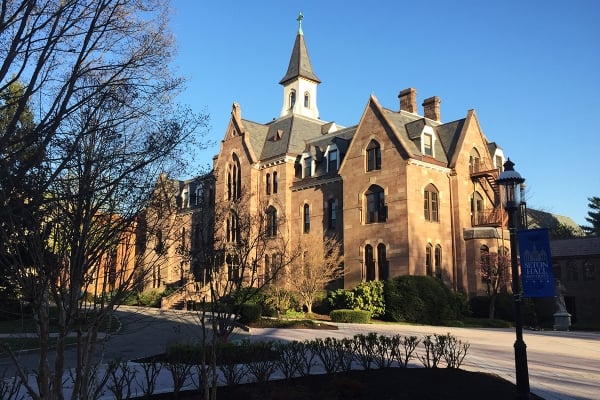
Seton Hall University president Monsignor Joseph Reilly is facing mounting pressure from public officials and demands for transparency following a report alleging that he looked the other way on sexual abuse cases.
At the same time, the university is contending with a lawsuit filed last year by former president Joseph Nyre, which alleges retaliation, breach of contract and various other misdeeds by the Board of Regents.
The regents have remained silent on the Reilly situation and said little about Nyre’s lawsuit, beyond a report issued in July. Now lawmakers are ratcheting up pressure on the private institution to take action, raising questions about how the board is navigating the dual controversies behind closed doors with little public oversight.
A Bombshell Report
Reilly, who was hired as president in April, has a long history with Seton Hall.
The new president earned a psychology degree from the university in 1987; in 2002, he became rector of the College Seminary at St. Andrew’s Hall, the undergraduate seminary of the Archdiocese of Newark, which is part of Seton Hall. A decade later Reilly became rector and dean of the university’s graduate seminary, a position he held until 2022. Then he took a yearlong sabbatical before returning as vice provost of academics and Catholic identity.
Reilly also served on Seton Hall’s Board of Trustees—one of two governing bodies—during his time as an administrator.
It was during his time at the graduate School of Theology that Reilly is accused of knowing about sexual abuse allegations that he did not report, according to documents reviewed by Politico. The case is linked to sprawling sexual abuse allegations involving disgraced cardinal Theodore McCarrick, the news outlet reported, who “created a culture of fear and intimidation” and “used his position of power as then–Archbishop of Newark”—which sponsors Seton Hall—“to sexually harass seminarians” for decades, according to a university report released in 2019.
McCarrick, who sat on both of Seton Hall’s boards, was defrocked by the Vatican after he was found guilty of sexual misconduct in a canonical trial. A criminal case against McCarrick was suspended last year due to his inability to stand trial because of a dementia diagnosis.
While Seton Hall never released to the public its full report on the abuse McCarrick allegedly committed, Politico’s review of the findings revealed that Reilly knew about the allegations against the cardinal and failed to report to university officials a student complaint about sexual assault by a seminarian. Politico also reported that Reilly dismissed another seminarian in 2012 who had allegedly been sexually abused and that he did not investigate the incident. In another instance, Reilly was allegedly made aware of a 2014 sexual harassment charge and did not report it.
Politico also reported that Reilly did not fully cooperate with a 2019 investigation into McCarrick’s alleged abuse. A task force set up in 2020 to mete out discipline after the McCarrick scandal reportedly recommended removing Reilly from board and leadership roles.
As the controversy has unfolded, Seton Hall has said little publicly.
“As part of the search for the university’s 22nd president, the Board of Regents reviewed several candidates and overwhelmingly selected Monsignor Joseph Reilly to lead Seton Hall in recognition of his decades of effective service and leadership,” a Seton Hall spokesperson wrote in an email to Inside Higher Ed. “The Board of Regents remains unequivocal in its support of Monsignor Reilly and firmly believes in his ability and vision to enhance Seton Hall’s standing as one of the nation’s foremost Catholic universities.”
The university did not provide a requested interview with regents, but the spokesperson added that following a 2019 review by a law firm, “the board determined that Monsignor Reilly should remain in his role and eligible for future roles at the University.” Seton Hall declined to provide a copy of the report.
Demanding Answers
Seton Hall’s silence has not gone unnoticed by Democratic state senator Andrew Zwecker, who chairs the Senate Oversight Committee and is vice chair of the higher education committee.
“I’m appalled at the fact that they’ve just doubled down at this point without any transparency, just generic statements about values and doing a good job, et cetera,” he told Inside Higher Ed.
Though Seton Hall is private, Zwecker noted that it receives about $2.5 million in state funding for certain programs. He added that the state could cut those funds—an option he might pursue if the university doesn’t respond transparently to concerns that Reilly ignored sexual abuse.
“That is a lever that we must absolutely consider to keep the pressure on,” Zwecker said.
He’s also weighing a public hearing. But Zwecker said he would rather see Seton Hall address the issue and answer questions about what Reilly knew about sexual abuse and whether the Board of Regents ignored those findings when it voted to hire him.
If regents knew and “voted to install this president anyway, they should resign immediately,” Zwecker said.
Democratic governor Phil Murphy also weighed in last week.
“The Governor is deeply concerned by the allegations and believes that Seton Hall University must release the full report,” press secretary Natalie Hamilton told Inside Higher Ed by email.
The Star-Ledger editorial board has challenged the university on its opacity, publishing an opinion piece on Monday under the headline “Why is Seton Hall hiding this sex abuse report?”
Faculty members at Seton Hall are also pressing for transparency.
Nathaniel Knight, chair of Seton Hall’s Faculty Senate, noted “considerable concern” among the professoriate and said he wants to see a “greater degree of transparency” from the university.
Knight said he supported Reilly’s hiring when he was named president, noting he “had the institutional memory” given his years of service and seemed to “embody the spirit of Seton Hall.” But now Knight wants the university to fully explain the concerns around the new president.
“I support Monsignor Reilly. I supported his hiring. I think he’s a good man, a man of integrity and religious faith, and is someone who brought a promise of bringing the university, the community, together around its core values as a Catholic institution of higher education. Whatever is out there, I’d like to be able to weigh that against the positives that I see with Monsignor Reilly,” Knight said.
An Explosive Lawsuit
For Seton Hall, the Reilly controversy comes on the heels of Nyre’s unexpected exit in 2023, which shocked many in the community.
“It was a surprise. I think we were bewildered. He had been brought in with great fanfare not long before,” Knight said. “He saw the university through the COVID years with a steady hand and was in the process of implementing this strategic plan that he had crafted. We saw no indication that there were any problems in the works. It was out of the blue and had us all scratching our heads.”
Nyre sued Seton Hall last February, alleging breach of contract and retaliation by the board.
In the lawsuit, Nyre alleges he was pushed out by the Board of Regents following a clash with then-chair Kevin Marino, whom he accused of micromanagement, improperly inserting himself into an embezzlement investigation at the law school and sexually harassing his wife, Kelli Nyre, among other charges. Marino, who is no longer on the board, was not named as a defendant in the lawsuit despite being at the center of many of the allegations.
“Our litigation centers on the alleged systemic failures of the Board of Regents and their unwillingness to comply with federal laws, including Title IX, Title VII, and Title IV, as well as university bylaws and policies,” Matthew Luber, an attorney representing Nyre, said in a statement. “As alleged in the Complaint, the Defendants prioritized self-preservation, suppressing dissent and retaliating against individuals like Dr. Nyre who reported misconduct and advocated for meaningful change. As further alleged in the Complaint, the Board of Regents not only neglected their fiduciary responsibilities, but exposed the University and its personnel to significant risk. No matter the outcome, change is urgently needed at Seton Hall.”
The university has pushed back in court. Officials filed a motion to dismiss last March, alleging that Nyre failed to state a claim and that the terms of his exit agreement barred him from filing a lawsuit against Seton Hall and/or its Board of Regents. Lawyers for Seton Hall wrote in a brief that Nyre’s lawsuit “can best be described as gamesmanship, and at worst sheer dishonesty.”
University officials did not address the Nyre lawsuit in a statement to Inside Higher Ed, but last July they released a report from an outside law firm rejecting the claims against Marino. Attorneys for the firm, Perry Law, wrote that they “found no evidence to substantiate Mrs. Nyre’s allegations regarding Mr. Marino, despite the purported harassment allegedly occurring in public places in close proximity to numerous other individuals.”
The Perry Law report was issued July 2, one day after Reilly assumed office. The report did not include interviews with the Nyres, who the authors noted did not participate in the investigation. Witnesses present for the alleged incidents told investigators that they did not see Marino engage in the behavior he is accused of, and the former board chair has denied the claims and blasted the lawsuit as “desperate and pathetic.” And, in a statement to Inside Higher Ed last year, Seton Hall said the claims were without merit.
As controversies around Seton Hall’s current and former leaders play out, more details are likely to emerge in the Nyre case, barring a dismissal or settlement. But the Reilly review may remain shrouded in mystery as Seton Hall hunkers down, ignoring widespread calls for transparency.