Tag: play

  • Being a principal just got harder–and here’s why

    Being a principal just got harder–and here’s why

    eSchool News is counting down the 10 most-read stories of 2025. Story #3 focuses on challenges in school leadership.

    This story was originally published by Chalkbeat. Sign up for their newsletters at ckbe.at/newsletters.

    There is a squeaky old merry-go-round in my neighborhood that my own children play on from time to time. Years of kids riding on it have loosened its joints so it spins more freely and quickly. The last time they played on the merry-go-round, my children learned the important lesson that the closer to the center they sit the more stable and in control they feel.

    While being a school leader has always felt like being on a spinning piece of playground equipment, leading since the inauguration of President Donald Trump has made me feel as if I moved from the center to the edges in this merry-go-round metaphor. Immigration raids and attacks on civil liberties have made the work feel blindingly fast.

    The school I serve has a large population of immigrant students. Teens who just weeks ago felt like our school was a safe and secure place now carry a new level of concern into our classrooms and hallways. My school has seen a significant drop in attendance since January with parents and guardians citing the desire to keep their children home instead of sending them to school and putting them in harm’s way as ICE raids happen across the city.

    Our staff feels the impact of the rhetoric and policy shifts out of Washington as well. They fear for the physical and emotional safety of our students when they leave the school.

    For my part, I wonder if my decisions that prioritize equity and inclusion will make me the target of criticism–or worse, an investigation. This year, we have had ongoing professional development opportunities to teach staff how they can better support our queer students and employees. Each time we engage in these discussions, I find myself worrying about the repercussions.

    But I am determined that the programs and people in place to support and protect our most vulnerable students will not go away. Rather, they will be reinforced. My role as a school leader is to create an environment so safe and accepting that students and staff never feel like they must look over their shoulder while they are at school. We want them to breathe easily knowing that, at least during the school day, they can be seen, safe, and successful.

    To be sure, this job has always been a juggle, which includes instructional leadership, behavioral support, budgeting, staffing, and–in my case–fighting the stigma of historically being identified as a low-performing school by the Colorado Department of Education. But the changes out of Washington have taken things to the next level. As I navigate it all, I do my best to be energetic, optimistic, and reliable. Each day is an exercise in finding joy in my interactions with students and staff.

    I find joy in seeing students cheer on their peers at basketball games. I find joy in watching a teacher sit with a student until they grasp a challenging concept. I find joy when I see staff members step in to teach a class for a colleague who is sick or just needs a break. I find joy and hope in my daily interactions with students and staff; they are the core of my work and are the bravest people I have worked with in my career.

    When I push my children on the merry-go-round, I tell them to get to the center because the spinning seems to slow down and the noise decreases. This is the same advice I would give to school leaders right now. Get right to the center of your work by being with students and staff as much as possible. Even at the center, the spinning does not stop. The raids, political attacks, and fear tactics do not decrease, but the challenge of facing them becomes a little more manageable. While every force out there may be pushing leaders away from the center of their work, prioritizing that values-based work reminds us exactly why we do what we do.

    Chalkbeat is a nonprofit news site covering educational change in public schools.

    For more news on school leadership, visit eSN’s Educational Leadership hub.

    Latest posts by eSchool Media Contributors (see all)

    Source link

  • What role do diplomats play?

    What role do diplomats play?

    “There is a perception that diplomats lead a comfortable life throwing dinner parties in fancy homes. Let me tell you about some of my reality. It has not always been easy. I have moved 13 times and served in seven different countries, five of them hardship posts. My first tour was Mogadishu, Somalia.”

    So said Marie Yovanovitch, a veteran U.S. diplomat who was the first witness in a congressional inquiry held to find out whether President Donald Trump abused his power as president by extorting a foreign president into investigating a Trump rival, former Vice President Joe Biden, in the race for the 2020 U.S. elections.

    The congressional hearings, only the third in the nation’s 243-year history to target a president for impeachment, have dominated the U.S. political debate for weeks and will continue making headlines for months both in the United States and elsewhere.

    It is a case that highlights, among other issues, widespread perceptions that diplomats have cushy jobs and play a lesser role in implementing foreign policy than soldiers.

    Yovanovitch, who was recalled from her post as ambassador to Ukraine for reasons that are at the heart of the impeachment proceedings, went on to tell a hushed meeting chamber: “The State Department as a tool of foreign policy often doesn’t get the same attention and respect as the military might of the Pentagon does, but we are — as they say — ‘the pointy end of the spear.’”

    “If we lose our edge, the U.S. will inevitably have to use other tools, even more often than it does today. And those other tools are blunter, more expensive and not universally effective.”

    Exhibit A is Cuba.

    Those tools include military force and economic sanctions, the latter being Trump’s favourite method to try to bend antagonistic governments to his will. The limits of military force are particularly obvious in Afghanistan and Iraq, where American troops have been waging war for 18 and 15 years, respectively.

    Exhibit A for the limits of economic sanctions is Cuba, which withstood an American embargo for more than 50 years. More recently, “maximum pressure” to cripple Iran’s economy has yet to persuade the government there to drop its nuclear ambitions, curb its quest for regional supremacy or curb support for groups hostile to the United States and Israel.

    The impeachment hearings have brought into focus the interplay between diplomacy and military strength.

    According to a parade of witnesses, all of whom except one were professional diplomats or career civil servants, Trump made the release of $391 million in military aid to Ukraine contingent on its president, Volodymyr Zelenski, launching an investigation into Biden and his son Hunter, who worked for a Ukrainian energy company while his father was the point person for Ukraine in the administration of ex-President Barack Obama.

    For the past five years, Ukraine has been fighting Russian-backed separatists in a low-intensity war in the east of the country. It needs the American aid, including anti-tank missiles, to keep control of its territory.

    According to administration witnesses in the impeachment hearings, Trump had ordered a freeze on the aid — which had been allocated by Congress — as a lever, thus using public funds for personal advantage.

    Big military spender

    The main conduit for the request for an investigation was President Trump’s personal attorney, Rudy Giuliani, who is a private citizen, rather than the U.S. ambassador to Ukraine, the State Department or the National Security Council.

    Giuliani saw Yovanovitch as an obstacle for the aid-for-investigations deal and he spread false rumours about her being a Trump critic. The end result: she received a middle-of-the-night call telling her to leave her post and take the next flight to Washington.

    Ivanovitch’s testimony at the impeachment hearing echoed complaints, voiced mostly in private, from foreign service diplomats almost as soon as Trump assumed office. Now, she said, there is “a crisis in the State Department as the policy process is visibly unraveling, leadership vacancies go unfilled and senior and mid-level officers ponder an uncertain future and head for the doors.”

    By word and by tweet, Trump has made clear his disdain for the institutions of state, from the State Department to the Central Intelligence Agency, the FBI and the Justice Department. This year, for the third year in a row, the administration is cutting the budget for the State Department while increasing the Pentagon’s.

    The United States already spends as much on its military as the next eight countries combined. It tops the list of global arms sellers. U.S. armed forces outnumber the diplomatic service and its major foreign aid agency by a ratio of around 180:1, vastly higher than other Western democracies.

    Beyond military solutions

    Curiously, the imbalance between the size of the U.S. armed forces and the civilian agencies that make up “soft power” — chiefly the foreign service and the United States Agency for International Development — have long been a matter of concern for military leaders.

    Often used in academic discourse, the term “soft power” was coined in the 1980s by Harvard political scientist Joseph Nye. It embraces diplomacy and assistance to foreign countries as well as cultural and exchange programs meant to improve the image of the United States. Hard power, in contrast, includes guns, tanks, war planes and soldiers.

    Last year, budget cuts for diplomacy and development so alarmed the military that 151 retired generals and admirals wrote to congressional leaders to plead for greater emphasis on civilian foreign policy and security agencies. “Today’s crises do not have military solutions alone,” the officers’ letter said.

    It quoted an observation by General James Mattis, the Trump administration’s first Defense secretary: “America’s got two fundamental powers, the power of intimidation and the power of inspiration.”

    Soon after taking office in January 2017, Trump promised “one of the greatest military buildups in military history” and put forward an “America First budget. It is not a soft power budget, it is a hard power budget.”

    There were not then, nor are there now, provisions to boost the power of inspiration.


    THREE QUESTIONS TO CONSIDER:

    1. In what ways are economic sanctions limited?

    2. What is “soft power”?

    3. How might you use a form of diplomacy to bring them together two people angry at each other?

    Source link

  • Games for Change Opens 2026 Student Challenge to Game Creators and Innovators Ages 10–25

    Games for Change Opens 2026 Student Challenge to Game Creators and Innovators Ages 10–25

    The annual global game design awards $20,000 in grand prizes for creative and impactful games that advance the UN Sustainable Development Goals

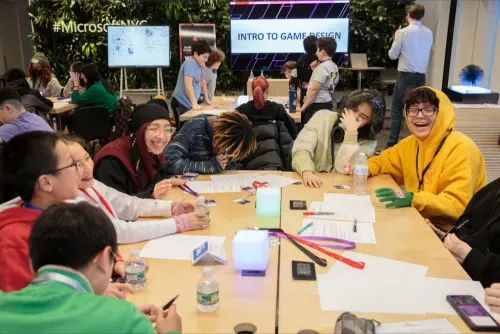
    NEW YORK, NY — [NOV 10, 2025] — Games for Change (G4C), the leading nonprofit that empowers game creators and innovators to drive real-world change, today announced the kick off of the 2025- 2026 Games for Change Student Challenge, a global game design program inviting learners ages 10–25 years old to tackle pressing world issues that address the United Nations Sustainable Development Goals, through creativity, play, and purposeful design.

    Now in its eleventh year, the Student Challenge has reached more than 70,000 students and almost 2,000 educators and faculty across 600cities in 91 countries, inspiring the creation of over 6,600 original student-designed games that connect learning to action. From November to April 2026, participants will design and submit games for consideration in regional and global competitions, with Game Jams taking place worldwide throughout the season.

    “The G4C Student Challenge continues to show that when young people design games about real-world issues, they see themselves not just as players, but as problem solvers and changemakers,” said Arana Shapiro, Chief Operations and Programs Officer at Games for Change. “Through game design, students learn to think critically, collaborate, and build solutions with purpose. In a world shaped by AI and constant change, durable skills like problem solving, critical thinking, and game design will allow all learners to thrive in their communities and worldwide.”

    This year, students will explore three new themes developed with world-class partners to inspire civic imagination and problem-solving:

    Two grand-prize winners will receive a total of $20,000 in scholarships, generously provided by Take-Two Interactive and Endless. Winners and finalists will be celebrated at the Student Challenge Awards on May 28, 2026, in recognition of exceptional creativity, social impact, and innovation in student game design.

    “With 3.4 billion players worldwide, the video games industry has an unprecedented ability to reach and inspire audiences across cultures and our next generation of leaders,” said Lisa Pak, Head of Operations at Playing for the Planet. “We’re excited about our collaboration with Games for Change, empowering students to use their creativity to spotlight the threats to reefs, rainforests, and our climate. Together, we’re transforming play into a powerful tool for awareness, education, and action.”

    More than 319 million people face severe hunger around the world today,” said Jessamyn Sarmiento, Chief Marketing Officer at World Food Program USA. “Through the ‘Outgrow Hunger’ theme, we’re giving the next generation a way to explore the root causes of food insecurity and imagine solutions through research, game design, and play. This collaboration helps students connect their creativity to one of the most urgent challenges of our time—ending hunger for good.”

    Additionally, G4C is expanding its educator support with the launch of the G4C Learn website, the world’s largest online resource library featuring lesson plans, tutorials, and toolkits to guide students, teachers, and faculty on topics like game design, game-based learning, esports, career pathways, and more. In partnership with Global Game Jam, educators worldwide can receive funding, training, and support to host Student Challenge Game Jams in their classrooms and communities.

    “Games turn learning into challenges students actually want to take on,” said Luna Ramirez, CTE teacher at Thomas A. Edison CTE High School based in New York City. “When students design games to tackle pressing global problems affecting their communities, they become curious about the world around them, experimenting, and bringing ideas to life. The best learning happens when students take risks, fail forward, and collaborate, and that’s exactly what the Games for Change Student Challenge empowers.”

    Educators, parents, and learners ages 10–25 can now registerfor the 2026 Games for Change Student Challenge and access free tools and resources at learn.gamesforchange.org.

    This year’s Student Challenge is made possible through the generous support of key partners, including Endless, General Motors, Verizon, Motorola Solutions Foundation, Take-Two Interactive, World Food Program USA, Playing for the Planet, Unity, and Global Game Jam.

    About Games for Change

    Since 2004, Games for Change (G4C) has empowered game creators and innovators to drive real-world change through games and immersive media, helping people learn, improve their communities, and make the world a better place. G4C partners with technology and gaming companies, nonprofits, foundations, and government agencies to run world-class events, public arcades, design challenges, and youth programs. G4C supports a global community of developers using games to tackle real-world challenges, from humanitarian conflicts to climate change and education. For more information, visit: https://www.gamesforchange.org/.

    Media contact(s):

    Alyssa Miller

    Games for Change

    [email protected]

    973-615-1292

    Susanna Pollack
    [email protected]

    Latest posts by eSchool News Contributor (see all)

    Source link

  • LEO has a role to play in picking winners

    LEO has a role to play in picking winners

    Perhaps we have LEO all wrong?

    In the week of the industrial strategy, which brought confirmation as to how central higher level skills will be to our plans for national growth, the annual release of longitudinal education outcomes (LEO) data) hits a bit different.

    In the past, ministers and higher education obsessives, have seen the release as a chance to rank universities and subjects – and perhaps even a chance to spot the infamous “low quality courses” – based on median graduate earnings. As we’ve been through time and time again on Wonkhe, this doesn’t really work.

    But quietly, and at the instigation of the former Unit for Future Skills which now forms a part of Skills England, earnings have taken something of a back seat to more detailed information about subject areas, place, and industrial sectors. If you wanted to understand the way in which investment in particular subjects might translate to benefits to particular industries (to support changes to the allocation of the Office for Students Strategic Priorities Grant, for example), LEO is where you would look.

    Factory model

    And you can illustrate this with today’s release of LEO data on graduate outcomes and provider level data. (There’s even a new DfE dashboard.)

    Let’s take a worked example. Advanced manufacturing is one of the eight sectors named in the industrial strategy as a national priority. As a sector it is going to be receiving £4.3bn over the next five years, including £2.8bn in research and development, from the state. Of the “frontier industries” within the manufacturing sector battery technology and advanced materials feel like clear priorities – and exactly the kind of things that might need the higher level skills that a university education might bring – although manufacturing as a whole will be in a similar position.

    How do you develop these skill sets?

    First up, we can see what graduates that work in manufacturing industries have studied. Engineering is the main route (and the route to the kind of high earnings that suggest senior roles) – just over 1,900 people with a first degree in engineering are working in the sector.

    [Full screen]

    But it is clear that manufacturing also needs business expertise (there are 1,350 business graduates in the field) and design capability (890 creative arts and design graduates). Both these groups earn rather less than the engineers – the low level of pay for creative arts graduates suggests that these workers may have recently moved into the sector or are in non-graduate roles, or (whisper it) we might need to pay them better. This latter interpretation is backed up by the fact that similar proportions of graduates are in this sector a year after graduation, and designers are consistently paid less.

    There is a regional component to this too (using the purple filters at the bottom of the chart, note that you can only use one of these at once) as we can see that when we look at London we can see that salary differentials shrink between our top three.

    In terms of specific manufacturing specialisms giving design graduates good jobs ten years on, another plot of the same data suggests automotive, and aircraft/space craft, manufacturing are particularly positive destinations. That said, they are not the primary destinations for creative arts and design graduates ten years out: as with many subject areas teaching is well represented, as are retail and advertising.

    [Full screen]

    The regional dimension

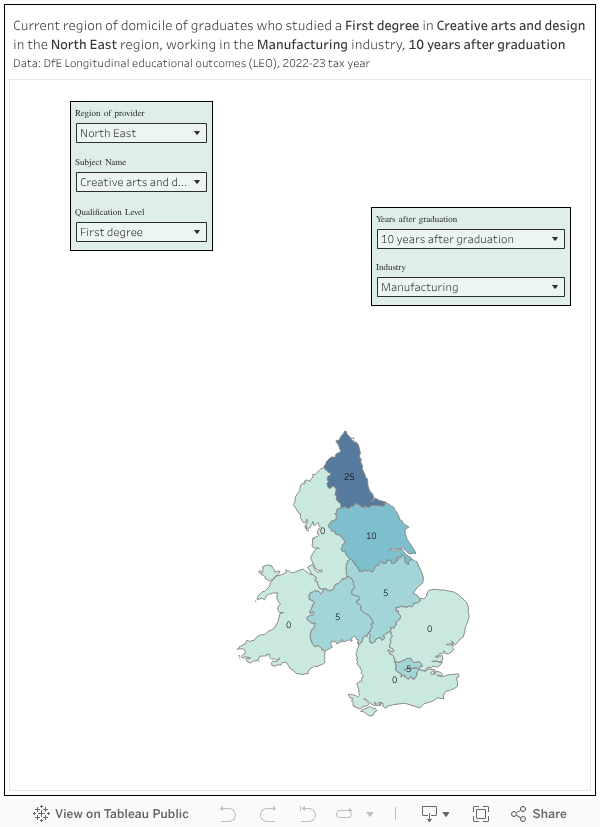
    Let’s say that we also want to use state investment in skills for manufacturing to have a regional benefit – and we wanted to focus on manufacturing in the north east. Would we need to specifically grow design provision in the north east of England in order to provide design graduates for firms there?

    Based on the data, the answer is yes. Most design graduates who studied in the north east working in manufacturing, are working in the north east ten years on. Though the numbers are small, the same appears to be true at other career points.

    [Full screen]

    Do we know if design students (rather than creative arts students) are the ones working in manufacturing? We don’t for certain but we can be reasonably sure. There are more design students than any other subjects in the creative arts and design area – and they tend to earn more ten years on than their peers in the arts. The median salaries also seem to match up – designers aren’t big earners, but they do earn more than some more traditional “skills priority” areas like ecology and mineral technology.

    [Full screen]

    Picking winners

    Seasoned LEO-watchers will be aware that there are issues when you look at specific sub-groups within the data. One of the drawbacks here is that we can’t track design specifically by provider – it would be helpful, if we decide we need more product designers in the north east, we knew which existing provider was landing them that well paid senior roles later in their careers. Best we can tell (and only five years out) it might be Newcastle and Northumbria – but we also need to factor in more granular effects (is Newcastle more likely to offer higher-paid design jobs than Sunderland or Middlesborough – I’d expect so, but we don’t get that data).

    [Full screen]

    It’s also likely that Teesside and Sunderland will be recruiting students with less traditional backgrounds, and we know that will have an impact on careers and salaries – but interestingly it appears to be Northumbria that are getting the best results for students from a domicile in a POLAR4 quintile one area.

    So there we have it: if we want to invest in advanced manufacturing in the north east of England in a way that gets the best results for local people, we need to support the design courses at Northumbria University. Which is something of a shame as we cut state support for design provision a couple of years ago.

    Source link

  • Why Teachers Can’t Afford to Wait on the Sidelines

    Why Teachers Can’t Afford to Wait on the Sidelines

    Tired of talking about AI? That’s too bad. The technology remains the most impactful force in education. The challenge becomes avoiding all the Claptrap. Thankfully, that’s where Denise Pope, Co-Founder of Challenge Success at the Stanford Graduate School of Education, comes in.

    I had the chance to explore the current AI state-of-play from her perspective. One striking disparity I haven’t heard talked about: While AI usage among students has skyrocketed—from 25% to 60% at the middle school level and 45% to 75% at the high school level over just two school years—only 32% of teachers report using AI for academic purposes.

    This gap has created what Denise describes as an educational “La La Land,” where students are experimenting with AI tools while many schools lack clear policies or guidance. The absence of structured approaches is breeding anxiety among both educators and students, who are left wondering when and how AI should appropriately be used in academic settings.

    Click through to hear how Denise believes this issue can be addressed:

    Kevin Hogan
    Latest posts by Kevin Hogan (see all)

    Source link

  • Empowering neurodiverse learners with AI-driven solutions

    Empowering neurodiverse learners with AI-driven solutions

    Key points:

    A traditional classroom is like a symphony, where every student is handed the same sheet music and expected to play in perfect unison. But neurodiverse learners are not able to hear the same rhythm–or even the same notes. For them, learning can feel like trying to play an instrument that was never built for them. This is where AI-powered educational tools step in, not as a replacement for the teacher, but as a skilled accompanist, tuning into each learner’s individual tempo and helping them find their own melody.

    At its best, education should recognize and support the unique ways students absorb, process, and respond to information. For neurodiverse students–those with ADHD, dyslexia, autism spectrum disorder (ASD), and other learning differences–this need is especially acute. Traditional approaches often fail to take care of their varied needs, leading to frustration, disengagement, and lost potential. But with advances in AI, we have the opportunity to reshape learning environments into inclusive spaces where all students can thrive.

    Crafting personalized learning paths

    AI’s strength lies in pattern recognition and personalization at scale. In education, this means AI can adapt content and delivery in real time based on how a student is interacting with a lesson. For neurodiverse learners who may need more repetition, multi-sensory engagement, or pacing adjustments, this adaptability is a game changer.

    For example, a child with ADHD may benefit from shorter, interactive modules that reward progress quickly, while a learner with dyslexia might receive visual and audio cues alongside text to reinforce comprehension. AI can dynamically adjust these elements based on observed learning patterns, making the experience feel intuitive rather than corrective.

    This level of personalization is difficult to achieve in traditional classrooms, where one teacher may be responsible for 20 or more students with diverse needs. AI doesn’t replace that teacher; it augments their ability to reach each student more effectively.

    Recent research supports this approach–a 2025 systematic review published in the EPRA International Journal of Multidisciplinary Research found that AI-powered adaptive learning systems significantly enhance accessibility and social-emotional development for students with conditions like autism, ADHD, and dyslexia.

    Equipping educators with real-time insights

    One of the most significant benefits of AI tools for neurodiverse learners is the data they generate–not just for students, but for educators. These systems can provide real-time dashboards indicating which students are struggling, where they’re excelling, and how their engagement levels fluctuate over time. For a teacher managing multiple neurodiverse learners, these insights are crucial. Rather than relying on periodic assessments or observations, educators can intervene early, adjusting lesson plans, offering additional resources, or simply recognizing when a student needs a break.

    Imagine a teacher noticing that a student with ASD consistently disengages during word problems but thrives in visual storytelling tasks. AI can surface these patterns quickly and suggest alternatives that align with the student’s strengths, enabling faster, more informed decisions that support learning continuity.

    Success stories from the classroom

    Across the U.S., school districts are beginning to see the tangible benefits of AI-powered tools for neurodiverse learners. For instance, Humble Independent School District in Texas adopted an AI-driven tool called Ucnlearn to manage its expanding dyslexia intervention programs. The platform streamlines progress monitoring and generates detailed reports using AI, helping interventionists provide timely, personalized support to students. Since its rollout, educators have been able to handle growing caseloads more efficiently, with improved tracking of student outcomes.

    Meanwhile, Houston Independent School District partnered with an AI company to develop reading passages tailored to individual student levels and classroom goals. These passages are algorithmically aligned to Texas curriculum standards, offering engaging and relevant reading material to students, including those with dyslexia and other learning differences, at just the right level of challenge.

    The future of neurodiverse education

    The promise of AI in education goes beyond improved test scores or sleek digital interfaces, it’s about advancing equity. True inclusion means providing every student with tools that align with how they best learn. This could be gamified lessons that minimize cognitive overload, voice-assisted content to reduce reading anxiety, or real-time emotional feedback to help manage frustration. Looking ahead, AI-driven platforms could even support early identification of undiagnosed learning differences by detecting subtle patterns in student interactions, offering a new frontier for timely and personalized intervention.

    Still, AI is not a silver bullet. Its impact depends on thoughtful integration into curricula, alignment with proven pedagogical goals, and ongoing evaluation of its effectiveness. To be truly inclusive, these tools must be co-designed with input from both neurodiverse learners and the educators who work with them. The score is not yet finished; we are still composing. Technology’s real legacy in education will not be in algorithms or interfaces, but in the meaningful opportunities it creates for every student to thrive.

    Latest posts by eSchool Media Contributors (see all)

    Source link

  • CoSN State Chapters Grow With Additions of MACE and CoSNE

    CoSN State Chapters Grow With Additions of MACE and CoSNE

    Washington, D.C.– CoSN today announced that the Mid-America Association for Computers in Education ( MACE) and the Nebraska Chapter of the Consortium for School Networking ( CoSNE) have been approved by the CoSN Board of Directors as official State Chapters. CoSN State Chapters play a crucial role in advancing the organization’s mission at the local level. These chapters provide a platform for education technology leaders to collaborate, share best practices and advocate for innovative solutions in their regions. Through networking events, professional development opportunities and policy influence, CoSN State Chapters empower members to drive impactful change in their school districts.

    MACE is a nonprofit corporation dedicated to advancing educational technology by fostering collaboration, sharing best practices and supporting educators in the effective use of technology. The organization works to enhance education through responsible use of hardware and software, engage with industry partners to establish technical standards, and connect professionals in the field.   CoSNE was established by the Nebraska Association of Technology Administrators ( NATA), along with a group of Nebraska K-12 chief technology officers, chief information officers and technology directors in smaller districts/regions — or not previously associated with NATA. CoSNE is advancing the focus on policy advocacy, professional development, and engagement with state and national entities to advance educational technology leadership and best practices for every K-12 technology leader across Nebraska.