Tag: pledge

  • Cornell Receives $371.5M Pledge From Alumnus Entrepreneur

    Cornell Receives $371.5M Pledge From Alumnus Entrepreneur

    Cornell University has received a pledge of $371.5 million from alumnus and software entrepreneur David Duffield, marking the largest single gift in the institution’s history.

    Combined with previous gifts from Duffield—which now total $550 million—the new contribution will establish the Cornell David A. Duffield College of Engineering. Cornell is already home to Duffield Hall, which was completed in 2004 and houses research and teaching facilities for nanoscale science and engineering. Last year Duffield pledged $100 million—at the time, the largest gift in Cornell’s history—to update and expand the eponymous building.

    The new pledge will be used primarily for endowment funds, including $250 million for the Duffield Legacy Fund, which will support the university’s ongoing strategic pursuits, and $50 million to advance key priorities related to educational excellence. The remainder will create the Duffield Launch Fund, which will support updating the college’s physical infrastructure, strengthening research facilities, supporting teaching and learning, and advancing research excellence.

    “I welcome the opportunity to help advance technological research, innovation and leadership at Cornell,” Duffield said in news release. “I’ve worked closely with many Cornellians over the years, and they consistently demonstrate exceptional leadership, creativity and problem-solving abilities. It’s a privilege to give back to my alma mater in ways that strengthen the university’s commitment to excellence.”

    Duffield has credited his Cornell professors for setting him on the path to success. He went on to become the founding CEO of two companies— PeopleSoft and Workday—that were each valued at $1 billion or more at their initial public offerings.

    “Many Cornell graduates have gone on to make incredible contributions to society through their innovations,” Cornell president Michael I. Kotlikoff said in a statement. “Among this esteemed group, Dave Duffield stands out for his transformational accomplishments and his determination to do the greatest good. We are tremendously grateful for Dave’s generous previous support of the College of Engineering and the Veterinary College. And Dave’s new gift and naming of the College of Engineering will impact Cornellians for generations and is an extraordinary tribute to the college and to Cornell.”

    Source link

  • No, you can’t make students stand for the Pledge of Allegiance

    No, you can’t make students stand for the Pledge of Allegiance

    For more than 80 years, the law has been clear. The government can’t force public school children to stand and recite the Pledge of Allegiance. 

    One Tennessee school was either oblivious to this settled First Amendment principle or chose to ignore it. But thanks to a letter from FIRE, the school district has stepped in and promised to investigate.

    Last month, FIRE wrote to the principal of Meadowview Middle School (part of the Hamblen County school district in eastern Tennessee) and the superintendent of the district after receiving reports that the principal had threatened — and actually followed through on — issuing demerits to students who refused to stand for the pledge. Principal Timothy Landefeld allegedly let students sit for religious reasons but not political ones. In this case, students could not sit in protest of Immigration and Customs Enforcement activity in the community.

    Pledge allegiance or else: Maryland public school forces students and teachers to salute the flag

    FIRE demanded that a public elementary school in Maryland retract its unconstitutional guidance that students and staff must stand and salute the U.S. flag during the Pledge of Allegiance.


    Read More

    Demerits aren’t trivial. Accumulating seven could land a student in 30 days of alternative school — a threshold easily reached in less than two weeks if a student protests every day. Even fewer demerits could carry serious consequences, such as removal from school clubs. All for exercising clearly established constitutional rights.

    FIRE’s letter called on Meadowview officials to immediately and publicly end this practice and rescind all related disciplinary actions. In response to our letter, legal counsel for the Hamblen County Board of Education promised the district was looking into the matter, assured FIRE that district policy allows students to opt out of the pledge, said any related demerits would be reversed, and said the superintendent would remind the district’s principals of the opt-out policy at an upcoming meeting. 

    “The First Amendment does not yield to the discomfort or hostility of onlookers.”

    We’re gratified that the district is taking our concerns and its constitutional obligations seriously. While school districts have broad discretion to establish curriculum and prohibit expression that’s truly disruptive to the learning environment, that doesn’t mean students “shed their constitutional rights to freedom of speech or expression at the schoolhouse gate.” Those rights include not just the right to speak but the right not to speak, including the right to refuse to pledge allegiance to the flag or any other symbol. 

    In 1943, the Supreme Court conclusively ruled on the issue in West Virginia State Board of Education v. Barnette. Even in the midst of World War II, the Court invalidated a requirement that schoolchildren salute the flag and recite the pledge. As FIRE told Meadowview Middle School: 

    The Court recognized that coercing expressions of reverence for national symbols is incompatible with our country’s commitment to individual liberty. As the Court famously declared, “if there is any fixed star in our constitutional constellation, it is that no official, high or petty, can prescribe what shall be orthodox in politics, nationalism, religion, or other matters of opinion or force citizens to confess by word or act their faith therein.” 

    That protection extends not only to refusing to salute the flag or recite the pledge, but also to declining to stand for it at all. Like a flag salute, standing for the pledge is a symbolic gesture that cannot be compelled. In fact, sitting silently to protest ICE is doubly protected — both as a refusal to endorse the government’s message and as a non-disruptive expression of a different message. 

    By allowing only a religious opt-out, Meadowview officials both unconstitutionally compelled speech and discriminated based on viewpoint, which the Supreme Court has called an “egregious” form of censorship. In Barnette, the students objected to saluting the flag on religious grounds, but it doesn’t matter whether a student’s decision is for religious or political reasons. Courts have consistently upheld students’ right not to take the pledge for political reasons. That’s because all Americans have the right not to affirm a government message, full stop. This is a basic First Amendment principle that doesn’t turn on one’s reason why. 

    Forcing students . . . to profess allegiance ironically violates the very principles of freedom of conscience and individual liberty that the flag itself represents.

    Meadowview officials may be offended by the students’ reasons for sitting, and they may be upset by what they see as disrespect toward a revered national symbol. But, as we told the school, “the First Amendment does not yield to the discomfort or hostility of onlookers.” Meadowview may not punish students out of “a mere desire to avoid the discomfort and unpleasantness that always accompany an unpopular viewpoint.” 

    America’s public schools partly exist to help turn students into engaged citizens, and school officials are free to model respect for national symbols. But compelled loyalty rings hollow. Forcing students, under threat of punishment, to profess allegiance ironically violates the very principles of freedom of conscience and individual liberty that the flag itself represents.

    FIRE applauds the Hamblen County school district for taking swift action to address this issue. We encourage district officials to not only remind school principals of their constitutional requirements, but to ask that individual school officials, especially at Meadowview, proactively notify students and parents that students are free to exercise their First Amendment rights when it comes to pledging allegiance to the flag “and the liberty for which it stands.” FIRE will continue watching to ensure students’ rights are secure.


    Source link

  • Sen. Marshall Proposes Legislation to Fulfill Trump Campaign Pledge on “No Tax on Overtime” – CUPA-HR

    Sen. Marshall Proposes Legislation to Fulfill Trump Campaign Pledge on “No Tax on Overtime” – CUPA-HR

    by CUPA-HR | May 12, 2025

    On May 6, Senator Roger Marshall (R-KS), along with Sens. Tommy Tuberville (R-AL), Jim Justice (R-WV), and Pete Ricketts (R-NE), introduced the Overtime Wages Tax Relief Act, which is intended to fulfill President Trump’s campaign promise to eliminate taxes on overtime pay. The proposal provides an income tax deduction for overtime pay up to a certain threshold. Marshall explained that his goal with the legislation was to target the benefit to lower- and middle-income workers in industries and occupations that traditionally pay overtime.

    Under the proposal, individuals would be able to deduct up to $10,000 of overtime pay from their income taxes. For married couples, the cap would be set at $20,000. This is an “above-the-line” income tax deduction, so workers would have the ability to claim the deduction whether they itemize their deductions or take the standard deduction.

    Additionally, the proposal phases out the benefit for top earners, identified as individuals earning $100,000 or more and married couples earning $200,000 or more. The deduction is reduced by $50 for every $1,000 in income the individual or married couple earns above their respective threshold.

    The legislation also includes reporting obligations for employers “to ensure transparency and accuracy in claiming the deduction.” Employers will be required to report overtime earnings to employees in their annual wage and tax statements.

    Marshall is hoping to have the legislation included in the Republican’s fiscal year 2025 budget reconciliation bill, which is expected to cover everything from border security to extensions for the expiring 2017 tax cuts President Trump signed into law during his first term.

    CUPA-HR will keep members apprised of additional updates on this bill and others related to overtime laws and regulations.


    Source link

  • Harvard Faculty Pledge 10% of Salary to Defend Against Trump

    Harvard Faculty Pledge 10% of Salary to Defend Against Trump

    Nearly 100 senior faculty members at Harvard have committed to taking a pay cut to support the institution’s legal defense against the federal government.

    The Trump administration has frozen more than $2 billion in federal funding, threatened to revoke Harvard’s tax-exempt status and said it would end the institution’s ability to enroll international students.

    Last month, Harvard filed a lawsuit to halt the federal freeze on $2.2 billion in grants after university officials refused to comply with a sweeping list of demands from the government.

    On Friday, President Trump repeated his calls to revoke Harvard’s tax exempt status. “We are going to be taking away Harvard’s Tax Exempt Status. It’s what they deserve!” he said in a post on his social media platform, TruthSocial.

    Harvard president Alan Garber said taking away the institution’s nonprofit tax exemption would be “highly illegal” and that its mission to educate and research would be “severely impaired” if the status were revoked.

    In their pledge, 89 senior faculty signatories said they would take a 10 percent pay cut for up to a year to protect the institution, as well as faculty and students who are more exposed to efforts to shore up costs, including by limiting graduate student enrollment and implementing hiring and salary freezes.

    “The financial costs will not be shared equally among our community. Staff and students in many programs, in particular, are under greater threat than those of us with tenured positions,” the pledge says.

    Ryan Enos, a signatory and professor of government at Harvard, estimated that the donations could amount to more than $2 million.

    The group said it intends to move quickly but has not decided how the salary cuts will be implemented.

    “We envision that faculty who have made the pledge will hold a vote and if the majority agrees that the university is making a good faith effort to use its own resources in support of staff, student, and academic programs, faculty will proceed with their donation.”

    Last week the institution announced changes to its admissions, curriculum and disciplinary procedures after two internal task forces launched last year investigating anti-Muslim bias and antisemitism on campus found the university’s response lacking.

    In response to the efforts, a White House official told CNN, “Harvard’s steps so far to curb antisemitism are ‘positive,’” but “what we’re seeing is not enough, and there’s actually probably going to be additional funding being cut.”

    Source link

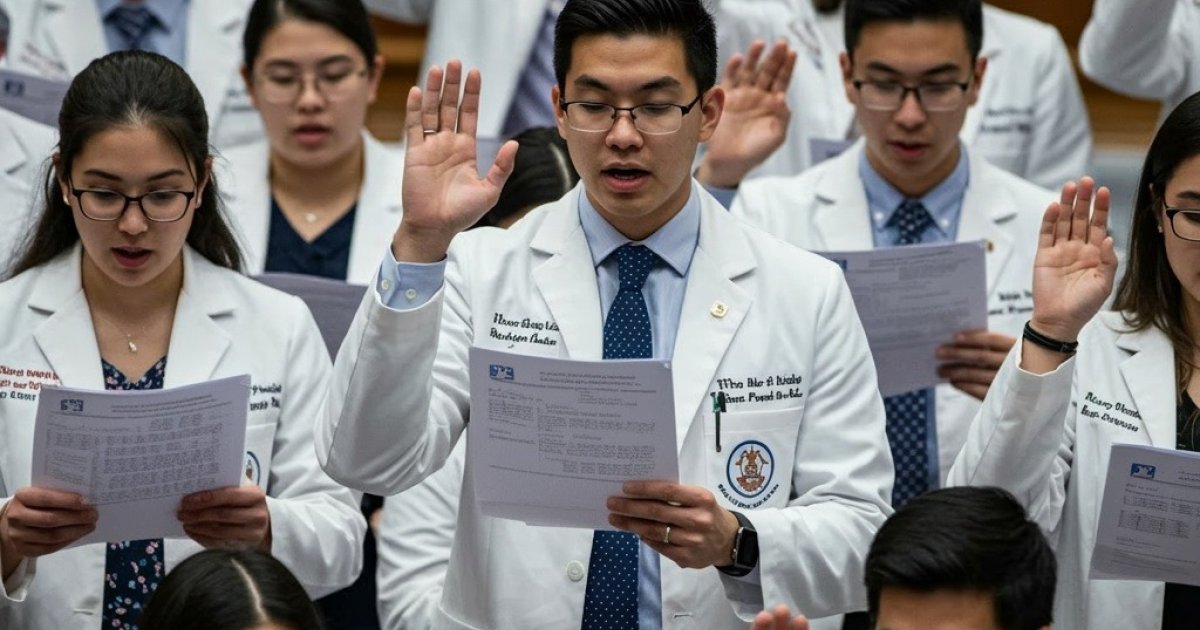
  • UConn Med now lets students opt out of DEI pledge of allegiance

    UConn Med now lets students opt out of DEI pledge of allegiance

    Great news: UConn School of Medicine administrators are going scalpels down on the school’s attempt to forcibly transplant politics and ideology into its incoming student body. 

    In 2022, UConn finalized its own version of the Hippocratic Oath, which includes a promise to “actively support policies that promote social justice and specifically work to dismantle policies that perpetuate inequities, exclusion, discrimination and racism.” Most recently, UConn required the incoming class of 2028 to pledge allegiance not simply to patient care, but to support diversity, equity, and inclusion.

    In January, an admissions staff member at the medical school told FIRE that the oath is mandatory for students. That’s a problem because, as a public university, UConn is strictly bound by the First Amendment and cannot compel students to voice beliefs they do not hold. 

    Concerned about this and similar cases, FIRE wrote the UConn School of Medicine on Jan. 31, calling on the school to make clear that students have every right to refuse to pledge allegiance to DEI. 

    We got back radio silence.

    After following up via email, we finally got some good news from UConn. The school’s communications director clarified, “UConn’s medical school does not mandate nor monitor a student’s reciting of all or part of our Hippocratic Oath, nor do we discipline any student for choosing to not recite the oath or any part of it.”

    Public institutions have every right to try to address any bias that might impact medical education. But forcing med students to pledge themselves to DEI — or any other political ideology — is First Amendment malpractice. They have no more right to do so than they do to force students to pledge allegiance to a political figure, or to the American flag. 

    In the landmark 1943 case West Virginia State Board of Education v. Barnette, the Supreme Court held that students could not be forced to salute the American flag, saying, “If there is any fixed star in our constitutional constellation, it is that no official, high or petty, can prescribe what shall be orthodox in politics, nationalism, religion, or other matters of opinion or force citizens to confess by word or act their faith therein.” 

    In the medical context it gets even worse, as these nebulous commitments could become de facto professionalism standards, with students facing punishment for failing to uphold them. (After all, they took an oath!) What, exactly, must a medical student do to “support policies that promote social justice?” Presumably, that would be for UConn to determine. And if a student disagrees with UConn’s definition of “social justice” or chooses not to promote it in the prescribed way, could she be dismissed for violating her oath? 

    FIRE has repeatedly seen administrators of professional programs — including medicinedentistrylaw, and mortuary science — deploy ambiguous and arbitrarily defined “professionalism” standards to punish students for otherwise protected speech. It’s no stretch to imagine it happening here as well.

    UConn isn’t alone in making changes to its version of the Hippocratic Oath. Other prestigious medical schools, including those at Harvard, Columbia, Washington UniversityPitt Med, and the Icahn School of Medicine have adopted similarly updated oaths in recent years. However, not all schools compel students to recite such oaths. 

    When we raised concerns in 2022 about the University of Minnesota Medical School’s oath, which includes an affirmation that the school is on indigenous land and a vow to fight “white supremacy,” the university confirmed that students are not obligated to recite it. 

    We’re glad that UConn has now done the same. FIRE celebrates this surgical success, and we won’t stand by while schools try to graft ideology onto student minds.

    Source link