

Tag: Plummet

  • UK study visa applications up 7% while dependant numbers plummet

    UK study visa applications up 7% while dependant numbers plummet

    New Home Office migration statistics show the full effect of an almost outright ban on dependants – with numbers dropping sharply for the second year in a row since the policy was announced.

    While there were 419,558 main applications for UK study visas in the year ending September 2025, marking a 7% increase on the previous year, there were 20,366 dependants – a 57% decrease year on year.

    It marks the second consecutive year of falling dependants, with this number decreasing annually by a whopping 87% in the year ending September 2024.

    It follows new rules introduced in January 2024 to ban students on postgraduate-taught programs from bringing their dependants with them to the UK.

    The number of UK study visas issued to international students and their dependants rose sharply after 2016 – reaching a post-Covid peak of 652,072 in 2023. Now, since the dependants ban, the number of study visas issued has fallen to 439,924.

    According to the Home Office, there has been roughly one dependant for every 20 main study visa applicants since the year ending March 2025 – a stark decline since the year ending September 2023, when this number stood at six per 20 main applicants.
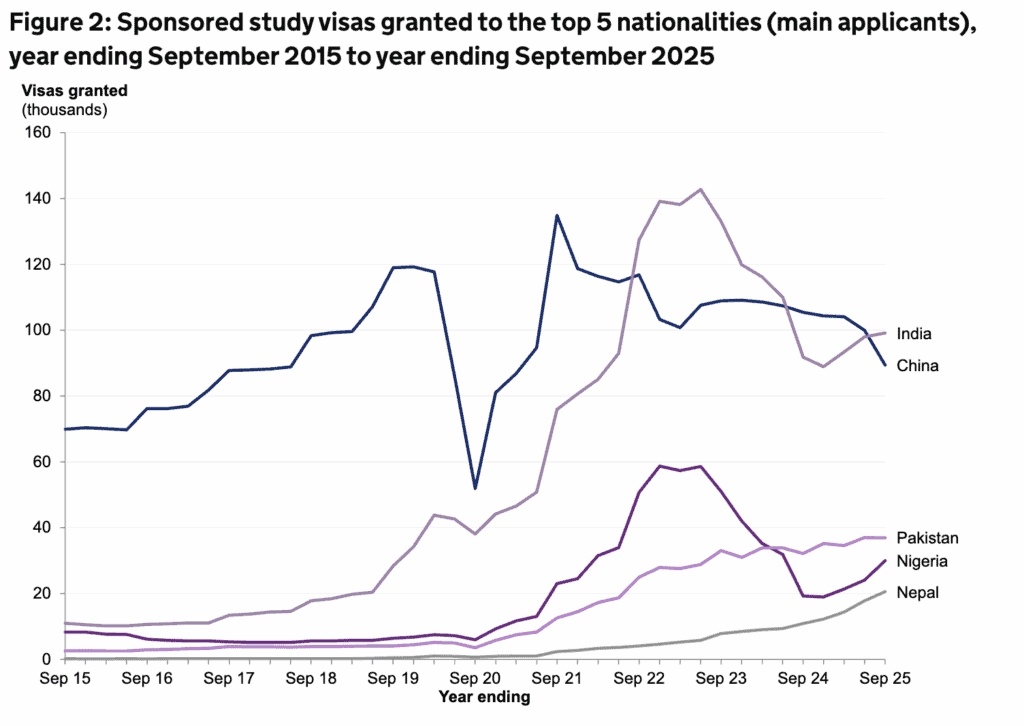
    Source: Home Office

    Indian students were issued the most sponsored study visas in the year ending September 2025, with 99,18 visas issued. Chinese students made up the second biggest cohort – with 89,397 visas issued, 15% fewer than the previous year.

    Pakistani students were the third biggest group – issued 39,924 study visas, while there were gains for Nepali students (up 89% to 20,572) and Nigerian students (up 56% to 30,009).

    According to James Pitman, chairman of Independent Higher Education (IHE) and CEO of Studygroup, the effect of the dependants ban has been discriminatory – disproportionately affecting women.

    Speaking in a personal capacity at yesterday’s IHE annual conference, Pitman acknowledged that the dependants visa has “a major flaw”, but said that this could have been corrected rather than withdrawing the scheme entirely for taught degrees.

    “As predicted by the sector, that withdrawal was gender discriminatory, leading to the loss of 19,000 female students vs prior year in the January 2024 intake alone,” he said. “Every one of those was a human story, of ambitions denied, families fractured, careers restricted and yet again women being discriminated against – in this case by UK government policy.”

    Every one of those was a human story, of ambitions denied, families fractured, careers restricted and yet again women being discriminated against
    James Pitman

    Home Office figures obtained by Pitman via a freedom of information request show a marked year-on-year decline in women issued sponsored study visa grants for courses at RQF level 6-8 or equivalent starting in January.

    In 2023, of 81,079 total student visas, 45% were issued to women, compared to 55% that were issued to men. But the following year, after the dependants ban was brought in, the gender split was 66% in favour of men. These numbers stayed stable in 2025, the data showed, with 65% of sponsored study visas issued to men.
    Source link

  • UC San Diego Sees Students’ Math Skills Plummet

    UC San Diego Sees Students’ Math Skills Plummet

    Laser1987/iStock/Getty Images

    The number of first-year students at the University of California, San Diego, whose math skills fall below a middle school level has increased nearly 30-fold over the past five years, according to a new report from the university’s Senate–Administration Working Group on Admissions. In the 2025 fall cohort, one in eight students placed into math below a middle school level, despite having a solid math GPA.

    The number of first-year students in remedial math courses at the university surged to 390 in fall 2022, up from 32 students in fall 2020. The remedial math course was designed in 2016 and only addressed missing high school math knowledge, but instructors quickly realized that many of their students had knowledge gaps that went back to middle or elementary school, the report states. For fall 2024, UC San Diego revamped its remedial math course to address middle school math gaps and introduced an additional remedial course to cover high school math. In fall 2025, 921 students enrolled in one of these two courses—11.8 percent of the incoming class.

    “This deterioration coincided with the COVID-19 pandemic and its effects on education, the elimination of standardized testing, grade inflation, and the expansion of admissions from under-resourced high schools,” the report states. “The combination of these factors has produced an incoming class increasingly unprepared for the quantitative and analytical rigor expected at UC San Diego.”

    Within the UC system, the San Diego campus isn’t alone, but its problem is “significantly worse,” the report states. This is partly because the university has, since 2022, admitted and enrolled more students from low-income schools that saw greater COVID-era learning loss than other UC campuses. Many other UC campuses are seeing similar, though smaller, declines in student preparation. About half of UC campus math chairs responded to a survey saying that the “number of first-year students that are unable to start in college-level precalculus” increased twofold between fall 2020 and fall 2025, and the other half said the number increased threefold. 

    High school grade inflation is not helping the university evaluate students’ math skills, the report states. In 2024, the average high school math GPA for students in Math 2, the middle school–level remedial math course, was 3.65—an A-minus.

    “At the same time our admit pool is slipping in math preparation, we see a slight improvement in their math grades from high school,” the report states. “The elimination of standardized testing together with COVID resulted in a mismatch between students’ course level/grades and their actual levels of preparation, with far-reaching implications for determining math readiness and course placement.”

    The working group put forward a number of recommendations for addressing these shortcomings, including using a “math index” based on historical placement data and transcript-based variables to “predict students’ likelihood of placement into remedial math.” The group also recommended establishing feedback mechanisms with high schools and requiring math placement testing by June 1 for incoming students, among other things.

    Source link