Tag: plunges

  • Columbia University’s operating income plunges by nearly two-thirds

    Columbia University’s operating income plunges by nearly two-thirds

    This audio is auto-generated. Please let us know if you have feedback.

    Dive Brief:

    • Columbia University’s operating surplus fell by just over 63% year over year to $112.6 million in fiscal 2025, according to financial statements released Thursday. 
    • Operating revenues increased 2.1% while expenses rose 5.3%, Anne Sullivan, the Ivy League university’s executive vice president for finance, noted in a public message. In a tumultuous political year, federal grant revenue remained essentially flat at $1.3 billion, she said. 
    • Sullivan described the Trump administration’s termination of hundreds of grants to Columbia this year as “destabilizing” and said the university’s financial report “does not adequately capture the level of strain experienced by the research enterprise in the third and fourth quarters.”

    Dive Insight:

    Columbia’s head-on encounter with the Trump administration left a mark on its finances, even if — as Sullivan pointed out — the damage wasn’t fully captured in the institution’s fiscal year, which ended June 30. 

    In March, the administration terminated $400 million of Columbia’s federal grants and contracts. The cuts came just days after the government announced a probe over allegations that the university hadn’t done enough to protect Jewish students from antisemitism. 

    Amid the turmoil, Columbia laid off nearly 180 employees tied to federally funded projects. The university also dipped into its endowment’s unrestricted funds to help preserve some of the research projects, creating what the institution called its Research Stabilization Fund. 

    Sullivan on Thursday said the fund issued some 500 internal grants to Columbia researchers in June and September. She didn’t specify the total amount spent but described the scale as “modest.”

    Soon after terminating Columbia’s funding in March, the Trump administration offered the university an ultimatum. Columbia agreed to a host of unprecedented conditions in return for the government reinstating most of the canceled research grants. 

    Columbia signed a formal agreement with the Trump administration in July that included a $200 million payment to the government, to be paid over three years, in addition to a $21 million sum for a claims fund under an agreement with the U.S. Equal Employment Opportunity Commission. Although signed just after the close of fiscal 2025, the settlement is accounted for in Columbia’s financial statements.

    But the heaviest impact on the university’s income statement came from rising operating costs, which jumped 5.3% to $6.6 billion. Expenses rose across the board — from salaries for instructors and administrators to research costs to maintenance.

    Meanwhile, revenues grew more slowly. Sullivan described Columbia’s 4.1% increase in net tuition and fee revenue, which totaled $1.6 billion, as “modest.” Tempering that gain was a 4.6% rise in institutional financial aid to $622.6 million for the fiscal year. Columbia is among the most expensive colleges in the country to attend, though it offers free tuition to students from families that make under $150,000 a year. 

    With expenses rising at more than double operating revenue, Columbia saw its operating income shredded by nearly two-thirds, which Sullivan characterized as “modest” and “lower than our historical average.”

    Still, Sullivan described its operating surplus as critical to helping fund capital projects, including maintenance and renovation of its facilities. 

    The University’s ongoing cost containment efforts remain important to preserve financial flexibility and ensure that resources are allocated in a manner consistent with our priorities for excellence in teaching, research, and patient care,” she added.

    To be sure, Columbia is still among the wealthiest universities in the U.S. Its net assets grew 3.7% year over year to $20.5 billion. 

    Gifts to the university’s endowment fell by about a quarter, to $177.9 million. Even so, the value of the endowment’s donor-restricted funds still rose 8.7%, to $10.9 billion.

    In terms of operating income, Columbia’s Ivy League peer Harvard University fared worse. Its recently issued fiscal 2025 financials showed a $112.6 million operating loss, Harvard’s biggest loss in nearly a decade and a half. 

    Like Columbia, Harvard has come under financial attack by the Trump administration, which has sought to damage the institution on multiple fronts and is using several government agencies in its withering campaign of attacks. 

    “Even by the standards of our centuries-long history, fiscal year 2025 was extraordinarily challenging,” Harvard President Alan Garber said in a message accompanying the financial statements.”

    Source link

  • Global demand for US master’s degrees plunges by 60%

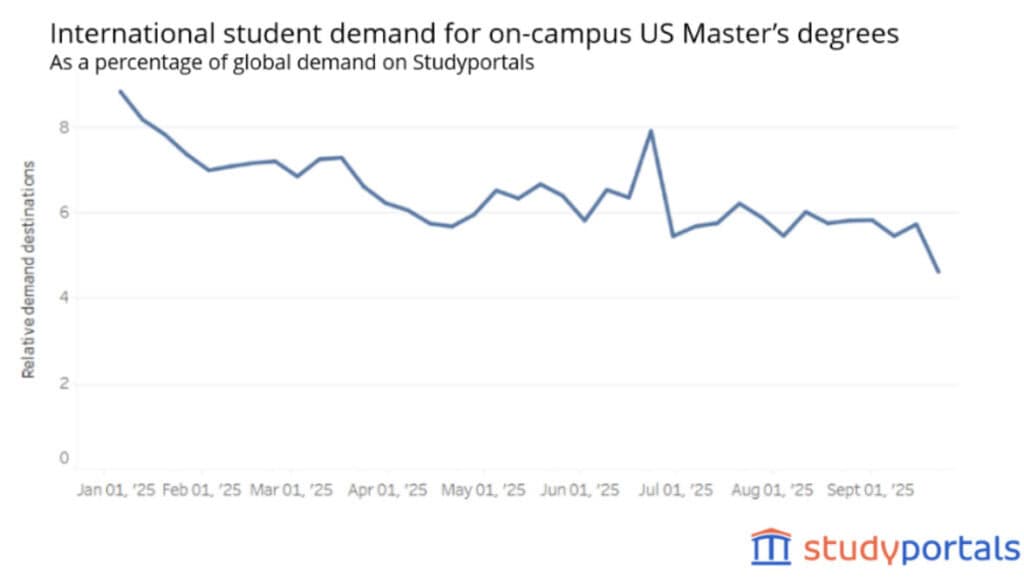
    Global demand for US master’s degrees plunges by 60%

    The data, collected from January 6 to September 28, aligns closely with the start of Donald Trump’s second presidential term and the ensuing uncertainty around student visas and post-graduation work opportunities. It is based on the search behaviour of over 50 million prospective students on Studyportals.  

    “Prospective international students and their families weigh not only academic reputation but also regulatory stability and post-graduation prospects,” said Studyportals CEO Edwin van Rest: “Right now, those factors are working against institutions.”  

    Studyportals said the steep decline – dropping more than 60% in less than nine months – corresponds to proposed and enacted policy changes impacting student visa duration, Optional Practical Training (OPT) and H-1B work authorisation in the US. 

    Last week, the Trump administration shocked businesses and prospective employees by hiking the H-1B visa fee to $100,000 – over 20 times what employers previously paid. Days later, the government announced proposals to overhaul the visa system in favour of higher-paid workers.  

    Sector leaders have warned that OPT could be the administration’s next target, after a senior US senator called on the homeland security secretary Kristi Noem to stop issuing work authorisations such as OPT to international students.  

    Such a move would have a detrimental impact on student interest in the US, with a recent NAFSA survey suggesting that losing OPT reduces enrolment likelihood from 67% to 48%.  

    Meanwhile, roughly half of current students planning to stay in the US after graduation would abandon those plans if H-1B visas prioritised higher wage earners, the survey indicated.  

    “Prospective students are making go/no-go enrolment decisions, while current students are making stay/leave retention decisions,” said van Rest. 

    “Policy changes ripple through both ends of the pipeline, reducing new inflow and pushing out existing talent already contributing to US research, innovation and competitiveness,” he added.  

    Data: Studyportals

    The search data revealed a spike in interest at the beginning of July, primarily from Vietnam and Bangladesh, and to a lesser extent India and Pakistan. Experts have suggested the new Jardine-Fulbright Scholarship aimed at empowering future Vietnam leaders could have contributed to the rise.  

    Meanwhile, Iran, Nepal and India have seen the steepest drops in master’s demand, declining more than 60% this year to date compared to last.  

    While federal SEVIS data recorded a 0.8% rise in international student levels this semester, plummeting visa arrivals and anecdotal reports of fewer students on campus suggest the rise was in part due to OPT extensions – individuals who are counted in student totals but who are not enrolled on US campuses or paying tuition fees.  

    Beyond the immediate financial concerns of declining international enrolments for some schools, van Rest warned: “The policies we adopt today will echo for years in global talent flows.”

    The UK and Ireland have gained the most relative market share of international interest on Studyportals – both up 16% compared to the same period in 2024. Australia, Austria, Sweden and Spain all experienced a 12% increase on the previous year.  

    In the US, international students make up over half of all students enrolled in STEM fields and 70% of all full-time graduate enrolments in AI-related disciplines, according to Institute of International Education (IIE) data.  

    The policies we adopt today will echo for years in global talent flows

    Edwin van Rest, Studyportals

    What’s more, universities with higher rates of international enrolment have been found to produce more domestic STEM graduates, likely due to greater investment in these disciplines, National Foundation for American Policy (NFAP) research has shown.  

    Last year, graduate students made up 45% of the overall international student cohort (including OPT), compared to undergraduate which comprised roughly 30%, according to IIE Open Doors data.  

    Universities with higher proportions of overseas students have been found to produce more domestic STEM graduates, likely due to greater investment in these disciplines, National Foundation for American Policy (NFAP) research has shown. 

    The news of plummeting international demand comes as domestic enrolments are declining, with less high school graduates entering college education and an overall demographic shrinking of university-age students.  

    In a recent survey by the American Council on Education (ACE), nearly three quarters of college leaders said they were concerned about enrolment levels this semester, with 65% moderately or extremely worried about immigration restrictions and visa revocations.  

    Source link