This week on the podcast we examine the latest attacks on international student recruitment as Policy Exchange calls for new restrictions and a £1,000 levy on international fees.
Are universities really “selling immigration not education,” and what would raising English language requirements to advanced level mean for the sector?
Plus we discuss what incoming student leaders are promising in their manifestos – from subsidised laundry to lecture materials uploaded in advance – and ask whether the new metascience unit can deliver on its promise of a more efficient and transparent research funding system.
With Duncan Ivison, President and Vice Chancellor at the University of Manchester, Vicki Stott, Chief Executive at the Quality Assurance Agency for Higher Education, Debbie McVitty, Editor at Wonkhe and presented by Jim Dickinson, Associate Editor at Wonkhe.
“To me the essential ingredient is that two persons or two teams from different countries collaborate, right?” Ricci said. “So who’s doing the podcast itself makes it really a cross-border operation.”
A podcast becomes cross-border, he said, when you bring different perspectives from different countries together in one story. There are two ways to make that story compelling to both the audiences and to Europe as a whole.
The first way, he said, is to have a strong story that articulates across borders and is relevant for two countries. It can be a very specific story that relates to feelings and notions interesting to anyone. The second way is to start from a general topic and then find a story within that topic.
“I’d really love that all podcasts speak to every audience we aim to target,” Ricci said. “I think it’s the biggest challenge to make sure that every podcast finds its audience in every national context.”
At WePod, the team divided the production process into stages.
First there was a pre-editorial stage where they brainstormed ideas. Then came a pre-production phase, where within the topic they reflected more concretely about the characters of each podcast.
“How do the different episodes talk to each other?” Ricci said.
Provide room for perspectives.
That was followed by the production phase. That involved going on the ground, setting up interviews and working on scripts and language transcriptions.
Finally, in the post-production phase everything textual became a finished podcast, ready to be promoted and distributed.
Caminero said that every podcast WePod did was produced in at least two languages, the first in the native language of the podcast producer and in English for a cross-border audience. “Obviously, this creates specific challenges because not all versions can be identical,” Caminero said. “You need to make room for adaptations.”
Ricci said that it was important in a big production like WePod, with people from different nationalities, to give people room to express themselves. “I think it takes time just to sit around the table, understand each other,” Ricci said.
This becomes important when you have deadlines and deliverables. “You’re pretty much kind of freaking out to meet everything, every deliverable you have to meet, every deadline,” Ricci said. If you try to impose a top down approach, it won’t work.
“So, I think it just takes a lot of talking before action,” Ricci said.
Questions to consider:
1. What does it mean to be cross-border?
2. How can a story that is interesting in one country have resonance in another?
3. Can you think of a topic important to your region that would also be important to people elsewhere?
As of 2023, more than 464 million people listen to podcasts regularly, and this number is growing each year. And with over 70% of parents listening with their children, podcasts are a communication channel your school can’t afford to overlook.
Why does this matter for education marketing?
Because parents, students, and alumni increasingly expect content that’s on demand, easy to consume, and aligned with how they already engage with other brands. A podcast offers exactly that. It provides a way to humanize your institution, give voice to your values, and build stronger relationships with your audience, all without requiring a massive budget or full production studio.
Is a school podcast worth the effort?
Here’s the reality: Schools that use podcasting strategically are finding new ways to connect with prospective families, boost engagement, and increase brand awareness. Whether you’re trying to showcase your faculty, highlight student achievements, or simply keep your community informed, a podcast gives you a direct line to your audience’s attention.
First things first, what is a podcast in school? A school podcast is an audio series created by educators, students, or staff to share news, stories, or educational content. It can highlight campus life, feature interviews, or support learning, helping schools connect with their communities in an accessible, on-demand format.
This blog post breaks down seven clear steps for launching a school podcast, from planning and production to promotion and measurement.
Struggling with enrollment?
Our Digital Marketing team can help you generate more leads!
Step 1: Define Your Podcast’s Purpose
Before you record a single second of audio, it’s important to answer one key question: Why are we starting this podcast?
A well-defined purpose ensures your content stays focused and impactful. Are you hoping to:
Attract and engage prospective families?
Showcase student life and culture?
Build thought leadership through staff and faculty interviews?
Strengthen alumni connections?
The most successful school podcasts have a clear audience and goal. For example, a private school may want to build trust with prospective families by featuring authentic stories from teachers and students. A language institute might use a podcast to demonstrate teaching methods or highlight student success stories. A university could aim to strengthen alumni ties through interviews and updates.
Whatever the goal, be specific. Broad intentions like “we want to communicate better” are too vague. Instead, anchor your podcast in a focused objective, be it enhancing recruitment, increasing transparency, or offering value-added resources to your community.
Once the purpose is clear, ensure leadership is aligned. Gaining buy-in from school administrators and relevant departments will give your project momentum, credibility, and cross-functional support.
Example: Yale University’s admissions office launched an official podcast called Inside the Yale Admissions Office to pull back the curtain on their application process. Their goal was to demystify college admissions for prospective students by sharing firsthand insights from actual admissions officers. Because the project aligned perfectly with Yale’s outreach goals, it had strong internal buy-in. Admissions staff themselves host the show, with support from the Dean.
Pro tip: Avoid trying to appeal to everyone. Tailor your podcast to a specific listener group and let that clarity shape your voice, content, and messaging.
Step 2: Choose the Right Format
The best podcast format is the one that plays to your strengths and fits your resources. You don’t need to copy what others are doing. What matters most is that your format fits your team and speaks to your audience.
Popular school-friendly formats include:
Interviews with staff, students, or alumni to spotlight personalities and accomplishments
Thematic episodes exploring topics like student life, curriculum innovations, or study tips.
Student-produced episodes that give learners ownership and boost engagement, or other types of user-generated content
Roundtable discussions where multiple voices weigh in on a key theme.
Example: A great illustration of a defined concept is Stanford University’s The Future of Everything podcast, produced by its School of Engineering. The show’s premise is crystal clear – each episode explores how technology, science, and medicine are shaping our lives and future. Hosted by a Stanford bioengineering professor, it follows an interview format where experts discuss innovations in fields from AI to health care. This distinctive theme and structure leverage Stanford’s academic strengths and consistently deliver on what the title promises.
Whatever you choose, aim for consistency in tone and structure. A 20-minute interview series sounds very different from a 10-minute solo voice memo, but either can be powerful if well-executed.
Remember: A podcast is more than a recording; it’s a conversation. Make space for authenticity and spontaneity to shine through.
Step 3: Build a Content Plan and Plan Episodes in Advance
Now that you’ve defined your purpose and format, it’s time to think long-term. One of the biggest mistakes new podcasters make is launching without a content roadmap. Jumping into production without a plan can lead to burnout or disjointed messaging.
Ask yourself:
What themes or topics will we cover across the season?
Which internal experts or guests should we feature?
Are there recurring segments that can anchor each episode?
A solid content calendar will help you avoid scrambling for ideas and ensure your messaging supports broader marketing campaigns (like admissions deadlines, open houses, or graduation season).
Here’s an example of a 6-episode launch plan for a K–12 school podcast:
Welcome from the Head of School
A Day in the Life of a Student
Meet Our Parent Community
Inside the Classroom: A Faculty Roundtable
From Our Alumni: Life After Graduation
How We Support Student Wellbeing
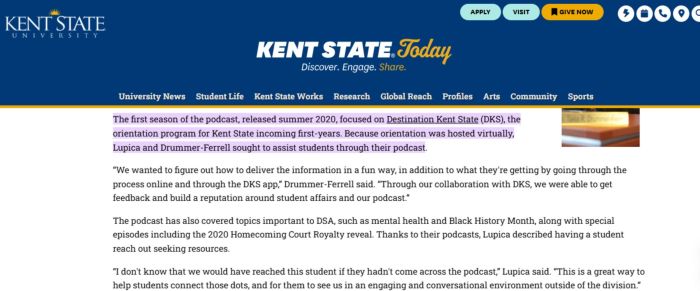
Example: At Kent State University, the Division of Student Affairs took a strategic approach when launching its podcast. They deliberately planned the first season of the podcast to coincide with the university’s virtual orientation program for new students. Because orientation had moved online (due to the pandemic), the podcast team organized a series of episodes addressing topics incoming freshmen needed, essentially turning the podcast into a fun, on-demand extension of orientation. They collaborated with the orientation staff (Destination Kent State) to ensure content was relevant and even gathered feedback from that partnership to improve the show.
Bonus tip: Batch-record your first few episodes in advance so you can launch with momentum and buffer time.
Step 4: Set Up Your Equipment and Software
Worried about needing a full recording studio? Don’t be. Getting started doesn’t require expensive equipment. Here’s a basic setup to launch your podcast with professional quality:
Essentials:
Microphone: A USB mic like the Blue Yeti or Samson Q2U delivers clear, studio-like audio.
Headphones: Avoid audio bleed and ensure consistent sound levels during editing.
Recording Software: Tools like Audacity (free) or Descript (freemium) let you easily record and edit.
Hosting Platform: Services like Buzzsprout, Podbean, or Anchor distribute your podcast to Spotify, Apple Podcasts, and Google Podcasts.
Tip for schools on a budget: Consider using your media or IT lab for recordings. You may already have access to podcast-friendly tools through student programs.
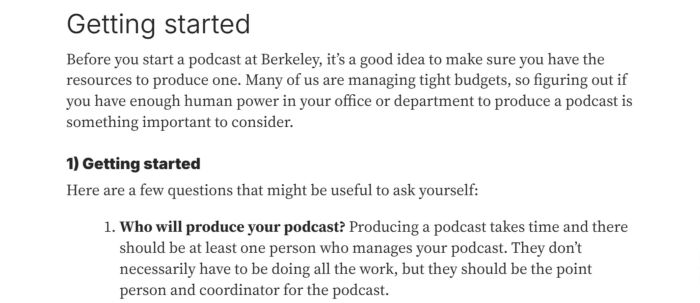
Example: At UC Berkeley, staff in the communications department use a variety of clever do-it-yourself strategies to produce high-quality podcasts on a tight budget, proving that high production value is possible even without a fancy studio or expensive equipment.
Step 5: Record and Edit With Your Audience in Mind
Now it’s time to hit “record.” As you begin, remember that quality matters, not just in audio clarity, but in tone, pacing, and structure.
Keep your episodes:
Concise. Aim for 15 to 30 minutes per episode. That’s long enough to deliver substance, but short enough to fit into a morning commute or lunchtime walk.
Focused. Each episode should revolve around a single topic or theme. If you have more to say, turn it into a two-part series.
Natural. Avoid reading from a script word-for-word. Outline your key points, then speak conversationally.
Editing is where your podcast becomes polished. Using editing software, you can tighten up the conversation, remove umms/uhs, add intro music or segues, and generally polish the recording. Aim to balance the sound levels between speakers and cut any extraneous digressions to keep the episode flowing. The goal is an episode that sounds natural but also stays on topic and within your desired length.
Don’t be discouraged if the first few recordings feel rough. Podcasting has a learning curve for everyone, and you’ll get more comfortable and skilled with each episode. Incorporate feedback from early listeners and continuously improve your technique.
Example: The team behind Bucknell University, which produces the College Admissions Insider podcast, began with two co-hosts from the admissions office and communications staff who had no prior podcasting experience. They weren’t trained radio personalities, but their deep knowledge of the admissions process and ability to communicate enabled them to create engaging episodes from the get-go. In their case, the hosts’ confidence and skill grew quickly as they recorded more sessions. After the first few episodes, they found their rhythm in interviewing guests and editing the content into a polished final product.
Pro tip: If editing feels overwhelming, explore student help or freelance editors. Podcast production is a great opportunity for cross-department collaboration.
Step 6: Publish and Distribute Your Podcast
With a finished episode in hand, it’s time to share it with the world. This step involves uploading your episode to your chosen podcast hosting platform and ensuring it gets distributed to all the major listening apps. The good news: once set up, this process is straightforward.
Start by choosing a podcast hosting service (if you haven’t already). There are many options – from free platforms like Anchor (Spotify for Podcasters) to paid hosts like Libsyn, Podbean, or Buzzsprout. The host is essentially where your audio files live and where your podcast’s RSS feed is generated. When you upload a new episode, your host will update the RSS feed, which in turn notifies podcast directories (like Apple Podcasts) to pull the new content.
Upload your MP3 file to the host and fill in the episode details: title, description, episode number, season (if applicable), etc. Use this metadata to attract listeners – write a clear, engaging description and include relevant keywords (e.g., “STEM education chat with our Science Department” or “Tips for college admissions interviews”). Also, upload your cover art if you haven’t already, as it will display on players.
Next, distribute your podcast. Submit the RSS feed to major platforms such as Apple Podcasts, Spotify, Google Podcasts, and Amazon Music. Many hosts provide one-click distribution or guides to do this. Usually, you only need to do the submission once for each platform; after that, new episodes will appear automatically. Don’t forget any niche or regional platforms popular with your audience. Essentially, you want your school’s podcast to be available wherever listeners might look.
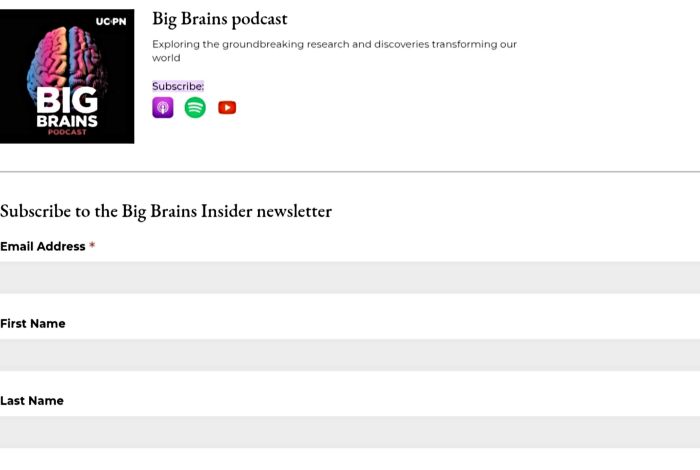
Example: The University of Chicago hosts its award-winning Big Brains podcast on a platform that syndicates it widely – on the official UChicago site, the podcast page prominently offers subscribe buttons for Apple Podcasts, Spotify, and even YouTube. Once UChicago uploaded episodes and submitted their feed, their content became available across all those apps. In practice, this means a parent commuting to work can pull up Apple Podcasts and find the school’s show, while a student on Android might use Spotify to listen – the experience is seamless.
“If you build it, they will come” doesn’t quite apply in podcasting. After creating a podcast for students and other members of your school’s community, you have to actively promote your school podcast so that your community (and beyond) know it exists. Promotion is an ongoing step, not a one-time task.
Here’s how to promote your school podcast effectively:
Website: Create a dedicated podcast page with episode archives and show notes.
Social Media: Share episode clips, quotes, or audiograms on social media platforms like Instagram, Facebook, and LinkedIn.
Email Marketing: Feature new episodes in newsletters or nurture campaigns.
Admissions Materials: Mention your podcast in brochures or application confirmation emails.
Student Portals and Alumni Networks: Make your episodes discoverable for internal and extended communities.
Example: Bucknell didn’t just publish episodes and hope people would find them. The university made the podcast an integral part of its outreach. They promoted it vigorously by including podcast links in emails to prospective students and parents, sharing episode clips on social media, and even running targeted online ads to reach more listeners.
Think beyond downloads: Use the podcast to reinforce messaging in other marketing assets like blog posts, webinars, or virtual tours.
Bonus Tip: Track Performance and Evolve
Like any marketing initiative, measurement is key. Use analytics tools (often provided by your podcast host) to track:
Number of downloads
Listener demographics
Episode drop-off points
Subscription growth
But don’t stop at the numbers. Solicit feedback from listeners. What do they want to hear more of? Which episodes resonated most?
Note: Your podcast will evolve. You might tweak your format, test new topics, or expand your production team. That’s a good thing. Podcasting, like all great content marketing, thrives on iteration.
Partner With HEM to Create an Authentic Podcast That Stands Out
Starting a school podcast isn’t about jumping on a trend. It’s about creating a platform to tell your school’s story in a compelling, authentic way.
Why are podcasts good for school?Podcasts are engaging, cost-effective, and easy to access. They help schools build trust, highlight culture, and communicate more personally with students, parents, and alumni, especially in today’s mobile-first world where audio content fits busy lifestyles.
In today’s crowded education market, families crave meaningful connections. They want to hear directly from your community, not just what you offer, but who you are. A podcast helps you do exactly that.
It’s a platform that humanizes your brand, showcases your values, and builds real relationships with your audience. In short, it allows your community to hear your voice, quite literally.
In a nutshell, the answer to the question “How do I make an academic podcast?” can be summed up in a few crucial steps. Start by defining your goal and audience. Choose a format, plan episodes, and use basic recording equipment or software. Feature faculty or students, keep episodes concise, edit for clarity, and publish on platforms like Spotify or Apple Podcasts. Promote it across your school’s channels.
Ready to bring your school’s story to life through podcasting? Start by defining your audience and recording a pilot episode. With each step, you’ll gain clarity and momentum.
If you’d like support planning your podcast strategy, identifying compelling topics, or aligning the content with your admissions goals, HEM is here to help.
Would you like to learn how to create a podcast for students?
Contact HEM for more information.
Struggling with enrollment?
Our Digital Marketing team can help you generate more leads!
Frequently Asked Questions
Question: What is a podcast in school? Answer: A school podcast is an audio series created by educators, students, or staff to share news, stories, or educational content. It can highlight campus life, feature interviews, or support learning, helping schools connect with their communities in an accessible, on-demand format.
Question: Why are podcasts good for school? Answer: Podcasts are engaging, cost-effective, and easy to access. They help schools build trust, highlight culture, and communicate more personally with students, parents, and alumni, especially in today’s mobile-first world where audio content fits busy lifestyles.
Question: How do I make an academic podcast? Answer: Start by defining your goal and audience. Choose a format, plan episodes, and use basic recording equipment or software. Feature faculty or students, keep episodes concise, edit for clarity, and publish on platforms like Spotify or Apple Podcasts. Promote it across your school’s channels.
This week on the podcast we examine the government’s new industrial strategy and what it really means for higher education – from regional clusters and research funding to skills bootcamps and spin-out support.
Will the plans finally integrate universities into the UK’s economic future, or is this another case of policy promises outpacing delivery?
Plus we discuss the franchising scandal and the damning case for urgent reform, and ask whether new research on social mobility challenges the sector’s claims about access, aspiration, and advancement.
With Katie Normington, Vice Chancellor at De Montfort University, Johnny Rich, Chief Executive at the Engineering Professors’ Council and Push, James Coe, Associate Editor at Wonkhe and presented by Mark Leach, Editor-in-Chief at Wonkhe.
This week on the podcast we examine the Office for Students’ new free speech guidance as controversial requirements prepare to take effect from August 1st.
What do the “deeply disturbing” YouGov findings about academic self-censorship really tell us, and how should universities navigate campus protests and challenging research topics?
Plus we discuss outgoing UKRI chief Ottoline Leyser’s stark warning about “inevitable consolidation” in university research.
With Mark Peace, Professor of Innovation in Education at King’s College London, Arti Saraswat, Senior Policy Manager for Higher Education at the Association of Colleges, Livia Scott, Partnerships Coordinator at Wonkhe, and presented by Jim Dickinson, Associate Editor at Wonkhe.
This week on the podcast we examine the government’s spending review and what it means for higher education. How will the £86bn R&D commitment translate into real-terms funding, and why was education notably absent from the Chancellor’s priorities?
Plus we discuss the Post-18 Project’s call to fundamentally reshape HE policy away from market competition, the startling new REF rules, and the striking rise in student term-time working revealed by the latest Student Academic Experience Survey.
With Stephanie Harris, Director of Policy at Universities UK, Ben Vulliamy, Executive Director at the Association of Heads of University Administration, Michael Salmon, News Editor at Wonkhe, and presented by Mark Leach, Editor-in-Chief at Wonkhe.
This week on the podcast we examine Universities UK’s efficiency and transformation taskforce report. What do shared back-office services, federation models and subject cold spots tell us about the sector’s financial pressures?
Plus we discuss Research England’s new EDI action plan, and explore whether the UK’s rapid three-year degree model is harming student wellbeing and learning outcomes.
With Rille Raaper, Associate Professor in Sociology of Higher Education at Durham University, Jess Lister, Director (Education) at Public First, Mack Marshall, Community and Policy Officer at Wonkhe SUs, and presented by Jim Dickinson, Associate Editor at Wonkhe.
This week on the podcast we examine the OfS penalty imposed on Leeds Trinity over subcontractual partnerships oversight. What does the £115,000 fine and a new proposed code of “ethical” governance tell us about decision-making at the top?
Plus we discuss the government’s decision to axe level 7 apprenticeships from levy funding, and explore incoming OfS chair Edward Peck’s ten trends shaping the future of campus universities.
With Alex Stanley, Vice President for Higher Education at the National Union of Students, Pam Macpherson Barrett, Head of Policy and Regulation at the University of Leeds, David Kernohan, Associate Editor at Wonkhe and presented by Mark Leach, Editor-in-Chief at Wonkhe.
She suggests teaming up with a buddy. “Looking back on all the stuff I’ve produced, I’ve never produced it alone or in a silo,” she said. “You really need to connect with other people. And I think that’s a great way to do it.”
4. Find your mango. Colter said that piece of advice came from climate journalist Katherine Dunn, who runs the Oxford Climate Journalism Network. It means connecting climate to the things that people care about. “Yummy, delicious mangoes are struggling to thrive on a heating planet right now,” Colter said. “So that’s something that actually is under threat. It’s something that people love. The thing I like about it is that mangoes are really visual. Everybody knows them.”
5. Make small splashes as opposed to big waves. You don’t need to think about a massive climate headline, Colter said. It can and should be stories that you’re personally interested in that have a climate element to them. Climate is everywhere, Colter said. “It’s just about finding your route into it,” she said. “Find small ways to connect the dots to climate change.”
6. Keep it simple: Listeners want to feel like they are part of a conversation. So talk like you’d normally talk. “It doesn’t need to sound like a science textbook,” Colter said. “Like we’re not all climate scientists and I don’t think we should feel that we have to communicate in such a way.”
7. Keep it human: We tend to focus climate stories around some aspect of the planet: air, water, wildlife, plants. But it is a mistake to ignore people. “That’s who is mainly suffering and who will suffer,” Colter said. “Nature will go on, humans won’t.” She said center a story around humans and speak directly to the people that your story affects by reaching out to them and interviewing them.
“It’s amazing now you you can pretty much contact anyone all over the world,” she said. “And what I would say is just go for it because you’d be surprised at who replies.”
8: Give people ways that take action. Colter said that you don’t want to lecture people or demand that they change the way they live. But you can make suggestions and give them blueprints of how others have taken action. “It’s very much about taking stock of what’s going on in your life and your community and taking action within that,” she said.
9. Find technology you are comfortable with. There are seemingly endless apps and software programs and hardware you can buy and download and install and use. But you don’t need expensive equipment or complicated programs. There are simple, inexpensive microphones you can buy or use the one that comes on your laptop or phone. You can use free software that called a digital audio workspace. On an Apple device there is an app for recording called Voice Memos, for example. “So you literally just open that, hit go and you’re good to go,” she said.
You will need an editing program. Again there are fancy programs you can get such as Adobe Audition but there are simpler programs as well. Colter pointed to Descript, which allows you to edit the audio by editing the words. “So you can literally highlight a whole sentence and click delete if you don’t want that sentence,” she said. “I think Descript is a really good entry tool if you just want to have a play around.”
10. Publish. Like with recording and editing technology, there are a lot of publishing platforms like Buzzsprout, Acast and Simplecast and all will enable people to find your podcast on Apple, Spotify and other commonly used streaming services. Some are free and some cost money. You might want to explore and compare.
Questions to consider:
1. Why is there more to podcasting than just talking into a mic?
2. What are some ways you can connect to an audience?
3. If you were to create a new podcast, what would it be about?
This week on the podcast we examine the government’s brutal funding cuts to universities.
What does the £108m reduction in the Strategic Priorities Grant mean for higher education, and why are media studies and journalism courses losing their high-cost subject funding?
Plus we discuss the independent review of student suicides, and explore new research on widening participation and regional disparities.
With Shân Wareing, Vice Chancellor at Middlesex University, Richard Brabner, Executive Chair at the UPP Foundation, Debbie McVitty, Editor at Wonkhe and presented by Jim Dickinson, Associate Editor at Wonkhe.