Tag: political

  • ED Put Political Out-of-Office Reply on Staff Emails

    ED Put Political Out-of-Office Reply on Staff Emails

    Photo illustration by Justin Morrison/Inside Higher Ed | Tierney L. Cross/Getty Images | nevodka/iStock/Getty Images

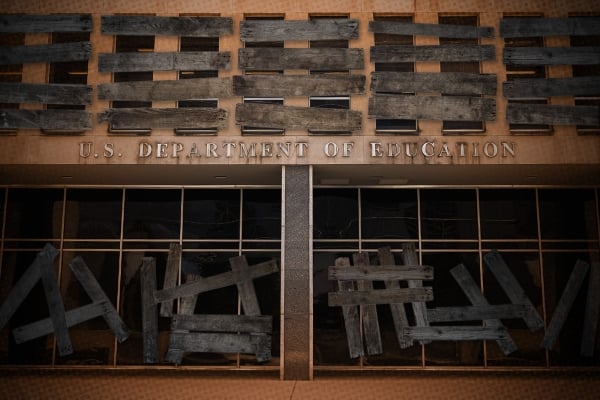
    Wednesday morning, as the government shutdown began, chief officers at the Department of Education distributed a standard out-of-the-office statement to all furloughed staff members and instructed them to copy and paste it into their email. So that’s what they did.

    But just hours later, those same nonpartisan staffers began to hear that the message they’d pasted into their email account was not the message being received by the public.

    “On Wednesday evening, my supervisor reached out to me on my personal equipment and said, ‘You’re going to want to log in and change your out-of-office status,’” one department staffer told Inside Higher Ed on the condition of anonymity out of fear of losing her job.

    When she followed her supervisor’s direction and logged in, the automatic message she saw was not the one she had saved earlier that morning.

    Rather than the original note, which had said, “There is a temporary shutdown … due to a lapse in appropriations,” the new message said, “Unfortunately, Democrat Senators are blocking passage of [a bill] … which has led to a lapse in appropriations.”

    This is one of the more than 10 emails Inside Higher Ed received as automatic responses including the same political message. Although Keast was appointed by Trump, most of the staffers we contacted were not.

    The outgoing message had been changed internally without her consent. And this staffer was not alone. Inside Higher Ed emailed 10 separate Education Department staffers Thursday, all of whom had been placed on furlough, and each one bounced back with identical responses. One senior leader from the department, who also spoke anonymously, said that to his knowledge the politically charged message was set as the out-of-office notification for all furloughed employees.

    (The Department of Education did not immediately provide comment. In fact, the emails sent to both deputy press secretary Ellen Keast and the general press team account were met with the same automatic response.)

    The first staffer said that while she was caught off guard by the override at first, it made sense the more she thought about it. Similar messages blaming Democratic senators for the shutdown had already been put at the top of HUD.gov, the landing page for all things Department of Housing and Urban Development, and other federal websites.

    As of Thursday evening, the HUD website noted, “The Radical Left in Congress shut down the government. HUD will use available resources to help Americans in need.”

    Republicans control the White House, the House and the Senate. In the Senate, they need the votes of at least seven Democratic senators to reach the 60-vote threshold necessary to overcome a filibuster.

    “I was really surprised, because we had gotten such explicit instructions on what to use for our out-of-office message,” the staffer said. But “when I saw that message from my supervisor, I assumed it had been changed to something more political than the original neutral one.”

    She has already logged back in multiple times to change the automatic response back to the neutral language. But each time, within hours, the department has overridden her changes.

    “It’s what [is being sent] to people who contact me, and they could reasonably misunderstand it as coming from me, and I don’t feel comfortable as a federal employee communicating a political message like that,” she said.

    A second staffer told Inside Higher Ed that he has worked through multiple shutdowns prior but not experienced anything like this.

    “It’s just wild to see your name attached to a message that you had nothing to do with,” he said. “It feels like a violation … You know that you don’t have any expectation of privacy when you’re working for the federal government. But it’s a different thing to say that you don’t have autonomy over your own words.”

    The second staffer noted that in his view, not only did this seem to be a violation of his personal rights, but also a violation of federal law.

    The Hatch Act, passed in 1939, was intended to ensure that nonpartisan federal workers who worked across administrations remained just that—nonpartisan. And according to documents from the Office of Special Counsel website, the Hatch Act “limits certain political activities of federal employees,” like using official authority for political purposes, soliciting political donations, wearing partisan political gear at work and posting or sharing partisan content on government systems.

    “It’s crazy to see the law violated on your behalf,” the second staffer said.

    None of the department employees Inside Higher Ed spoke with intended to file an individual lawsuit, nor had they heard anything from their union about a collective legal response. But one shared that Democracy Forward, a nonprofit legal organization that has sued the Trump administration several times this year, will be going to court over the matter as soon as Friday.

    Source link

  • Trump Administration Compact Demands Universities Align With Political Agenda

    Trump Administration Compact Demands Universities Align With Political Agenda

    The Trump administration has escalated its confrontation with higher education institutions by sending detailed policy demands to nine universities, conditioning their continued access to federal funding on compliance with the president’s political objectives.

    The unprecedented move, delivered via letters signed by Education Secretary Linda McMahon and other senior officials, presents a 10-page “compact” that outlines sweeping requirements affecting tuition pricing, international student enrollment, gender policy, and campus speech.

    The compact mandates that participating institutions freeze tuition rates for five years, place restrictions on international student enrollment, and adopt administration-approved definitions of gender. Universities must also commit to preventing any policies that the administration characterizes as punishing conservative viewpoints.

    The nine institutions that received letters on Wednesday include Dartmouth College, Brown University, Massachusetts Institute of Technology, University of Southern California, University of Arizona, University of Virginia, University of Pennsylvania, University of Texas, and Vanderbilt University.

    According to The New York Times, May Mailman, the White House’s senior adviser for special projects and a letter signatory, indicated the administration remains open to dialogue with contacted universities. “We hope all universities ultimately are able to have a conversation with us,” Mailman stated.

    The demands represent a significant threat to institutional autonomy and could have far-reaching implications for diversity, equity, and inclusion efforts on college campuses. The restrictions on international student enrollment raise particular concerns about the future of global education exchange and the presence of international scholars who contribute substantially to research and campus diversity.

    The administration’s approach effectively creates a two-tiered system where compliance brings preferential treatment in federal grant competitions. As one senior White House official told The Washington Post, universities would technically remain eligible for grants, but compliant institutions would gain a “competitive advantage.”

    This compact represents the latest escalation in the administration’s sustained campaign targeting higher education. Previous actions have included funding freezes, threats to revoke tax-exempt status, and attempts to eliminate universities’ authorization to host international students.

    The administration has particularly focused on policies related to international students, pro-Palestinian campus activism, transgender student athletes, and diversity, equity, and inclusion programming.

    Harvard University stands alone among major research universities in actively resisting the administration’s demands through litigation. In an April open letter to the Harvard community, President Alan Garber articulated the stakes for academic freedom: “No government—regardless of which party is in power—should dictate what private universities can teach, whom they can admit and hire, and which areas of study and inquiry they can pursue.”

    However, on Tuesday, President Trump claimed a deal with Harvard was nearing completion. The administration has already announced agreements with the University of Pennsylvania, Columbia University, and Brown University earlier this year.


    Source link

  • UNC Professor on Leave After Alleged Advocacy of Political Violence

    UNC Professor on Leave After Alleged Advocacy of Political Violence

    Eros Hoagland/Getty Images

    Officials at the University of North Carolina at Chapel Hill placed Professor Dwayne Dixon on leave Monday while the university investigates his “alleged advocacy of politically motivated violence,” said Dean Stoyer, UNC Chapel Hill’s vice chancellor for communications and marketing.

    Dixon, an associate professor of Asian and Middle Eastern studies, used to be a member of Silver Valley Redneck Revolt, a chapter of the antifascist, antiracist, anticapitalist political group Redneck Revolt. The group was formed in 2016 and some members, including Dixon, were present at the 2017 Unite the Right rally in Charlottesville, Va., to provide armed security and medical assistance to counterprotesters. Redneck Revolt disbanded in 2019 and has no active chapters, according to its website.

    In a 2018 interview with The Chronicle of Higher Education, Dixon described himself as an “anarchist,” and he is no stranger to blowback for his political activism and support for gun rights. He was arrested for bringing a semiautomatic rifle to a Ku Klux Klan counterprotest in Durham, N.C., in 2018—the case was later dismissed as unconstitutional on the grounds that the charges violated Dixon’s First and Second Amendment rights. He was also among 20 people who protected counterprotesters in Durham when white supremacists protested the removal of a Confederate statue in 2017. Through all these events, Dixon remained employed at UNC Chapel Hill.

    Why is Dixon in the hot seat now? The answer is convoluted, but it begins with fliers on the Georgetown University campus.

    On Sept. 24, Andrew Kolvet, a spokesperson for the late Charlie Kirk’s Turning Point USA, posted on X a photo of a flier on the Georgetown campus in Washington, D.C., that read, “Hey Fascist! Catch!”—a nod to engraving on the casing of bullets left behind by Kirk’s suspected killer—and “The only political group that celebrates when Nazis die.” The flier also included a QR code to a Google form for a potential Georgetown chapter of the John Brown Gun Club, a Redneck Revolt affiliate organization known as a “leftist gun-rights group” with multiple independent chapters, including one in the D.C. area, according to the Counter Extremism Project. It “arms itself to defend against far-right violence and often appears as a security force at protests to protect against expected far-right violence,” the CEP wrote. Google has since removed the form for violating its terms of service.

    University officials removed the fliers and reported them to the FBI. Education Secretary Linda McMahon also weighed in: “At a moment like this, Georgetown has to determine what it stands for as an institution … Allowing violent rhetoric to fester on our nation’s campuses without consequences is dangerous. It must be condemned by institutional leaders,” she wrote on X. “I am grateful to those who spoke out against this and made noise about the posters on campus—you made a difference. There is power in speaking up to reveal these hateful ideologies that have incited deadly violence.”

    Kolvet posted again, this time linking to a recent Fox News article that cited Dixon’s involvement in Redneck Revolt based on an old blog post that has since been taken down. “I posted this flyer our team spotted at Georgetown University, and now we find out professors at ‘elite’ schools are members of this group and its offshoots,” Kolvet wrote. “This professor must be immediately fired and the group/network investigated.”

    Dixon was placed on leave Monday, which will “allow the University to investigate these allegations in a manner that protects the integrity of its assessment,” UNC’s Stoyer said in his statement. “Depending upon the nature and circumstances of this activity, this conduct could be grounds for disciplinary action up to and including potential termination of employment.”

    UNC Chapel Hill officials declined to answer any other questions about Dixon and did not say whether Kolvet’s post or the Fox News article led to the investigation. Dixon did not reply to a request for comment but told the student newspaper The Daily Tarheel that he left the Silver Valley Redneck Revolt in 2018.

    A Change.org petition to reinstate Dixon is circulating and as of Wednesday evening had more than 900 signatures. In a statement Wednesday, the North Carolina chapter of the American Association of University Professors, as well as UNC Chapel Hill’s AAUP president, condemned the university’s actions and demanded Dixon be reinstated.

    “Right-wing activists are attacking Dixon for prior membership in a group that has been inactive since 2019, and are baselessly connecting him to flyers allegedly posted by a different group on a different campus outside of North Carolina. Fox News picked up the story on September 27, 2025, without verifying the existence of the flyers, and apparently this was enough for UNC’s administration to remove a professor from the classroom in the middle of the semester and bar him from campus,” the statement read. “Let’s call this what it is: UNC administrators are capitulating to a call from a right-wing group, infamous for attacking faculty, to fire a professor based on an unsubstantiated rumor.”

    Dixon joins the ranks of dozens of college and university faculty members who have been placed on leave, disciplined or fired in the weeks since Kirk was shot and killed. All of these professors have been investigated after right-wing personalities identified them on social media. Two of them—Michael Hook, who was placed on leave for social media comments he made about Kirk’s death, and Thomas Alter, who was terminated after being accused of inciting violence during a speech—have been reinstated by court orders.

    Source link

  • What to Do When Presidents Face Personal and Political Attacks

    What to Do When Presidents Face Personal and Political Attacks

    When a crisis strikes, college and university presidents and chancellors are asked to balance competing priorities in real time: protecting students, reassuring faculty, and staff, addressing trustees and communicating with stakeholders, including the public and other key partners. All while trying to be the role model and stay on mission as best as possible.

    While each crisis has distinctive characteristics, these situations never unfold in a vacuum. Today, they are happening as the value of higher education is being questioned, policymakers are sharpening their scrutiny, and financial pressures are forcing tough choices across campus communities. Moreover, our fast, fragmented information environment doesn’t just shape crises. It can, in effect, create them, manufacturing controversy where little existed.

    Strong crisis communications are not just about surviving the alarming hours, days or weeks of a crisis. They are about preserving trust and protecting reputation–which inevitably connects with revenue–thereby positioning the institution to lead credibly into the future.

    We were heartened when attending a recent annual, on-the-record convening of college presidents and journalists at the Press Club in Washington, DC, last month. Campus leaders showed up and readily expressed renewed energy for their roles and prospects for what remains the world’s most admired higher education system. These higher ed leaders gathered voluntarily (yes, voluntarily) to share specific examples of today’s campus environment, dispel some of the current higher ed narratives and inform the media–without defensiveness or naiveté–of the impact on their immediate communities and beyond.

    We cannot recommend engaging in such public conversations highly enough, as a means of building goodwill and busting myths. After all, the best crisis “response” begins long before any crisis occurs.

    Preparing before the crisis

    Presidents should ensure their teams are equipped with:

    • Clear, values-based messaging. A well-defined set of institutional values, articulated consistently (and easily located on public-facing websites), gives everyone a steady reference point. Do students, faculty, staff, families, alumni, neighbors and legislators know what the university stands for during times thick and thin?
    • Scenario planning and tabletop exercises. Running through potential crises, from student protests to cybersecurity breaches, helps identify weaknesses in protocols and message discipline. Exercises also clarify roles so that when a real situation arises, the team knows who speaks, who decides and who executes.
    • Designated spokespeople, prepared with media training. While a president may become the voice in a crisis, other leaders, such as a provost, communications official or dean of students, must be ready to carry the message.

    Leading during the crisis

    During the heat of a crisis, your guiding stars are simple: safety and support for your people. Accuracy, speed and transparency will matter most. Keep the following principles in mind:

    • Respond promptly, but don’t speculate. Silence creates a vacuum, but premature statements can backfire or harm. Even a short acknowledgment, such as “We are aware of the situation and will share updates as we confirm details,” signals attentiveness and concern.
      This playbook paid off during the pandemic for William & Mary, when President Katherine A. Rowe gathered input from the university’s subject-matter experts early on and established credible public health and safety approaches.
    • Center your people, not your process. Your stakeholders need to hear about safety, support and accountability before they hear about the college’s committees or investigations coming together. Prioritize action coupled with compassion. Even 20 years later, we remember the example of Scott Cowen, president of Tulane University during Hurricane Katrina, and the trust built due to his people-first approach. During the pandemic, Colgate University President Brian Casey modeled people-first leadership by moving into student housing to better understand students’ experiences and guide the campus through an especially challenging time.
    • Communicate consistently across channels. Students, families and alumni are likely to first encounter your messages (or off-base, inaccurate versions of this news) on social media, while others may hear news via email, during town halls or staff meetings. Coordinated, consistent language is critical for accuracy and credibility.
    • Engage trustees and legislators early. Surprises erode trust. One university president we admire follows the “No surprises” rule, crisis or no crisis. Keep key stakeholders briefed, even if details are evolving. A healthy president-board relationship, or the opposite, can easily become apparent during a crisis.

    The all-important post-crisis phase

    Too many falter by assuming that once any headlines fade, the crisis is behind them. In fact, the post-crisis period is where reputations are refined and strengthened. Presidents should treat this phase as an opportunity for reflection, accountability and rebuilding confidence.

    • Conduct a candid after-action review. What worked? What didn’t? Invite honest feedback from leadership, communications staff and key campus partners. A president who once worked at NASA introduced that agency’s practice of conducting a “hotwash,” the immediate, constructive, after-action review at her university.
    • Fix what needs improvement. Based on what you learn from the after-action review, consider who among your team demonstrated they are best suited for crisis situations. Determine who will stand in when these individuals are away or temporarily unreachable. Have a backup plan for the backup plan, including communications tools ranging from analog to digital. Cybersecurity breaches happen, as do power outages. Consider engaging external expertise to audit your policies and practices before, yes, the next crisis.
    • Follow up with your community. Students, faculty, staff, families and alumni will remember how your institution followed through. Report on the status of (non-confidential) investigations, share policy changes and highlight steps taken to prevent recurrence. Determine the cadence and keep to it, for communication containing substantive updates. Demonstrating accountability reinforces trust.
    • Reconnect the crisis to the institution’s mission. For example, if the issue involved free speech, show how new steps align with the university’s now-broader commitment to inquiry and dialogue. If it involved safety, emphasize your institution’s improved duty of care.
    • Strengthen external relationships. Use the post-crisis time to meet with legislators, donors and alumni leaders. Transparency about what happened and how the university has responded often earns respect over time, potentially turning doubters into advocates. The word potentially is deliberate here, in that this work can be challenging, it may take years and we need to be realistic about what is feasible. Is there common ground to be found? Are we seeking to please a few at the expense of the many?

    The special case of manufactured crises

    While the principles of communication are consistent across all crises, a manufactured crisis—one designed to harm a leader through disinformation—requires a different approach. Unlike a natural disaster or an institutional mistake, these situations are orchestrated attacks. Their primary purpose is not to address a problem but to create one. They become personal, understandably taken to heart. Leaders must steel themselves, identify key allies to clarify misinformation, and draw from resources in the “bank of goodwill” built during their presidency. Always easier said than done, yet the challenge for any leader in such circumstances is to not become the crisis.

    Why it matters more than ever

    Higher education’s current reputational challenges heighten the stakes. Campus leaders cannot afford to treat crisis communications as a tactical exercise. Instead, crisis communications should be integrated into a broader strategy for sustaining trust in the institution and, by extension, in the value of higher education itself.

    Handling a crisis can demonstrate an institution’s resilience, values and leadership. It can show students and families that the university is committed to their safety and success. It can show legislators that higher education takes accountability seriously. And it can remind the broader public that colleges and universities remain vital engines of knowledge, opportunity and community—even in turbulent times. You may have heard this beautiful phrase before, but remember and repeat: Higher education builds America.

    Crises will come. Presidents cannot control exactly when or how. By preparing in advance, leading with compassion and clarity in the moment and taking ownership in the aftermath, leaders can turn adversity into an opportunity to strengthen their institution’s credibility and standing. All of higher education stands to benefit from such examples of leadership.


    If you have any questions or comments about this blog post, please contact us.

    Source link

  • Texas A&M President Steps Down After Political Campaign Targets Academic Freedom

    Texas A&M President Steps Down After Political Campaign Targets Academic Freedom

    Texas A&M University President Dr. Mark A. Welsh III announced his resignation Thursday following intense political pressure from state Republican leaders over a viral confrontation involving gender content in a children’s literature course—the latest in a series of incidents that underscore the mounting challenges facing academic freedom and diversity efforts at public universities across Texas.

    Welsh’s departure came just over a week after state Rep. Brian Harrison amplified a video on social media showing a student confronting Professor Melissa McCoul about course content. Despite initially defending McCoul’s academic freedom, Welsh terminated the professor the following day under pressure from Harrison and Lt. Gov. Dan Patrick.

    The incident represents part of a broader Republican-led campaign to exert political control over university curricula, faculty hiring, and campus speech—efforts that education advocates warn are undermining the foundational principles of higher education.

    Welsh’s tenure, which began in 2023, was marked by repeated clashes with state political leaders over diversity and inclusion initiatives. In January, Gov. Greg Abbott threatened Welsh’s position after the university’s business school planned to participate in a conference aimed at recruiting Black, Hispanic, and Indigenous graduate students. Under pressure, Welsh withdrew the university from the conference entirely.

    The pattern reflects what faculty and higher education experts describe as an escalating assault on academic autonomy.

    Despite strong support from faculty and students, Welsh’s position became untenable under sustained political attack. On last Wednesday, the university’s Executive Committee of Distinguished Professors—composed of 12 faculty members holding the institution’s highest academic honor—sent a letter urging regents to retain Welsh.

    “All members of this Committee write this letter collectively to strongly urge you to retain President Mark Welsh in the wake of recent events,” the faculty letter stated.

    Student leaders also rallied behind Welsh, with dozens of current and former student government representatives praising his “steadfast love and stewardship for our University” and expressing “faith and confidence in his leadership.”

    However, these expressions of campus support proved insufficient against external political pressure.

    Welch’s predecessor, M. Katherine Banks, had resigned following the botched hiring of journalism professor Kathleen McElroy, whose employment offer was undermined after regents expressed concerns about her work on diversity, equity, and inclusion.


    Source link

  • Stopping Political Violence With Free Speech

    Stopping Political Violence With Free Speech

    The horrific assassination of Charlie Kirk at Utah Valley University is an unspeakable crime. But we must speak about its causes and how we can seek to reduce violence of this kind—and also how we must not seek to silence free speech in response.

    Obviously, murder is an evil act in itself. But a political assassination of this kind is many magnitudes worse than the all-too-common murders we encounter every day in America.

    Political violence undermines the sense of safety that’s essential to free and open debate. If controversial views inspire murder, then most of us will be reluctant to speak out honestly. Political violence and threats can be a powerful source of self-censorship. We need to end support for political violence of every kind on every side, from this terrible murder to the threats of violence against professors from all sides who express controversial views.

    Political violence also breeds administrative censorship. Many of the campus bans on protests and suspensions and banishments of those accused of misconduct are done using the excuse of fear of violence. Safety becomes a simple defense for every act of repression, and Kirk’s murder may be used by campus officials to ban controversial speakers from all sides and to prohibit the kind of public discussion that Kirk was admirably engaged in when he was killed.

    And political violence inspires political censorship, particularly when elected officials are looking for any excuse to suppress their ideological opponents. Donald Trump announced a campaign of retribution against leftists who harshly criticized Kirk: “For years those on the radical left have compared wonderful Americans like Charlie to Nazis. This kind of rhetoric is directly responsible for the terrorism that we’re seeing in our country and it must stop right now. My administration will find each and every one of those who contributed to this atrocity and to other political violence, including the organizations that fund it and support it …”

    It’s appalling that Trump would call for unconstitutional repression of this kind to “find” and “stop” any leftist who ever used mean rhetoric—and the organizations that fund or support them. Even if you believe (as I do) that prominent political leaders such as Trump—one of the worst offenders at nasty political rhetoric—should tone down their hatred, that doesn’t mean that everyone should restrain their rhetoric, and it certainly does not allow the government to punish those who choose to say harsh words.

    Since we do not yet know who murdered Kirk or what the motives were, it’s bizarre to assign ideological blame for this violence. But even if the murderer turns out to be a leftist inspired by hateful essays about Kirk, we must not punish (or even condemn) people who denounced Kirk.

    We need to condemn horrible violence of this kind from any source, but we cannot blame those who engage in political critique for the crimes of lunatics. Words do not cause violence, and censorship does not stop it. It’s bizarre that the party of “guns don’t kill people, people kill people” is now suggesting that mean tweets kill people.

    Other Republican politicians urged repression as the response. Rep. Clay Higgins (a Louisiana Republican) called for massive censorship of anyone who “belittled the assassination of Charlie Kirk,” calling for them to be “banned from ALL PLATFORMS FOREVER,” to have their business licenses and permits and driver’s licenses revoked, and be “kicked from every school.”

    By far the most disturbing finding in the latest free speech survey of college students released this week by the Foundation for Individual Rights and Expression was that the proportion of students willing to support physical violence to stop an offensive speaker on campus grew from 20 percent in 2022 to 34 percent in 2025. FIRE chief research adviser Sean Stevens noted, “This finding cuts across partisan lines. It is not a liberal or conservative problem—it’s an American problem.”

    In FIRE’s survey, the growth in willingness to use violence to stop an offensive speaker over the past few years tracks directly with the growth in willingness to shout down speakers (from 62 percent to 71 percent) and to physically block students from attending a speech (from 37 percent to 54 percent).

    The willingness of people to silence speech is connected to their willingness to support violence as just one further step to achieve that repression. Stopping political violence can’t be seen in isolation from stopping political censorship of all kinds. We need to view a commitment to free speech as an essential tool to help reduce political violence.

    Censorship can become the training wheels for political violence. Once you are willing to dehumanize someone by stripping away their rights and silencing their speech, the kind of dehumanization necessary to violently attack them becomes easier to imagine. And once you’re willing to use political violence, the reality will always become more likely.

    Alice Dreger at Heterodox Academy noted that after the problems we’ve seen with the heckler’s veto, “The shooter’s veto is a whole new level of terrorism endangering political speech in America.” But what if the shooter’s veto is just the logical extension of the heckler’s veto?

    It’s worth noting that in another of the rare cases of violence against a campus speaker—at Middlebury College in 2017, when Charles Murray was attacked and Professor Allison Stanger was injured—the violence followed in the wake of the students shouting down Murray. Censorship and violence are often linked together, and both are common weapons of totalitarian regimes.

    That’s why we must reject political violence in all its forms and begin with the steps of censorship that often lead to it. That’s also why we must reject censorship as an answer to political violence. Because censorship is the foundation of political violence, we cannot cure it with more censorship.

    I disagreed with many of Kirk’s political views, but I liked some of his methods—organizing students and publicly engaging in debates on campus with critics (as he was doing when he was murdered).

    As I noted back in 2017 for why colleges must recognize TPUSA chapters, “Although Professor Watchlist is morally wrong and a threat to academic freedom, that is not a good reason for a university to de-recognize a student group associated with it. Free speech applies even to those who oppose free speech. And the right of students to form organizations is an essential part of student liberty, even if that means criticizing faculty.” I wrote about those leftists who supported repression, “If you think only your political enemies will be subject to censorship by administrators, I think you are very mistaken.”

    We need colleges to be safe spaces in the sense of physical safety from political violence and physical threats. We also need safety from professional retaliation, to ensure that people are not fired or silenced or punished for their beliefs. We must reject the use of repression to protect people from hearing offensive ideas, whichever side is being censored. By rejecting censorship, and making the open exchange of ideas an essential part of campus life that no violent act can take away, we can reduce the culture of political violence that endangers all of our voices.

    The best tribute to Kirk would be for colleges and politicians and advocates on all sides to imitate the best of what he did—to create and approve student organizations that express controversial views and debate those who disagree, asking them to “prove me wrong.”

    Source link

  • Trump Political Appointees in Charge of Grant Decisions

    Trump Political Appointees in Charge of Grant Decisions

    Wesley Lapointe/The Washington Post via Getty Images

    President Donald Trump is now requiring grant-making agencies to appoint senior officials who will review new funding opportunity announcements and grants to ensure that “they are consistent with agency priorities and the national interest,” according to an executive order issued Thursday. And until those political appointees are in place, agencies won’t be able to make announcements about new funding opportunities.

    The changes are aimed at both improving the process of federal grant making and “ending offensive waste of tax dollars,” according to the order, which detailed multiple perceived issues with how grant-making bodies operate. 

    The Trump administration said some of those offenses have included agencies granting funding for the development of “transgender-sexual-education” programs and “free services to illegal immigrants” that it claims worsened the “border crisis.” The order also claimed that the government has “paid insufficient attention” to the efficacy of research projects—noting instances of data falsification—and that a “substantial portion” of grants that fund university-led research “goes not to scientific project applicants or groundbreaking research, but to university facilities and administrative costs,” which are commonly referred to as indirect costs.  

    It’s the latest move by the Trump administration to take control of federally funded research supported by agencies such as the National Science Foundation, the National Institutes of Health and the Department of Energy. Since taking office in January, those and other agencies have terminated thousands of grants that no longer align with their priorities, including projects focused on vaccine hesitancy, combating misinformation, LGBTQ+ health and promoting diversity, equity and inclusion. 

    Federal judges have since ruled some of those terminations unlawful. Despite those rulings, Thursday’s executive order forbids new funding for some of the same research topics the administration has already targeted.  

    It instructs the new political appointees of grant-making agencies to “use their independent judgment” when deciding which projects get funded so long as they “demonstrably advance the president’s policy priorities.” 

    Those priorities include not awarding grants to “fund, promote, encourage, subsidize, or facilitate” the following:

    • “Racial preferences or other forms of racial discrimination by the grant recipient, including activities where race or intentional proxies for race will be used as a selection criterion for employment or program participation;
    • “Denial by the grant recipient of the sex binary in humans or the notion that sex is a chosen or mutable characteristic;
    • “Illegal immigration; or
    • “Any other initiatives that compromise public safety or promote anti-American values.”

    The order also instructs senior appointees to give preference to applications from institutions with lower indirect cost rates. (Numerous agencies have also moved to cap indirect research cost rates for universities at 15 percent, but federal courts have blocked those efforts for now.)

    Source link

  • Elite Power, Higher Education, and Political Ambition

    Elite Power, Higher Education, and Political Ambition

              [JB and Penny Pritzker] 

    The Pritzker family stands as a symbol of wealth, influence, and access in American public life. From the luxury of Hyatt Hotels to the boardrooms of private equity and the highest ranks of government, their reach extends across economic sectors and institutional spheres. But beneath the carefully managed public image lies a troubling contradiction—one that implicates higher education, for-profit exploitation, and national politics.

    Penny Pritzger

    Penny Pritzker, a former U.S. Secretary of Commerce and current trustee of Harvard University, has been a key figure in shaping education policy from elite perches. She also had a working relationship with Vistria Group, a private equity firm that now owns the University of Phoenix and Risepoint. These two entities have been central to the subprime college industry—profiting from the hopes of working-class students while delivering poor outcomes and burdensome debt.

    Pritzker’s relationship with Vistria runs deeper than simple association. In the late 1990s, she partnered with Vistria co-founder Marty Nesbitt to launch The Parking Spot, a national airport parking venture that brought them both business success and public recognition. When Nesbitt founded Vistria in 2013, he brought with him the experience and elite networks formed during that earlier partnership. Penny Pritzker’s family foundation—Pritzker Traubert—was among the early funders of Vistria, helping to establish its brand as a more “socially conscious” private equity firm. Although she stepped away from any formal role when she joined the Obama administration, her involvement in Vistria’s formation and funding set the stage for the firm’s expansion into sectors like for-profit education and healthcare.

    Vistria’s acquisition of the University of Phoenix, and later Risepoint, positioned it as a major player in the privatization of American higher education. The firm continues to profit from schools that promise economic mobility but often deliver student debt and limited job prospects. This is not just a critique of business practices, but a systemic indictment of how elite networks shape education policy, finance, and outcomes.

    Penny’s role as a trustee on the Harvard Corporation only sharpens this contradiction. Harvard, a university that markets itself as a global champion of meritocracy and inclusion, remains silent about one of its trustees helping to finance and support a firm that monetizes educational inequality. The governing body has not publicly addressed any potential conflict of interest between her Harvard role and her involvement with Vistria.

    JB Pritzger

    These contradictions are not limited to Penny. Her brother, J.B. Pritzker, is currently the governor of Illinois and one of the wealthiest elected officials in the country. Though he has no documented personal financial stake in Vistria, his administration has significant ties to the firm. Jesse Ruiz, J.B. Pritzker’s Deputy Governor for Education during his first term, left state government in 2022 to take a top leadership position at Vistria as General Counsel and Chief Compliance Officer.

    This revolving-door dynamic—where a senior education policymaker transitions directly from a progressive administration to a private equity firm profiting from for-profit colleges—underscores the ideological alignment and operational synergy between the Pritzker political machine and firms like Vistria. While the governor publicly champions equity and expanded public education access, his administration’s former top education official is now helping manage legal and compliance operations for a firm that extracts value from struggling students and public loan programs.

    J.B. Pritzker has announced plans to run for a third term as governor in 2026, but many observers believe he is positioning himself for a 2028 presidential campaign. His high-profile public appearances, pointed critiques of Donald Trump, and increased visibility in early primary states all suggest a national campaign is being tested. With his vast personal wealth, Pritzker could self-fund a serious run while drawing on elite networks built over decades—networks that include both his sister’s role at Harvard and their shared business and political allies.

    Elites in US Higher Education, A Familiar Theme 

    What emerges is a deeply American story—one in which the same elite networks shape both the problems and the proposed solutions. The Pritzkers are not alone in this dynamic, but their dual influence in higher education and politics makes them a case study in elite capture. They are architects and beneficiaries of a system in which public office, private equity, and nonprofit institutions converge to consolidate power.

    The for-profit education sector continues to exploit regulatory gaps, marketing expensive credentials to desperate individuals while avoiding the scrutiny that traditional nonprofit colleges face. When private equity firms like Vistria acquire troubled institutions, they repackage them, restructure their branding, and keep extracting value from public loan dollars. The government lends, students borrow, and investors profit. The people left behind are those without political clout—low-income students, veterans, working parents—who believed the marketing and now face debt with little return.

    Harvard’s silence, University of Phoenix’s reinvention, the rebranding of Academic Partnerships/Risepoint, and J.B. Pritzker’s ambitions all signal a troubling direction for American democracy. As more billionaires enter politics and public institutions become more dependent on private capital, the line between public service and private gain continues to erode.

    The Higher Education Inquirer believes this moment demands not only scrutiny, but structural change. Until elite universities hold their trustees accountable, until political candidates reject the influence of exploitative industries, and until the public reclaims its voice in higher education policy, the Pritzker paradox will continue to define the American experience—where access to opportunity is sold to the highest bidder, and democracy is reshaped by those who can afford to buy it.

    Sources

    – U.S. Department of Education College Scorecard

    – University of Phoenix outcome data (IPEDS, 2024)

    – Harvard University governance and trustee records

    – Vistria Group investor reports and public filings

    – Wall Street Journal, “America’s Second-Richest Elected Official Is Acting Like He Wants to Be President” (2025)

    – Associated Press, “Governor J.B. Pritzker positions himself as national Democratic leader” (2025)

    – Vistria.com, “Marty Nesbitt on his friendship with Obama and what he learned from the Pritzkers”

    – Politico, “Former Obama Insiders Seek Administration’s Blessing of For-Profit College Takeover” (2016)

    – Vistria Group announcement, “Jesse Ruiz Joins Vistria as General Counsel and CCO” (2022)

    Source link

  • Teaching Critiques in an Unsettled Political Time (opinion)

    Teaching Critiques in an Unsettled Political Time (opinion)

    As a university professor, I recently found myself in an awkward spot. I teach a large survey course called Introduction to Cultural Anthropology that enrolls some 350 students. As part of the course, I usually spend one class period every semester lecturing on the anthropology of development. This is a field in which the dominant strains have involved critiquing development projects, most frequently for two sorts of reasons: either for ignoring local cultural practices and priorities, or for exacerbating the very things that development projects are meant to ameliorate.

    In the spring semester of 2025, after I had already finalized and posted the course syllabus, something unprecedented happened in the United States: the United States Agency for International Development (USAID) was dismantled by the Trump administration and Elon Musk’s Department of Government Efficiency (DOGE). From the standpoint of the standard critiques of development, some of the rationales the Trump administration provided for this unprecedented move were eerily familiar. “Musk and the Right Co-Opt the Left’s Critique of U.S. Power,” The New York Times proclaimed.

    Development isn’t the only topic on which such a critique of power has suddenly shifted politically. Science, another topic on which I spend some class sessions, is similarly fraught. For a long time, many researchers in the anthropology of science argued that the values and beliefs of scientists shape the sciences. The attacks on scientific authority that began during President Trump’s first term and have intensified since amplify these very same sorts of arguments. So how do we broach these topics today, as university professors?

    In pondering this question in the context of my own class, I came to view the common refrain that the right is “coopting” or “appropriating” the critiques made by the left with some curiosity and a bit of suspicion. Both of these terms carry some connotations of misuse and bad faith. Don’t get me wrong: There certainly is truth to the view that some Republican politicians in the United States have recently lifted and re-deployed arguments simply because they justify a desired end (and achieve a little trolling as an added benefit). But, educationally, “appropriation” in this context is not always a useful refrain. It sidesteps the arguments themselves by drawing pre-determined boundaries around their fair use.

    Further, the view that these migrating arguments are cases of “cooptation” does not always stand up to historical scrutiny. Take, for example, questions concerning the power vested in experts. Today, the right is waging more of a battle against experts and the institutions that house them than the left. This battle is undergirded by several arguments, including claims of insufficient “viewpoint diversity” and elite capture, themselves logics that have migrated.

    This battle against experts is most vociferously waged in the name of a populist view: that the people know what’s best for them. A couple of decades ago, the left was more invested in critiquing the ways that expertise was used to exert control over people who understood their own circumstances and their own needs better than many experts.

    But before that, a similar argument sat at the core of the neoliberal right. The famed neoliberal theorist Friedrich von Hayek made this sort of argument against expertise as part of his case for unfettered markets, which, he argued, aggregated and responded to the locally informed decisions of large numbers of individuals better than any expert ever could. It’s also a mistake to think about the migration of these ideas in terms of a stable divide between left and right: MAGA has instilled in the “right” in the guise of the current Republican party a new hostility toward the free market while the “left” of today’s Democratic party has embraced elements of neoliberalism.

    Instead of simple “appropriation,” the migration of arguments across an array of worldviews should be interpreted as zones of agreement where the depth of that agreement—superficial or comprehensive?—has to be scrutinized. Why and how are different implications drawn from these zones? This entails continuing to think about and teach these critical perspectives rather than shying away from them for fear of exacerbating the attacks they now authorize.

    Ultimately, recognizing that similar critiques cross-pollinate with disparate ideological positions is an invitation to engage even more deeply with the substance of these arguments, both in the classroom and beyond.

    Talia Dan-Cohen is an associate professor of sociocultural anthropology and associate director of the Center for the Humanities at Washington University in St. Louis.

    Source link

  • IRS: Churches Can Now Back Political Candidates, But Scholars Remain Concerned

    IRS: Churches Can Now Back Political Candidates, But Scholars Remain Concerned

    In a July 7 court filing, the Internal Revenue Service (IRS) announced that churches can now endorse political candidates without losing their tax-exempt status. This news follows over seven decades since the Johnson Amendment, a U.S. tax code provision that prohibited non-profit organizations and churches from intervening in political campaigns.

    Religion, American public life, and Black church studies scholars argue that this moment marks a significant erosion of the separation of church and state.

    Dr. Valerie Cooper“Both the government and the church are incredibly powerful institutions,” says Dr. Valerie Cooper, an associate professor of religion and society and Black church studies at Duke Divinity School and senior fellow at the Center for Theological Inquiry (CTI). “While it is important for citizens to be able to bring their religious convictions to their civic life, there is a concern, for me, as a person who loves the Christian church, about churches selling out for government power and losing their ability to be a prophetic voice.”

    Since 1954, only one house of worship has lost its tax-exempt status for violating this amendment.

    “The law has not changed, but the interpretation has,” says Dr. Corey D.B. Walker, Dean of Wake Forest University’s School of Divinity and a professor of the humanities. “What the IRS has said is that they’re not going to bring any cases for churches violating the Johnson Amendment.”

    According to Cooper, “conservative churches, particularly, white evangelicals, have been after this for years, if not decades,” she says in an interview with Diverse. “There are hot-button issues, and they’ve distributed information doing everything short of endorsements.”

    The issue has caught the attention of civil rights leaders like the Reverend Al Sharpton who said that the issue has to be studied carefully to ensure that “it does not create a double-edged sword.”Dr. Corey D.B. WalkerDr. Corey D.B. Walker

    “We cannot have a system in which right-wing congregations may endorse political candidates and others of a different political persuasion remain under scrutiny and lead to a situation that is not beneficial to all,” says Sharpton, the founder and president of National Action Network (NAN). 

    Sharpton, and NAN’s Board Chairman Reverend Dr. W. Franklyn Richardson, have convened a Zoom call with Black pastors and legal experts to explore the pros and cons of the decision

    Scholars of African American religion and religion in American public life have been tracking this movement for decades as well, says Walker. 

    “That danger the founders of the nation saw, that’s also the danger that we saw,” he says. “One of the real and understated issues that this new interpretation brings is that partisan political actors can now fund whatever limit they want into religious bodies to then instill and support particular political ideologies and projects, and that’s the danger of continually eroding the line between church and state.”

    Cooper, who was the first African American woman to earn tenure at Duke Divinity School in 2014, examines the ways religion does or does not impact other existing structures, like racism or inequality. 

    “I’m not just a religious scholar,” she adds. “I’m a religious person, and so I’m concerned about what appears to be a kind of political intervention.”

    Cooper says this kind of engagement could end with churches compromising their principles for political reasons.

    “Almost exactly a year before his assassination, Martin Luther King Jr. gives us a speech/sermon where he comes out against the Vietnam War, and many people in the Civil Rights Movement were horrified by this choice, because Johnson had been such an ally,” she says. “But King really felt that it was his obligation to speak prophetically and according to his faith, not according to what was maybe even wise political policy.”

    Cooper questions how this new development might impact church leaders’ ability to speak prophetically in the present day. 

    “What does that mean? Does that mean that the pastor is then no longer free to speak, even to call out the candidate, if he or she stops doing what is in the interest of the church,” she asks.

    Walker says that he is concerned about making absolute claims on public life that bypass shared beliefs, languages, and common frameworks.

    “So, the question becomes, what is the Court of Appeal when individuals are discriminated against, such as our LGBTQ brothers and sisters, or when individuals find themselves without funding for public schools because public school funding has been funneled into private religious schools,” he says. “What happens when you have reproductive rights no longer supported because reproductive rights are seen as anathema to God?”

    Walker adds that this development blurs the lines between churches and families.

    “Churches, congregations, religious bodies and worship are not the same as families discussing politics,” he says. “Families belong in the private sphere, so the idea that a worship service and a sermon are the same as a family in their living room discussing politics begs the question, what logic is operative at this moment?” 

    Cooper believes that this intervention on churches will impact everyone, even those who fought to remove the restrictions of the Johnson Amendment.

    “If people begin winning elections at the cost of the health and vitality of churches, we have not won anything,” she says.

    Source link