Hello! This is Christina Samuels, the early education editor here at Hechinger.
By now, I hope you’ve had a chance to read my colleague Jackie Mader’s story about the important role that Head Start plays in rural communities. While Jackie set her story in western Ohio, she also interviewed Head Start parents and leaders in other parts of the country and collected their views for a follow-up article.
In a fortunate bit of timing, the advocacy group First Five Years Fund published the results of a survey it commissioned on rural Americans and their feelings on child care access and affordability. Like the people Jackie interviewed, the survey respondents, more than half of whom identified as supporters of President Donald Trump, said they had very positive views of Head Start. The federally funded free child care program received positive marks from 71 percent of rural Republicans, 73 percent of rural independents and 92 percent of rural Democrats.
The survey also found that 4 out of 5 respondents felt that finding quality child care is a major or critical problem in their part of the country. Two-thirds of those surveyed felt that spending on child care and early education programs is a good use of taxpayer dollars, and a little more than half said they’d like to see more federal dollars going to such programs.
First Five Years Fund was particularly interested in getting respondents to share their thoughts on Head Start, said Sarah Rubinfield, the managing director of government affairs for First Five Years Fund. The program has been buffeted by regional office closures and cuts driven by the administration’s Department of Government Efficiency.
“We recognize that these are communities that often have few options for early learning and care,” Rubinfield said.
In the survey, rural residents said they strongly supported not just the child care offered by Head Start, but the wraparound services such as healthy meals and snacks and the program’s support for children with developmental disabilities. Though Head Start programs are federally funded, community organizations are the ones in charge of spending priorities.
“Rural voters want action. They support funding for Head Start and for child care. They want Congress to do more,” Rubinfield said. Though the “big beautiful bill” signed into law in July expands the child care tax credit for low-income families, survey respondents “recognized that things were not solved,” she added.
The First Five Years Fund survey was released just a few days before a congressional standoff led to a government shutdown. The shutdown is not expected to touch Head Start immediately, said Tommy Sheridan, the deputy director of the National Head Start Association, in an interview with The New York Times. The 1,600 Head Start programs across the country receive money at different points throughout the calendar year; eight programs serving about 7,500 children were slated to receive their federal funding on Oct. 1, Sheridan told the Times. All should be able to continue operating, as long as the shutdown doesn’t last more than a few weeks, he said.
“We’re watching with careful concern but trying not to panic,” Rubinfield said. “We know the impacts may not be immediate, but the longer this goes on, the harder the impacts may be for families and programs.”
This story about rural Americans was produced by The Hechinger Report, a nonprofit, independent news organization focused on inequality and innovation in education. Sign up for the Hechinger newsletter.
The Hechinger Report provides in-depth, fact-based, unbiased reporting on education that is free to all readers. But that doesn’t mean it’s free to produce. Our work keeps educators and the public informed about pressing issues at schools and on campuses throughout the country. We tell the whole story, even when the details are inconvenient. Help us keep doing that.
Ukrainian President Volodymyr Zelensky says religion was one topic his family never mentioned at the dinner table.
That could be because he’s from the Jewish minority, or because the overwhelming Orthodox Christian majority was split into different branches.
Ukraine’s Orthodox have gradually become more Ukrainian, to the detriment of a once-powerful pro-Russian Church, and the trend has sped up now that Kyiv and Moscow are at war.
The conflict between the pro-Kyiv Orthodox Church of Ukraine (OCU) and the pro-Moscow Ukrainian Orthodox Church (UOC) gets lost in the international coverage of the drama on the battlefield.
But with about 80% of Ukrainians identifying as Orthodox Christians, even if probably less than half attend church regularly, this split between the two Churches seeps into politics.
Christmas in Kyiv
The religious conflict crept into the news last month when the pro-Kyiv Church authorized all Ukrainian parishes to celebrate Christmas on December 25 if they wished, rather than the traditional Orthodox date of January 7.
The symbolism of allowing Christmas to be celebrated on the date used in the West was not lost on Ukrainian believers.
The roots to this clash go back to the communist period. While Ukraine was part of the Soviet Union, it was under the umbrella of the Russian Orthodox Church.
When the Soviet Union collapsed in 1991, the Ukrainian Orthodox Church continued to operate in the newly sovereign Ukraine, but proclaimed its loyalty to the Moscow Patriarchate.
Ukrainian patriots objected and said they deserved their own Church. Their rival Orthodox Church of Ukraine was created in 1992, soon after Ukraine’s independence. It was recognized as autocephalous (independent) by the Ecumenical Patriarchate in Istanbul — the highest authority in Orthodox Christianity — in 2019.
The politics of praying in Ukrainian
The two Churches have the same theology, liturgy and even architecture as the Moscow Church. But the Kyiv Church prays in Ukrainian rather than Church Slavonic and declares allegiance to Ecumenical Patriarch Bartholomew in Istanbul instead of Moscow’s Patriarch Kirill.
Originally much larger, the Moscow Church saw parishes defecting to its rival, especially after the war began. Under this pressure, the Ukrainian branch declared its independence from Russia in May, condemned the invasion and refused to recognize Patriarch Kirill in its liturgies.
It’s unclear now which Church is larger. But the head of the Kyiv Patriarchate, Metropolitan Epiphinius, told Religion News Service in May: “Every day, Ukrainians are gradually coming to understand which Church is truly Ukrainian and which Church is Russian.”
The Moscow Patriarchate tried to shield off Russian-occupied Crimea by creating its own metropolitanate (archdiocese) there in June. The Kyiv Church refused to recognize this.
When Putin annexed four Ukrainian territories in September — even though he did not completely control them — he tried to justify the move in religious terms, calling it a “glorious spiritual choice.”
Sermons, spies and the Security Service
But Kyiv increasingly saw the pro-Moscow Church as a fifth column, or spies of Putin. In October, the acting head of Ukraine’s Security Service revealed it had found 33 suspected Russian agents among the Moscow Church’s clergy in Ukraine.
Some preached pro-Russian sermons, Kyiv said, some had anti-Ukrainian literature and some were army chaplains who passed on information about Ukrainian artillery batteries to Russian agents.
That’s when the Kyiv Church authorized all Ukrainian parishes to celebrate Christmas on December 25 if they wished. On December 1, Zelensky upped the ante by calling for an official ban on all activities of the Moscow Patriarchate’s Church in Ukraine. Parliament was asked to draft a suitable law, which may be difficult given the provision in the Ukrainian constitution of freedom of religion.
In late December, Ukraine refused to renew the Moscow Church’s lease on the Cathedral of the Dormition at Kyiv’s Monastery of the Caves, traditionally the center of Ukrainian Orthodoxy.
On January 7, Metropolitan Epiphanius, head of the pro-Kyiv Church, celebrated the traditional Christmas there to show he was the new man in charge now.
And in its latest turn to faith, Russia called for a 36-hour truce to mark the traditional Christmas on January 7. Kyiv and its western allies rejected this as a cynical ploy, and both sides continued shelling each other as if nothing had happened.
The battlefield struggle is still the main story, both in its ultimate importance and in the David-and-Goliath story that readers understand. The religious rivalry will always be secondary.
But these pinpricks on the faith front add up to a new phase in the growth of local nationalism, which helps buoy Ukrainian morale. In hoping to defeat a country he thought would easily give in, Putin has done more than anyone to forge a united and defiant Ukrainian nation.
Three questions to consider:
1. Why do politicians often appeal to religion during a war?
2. Do mainstream journalists make religious angles clear in a conflict?
3. When do separate small events add up to a noteworthy trend?
This story was originally published by CalMatters. Sign up for their newsletters.
This fall, every high school in California was supposed to offer ethnic studies — a one-semester class focused on the struggles and triumphs of marginalized communities.
But the class appears stalled, at least for now, after the state budget omitted funding for it and the increasingly polarized political climate dampened some districts’ appetite for anything that hints at controversy.
“Right now, it’s a mixed bag. Some school districts have already implemented the course, and some school districts are using the current circumstances as a rationale not to move forward,” said Albert Camarillo, a Stanford history professor and founder of the university’s Center for Comparative Studies in Race and Ethnicity. “But I’m hopeful. This fight has been going on for a long time.”
California passed the ethnic studies mandate in 2021, following years of debate and fine-tuning of curriculum. The class was meant to focus on the cultures and histories of African Americans, Asian Americans, Native Americans and Latinos, all of whom have faced oppression in California. The state’s curriculum also encourages schools to add additional lessons based on their student populations, such as Hmong or Armenian.
The course would have been required for high school graduation, beginning with the Class of 2030.
But the state never allotted money for the course, which meant the mandate hasn’t gone into effect. The Senate Appropriations Committee estimated that the cost to hire and train teachers and purchase textbooks and other materials would be $276 million. Some school districts have used their own money to train teachers and have started offering the class anyway.
Accusations of antisemitism
Meanwhile, fights have erupted across the state over who and who isn’t included in the curriculum. Some ethnic studies teachers incorporated lessons on the Gaza conflict and made other changes put forth by a group of educators and activists called the Liberated Ethnic Studies Model Curriculum Consortium. That’s led to accusations of antisemitism in dozens of school districts.
Antisemitism has been on the rise generally in California, not just in schools. Statewide, anti-Jewish hate crime rose 7.3% last year, according to the California Department of Justice. In Los Angeles County, hate crimes — including slurs— against Jewish people rose 91% last year, to the highest number ever recorded, according to the county’s Commission on Human Relations.
Those numbers in part prompted a pair of legislators to propose a bill addressing antisemitism in California public schools. Assembly Bill 715, which is now headed to Gov. Gavin Newsom, would beef up the discrimination complaint process in schools and create a statewide antisemitism coordinator to ensure schools comply. Another bill, which died, would have directly addressed antisemitism in ethnic studies classes by placing restrictions on curriculum.
‘On life support’
But the delays and public controversies have taken a toll. No one has tracked how many schools offer ethnic studies, or how many require it, but some say the momentum is lost.
“It’s already on life support and this could be one more arrow,” said Tab Berg, a political consultant based in the Sacramento area.
Berg has been a critic of ethnic studies, saying it’s divisive. A better way to encourage cultural understanding is to eliminate segregation in schools and ensure the existing social studies curriculum is comprehensive and accurate, he said. “We should absolutely find ways to help students appreciate and understand other cultures. But not in a way that leads to further polarization of the school community.”
Carol Kocivar, former head of the state PTA and a San Francisco-based education writer, also thinks the class may be stalled indefinitely.
“I think the people who supported ethnic studies didn’t realize they were opening a can of worms,” Kocivar said. “Until there’s an agreement on the ideological guardrails, I just don’t see it moving forward on a broad scale.”
Kocivar supports the ethnic studies curriculum generally, but thinks it should be woven into existing classes like English, history and foreign language. That would leave room in students’ schedules for electives while still ensuring they learn the histories of marginalized communities.
Schools moving ahead
In Orange County, nearly all high schools are offering ethnic studies as a stand-alone elective course or paired with a required class like English or history. Teachers use curriculum written by their districts with public input, drawn from the state’s recommended curriculum. They also have the option of adding lessons on Vietnamese, Hmong or Cambodian culture, reflecting the county’s ethnic makeup.
“The feedback has been overwhelmingly positive,” said Marika Manos, manager of history and social science for the Orange County Department of Education. “Students see themselves in the curriculum and in the broader story of America. … It’s a wonderful opportunity for them to get some joy in their day.”
A handful of districts are waiting to see if the state authorizes funding, but the rest have found their own money to hire and train teachers and purchase materials. There was some pushback against Santa Ana Unified when two Jewish civil rights groups sued, claiming the district’s ethnic studies courses contained antisemetic material. The district settled earlier this year and changed the course curriculum.
Polarized political climate
Camarillo, the Stanford professor, said the national political climate “no question” has had a significant effect on the ethnic studies rollout. Parents might have genuine concerns about what’s being taught, “but we’re also seeing the impact of extremist groups that are fomenting distrust in our schools.”
He pointed to book bans, attacks on “woke” curriculum and other so-called culture war issues playing out in schools nationwide.
But the fight over ethnic studies has been going on for decades, since the first student activists pushed for the course at San Francisco State in the 1960s, and he’s hopeful that the current obstacles, especially the fights over antisemitism, will eventually resolve.
“I hate to see what’s happening but I think there’s hope for a resolution,” he said. “Ethnic studies can help us understand and appreciate each other, communicate, make connections. I’ve seen it play out in the classroom and it’s a beautiful thing.”
‘A really special class’
In Oakland, Summer Johnson has been teaching ethnic studies for three years at Arise High School, a charter school in the Fruitvale district. She uses a combination of liberated ethnic studies and other curricula and her own lesson plans.
She covers topics like identity, stereotypes and bias; oppression and resistance; and cultural assets, or “the beautiful things in your community,” she said. They also learn the origins of the class itself, starting with the fight for ethnic studies at San Francisco State.
Students read articles and write papers, conduct research, do art projects and give oral presentations, discuss issues and take field trips. She pushes the students to “ask questions, be curious, have the tough conversations. This is the place for that.”
She’s had no complaints from parents, but sometimes at the beginning of the semester, students question the value of the class.
“When that happens, we have a discussion,” Johnson said. “By the end of the class, students learn about themselves and their classmates and learn to express their opinions. Overall students respond really well.”
Johnson, who has a social studies teaching credential, sought out training to teach ethnic studies and feels that’s critical for the course to be successful. Teachers need to know the material, but they also need to know how to facilitate sensitive conversations and encourage students to open up to their peers.
“It’s a really special class. I’d love to see it expand to all schools,” Johnson said. “The purpose is for students to have empathy for each other and knowledge of themselves and their communities. And that’s important.”
This audio is auto-generated. Please let us know if you have feedback.
Dive Brief:
Nearly 4 in 5 surveyed Americans, 78%, said a college education is somewhat or very important to a young person’s success, according to a new poll from researchers at Vanderbilt University.
Despite increasing polarization around higher ed, a significant majority of both Democrats and Republicans — 87% and 68%, respectively — said a college education was at least somewhat important.
The broadly favorable public sentiment comes amid the federal government’s allegations of “violations, shortcomings and biases” at colleges, John Geer, head of the nonpartisan Vanderbilt Project on Unity & American Democracy, said in a Wednesday press release.
Dive Insight:
The Trump administration has increasingly targeted higher education, decrying colleges as hubs of liberal indoctrination and wastes of federal funding. Against this backdrop, Vanderbilt researchers polled 1,030 adults in English and Spanish from Sept. 5 to Sept. 8.
“Higher education has undoubtedly been a primary concern for President [Donald] Trump’s administration,” Geer said. “Certainly, people expressed areas of concern and viewed certain institutions as more problematic than others, but support for colleges and universities remains substantial, even in the midst of these many criticisms from Washington,” he said.
Nearly two-thirds of respondents, 65%, said colleges have a positive effect on society. A large majority of Democrats agreed with this statement, as did most of the “traditional” Republicans surveyed, according to the Wednesday release.
A deeper schism emerged from Republican respondents who identified with the Make America Great Again movement. Among those supporting MAGA ideology, 65% said colleges have a negative effect on the U.S.
In a February poll,Vanderbilt found that a majority of Republicans surveyed, 52%, identified with the MAGA movement — though slight, it was the first majority since researchers began asking the question in June 2023.
The September survey also found a broader skepticism of some aspects of higher education that transcended political divides. Among the overall respondent pool, 67% said ideological or political bias is at least somewhat of a serious problem at colleges. Within that share, 35% said bias is a problem at most institutions.
However, the respondents who said political bias exists on campuses did not broadly fault academic instruction.About 2 in 5, or 43%, blamed administrative decisions, while 16% cited what is being taught in the classroom.
Nearly three-quarters of respondents, 71%, said colleges should not “take official positions on controversial political issues.” Broken down by political party, 83% of Republicans and 59% of Democrats concurred with that statement.
“That mix of skepticism and expectation underscores how difficult it will be for colleges to persuade the public that they are neutral arbiters in a polarized environment,” Vanderbilt said.
The public showed mixed opinions on different types of institutions, the poll found.
For instance, 70% of respondents expressed confidence in community colleges. Vanderbilt researchers noted that community colleges “have largely avoided the controversies embroiling larger, wealthier institutions.”
But that confidence level dropped sharply for Ivy League institutions. Less than half of those surveyed, 48%, expressed a somewhat or very favorable opinion of those eight universities.
What’s more, respondents’ view of the Ivies varied significantly by their political party. Among Democrats, 72% approved of Ivy League universities, compared to just 33% of Republicans.
Other colleges earned a similar approval rating as the Ivies but with a smaller political divide.
Just 2 in 5 respondents expressed overall confidence in colleges in the Southeastern Conference,which includes the University of Georgia, the University of Tennessee andMississippi State University among its 16 members.
About half of Republicans, 51%, expressed a favorable opinion of those institutions, as did 33% of Democrats.
ASHE COUNTY, N.C. — In the time it took to read an email, the federal money vanished before Superintendent Eisa Cox’s eyes: dollars that supported the Ashe County school district’s after-school program, training for its teachers, salaries for some jobs.
The email from the Department of Education arrived June 30, one day before the money — $1.1 million in total — was set to materialize for the rural western North Carolina district. Instead, the dollars had been frozen pending a review to make sure the money was spent “in accordance with the President’s priorities,” the email said.
In a community still recovering from Hurricane Helene, where more than half of students are considered economically disadvantaged, Cox said there was no way they could replace that federal funding. “It is scary to think about it, you’re getting ready to open school and not have a significant pot of funds,” she said.
School leaders across the country were reeling from the same news. The $1.1 million was one small piece of a nearly $7 billion pot of federal funding for thousands of school districts that the Trump administration froze — money approved by Congress and that schools were scheduled to receive on July 1. For weeks, leaders in Ashe County and around the country scrambled to figure out how they could avoid layoffs and fill financial holes — until the money was freed July 25, after an outcry from legislators and a lawsuit joined by two dozen states.
“I had teachers crying, staff members crying. They thought they were going to lose their jobs a week before school,” said Curtis Finch, superintendent of Deer Valley Unified School District in Phoenix.
About $1.1 million was at stake for the Ashe County school district in western North Carolina this summer when a portion of K-12 schools’ federal funding was frozen. Credit: Ariel Gilreath/The Hechinger Report
Now, as educators welcome students back to classrooms, they can no longer count on federal dollars as they once did. They must learn to plan without a playbook under a president intent on cutting education spending. For many districts, federal money is a small but crucial sliver of their budgets, potentially touching every part of a school’s operations, from teacher salaries to textbooks. Nationally, it accounts for about 14 percent of public school funding; in Ashe County, it’s 17 percent. School administrators are examining their resources now and budgeting for losses to funding that was frozen this summer, for English learners, after-school and other programs.
So far, the Trump administration has not proposed cutting the largest pots of federal money for schools, which go to services for students with disabilities and to schools with large numbers of low-income students. But the current budget proposal from the U.S. House of Representatives would do just that.
At the same time, forthcoming cuts to other federal support for low-income families under the Republican “one big, beautiful bill” — including Medicaid and SNAP — will also hammer schools that have many students living in poverty. And some school districts are also grappling with the elimination of Department of Education grants announced earlier this year, such as those designed to address teacher shortages and disability services. In politically conservative communities like this one, there’s an added tension for schools that rely on federal money to operate: how to sound the alarm while staying out of partisan politics.
For Ashe County, the federal spending freeze collided with the district’s attempt at a fresh start after the devastation of Helene, which demolished roads and homes, damaged school buildings and knocked power and cell service out for weeks. Between the storm and snow days, students here missed 47 days of instruction.
Cox worries this school year might bring more missed days: That first week of school, she found herself counting the number of foggy mornings. An old Appalachian wives’ tale says to put a bean in a jar for every morning of fog in August. The number of beans at the end of the month is how many snow days will come in winter.
“We’ve had 21 so far,” Cox said with a nervous laugh on Aug. 21.
Fragrant evergreen trees blanket Ashe County’s hills, a region that bills itself as America’s Christmas Tree Capital because of the millions of Fraser firs grown for sale at the holidays. Yet this picturesque area still shows scars of Hurricane Helene’s destruction: fallen trees, damaged homes and rocky new paths cut through the mountainsides by mudslides. Nearly a year after the storm, the lone grocery store in one of its small towns is still being rebuilt. A sinkhole that formed during the flooding remains, splitting open the ground behind an elementary school.
Ashe County Schools Superintendent Eisa Cox visits classrooms at Blue Ridge Elementary School during the first week of the school year in Warrensville, N.C. Credit: Ariel Gilreath/The Hechinger Report
As students walked into classrooms for the first time since spring, Julie Taylor — the district’s director of federal programs — was reworking district budget spreadsheets. When federal funds were frozen, and then unfrozen, her plans and calculations from months prior became meaningless.
Federal and state funding stretches far in this district of 2,700 students and six schools, where administrators do a lot with a little. Even before this summer, they worked hard to supplement that funding in any way possible — applying to state and federal grants, like one last year that provided money for a few mobile hot spots for families who don’t have internet access. Such opportunities are also narrowing: The Federal Communications Commission, for example, recently proposed ending its mobile hot spot grant program for school buses and libraries.
“We’re very fiscally responsible because we have to be — we’re small and rural, we don’t have a large tax base,” Taylor said.
When the money was frozen this summer, administrators’ minds went to the educators and kids who would be most affected. Some of it paid for a program through Appalachian State University that connects the district’s three dozen early-career teachers with a mentor, helps them learn how to schedule their school days and manage classroom behavior.
The program is part of the reason the district’s retention rate for early career teachers is 92 percent, Taylor said, noting the teachers have said how much the mentoring meant to them.
Also frozen: free after-school care the district provides for about 250 children throughout the school year — the only after-school option in the community. Without the money, Cox said, schools would have to cancel their after-school care or start charging families, a significant burden in a county with a median household income of about $50,000.
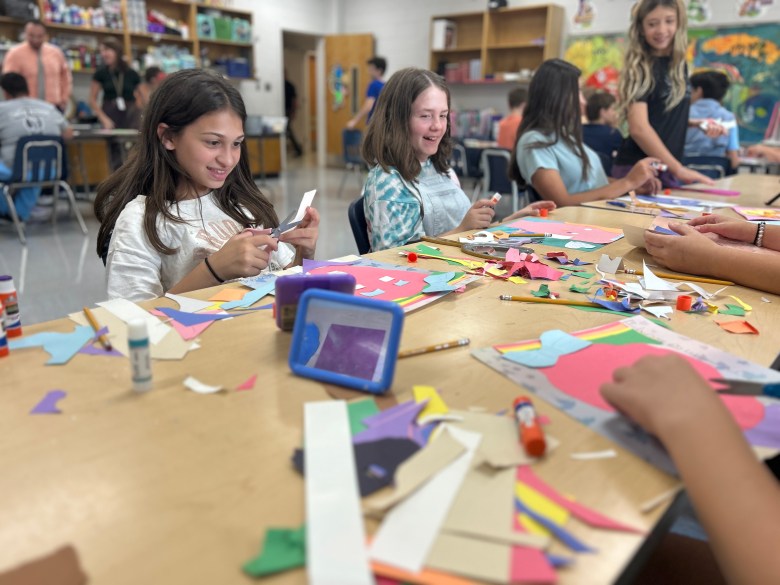
Sixth grade students make self-portraits out of construction paper during the first week of the school year at Blue Ridge Elementary School in Warrensville, N.C., in August. Credit: Ariel Gilreath/The Hechinger Report
The salary for Michelle Pelayo, the district’s migrant education program coordinator for nearly two decades, was also tied up in that pot of funding. Because agriculture is the county’s biggest industry, Pelayo’s work in Ashe County extends far beyond the students at the school. Each year, she works with the families of dozens of migrant students who move to the area for seasonal work on farms, which generally involves tagging and bundling Christmas trees and harvesting pumpkins. Pelayo helps the families enroll their students, connects them with supplies for school and home, and serves as a Spanish translator for parent-teacher meetings — “whatever they need,” she said.
Kitty Honeycutt, executive director of the Ashe County Chamber of Commerce, doesn’t know how the county’s agriculture industry would survive without the migrant students Pelayo works with. “The need for guest workers is crucial for the agriculture industry — we have to have them,” she said.
A couple of years ago, Pelayo had the idea to drive to Boone, North Carolina, where Appalachian State University’s campus sits, to gather unwanted appliances and supplies from students moving out of their dorm rooms at the end of the year to donate to migrant families. She’s a “find a way or make a way” type of person, Honeycutt said.
Cox is searching for how to keep Pelayo on if Ashe County loses these federal funds next year. She’s talked with county officials to see if they could pay Pelayo’s salary, and begun calculating how much the district would need to charge families to keep the after-school program running. Ideally, she’d know ahead of time and not the night before the district is set to receive the money.
Districts across the country are grappling with similar questions. In Detroit, school leaders are preparing, at a minimum, to lose Title III money to teach English learners. More than 7,200 Detroit students received services funded by Title III in 2023.
In Wyoming, the small, rural Sheridan County School District 3 is trying to budget without Title II, IV and V money — funding for improving teacher quality, updating technology and resources for rural and low-income schools, among other uses, Superintendent Chase Christensen said.
Schools are trying to budget for cuts to other federal programs, too — such as Medicaid and food stamps. In Harrison School District 2, an urban district in Colorado Springs, Colorado, schools rely on Medicaid to provide students with counseling, nursing and other services.
The district projects that it could lose half the $15 million it receives in Medicaid next school year.
“It’s very, very stressful,” said Wendy Birhanzel, superintendent of Harrison School District 2. “For a while, it was every day, you were hearing something different. And you couldn’t even keep up with, ‘What’s the latest information today?’ That’s another thing we told our staff: If you can, just don’t watch the news about education right now.”
There’s another calculation for school leaders to make in conservative counties like Ashe, where 72 percent of the vote last year went for President Donald Trump: objecting to the cuts without angering voters. When North Carolina’s attorney general, a Democrat, joined the lawsuit against the administration over the frozen funds this summer, some school administrators told state officials they couldn’t publicly sign on, fearing local backlash, said Jack Hoke, executive director of the North Carolina School Superintendents’ Association.
Cox sees the effort to slash federal funds as a chance to show her community how Ashe County Schools uses this money. She believes people are misguided in thinking their schools don’t need it, not malicious.
“I know who our congresspeople are — I know they care about this area,” Cox said, even if they do not fully grasp how the money is used. “It’s an opportunity for me to educate them.”
If the Education Department is shuttered — which Trump said he plans to do in order to give more authority over education to states — she wants to be included in state-level discussions for how federal money flows to schools through North Carolina. And, importantly, she wants to know ahead of time what her schools might lose.
As Cox made her rounds to each of the schools that first week back, she glanced down at her phone and looked up with a smile. “We have hot water,” she said while walking in the hall of Blue Ridge Elementary School. It had lost hot water a few weeks earlier, but to Cox, this crisis was minor — one of many first-of-the-year hiccups she has come to expect.
Still, it’s one worry she can put out of her mind as she looks ahead to a year of uncertainties.
Meanwhile, the anxiety about this school year hasn’t reached the students, who were talking among themselves in the high school’s media center, creating collages in the elementary school’s art class and trekking up to Mount Jefferson — a state park that sits directly behind the district’s two high schools — for an annual trip.
They were just excited to be back.
Marina Villeneuve contributed data analysis to this story.
Contact staff writer Ariel Gilreath on Signal at arielgilreath.46 or at [email protected].
The Hechinger Report provides in-depth, fact-based, unbiased reporting on education that is free to all readers. But that doesn’t mean it’s free to produce. Our work keeps educators and the public informed about pressing issues at schools and on campuses throughout the country. We tell the whole story, even when the details are inconvenient. Help us keep doing that.
From Texas to Florida to Arizona, school voucher policies are reshaping the landscape of American education. The Trump administration champions federal support for voucher expansion, and many state-level leaders are advancing school choice programs. Billions of public dollars are now flowing to private schools, church networks and microeducation platforms.
The push to expand school choice is not just reallocating public funds to private institutions. It is reorganizing the very purpose of schooling. And in that shift, something essential is being lost — the public mission of education as a foundation of democracy.
Civic education is becoming fragmented, underfunded and institutionally weak.
In this moment of sweeping change, as public dollars shift from common institutions to private and alternative schools, the shared civic entities that once supported democratic learning are being diminished or lost entirely — traditional structures like public schools, libraries and community colleges are no longer guaranteed common spaces.
The result is a disjointed system in which students may gain academic content or career preparation but receive little support in learning how to lead with integrity, think across differences or sustain democratic institutions. The very idea of public life is at risk, especially in places where shared experience has been replaced by polarization. We need civic education more than ever.
If we want students who can lead a multiracial democracy, we need schools of every type to take civic formation seriously. That includes religious schools, charter schools and homeschooling networks. The responsibility cannot fall on public schools alone. Civic formation is not an ideological project. It is a democratic one, involving the long-term work of building the skills, habits and values that prepare people to work across differences and take responsibility for shared democratic life.
What we need now is a civic education strategy that matches the scale of the changes reshaping American schooling. This will mean fostering coordinated investment, institutional partnerships and recognition that the stakes are not just academic, they are also democratic.
Americans overwhelmingly support civic instruction. According to a 2020 survey in Texas by the Center of Women in Politics and Public Policy and iCivics, just 49 percent of teachers statewide believed that enough time was being devoted to teaching civics knowledge, and just 23 percent said the same about participatory-democracy skills. This gap is not unique to Texas, but there is little agreement on how civics should be taught, and even less structural support for the schools trying to do it.
Without serious investment, civic formation will remain an afterthought — a patchwork effort disconnected from the design of most educational systems.
This is not an argument against vouchers in principle. Families should have options. But in the move to decentralize education, we risk hollowing out its civic core. A democratic society cannot survive on academic content alone. It requires citizens — not just in the legal sense, but in the civic one.
A democratic society needs people who can deliberate, organize, collaborate and build a shared future with others who do not think or live like they do.
And that’s why we are building a framework in Texas that others can adopt and adapt to their own civic mission.
The pioneering Democracy Schools model, to which I contribute, supports civic formation across a range of public and private schools, colleges, community organizations and professional networks.
Civic infrastructure is the term we use to describe our approach: the design of relationships, institutions and systems that hold democracy together. Just as engineers build physical infrastructure, educators and civic leaders must build civic infrastructure by working with communities, not for or on them.
We start from a democratic tradition rooted in the Black freedom struggle. Freedom, in this view, is not just protection from domination. It is the capacity to act, build and see oneself reflected in the world. This view of citizenship demands more than voice. It calls for the ability to shape institutions, policies and public narratives from the ground up.
The model speaks to a national crisis: the erosion of shared civic space in education. It must be practiced and must be supported by institutions that understand their role in building public life. Historically Black colleges and universities like Huston-Tillotson University offer a powerful example. They are not elite pipelines disconnected from everyday life. They are rooted in community, oriented toward public leadership and shaped by a history of democratic struggle. They show what it looks like to educate for civic capacity — not just for upward mobility. They remind us that education is not only about what students know, but about who they become and what kind of world they are prepared to help shape.
Our national future depends on how well we prepare young people to take responsibility for shared institutions and pluralistic public life. This cannot be accomplished through content standards alone. It requires civic ecosystems designed to cultivate public authorship.
We have an enormous stake in preparing the next generation for the demands of democratic life. What kind of society are we preparing young people to lead? The answer will not come from any single institution. It will come from partnerships across sectors, aligned in purpose even if diverse in approach.
We are eager to collaborate with any organization — public, private or faith-based — committed to building the civic infrastructure that sustains our democracy. Wherever education takes place, civic formation must remain a central concern.
Robert Ceresa is the founding director of the Politics Lab of the James L. Farmer House, Huston-Tillotson University.
The Hechinger Report provides in-depth, fact-based, unbiased reporting on education that is free to all readers. But that doesn’t mean it’s free to produce. Our work keeps educators and the public informed about pressing issues at schools and on campuses throughout the country. We tell the whole story, even when the details are inconvenient. Help us keep doing that.
This analysis originally appeared at The Up and Up, a newsletter focused on youth culture and politics.
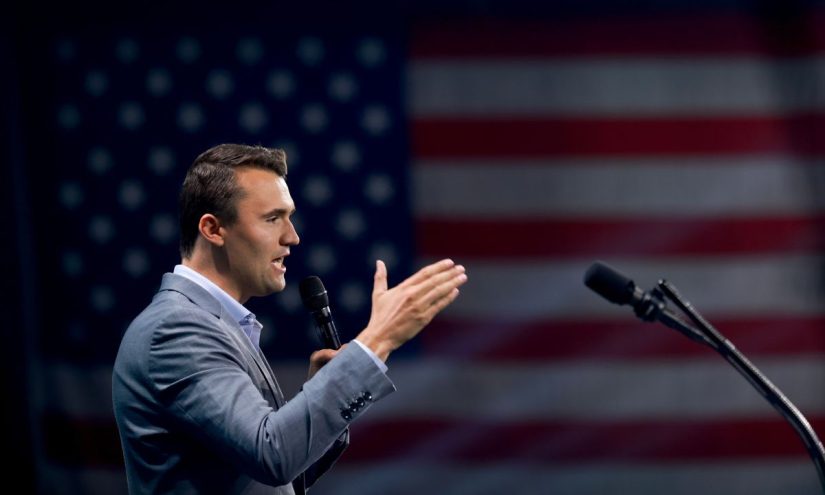
There’s been a massive effort to understand why Gen Z shifted right in the 2024 election. Part of that movement was thanks to Charlie Kirk and his work to engage young people — on and offline.
Whether it was his college tours or the campus debate videos he brought to the forefront of social media, he changed the way young people think about, consume and engage in political discourse.
Over the past few years, as I’ve conducted Gen Z listening sessions across the country, I’ve watched as freedom of speech has become a priority issue for young people, particularly on the right. The emphasis on that issue alone helped President Donald Trump make inroads with young voters in 2024, with Kirk as its biggest cheerleader. Just a few years ago, being a conservative was not welcomed on many liberal college campuses. That has changed.
Even on campuses he never visited, Kirk, via his massive social media profile and the resonance of his videos online, was at the center of bringing MAGA to the mainstream. Scroll TikTok or Instagram with a right-leaning college student for five minutes, and you’re likely to see one of those debate-style videos pop into their feed. Since the news broke of the attack on his life last week, I’ve heard from many young leaders — both liberal and conservative — who are distraught and shook up. The reality is that Kirk changed the game for Gen Z political involvement. Even for those who disagreed with his politics, his focus on young voters inevitably shifted how young people were considered and included in the conversation.
Like many of you, I’ve followed Kirk for years. Whether you aligned with his policy viewpoints or not, his influence on the conversation is undeniable. And, for young people, he was the face of the next generation for leadership in the conservative party.
Kirk’s assassination was the latest in a string of political violence, including the political assassination in Minnesota that took the life of former House Speaker Melissa Hortman and her husband, and left state Sen. John Hoffman wounded. One of the most common fears I hear from young people across the country and the political spectrum is that political division has gone too far. Last week’s shooting also coincided with a tragic school shooting in Colorado. The grave irony of all these forces coinciding — gun violence, political violence and campus violence — cannot be ignored.
In all my conversations with young people, one thing is clear: they are scared.
Gen Z perspectives
After Wednesday’s tragedy, I reached out to students and young people I’ve met through listening sessions with The Up and Up, as well as leaders of youth organizations that veer right of center. Others reached out via social media to comment. Here’s some of what they shared.
California college student Lucy Cox: “He was the leader of the Republican Party and the conservative movement right now especially for young people. He’s probably more famous than Trump for college students. He had divisive politics, but he never went about it in a divisive way. He’s been a part of my college experience for as long as I’ve been here. He felt like somebody I knew. His personality was so pervasive. It feels very odd that I’m never going to watch a new Charlie Kirk video again.”
Jesse Wilson, a 30-year-old in Missouri: “From the first time I saw him, it was on the ‘Whatever’ podcast, I’ve watched that for a long long long time. Just immediately, the way he carried himself and respected the people he was talking to regardless of who they were, their walk of life, how they treated him. Immediately I just thought, ‘Man, there’s just something different about him.’ He was willing to engage. It was the care, he didn’t want to just shut somebody down. He was like, ‘These are my points, and this is what I’m about,’ and it seemed like there was a willingness to engage and meet people where they’re at. I found it really heartwarming. And we need it. That’s what’s going to make a difference.”
Ebo Entsuah, a 31-year-old from Florida: “Charlie had a reach most political influencers couldn’t even imagine. I didn’t agree with him on a number of things, but there’s no mistaking that he held the ear of an entire generation. When someone like that is taken from the world, the impact multiplies.”
Danielle Butcher Franz, CEO of The American Conservation Coalition: “Charlie changed my life. The first time I ever went to D.C. was because of him. He invited me to join TPUSA at CPAC so I bought a flight and skipped class. When we finally met in person he grinned and said, ‘Are you Republican Sass?’ (My Twitter at the time) and gave me a big thumbs-up. I owe so much of my career to him. Most of my closest friends came into my life through him or at his events. Because of Charlie, I met my husband. We worked with him back when TPUSA was still run out of a garage. Charlie’s early support helped ACC grow when no one else took us seriously. He welcomed me with open arms to speak at one of his conferences to 300+ young people when ACC was barely weeks old. I keep looking around me and thinking about how none of it would be here if I hadn’t met Charlie.”
A 26-year-old woman who asked to remain anonymous: “I would be naive to not admit that my career trajectory and path would not have been possible without Charlie Kirk. He forged a path in making a career with steadfast opinions, engaging with a generation that had never been so open-minded and free, slanting their politics the exact opposite of his own. He made politics accessible. He made conservatism accessible. But damn, he made CIVICS accessible. He dared us to engage. To take the bait. To react. He was controversial because he was good at what he was doing. Good at articulating his beliefs with such conviction to dare the other side to express. He died engaging with the other side. In good or bad faith is one’s own to decide, but he was engaging. In a time where the polarization is never more clear. So I will continue to dare to engage with those I agree and those I disagree with. But it’s heartbreaking. It feels like we’ve lost any common belonging. There has not been an event in modern political history that has impacted me this much. Maybe it hits too close to home.”
Disillusioned by a divided America
Over the summer, I wrote about Gen Z’s sinking American pride. Of all generations, according to Gallup data, Gen Z’s American pride is the lowest, at just 41%. At the time, I wrote that this is not just about the constant chaos which has become so normalized for our generation. It’s more than that. It’s a complete disillusionment with U.S. politics for a generation that has grown up amid hyperpolarization and a scathing political climate. What happened last week adds a whole layer.
Beyond the shooting, there is the way in which this unfolded online. There’s a legitimate conversation to be had about people’s reactions to Kirk’s death and an unwillingness to condemn violence.
As a 19-year-old college student told me: “This reveals a big problem that I see with a lot of members in Gen Z — that they tend to see things in black and white and fail to realize that several things can be true at once.”
There’s also the need for a discussion about the speed at which the incredibly graphic video of violence circulated — and the fact that it is now seared into the minds of the many, many young people who watched it.
We live in a country where gun violence is pervasive. When we zoom out and look toward the future, there are inevitable consequences of this carnage.
Since The Up and Up started holding listening sessions in fall 2022, young people have shared that civil discourse and political violence are two of their primary concerns. One of the most telling trends are the responses to two of our most frequently asked questions: “What is your biggest fear for the country, and what is your biggest hope for the country?”
Consistently, the fear has something to do with violence and division, while the hope is unity.
I think we all could learn from the shared statement issued by the Young Democrats and Young Republicans of Connecticut before Trump announced Kirk’s death, in which they came together to “reject all forms of political violence” in a way we rarely, if ever, see elected officials do.
Tanish Doshi was in high school when he pushed the Tucson Unified School District to take on an ambitious plan to reduce its climate footprint. In Oct. 2024, the availability of federal tax credits encouraged the district to adopt the $900 million plan, which involves goals of achieving net-zero emissions and zero waste by 2040, along with adding a climate curriculum to schools.
Now, access to those funds is disappearing, leaving Tucson and other school systems across the country scrambling to find ways to cover the costs of clean energy projects.
The Arizona school district, which did not want to impose an economic burden on its low-income population by increasing bonds or taxes, had expected to rely in part on federal dollars provided by the Biden-era Inflation Reduction Act, Doshi said.
But under HR1, or the “one big, beautiful bill,” passed on July 4, Tucson schools will not be able to receive all of the expected federal funding in time for their upcoming clean energy projects. The law discontinues many clean energy tax credits, including those used by schools for solar power and electric vehicles, created under the IRA. When schools and other tax-exempt organizations receive these credits, they come in the form of a direct cash reimbursement.
At the same time, Tucson and thousands of districts across the country that were planning to develop solar and wind power projects are now forced to decide between accelerating them to try to meet HR1’s fast-approaching “commence construction” deadline of June 2026, finding other sources of funding or hitting pause on their plans. Tina Cook, energy project manager for Tucson schools, said the district might have to scale back some of its projects unless it could find local sources of funding.
“Phasing out the tax credits for wind and solar energy is going to make a huge, huge difference,” said Doshi, 18, now a first-year college student. “It ends a lot of investments in poor and minority communities. You really get rid of any notion of environmental justice that the IRA had advanced.”
Emma Weber leads a chant at a Colorado state capitol rally in support of “The Green New Deal for Colorado Schools.” Credit: Courtesy of Emma Weber
The tax credits in the IRA, the largest legislative investment in climate projects in U.S. history, had marked a major opportunity for schools and colleges to reduce their impact on the environment. Educational institutions are significant contributors to climate change: K-12 school infrastructure, for example, releases at least 41 million metric tons of emissions per year, according to a paper from the Annenberg Institute at Brown University. The K-12 school system’s buses — some 480,000 — and meals also produce significant emissions and waste. Clean energy projects supported by the IRA were helping schools not only to limit their climate toll but also to save money on energy costs over the long term and improve student health, advocates said.
As a result, many students, consultants and sustainability leaders said, they have no plans to abandon clean energy projects. They said they want to keep working to cut emissions, even though that may be more difficult now.
Related: Become a lifelong learner. Subscribe to our free weekly newsletter featuring the most important stories in education.
Sara Ross, cofounder of UndauntedK12, which helps school districts green their operations, divided HR1’s fallout on schools into three categories: the good, the bad and the ugly.
On the bright side, she said, schools can still get up to 50 percent off for installing ground source heat pumps — those credits will continue — to more efficiently heat and cool schools. The network of pipes in a ground source pump cycles heat from the shallow earth into buildings.
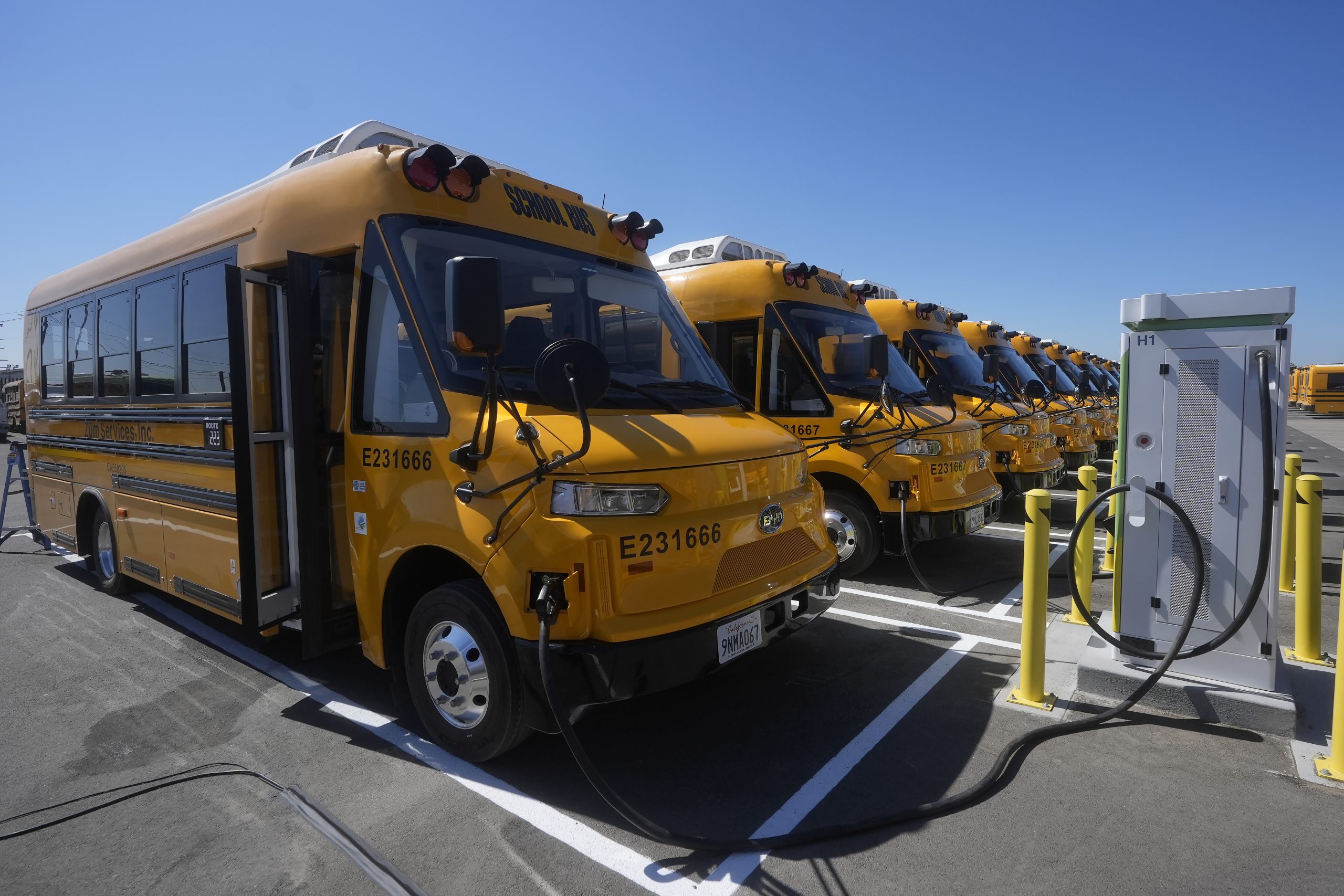
In the “bad” category, any electric vehicle acquired after Sept. 30 of this year will not be eligible for tax credits — drastically accelerating the IRA’s phase-out timeline by seven years. That applies to electric school buses as well as other district-owned vehicles. Electric vehicle charging stations must be installed by June 30, 2026 at an eligible location to claim a tax credit.*
The expiration of the federal tax credits could cost a district up to $40,000 more per vehicle, estimated Sue Gander, director of the Electric School Bus Initiative run by the nonprofit World Resources Institute.
Solar projects will see the most “ugly” effects of HR1, Ross said.
Los Angeles Unified School District is planning to build 21 solar projects on roofs, carports and other structures, plus 13 electric vehicle charging sites, as part of an effort to reduce energy costs and achieve 100 percent renewable energy by 2040. The district anticipated receiving around $25 million in federal tax credits to help pay for the $90 million contract, said Christos Chrysiliou, chief eco-sustainability officer for the district. With the tight deadlines imposed by HR1, the district can no longer count on receiving that money.
“It’s disappointing,” Chrysiliou said. “It’s nice to be able to have that funding in place to meet the goals and objectives that we have.”
Emma Weber, at left, trains student leaders at Sunrise Movement’s “summer intensive” in Illinois this year. Credit: Courtesy of Emma Weber
LAUSD is looking at a small portion of a $9 billion bond measure passed last year, as well as utility rebates, third-party financing and grants from the California Energy Commission, to help make up for some of the gaps in funding.
Many California State University campuses are in a similar position as they work to install solar to meet the system’s goal of carbon neutrality by 2045, said Lindsey Rowell, CSU’s chief energy, sustainability and transportation officer.
Tariffs on solar panel materials from overseas and the early sunsetting of tax credits mean that “the cost of these projects are becoming prohibitive for campuses,” Rowell said.
Sweeps of undocumented immigrants in California may also lead to labor shortages that could slow the pace of construction, Rowell added. “Limiting the labor force in any way is only going to result in an increased cost, so those changes are frightening as well,” she said.
New Treasury Department guidance, issued Aug. 15, made it much harder for projects to meet the threshold needed to qualify for the tax credits. Renewable energy projects previously qualified for credits once a developer spent 5 percent of a project’s cost. But the guidelines have been tightened — now, larger projects must pass a “physical work test,” meaning “significant physical labor has begun on a site,” before they can qualify for credits. With the construction commencement deadline looming next June, these will likely leave many projects ineligible for credits.
“The rules are new, complex [and] not widely understood,” Ross said. “We’re really concerned about schools’ ability to continue to do solar projects and be able to effectively navigate these new rules.”
Schools without “fancy legal teams” may struggle to understand how the new tax credit changes in HR1 will affect their finances and future projects, she added.
Some universities were just starting to understand how the IRA tax credits could help them fund projects. Lily Strehlow, campus sustainability coordinator at the University of Wisconsin, Eau-Claire, said the planning cycle for clean energy projects at the school can take ten years. The university is in the process of adding solar to the roof of a large science building, and depending on the date of completion, the project “might or might not” qualify for the credits, she said.
“At this point, everybody’s holding their breath,” said Rick Brown, founder of California-based TerraVerde Energy, a clean energy consultant to schools and agencies.
Brown said that none of his company’s projects are in a position where they’re not going to get done, but the company may end up seeing fewer new projects due to a higher cost of equipment.
Tim Carter, president of Second Nature, which supports climate work in education, added that colleges and universities are in a broader period of uncertainty, due to larger attacks from the Trump administration, and are not likely to make additional investments at this time: “We’re definitely in a wait and see.”
For youth activists, the fallout from HR1 is “disheartening,” Doshi said.
Emma and Molly Weber, climate activists since eighth grade, said they are frustrated. The Colorado-based twins, who will start college this fall, helped secure the first “Green New Deal for Schools” resolution in the nation in the Boulder Valley School District. Its goals include working toward a goal of Zero Net Energy by 2050, making school buildings greener, creating pathways to green jobs and expanding climate change education.
Emma, far left, and Molly Weber, far right, work with climate leaders from the Boulder Valley School District’s Sunrise Movement to prepare for Colorado’s legislative session. Credit: Courtesy of Emma Weber
“It feels very demoralizing to see something you’ve been working so hard at get slashed back, especially since I’ve spoken to so many students from all over the country about these clean energy tax credits, being like, ‘These are the things that are available to you, and this is how you can help convince your school board to work on this,’” Emma Weber said.
The Webers started thinking about other creative ways to pay for the clean energy transition and have settled on advocating for state-level legislation in the form of a climate superfund, where major polluters in a community would be responsible for contributing dollars to sustainability initiatives.
Consultants and sustainability coordinators said that they don’t see the demand for renewable energy going away. “Solar is the cheapest form of energy. It makes sense to put it on every rooftop that we can. And that’s true with or without tax credits,” Strehlow said.
*Correction: This version of the story includes updated information on the timeline for the expiration of tax credits for electric vehicle charging stations.
Contact editor Caroline Preston at 212-870-8965, via Signal at CarolineP.83 or on email at [email protected].
The Hechinger Report provides in-depth, fact-based, unbiased reporting on education that is free to all readers. But that doesn’t mean it’s free to produce. Our work keeps educators and the public informed about pressing issues at schools and on campuses throughout the country. We tell the whole story, even when the details are inconvenient. Help us keep doing that.
This story was reported by and originally published by APM Reports in connection with its podcast Sold a Story: How Teach Kids to Read Went So Wrong.
When voters elected Donald Trump in November, most people who worked at the U.S. Department of Education weren’t scared for their jobs. They had been through a Trump presidency before, and they hadn’t seen big changes in their department then. They saw their work as essential, mandated by law, nonpartisan and, as a result, insulated from politics.
Then, in early February, the Department of Government Efficiency showed up. Led at the time by billionaire CEO Elon Musk, and known by the cheeky acronym DOGE, it gutted the Department of Education’s Institute of Education Sciences, posting on X that the effort would ferret out “waste, fraud and abuse.”
DOGE is looking for help from the general public!
Please DM insight for reducing waste, fraud, and abuse, along with any helpful insights or awesome ideas, to the relevant DOGE affiliates (found on the Affiliates tab). For example, @DOGE_USDA, @DOGE_SSA, etc. We will add…
A post from the Department of Government Efficiency.
When it was done, DOGE had cut approximately $900 million in research contracts and more than 90 percent of the institute’s workforce had been laid off. (The current value of the contracts was closer to $820 million, data compiled by APM Reports shows, and the actual savings to the government was substantially less, because in some cases large amounts of money had been spent already.)
Among staff cast aside were those who worked on the National Assessment of Educational Progress — also known as the Nation’s Report Card — which is one of the few federal education initiatives the Trump administration says it sees as valuable and wants to preserve.
The assessment is a series of tests administered nearly every year to a national sample of more than 10,000 students in grades 4, 8 and 12. The tests regularly measure what students across the country know in reading, math and other subjects. They allow the government to track how well America’s students are learning overall. Researchers can also combine the national data with the results of tests administered by states to draw comparisons between schools and districts in different states.
The assessment is “something we absolutely need to keep,” Education Secretary Linda McMahon said at an education and technology summit in San Diego earlier this year. “If we don’t, states can be a little manipulative with their own results and their own testing. I think it’s a way that we keep everybody honest.”
But researchers and former Department of Education employees say they worry that the test will become less and less reliable over time, because the deep cuts will cause its quality to slip — and some already see signs of trouble.
“The main indication is that there just aren’t the staff,” said Sean Reardon, a Stanford University professor who uses the testing data to research gaps in learning between students of different income levels.
All but one of the experts who make sure the questions in the assessment are fair and accurate — called psychometricians — have been laid off from the National Center for Education Statistics. These specialists play a key role in updating the test and making sure it accurately measures what students know.
“These are extremely sophisticated test assessments that required a team of researchers to make them as good as they are,” said Mark Seidenberg, a researcher known for his significant contributions to the science of reading. Seidenberg added that “a half-baked” assessment would undermine public confidence in the results, which he described as “essentially another way of killing” the assessment.
The Department of Education defended its management of the assessment in an email: “Every member of the team is working toward the same goal of maintaining NAEP’s gold-standard status,” it read in part.
The National Assessment Governing Board, which sets policies for the national test, said in a statement that it had temporarily assigned “five staff members who have appropriate technical expertise (in psychometrics, assessment operations, and statistics) and federal contract management experience” to work at the National Center for Education Statistics. No one from DOGE responded to a request for comment.
Harvard education professor Andrew Ho, a former member of the governing board, said the remaining staff are capable, but he’s concerned that there aren’t enough of them to prevent errors.
“In order to put a good product up, you need a certain number of person-hours, and a certain amount of continuity and experience doing exactly this kind of job, and that’s what we lost,” Ho said.
The Trump administration has already delayed the release of some testing data following the cutbacks. The Department of Education had previously planned to announce the results of the tests for 8th grade science, 12th grade math and 12th grade reading this summer; now that won’t happen until September. The board voted earlier this year to eliminate more than a dozen tests over the next seven years, including fourth grade science in 2028 and U.S. history for 12th graders in 2030. The governing board has also asked Congress to postpone the 2028 tests to 2029, citing a desire to avoid releasing test results in an election year.
“Today’s actions reflect what assessments the Governing Board believes are most valuable to stakeholders and can be best assessed by NAEP at this time, given the imperative for cost efficiencies,” board chair and former North Carolina Gov. Bev Perdue said earlier this year in a press release.
The National Assessment Governing Board canceled more than a dozen tests when it revised the schedule for the National Assessment of Educational Progress in April. This annotated version of the previous schedule, adopted in 2023, shows which tests were canceled. Topics shown in all caps were scheduled for a potential overhaul; those annotated with a red star are no longer scheduled for such a revision.
Recent estimates peg the annual cost to keep the national assessment running at about $190 million per year, a fraction of the department’s 2025 budget of approximately $195 billion.
Adam Gamoran, president of the William T. Grant Foundation, said multiple contracts with private firms — overseen by Department of Education staff with “substantial expertise” — are the backbone of the national test.
“You need a staff,” said Gamoran, who was nominated last year to lead the Institute of Education Sciences. He was never confirmed by the Senate. “The fact that NCES now only has three employees indicates that they can’t possibly implement NAEP at a high level of quality, because they lack the in-house expertise to oversee that work. So that is deeply troubling.”
The cutbacks were widespread — and far outside of what most former employees had expected under the new administration.
“I don’t think any of us imagined this in our worst nightmares,” said a former Education Department employee, who spoke on condition of anonymity for fear of retaliation by the Trump administration. “We weren’t concerned about the utter destruction of this national resource of data.”
“At what point does it break?” the former employee asked.
Every state has its own test for reading, math and other subjects. But state tests vary in difficulty and content, which makes it tricky to compare results in Minnesota to Mississippi or Montana.
“They’re totally different tests with different scales,” Reardon said. “So NAEP is the Rosetta stone that lets them all be connected.”
Reardon and his team at Stanford used statistical techniques to combine the federal assessment results with state test scores and other data sets to create the Educational Opportunity Project. The project, first released in 2016 and updated periodically in the years that followed, shows which schools and districts are getting the best results — especially for kids from poor families. Since the project’s release, Reardon said, the data has been downloaded 50,000 times and is used by researchers, teachers, parents, school boards and state education leaders to inform their decisions.
For instance, the U.S. military used the data to measure school quality when weighing base closures, and superintendents used it to find demographically similar but higher-performing districts to learn from, Reardon said.
If the quality of the data slips, those comparisons will be more difficult to make.
“My worry is we just have less-good information on which to base educational decisions at the district, state and school level,” Reardon said. “We would be in the position of trying to improve the education system with no information. Sort of like, ‘Well, let’s hope this works. We won’t know, but it sounds like a good idea.’”
Seidenberg, the reading researcher, said the national assessment “provided extraordinarily important, reliable information about how we’re doing in terms of teaching kids to read and how literacy is faring in the culture at large.”
Producing a test without keeping the quality up, Seidenberg said, “would be almost as bad as not collecting the data at all.”
The Hechinger Report provides in-depth, fact-based, unbiased reporting on education that is free to all readers. But that doesn’t mean it’s free to produce. Our work keeps educators and the public informed about pressing issues at schools and on campuses throughout the country. We tell the whole story, even when the details are inconvenient. Help us keep doing that.
As a college president, I see the promise of higher education fulfilled every day. Many students at my institution, Whittier College, are the first in their families to attend a university. Some are parents or military veterans who have already served in the workforce and are returning to school to gain new skills, widen their perspectives and improve their job prospects.
These students are the future of our communities. We will rely on them to fill critical roles in health care, education, science, entrepreneurship and public service. They are also the students who stand to lose the most under the proposed fiscal year 2026 federal budget, and those who were already bracing for impact from the “One Big Beautiful Bill” cuts, including to the health care coverage many of them count on.
The drive with which these extraordinary students — both traditionally college-aged and older — pursue their degrees, often while juggling caregiving commitments or other responsibilities, never fails to inspire me.
Related: Interested in innovations in higher education? Subscribe to our free biweekly higher education newsletter.
We do not yet know the precise contours of the spending provisions Congress will consider once funding from a continuing resolution expires at the end of September. Yet we expect they will take their cues from the president’s proposed budget, which slashes support for students and parents and especially hammers those already struggling to improve their lives by earning a college degree, with cuts to education, health and housing that could take effect as early as October 1.
That budget would mean lowering the maximum Pell Grant award from $7,395 to $5,710, reversing a decade of progress. For the nearly half of Whittier students who received Pell Grants last year, this rollback would profoundly jeopardize their chances of finishing school.
So would the proposal to severely restrict Federal Work-Study, which supports a third of Whittier students according to our most recent internal analysis, and to eliminate the Supplemental Educational Opportunity Grant, which more than 16 percent of our student body relies upon. In addition, this budget would impose a cap on Direct PLUS Loans for Parents, which would impact roughly 60 percent of our parent borrowers. It would also do away with the Direct PLUS Loans for Graduates program.
These programs are lifelines, not just for our students but for students all across the country. They fuel social mobility and prosperity by making education a force for advancement through personal work ethic rather than a way to rack up debt.
If enacted, these proposed cuts would gut the support system that has enabled millions of low-income students to earn a college degree.
Higher education is a bridge. To cross it and achieve their full potential, students from all walks of life must have access to the support and resources colleges provide, whether through partnerships with local high schools or with professional gateway programs in engineering, accounting, business, nursing, physical therapy and more. Yet, to access these invaluable programs, they must be enrolled. How will they reach such heights if they suddenly can’t afford to advance their studies?
The harm I’ve described doesn’t stop with cuts to financial aid, loans and services. Proposed reductions also target research funding for NASA, NIH and the National Science Foundation. One frozen NASA grant has already led to the loss of paid student research fellowships at Whittier, a setback not just in dollars but in momentum for students building real-world skills, networks and résumés.
These research opportunities often enable talented first-generation students to connect their classroom learning to career pathways, opening the door to graduate school, lab technician roles and futures in STEM fields. We’ve seen how federal funding has supported student projects in everything from climate data analysis to environmental health.
Stripping away support for hands-on research undermines the federal government’s own calls for colleges like ours to better prepare students for the workforce by dismantling the very mechanisms that make such preparation possible.
It’s particularly disheartening that these changes will disproportionately hurt those students who are working the hardest to achieve their objectives, who have done everything right and have the most to lose from this lack of investment in the future.
The preservation and strengthening of Pell, Work-Study, Supplemental Educational Opportunity grants and federal loan programs is not a partisan issue. It is a moral and economic imperative for a nation that has long been proud to be a land of opportunity.
Let’s build a system for strivers that opens doors instead of slamming them shut.
Let’s recommit to higher education as a public good. Today’s students are willing to work hard to deserve our continuing belief in them.
Kristine E. Dillon is the president of Whittier College in California.
The Hechinger Report provides in-depth, fact-based, unbiased reporting on education that is free to all readers. But that doesn’t mean it’s free to produce. Our work keeps educators and the public informed about pressing issues at schools and on campuses throughout the country. We tell the whole story, even when the details are inconvenient. Help us keep doing that.