Tag: Portfolio

  • Why ideas of graduate success need to catch up with portfolio careers

    Why ideas of graduate success need to catch up with portfolio careers

    For many graduates in the creative industries, the question “what do you do?” has never had a simple answer.

    A graduate might be holding down part-time work in a gallery, freelancing in digital design, tutoring on the side, stage managing in the summer, and selling their own work online. It’s a patchwork, a blend, a portfolio.

    And yet when we measure their success through Graduate Outcomes, the official data collection exercise on graduate employment, they’re told to tick a single box. The reality of hybridity is flattened into the illusion of underemployment.

    This is not a trivial issue. Policymakers rely on Graduate Outcomes (and reports based on the collection, like this year’s What do graduates do? out today) to make judgements about which subjects, courses and institutions are “succeeding” in employability terms. Yet in the creative arts, where portfolio working is both the norm and, in many ways, a strength, these categories misrepresent lived reality. The result is a story told back to government, employers and students in which creative graduates appear more precarious, less stable, and less successful than they often are.

    Portfolio careers are current and they’re the future

    The creative economy has been pointing towards this future for years. In What Do Graduates Do? , the creative arts overview that Elli Whitefoot and I authored, we found repeated evidence of graduates combining multiple sources of income, employment, freelancing, self-employment, often in ways that nurtured both security and creativity. The forthcoming 2025 overview by Burtin and Halfin reinforces the same point: hybridity is a structural feature, not a marginal quirk.

    This hybridity is not inherently negative. Portfolio work can provide resilience, satisfaction and autonomy. As Sharland and Slesser argued in 2024, the future workforce needs creative thinkers who can move across boundaries. Portfolio careers develop precisely those capabilities. At the Advance HE Symposium earlier this year, I led a workshop on future-proofing creative graduates through AI, entrepreneurship and digital skills, all of which thrive in a portfolio setting.

    Policy writers and senior leaders need to wake up quickly to realise that creative graduates are early adopters of what more of the labour market is beginning to look like. Academic staff, for example, increasingly combine research grants, teaching roles, consultancy and side projects. Tech and green industries are also normalising project-based work, short-term contracts and hybrid roles. In other words, the creative industries are not an outlier; they are a preview.

    Why measurement matters

    If the data system is misaligned with reality, the consequences are serious. Universities risk being penalised in performance frameworks like TEF or in media rankings if their graduates’ outcomes are deemed “poor.” Students risk being discouraged from pursuing creative courses because outcomes data suggests they are less employable. Policymakers risk designing interventions based on a caricature rather than the real graduate experience.

    As Conroy and Firth highlight, employability education must learn from the present, and the present is messy, hybrid, and global. Yet our data systems remain stuck in a single-job paradigm.

    The wider sector context is equally pressing. Graduate vacancies have collapsed from around 180,000 in 2023 to just 55,000 this year, according to Reed. Almost seven in ten undergraduates are now working during term-time just to keep going according to the latest student academic experience survey. And international graduates face higher unemployment rates, around 11 per cent, compared with 3 per cent for UK PGT graduates. The labour market picture is not just challenging, it is distorted when portfolio working is coded as failure.

    Without intervention, this issue will persist. Not because creative graduates are difficult to track, but because our measurement tools are still based on outdated assumptions. It is therefore encouraging that HESA is taking steps to improve the Graduate Outcomes survey questionnaire through its cognitive testing exercise. I am currently working with HESA and Jisc to explore how we can better capture hybrid and portfolio careers. These efforts will help bridge the gap in understanding, but far more nuanced data is needed if we are to fully represent the complex and evolving realities of creative graduates.

    So what should change?

    Data collection needs to become more granular, capturing the combination of employment, self-employment, freelancing and further study rather than forcing graduates into a false hierarchy. Recognising hybridity would make Graduate Outcomes a more accurate reflection of real graduate lives.

    One complicating factor is that students who do not complete a creative programme, for example, those who transfer courses or graduate from non-creative disciplines but sustain a creative portfolio, are even less likely to record or recognise that work within Graduate Outcomes. Because it isn’t linked to their area of study, they rarely see it as a legitimate graduate destination, and valuable evidence of creative contribution goes uncounted.

    We also need to value more than salary. The “graduate premium” may be shrinking in monetary terms, but its non-monetary returns, civic participation, wellbeing, and resilience, are expanding. Research from Firth and Gratrick in BERA Bites identifies clear gaps in how universities support learners to develop and articulate these broader forms of employability.

    Evidence must also become richer and longer-term. The work of Prospects Luminate, AGCAS CITG and the Policy and Evidence Centre on skills mismatches shows that snapshot surveys are no longer sufficient. Graduates’ careers unfold over years, not months, and portfolio working often evolves into sustainable, fulfilling trajectories.

    Beyond the UK there are instructive examples of how others have rethought the link between learning and employability. None offers a perfect model for capturing the complexity of graduate working lives, but together they point the way. The Netherlands Validation of Prior Learning system recognises skills gained from outside formal education, Canada’s ELMLP platform connects education and earnings data to map real career pathways, and Denmarks register-based labour statistics explicitly track people holding more than one job. If the UK continues to rely on outdated, single-job measures, it risks being left behind.

    Beyond the creative industries

    This is not an argument limited to art schools or design faculties. The wider labour market is moving in the same direction. Skills-based hiring is on the rise, with employers in AI and green sectors already downplaying traditional degree requirements in favour of demonstrable competencies. Academic precarity is, in effect, a form of portfolio career. The idea of a single linear graduate role is increasingly a historical fiction.

    In this context, the creative industries offer higher education a lesson. They have been navigating portfolio realities for decades. Rather than treating this as a problem to be solved, policymakers could treat it as a model to be understood.

    The full beauty of graduate success

    When we collapse a graduate’s career into a single tick-box, we erase the full beauty of what they are building. We turn resilience into precarity, adaptability into instability, creativity into failure.

    If higher education is serious about employability, we need to update our measures to reflect reality. That means capturing hybridity, valuing breadth as well as salary, and designing policy that starts with the lived experiences of graduates rather than the convenience of categories.

    Portfolio careers are not the exception. They are the shape of things to come. And higher education, if it is to remain relevant, must learn how to see them clearly.

    Source link

  • BPP Education Group expands portfolio with acquisition of Sprott Shaw College

    BPP Education Group expands portfolio with acquisition of Sprott Shaw College

    BPP Education Group’s growth plan has been backed by the private equity firm TDR Capital, with a view to expand geographically into various sites around the world.

    The group, which provides education and training in various fields of work like Law and Finance, hopes to increase the variety of ITS portfolio of courses through the acquisition of dynamic education businesses like Sprott Shaw College.

    Sprott Shaw College (SSC), founded in 1903, is one of the largest regulated career colleges IN Canada and offers students connections with real-word opportunities to ready them for work in positions such as nursing and business.

    Prior to the deal, it was a subsidiary of Global Education Communities Corporation (GECC), which is one of the largest education and student housing investment companies in Canada.

    The college also places a large focus on cultural awareness and inclusivity – and its courses are designed with these in mind.

    According to Graham Gaddes, CEO of BPP, the acquisition marks an “important milestone into BPP’s internationalisation”.

    “The acquisition will support SSC’s plans to continue to be agile in meeting the needs of the domestic and international community, with programmes developed with cultural awareness and inclusivity in mind,” he added. “We admire what Sprott Shaw College has achieved to date and look forward to welcoming the team to the BPP Education Group.”

    The college has grown substantially in size with integrity and has gained respect from the global education community
    Toby Chu, GECC

    This purchase opens doorways for BPP to offer a vast range of professional education programs due to an alignment with other institutions in its portfolio, such as Ascenda School of Management and Arbutus College.

    The programs would range from certificates to degree levels, which would aid both domestic and international students.

    Toby Chu, president and CEO of GECC, said that he is “confident that Sprott Shaw College will continue to flourish under BPP’s ownership”.

    The college had weathered many difficulties in recent years, he said, including the Covid-19 pandemic and more recent study permit caps in Canada.

    “Despite these challenges, the college has grown substantially in size with integrity and has gained respect from the global education community. I am confident that Sprott Shaw College will continue to flourish under BPP’s ownership,” he said.

    Source link

  • From Intuition to Intelligence: Leveraging Data to Guide Academic Portfolio Strategy

    From Intuition to Intelligence: Leveraging Data to Guide Academic Portfolio Strategy

    In today’s competitive higher education landscape, institutions can no longer afford to rely on instinct alone when it comes to academic program planning. The stakes are too high and the margin for error too slim. 

    Leaders are facing increasing pressure to align their portfolios with market demand, institutional mission, and student expectations — all while navigating constrained resources and shifting demographics. 

    The good news? You don’t have to guess. Market intelligence offers a smarter, more strategic foundation for building and refining your academic program mix. 

    Why program optimization matters now more than ever 

    Most institutions have at least one program that’s no longer pulling its weight — whether due to declining enrollment, outdated relevance, or oversaturated competition. At the same time, there are often untapped opportunities for growth in emerging or underserved fields. 

    But how do you decide which programs to scale, sustain, or sunset? 

    Optimizing your portfolio requires more than internal performance metrics. It calls for an external lens — one that brings into view national and regional trends, labor market signals, and consumer behavior. When done effectively, academic portfolio strategy becomes less about trial and error, and more about clarity and confidence. 

    The first step: Start with the market 

    The strongest portfolio strategies begin with robust external data. At Collegis Education, we draw from sources like the National Center for Education Statistics (IPEDS), Lightcast labor market analytics, and Google search trends to assess program performance, student demand, and employment outlooks. 

    National trends give us the big picture and a foundation to start from. But for our partners, we prioritize regional analysis — because institutions ultimately compete and serve in specific geographic contexts, even with fully online programs. Understanding what’s growing in your state or region is often more actionable than knowing what’s growing nationwide. 

    Our proprietary methodology filters for: 

    • Five-year conferral growth with positive year-over-year trends 
    • Programs offered by a sufficient number of institutions (to avoid anomalies) 
    • Competitive dynamics and saturation thresholds 
    • Job postings and projected employment growth 

    This data-driven process helps institutions avoid chasing short-term trends and instead focus on sustainable growth areas. 

    Ready for a Smarter Way Forward?

    Higher ed is hard — but you don’t have to figure it out alone. We can help you transform challenges into opportunities.

    Data in action: Insights from today’s growth programs 

    Collegis’ latest program growth analyses — drawing from 2023 conferral data — surface a diverse mix of high-opportunity programs. While we won’t detail every entry here, a few trends stand out: 

    • Technology and healthcare programs remain strong at the undergraduate level, with degrees like Computer Science and Health Sciences showing continued growth. 
    • Graduate credentials in education and nursing reflect both workforce need and strong student interest. 
    • Laddering potential is especially evident in fields like psychology and health sciences, where institutions can design seamless transitions from associate to bachelor’s. In fields such as education, options to ladder from certificate to master’s programs are growing in demand. 

    What’s most important isn’t the specific programs, it’s what they reveal: external data can confirm intuition, challenge assumptions, and unlock new strategic direction. And when paired with regional insights, these findings become even more powerful. 

    How to turn insight into strategy 

    Having market data is just the beginning. The true value lies in how institutions use it. At Collegis, we help our partners translate insight into action through a structured portfolio development process that includes the following: 

    1. Market analysis: Analyzing external data to identify growth areas, saturation risks, and demand signals — regionally and nationally. 
    1. Gap analysis: Identifying misalignments between current offerings and market opportunity. 
    1. Institutional alignment: Layering in internal metrics — enrollment, outcomes, mission fit, modality, and margin. 
    1. Strategic decisions: Prioritizing programs to expand, launch, refine, or sunset. 
    1. Implementation support: Developing go-to-market plans, supporting change management, and measuring results. 

    By grounding these decisions in both internal and external intelligence, institutions can future-proof their portfolios — driving enrollment, meeting workforce needs, and staying mission-aligned. 

    Put data to work for your portfolio 

    Program portfolio strategy doesn’t have to be a guessing game. With the right data and a trusted partner, institutions can make bold, confident moves that fuel growth and student success. 

    Whether you’re validating your instincts or exploring new academic directions, Collegis can help. Our market research and portfolio development services are built to support institutions at every step of the process — with national insights and regional specificity to guide your next move. 

    Innovation Starts Here

    Higher ed is evolving — don’t get left behind. Explore how Collegis can help your institution thrive.

    Source link

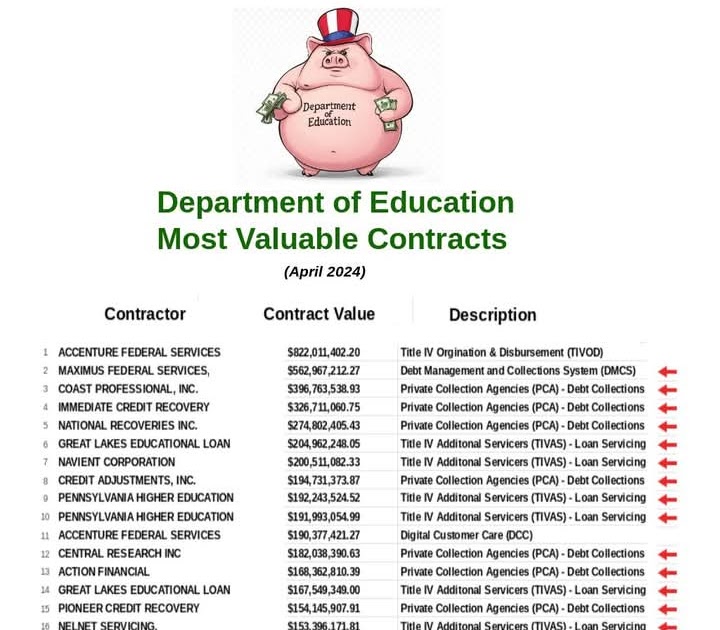
  • List of Government Contractors Involved with the Student Loan Portfolio

    List of Government Contractors Involved with the Student Loan Portfolio

    Thanks to Alan Collinge and Student Loan Justice for this information on government contractors for the US Department of Education’s Student Loan Portfolio. 

    Source link