Tag: positions

  • MSU Eliminates 99 Positions Amid $85 Million Budget Reduction Plan

    MSU Eliminates 99 Positions Amid $85 Million Budget Reduction Plan

    Michigan State University has cut 99 positions as part of a comprehensive cost-reduction strategy aimed at addressing mounting financial pressures, President Kevin Guskiewicz announced in a recent letter to campus stakeholders.

    The elimination of positions—spanning executive roles, support staff, faculty, and academic staff—represents the first phase of an $85 million budget reduction plan the institution unveiled in May. The cuts do not include non-renewed fixed-term appointments.

    The predominantly white institution in East Lansing is targeting a 6% spending reduction this fiscal year, totaling $50 million, with plans to cut an additional $35 million—or 3%—in the following fiscal year.

    Departments were directed to minimize personnel reductions during the initial year of cuts. Nearly two-thirds of this year’s $50 million reduction came from non-personnel expenses, including supplies and services, though layoffs proved unavoidable.

    Beyond internal budget constraints, federal funding cuts eliminated an additional 83 positions at the university. In late July, 94 MSU Extension staff members lost their positions following the discontinuation of the Supplemental Nutrition Assistance Program-Education (SNAP-Ed), which provided nutrition and physical activity programming to low-income families.

    Combined, the reductions have impacted 1.3% of MSU’s workforce since March 1.

    Guskiewicz attributed the budget crisis to multiple factors: double-digit increases in employee healthcare costs, federal funding reductions, and accumulated general fund deficits from previous years.

    The financial challenges persist despite MSU reporting its second-largest fall enrollment of 51,838 students and receiving a modest 2.1% increase in state appropriations, totaling approximately $333.8 million.

    “We have taken the first difficult and necessary steps to assure the university’s financial sustainability,” Guskiewicz wrote, thanking faculty and staff for their commitment to the institution’s mission.

    The university will launch its next budgeting cycle shortly, with request letters scheduled for early November and submissions due Jan. 23. Guskiewicz pledged to share additional information as the fiscal year concludes.

    MSU is providing outplacement services to eligible individuals affected by the cuts. The president acknowledged that some reductions continue to unfold through union and Human Resources processes.

    “I appreciate the compassion our teams are showing one another during this period, as well as your patience in understanding that we are trying to share information transparently and in a timely manner,” he stated.

    The university operates on a nearly $3.7 billion budget, with $1.7 billion allocated to the general fund.

    Source link

  • St. Norbert College to cut over 2 dozen faculty positions and 20 programs

    St. Norbert College to cut over 2 dozen faculty positions and 20 programs

    This audio is auto-generated. Please let us know if you have feedback.

    Dive Brief:

    • St. Norbert College’s trustee board recently approved discontinuing 20 academic programs, according to a message last week from college President Laurie Joyner.
    • Additionally, the Wisconsin college expects to terminate 21 faculty positions by May. It will eliminate another six faculty positions in 2026. 
    • The cuts come as the private Catholic institution looks to shed $7 million in costs to balance its budget for fiscal 2026. These decisions, though difficult, set us on a path to emerge stronger from this transitional period,” Joyner said Thursday.

    Dive Insight:

    Not long after Joyner joined St. Norbert in July 2023having previously led St. Xavier University in Chicago she found “a significant miscalculation” in the upcoming budget for the fiscal 2024 year, according to the college. 

    After two consecutive years of running deficits, the 2024 budget’s gap was even larger than expected. The college subsequently moved to cut $12 million from the budget — including through multiple rounds of layoffs. But it still faces a $7 million deficit in fiscal 2026 and anticipated further gaps in the years ahead.

    The deficits follow shrinking enrollments and rising costs. In 2022, according to the college, it had the highest faculty numbers in a decade but hundreds fewer students. Headcount during those 10 years fell by 405 students, with 1,882 students attending in fall 2022, per federal data.

    The shrinking student body is a major source of financial strain on St. Norbert. The college received 50% of its core revenue from tuition and fees in the 2023 fiscal year, according to latest federal data. 

    Between fiscal 2021 and 2024, revenue from tuition and fees fell 13.1% to $35.8 million at St. Norbert, according to its financial statements.

    The college says it is restructuring from “a position of relative strength as it adjusts its staffing to mirror its student population,” and the cuts are “creating an even stronger foundation as we prepare to weather the headwinds facing higher education.”

    The slate of programs approved for discontinuation include both majors and minors running the gamut from studio art and theology to physics and applied mathematics. Students enrolled in majors and minors set for discontinuation will be able to complete them, Joyner said. And some coursework in discontinued programs will continue to be taught. 

    St. Norbert joins a growing field of colleges paring back their programs and employee ranks in the face of demographic declines and cost inflation. That includes several of St. Norbert’s Catholic peers, including Saint Louis University, University of Dayton and University of St. Thomas.

    Source link

  • Event Planning, Institutional Research, Museum, and Tutor Positions See Significant Growth in the Wake of the Pandemic – CUPA-HR

    Event Planning, Institutional Research, Museum, and Tutor Positions See Significant Growth in the Wake of the Pandemic – CUPA-HR

    by CUPA-HR | August 10, 2022

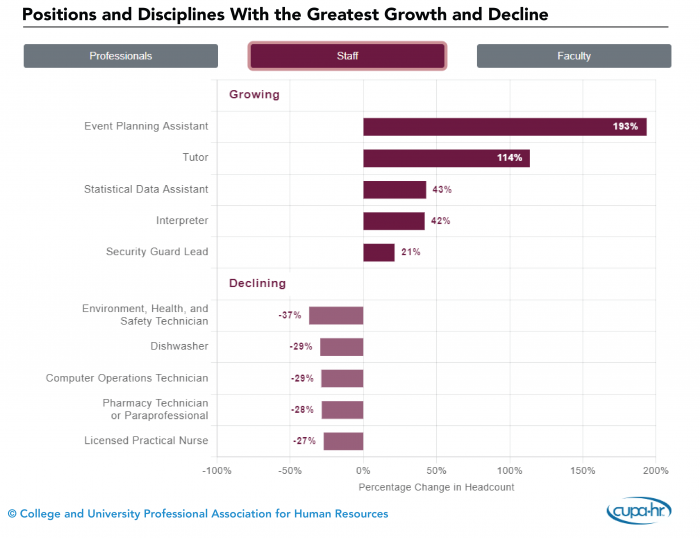
    According to data recently released by CUPA-HR, the higher ed workforce positions that saw the greatest growth from 2020-21 to 2021-22 were event planning assistant (up 193%), institutional research analyst (up 161%), head of campus museum (up 120%) and tutor (up 114%). These increases reflect an increase in the number of people hired to fill existing or newly created positions since 2020-21.

    The positions that saw the greatest decline in number of employees were environment, health and safety technician (down 37%), head of campus learning resources center (down 36%), online instruction operations manager (down 32%) and dishwasher (down 29%). These decreases reflect a decrease in the number of people in these positions since 2020-21, either because the institution has reduced the number of available positions or because those positions have unfilled vacancies.

    A new interactive graphic from CUPA-HR shows the Positions and Disciplines With the Highest Growth and Decline for higher ed professionals, staff and tenure-track faculty.

    The Ongoing Impact of COVID-19

    In many cases, the growth and decline in these positions over the past year reflect the impact of the COVID-19 recession that began in the spring of 2020. Like so many employers, institutions have experienced the effects of the Great Resignation and the subsequent challenges of talent recruitment amid the growing availability of remote and flexible work options.

    Other factors may also be at work. The return to in-person events, the growing demand for data to inform institutional decision-making, and the continued interest in honoring the cultural histories of institutions may have increased demand for the positions that saw the greatest increases. Also, as the high school graduates most impacted by the pandemic’s disruption of classroom learning make their way to college, more tutors may be needed to help them bridge anticipated gaps.

    Smaller Shifts in Faculty

    Overall, tenure-track faculty saw much smaller increases and declines in the years analyzed. Disciplines with the highest growth were Library Science (up 8.4%), Liberal Arts and Sciences (up 7.0%), and Area, Ethnic, Cultural, Gender and Group Studies (up 2.3%). Disciplines with the greatest declines were Communications Technologies (down 22%), Agriculture (down 9%) and Engineering Technologies and Technicians (down 6.4%).

    More About the Results

    The data for these results came from CUPA-HR’s annual Professionals in Higher Education Survey, Staff in Higher Education Survey and Faculty in Higher Education Survey. Analyses included more than 600 institutions that participated in each survey in both years of the comparison. For additional details, see the interactive graphic in the Research Center. These data and more are available through CUPA-HR’s DataOnDemand subscription service.


    Source link