
Tag: possibilities

  • One Platform, Endless Possibilities: Meet ScaleFunder Giving Form

    One Platform, Endless Possibilities: Meet ScaleFunder Giving Form

    Did you know that beyond powering multi-million dollar Giving Days and dynamic crowdfunding initiatives, ScaleFunder also offers functionality for creating simple and easy to use giving forms?

    This versatility is why ScaleFunder Giving Forms are rapidly gaining momentum! If your institution is already a ScaleFunder Crowdfunding partner, you automatically have unlimited access to create as many Giving Forms as you need. Continue reading to explore how consolidating all your giving initiatives to the ScaleFunder platform can strengthen cross-campus collaboration, simplify the donor experience, and offer operational flexibility.

    Stay friends with your gift processing team

    Keep your gift processing team smiling, because fewer platforms mean fewer headaches. With every gift flowing through the same trusted payment processor (of your choice), your payment mapping fields stay consistent across all ScaleFunder Giving Day and crowdfunding campaigns. Plus, digital wallet options activated through your payment integration let donors give how they prefer without throwing your processing pals a curveball. In addition, you can now easily add opt-in questions for university-wide texts and emails, making it easier than ever to gather big-picture data while keeping your systems (and friendships) running smoothly.

    Build consistency with donors

    Familiarity builds confidence, and ScaleFunder keeps things beautifully consistent. Whether a donor is supporting your Giving Day, a crowdfunding project, or a giving form, the experience looks and feels consistent once they land on the donation form. After a few gifts, they’ll be pros at checkout…breezing through the form with ease. That comfort can translate to higher completion rates, faster transactions, and more donors exploring other opportunities on your platform.

    Plus, once they’ve landed on one Giving Form, connecting them to others is a snap. Link to additional forms—like athletics, annual fund, or individual colleges and schools—just like our partners at Michigan Tech do, making it effortless for donors to discover new ways to give.

    Pictured: The Michigan Technological University annual fund giving page.

    Enjoy the flexibility you know and love
    Marshall University Foundation

    Creating a universal giving form has never been easier—you can do it in under five minutes! Need a simple form for one fund? Done. Want to showcase all 3,000 of your institution’s funds on a single page? Easy. The athletic director dreaming of a QR code in the banquet program that links to every athletic fund? Consider it handled.

    You can add unlimited custom questions to make your form as fun—or as functional—as you like. Ask for T-shirt sizes, invite donors to share their stories, or let them vote for their favorite residence hall. The options are limitless, and the setup is a breeze.

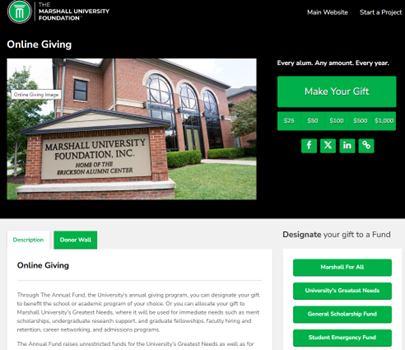
    Pictured: Our partners at Marshall University have identified nearly 20 priority funds on their Giving Form, which appear in two ways: visually appealing buttons on the project page and a searchable, scrollable list on the Giving Form.

    Maintain your identity
    UMass Amherst Foundation

    Your brand is uniquely yours and it should shine through every click, color, and contribution. When you join the ScaleFunder family, our team crafts a custom site design and background that aligns with your institution’s brand standards, colors, and tone. Every page carries that same cohesive look and feel, so donors always know they’re in your world.

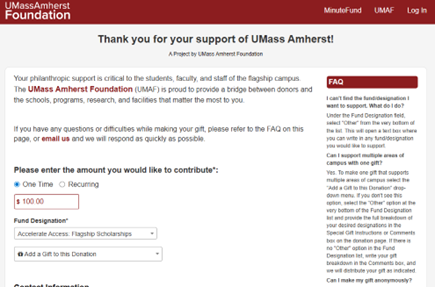
    From your logo and language to your custom domain, everything says “you,” while Google reCAPTCHA quietly works behind the scenes to reassure them that every gift is safe and secure. This consistency of branding also means it’s easy to link to your Giving Forms from external pages, just like our partners at UMass Amherst have done from their main foundation website.

    Pictured: The UMass Amherst Foundation giving page.

    Ready to learn more?

    Whether you’re exploring digital fundraising platforms or already part of the ScaleFunder family, we’d love to help you get the most out of your tools. Connect with Courtney Pourciaux, senior consultant, to learn how Giving Forms and ScaleFunder can elevate your fundraising strategy. Reach out and we can schedule a demo as well as discuss how to make your giving experience easy and consistent for your donors.

    Talk with our digital giving experts

    RNL works with institutions on digital giving and donor engagement, including crowdfunding, giving days, and omnichannel fundraising. Set up a time to talk with our fundraising experts to find your optimal strategies.

    Request Consultation

    Source link

  • The possibilities for radical collaboration in HE go far beyond mergers

    The possibilities for radical collaboration in HE go far beyond mergers

    2024-25 has been quite a year for collaboration in higher education. A year on from the election of the Labour government two things are pretty clear: there will be no significant injection of public funds into the sector in the current parliament; and the guiding lens for this government’s post-16 education policy will be regional.

    Instead of a highly competitive national higher education market the current policy landscape speaks to finding more ways to pool resources between institutions – so much so that Universities UK announced the formation of its taskforce on efficiency and transformation with the announcement of a “new era of collaboration” in higher education.

    Early in the year as the reality of the fiscal situation became clearer the sector saw a renewal of interest in coordinated efficiency models, including shared services, joint procurement, and up to and including mergers and acquisitions. There was only one problem: anyone who had experience of these kinds of initiatives, whether in higher education or another sector, would quickly warn that they require a great deal of upfront investment of time and energy, and the intended efficiency savings rarely materialise in the short term.

    No institution whose sole objective was to save money would look to collaboration as the best solution. But when we have explored themes of collaboration with the sector – through our radical efficiency article series with KPMG UK and our Connect More report with Mills & Reeve – we have found that despite the competitive pressures on the sector there is an appetite to explore where greater coordination between institutions could enhance value for students, employers, research funders and communities and regions.

    Play by play

    That sense of strategic potential for new ways of realising value is the starting point for a new publication from KPMG UK and Mills & Reeve. Titled Radical collaboration: a playbook, the report sets out the strategic context and considerations for boards and executives considering the range of options for structural collaboration, and the legal implications for the different kinds of possible models for structural collaboration.

    “If structural collaboration is framed as a short term fix for immediate financial sustainability then it’s the wrong answer to a bad question,” says Justine Andrew, partner at KPMG UK, and one of the authors of the playbook. “I think this is the moment, looking at the medium to long term, to say ‘is there a more joined-up way of fulfilling the purposes of what universities are for which is delivering world class teaching and research with impact in our places?’”

    It is often assumed that “structural collaboration” is a euphemism for merger – which itself is a euphemism for acquisition of one education provider by another. But this is far from accurate. One of the intents of the playbook is to explore the breadth of possible collaborations available to higher education providers on a spectrum from the softer to harder forms, including contractual alliance models, federation, group structures, and even the concept of a “multi-university trust.”

    “The multi-university trust is a concept that doesn’t exist yet,” says Poppy Short, partner at Mills & Reeve, and playbook author. “But in the school sector we have multi-academy trusts where all the institutions combine into one charitable company but the legacy institutions operate out of a separate academic division within that corporate vehicle, with some localised autonomy and branding. I think we will see one or more of those in higher education in the not too distant future.”

    Better the hurdle you know

    A further, highly practical, intent of the playbook is to help institutions to navigate some of the initial barriers to thinking through those different possibilities. Where higher education providers have merged – something that, while not especially common in higher education, is hardly beyond the bounds of accepted practice – they have been surprised to discover a lack of formal guidance that sets out the legal and regulatory requirements to help two organisations become one. There is even a degree of murkiness about the extent to which organisations are allowed to start conversations about collaboration under competition law – something which, under pressure from the sector, the Competition and Markets Authority (CMA) has said it will look into.

    To tackle this lack of guidance, for each of the collaborative entities explored the playbook sets out the corporate structure and governance, and the implications for brand identity, management of finances and delivery of services, and the impact on staff and students, including a real-world example where one exists. The playbook then sets out a worked example of a hypothetical scenario of a group of providers in a place working through options for structural collaboration, thinking through what the strategic drivers and risks for individual institutions might be, and the legal, financial and regulatory implications for a new corporate group entity.

    “We really hope the playbook can move the conversation from the theoretical into a really practical one,” says Justine. “We’re using the fictional example of a place called Newtown that has a diverse range of FE and HE providers, and looking through a regional lens, if I’m a student, if I’m an employer, if I’m a combined authority, an industrial partner is the way that the sector I’m interfacing with set up the best for me from a curriculum, a research, a delivery point of view. So we’re not only thinking through the impact on the institutions themselves but flipping the lens a bit and asking whether, from the end user point of view, there is a better way of doing this.”

    Why wait for government

    Traditionally, the sector might have looked to the government to set out an agenda or framework where policy gaps are identified – but it’s also fair to say that few in the sector want the government to start putting pressure on institutions to work together or combine forces when the strategic rationale for doing so is undercooked. Far better for the impetus to come from institutions themselves, underpinned by a shared idea of the kinds of value that can be created through collaboration and a common commitment to achieving those ends.

    That doesn’t mean there is no role for government, not least in reducing the barriers to collaboration and potentially setting out some kind of brokerage framework or regulatory support service to encourage and support exploration of options. There are also some obvious tweaks to be made to the tax system to, at the very least, ensure structural collaborations do not incur a tax penalty.

    “I think the Department for Education is in listening mode,” says Poppy. “I think they are looking for the sector to come forward with ideas, for these conversations to start happening, and for the asks to fall out of that. Obviously there are funding challenges but there are other asks as well, such as could the department broker conversations with the CMA or give some additional regulatory guidance? Also it would be helpful to work on joining up the different forms of education provision across FE and HE so you’re not constantly finding hurdles – just as you get over one issue in your sector, you’re in another sector. I think there are many things the department could do to help universities navigate their way through some of the decision-making and planning and considering what their options are.”

    None of this looks like the kind of funding investment in transformation the sector might hope to see, but it’s worth noting that in some cases a benefit of scale can be to unlock opportunities for private investment. The playbook works through the circumstances under which private investment could be a sensible option and points to some existing public/private partnerships already in place in the sector.

    Radical collaboration may not be the answer for all or even most higher education institutions in England. But both the sector and government have to answer the fundamental policy question of how to organise the post-16 education sector in such a way as to support the provision of the kinds of diversity of qualifications, subjects and modes of delivery that will enable the largest possible numbers to benefit from the opportunity to enhance their life chances.

    If there is a chance that broader and deeper structural collaborations across further and higher education can help to deliver that agenda, then at the very least boards and executive teams have to give those options meaningful consideration – and this playbook just radically lowered the bar to starting that process.

    This article is published in association with KPMG UK and Mills & Reeve. You can view and download Radical collaboration: a playbook here.

    Source link