Tag: postcard

  • Higher education postcard: Jesus College, Cambridge

    Higher education postcard: Jesus College, Cambridge

    In about 520CE, or so the story goes, Radegund was born, daughter of Bertachar, one of three brother kings of Thuringia.

    Uncle Hermanfrid, one of the other brothers, killed Bertachar; Radegund moved into his household. Hermanfrid allied with another king, Theuderic, to defeat Radegund’s other uncle, Baderic, and thus became sole King of Thuringia. And in so doing he reneged on an agreement with Theuderic.

    I hope you’re paying attention, because there’ll be a short test later.

    Now Theuderic was not the kind to forget a slight, and in 531, when Radegund was 11, he invaded Thuringia, with his brother Clothar. They defeated Hermanfrid, and Ragemund was taken into Clothar’s household. She lived in Picardy until 540, when Clothar married her, bringing his total of wives to six. (The other wives were Guntheuca, Chunsina, Ingund, Aregund and Wuldetrada, just in case you think I’m making this up.)

    In 545 Clothar murdered Radegund’s last surviving brother, and that was clearly the last straw, as she fled. She sought the protection of the church, and Medardus, Bishop of Noyen, ordained her as deaconess. In about 560 she founded the abbey of Sainte-Croixe near Poitiers, and she died in 567, having reputedly lived an austere, ascetic life, renowned for her healing powers. Or so the story goes.

    Now fast forward 600 years or so. Malcolm IV, King of Scotland and Earl of Huntingdon, visited Poitiers, the site of the cult of the now-sanctified Radegund. He gave ten acres of land to found a priory, dedicated to St Mary and St Radegund. And this land was in what would in time become central Cambridge.

    Now fast forward another 300 years. The priory now had a – ahem – reputation. John Alcock, Bishop of Ely, in whose see the priory sat, was given permission by Pope Alexander VI and King Henry VII to dissolve the priory. This was in 1496; the later description of the priory as a “community of spiritual harlots” may have been the cause; it may also, of course, have been a post facto justification. In any event, the priory was dissolved and a college founded in its place. The College of the Blessed Virgin Mary, Saint John the Evangelist and the glorious Virgin Saint Radegund, near Cambridge, which is now more commonly known as Jesus College, Cambridge, took over the priory buildings, and away it went.

    Bishop Alcock, by the way, gave the college its arms: the three cocks’ heads play on his surname. No sniggering at the back there.

    For hundreds of years Jesus was, in essence, a training college for clergy, staying small. But in 1863 Henry Morgan was appointed tutor of the college, and set about his duties with energy. The railway boom at the time meant that some of the original priory lands could be sold, bringing in cash with which Morgan expanded the college: by 1871 there were four times as many students as ten years previously; by 1881 the college had nearly doubled in size again from 1871. And these students would not be confined to those seeking a career in the Church of England.

    Let’s have a look at some Jesus College people. (What’s the correct term? Jesuits is logical but it really does have a more specific meaning. Jesusites? Jesusians? I bet there’s a correct term, and I bet someone will comment to say.)

    A good place to start is Thomas Cranmer, Archbishop of Canterbury at the time of Henry VIII, and architect of the English reformation. Cranmer may have (but probably didn’t) attended the college as a student, but he was certainly reader in divinity at Jesus from 1517 to 1528. He didn’t keep strong connections to the college after moving into court circles as archbishop, but as he was ultimately executed as a traitor (he backed the wrong team in the post-Edward VI power struggle) this may have been no bad thing, for the college at least.

    Let’s then move on to Laurence Sterne, student at the college 1733–37. He became a clergyman, but no-one remembers him for this. Because he arguably invented the English novel, with The Life and Opinions of Tristram Shandy, Gentleman published between 1759 and 1767. If you don’t know it, have a read; it is well worth it. It may change your opinions about just how modern modern writing is.

    Next in the roll of honour is Thomas Malthus, student of the college 1784–88 and fellow 1793–1804. As an economist Malthus was influential. In his Essay on the Principle of Population as it Affects the Future Improvement of Society he argued that population growth was unsustainable, because demand for food would inevitably outstrip supply. It is worth noting that the world population at that time was about 800 million; it is ten times that today. And while food is not fairly distributed across the world, neither is there a population crash as Malthus argued there would be.

    And now let’s move on to Samuel Taylor Coleridge, romantic poet and opium addict, author of The Rime of the Ancient Mariner and Kubla Khan. Coleridge was a student at Jesus. He developed his opium habit while at college, and in his third year dropped out to join the army, under the assumed name of Silas Tomkyn Comberbache. His brother had to pay a bribe to get him out of the army, and although he returned to Cambridge thereafter he never quite graduated.

    In 2019 Jesus appointed its first female master, Sonita Alleyne, having first admitted women as students in 1979. Alleyne was also the first black head of an Oxbridge college, preceding Valerie Amos at University College, Oxford by a year. More generally, the college has a very good run through its history here.

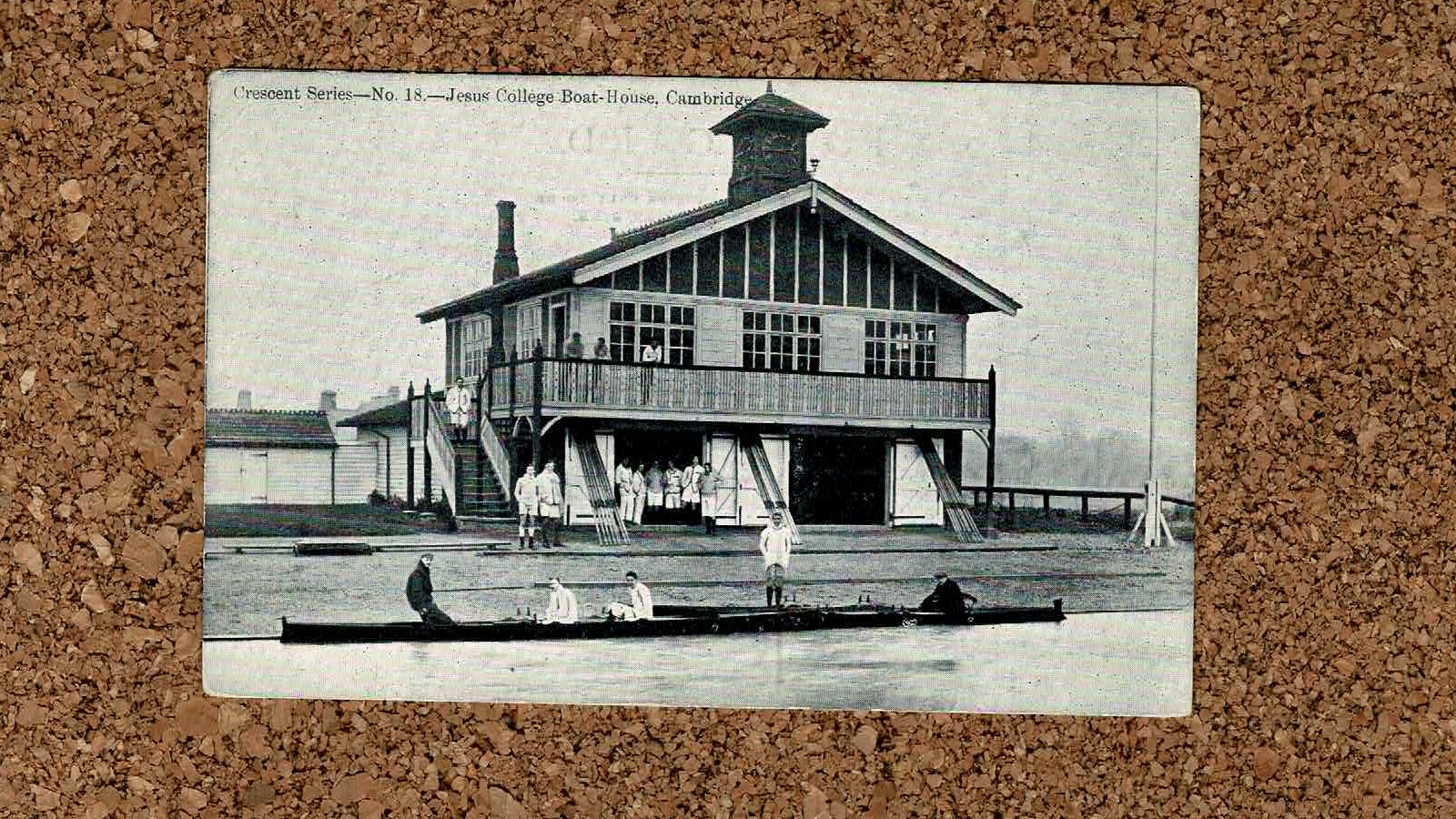
    Jesus is a sporty college, and its boat club is very strong. It holds the most headships of the river in the May and the Lent bumps, across both men’s and women’s boats. (I tried to explain about Cambridge rowing a while ago – here’s the link in case you’re interested.)

    And here’s a jigsaw of the card – hope you enjoy it!

    Source link

  • Higher education postcard: Lincoln College, Oxford

    Higher education postcard: Lincoln College, Oxford

    It’s late fourteenth century England, and a religious reform movement known as Lollardy was on the rise.

    The incomparable Sellar and Yeatman had it thus:

    During this reign the memorable preacher Wyclif collected together a curious set of men known as the Lollards or Dullards, because they insisted on walking about with their tongues hanging out and because they were so stupid that they could not do the Bible in Latin and demanded that everyone should be allowed to use an English translation. They were thus heretics and were accordingly unpopular with the top men in the Church who were very good at Latin and who liked to see some Dullards burnt before every meal.

    The Encyclopaedia Britannica will give you more detail if you need to know. Importantly, remember that John Wyclif is not the same person as Wyclef Jean.

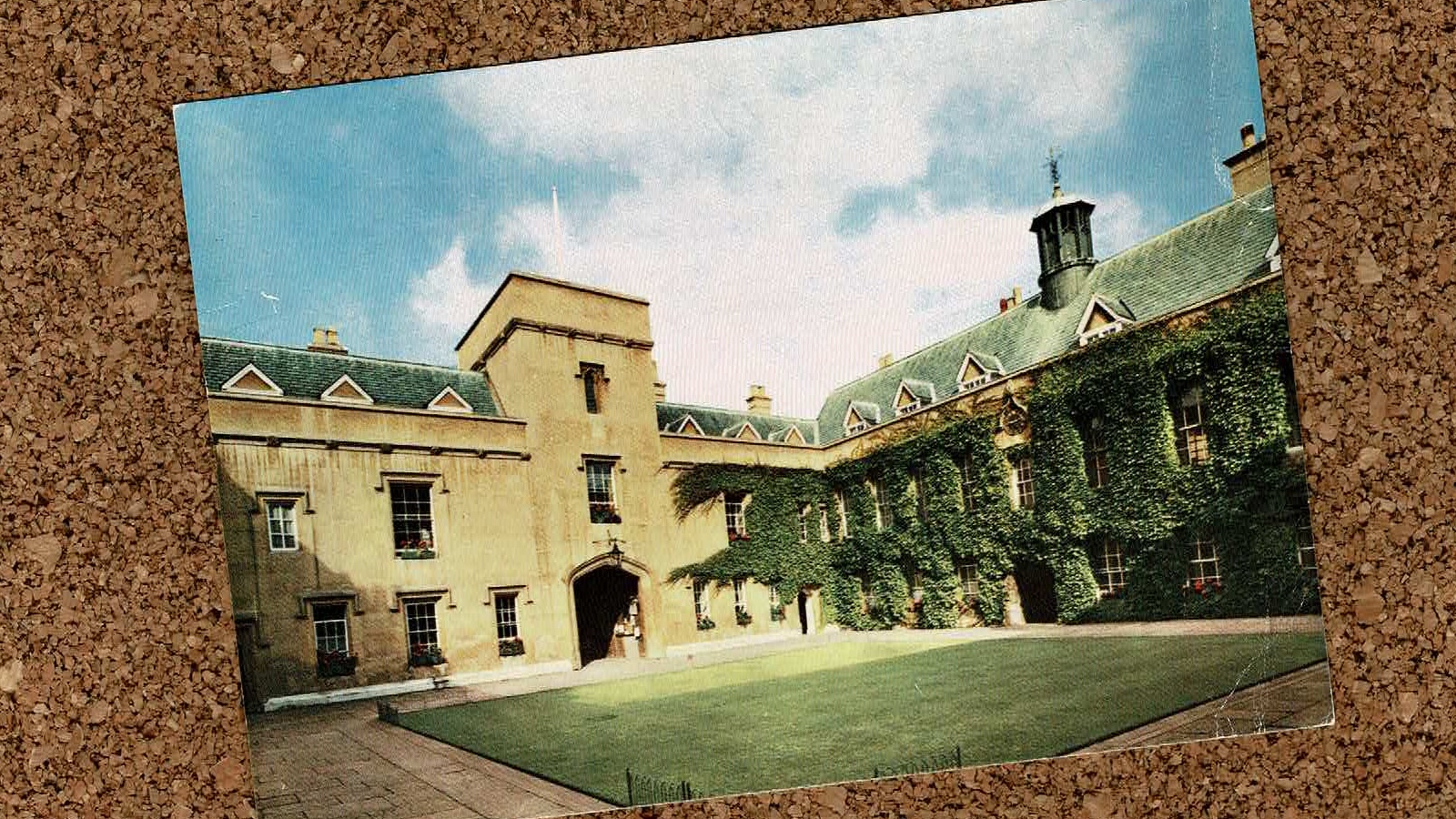
    Anyway, Lollardy was considered a problem by the church, and in 1427 Richard Fleming, Bishop of Lincoln, founded a college in Oxford as, apparently, “a little college of true students of theology who would defend the mysteries of Scripture against those ignorant laymen who profaned with swinish snouts its most holy pearls.”

    Benefactions in 1436 and 1437 enabled the nascent college to establish a physical base in Oxford, with a chapel, a library, a hall, a kitchen, rooms and, in 1465, rooms for the college’s master. In 1478, a second Royal Charter was granted, at the prompting of Thomas Rotherham, Bishop of Lincoln and later Lord Chancellor and Archbishop of York, who was the college’s visitor. (We’ll cover the role of the visitor another time, when I have the right postcard!)

    By this stage we’ve got in place the necessities of a college, and a few more elements – leasing the Mitre Inn, gaining a coat of arms – followed in the next hundred years. And the college continued to add buildings and the like, in the way that medieval Oxford colleges did. The interesting parts of our story now are people.

    Let’s fast forward to 1726, when John Wesley was elected a fellow of Lincoln. Discussions within the college set the scene for the establishment of Methodism. Having started as a college to counter heretical beliefs, the college had now enabled a significant branch of non-conformist Christianity to be born.

    In 1882 the first Jewish fellow of an Oxford college was elected at Lincoln. This followed the Universities Tests Act, passed in 1871, which removed religious barriers to participation in university life at Oxford, Cambridge and Durham. The fellow in question was Samuel Alexander, who later became a professor at Owens College, Manchester, and whose work focused, as best as I can tell, on questions of the nature of space and time. He’d have answered Zeno’s paradox, I suspect, by denying the reality of incrementally smaller units of time. But I may be wrong!

    In 1925 Theodor Seuss Geisel enrolled as a graduate student at Lincoln, having completed undergraduate studies at Dartmouth College, USA. We know him better as Dr Seuss. He didn’t, it seems, complete his postgraduate work. Maybe he’d have been a better writer if he had, maybe not – who knows?

    In 1952 another notable writer began his studies at Lincoln. This was David Cornwall, who is similarly better known by his pen-name: John le Carré. Cornwall graduated in 1956; it is thought that he was working for MI5 while at the college, and he certainly became an intelligence agent afterwards, continuing until 1964, when the fall-out from Kim Philby’s spectacular betrayal of many British agents means that he left the secret service. Fortunately for him, his writing enabled him to make an alternative living.

    Other notable Lincoln names include Rishi Sunak, former PM; Edward Thomas, WW1 poet; and physician John Radcliffe, after whom many Oxford buildings, including the hospital, the camera and the observatory, were named.

    Women were admitted to Lincoln for the first time in 1979.

    Lincoln College’s full name – reserved for Sunday best – is the College of the Blessed Mary and All Saints, Lincoln. It’s only called that by the monarch and by the university when it has been naughty, I imagine. The college has a very good page on its history – including some shot films – here. There’s more than I could reference in this piece.

    The card itself was unposted but has a message written on the back.

    Dear Mr Smithies, Great pleasure to talk to you – thanks for your kind offer of support.

    And as usual, here’s a jigsaw of the card – enjoy!

    Source link

  • Higher education postcard: matriculation | Wonkhe

    Higher education postcard: matriculation | Wonkhe

    It’s that time of year again. A level results have been and gone, the initial buzz of clearing has passed, and new students are about to turn up. It can only mean enrolment. Or, at some universities, this strange thing called matriculation.

    One internet definition of matriculation has it as “the process of matriculating”. Helpful.

    To get to the bottom of it, we need to remember that universities were medieval European creations, and medieval Europe was all about the corporation. A universitas was a single body of people, chartered by a king or a pope, or sometimes by both, and you had to become a member of the universitas to benefit from its protection and patronage.

    And the terminology stays with us – a degree refers to your class of membership of the universitas. A master had a license to teach at a universitas, and being a master at one would often (but not always) give you license to teach at another.

    Matriculation was the process whereby you became a student member of the university. At some universities (here’s Oxford, for example) it is a formal ceremony, dressing up and parading, and the whole works. At other universities it can be more administrative – in my own case, I got a letter from the University of London University Entrance Requirements office telling me that I’d matriculated. But I still had to queue up a long winding staircase at LSE to enrol, get my student ID and a grant cheque.

    Yes, I am that old.

    Enrolment is really the same as matriculation, but without the razzamatazz. It’s the moment when the contract between the student and the university becomes made by both sides; calling it enrolment not matriculation is a badge of the ongoing transition by universities from being medieval to being modern. Which I guess we should probably support. Before we need to transition to being postmodern.

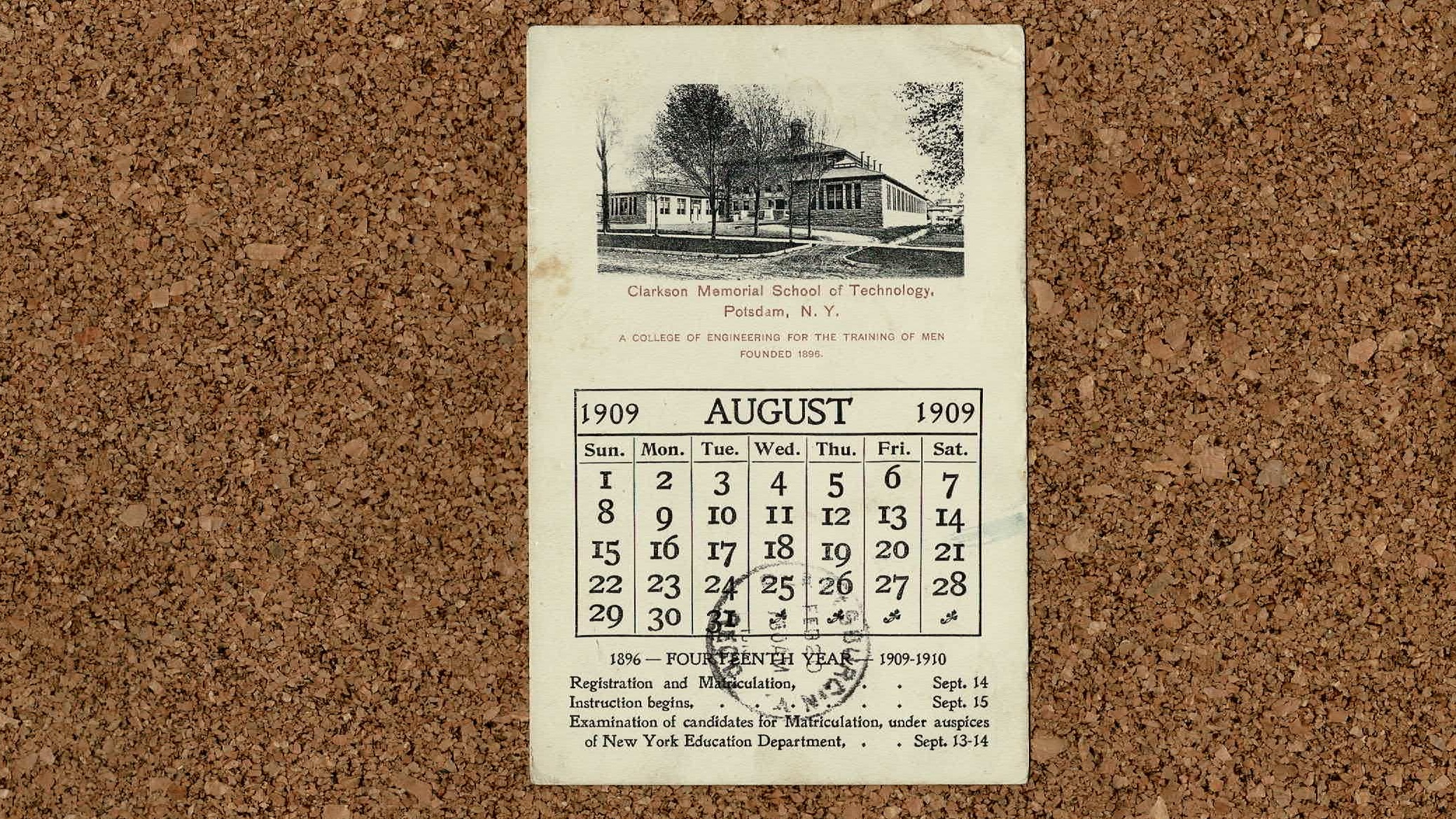
    The card itself was issued by Clarkson School of Technology, in the USA. It’s actually a marketing card. Come to Clarkson, it says. There’s still time to matriculate and register, and start to learn. Note that the sequence is: exam for matriculation, matriculation, instruction begins. And note that the exam to matriculate isn’t the university’s, but is the New York Education Department’s. An external verification that standards had been met before enrolment could happen.

    The Thomas S. Clarkson Memorial School of Technology was founded in 1896. Thomas S Clarkson was a businessman, with multiple interests including a quarry. In August 1894 we are told that a worker at the quarry was in danger of being crushed by a derrick pump. Clarkson pushed the worker out of the way, being crushed himself instead. He died five days later of his injuries. His three sisters and his niece established the technical school in his name.

    In 1912 the State University of New York required the registration of all higher educational establishments, and it became the Thomas S. Clarkson Memorial College of Technology, commonly known as the Clarkson College of Technology. It became a university in 1984. The university has a more thorough account of its history on its webpages.

    The card itself was sent on 19 February 1910.

    Good morning, Leon:- Haven’t heard from you this week. Neither have we heard from Mayme. Had letter from Mabel R, her vacation began last Monday and lasts ‘til April 1st ….

    Here’s the actual message if you can decipher more than I have, please share in the comments!

    Image: Hugh Jones

    And here’s a jigsaw of the postcard for you – hope you enjoy it.

    Source link

  • Higher education postcard: Philip Stott College

    Higher education postcard: Philip Stott College

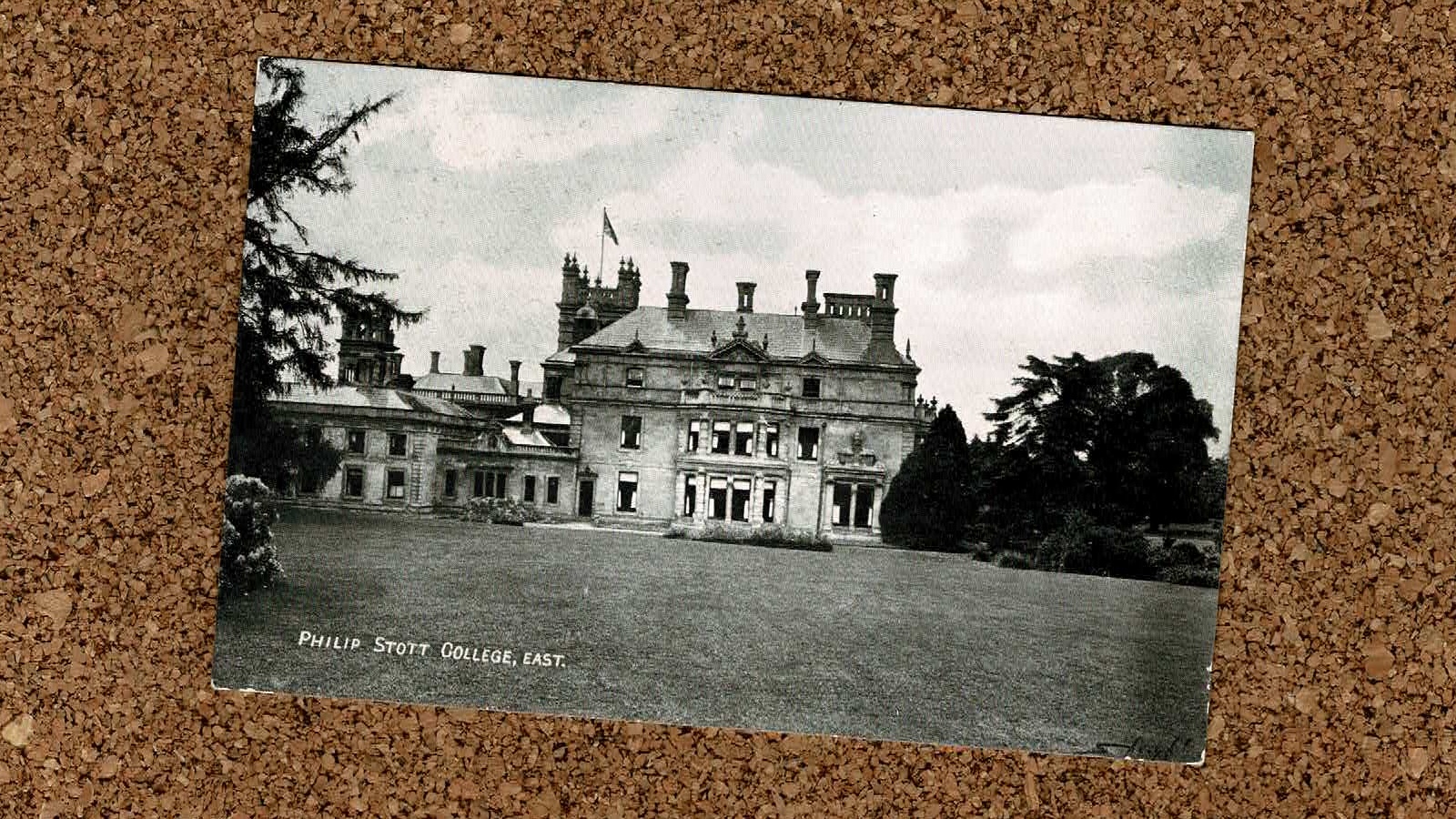
    We’ve seen before how, at the end of the nineteenth century, a college for the working classes was opened in Oxford. Ruskin College was strongly associated with the trade union movement, and the left of British politics. And in 1923 a Conservative equivalent opened – the Philip Stott College.

    Philip Stott (1858-1937) was, properly, Sir Philip Sidney Stott, and went, apparently, by Sidney Stott. Whichever first names he chose, he was an architect, who specialised in designing cotton mills. And so he became a wealthy and influential man, having designed 77 mills across Oldham and Lancashire more broadly, and having acquired shares in many of them. He had broad interests. He played rugby league for Oldham – the Athletic of 2 November 1881 records him playing at half-back, and making some “very strong runs” in Oldham’s comprehensive victory over Breightmet. He was president of the Oldham Lyceum.

    And, as soon as he could afford it, he moved to Gloucestershire, setting up home in Stanton Court, a Grade II listed Jacobean manor house. And here it seems he devoted his time and energy to the Conservative Party: he became president of the local Conservative Association. He was created a baronet in 1920, and in 1925 was High Sheriff of Gloucestershire.

    Stott wanted the Conservative Party to have a college of its own. The Conservative Party archives, held at the Bodleian library, record that:

    It having been decided to accept the generous offer of Sir Philip Stott, Bt., of the use of Overstone Park, Northampton, for the purposes of a permanent school for the study of Economics and Constitutional History, the first Session for Students commenced there on the 28th April last, and fortnightly courses have continued until the 29th September. During that period over 500 Students attended the College. They have been drawn from all classes, and from all parts of Great Britain, the majority being working men and Trade Unionists. Very encouraging reports have been received of the working of the College, and of the results achieved, the splendid efforts of the Lecturers and Tutors being greatly appreciated. Gifts of books from supporters of the Party and donations to be utilised in the purchase of books for the College Library have been thankfully received and acknowledged. The College was officially opened by the Prime Minister on the 27th September last.

    Gloriously, there is footage of the Prime Minister opening the college: this is from British Pathé in October 1923. The Prime Minister at the time was Stanley Baldwin – the first of his three periods in that office. And I defy you to find other footage of a Prime Minister being towed in a car by students acting as horses. This was a different age.

    The Spectator in June 1923 ran an account of the college’s early life. The college was initially aimed at working class conservatives, especially trade unionists, and it seems that the idea was to have intensive two-week courses, paid for by local associations and occasional bursaries. But it seems that this was insufficient to pay the college’s way, and its course were broadened to be open to Conservative party members more generally. There’s a good short account of the college (and a photograph from its early years) by Alastair Lexden, Lord Cooke, official historian to the Conservative Party.

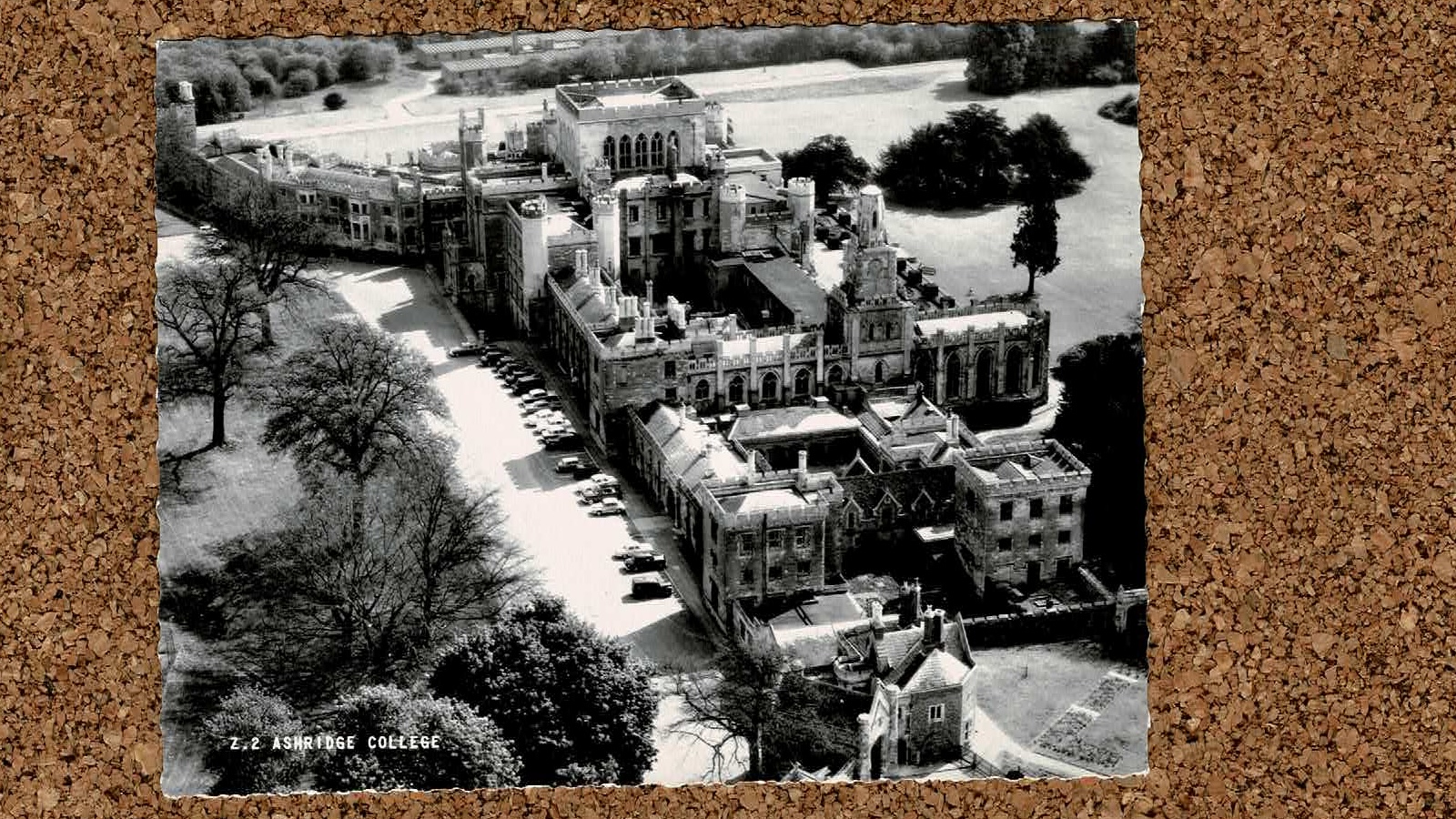
    The college closed in 1929. By then a rival had been set up by the then Conservative Party chairman, J C C Davidson. Bonar Law Memorial College – later to become the Ashridge Business School – was opened by Stanley Baldwin in 1929. Philip Stott College’s programmes and assets were transferred to the Bonar Law Memorial College, but it seems that nobody consulted Philip Sott about this. Which must have been a little galling. He resigned from the Conservative Party in 1935.

    I’ll write more about the Bonar Law Memorial College another day; but for now, here’s a jigsaw of the card – hope you enjoy it.

    Source link

  • Higher education postcard: Oh I do like to be beside the seaside!

    Higher education postcard: Oh I do like to be beside the seaside!

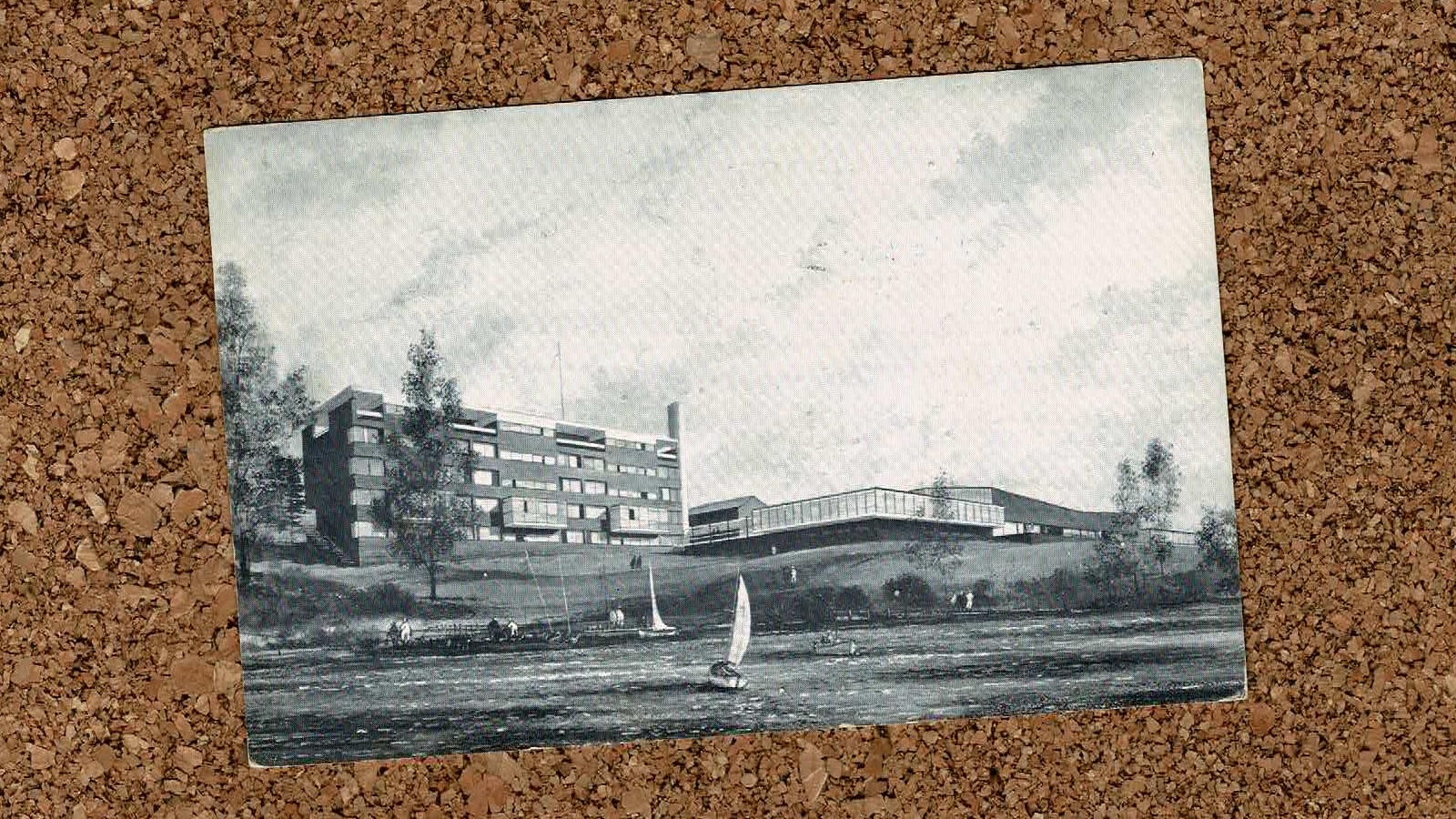
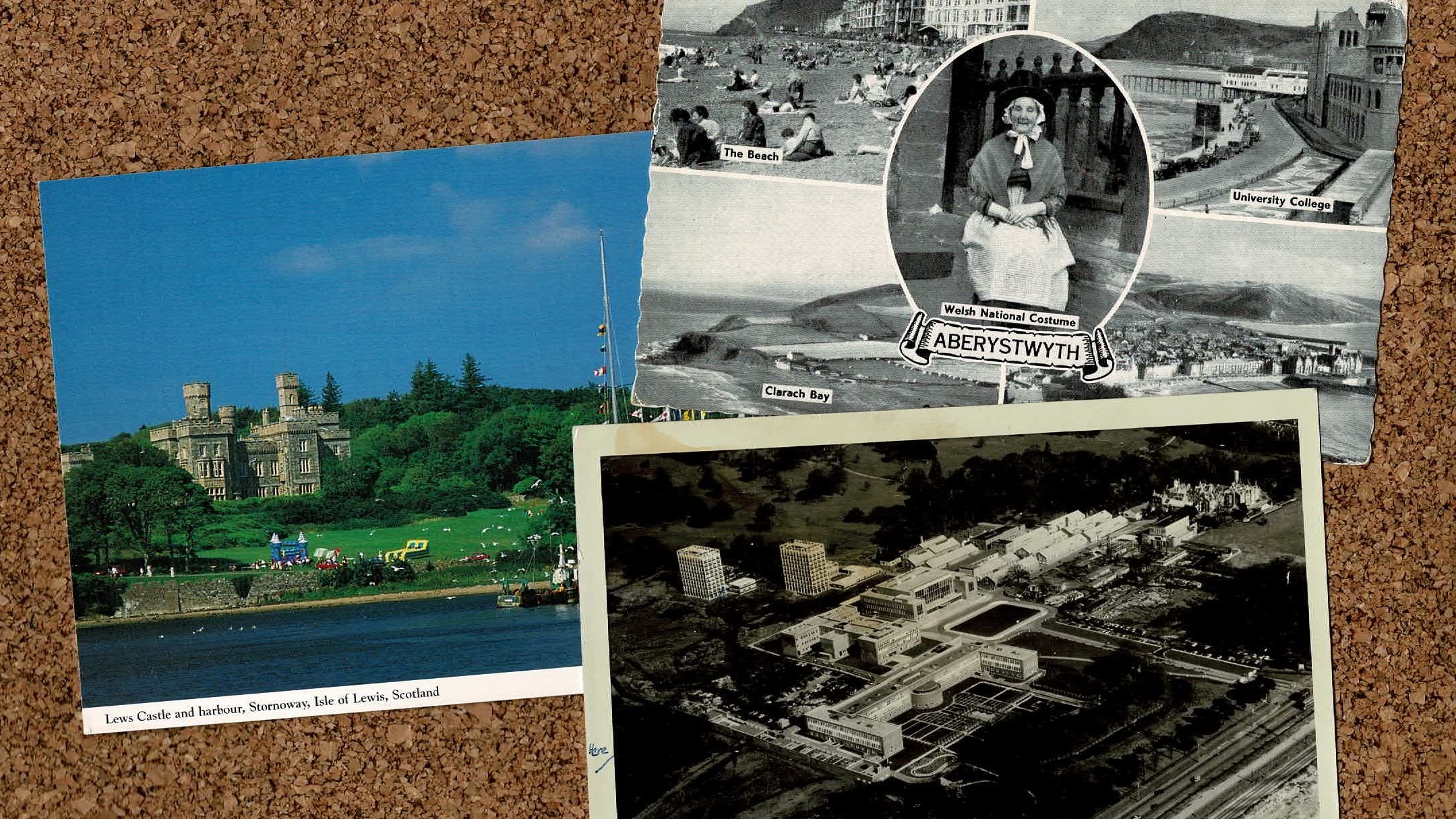
    Student life can mean lots of things, but for some universities it means the seaside! And I’m not talking here about universities in towns by the sea, I mean ones where the seaside is literally on their doorstep.

    Now I’m not claiming that this is a comprehensive survey of UK seaside universities – I haven’t visited them all, and I’m almost certain to have missed some. But let’s visit three.

    First of all, the University of the Highlands and Islands. Which, as the name suggests, includes some campuses on islands. And the Stornoway campus is in Lews castle, overlooking the sea. I wrote about UHI a couple of years ago – here’s a link – and it’s highly likely that some of the other campuses are right by the sea too. But I don’t have postcards, so I can’t really check.

    Secondly, going widdershins, is Aberystwyth. The old college, which is in the card, is no longer the hub of the university, but it is still part of the university. And it is literally on the seafront. I’ve written about Aberystwyth a few times – here’s one on the university, here’s one about student representation, and here’s one about the university court.

    And finally, here’s Swansea. The university’s old campus is right next to the coast – you can see the coast road, the now-gone railway and the edge of the beach at the bottom right of the card above. Swansea has a new campus too, further round the bay and still on the sea front. Here’s a blog I wrote about Swansea almost three years ago now.

    So what other universities are right by the sea? Let me know in the comments below, and I’ll try and find postcards and add them to my list of future bogs.

    Anyway, here’s a jigsaw of the three postcards, pinned, as it were, on the cork-board in your office. It’s a tougher one then normal!

    Thank you for reading, and for all of the comments and feedback. I hope you have a great summer, and I’ll be back again with some more higher education postcards in September.

    Source link

  • Higher education postcard: Corpus Christi, Cambridge

    Higher education postcard: Corpus Christi, Cambridge

    Greetings from Cambridge!

    The large majority of the old Oxbridge colleges were founded by rich and powerful individuals. One exception to that rule is Corpus Christi College, Cambridge. This was instead founded by (some of) the townspeople of Cambridge, and specifically by the Guild of Corpus Christi and the Guild of the Blessed Virgin Mary. Its mission was to train priests, in a town and country shocked by the impact of the Black Death. And one particular benefactor was notable: Margaret Andrew, who died in 1349 and gave lands to both guilds.

    What was a guild? There’s a fabulously helpful website which discusses their origin in Suffolk, and as Cambridge is next door there might not be too much difference. I’ll summarise: the word comes from the Old English term frith-gilds, associations of ten townsmen or villagers, and date from the 800s. These initially were to help enforce the peace – a medieval neighbourhood watch, if you like – but over time their character changed to take on a religious role and to act as a mutual insurance club of sorts, enabling people to have decent funerals, and celebrate saints days and the like. All of this was to help the members spend less time in purgatory after death.

    Guilds became associated with specific saints and, later, with specific parish churches. The Guild of the Blessed Virgin Mary probably doesn’t need much explanation. Guilds of Corpus Christi became popular following Pope Urban IV’s founding of the feast of Corpus Christi (the body of Christ) in 1264. Indulgences – get out of purgatory free cards – were granted to those who celebrated it, and so gilds began to be formed to do so.

    The love affair between the towns and the college didn’t last long. 1381 was the year of the Peasant’s Revolt, which was very active in East Anglia and Essex, Cambridge’s next-door counties. And in that year a mob from the town led by the mayor of Cambridge ransacked the college, burning books and causing mayhem, in protest against the college’s rapacious behaviour as a landlord. The specific crime was to enforce candle rents – charges payable based upon the number of candles or wax tapers present in their tenants’ homes. And in a broader context of revolt against authority, grievances would easy have been used to fan the flames.

    At this time the college, although formally known as The College of Corpus Christi and the Blessed Virgin Mary in the University of Cambridge, was referred to as Bene’t College or Benet Hall. This was because it used the neighbouring St Bene’t’s Church until in 1577 it got its own chapel. Bene’t is short for Benedict, the founder of the Benedictine order, by the way.

    The 1500s were notable for the college for other reasons too. In 1544, Henry VIII’s suppression of the monasteries was in full flow. The college’s master, Matthew Parker, obtained Anglo-Saxon manuscripts from several, and left them to the college, making the core of the Parker collection, of which the college is, reasonably, very proud.

    In 1569 Queen Elizabeth I imposed a master upon the fellows of the college, removing for a while their right to elect a master. In 1573 the college imposed new rules requiring that Latin, not English, be spoken by scholars during full term. The punishment for transgression was being “beaten at the Buttery hatch”, which sounds both unpleasant and like a top quality innuendo. (Imagine Kenneth Williams saying it while playing Thomas Cromwell in Carry On Henry and try not to smile.)

    We saw earlier that the college was founded just after the Black Death; and in 1630 another visitation of the plague took place. It seems that everyone in the college fled, except the master, a Dr Butts, who stayed behind to try to organise relief. The strain of it all was too much: he was found in 1632, having hanged himself.

    During the Civil War the Oxbridge colleges – rich foundations with collections of silver – often gave their wealth to one side or the other. Presumably under duress. Corpus Christi bucked this trend, by giving fellows leave of absence, and asking them to take some of the college silver with them for safekeeping, just as someone has to take the primary school hamster home to be looked after over the school holidays. And that is why Corpus Christi’s silverware collection is better than many other colleges today.

    The centuries rolled by, as they do. There were new buildings during the eighteenth and nineteenth centuries, and college life continued. The nineteenth century saw some evangelical zeal, but the number of students was also falling. Until 1906 Corpus Christi had always been led by a clergyman; the appointment of Robert Townley Caldwell as master. He was a colonel, commanding the 3rd battalion of the Gordon Highlanders in the mid-1890s, and a prominent freemason. He combined this with a career as a mathematician at Corpus Christi. His innovation was to change the policy on recruitment, so that it no longer focused on students who were, or wished to become, clergy. And accordingly the college began to grow again.

    In 1953 Francis Crick and James Watson announced their discovery of the double helix at The Eagle, which was – and still is – owned by the College. And the college became co-educational in 1980.

    Notable alumni include:

    • Christopher Marlowe, who arrived as a scholar at the college in 1580. His mysterious absences and high Buttery bills only add to the suggestion of his intelligence work, alongside his playwrightry (and yes, this is a proper word)
    • Basil Henry Liddell Hart, soldier, military historian – especially of the first world war – and theorist
    • E P Thompson, historian and titan of the left
    • Neil Hamilton, disgraced former politician and minor celebrity.

    The college has a splendid history on its website, which has informed much (but not all!) of this blog.

    And finally, here’s a jigsaw of the card – enjoy!

    Source link

  • Higher education postcard: Norwich University of the Arts

    Higher education postcard: Norwich University of the Arts

    From the Bolton Chronicle, 7 June 1845:

    [t]he following is the Report of the progress and state of this Institution made to Government, and just submitted to Parliament – The School of Design at Somerset-house was established at the commencement of the year 1837, by and under the superintendence of the Board of Trade, for the improvement of ornamental art, with regard especially to the staple manufactures of this country. The number of applicants for admission every month exceeds, by about fifty, that which the limited space in Somerset-house will accommodate.

    In connection with the head school at Somerset-house, schools have been formed in many of the principal manufacturing districts, namely, in Spitalfields, Coventry, Birmingham, Manchester, Sheffield, Nottingham, York, Newcastle and Glasgow; and applications are at present under consideration for the establishment of others in the boroughs of Southward and Lambeth, in Norwich, in the Staffordshire Potteries, and in Dublin…

    And it is to Norwich that we go.

    The idea of a school of design had been floated in Norwich for some time. The chief magistrate, Henry Bellenden Ker, had written to the mayor in November 1841 – the letter was published with an editorial in the Norwich Mercury on 6 November – setting out the expectations on the town, were it to be granted a government school of design. Essentially, they would have to find about £150 per year, supplemented by the government funding for the salary of the head of the school.

    The Norwich Mercury was very much in favour:

    In 1842 the town council agreed to a grant of £75 towards the costs, the remainder to be made via subscriptions. And it seems that the subscriptions must have been forthcoming, for on 21 January 1846 the Norwich School of Design was formally opened with much hoo-ha and admiring of the artistic collections that it had. In addition to the pieces granted by the government, the council provided some works from its own collection. And the school was up and running!

    By 1880 it was known as the Schools of Art and Science. It seems that this was by central government action: the schools of design were originally creations of the Board of Trade, and the Victorians recognised that science was just as important as creativity in that regard. (Even if this truth is one that our governments have forgotten today.)

    In 1899 the Technical Instruction Act empowered local authorities to control and fund technical education, and by the following year suggestions were being made that the School of Art and Sciences might fall within the scope of this act. Certainly the council was active in this area, a technical education committee having been established and an organiser and inspector of technical education appointed. By 1891 a new technical institute was being built in Norwich – the one shown on the card. The School of Art and Design was incorporated into this new Institute from 1901, as was, in 1913, the Norfolk and Norwich School of Cookery.

    The technical institute became the Norwich Technical College in 1930, and then in 1938 the Technical College and School of Art, Norwich. It feels almost like the artists and designers were not entirely integrated into the college!

    And in 1964 there was a separation. The college by then had a new building, and it seems that the technical subjects went to this new building on the Ipswich Road (still used by City College Norwich to this day), while the renamed Norwich School of Art stayed put. This also led to the School of Art moving into degree level education: from 1965 it offered the Diploma in Art and Design, validated by the National Council for Diplomas in Art and Design. And when in 1975 the National Council for Diplomas in Art and Design was incorporated into the Council for National Academic Awards, the school started offering bachelor’s degree courses.

    In 1974 responsibility for the School of Art had shifted from Norwich City Council to Norfolk County Council. And this fact became significant in 1989 when the School was merged with the Great Yarmouth College of Art, and the Norfolk Institute of Art and Design (NIAD) was created. This became an associate college of Anglia Polytechnic University (APU, as it then was), with APU validating NIAD’s degrees. These included postgraduate taught degrees from 1993, and research students from 1995.

    In 1994 the institute was incorporated as a higher education corporation – this is the legal form for most universities created from 1992 onwards – and renamed as the Norwich School of Art and Design. In 2007 it gained taught degree awarding powers and again assumed a new name, this time as the Norwich University College of the Arts. And finally in 2013, after the size threshold for university status had been reduced from 4,000 students to 1,000, it gained university status, becoming the Norwich University of the Arts.

    Alumni of the university include Keith Chapman, who created both Bob the Builder and Paw Patrol; and Neil Innes, of the Bonzo Dog Doo-Dah Band and Monty Python.

    The card itself is unsent, but looks to me to date from the first decade of the twentieth century. There’s a jigsaw here, for your delight and delectation.

    Source link

  • Higher education postcard: University of Bologna

    Higher education postcard: University of Bologna

    Saluti da Bologna!

    A long time ago, in a European country far, far away, the notion was stirring that learning might get you somewhere in life. (This was already known in other parts of the world, as my posts on Taxila, Nalanda, Fez and Al-Azhar show.) One place in which there were plenty of learned men from who to learn was Bologna, and it is to there that we travel today.

    This is the eleventh century (that is, years beginning with 10xx CE) and Bologna was a centre for the study of law, because it was itself the centre of some controversy. Having been part of the Carolingian empire, it seems that the city – and others like it – were wanting more autonomy. (After all, there were some alps between them and Aachen, so out-of-sight, out-of-mind, I guess.) But it was also in the buffer zone between the papacy and the Holy Roman Emperor. So they needed to grow lawyers to try to keep disputes in courts and not on battlefields.

    Students travelled to Bologna to study under these men, in what were private arrangements (that is, not under forms established by the state). Now, at that time, Bologna’s laws included collective punishment for crimes committed by foreigners (that is, if a foreigner committed a crime, all of those in Bologna from that nationality were liable for punishment.) Students – to protect themselves – formed collectives, known as nations; and these nations then became the groups who hired professors to teach.

    (You might at this point want to check out the learned Mike Ratcliffe’s presentation on higher education history, which includes an early slide on Bologna.)

    The students were definitely in charge, policing teachers’ attendance and punctuality in delivering lectures and requiring of teachers an oath to obey the students. Eventually the nations grouped together still further, forming what was known as a studium. From this position of strength they were able to negotiate collectively with the city itself, and collective punishment was dropped.

    It seems, by the way, that the studium was established in 1088; this is the date now mostly used for the establishment of the university, although charters and so forth didn’t come until later. And after the studium had been established, the teachers also sought to rebalance the power, and formed collegia doctorum, or doctors’ committees in each subject area. This enabled them to assert the right to set examination fees and to determine the criteria for admission to a degree. The different elements of a university were beginning to come into place.

    Now, I’m not a historian, and I’m definitely not a historian of the Holy Roman Empire, so to be honest the to-ing and fro-ing at this point gets a bit much for me. There were contests – some bloody, some wordy – between the papacy and the empire; sometimes one was on top, sometimes the other; the city states in the north of Italy grew in strength and autonomy; there were changes in leaders, plots and all sorts. Guelphs and Ghibellines, that sort of thing. Suffice to say that the University of Bologna was ultimately a beneficiary, gaining the emperor’s protection, and a charter (1158). And so the de facto university became one de jure.

    In 1219 the Pope – Honarius III – muscled in, insisting that the archdeacon of Bologna was the only office empowered to award the licentia docendi, or permission to teach. By 1278 the city of Bologna became part of the papal states – no longer under the Holy Roman Emperor – and in 1291 the licentia docendi of Bologna was ruled as being valid anywhere. At this time only law graduates could get a licentia docendi; as a few years later arts graduates could also gain the license to teach.

    Also at this time, the students of the other faculties – rhetoric, notary, medicine and philosophy – set up their own university in the city. No conditions of registration for them!

    In the following century there was yet more strife, and the politics impacted upon Bologna. This is the period when there was a Pope in Avignon and an Anti-Pope in Rome. To cement power, the Pope sent a legate who ruled in Bologna, and ruled despotically. Ownership of the city changed hands several times, but the influence of the university continued: teachers were often selected for fulfilling government and religious office. And in 1381 the city took action against the studium. Four Reformers of the Studium were to be elected each year, who would agree the contracts with teachers; the curricula and the subjects to be taught, and who would appoint the Punctator, the person in charge of ensuring the proper functioning of the university. The university had very much become a civic creature. And, for those so minded, there are some splendid role titles to consider resurrecting.

    Bologna was changing. As new forms of government were enacted in the late 1300s, the city became more self-confident, and also more insular. University teachers were put on the public payroll, and with a very few exceptions only Bolognese citizens could teach at the university. This led over time, inevitably, to a decline in the quality of the teaching and education at Bologna.

    One feature of the University Bologna at this stage which, to modern minds seems very odd, is that it didn’t have central premises. Teaching took place in private houses or rented halls – a throwback to the days of students hiring professors. This changed in the mid-16th century, as part of the more general rebuilding of the centre of Bologna. But is also enabled greater control over the university by the city authorities.

    Over the next couple of centuries the university was also drawn into the counter-reformation, with scholars leaving the university, and more timid academic appointments being made (Galileo Galilei passed over for the professorship of astronomy, for instance.)

    In the 1600’s, the university went further into a decline. Professorships salaries increased, and they became even more seen as a sinecure for local noble families. It is suggested by the University’s own history that at one point there were four professors for each student. But not many of them were any good. As the university ossified, and teaching stagnated in line with the doctrinal positions of a very conservative church, a few students sought to change things. The Academy of the Restless was established – a private club for discussion. In time this became part of the Academy of Sciences of the institute of Bologna: intellectual life was thriving, despite the university!

    Fast forward to the late 1700s, and revolution was in the air. Failed, in Bologna, but alive in France. In 1796 French troops entered Bologna, overthrowing the existing government. Reform of the university and its curriculum followed, as well as a move to new buildings. Italy was having a turbulent century, but as the modern state gradually coalesced, the University adopted more and more modern practices, with new faculties covering more branches of knowledge.

    The University was ingloriously fascist led during Mussolini’s reign; and the later twentieth century was also marked by disputes and unrest. But it was also a time for intellectual ferment and reinvention. In 1988, at its 900th anniversary celebrations, hundreds of university presidents, vice-chancellors and rectors from around the world signed the Magna Charta Universitatum; and the process of harmonization of European university qualifications is named the Bologna process in part after the university.

    This is an inadequate telling of the university’s story, but it isn’t, I think, fundamentally wrong. The University’s website has much detail, and probably reads better in Italian.

    And a positive note: despite its being overwhelmingly male for most of its history, the university hasn’t been entirely so. In 1237 Bettisia Gozzadini graduated in law from the university, and in 1239 was appointed lecturer. And in 1732 Laura Bassi became the first woman to be awarded a doctorate in science, and only the second to be awarded a PhD.

    One final thing to say: matriculation at Bologna looks a lot more fun than enrolment at most UK universities is today. A basket of hats! A lion! Minerva! No wonder they’re all queuing nicely.

    The card was sent ‘Alla Gentil Signorina Lina Mattia, via S Stefano 36, Bologna” in the most wonderful copperplate. It was sent in the days before split-back cards so there’s no message, or anything to indicate who it is from. If I can read the postmark correctly, it was posted on 28 September 1899. Here’s a jigsaw of the card – hope you enjoy it.

    Source link

  • Higher education postcard: Queen Alexandra’s House

    Higher education postcard: Queen Alexandra’s House

    Greetings from South Kensington!

    I’ve told elsewhere the story of how the Imperial Institute was founded following the Great Exhibition of 1851, and how the South Kensington site became a hub for colleges, museums and culture. And naturally, where there are students, there is a need to house students.

    And one group of students, in particular, exercised the Victorian imagination: women. Let’s take a look at The Era, of July 5, 1884:

    It’s clearly no use training the girls to be high class governesses, if you can’t keep them safe from the predations of that London.

    Step forward, Francis Cook. He was a rich man – head of Cook, Son and Co, traders in fabric and clothes – and became one of Britain’s richest men. He gave £40,000 to fund the construction of a hall of residence for women studying in South Kensington, which meant, at that time, at the Royal College of Art, the Royal College of Music, or the Royal College of Science. (It’s also worth noting another fact or two relating to Cook. His second wife, Tennessee Celeste Claflin was an American suffragist, clairvoyant and medium, who with her sister was one of the first women to open a Wall Street brokerage firm. The sister – Victoria Woodhull – was the first woman to run for the presidency of the United States, in 1872.)

    The hall was to provide 100 bedrooms, each two connected by a shared sitting room. Plans included a concert hall, gymnasium, library and common room. The concert hall would be used by the Royal College of Music, and there were music practice rooms and art studios too. A truly magnificent residence. There are images on the Queen Alexandra’s House website.

    It was named for Alexandra of Denmark, then Princess of Wales, who had taken a keen interest in the project. After the death of her husband King Edward VII, Alexandra became the Queen Mother, and suggested in 1914 that Alexandra House be renamed Queen Alexandra’s House.

    Also in 1914, a little scandal took place. Here’s a clipping from the Daily Chronicle of February 6 that year:

    The Ulster Volunteers were a paramilitary force, established in 1912, dedicated to the overthrow of Home Rule for Ireland. (And not to be confused with the unionist Ulster Volunteer Force which was active between 1966 and 2007, although they clearly shared a lot of aims and values!)

    As “Imperial Student” wrote, “I have known Irish women, Roman Catholics, Jewesses, Non-conformists there, and can safely say that all shades of opinion have been sheltered there. Are they expected to support such an entertainment as is to be held next Monday?” (To be clear, the scandal was the support for the Ulster Volunteers, not for the Student Christian Movement.) The correspondent continued:

    One feels sure that Queen Alexandra has no knowledge of the fact that an entertainment is to be held there in support of a hospital for volunteers armed to fight the forces of the Crown. It is to be hoped that this may be called to her Majesty’s attention and that she may intimate her disapproval of such a proceeding.

    I am sure you will be relieved to know that the Bucks Advertiser and Aylesbury News reported on 14 February that “the unfortunate incident at Queen Alexandra’s House has passed without causing trouble in Court of other circles.”

    Queen Alexandra’s House continues to serve today as when it was founded; it is an independent charity, still providing residential accommodation for female students, in a very desirable part of London.

    It’s royal connection continues; as shown in this February 1963 photograph in the Illustrated London News. I think that the Princess Alexandra in the photograph is the great granddaughter of the Alexandra after whom the House is named.

    The postcard was sent on 13 September 1914 – not long after the outbreak of World War I, to Miss Bates in Horsted Keynes, Sussex.

    Dear Winnie, Just a card of our house – no such houses at Horsted Keynes. Write soon, love from Gladys.

    And here’s a jigsaw.

    Source link

  • Higher education postcard: University of Buckingham

    Higher education postcard: University of Buckingham

    It’s a commonplace that the University of Cambridge was founded by scholars fleeing Oxford. Today’s postcard comes from a university with a similar origin myth, albeit quite a lot less medieval.

    And a lot newer too. We need to start in 1967, in May to be precise, when Dr John Paulley, an inveterate writer of letters to the times, had one published on the subject of university education. This included a call to action:

    Is it not time to examine the possibility of creating at least one new university in this country on the pattern of those great private foundations in the USA, without whose stimulus and freedom of action the many excellent state universities in that country would be so much poorer?

    And the call got a response. Three private conferences were held, two in 1968 and the third in early 1969, with plenty of disaffected Oxford academics attending. Preceding this latter conference was a declaration signed by 46 academics across the UK and Ireland, raising concerns about the influence of the state on university education. To quote from the Belfast Telegraph of Friday 3 January 1969:

    Professor Gibson said today: ‘increasingly the universities are being told, usually very politely and often indirectly, at what rate they shall expand and in what directions, and most recently the relative emphasis that should be placed on teaching and research.’

    He believed that this influence would increase and the power to exercise it, ‘because of the almost total financial dependence of the universities on the state.’

    ‘Furthermore I am convinced that centralised control of university education will in time weaken and perhaps destroy the international reputation of British universities,’ he added.

    (Professor Gibson, by the way, was Norman J Gibson, financial economist and professor at the New University of Ulster – the local angle clearly caught the eye of the Belfast Telegraph.)

    The argument was basically this: if the state pays for higher education, they will call the tune. And this is a bad thing, with deleterious effects for academic autonomy, for research and for quality and standards.

    Now, to my mind this argument omits the social justice and economic benefits of expanding access to university education, but it is hard to deny the proposition that the current financially-dependent HE sector in the UK is not exactly brim-full with stable and autonomous universities.

    So what happened as a result of the conferences? University College Buckingham, that’s what. It gained corporate form (as a non-profit charity) in 1973, started building works in 1974, and admitted its first students in 1976. Its first vice chancellor was Max Beloff, an Oxford professor.

    Buckingham was different – its undergraduate degrees were offered over two years, not three, students started in January not September, and it sat outside the state’s funding apparatus, and outside the UCCA (the Universities’ Central Council on Admissions – along with its polytechnic counterpart, one of the precursors to UCAS). If my memory is correct, there was an external academic advisory committee, which mentored the new university college through its initial years. It gained university status in 1983, under Margaret Thatcher’s premiership. (Mrs Thatcher, as former education secretary in the 1970–74 government, and then leader of the Conservative Party, had also opened the university in 1976. It is safe to say that she was in favour of the project.)

    Buckingham continued its journey parallel to the mainstream university sector (albeit still with an element of state support – see the below snippet from the Lincolnshire Standard and Boston Guardian in 1976) until 2001, when it subscribed to the QAA and joined in with the sector’s quality assurance system. From 2004 its students were able to access loan funding via the Student Loans Company, which enabled more students to attend: between 2007 and 2012 the university roughly doubled in size, although it was (and is) still relatively small.

    With the coming of the Higher Education and Research Act and the establishment of the OfS in 2018, Buckingham opted to maintain a certain arm’s-length-ness from the state: it is an Approved provider, meaning that it does not get the full £9,250 fee, nor any form of grant support from the OfS; but nor are its fees capped at £9,250. Students can access fee support loans up to £6,000 (or thereabouts) but Buckingham can charge more. And it does, although total fees are comparable with a full-time fee at another English university. Overseas students pay more, but the premium looks to be less, to my eyes, than at other UK universities. So, the principal of autonomy from the state is protected, to some extent.

    But only to some extent: the university still has to comply with the OfS conditions, and it became one of the first cases of a fine being issued for non-compliance: in this case, over late publication of accounts. This caused a certain amount of interest at Wonkhe towers: here in relation to the accounts when published; it’s also worth reading the OfS note on why the fine was as it was.

    In 2015 the university opened the first private medical school in modern UK history, working with the Milton Keynes NHS Foundation Trust to provide clinical placements.

    Buckingham’s alumni include Brandon Lewis, former Secretary of State for Northern Ireland; Pravind Jugnauth, former Mauritian Prime Minister and leader of that country’s Militant Socialist Movement; and Marc Gené, racing driver and winner of the Le Mans 24 hour race.

    Before we finish, it is worth a pause for reflection on the Buckingham story. As an experiment in trying to create a university outside of the normal state apparatus it is, I would argue, an unequivocal success. It is coming up to 50 years since the first students were admitted; there must be at least 50,000 Buckingham graduates; the university has expanded into different subject areas. None of this will have been easy to achieve.

    But perhaps the wider quest – to help create a private university, whose freedom of action would stimulate the other universities to innovate and improve – is at the very best a work in progress. One could point to the two-year degrees now available at some universities, as being a consequence of Buckingham. And this probably has some merit. Equally, the experiment shows that the degrees work for some specific student groups – for example, some mature students on courses with a specific professional orientation – but they’re not a panacea to all cost evils.

    And maybe the quest is a chimera. The recent rows in the US about Harvard, the private university par excellence, show just how much state funding it receives. (The amount under threat is about $2 billion, which is about five per cent of the total turnover of all universities in the UK.) What I think, for what it is worth, is that the UK sector with a Buckingham is better that it would be without.

    The postcard itself is not only of the university, although one of its building is shown top left, by the Great Ouse. The others are Buckingham scenes: the old gaol, the High Street, and the golden swan atop the old Town Hall.

    Here’s a jigsaw of today’s card. Thanks to Harriet Dunbar-Morris, Pro Vice-Chancellor Academic and Provost of the university, and an old pal from 1994 Group days – for suggesting Buckingham. As always, if you have a request, please let me know. If I don’t have a postcard, I might enjoy tracking one down!

    Source link