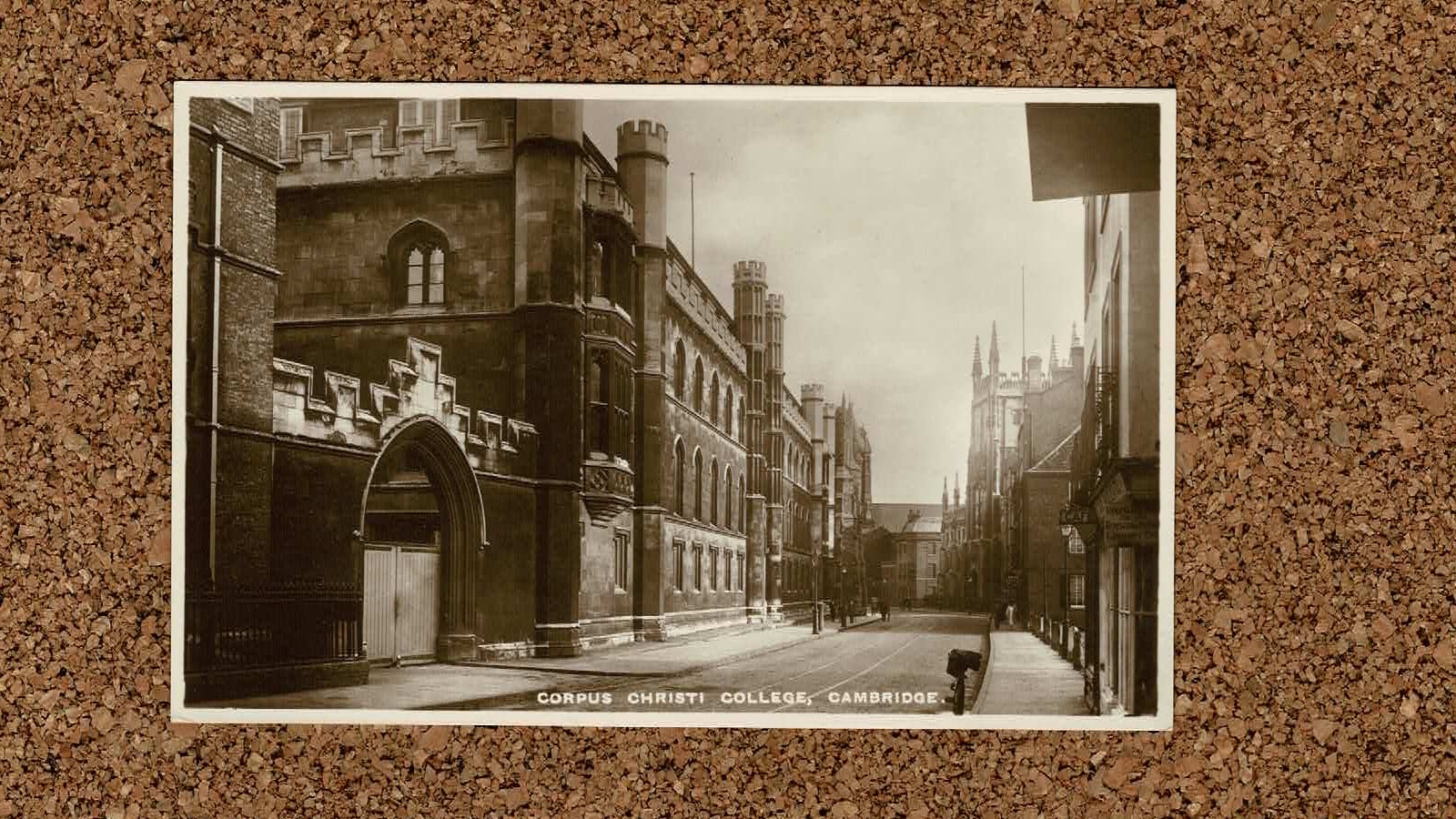
Tag: postcard

  • Higher education postcard: Corpus Christi, Cambridge

    Higher education postcard: Corpus Christi, Cambridge

    Greetings from Cambridge!

    The large majority of the old Oxbridge colleges were founded by rich and powerful individuals. One exception to that rule is Corpus Christi College, Cambridge. This was instead founded by (some of) the townspeople of Cambridge, and specifically by the Guild of Corpus Christi and the Guild of the Blessed Virgin Mary. Its mission was to train priests, in a town and country shocked by the impact of the Black Death. And one particular benefactor was notable: Margaret Andrew, who died in 1349 and gave lands to both guilds.

    What was a guild? There’s a fabulously helpful website which discusses their origin in Suffolk, and as Cambridge is next door there might not be too much difference. I’ll summarise: the word comes from the Old English term frith-gilds, associations of ten townsmen or villagers, and date from the 800s. These initially were to help enforce the peace – a medieval neighbourhood watch, if you like – but over time their character changed to take on a religious role and to act as a mutual insurance club of sorts, enabling people to have decent funerals, and celebrate saints days and the like. All of this was to help the members spend less time in purgatory after death.

    Guilds became associated with specific saints and, later, with specific parish churches. The Guild of the Blessed Virgin Mary probably doesn’t need much explanation. Guilds of Corpus Christi became popular following Pope Urban IV’s founding of the feast of Corpus Christi (the body of Christ) in 1264. Indulgences – get out of purgatory free cards – were granted to those who celebrated it, and so gilds began to be formed to do so.

    The love affair between the towns and the college didn’t last long. 1381 was the year of the Peasant’s Revolt, which was very active in East Anglia and Essex, Cambridge’s next-door counties. And in that year a mob from the town led by the mayor of Cambridge ransacked the college, burning books and causing mayhem, in protest against the college’s rapacious behaviour as a landlord. The specific crime was to enforce candle rents – charges payable based upon the number of candles or wax tapers present in their tenants’ homes. And in a broader context of revolt against authority, grievances would easy have been used to fan the flames.

    At this time the college, although formally known as The College of Corpus Christi and the Blessed Virgin Mary in the University of Cambridge, was referred to as Bene’t College or Benet Hall. This was because it used the neighbouring St Bene’t’s Church until in 1577 it got its own chapel. Bene’t is short for Benedict, the founder of the Benedictine order, by the way.

    The 1500s were notable for the college for other reasons too. In 1544, Henry VIII’s suppression of the monasteries was in full flow. The college’s master, Matthew Parker, obtained Anglo-Saxon manuscripts from several, and left them to the college, making the core of the Parker collection, of which the college is, reasonably, very proud.

    In 1569 Queen Elizabeth I imposed a master upon the fellows of the college, removing for a while their right to elect a master. In 1573 the college imposed new rules requiring that Latin, not English, be spoken by scholars during full term. The punishment for transgression was being “beaten at the Buttery hatch”, which sounds both unpleasant and like a top quality innuendo. (Imagine Kenneth Williams saying it while playing Thomas Cromwell in Carry On Henry and try not to smile.)

    We saw earlier that the college was founded just after the Black Death; and in 1630 another visitation of the plague took place. It seems that everyone in the college fled, except the master, a Dr Butts, who stayed behind to try to organise relief. The strain of it all was too much: he was found in 1632, having hanged himself.

    During the Civil War the Oxbridge colleges – rich foundations with collections of silver – often gave their wealth to one side or the other. Presumably under duress. Corpus Christi bucked this trend, by giving fellows leave of absence, and asking them to take some of the college silver with them for safekeeping, just as someone has to take the primary school hamster home to be looked after over the school holidays. And that is why Corpus Christi’s silverware collection is better than many other colleges today.

    The centuries rolled by, as they do. There were new buildings during the eighteenth and nineteenth centuries, and college life continued. The nineteenth century saw some evangelical zeal, but the number of students was also falling. Until 1906 Corpus Christi had always been led by a clergyman; the appointment of Robert Townley Caldwell as master. He was a colonel, commanding the 3rd battalion of the Gordon Highlanders in the mid-1890s, and a prominent freemason. He combined this with a career as a mathematician at Corpus Christi. His innovation was to change the policy on recruitment, so that it no longer focused on students who were, or wished to become, clergy. And accordingly the college began to grow again.

    In 1953 Francis Crick and James Watson announced their discovery of the double helix at The Eagle, which was – and still is – owned by the College. And the college became co-educational in 1980.

    Notable alumni include:

    • Christopher Marlowe, who arrived as a scholar at the college in 1580. His mysterious absences and high Buttery bills only add to the suggestion of his intelligence work, alongside his playwrightry (and yes, this is a proper word)
    • Basil Henry Liddell Hart, soldier, military historian – especially of the first world war – and theorist
    • E P Thompson, historian and titan of the left
    • Neil Hamilton, disgraced former politician and minor celebrity.

    The college has a splendid history on its website, which has informed much (but not all!) of this blog.

    And finally, here’s a jigsaw of the card – enjoy!
    Source link

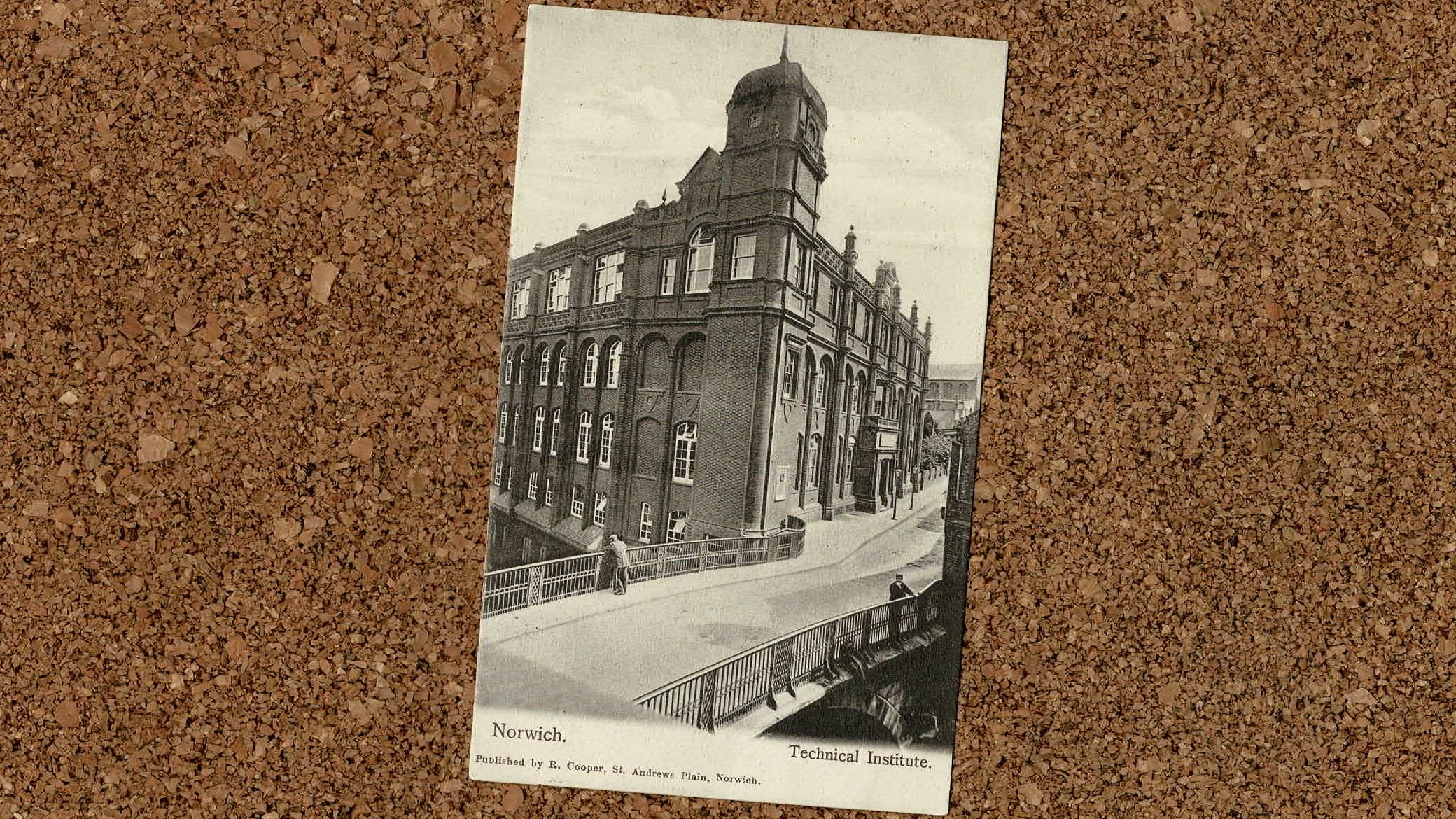
  • Higher education postcard: Norwich University of the Arts

    Higher education postcard: Norwich University of the Arts

    From the Bolton Chronicle, 7 June 1845:

    [t]he following is the Report of the progress and state of this Institution made to Government, and just submitted to Parliament – The School of Design at Somerset-house was established at the commencement of the year 1837, by and under the superintendence of the Board of Trade, for the improvement of ornamental art, with regard especially to the staple manufactures of this country. The number of applicants for admission every month exceeds, by about fifty, that which the limited space in Somerset-house will accommodate.

    In connection with the head school at Somerset-house, schools have been formed in many of the principal manufacturing districts, namely, in Spitalfields, Coventry, Birmingham, Manchester, Sheffield, Nottingham, York, Newcastle and Glasgow; and applications are at present under consideration for the establishment of others in the boroughs of Southward and Lambeth, in Norwich, in the Staffordshire Potteries, and in Dublin…

    And it is to Norwich that we go.

    The idea of a school of design had been floated in Norwich for some time. The chief magistrate, Henry Bellenden Ker, had written to the mayor in November 1841 – the letter was published with an editorial in the Norwich Mercury on 6 November – setting out the expectations on the town, were it to be granted a government school of design. Essentially, they would have to find about £150 per year, supplemented by the government funding for the salary of the head of the school.

    The Norwich Mercury was very much in favour:

    In 1842 the town council agreed to a grant of £75 towards the costs, the remainder to be made via subscriptions. And it seems that the subscriptions must have been forthcoming, for on 21 January 1846 the Norwich School of Design was formally opened with much hoo-ha and admiring of the artistic collections that it had. In addition to the pieces granted by the government, the council provided some works from its own collection. And the school was up and running!

    By 1880 it was known as the Schools of Art and Science. It seems that this was by central government action: the schools of design were originally creations of the Board of Trade, and the Victorians recognised that science was just as important as creativity in that regard. (Even if this truth is one that our governments have forgotten today.)

    In 1899 the Technical Instruction Act empowered local authorities to control and fund technical education, and by the following year suggestions were being made that the School of Art and Sciences might fall within the scope of this act. Certainly the council was active in this area, a technical education committee having been established and an organiser and inspector of technical education appointed. By 1891 a new technical institute was being built in Norwich – the one shown on the card. The School of Art and Design was incorporated into this new Institute from 1901, as was, in 1913, the Norfolk and Norwich School of Cookery.

    The technical institute became the Norwich Technical College in 1930, and then in 1938 the Technical College and School of Art, Norwich. It feels almost like the artists and designers were not entirely integrated into the college!

    And in 1964 there was a separation. The college by then had a new building, and it seems that the technical subjects went to this new building on the Ipswich Road (still used by City College Norwich to this day), while the renamed Norwich School of Art stayed put. This also led to the School of Art moving into degree level education: from 1965 it offered the Diploma in Art and Design, validated by the National Council for Diplomas in Art and Design. And when in 1975 the National Council for Diplomas in Art and Design was incorporated into the Council for National Academic Awards, the school started offering bachelor’s degree courses.

    In 1974 responsibility for the School of Art had shifted from Norwich City Council to Norfolk County Council. And this fact became significant in 1989 when the School was merged with the Great Yarmouth College of Art, and the Norfolk Institute of Art and Design (NIAD) was created. This became an associate college of Anglia Polytechnic University (APU, as it then was), with APU validating NIAD’s degrees. These included postgraduate taught degrees from 1993, and research students from 1995.

    In 1994 the institute was incorporated as a higher education corporation – this is the legal form for most universities created from 1992 onwards – and renamed as the Norwich School of Art and Design. In 2007 it gained taught degree awarding powers and again assumed a new name, this time as the Norwich University College of the Arts. And finally in 2013, after the size threshold for university status had been reduced from 4,000 students to 1,000, it gained university status, becoming the Norwich University of the Arts.

    Alumni of the university include Keith Chapman, who created both Bob the Builder and Paw Patrol; and Neil Innes, of the Bonzo Dog Doo-Dah Band and Monty Python.

    The card itself is unsent, but looks to me to date from the first decade of the twentieth century. There’s a jigsaw here, for your delight and delectation.

    Source link

  • Higher education postcard: University of Bologna

    Higher education postcard: University of Bologna

    Saluti da Bologna!

    A long time ago, in a European country far, far away, the notion was stirring that learning might get you somewhere in life. (This was already known in other parts of the world, as my posts on Taxila, Nalanda, Fez and Al-Azhar show.) One place in which there were plenty of learned men from who to learn was Bologna, and it is to there that we travel today.

    This is the eleventh century (that is, years beginning with 10xx CE) and Bologna was a centre for the study of law, because it was itself the centre of some controversy. Having been part of the Carolingian empire, it seems that the city – and others like it – were wanting more autonomy. (After all, there were some alps between them and Aachen, so out-of-sight, out-of-mind, I guess.) But it was also in the buffer zone between the papacy and the Holy Roman Emperor. So they needed to grow lawyers to try to keep disputes in courts and not on battlefields.

    Students travelled to Bologna to study under these men, in what were private arrangements (that is, not under forms established by the state). Now, at that time, Bologna’s laws included collective punishment for crimes committed by foreigners (that is, if a foreigner committed a crime, all of those in Bologna from that nationality were liable for punishment.) Students – to protect themselves – formed collectives, known as nations; and these nations then became the groups who hired professors to teach.

    (You might at this point want to check out the learned Mike Ratcliffe’s presentation on higher education history, which includes an early slide on Bologna.)

    The students were definitely in charge, policing teachers’ attendance and punctuality in delivering lectures and requiring of teachers an oath to obey the students. Eventually the nations grouped together still further, forming what was known as a studium. From this position of strength they were able to negotiate collectively with the city itself, and collective punishment was dropped.

    It seems, by the way, that the studium was established in 1088; this is the date now mostly used for the establishment of the university, although charters and so forth didn’t come until later. And after the studium had been established, the teachers also sought to rebalance the power, and formed collegia doctorum, or doctors’ committees in each subject area. This enabled them to assert the right to set examination fees and to determine the criteria for admission to a degree. The different elements of a university were beginning to come into place.

    Now, I’m not a historian, and I’m definitely not a historian of the Holy Roman Empire, so to be honest the to-ing and fro-ing at this point gets a bit much for me. There were contests – some bloody, some wordy – between the papacy and the empire; sometimes one was on top, sometimes the other; the city states in the north of Italy grew in strength and autonomy; there were changes in leaders, plots and all sorts. Guelphs and Ghibellines, that sort of thing. Suffice to say that the University of Bologna was ultimately a beneficiary, gaining the emperor’s protection, and a charter (1158). And so the de facto university became one de jure.

    In 1219 the Pope – Honarius III – muscled in, insisting that the archdeacon of Bologna was the only office empowered to award the licentia docendi, or permission to teach. By 1278 the city of Bologna became part of the papal states – no longer under the Holy Roman Emperor – and in 1291 the licentia docendi of Bologna was ruled as being valid anywhere. At this time only law graduates could get a licentia docendi; as a few years later arts graduates could also gain the license to teach.

    Also at this time, the students of the other faculties – rhetoric, notary, medicine and philosophy – set up their own university in the city. No conditions of registration for them!

    In the following century there was yet more strife, and the politics impacted upon Bologna. This is the period when there was a Pope in Avignon and an Anti-Pope in Rome. To cement power, the Pope sent a legate who ruled in Bologna, and ruled despotically. Ownership of the city changed hands several times, but the influence of the university continued: teachers were often selected for fulfilling government and religious office. And in 1381 the city took action against the studium. Four Reformers of the Studium were to be elected each year, who would agree the contracts with teachers; the curricula and the subjects to be taught, and who would appoint the Punctator, the person in charge of ensuring the proper functioning of the university. The university had very much become a civic creature. And, for those so minded, there are some splendid role titles to consider resurrecting.

    Bologna was changing. As new forms of government were enacted in the late 1300s, the city became more self-confident, and also more insular. University teachers were put on the public payroll, and with a very few exceptions only Bolognese citizens could teach at the university. This led over time, inevitably, to a decline in the quality of the teaching and education at Bologna.

    One feature of the University Bologna at this stage which, to modern minds seems very odd, is that it didn’t have central premises. Teaching took place in private houses or rented halls – a throwback to the days of students hiring professors. This changed in the mid-16th century, as part of the more general rebuilding of the centre of Bologna. But is also enabled greater control over the university by the city authorities.

    Over the next couple of centuries the university was also drawn into the counter-reformation, with scholars leaving the university, and more timid academic appointments being made (Galileo Galilei passed over for the professorship of astronomy, for instance.)

    In the 1600’s, the university went further into a decline. Professorships salaries increased, and they became even more seen as a sinecure for local noble families. It is suggested by the University’s own history that at one point there were four professors for each student. But not many of them were any good. As the university ossified, and teaching stagnated in line with the doctrinal positions of a very conservative church, a few students sought to change things. The Academy of the Restless was established – a private club for discussion. In time this became part of the Academy of Sciences of the institute of Bologna: intellectual life was thriving, despite the university!

    Fast forward to the late 1700s, and revolution was in the air. Failed, in Bologna, but alive in France. In 1796 French troops entered Bologna, overthrowing the existing government. Reform of the university and its curriculum followed, as well as a move to new buildings. Italy was having a turbulent century, but as the modern state gradually coalesced, the University adopted more and more modern practices, with new faculties covering more branches of knowledge.

    The University was ingloriously fascist led during Mussolini’s reign; and the later twentieth century was also marked by disputes and unrest. But it was also a time for intellectual ferment and reinvention. In 1988, at its 900th anniversary celebrations, hundreds of university presidents, vice-chancellors and rectors from around the world signed the Magna Charta Universitatum; and the process of harmonization of European university qualifications is named the Bologna process in part after the university.

    This is an inadequate telling of the university’s story, but it isn’t, I think, fundamentally wrong. The University’s website has much detail, and probably reads better in Italian.

    And a positive note: despite its being overwhelmingly male for most of its history, the university hasn’t been entirely so. In 1237 Bettisia Gozzadini graduated in law from the university, and in 1239 was appointed lecturer. And in 1732 Laura Bassi became the first woman to be awarded a doctorate in science, and only the second to be awarded a PhD.

    One final thing to say: matriculation at Bologna looks a lot more fun than enrolment at most UK universities is today. A basket of hats! A lion! Minerva! No wonder they’re all queuing nicely.

    The card was sent ‘Alla Gentil Signorina Lina Mattia, via S Stefano 36, Bologna” in the most wonderful copperplate. It was sent in the days before split-back cards so there’s no message, or anything to indicate who it is from. If I can read the postmark correctly, it was posted on 28 September 1899. Here’s a jigsaw of the card – hope you enjoy it.

    Source link

  • Higher education postcard: Queen Alexandra’s House

    Higher education postcard: Queen Alexandra’s House

    Greetings from South Kensington!

    I’ve told elsewhere the story of how the Imperial Institute was founded following the Great Exhibition of 1851, and how the South Kensington site became a hub for colleges, museums and culture. And naturally, where there are students, there is a need to house students.

    And one group of students, in particular, exercised the Victorian imagination: women. Let’s take a look at The Era, of July 5, 1884:

    It’s clearly no use training the girls to be high class governesses, if you can’t keep them safe from the predations of that London.

    Step forward, Francis Cook. He was a rich man – head of Cook, Son and Co, traders in fabric and clothes – and became one of Britain’s richest men. He gave £40,000 to fund the construction of a hall of residence for women studying in South Kensington, which meant, at that time, at the Royal College of Art, the Royal College of Music, or the Royal College of Science. (It’s also worth noting another fact or two relating to Cook. His second wife, Tennessee Celeste Claflin was an American suffragist, clairvoyant and medium, who with her sister was one of the first women to open a Wall Street brokerage firm. The sister – Victoria Woodhull – was the first woman to run for the presidency of the United States, in 1872.)

    The hall was to provide 100 bedrooms, each two connected by a shared sitting room. Plans included a concert hall, gymnasium, library and common room. The concert hall would be used by the Royal College of Music, and there were music practice rooms and art studios too. A truly magnificent residence. There are images on the Queen Alexandra’s House website.

    It was named for Alexandra of Denmark, then Princess of Wales, who had taken a keen interest in the project. After the death of her husband King Edward VII, Alexandra became the Queen Mother, and suggested in 1914 that Alexandra House be renamed Queen Alexandra’s House.

    Also in 1914, a little scandal took place. Here’s a clipping from the Daily Chronicle of February 6 that year:

    The Ulster Volunteers were a paramilitary force, established in 1912, dedicated to the overthrow of Home Rule for Ireland. (And not to be confused with the unionist Ulster Volunteer Force which was active between 1966 and 2007, although they clearly shared a lot of aims and values!)

    As “Imperial Student” wrote, “I have known Irish women, Roman Catholics, Jewesses, Non-conformists there, and can safely say that all shades of opinion have been sheltered there. Are they expected to support such an entertainment as is to be held next Monday?” (To be clear, the scandal was the support for the Ulster Volunteers, not for the Student Christian Movement.) The correspondent continued:

    One feels sure that Queen Alexandra has no knowledge of the fact that an entertainment is to be held there in support of a hospital for volunteers armed to fight the forces of the Crown. It is to be hoped that this may be called to her Majesty’s attention and that she may intimate her disapproval of such a proceeding.

    I am sure you will be relieved to know that the Bucks Advertiser and Aylesbury News reported on 14 February that “the unfortunate incident at Queen Alexandra’s House has passed without causing trouble in Court of other circles.”

    Queen Alexandra’s House continues to serve today as when it was founded; it is an independent charity, still providing residential accommodation for female students, in a very desirable part of London.

    It’s royal connection continues; as shown in this February 1963 photograph in the Illustrated London News. I think that the Princess Alexandra in the photograph is the great granddaughter of the Alexandra after whom the House is named.

    The postcard was sent on 13 September 1914 – not long after the outbreak of World War I, to Miss Bates in Horsted Keynes, Sussex.

    Dear Winnie, Just a card of our house – no such houses at Horsted Keynes. Write soon, love from Gladys.

    And here’s a jigsaw.

    Source link

  • Higher education postcard: University of Buckingham

    Higher education postcard: University of Buckingham

    It’s a commonplace that the University of Cambridge was founded by scholars fleeing Oxford. Today’s postcard comes from a university with a similar origin myth, albeit quite a lot less medieval.

    And a lot newer too. We need to start in 1967, in May to be precise, when Dr John Paulley, an inveterate writer of letters to the times, had one published on the subject of university education. This included a call to action:

    Is it not time to examine the possibility of creating at least one new university in this country on the pattern of those great private foundations in the USA, without whose stimulus and freedom of action the many excellent state universities in that country would be so much poorer?

    And the call got a response. Three private conferences were held, two in 1968 and the third in early 1969, with plenty of disaffected Oxford academics attending. Preceding this latter conference was a declaration signed by 46 academics across the UK and Ireland, raising concerns about the influence of the state on university education. To quote from the Belfast Telegraph of Friday 3 January 1969:

    Professor Gibson said today: ‘increasingly the universities are being told, usually very politely and often indirectly, at what rate they shall expand and in what directions, and most recently the relative emphasis that should be placed on teaching and research.’

    He believed that this influence would increase and the power to exercise it, ‘because of the almost total financial dependence of the universities on the state.’

    ‘Furthermore I am convinced that centralised control of university education will in time weaken and perhaps destroy the international reputation of British universities,’ he added.

    (Professor Gibson, by the way, was Norman J Gibson, financial economist and professor at the New University of Ulster – the local angle clearly caught the eye of the Belfast Telegraph.)

    The argument was basically this: if the state pays for higher education, they will call the tune. And this is a bad thing, with deleterious effects for academic autonomy, for research and for quality and standards.

    Now, to my mind this argument omits the social justice and economic benefits of expanding access to university education, but it is hard to deny the proposition that the current financially-dependent HE sector in the UK is not exactly brim-full with stable and autonomous universities.

    So what happened as a result of the conferences? University College Buckingham, that’s what. It gained corporate form (as a non-profit charity) in 1973, started building works in 1974, and admitted its first students in 1976. Its first vice chancellor was Max Beloff, an Oxford professor.

    Buckingham was different – its undergraduate degrees were offered over two years, not three, students started in January not September, and it sat outside the state’s funding apparatus, and outside the UCCA (the Universities’ Central Council on Admissions – along with its polytechnic counterpart, one of the precursors to UCAS). If my memory is correct, there was an external academic advisory committee, which mentored the new university college through its initial years. It gained university status in 1983, under Margaret Thatcher’s premiership. (Mrs Thatcher, as former education secretary in the 1970–74 government, and then leader of the Conservative Party, had also opened the university in 1976. It is safe to say that she was in favour of the project.)

    Buckingham continued its journey parallel to the mainstream university sector (albeit still with an element of state support – see the below snippet from the Lincolnshire Standard and Boston Guardian in 1976) until 2001, when it subscribed to the QAA and joined in with the sector’s quality assurance system. From 2004 its students were able to access loan funding via the Student Loans Company, which enabled more students to attend: between 2007 and 2012 the university roughly doubled in size, although it was (and is) still relatively small.

    With the coming of the Higher Education and Research Act and the establishment of the OfS in 2018, Buckingham opted to maintain a certain arm’s-length-ness from the state: it is an Approved provider, meaning that it does not get the full £9,250 fee, nor any form of grant support from the OfS; but nor are its fees capped at £9,250. Students can access fee support loans up to £6,000 (or thereabouts) but Buckingham can charge more. And it does, although total fees are comparable with a full-time fee at another English university. Overseas students pay more, but the premium looks to be less, to my eyes, than at other UK universities. So, the principal of autonomy from the state is protected, to some extent.

    But only to some extent: the university still has to comply with the OfS conditions, and it became one of the first cases of a fine being issued for non-compliance: in this case, over late publication of accounts. This caused a certain amount of interest at Wonkhe towers: here in relation to the accounts when published; it’s also worth reading the OfS note on why the fine was as it was.

    In 2015 the university opened the first private medical school in modern UK history, working with the Milton Keynes NHS Foundation Trust to provide clinical placements.

    Buckingham’s alumni include Brandon Lewis, former Secretary of State for Northern Ireland; Pravind Jugnauth, former Mauritian Prime Minister and leader of that country’s Militant Socialist Movement; and Marc Gené, racing driver and winner of the Le Mans 24 hour race.

    Before we finish, it is worth a pause for reflection on the Buckingham story. As an experiment in trying to create a university outside of the normal state apparatus it is, I would argue, an unequivocal success. It is coming up to 50 years since the first students were admitted; there must be at least 50,000 Buckingham graduates; the university has expanded into different subject areas. None of this will have been easy to achieve.

    But perhaps the wider quest – to help create a private university, whose freedom of action would stimulate the other universities to innovate and improve – is at the very best a work in progress. One could point to the two-year degrees now available at some universities, as being a consequence of Buckingham. And this probably has some merit. Equally, the experiment shows that the degrees work for some specific student groups – for example, some mature students on courses with a specific professional orientation – but they’re not a panacea to all cost evils.

    And maybe the quest is a chimera. The recent rows in the US about Harvard, the private university par excellence, show just how much state funding it receives. (The amount under threat is about $2 billion, which is about five per cent of the total turnover of all universities in the UK.) What I think, for what it is worth, is that the UK sector with a Buckingham is better that it would be without.

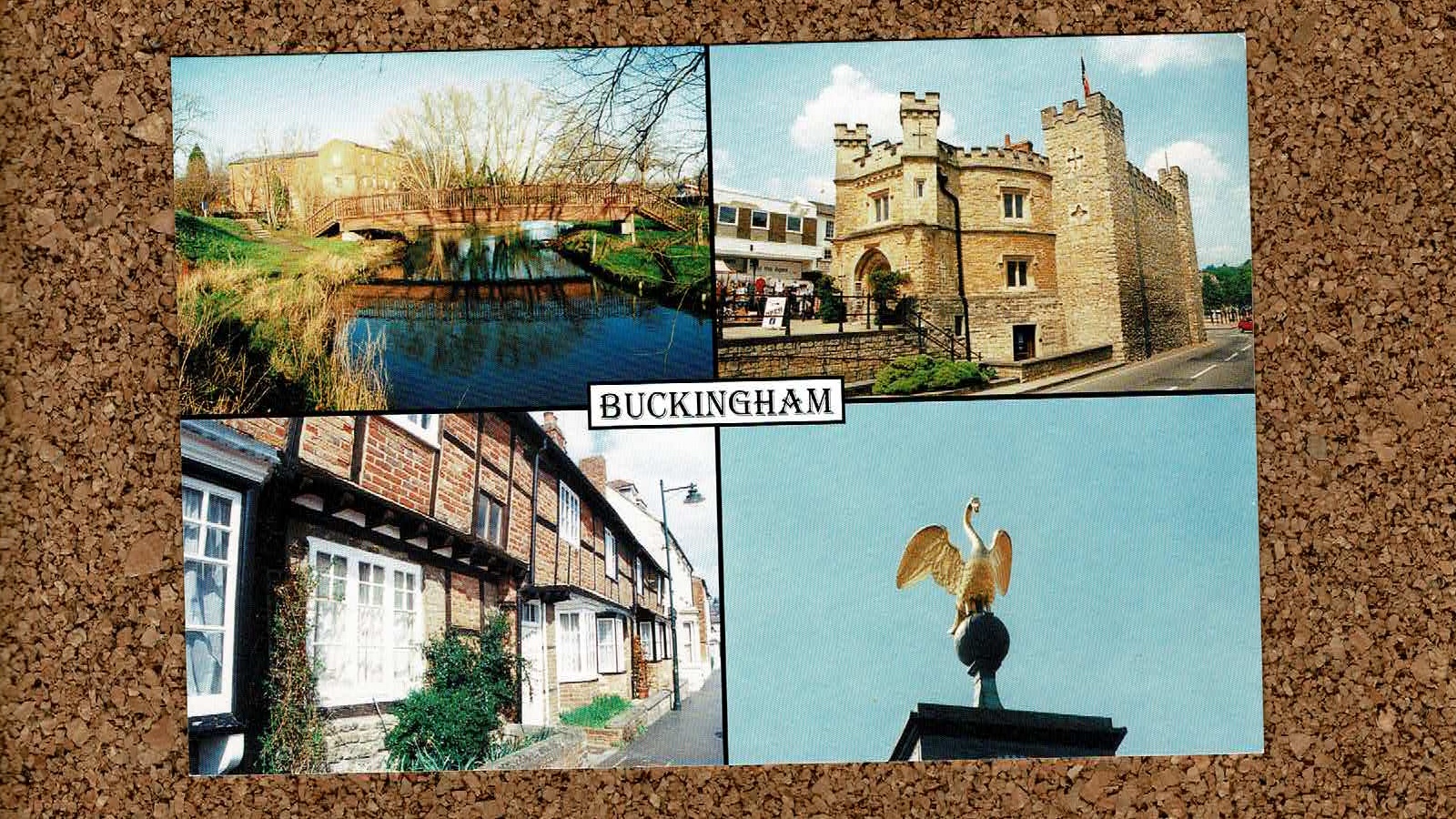
    The postcard itself is not only of the university, although one of its building is shown top left, by the Great Ouse. The others are Buckingham scenes: the old gaol, the High Street, and the golden swan atop the old Town Hall.

    Here’s a jigsaw of today’s card. Thanks to Harriet Dunbar-Morris, Pro Vice-Chancellor Academic and Provost of the university, and an old pal from 1994 Group days – for suggesting Buckingham. As always, if you have a request, please let me know. If I don’t have a postcard, I might enjoy tracking one down!

    Source link

  • Higher education postcard: University of Cambridge, the Senate House

    Higher education postcard: University of Cambridge, the Senate House

    Greetings from Cambridge!

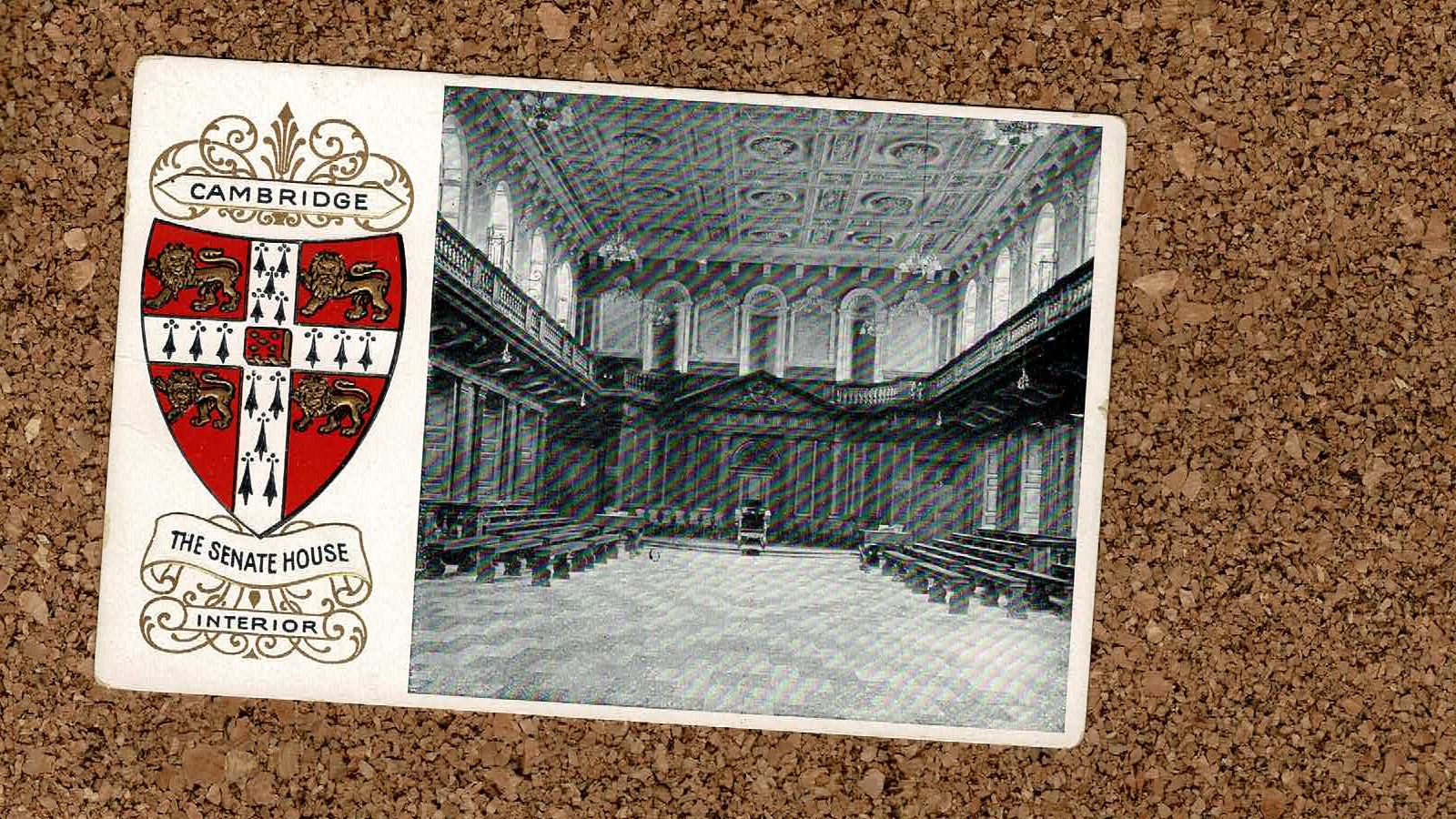
    Today’s card shows the Senate House at the University of Cambridge. Building started in 1722, the Senate House opened in 1730, and it was completed in 1768 (yes, that is the right order of events). It was designed by the Jameses Gibbs and Burroughs (the latter being master of Gonville and Caius); woodwork by James Essex the Elder; and ceiling plaster by Artari and Bagutti.

    As the name suggests, it was built as a meeting place for the university’s senate. And until 1926, the senate was a very big deal at Cambridge, being the governing body, in charge of everything. And since its members comprised everybody who held a Cambridge MA, it was a quite a thing to get a decision made. (I’ve blogged previously on the Microcosmographia academica, which is concerned with the politics of getting things agreed within the University of Cambridge senate).

    In 1926 things took a turn for the senate – its governance functions were given to the Regent House. Senate is now mostly responsible for electing the university’s chancellor and for electing the High Steward, who oversees senate procedure.

    There’s currently an election on for the University of Cambridge chancellor, which is all very exciting. For certain values of exciting. There’s ten candidates, including a big ticket HE name (Lord John Browne, he of the Browne review); big political names (former MP and cabinet minister Lord Chris Smith; Brexit campaigner Gina Miller); and the ubiquitous Sandi Toksvig. Voting takes place in person at the Senate House for two days in July; or online for about a week in July.

    When it’s not being used for cancellarial (it’s a real word, honest) elections – which is most of the time, in fact – Senate House is also used for graduation ceremonies at Cambridge. I’ve written before about one aspect of these; safe to say that there’s lots of other local peculiarities. At Cambridge, for example, each graduation is a separate decision of the governing body, so a special meeting of the Regent House (and before then, of the senate) is held for each ceremony. I suspect this may be where be get the notion of the degree congregation, which language I’ve heard used at other universities.

    There’s also an order of precedence for the colleges at graduation, established in the Statues and Ordinances. It is: King’s College, Trinity College, St John’s College, Peterhouse, Clare College, Pembroke College, Gonville and Caius College, Trinity Hall, Corpus Christi College, Queens’ College, St Catharine’s College, Jesus College, Christ’s College, Magdalene College, Emmanuel College, Sidney Sussex College, Downing College, Girton College, Newnham College, Selwyn College, Fitzwilliam College, Churchill College, Murray Edwards College, Darwin College, Wolfson College, Clare Hall, Robinson College, Lucy Cavendish College, St Edmund’s College, Hughes Hall, and Homerton College. And this isn’t strictly the order in which the colleges were established or admitted as colleges. If anyone knows why, please let me know!

    Senate House has seen its share of high jinks. Most notable, perhaps, is the 1958 incident where students contrived to place an Austin Seven on its roof. Here’s the Liverpool Daily Post, reporting with an admirable straight face on plans for its retrieval.

    Eagle eyed readers may remember that this stunt was followed by a similar, suspending an Austin from the Bridge of Sighs.

    Here, as always, is a jigsaw of the card – hope you enjoy it.

    Source link

  • Higher education postcard: University of the Balearic Islands

    Higher education postcard: University of the Balearic Islands

    Oh this year we’re off to sunny Spain! (If you’re old enough, you’ll know.) But we’re not taking the Costa Brava plane, instead we’re off to Mallorca.

    In 1483 King Ferdinand of Aragon (yes, that one; half of the double-act Ferdinand and Isabella) authorised the establishment of the Estudi General Lul-Lià in Palma, on the island of Mallorca. This was a college named in honour of Ramon Llull.

    Ramon Llull, philosopher and theologian, who lived from 1232 to 1316, and was a native Mallorcan. The entry for him in the Stanford Encyclopaedia of Philosophy – it’s linked at the start of this paragraph – merits a read. Even if you don’t grasp the philosophical bits, the history and biography is quite something. I like him for three reasons. First, he was a unifier: trying to bring together philosophy, theology and mysticism into one body of knowledge and practice. Second, he wrote in languages that people could read: he was the first philosopher, for example, to write in vernacular Catalan. And finally, he believed that it would be possible to convert people to Christianity from Islam and Judaism by means of rational argument. As they say in the south of the USA, bless his heart.

    Anyway, back to the main strand. The college acquired its first owned premises in 1561, and by 1673 it was granted a Papal Bull by Pope Clement X, recognising it as the Royal and Pontifical Literary University of Mallorca. It drafted statutes in 1692 which were approved by King Carlos II of Spain in 1697: the Pontifical, Royal, and Lulian Literary University of Majorca was on the map!

    The university moved hither and thither in Palma over the next couple of centuries until, in 1835, it was disestablished. I can’t give chapter and verse as to why this was, but as at that time Spain was engulfed in a monumental civil war, contesting the succession to the throne and the nature of the monarchy (absolute or constitutional), I suspect it had to do with notions of bringing the former Aragon (which included the Balearic islands) back into line. But, this may be absolutely wrong – and if anyone who knows Spanish history can tell the story here, that would be great!

    And so from 1835 students in the Balearic Islands had to go to mainland Spain to undertake higher study: there was no university.

    Until in 1949 the University of Barcelona established what we would now call a branch campus in Mallorca, offering programmes in philosophy and philology at a reconstituted Estudi General Lul-Lià. In 1972 two further faculties were added: sciences, sponsored by the Autonomous University of Barcelona, and arts, sponsored by the University of Barcelona. A faculty of law was subsequently added and, in 1978, the branch campus became the University of Palma.

    The university continued to expand, with campuses on Ibiza and Menorca, and in 1985 it became the University of the Balearic Islands.

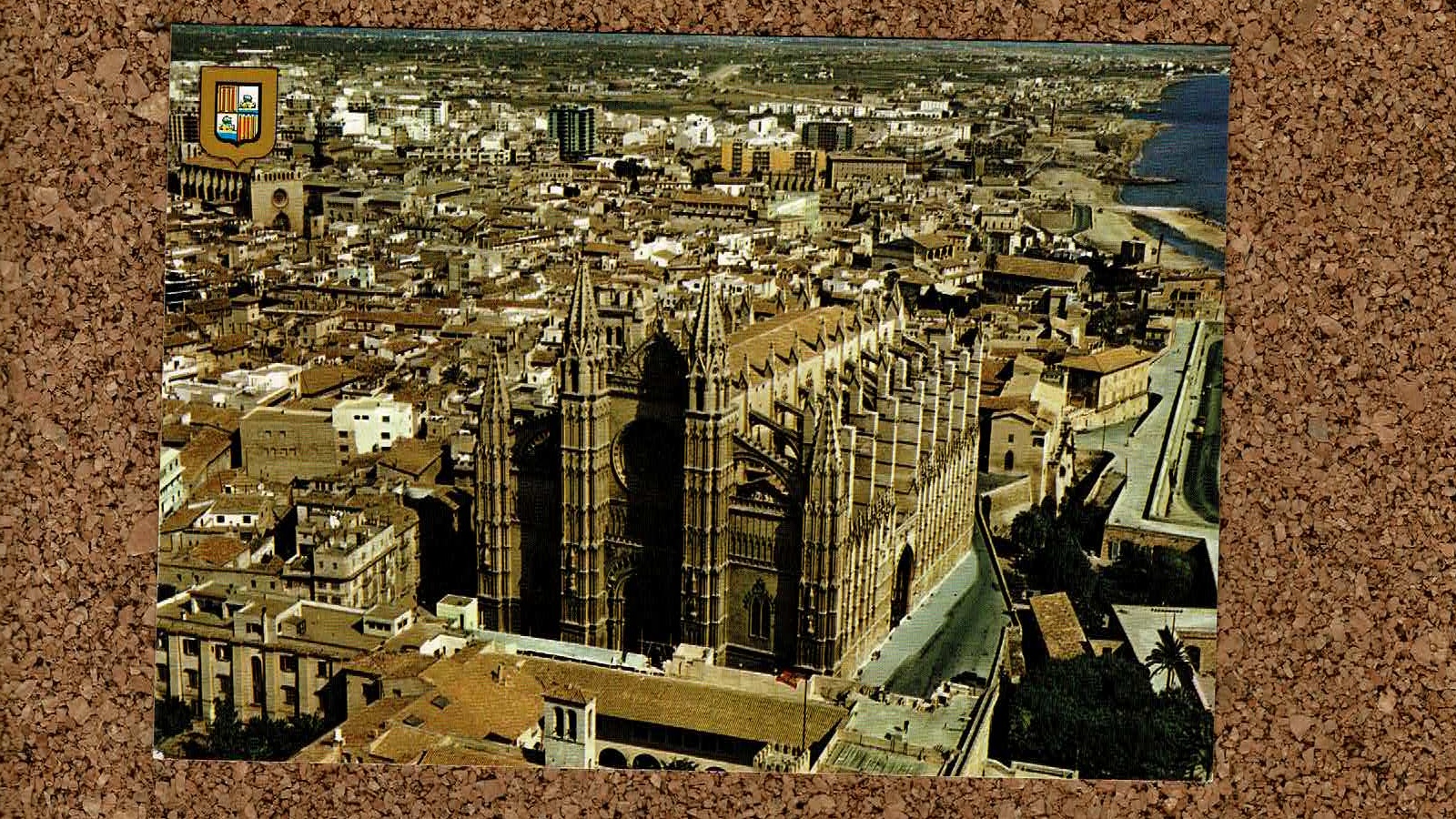
    Here’s a jigsaw of the card – it’s a tough one this week. The card itself shows, in the main, the rather splendid basilica of Santa María de Mallorca. But if you look about halfway up the left had side of the card, there’s a white building just to the left of the left-most of the cathedral’s four towers. And just behind that you can see roofs, one of which is the roof of the Estudi General, which is now a cultural centre.

    This week’s card was requested by, and is in honour of, Susannah Marsden, who is a big fan of Mallorca. As always, if there’s a university you’d like me to feature, let me know in the comments!

    Source link

  • Higher education postcard: University of Greater Manchester

    Higher education postcard: University of Greater Manchester

    Greetings from Bolton. Definitely Bolton.

    In 1824, a mechanics’ institute was established in Bolton. Mechanics’ institutes were a new phenomenon – the first was established in Scotland in 1821. They were, in essence, a subscription-based club which provided an opportunity for education, aimed at the better-off members of the working class.

    As the 1857 advert in the Bolton Chronicle shows, it was still going fifty years later.

    You can see the 1857 subscription fees in the advertisement. It’s hard to directly read across into today’s prices, because costs and wage structures change so much over the years. On a straightforward inflation calculation, using the Bank of England calculator, the annual fee would be about £50 today, which is a bit of a bargain. But comparing wages makes this feel different – for example, an average agricultural wage in 1857 was just shy of 11 shillings a week, so the subscription would be a quarter of a week’s wages. (And note also that the annual fee of ten shillings was just the quarterly fee multiplied by four. No discounts here for upfront payment.)

    The curriculum looks good, but elementary: school rather than higher education. And this makes sense – many people would have had minimal schooling. Only about 70 per cent of the population could read and write. And so a good basic education didn’t hurt.

    By the late 1880s there was a groundswell of opinion that Bolton needed better. As reported in the Bolton Evening News of 1 December 1886, the new chairman of the Mechanics’ Institute, Mr John Haywood MA, argued that:

    In Manchester, they are content with one well-equipped technical school; whereas in Bolton we must, forsooth, have three struggling institutions, with the result, as far as the Mechanics’ is concerned, that the progress made is in the direction of increased debt.

    The newspaper continued: “Mr Haywood thinks that Bolton has gone mad on sectarian and political distinctions when its young men cannot even sit on the same form to receive technical education.”

    And so in 1887 the committee of the Mechanics’ Institute agreed to establish a technical school. A committee was established, which raised funds, but found itself short; and an appeal was made to the county council. And in 1891 the Bolton Technical School opened.

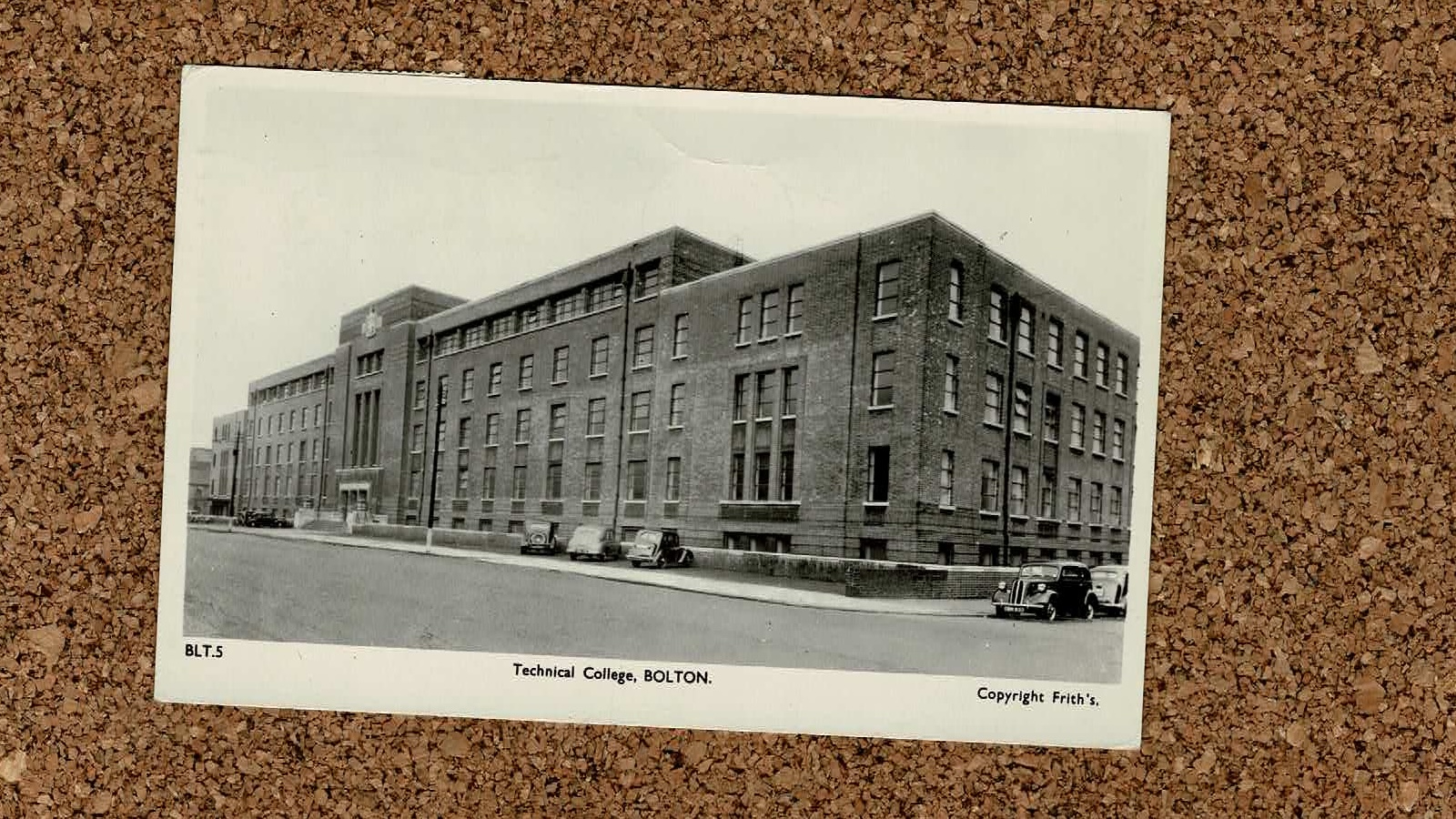
    In 1926 Bolton Technical School became Bolton Technical College, and in 1941 a new building opened – that shown on the card – which enabled a broader range of courses to be offered. Engineering was, apparently, the most popular.

    In 1964 the college bifurcated, splitting the lower and higher level education. Bolton Technical College focused on FE, and the Bolton Institute of Technology focused on higher studies.

    A brief aside is now necessary, to introduce another institution, the Bolton Training College. This focused on training teachers for technical subjects and was one of three in the country doing this (the others being in Huddersfield and at Garnett College, in London). I’m afraid I can’t tell you when it was founded, but it is clear that there was a threat to close it in the 1950s, happily averted.

    And in 1982 the Bolton Institute of Technology merged with the Bolton Training College to form the Bolton Institute of Higher Education. This gained taught degree awarding powers in 1992, research degree awarding powers in 1996 and became a university in 2004.

    In December 2024 the university changed its name, becoming the University of Greater Manchester. And in what is becoming a bit of a busy year for the university, in governance terms, it was placed under enhanced OfS monitoring in February and suspended its vice chancellor in May. Let’s see what June and July bring for the university.

    The postcard was sent in October 1961 to Miss Medley in Andover.

    Dear Janet, Today I am going through to Blackpool to see “West Side Story”. The week has flown by, and tomorrow I shall have to return to the quiet South from the lively North. Love Jillian

    And here’s the customary jigsaw – hope you enjoy it. Comment below if you can identify the cars.

    Source link

  • Higher education postcard: Hughes Hall, Cambridge

    Higher education postcard: Hughes Hall, Cambridge

    Greetings from Cambridge – and unlike last week, this time we’re definitely in England.

    It is 1878, and the Cambridge Independent Press of 7 December reports that the university has taken steps to enable the training of teachers. The Teachers’ Training Syndicate (its Cambridge-ese for a committee or working group, I think) is to be established, to oversee programmes of training for students intending to become school teachers, and the colleges at which they train.

    Image: Shutterstock

    All of this took place in the context of increased state engagement with school education: the provision of schools for all children was becoming increasingly necessary, and local authorities of various kinds (it’s complicated!) were empowered to fund such schools.

    And it stands to reason that where you have schools, you need teachers. And by then the practice of teaching was becoming increasingly professionalised. Plus, it was one of the few professions open to women.

    And so in 1885 the Cambridge Training College for Women was opened. Initially based at Newnham College, there were fourteen students, under the guidance of the college’s first principal, Elizabeth Phillips Hughes. Hughes was the first woman to gain first class honours in moral sciences at Cambridge, having studied at Newnham. (She also helped to found the Barry Teachers Training College, which ultimately became part of the University of South Wales, and helped to draft the statutes of the University of Wales). She remained principal of the new college until 1899, steering it from its modest start to a new building – that shown on the card – in 1895.

    The driving forces behind the establishment of the college included Miss Frances Buss, champion of girls’ education, and one of the subjects of an anonymous verse of some fame:

    Miss Buss and Miss Beale

    Cupid’s darts do not feel.

    How different from us

    Miss Beale and Miss Buss.

    Miss Beale was Dorothea Beale, suffragist, headmistress of Cheltenham Ladies’ College and one of the founders of St Hilda’s College, Oxford. And it seems that the pioneers of women’s education had a lot to put up with.

    At this point Hughes Hall was not a college. (It wasn’t even Hughes Hall yet!) It was only after the university recognised women as full members (in 1947, less than a lifetime ago) that the college gained recognition as part of the university (albeit not yet a college) and was renamed Hughes Hall. This was in honour of Elizabeth Phillips Hughes, the first principal; its full name at that time was Elizabeth Phillips Hughes Hall.

    It began to admit male students in 1973: the first of Cambridge’s all-women institutions to do so. In 1985 Hughes Hall became an “approved foundation” of the university (it’s the step below being a full college) and in 2006 Hughes Hall became a college of the university, with a charter and everything. And a full name – for Sunday best or when it has been naughty – of The President and Fellows of Hughes Hall in the University of Cambridge.

    Hughes Hall admits only mature students (judged by age not attitude), to both undergraduate and postgraduate degrees. It still teaches education, both as an academic subject and as a PGCE, as well as programmes across other disciplines.

    This post owes its origins to the eagle-eyed Professor Chris Brooke of Homerton, Cambridge, who corrected me about wat was shown on the card. I’d shared the card as one of my daily posts on Bluesky thinking it was Homerton. But it definitely isn’t!

    Here’s a jigsaw of the card – hope you enjoy it.

    Backstory

    A couple of you have asked about the #HigherEducationPostcard backstory.

    It started about ten years ago when I was in a Cardiff antiques mall, sheltering from the rain. One of the stalls had books and old postcards, and when browsing the latter I found half a dozen showing universities. Which I thought was quite cute. So I bought them.

    Fast forward to 2020 and the pandemic. The first few months were scary for lots of reasons, and if you were self-employed in the HE sector the question of how to do consulting without being on site was very much front and centre. And whilst sitting at my desk trying to solve this puzzle I noticed the small stack of postcards, and thought I’d share them on Twitter. They were really popular, so I thought I could carry on doing this. But where to get postcards? eBay, mostly. And so I started bidding. And then the collection sort of growed. Its at about 1200 cards now, in fifteen albums with a stack of a couple of hundred still to be scanned and filed.

    In the summer of 2020 I ran a #HigherEducationPostcard world cup on Twitter – 32 cards, paired off, the one with most votes went through to the next round. In the final, Swansea University beat van Mildert College, Durham; thousands of votes were cast, each institution getting its students, staff and alumni to join in. It was great fun!

    I’d been posting daily on Twitter, and when in summer 2021 Paul Greatrix retired from weekly Registrarism blogposts on Wonkhe, I suggested that I write a weekly higher education postcard blog. The good folk at Wonkhe towers said yes, and here we are, 170 posts later. My only rule is that I have to own the actual postcard; and I try to make them interesting and informative. And mostly true. I really enjoy writing and sharing them, and have no plans to stop just yet. I hope you like them too. Thanks for reading!

    Source link

  • Higher education postcard: Harvard University

    Higher education postcard: Harvard University

    Greetings from Cambridge! No, not that one.

    This is Cambridge, Massachusetts, home of Harvard University. Harvard is one of the world’s great universities; it’s the oldest university in the United States of America; and it is currently the target of attempted coercion by the executive of the USA. There’s quite a story to tell!

    April showers bring May flowers

    In the 1630s, the northeast of what would become the USA was a series of colonies from Britain: parties of settlers had landed, established small towns, fought and traded with the people who were already there (this was no terra incognita), and either died out or survived. The colonies were not independent states: they were British, and ultimately ruled from Britain. But local government was needed, and in the case of the Massachusetts Bay colony this was via the charter obtained by the Massachusetts Bay Company.

    The General Court of Massachusetts was the local government, and in 1636 it allocated £400 to establish a college to be located in Newetowne. In 1638, Newetowne was renamed Cambridge; this was coincident with a bequest by John Harvard, a graduate of the University of Cambridge in England, who left the college half of his estate, and his library of 400 books.

    John Harvard was born in Southwark in 1607; he studied at Emmanuel College, Cambridge and gained a BA in 1632, and an MA in 1635. He moved to the Massachusetts colony in 1637 and was a puritan preacher, he died in 1638. The value of his estate was £1700, worth about 300,000 today. And the college got half of that. Not a huge amount, but enough to get the college going; and it was named for him in commemoration.

    Here’s two fun facts: the statue of Harvard at Harvard says on its plinth that he was the founder. Not true. Also, it isn’t an image of Harvard, but of an 1884 student who was descended from an early president of the university.

    The first students graduated in 1642. In 1650 the college was granted a charter – issued by the General Court, not the British monarch, for by 1650 Britain was temporarily a commonwealth not a monarchy. The charter created the Harvard Corporation, being the president and the fellows of Harvard College; and it is this corporation which continues to this day.

    Harvard College continued to grow and develop, as successful colleges do. Its curriculum was modelled on the Cambridge liberal arts approach; its theology was Puritan. It enrolled a native American student, John Sassemon, in 1653. When serving as interpreter to Metacom, the Wampanoag chief in 1675, he was murdered as an English informant, sparking the worst of the many wars between settlers and existing populations in New England.

    Independence day

    The late eighteenth century was momentous in America. Eight Harvard graduates (John Hancock, Samuel Adams, John Adams, Robert Treat Paine, Elbridge Gerry, William Ellery, William Williams, and William Hooper) signed the declaration of independence in 1776.

    In 1780, when Massachusetts as a state gained a constitution, it granted to Harvard the title of university. In 1781 a chapter of Phi Beta Kappa opened at Harvard – it is the oldest continually running chapter of the society. And in 1782 it opened a medical school – which, interestingly, the university’s own history regards as the start of it being a proper university.

    A side note on Phi Beta Kappa. This described itself as an academic honour society; such societies also might be known as fraternities. Frat houses cause no end of trouble on some American university campuses, as well as providing a location for some sometimes dubious comedy.

    You may recall in my blog on Purdue University that one of its presidents resigned having failed to ban fraternities from campus. There’s loads of them – the Wikipedia entry has too many for me to count – and there are accrediting bodies. I may have to find a postcard one day…

    Football crazy

    In the nineteenth century Harvard continued to grow, adding schools of divinity and law in the first couple of decades, a science school in the 1850s, a dental school in the 1860s, and a graduate school in 1872. In 1852 the first intercollegiate boat race – Harvard versus Yale – took place on Lake Winnipesaukee. And in 1875 the first intercollegiate football match (gridiron, not association, union or league) took place. Harvard won.

    Let’s at this point note Tom Lehrer, mathematician, satirist, Harvard alumnus and academic, who I regard as one of Harvard’s finest. An early song of his, Fight fiercely, Harvard, satirizes the football fight song. And the YouTube video linked above has some fabulous footage of Harvard v Yale games through the ages.

    Lehrer also wrote Bright College Days, a satire of college songs. Which includes the wonderful line, “ivy-covered professors, in ivy-covered halls”. A great Lehrer quote: “political satire became obsolete when Henry Kissinger was awarded the Nobel peace prize.” And finally, Lehrer in 2022 gave all his songs to the public, making them available without copyright on a website: well done, sir.

    Establishment

    Harvard was by now a firm fixture in the US establishment. Eight US Presidents have been educated at Harvard (as was the most recent Canadian Prime Minister, Mark Carney). In 1886, at its 250th anniversary celebrations, President Grover Cleveland, not an alumnus, was in attendance.

    In 1908 the Harvard Business School opened, the first in the country restricting its intake to graduates. More schools were established; the Harvard University Press opened in 1913; the first Harvard Nobel laureate was crowned in 1914 (Theodore Richards, for determination of atomic weights).

    In 1947 General George C Marshall (pictured, when he himself was a student at the Virginia equivalent of Colonel Oates’ miliary academy), then Secretary of State, received an honorary degree. He used his speech to announce the Marshall Plan, via which the US supported the rebuilding of post-war Europe. To be fair this knocks most graduation speeches I have heard into a cocked hat.

    Opening the door a little wider…

    It would be fair to characterise Harvard as not having been, historically, at the forefront of change. One example is women’s education.

    Harvard was, like (I suspect but can’t demonstrate) nearly all universities previously, restricted to men only. In 1879 Arthur Gilman, a banker, and his wife Stella Scott Gilman, wished their daughter to have a university education. Harvard would not admit women, so they persuaded the president of Harvard to allow them to employ Harvard academics, part-time, to deliver courses to women in what became known as the Harvard Annex.

    They had hoped that Harvard might relax its stance and accept women to study for degrees, but the attitude of the university was summed up in 1869 by its President, Charles Eliot, who in his inaugural address said:

    The world knows next to nothing about the capacities of the female sex. Only after generations of civil freedom and social equality will it be possible to obtain the data necessary for an adequate discussion of woman’s natural tendencies, tastes, and capabilities…It is not the business of the University to decide this mooted point.

    And this in 1888 from Eliot to a potential new faculty member:

    There is no obligation to teach at The Annex. Those professors who on general grounds take an interest in the education of women…feel some obligation but there are many professors who think it their duty NOT to teach there, in which opinion some of the Corporation and Overseers agree.

    Nevertheless, the Harvard Annex thrived, with increasing numbers of women wishing to study there. In 1894 a compromise was reached: the annex became a degree-awarding college – Radcliffe College – with Harvard staff teaching and guaranteeing standards.

    In the 1930s a subsequent Harvard President – Lawrence Lowell – felt that Radcliffe was a distraction to Harvard’s academics, and a limit was placed on the number of students who could be admitted to Radcliffe: 750 undergraduates in total, 250 graduate students. These limits stayed in place until 1979, when Radcliffe was incorporated into Harvard, which finally became co-educational.

    It wasn’t only women with which Harvard, historically, had a problem. In the 1923, Lowell had sought to put a cap on the proportion of Jewish students at Harvard. He was unsuccessful. Harvard presidents don’t always get what they want.

    Lowell also enforced racial segregation where he could. In 1921 he refused to allow black students to reside in the university’s dormitories. Writing to the father of one such student, he said:

    We owe to the colored man the same opportunities for education that we do to the white man, but we do not owe to him to force him and the white into social relations that are not, or may not be, mutually congenial.

    Do the right thing

    Faced with examples like these, you might be forgiven for thinking Harvard would always behave badly where it could. But they are currently taking a stand for academic autonomy.

    Threatened with withdrawal of funding and tax exempt status, the university has refused to accede to the US government’s demands which are, frankly, a full-on assault on academic autonomy. Here’s the letter of 11 April sent to the university; here’s the university’s response.

    It is worth taking a minute to read the demands made of Harvard. They relate to student discipline; the appointment and employment of faculty; the content of programmes; the admission of students. The US government cavilled that the letter was sent in error (and if you believe that I’d like to talk to you about a bridge I have for sale) but its my view that where a country’s government threatens universities, that country is in trouble.

    Harvard has an endowment of over $50 billion, so it has the financial resources to cushion the significant blow. But it didn’t have to resist, and we should all be glad that it is doing so.

    Missed opportunities

    With such a big university, such a famous university and such an old university, there’s a stack of things which I haven’t been able to write about. Another time, maybe.

    For now, here’s a jigsaw of the card, which was sent in November 1907 to Miss Adeline Tower at Rutgers Prep School, New Jersey. The message on the front – to save you straining you eyes – reads:

    Dear Ade: how are you? Eliza came home alright. I missed her very much. Hope to see you Xmas. Love Grandma

    Source link