Tag: postcard

  • Higher education postcard: University of Al Quaraouiyine

    Higher education postcard: University of Al Quaraouiyine

    Greetings from Morocco!

    I’ve covered some of the UK’s ancient universities – Oxford, Cambridge, St Andrews, Glasgow, Aberdeen, and Edinburgh – in this blog. And if I tell you that the University of Al-Qaraouyine used to be known as the University of Fez, you might know that we’re going to look at somewhere that makes these universities look like the new kids on the block.

    We need to start in the year 859, using the common era calendar. In Britain, there were many small kingdoms. The great Viking invasion hadn’t yet happened. Æthelbald was King of Wessex (you might have heard of his brother Alfred, the Great). Rhodri Mawr was asserting kingship over something approximating to modern Wales. The unified Kingdom of Alba in Scotland hadn’t yet happened. It was a long time ago.

    In continental Europe the Byzantine empire still had hundreds of years to go. The empire formed by Charlemagne was already in the process of breaking up; France was just beginning to emerge as a single political entity. There were emerging states in Serbia and Hungary. There was not yet a Russia, although the Kievan Rus’ were around and about.

    Further south, across the Mediterranean, there was less flux. In Baghdad and Cairo there were caliphates; there was an emirate in Cordoba; and in Fez the Idrisid dynasty had ruled for almost 100 years. And in Fez, or so the story goes, a woman named Fatima al-Fihriya founded the al-Qarawiyyin Mosque. She was daughter of a merchant, and inherited money, which she used to establish the mosque. And her sister Mariam similarly used her share of the inheritance to establish another mosque in Fez.

    It is obviously hard to know the truth from a distance of over eleven centuries, but historians have disputed this foundation story. Some say that the mosque was founded by the son of Idris II, the then ruler. But in any event, it was founded. At that time mosques tended to be centres for teaching and other civic roles, as well as their religious function, and it seems that this was true for the al-Qarawiyyin Mosque. Certainly in the early 900s it became the Friday mosque for Fez – the main one in the city.

    Now hang on a moment, I hear you say, this is meant to be higher education postcard, not religious building postcard. To which I’d reply, remember that in many cultures, education and religion have at times gone hand-in-hand. Christ Church Oxford, which I wrote about last year, is both college and cathedral. And when Galileo was prosecuted by the Catholic Church, part of the case was made by the church’s own astronomers, who were proper scientists.

    In the same spirit, bear with me on the al-Qarawiyyin Mosque. For it became much more learned. No doubt with the patronage of Fez’s richer residents, some scholars believe that it gained status as a teaching institution from the 1040’s onwards. And certainly in the twelfth and thirteenth centuries it was offering a wide curriculum, similar to that at Oxford and Cambridge: as well as theology and jurisprudence, students studies grammar, rhetoric, logic, mathematics, medicine, astronomy and geography. Indeed, in 1207 the university (as it was now known) awarded the earliest known doctor of medicine degree to Abdellah BenSaleh Al Koutami. Other sources suggest that Pope Sylvester II (before he was Pope) studied at the university, although, to be fair, specific evidence for this has not been found.

    The university then went into decline – as has happened elsewhere – with a narrower curriculum, perhaps aligned to an increasingly conservative approach to religion. Fez had become less important over the centuries, and perhaps this lack of access to power and cultural significance contributed to the decline.

    As the nineteenth century turned to the twentieth century, the political landscape was changing. European powers were increasingly flexing their muscles, fuelled by colonial ambitions and notions of racial superiority. Morocco went to war with France in 1844 and Spain in 1859, coming out worse both times. Increasing European influence further weakened the Moroccan state, and in 1912, after some gunboat diplomacy, Morocco became a French protectorate, via the Treaty of Fez.

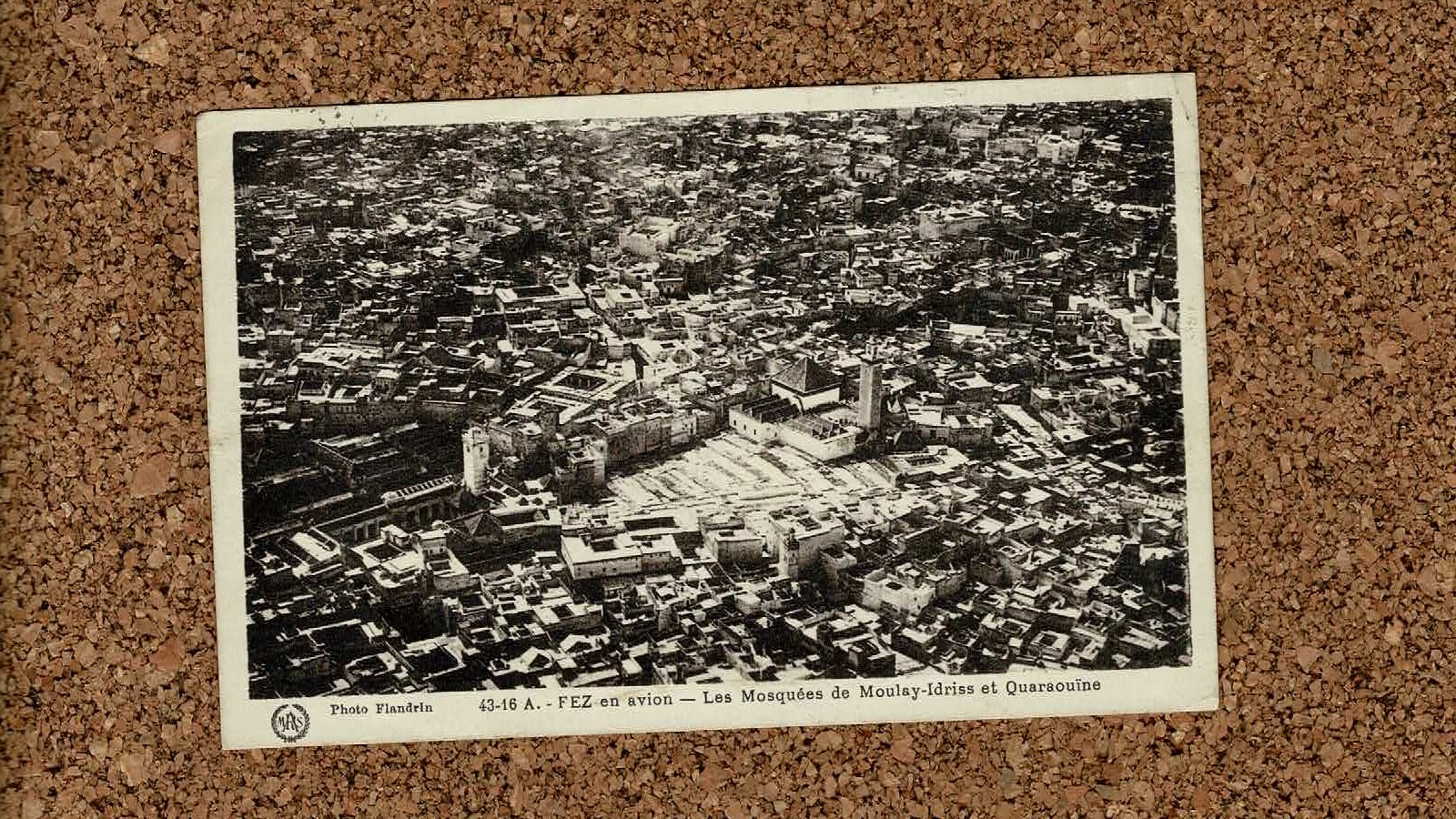
    The postcard dates from this time: my French isn’t up to scratch, but I think it is saying that the image was taken by one of the French air force units stationed in Fez in 1927. The picture on the front of the postcard shows two mosques. The Al Quaraouiyine university is the building to the right centre, with the tall stone minaret and the white-walled buildings with steep roofs. The presence of the French military reminds us that the French occupation was by force: it was only in 1926 that the first armed resistance to French rule was ended.

    In 1947 Al Quaraouiyine university was integrated into the state education system, and women were admitted as students. By 1956 Morocco had gained independence from France, and in 1963 Al Quaraouiyine officially became a university, by royal decree. Classes moved from the mosque to an old barracks; faculties were established. It became officially the University of Al Quaraouiyine in 1965.

    But history moves in fits and starts, not in a straight line. In the 1970s secular subjects were moved to another university; Al Qaraoiyine was to focus on theological disciplines; and in 1988 traditional Islamic teaching was resumed at the university. And then the pendulum swung again – in 2015 the university was re-founded. The words of the university president are worth quoting in full:

    His Majesty King Mohammed VI May God Assist Him, keen on conferring to Al Qaraouyine University its intellectual and social influence anew, and given the historical role it played in teaching and training scientists, scholars, lecturers and orators for nearly twelve centuries and in order for Al Qaraouyine University to regain its scientific clout as referenced in specialized, distinguished and judicious training in legal sciences, Islamic studies, comparative jurisprudence and Maliki heritage, and in order to develop scientific research and its methods in such fields Royal Dahir (Decree) no 1.15.71 dated on Ramadan 7th, 1436 corresponding to June 24th 2015, was issued, stipulating the reorganization of Al Qaraouyine University as a public higher education and scientific research institution, with a legal body, financial, educational and scientific autonomy.

    Such a new regulation aims at enabling Al Qaraouyine University and its affiliated institutions to optimally and efficiently carry out its mission. Such will be performed through improving the content of programs at all levels of training cycles on one hand, and enhancing the supervision at all affiliated institutions or the ones under its educational supervision on the other hand

    Generating and passing on knowledge requires building and highlighting the qualifications, revealing and confirming the skills to ease the educational process in Qoran, Hadith, Figh studies and legal sciences, besides the religious supervision.

    Whereas Al Qaraouyine University wishes to train researchers, specialized scholars, Imams, male and female qualified guides, by means of methods and knowledge that enable them to perform their tasks as best as possible, such training requires being aware of the key contemporary issues. This implies teaching foreign living languages and impregnating with a dialog culture and a break-off with preconceived ideas and slavish imitation. In this regard, it is now necessary that Al Qaraouyine University students know about open and illuminated Islamic thought issues, imbued with the dialog culture, so they would be become more open and prone to exchange and coexistence using all granted communication tools.

    Such openness will undoubtedly make Al Qaraouyine graduates strongly quipped in the face of the future, with solid science and efficient culture, while greatly combining the heritage drawn from religious principles and national values, Moroccan identity resources, good knowledge of Morocco’s history, and the contemporary life that allows them to manifest modernity free from intellectual alienation. Ultimately, this will help improve the image of Islam and Muslims in countless fields, so that the glorious past of Al Qaraouyine University will serve its present, bestowing it with the position it well deserves and shining its light in the near future with its usual influence in the Arab, African and Islamic world, and worldwide.

    I like a university seeking to regain its “scientific clout”; and you can see in “this implies teaching foreign living languages and impregnating with a dialog culture and a break-off with preconceived ideas and slavish imitation” a defence of university values. It’s worth remembering that all universities exist within a society’s culture, and that if a university is worth having it will be pushing the boundaries of that culture. That’s what I see here.

    So that’s the University of Fez, or as it is more properly known, the University of Al Quaraouiyine. It’s a UNESCO world heritage site as well as being a modern university. And here’s a jigsaw of the card to keep you occupied.

    Source link

  • Higher education postcard: Christ Church, Oxford

    Higher education postcard: Christ Church, Oxford

    We’re well into advent, so it seems apposite to look at Christmas and, in the context of higher education postcards, a college named after its eponymous protagonist.

    We’ll start in 1002, which is well before there was a university at Oxford, let alone a college. King Æethelred had ordered a massacre of Danes within his kingdom, which took place on 13 November, St Brice’s day. Amidst the massacring, St Frideswide’s nunnery was destroyed (with, presumably, woeful consequences for the nuns). As a result of the massacre of the Danes – which Æethelred had apparently been advised would be an effective pre-emptive strike – the Danes, led by Sweyn Forkbeard, went on a bit of a rampage. This, by the way, was why Æethelred was the unrede – not “unready” but “badly advised”.

    Anyway, back to the main story. Æethelred had St Frideswide rebuilt as a priory, and under Henry I this became an Augustinian foundation. Which rubbed along with the people of Oxford until in 1524 it was suppressed, by Cardinal Wolsey. He used the proceeds from the suppression of other priories, including Wallingford Priory, to repurpose the priory’s buildings and establish Cardinal College.

    Which you may never have heard of, at least until now. And that’s because Wolsey had a spectacular fall from grace. Having failed to secure a divorce for psychopathic king Henry VIII, he was cast from the inner court. In 1530, ill with dysentery, he died in Nottingham as he was returning to London to face trial for treason.

    Now Henry was not the sort of king to let bygones be bygones. He suppressed Cardinal College in 1531, and the following year re-founded it. As King Henry VIII’s College. He wasn’t a modest man.

    And in 1546 he was a much richer man. Using the Protestant reformation as cover for personal aggrandisement, he broke from Rome, founded the Church of England with himself as its head (like I said, he wasn’t a modest man), and moved from dissolving priories to dissolving monasteries – far richer pickings. This enabled him to re-found King Henry VIII’s College as Christ Church College, and simultaneously made the priory church into the cathedral of the Church of England diocese of Oxford. The college’s full formal name reflects all of this: the Dean and Chapter of the Cathedral Church of Christ in Oxford of the Foundation of King Henry the Eighth.

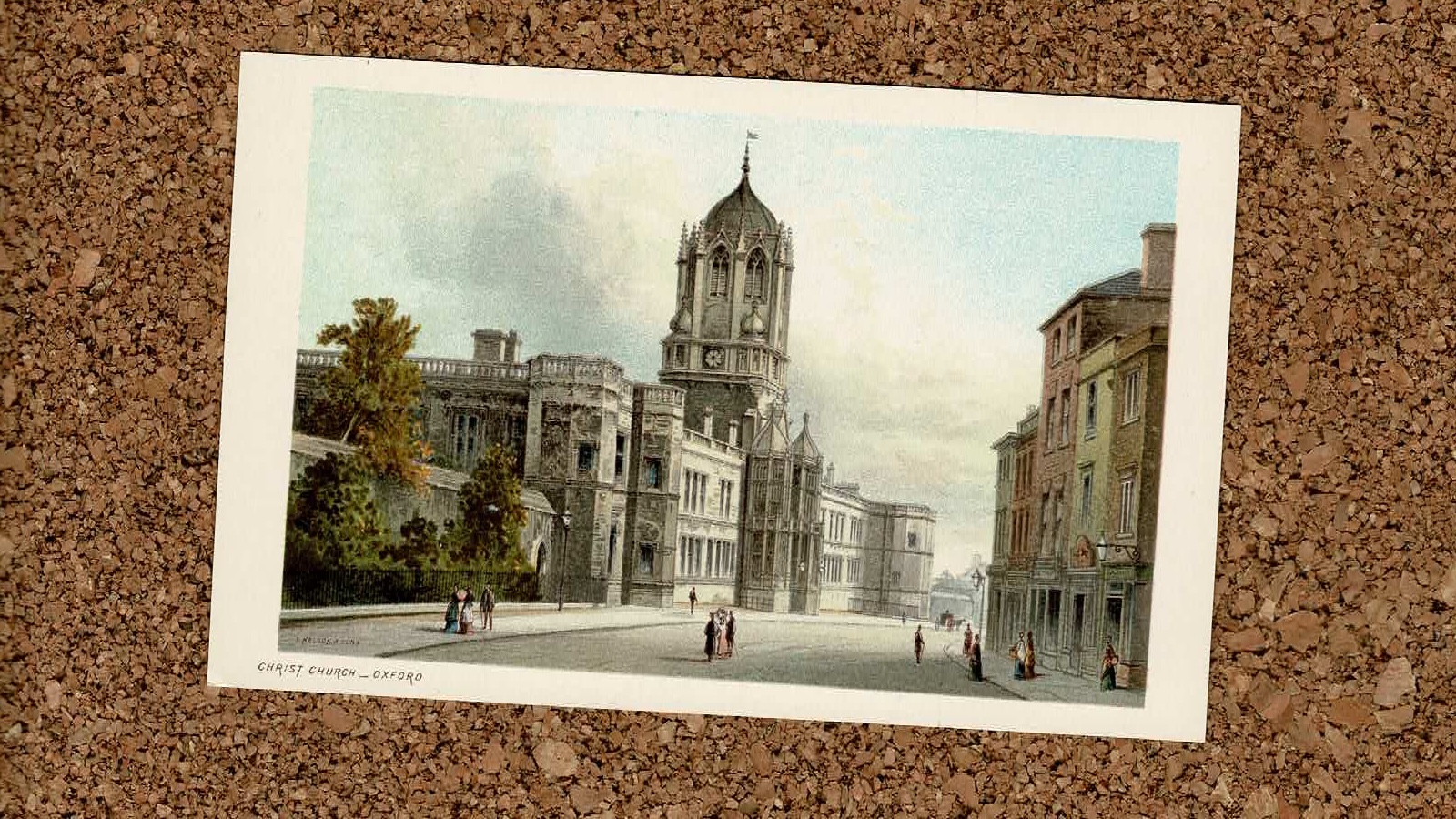
    The buildings started by Wolsey were completed, and added to. Christoper Wren designed the Tom Tower, the one on the card. This holds the Great Tom bell, which is rung 101 times every night at 9pm Oxford time (yes, of course it has its own time zone), or about five minutes past 9pm Greenwich Mean Time.

    Let’s fast forward to 1642. Supporters of Parliament were at war with supporters of the king; armies had been raised. A pitched battle had been fought at Edgehill; it was indecisive, enabling the king – Charles I, or Charles as he was known at the time – to continue his march on London. Realising London could not be taken by force, Charles retreated to Oxford, and made his base there. (In the meantime, parliamentarian forces had arrested the university’s vice chancellor, John Prideaux, an event which must, even today, give hope to people across higher education.)

    Charles set up shop in Christ Church. He used the deanery as his royal apartments, and the college’s great hall became the meeting place for the parliament. (Parliament had not been dissolved before the outbreak of the war. Charles summoned it to Oxford. Most of the Lords attended, and about a third of the Commons. It met from January to April 1644 and again from October 1644 to March 1645. What did it do? We don’t really know, as its records were burnt in 1646 before parliamentary forces retook the city.)

    Christ Church’s alumni include thirteen British Prime Ministers, although one of the them, William Pulteney, first Earl of Bath, held office for two (2) days only, and whether he actually ever was Prime Minister is now disputed by historians. The parliamentary history records that after his two-day prime ministership he “spent the rest of his life in retirement, consoling himself with the pleasures of avarice, to which he had always been notoriously, indeed scandalously, addicted.”

    Alumni also include many politicians of ministerial rank (for example, Nigel Lawson, David Willetts, Chris Skidmore); monarchs (including Edward VII, although he transferred to Trinity Cambridge); scientists (such as Robert Hooke, Martin Ryle); a whole gaggle of top-drawer philosophers (such as John Locke, Freddie Ayer, Daniel Dennett, John Rawls, and a personal favourite, Gilbert Ryle); literary figures including Lewis Carroll, W H Auden, and John Ruskin; and, perhaps best of all, both Flanders and Swann.

    There are a few additional points to cover before I wrap up this account.

    Firstly, an epic disagreement between the former dean of Christ Church and the college. This long statement by the college sets out one side of the issue.

    Secondly, what a wonderful set of buildings! They’ve inspired the buildings of the University of Galway, and have also, apparently, featured in the Harry Potter films, although as your correspondent has never seen any of these we have to take this on trust.

    And finally, Christ Church’s arms: these are Cardinal Wolsey’s arms; properly described they are Sable, on a cross engrailed argent, between four leopards’ faces azure a lion passant gules; on a chief or between two Cornish choughs proper a rose gules barbed vert and seeded or. And its always good to see a chough, whether from Cornwall or anywhere else.

    Here’s a jigsaw of the postcard, to give you a bit of festive diversion; and a bonus jigsaw of the college kitchen, which is a bit harder, should you need an excuse to spend more time secluded with your computer over the festive season.

    And that’s it for 2024’s higher education postcards. I’ll be back in January with more; in the meantime, a very merry Christmas to you all.

    Source link