Right now, tomorrow’s workforce is on TikTok and Instagram, looking at “influencer” or “crypto genius” as an exciting career option — not so different, really, from a previous generation wanting to be a pop star or win Shark Tank.
Like those old-school dream gigs, today’s hot online careers are mostly unattainable and unstable. For some young people, they’re also a capitulation: “My job feels like a dead end and business school isn’t in my future. Maybe people will watch me unbox purchases.”
The next generation, a huge reservoir of talent, is rarely challenged to set a higher bar — and they get a lot more advice about building a personal brand than about building a career. Those of us leading organizations owe it to them to demystify professions and create new pathways.
Here are three promising practices for the new workforce, especially for young people without traditional access: intensive mentoring, cross-organizational cohorts, and early experiences with professional environments.
Mentoring
The traditional approach to mentoring is the “old boy network.” Since the 1990s, more workers have also benefited from informal networks such as alumni associations or sometimes nonprofits that serve this purpose. However, young people may need more formal mentoring within the workplace to thrive and persist.
Many companies assign mentors to brand new employees, but not generally for the long term. The next generation needs ongoing mentoring. First-gen professionals, especially, can find it difficult to seek guidance. They may not want to appear vulnerable; they may not know what they don’t know. Online courses — valuable for a population that has grown up watching videos — can help. But there are a million; which ones are useful? And perhaps the new employee fears being caught trying to learn their job. To address such needs, they need more than a mentor. They need a navigator.
Beyond knowledge gaps, some young employees also need help with organizational culture. I know a recent college graduate in a start-up job where colleagues regularly drink at work. She felt she had to participate to be taken seriously. Some other, more senior colleagues who had opted out could have helped her find another way to engage. It’s on us to assist young coworkers struggling with fit.
These new members of the workforce also need encouragement to find ongoing mentoring and keep seeking engagement. For many of them, an elevator ride with the CEO would be a terrifying moment, rather than an opportunity. A lack of guidance leads to frustration, and ultimately nonpersistence.
Cohorts
It doesn’t always take a senior person to help a new employee navigate. Peer cohorts can also help. Most young workers are already comfortable traveling in packs socially. An ongoing professional conversation with their peers can benefit both them and the company, and shared responsibility for problem-solving can be liberating. Women in particular have a stereotypical but real inclination to be useful, and they are more apt to receive if they can also give. Cohorts offer a way to do that.
Even for midlevel employees, there is value in connecting across silos. I know one organization where colleagues from different departments meet monthly to catch up on their work. Individuals offer each other expertise, and departments pitch in together, which creates efficiencies.
Engaging like this especially helps employees who are more reticent. Helping as well as being helped creates social glue — and it can also build organizational loyalty, as employees see themselves in a bigger picture.
Early exposure
“Summer camp” experiences on college campuses are a common way to create access and persistence for first-generation students. When middle schoolers visit campuses, they can imagine college life. Similarly, Take Your Child to Work Day has, since the 1990s, offered glimpses of the working world—at least, for children of white-collar professionals.
But when parents work in a meatpacking plant, their children have no opportunity to get to know office culture. More and more next-gen workers lack a vision of how to belong in a corporate or institutional setting. Yet that is the most powerful element: the vision of oneself in a new context, and permission to be there.
To get the farm team ready and overcome the sense of “not for me,” employers must invite them in early. Google, for example, invites school groups to its campus. If these young people eventually land an interview, the campus already feels familiar.
If these promising practices seem self-evident to you, consider where you learned about your work environment. If the answer is “in college” or “from relatives,” you might ask: Who in my workforce did not get that experience? And if the answer is “I learned the hard way,” can you help someone else not to have to learn the hard way, too?
Did you use this article in your work?
We’d love to hear how The 74’s reporting is helping educators, researchers, and policymakers. Tell us how
In higher education, organic social media often serves as the front door of your institution’s brand. It’s the place where prospective and current students, parents, alumni, and donors first get a sense of your institution’s culture, values, and voice.
Standing out in today’s saturated social media feeds requires more than just frequent posting. It’s about understanding what makes social media “social” and using it to connect with your audience in engaging ways.
Below, we’ll explore best practices for higher education institutions looking to elevate their organic social media. With these tips, you can foster genuine engagement, all while infusing your brand’s unique personality in each post.
What is Organic Social Media?
Organic social media refers to the unpaid content your institution shares on platforms like Instagram, TikTok, Facebook, and LinkedIn. Rather than running targeted, paid campaigns with these posts, organic social media relies on building and maintaining relationships with users who follow your institution’s accounts or come across your posts via recommendations made by platform algorithms.
Organic social is where your audience experiences the heart of your institution: the people, stories, and everyday moments that bring your campus community to life. It’s not about flashy production or ad-level polish; it’s about connection, authenticity, and storytelling.
Organic Social Media Best Practices for Higher Ed
Keep these tips in mind as you work on your institution’s organic social media strategy:
Keep It Casual (and Native)
Users scroll quickly, and they know when something feels too polished or out of place. Today’s audiences crave authenticity, not perfection. In fact, 90% of consumers say authenticity is important when deciding which brands to support (Adweek), and 63% of people say they’d engage more with brands that share content that feels real and unfiltered (Visual Contenting).
Embrace lo-fi, native-style content that blends naturally into their feeds. Phone-filmed videos, trending audio, and spontaneous moments often outperform professional shoots on platforms like TikTok and Instagram. The ultimate goal is relatability.
Show Real People
Faces stop the scroll. Featuring students, faculty, and staff helps humanize your brand and creates content the algorithm favors. Showcase day-in-the-life clips, student takeovers, or behind-the-scenes glimpses to build trust and relatability.
Be Trend-Aware (But True to You)
Trend participation can boost visibility, but don’t jump on every viral moment. Choose trends that align with your school’s voice and mission, then add your institution’s own creative spin. That’s what makes content memorable.
Don’t Be Overly Salesy
Organic social media isn’t the place to push “Apply Now” or “Learn More” in every post. Instead, focus on cultivating community, telling authentic stories, and providing value. When your audience feels connected, conversions follow naturally through awareness and affinity.
Respond to Comments
Engagement is a two-way street. Replying to comments, answering questions, and even reacting with humor show that your brand listens and cares. It also signals to platform algorithms that your account fosters consistent, genuine interaction.
Every college or university has a unique voice and culture, so let it shine. Whether it’s pride, humor, or heartwarming stories, your organic social media’s tone and storytelling style should reflect what makes your community distinct. A consistent voice builds familiarity and recognition.
Listen to Your Audience
Use your comments, DMs, mentions, forum-based platforms like Reddit, and organic social listening tools as insight. What are students asking about? What content types spark the most discussion? Social listening allows you to adjust your strategy and create content they want to see.
Hone in on 3–5 Content Pillars
Avoid the temptation to post anything and everything. Identify 3–5 key themes that represent your institution (e.g., student life, academics, athletics, alumni success, community impact) and stick to them. This keeps your feed consistent and recognizable.
Take Note of Top-Performing Content
Regularly analyze what’s working through platform audits. Look at engagement metrics and qualitative feedback to identify trends in format, tone, or topic. Use those insights to refine your future content strategy, without having to reinvent the wheel each time.
Sharpen Your Organic Social Media
Organic social media is your institution’s opportunity to connect, not just communicate. By showing up authentically, highlighting real people, and leaning into your school’s unique personality, you can transform your platforms into vibrant communities that reflect campus life and values.
If your higher ed institution is ready to take the next step in its social media strategy—whether that means creating a strong organic social strategy, developing and posting content, performing a social listening analysis, or conducting a full social audit, Carnegie can help. Start a conversation with us today.
When districts adopt evidence-based practices like Structured Literacy, it’s often with a surge of excitement and momentum. Yet the real challenge lies not in the initial adoption, but in sustaining and scaling these practices to create lasting instructional change. That’s the point at which implementation science enters the picture. It offers a practical, research-backed framework to help district leaders move from one-time initiatives to systemwide transformation.
Defining the “how” of implementation
Implementation science is the study of methods and strategies that support the systematic uptake of evidence-based practices. In the context of literacy, it provides a roadmap for translating the science of reading, based on decades of cognitive research, into day-to-day instructional routines.
Without this roadmap, even the most well-intentioned literacy reforms struggle to take root. Strong ideas alone are not enough; educators need clear structures, ongoing support, and the ability to adapt while maintaining fidelity to the research. Implementation science brings order to change management and helps schools move from isolated professional learning sessions to sustainable, embedded practices.
Common missteps and how to avoid them
One of the most common misconceptions among school systems is that simply purchasing high-quality instructional materials or delivering gold-standard professional learning, like Lexia LETRS, is enough. While these are essential components, they’re only part of the equation. What’s often missing is a focus on aligned leadership, strategic coaching, data-informed decisions, and systemwide coordination.
Another frequent misstep is viewing Structured Literacy as a rigid, one-size-fits-all approach. In reality, it is a set of adaptable practices rooted in the foundational elements of reading: Phonemic awareness, phonics, fluency, vocabulary, and comprehension. Effective implementation requires both structure and flexibility, guided by tools like the Active Implementation Formula or NIRN’s Hexagon Tool.
District leaders must also rethink their approach to leadership. Instructional change doesn’t happen in a vacuum or stay confined to the classroom. Leaders at every level–from building principals to regional directors–need to be equipped not just as managers, but as implementation champions.
Overcoming initiative fatigue
Initiative fatigue is real. Educators are weary of the pendulum swings that often characterize educational reform. What’s new today may feel like a rebranded version of yesterday’s trend. Implementation science helps mitigate this fatigue by building clear, supportive structures that promote consistency over time.
Fragmented professional learning is another barrier. Educators need more than one-off workshops–they need coherent, job-embedded coaching and opportunities to reflect, revise, and grow. Coaching plays a pivotal role here. It serves as the bridge between theory and practice, offering modeling, feedback, and emotional support that help educators build confidence and capacity.
Building sustainable systems
Sustainability starts with readiness. Before launching a Structured Literacy initiative, district leaders should assess their systems. Do they have the right people, processes, and tools in place? Have they clearly defined roles and responsibilities for everyone involved, from classroom teachers to district office staff?
Implementation teams are essential. These cross-functional groups help drive the work forward, break down silos, and ensure alignment across departments. Successful districts also make implementation part of their onboarding process, so new staff are immersed in the district’s instructional vision from day one.
Flexibility is important, too. No two schools or communities are the same. A rural elementary school might need different pacing or grouping strategies than a large urban middle school. Implementation science supports this kind of contextual adaptation without compromising core instructional principles.
Measuring progress beyond test scores
While student outcomes are the ultimate goal, they’re not the only metric that matters. Districts should also track implementation fidelity, educator engagement, and coaching effectiveness. Are teachers confident in delivering instruction? Are they seeing shifts in their students’ engagement and performance? Are systems in place to sustain these changes even when staff turnover occurs?
Dashboards, coaching logs, survey tools, and walkthroughs can all help paint a clearer picture. These tools also help identify bottlenecks and areas in need of adjustment, fostering a culture of continuous improvement.
Equity at the center
Implementation science also ensures that Structured Literacy practices are delivered equitably. This means all students, regardless of language, ability, or zip code, receive high-quality, evidence-based instruction.
For multilingual learners, this includes embedding explicit vocabulary instruction, oral language development, and culturally responsive scaffolding. For students with disabilities, Structured Literacy provides a clear and accessible pathway that often improves outcomes significantly. The key is to start with universal design principles and build from there, customizing without compromising.
The role of leadership
Finally, none of this is possible without strong leadership. Implementation must be treated as a leadership competency, not a technical task to be delegated. Leaders must shield initiatives from political noise, articulate a long-term vision, and foster psychological safety so that staff can try, fail, learn, and grow.
As we’ve seen in states like Mississippi and South Carolina, real gains come from enduring efforts, not quick fixes. Implementation science helps district leaders make that shift–from momentum to endurance, from isolated success to systemic change.
Kimberly Stockton, Ed.D.
Dr. Kimberly Stockton is a former intensive reading intervention specialist and currently serves as a senior literacy advisor for Lexia, partnering with education leaders to create practical instructional frameworks aiming to ensure equitable literacy education nationwide.
Latest posts by eSchool Media Contributors (see all)
AI is now at the center of almost every conversation in education technology. It is reshaping how we create content, build assessments, and support learners. The opportunities are enormous. But one quiet risk keeps growing in the background: losing our habit of critical thinking.
I see this risk not as a theory but as something I have felt myself.
The moment I almost outsourced my judgment
A few months ago, I was working on a complex proposal for a client. Pressed for time, I asked an AI tool to draft an analysis of their competitive landscape. The output looked polished and convincing. It was tempting to accept it and move on.
Then I forced myself to pause. I began questioning the sources behind the statements and found a key market shift the model had missed entirely. If I had skipped that short pause, the proposal would have gone out with a blind spot that mattered to the client.
That moment reminded me that AI is fast and useful, but the responsibility for real thinking is still mine. It also showed me how easily convenience can chip away at judgment.
AI as a thinking partner
The most powerful way to use AI is to treat it as a partner that widens the field of ideas while leaving the final call to us. AI can collect data in seconds, sketch multiple paths forward, and expose us to perspectives we might never consider on our own.
In my own work at Magic EdTech, for example, our teams have used AI to quickly analyze thousands of pages of curriculum to flag accessibility issues. The model surfaces patterns and anomalies that would take a human team weeks to find. Yet the real insight comes when we bring educators and designers together to ask why those patterns matter and how they affect real classrooms. AI sets the table, but we still cook the meal.
There is a subtle but critical difference between using AI to replace thinking and using it to stretch thinking. Replacement narrows our skills over time. Stretching builds new mental flexibility. The partner model forces us to ask better questions, weigh trade-offs, and make calls that only human judgment can resolve.
Habits to keep your edge
Protecting critical thinking is not about avoiding AI. It is about building habits that keep our minds active when AI is everywhere.
Here are three I find valuable:
1. Name the fragile assumption Each time you receive AI output, ask: What is one assumption here that could be wrong? Spend a few minutes digging into that. It forces you to reenter the problem space instead of just editing machine text.
2. Run the reverse test Before you adopt an AI-generated idea, imagine the opposite. If the model suggests that adaptive learning is the key to engagement, ask: What if it is not? Exploring the counter-argument often reveals gaps and deeper insights.
3. Slow the first draft It is tempting to let AI draft emails, reports, or code and just sign off. Instead, start with a rough human outline first. Even if it is just bullet points, you anchor the work in your own reasoning and use the model to enrich–not originate–your thinking.
These small practices keep the human at the center of the process and turn AI into a gym for the mind rather than a crutch.
Why this matters for education
For those of us in education technology, the stakes are unusually high. The tools we build help shape how students learn and how teachers teach. If we let critical thinking atrophy inside our companies, we risk passing that weakness to the very people we serve.
Students will increasingly use AI for research, writing, and even tutoring. If the adults designing their digital classrooms accept machine answers without question, we send the message that surface-level synthesis is enough. We would be teaching efficiency at the cost of depth.
By contrast, if we model careful reasoning and thoughtful use of AI, we can help the next generation see these tools for what they are: accelerators of understanding, not replacements for it. AI can help us scale accessibility, personalize instruction, and analyze learning data in ways that were impossible before. But its highest value appears only when it meets human curiosity and judgment.
Building a culture of shared judgment
This is not just an individual challenge. Teams need to build rituals that honor slow thinking in a fast AI environment. Another practice is rotating the role of “critical friend” in meetings. One person’s task is to challenge the group’s AI-assisted conclusions and ask what could go wrong. This simple habit trains everyone to keep their reasoning sharp.
Next time you lean on AI for a key piece of work, pause before you accept the answer. Write down two decisions in that task that only a human can make. It might be about context, ethics, or simple gut judgment. Then share those reflections with your team. Over time this will create a culture where AI supports wisdom rather than diluting it.
The real promise of AI is not that it will think for us, but that it will free us to think at a higher level.
The danger is that we may forget to climb.
The future of education and the integrity of our own work depend on remaining climbers. Let the machines speed the climb, but never let them choose the summit.
Laura Ascione is the Editorial Director at eSchool Media. She is a graduate of the University of Maryland’s prestigious Philip Merrill College of Journalism.
About one in four teachers say their schools don’t give students zeroes. And nearly all of them hate it.
The collection of practices known as equitable grading, which includes not giving students zeroes, not taking off points for lateness, and letting students retake tests, has spread in the aftermath of the pandemic. But it wasn’t known how widespread the practices were.
A new nationally representative survey released Wednesday finds equitable grading practices are fairly common, though nowhere near universal. More than half of K-12 teachers said their school or district used at least one equitable grading practice.
The most common practice — and the one that drew the most heated opposition in the fall 2024 survey — is not giving students zeroes for missing assignments or failed tests. Just over a quarter of teachers said their school or district has a no-zeroes policy.
Around 3 in 10 teachers said their school or district allowed students to retake tests without penalty, and a similar share said they did not deduct points when students turned in work late. About 1 in 10 teachers said they were not permitted to factor class participation or homework into students’ final grades.
Only 6% of teachers said their school used four or more equitable grading practices.
That was surprising to Adam Tyner, who co-authored the new report for the Thomas B. Fordham Institute, a conservative think tank, in partnership with the RAND Corporation, a nonprofit research organization. He expected more schools would be following a “whole package” of grading reforms supported by advocates like former teacher and education consultant Joe Feldman, who wrote the influential book “Grading for Equity.”
Proponents of equitable grading say it’s important for students to be able to show what they know over time, and that just a few zeroes averaged into a grade can make it difficult for students to ever catch up. When students don’t see a path to passing a class, it can make them less motivated or stop trying altogether.
Eight in 10 teachers said giving students partial credit for assignments they didn’t turn in was harmful to student engagement. Opposition to no-zeroes policies came from teachers of various racial backgrounds, experience levels, and who worked with different demographics of students.
No-zeroes policies can take various forms but often mean that the lowest possible grade is a 50 on a 100-point scale. Some schools use software that will automatically convert lower grades to a 50, one teacher wrote on the survey.
Schools that enrolled mostly students of color were more likely to have no-zeroes policies, the survey found. And middle schools were more likely than high schools and elementary schools to have no-zeroes policies, no-late-penalty policies, and retake policies.
Researchers weren’t sure why those policies popped up more in middle schools.
But Katherine Holden, a former middle school principal in Oregon’s Ashland School District who trains school districts on equitable grading practices, has some guesses.
High schools may be more worried that changing their grading practices will make it harder for students to get into college, Holden said — a misconception in her eyes. And districts may see middle schoolers as especially likely to benefit from things like clear grading rubrics and multiple chances to show what they know, as they are still developing their organization and time-management skills.
In the open-ended section of the survey, several teachers expressed concerns that no-zeroes policies were unfair and contributed to low student motivation.
“Students are now doing below-average work or no work at all and are walking out with a C or B,” one teacher told researchers.
“Most teachers can’t stand the ‘gifty fifty,’” said another.
More than half of teachers said letting students turn in work late without any penalty was harmful to student engagement.
“[The policy] removes the incentive for students to ever turn work in on time, and then it becomes difficult to pass back graded work because of cheating,” one teacher said.
But teachers were more evenly divided on whether allowing students to retake tests was harmful or not.
“Allowing retakes without penalty encourages a growth mindset, but it also promotes avoidance and procrastination,” one teacher said.
Another said teachers end up grading almost every assignment more than once because students have no reason to give their best effort the first time.
The report’s authors recommend getting rid of blanket policies in favor of letting individual teachers make those calls. Research has shown that other grading reforms, such as grading written assignments anonymously or using grading rubrics, can reduce bias.
Still, teachers don’t agree on the best approach to grading. In the survey, 58% of teachers said it was more important to have clear schoolwide policies to ensure fair student grading — though the question didn’t indicate what that policy should look like — while the rest preferred using their professional judgment.
“There are ways to combat bias, there are ways to make grading more fair, and we’re not against any of that,” Tyner said. “What we’re really concerned about is when we’re lowering standards, or lowering expectations. … Accountability is always a balancing act.”
Nicole Paxton, the principal of Mountain Vista Community School, a K-8 school in Colorado’s Harrison School District 2, has seen that balancing act in action.
Her district adopted a policy a few years ago that requires teachers to grade students on a 50-100 scale. Students get at least a 50% if they turn in work, but they get a “missing” grade if they don’t do the assignment. Middle and high schoolers are allowed to make up missing or incomplete assignments. But it has to be done within the same quarter, and teachers can deduct up to 10% for late assignments.
Paxton thinks the policy was the right move for her district. She says she’s seen it motivate kids who are struggling to keep trying, when before they stopped doing their work because they didn’t think they could ever bounce back from a few zeroes.
“As adults, in the real world, we get to show what we know and learn in our careers,” Paxton said. “And I think that kids are able to do that in our building, too.”
Chalkbeat is a nonprofit news site covering educational change in public schools.
Marketing can make or break a private school’s success. Because even the best programs won’t fill classrooms if families don’t know what your school has to offer.
Private and independent schools that once relied on word-of-mouth or legacy reputation now compete in a vastly different environment. Families have more options, higher expectations, and greater access to information than ever before. The result? Schools must communicate not just what they offer, but why it matters.
The pandemic underscored this shift. While many private schools saw enrollment rise as families sought flexibility and a sense of community, sustaining that growth now depends on something deeper: a clear, consistent brand story and a modern marketing strategy that builds trust through every interaction.
This guide shows you how.
Drawing on 15+ years of HEM’s work with schools and colleges, we’ll clarify what private educational marketing means and why it’s now mission-critical for admissions and retention. Then we’ll move from strategy to execution, how to define your school’s positioning, understand the motivations of parents and students, and turn that insight into high-performing digital and word-of-mouth campaigns.
What you’ll learn:
How to differentiate your school with a compelling value proposition and proof points
The channels that actively move inquiries (website/SEO, social, email, paid)
Content and community tactics that convert interest into visits and applications
A step-by-step plan to build (or refresh) a coherent marketing strategy
We’ll weave in real examples, both client work and standout schools, to keep it practical and immediately usable.
Struggling with enrollment?
Our expert digital marketing services can help you attract and enroll more students!
What Is Marketing in Education?
Put simply, marketing in education is about connection. It’s understanding what families value and communicating how your school meets those needs with clarity and authenticity. It’s a strategic process of shaping perception, building relationships, and inspiring trust in your institution’s promise.
In practice, this means identifying what makes your school distinct, whether it’s academic excellence, small class sizes, or a values-driven community, and ensuring those strengths are reflected across every touchpoint: your website, social media, campus events, and everyday communication.
But here’s the key difference from corporate marketing: in education, the “product” is transformative. You’re not selling a service; you’re demonstrating outcomes like student growth, alumni success, and lifelong belonging.
That’s why leading independent schools now view marketing as a strategic discipline, not an afterthought. Many have dedicated teams managing branding, digital presence, and admissions communications, because in today’s landscape, great education needs great storytelling to thrive.
What Is the Role of Marketing in Schools?
Essentially, marketing in schools is about alignment; connecting what a school offers with what families seek. A strong marketing function doesn’t just fill seats; it sustains a mission. It ensures enrollment remains healthy, relationships stay strong, and the school continues to thrive long term. Here are a few key roles that marketing plays in a private or independent school:
Driving Enrollment and Retention: Effective private education marketing attracts new families and nurtures existing ones. From open house campaigns to parent newsletters that celebrate student success, it reassures families they’ve made the right choice, turning satisfaction into advocacy.
Building Brand and Reputation: Every message, photo, and interaction shapes how a school is perceived. Strong marketing clarifies the school’s value and ensures consistency across channels, building recognition and trust.
Fostering Community Engagement: Marketing also connects the internal community (students, parents, and alumni), transforming them into ambassadors whose stories amplify the school’s credibility and reach.
In essence, marketing is the strategic engine that sustains both mission and momentum.
How to Market Private Schools: Key Strategies
Marketing independent schools successfully starts with one word: focus. The most effective strategies combine digital innovation with human connection, reflecting both the school’s personality and the priorities of modern families. In this section, we explore key strategies and best practices for private education marketing. These will answer the big question: “How do we market our private or independent school to boost enrollment and stand out?”
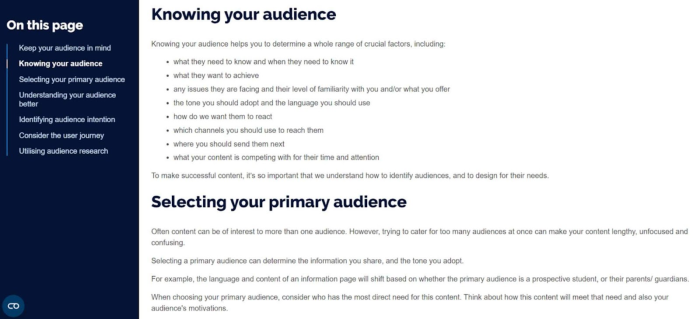
1. Understand Your Target Audience and Their Needs
Everything begins with insight. Parents and guardians are the primary decision-makers for K–12 education, so understanding what they value, whether it’s academic rigor, faith-based values, or community belonging, is essential. Avoid broad messaging that speaks to “everyone.” Instead, analyze your current families: Where do they live? What motivated their choice? What concerns drive their decision-making?
Many schools formalize this through personas, fictional yet data-driven profiles like “Concerned Parent Carol,” representing key audience segments. Surveys, interviews, and CRM data can help refine these personas to reveal motivations and needs.
Example: Newcastle University (UK). The university’s marketing team uses data and research to deeply understand prospective students. Newcastle’s internal content guide emphasizes identifying audience needs through methods like analytics, social media listening, surveys, and focus groups. This research informs content planning, ensuring communications solve audience problems and use the right tone and channels.
Once you know your audience, tailor your outreach accordingly. Working parents may prefer evening emails; international families may value multilingual content highlighting boarding life. Each message should reflect your school’s unique strengths and speak directly to what families care about most.
In short, marketing begins with knowing your families deeply and crafting messages that make them feel seen, understood, and inspired to choose your school.
2. Define and Promote Your School’s Unique Value Proposition
Once you know your audience, the next step is to define what truly makes your school stand out. In a competitive education landscape, clarity is power, and your Unique Value Proposition (UVP) is what helps families instantly understand why your school is the right choice.
Start by asking: “What do we offer that others don’t?” Your differentiators might be tangible (like an IB-accredited curriculum, advanced STEM facilities, or bilingual instruction) or emotional (a nurturing environment, strong moral foundation, or inclusive community). The key is to highlight the qualities that align with your audience’s values and can’t easily be replicated by competitors.
Look at what nearby schools emphasize, then find the white space. Finally, weave your UVP consistently through your website, tagline, visuals, and social media tone. A clear, authentic value proposition creates confidence and shows families not just what you offer, but why it matters.
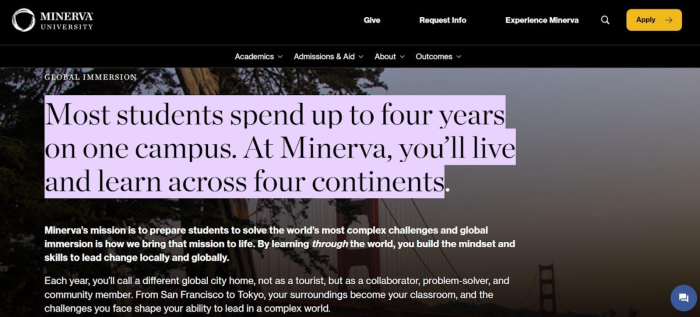
Example: Minerva University (USA). Minerva differentiates itself with a global immersion undergraduate program and an active learning model. The university clearly promotes this UVP: students live and study in seven cities on four continents over four years, rather than staying on one campus. Minerva’s website emphasizes that this global rotation and its innovative, seminar-based curriculum prepare students to solve complex global challenges. Each year in a new international city is not a travel experience but an integral part of academics, which Minerva markets as a unique offering in higher education.
3. Build a Robust Online Presence (Website, SEO, and Content)
Your school’s online presence is its digital front door, often the first impression prospective families have. A strong online foundation combines a polished website, smart SEO, and valuable content that informs, inspires, and converts.
Website Design & User Experience (UX) Your website should feel like a guided tour: beautiful, intuitive, and informative. Parents should quickly find essentials like admissions details, tuition, programs, and contact info. Use clean navigation, mobile-first design, and fast loading speeds to keep users engaged. High-quality visuals, such as campus photos, testimonial videos, or 360° virtual tours, bring your school to life. Consistent colors, logos, and tone across every page reinforce trust and ensure brand cohesion.
Search Engine Optimization (SEO) Even the best website can’t help if no one finds it. Use relevant keywords (e.g., “private school in Toronto,” “Catholic high school with IB program”) naturally in titles, headings, and meta descriptions. Create dedicated pages for programs and locations, optimize image alt text, and claim your Google Business profile to strengthen local SEO visibility.
Content Marketing Keep your site dynamic through regular updates via blog posts, student stories, and event recaps. Highlighting achievements and thought-leadership topics (like “How to Choose the Right Private School”) builds credibility and draws organic traffic.
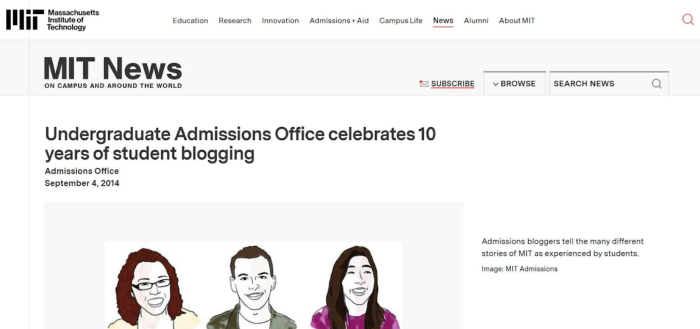
Example: Massachusetts Institute of Technology – MIT (USA): MIT’s Admissions Office hosts a famous student-written Admissions Blog that has become a pillar of its online presence. For over a decade, current MIT students have blogged candidly about campus life and academics, amassing thousands of posts read by prospective students worldwide. This blog strategy – focusing on transparency and real student voices – has paid off: the content generated millions of views, a robust engagement, and is often cited by applicants as influential in their college choice. MIT even curates a “Best of the Blogs” booklet and frequently analyzes blog traffic and feedback, using those insights to continually refine content and keep its website highly relevant to what prospective students want to know.
A well-designed, search-optimized, content-rich website isn’t just marketing; it’s proof of excellence.
4. Leverage Social Media and Digital Engagement
Social media is no longer optional. For private schools, it’s often the first place parents and students experience your community. Done right, it doesn’t just showcase your school; it builds lasting emotional connections.
Choose the Right Platforms Focus on where your audience spends time. For most schools, Facebook and Instagram are the anchors.
Facebook for community updates, parent groups, and event highlights.
Instagram for vibrant visuals and stories from daily campus life.
Schools serving older students or alumni can also explore TikTok, YouTube, or LinkedIn to reach new audiences.
Be Consistent and Purposeful Post regularly, at least a few times weekly, and plan around the school calendar. Use photos, short videos, or student/teacher takeovers to bring authenticity. Feature achievements, classroom moments, and cultural highlights to help families visualize their child’s experience.
Engage and Respond Social media is a dialogue, not a monologue. Reply promptly to comments, use polls or Q&As, and encourage user-generated content. Paid campaigns on Facebook and Instagram can further boost awareness, driving families to your website or open house events.
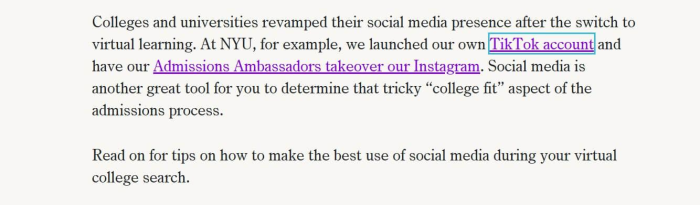
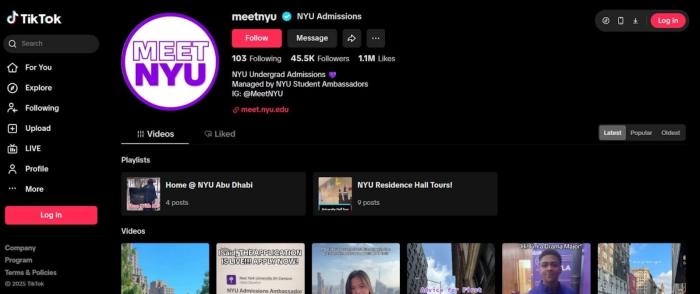
Example: New York University (USA). NYU’s admissions team expanded its digital reach by launching an official TikTok account and running student-led Instagram takeovers to showcase campus life. Current NYU students (Admissions Ambassadors) frequently create Instagram Stories and TikToks about dorm life, classes, and NYC activities, allowing prospects to see authentic student experiences. NYU actively encourages prospective students to engage – liking, commenting, or DMing questions – and monitors that feedback. This social strategy not only entertains (e.g., seniors doing TikTok dances) but also provides valuable peer-to-peer insights about “fit,” helping applicants feel more connected to the university culture.
A strong social presence humanizes your brand and turns followers into advocates.
5. Utilize Both Digital and Traditional Advertising Wisely
A balanced mix of digital and traditional advertising ensures your school reaches families online and in the local community. Each channel serves a distinct purpose.
Digital Advertising: Platforms like Google Ads and Facebook/Instagram Ads allow precise targeting by location, interests, and demographics. Search ads capture families actively looking for private schools (“private school near me”), while display and remarketing ads keep your brand visible even after visitors leave your site. For best results, pair strong ad copy with well-optimized landing pages. Email marketing is also a cost-effective channel for nurturing inquiries through newsletters and event updates.
Traditional Advertising: Local print ads, outdoor banners, and community events remain powerful for visibility. Direct mail campaigns and education fairs can connect you with parents in person, adding a personal touch that digital may lack. Track every campaign’s ROI and adjust accordingly.
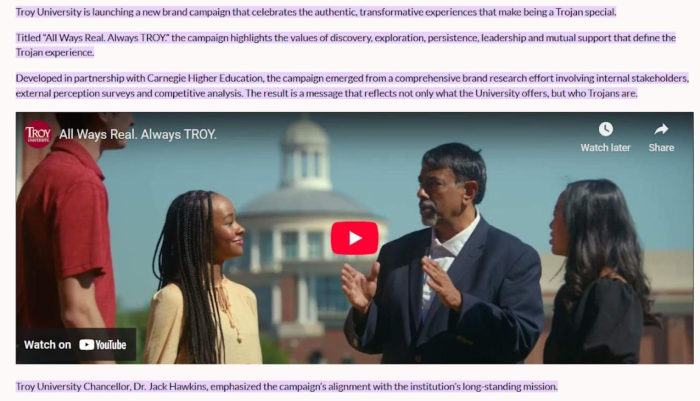
Example: In 2025, Troy University rolled out “All Ways Real. Always TROY,” a new brand campaign across a mix of traditional and digital channels. The integrated campaign includes a dynamic video commercial, print ads in publications, targeted online ads, extensive social media content, billboards in key markets, and even on-campus signage reinforcing the message. By deploying a cohesive theme on multiple platforms, Troy ensures its story of “authentic, career-focused” education reaches people wherever they are – whether scrolling online or driving past a billboard. (The campaign was informed by research and campus stakeholder input, and its multi-channel approach builds broad awareness while maintaining consistent branding.)
6. Emphasize Personal Connections: Tours, Open Houses, and Word-of-Mouth
Even in the digital age, enrollment decisions are deeply personal. Families may start online, but the final decision often comes down to how a school feels, its people, warmth, and community spirit. That’s why in-person experiences and authentic connections remain at the heart of private school marketing.
Tours and Open Houses: These events are your strongest conversion tools. Host open houses that showcase your facilities, programs, and culture. Include presentations, guided tours, and student or parent ambassadors to share authentic perspectives. Personal tours should be tailored to family interests, show relevant classrooms, introduce teachers, and follow up promptly afterward.
Word-of-Mouth and Community Engagement: Encourage satisfied parents, alumni, and students to share their experiences online and offline. Create ambassador programs or host informal meet-ups. Families trust real stories from peers more than polished ads, its important to nurture that organic advocacy.
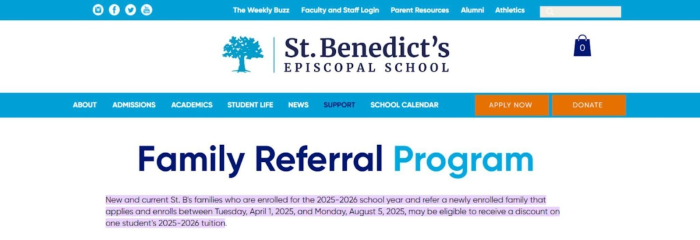
Example:St. Benedict’s Episcopal School (USA). This private school in Georgia leverages parent word-of-mouth through an organized Parent Ambassador Program. Enthusiastic current parents serve as school ambassadors – they attend open houses (in person or virtual) to welcome and mentor new families, display yard signs in their neighborhoods, bumper stickers on cars, and share school posts on their personal social media to spread the word. To further encourage referrals, St. Benedict’s even offers a Family Referral Program: current families receive a tuition discount (10–15% off one child’s tuition) if they refer a new family who enrolls. These personal recommendations and community events create a warm, trust-based marketing channel that no paid advertisement can replace.
7. Monitor, Measure, and Refine Your Marketing Efforts
Marketing is an evolving process of observation, analysis, and improvement. The best-performing private schools treat marketing as a cycle: plan, execute, measure, and refine.
Track and Analyze Performance: Use tools like Google Analytics, Meta Ads Manager, or your CRM to monitor how families engage with your campaigns and website. Track metrics such as page visits, inquiries, conversion rates, and the most effective traffic sources. For example, if your admissions page gets plenty of views but few form completions, it may need stronger calls to action or a simpler layout.
Define and Review KPIs: Set measurable goals, like inquiry volume, open house attendance, or enrollment yield, and review them monthly or quarterly. Data-driven insights allow you to invest more in what works and cut what doesn’t.
Iterate and Adapt: Marketing trends shift quickly. Regularly test your messaging, visuals, and targeting strategies. Even small A/B tests on ads or email subject lines can lead to significant improvements over time.
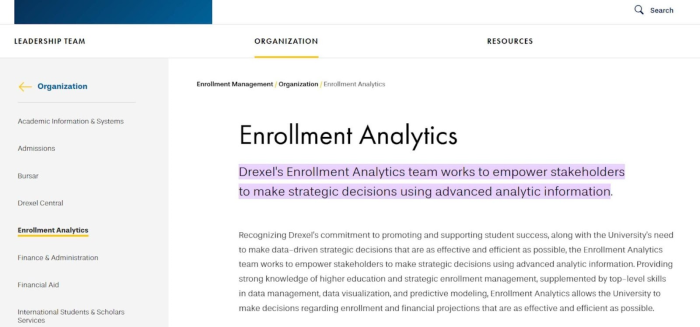
Example:Drexel University (USA). Drexel invests heavily in data analytics to continually refine its marketing and enrollment strategies. The university established an Enrollment Analytics team dedicated to measuring what’s working and advising adjustments. This team analyzes prospect and applicant data, builds dashboards and predictive models, and shares actionable insights with admissions and marketing units. By using data visualization and machine-learning models (for example, predicting which inquiries are most likely to apply), Drexel’s marketers can focus resources on high-yield activities and tweak messaging or outreach frequency based on evidence. The goal is to enable fully data-driven decisions – Drexel explicitly ties this analytic approach to improving efficiency and effectiveness in hitting enrollment goals.
How to Create a Marketing Strategy for a School (Step-by-Step)
We’ve explored what effective school marketing entails. Now let’s unpack how to build a plan that actually works.
How to create a marketing strategy for a school? To create a marketing strategy for a school, set clear goals, analyze your audience and competitors, define your unique value proposition, choose effective marketing channels, implement campaigns consistently, measure performance using data and feedback, and refine tactics regularly for continuous improvement and enrollment growth.
Whether you’re starting from scratch or optimizing an existing strategy, a clear, step-by-step framework helps you move from ideas to measurable impact.
Step 1: Determine Your Goals
Start by defining what success looks like for your school. Without clear goals, marketing becomes guesswork. Use the SMART framework: Specific, Measurable, Achievable, Relevant, and Time-bound, to make goals actionable.
For instance:
Increase Grade 9 applications by 15% for the next school year
Boost awareness in new neighborhoods to attract 10 students from that area
Enhance perception of our arts program through digital storytelling campaigns
Each goal should have a metric. If you aim to “increase inquiries,” specify how many, by when, and through which channels. Concrete targets create accountability and make it possible to assess ROI later.
Step 2: Conduct a Situation Analysis
Before planning tactics, understand your current position. Conduct a SWOT analysis (Strengths, Weaknesses, Opportunities, Threats) to evaluate both internal and external factors.
Internal Assessment:
What is your brand reputation in the community?
Are your social media channels active and engaging?
Does your website effectively communicate your strengths?
External Assessment:
Is the local school-age population growing or declining?
Who are your competitors, and what are they emphasizing?
What economic, demographic, or policy shifts could impact enrollment?
For example, a strength could be high university placement rates; a weakness might be outdated branding; an opportunity could be a new housing development nearby; a threat might be a competing school opening next year.
Review past marketing data, too. Which campaigns generated the most inquiries? Did your open house attendance meet expectations? Insights from past efforts shape a more effective plan moving forward.
Step 3: Define Your Value Proposition and Key Messages
Your Unique Value Proposition (UVP) is the heart of your marketing strategy. It defines what makes your school distinct and why families should choose you.
Once identified, craft three to five key supporting messages. Example:
UVP: “We provide a holistic education that develops intellect and character.”
Key Messages:
Dual-curriculum integrating academics and character education.
Small class sizes for individualized attention.
Safe, inclusive community environment.
Commitment to innovation and creativity.
Decades-long legacy of academic excellence.
These pillars should guide every piece of communication, from your homepage copy to your social media captions. Make sure they align with your audience’s priorities. Involving key stakeholders, teachers, admissions staff, parents, and alumni ensures authenticity and internal alignment.
Step 4: Select Your Marketing Channels and Tactics
With messaging established, identify how you’ll deliver it. The best school marketing strategies blend digital and traditional approaches, tailored to your budget and bandwidth.
Digital Channels:
Revamp and optimize your website for clarity, SEO, and mobile responsiveness.
Create a content calendar for blogs, newsletters, and video storytelling.
Maintain consistent posting on key social platforms (e.g., Instagram, Facebook, YouTube).
Run targeted Google Ads and Facebook campaigns for open house registrations.
Traditional Channels:
Host community events, sponsor local activities, or participate in school expos.
Distribute branded print materials like brochures and banners.
Leverage alumni and parent networks for referral-based outreach.
Outline timelines and assign responsibilities. For instance, if the admissions team handles social posts while a vendor manages SEO, document it clearly. Prioritize what’s realistic, for example, executing three channels effectively beats juggling six poorly.
Tip: Always make sure your digital foundation (especially your website) is strong before investing in high-cost advertising. A great ad can’t compensate for a poor landing page.
Step 5: Launch and Implement the Campaign
This is where planning meets execution. Roll out initiatives systematically and track everything from day one.
Develop a month-by-month marketing calendar tied to admissions milestones. For example:
August: Update website content, design new visuals, and optimize SEO.
September: Launch “Back-to-School” awareness campaign and host the first open house.
October–November: Run paid social ads and distribute direct mailers.
January: Promote application deadlines through retargeting and email follow-ups.
To maintain consistency, use automation tools (like HubSpot or Hootsuite) to schedule posts, emails, and reminders. However, ensure automation still feels human; personalized responses matter.
Coordinate closely with admissions and faculty teams so inquiries are promptly followed up on. A well-executed campaign can fail if responses are delayed. Always be ready to scale operationally when interest spikes.
Step 6: Evaluate and Refine
Once campaigns have run for a few months or after a full admissions cycle, analyze outcomes against your original goals.
Ask:
Did applications or inquiries increase as projected?
Which channels drove the most qualified leads?
Were conversion rates consistent across the funnel (inquiry → visit → enrollment)?
Review quantitative data (Google Analytics, CRM reports, ad dashboards) and qualitative feedback (from parent surveys, open house attendees, or declined applicants).
Then refine your strategy accordingly. Maybe your direct mail campaign underperformed while Instagram ads overdelivered. Next year, you’ll reallocate the budget. Or perhaps your messaging around “academic rigor” resonated more than “extracurricular excellence,” lean into what’s connecting emotionally.
Treat underperforming tactics not as failures but as opportunities to learn and adapt. The most successful schools are agile; they evolve messaging, visuals, and targeting as they collect new insights.
Step 7: Maintain and Innovate (Ongoing)
Marketing is cyclical. Each year, repeat the process of reassessing goals, refreshing creative assets, and incorporating new ideas.
Innovation keeps your brand vibrant. Test emerging platforms (like TikTok or Threads), experiment with storytelling formats (student podcasts, short documentaries), or integrate automation and AI for efficiency. Ensure each new initiative aligns with your mission and audience preferences.
Document everything in a concise marketing strategy brief: a one-page summary outlining:
Goals and KPIs
Target audience profiles
Key messages
Marketing channels and timeline
Budget and resource plan
Sharing this internally keeps admissions, communications, and leadership aligned.
Creating a marketing strategy for your school is about clarity, structure, and alignment. By defining goals, analyzing your position, articulating your value, choosing the right channels, and refining based on results, your school can build a sustainable and measurable marketing system.
At HEM, we’ve experienced how following this structured approach outperforms those relying on ad-hoc efforts. The difference? A strategy built on data, storytelling, and intentionality, turning marketing from a task into a powerful growth engine for your institution.
Wrapping Up
Marketing a private or independent school is both an art and a science. It blends the emotional connection of storytelling with the precision of data-driven strategy. The most successful schools understand their audiences deeply, communicate their value clearly, and use modern tools to bring those stories to life.
In today’s evolving landscape of private education marketing, technology has created new opportunities, from SEO and social media to virtual tours and AI chatbots, yet the heart of school marketing remains the same: authentic human connection. A well-placed digital ad may spark interest, but it’s the warmth of a personal tour or a parent’s heartfelt testimonial that inspires trust and enrollment.
If you’re just beginning, focus on the fundamentals: know your audience, tell your school’s story authentically, and ensure every touchpoint, online and offline, reflects your values. With consistent, strategic communication, your school can build visibility, strengthen relationships, and attract the right families.
And remember, you don’t have to do it alone. Partnering with education marketing experts like Higher Education Marketing can help transform your strategy into measurable enrollment success.
Do you need help developing a results-driven private education marketing plan for your institution?
Struggling with enrollment?
Our expert digital marketing services can help you attract and enroll more students!
Frequently Asked Questions
Question: What is the role of marketing in schools?
Answer: Essentially, marketing in schools is about alignment; connecting what a school offers with what families seek. A strong marketing function doesn’t just fill seats; it sustains a mission. It ensures enrollment remains healthy, relationships stay strong, and the school continues to thrive long term.
Question: How to create a marketing strategy for a school?
Answer: To create a marketing strategy for a school, set clear goals, analyze your audience and competitors, define your unique value proposition, choose effective marketing channels, implement campaigns consistently, measure performance using data and feedback, and refine tactics regularly for continuous improvement and enrollment growth.
Question: What is marketing in education?
Answer: Put simply, marketing in education is about connection. It’s understanding what families value and communicating how your school meets those needs with clarity and authenticity. It’s a strategic process of shaping perception, building relationships, and inspiring trust in your institution’s promise.
The UK’s international higher education sector is at yet another crossroads.
The positioning of international students as not only economic contributors to universities, but also cultural and intellectual assets to our campuses and communities is a well-told tale. But with ever-increasing government scrutiny of international recruitment practice, it is essential that the sector can unequivocally demonstrate that it operates with integrity and transparency.
It is not just the government institutions must convince of the UK’s commitment to high quality opportunities, but students themselves to ensure the UK remains a destination of choice.
Last month, IDP published its global commitment to quality and, as part of this, announced we are fully compliant with the British Council’s Agent Quality Framework (AQF). I imagine some might read that and ask “so what? Were you not already working in a compliant way already?”
To be clear, we were (and always have been) committed to being ethical and responsible in our approach to recruitment, and it is what our partners know and trust us for. But our public commitment to the AQF in January 2024 and more latterly basic compliance assessment (BCA) requirements changes inspired us to have a wholesale review of our processes to ensure all our processes and practices drive quality. Transparency matters more now than ever – the more reassurance we can give our partners that we take our role in their student recruitment seriously sends the right signal to the government that we are committed to sustainable growth focused on right metrics.
We are in this for the right reasons, that is, the right students, with the right standards and intentions, going to the right universities to complete their studies while living and thriving in our towns and cities. But it’s our hope that by being public about our official compliance, we can encourage others to do the same.
The fact it has taken us, a well-established world-leading recruitment partner, months to feel confident the checks and balances are in place and that we have full adherence to the framework, demonstrates the complexity behind compliance. As we go along, we’ll no doubt learn more about how we can improve and strengthen those assurances to our partners (and therefore to the government) that international education is not full of ‘bad actors’.
This is about more than compliance with external standards. It is a need for the international education community to be loud and proud about our work at a time when quality assurance in recruitment is under a brighter spotlight than ever.
Regulation, regulation, regulation
The UK government has made clear that international student recruitment cannot be divorced from broader debates around immigration, compliance and the sustainability of the sector. Parliamentary inquiries. Home Office interventions. The MAC review. The Immigration White Paper. The Home Office English Language Test. Freedom of Information requests. Intensified media focus. All this has raised questions about whether recruitment practice is always consistent with the standards expected of a world-leading education system. And this isn’t just about immigration rhetoric – this is about how those practices impact students and the enormous financial and emotional investment they make in choosing the UK for higher education, and make them feel their investment is worth it.
In this environment, questions may be asked as to whether self-regulation is sufficient. The AQF, developed by the British Council in partnership with BUILA, UKCISA and Universities UK International, provides the only recognised, sector-wide framework for professionalism, ethical practice, and student-centred advice. To ignore or sidestep it is to invite greater external regulation and risk undermining already-precarious confidence in the sector.
International students deserve more than transactional recruitment processes; they deserve ethical, transparent, and student-first guidance that empowers them to make the right choices for their future. Likewise, the UK needs to demonstrate to policymakers that the sector is capable of regulating itself to the highest standard.
Quality is a shared responsibility
The AQF sets out clear principles in five areas; organisational behaviour, ethical business practice, objective advice and guidance, student-centred practice and organisational competence
Compliance across all these standards is not the endpoint. Instead, it is a baseline for our work. Compliance establishes credibility, but the leadership requires continuous improvement and a proactive commitment to go beyond minimum requirements.
The onus is now on all organisations involved in international student recruitment – universities, agents, sub-agents, aggregators and service providers – to align with the AQF and evidence their compliance. AQF compliance is a collective responsibility. The question is no longer whether institutions and agents should adopt the AQF, but instead how quickly they can demonstrate alignment and ensure that these standards are consistently embedded in practice. Anything less risks weakening trust in the UK’s international education offer.
The message to the sector is clear – quality must take precedence over volume until we are confident we’re in a position to grow sustainably and deliver on student expectations. Only by embedding AQF standards across all recruitment channels can the UK demonstrate to government, students and the wider international community that it is serious about maintaining excellence.
The UK has an opportunity to lead globally on quality standards. Let’s do it together.
While most teachers are eager to implement the science of reading, many lack the time and tools to connect these practices to home-based support, according to a new national survey from Lexia, a Cambium Learning Group brand.
The 2025 Back-to-School Teacher Survey, with input from more than 1,500 K–12 educators nationwide, points to an opportunity for district leaders to work in concert with teachers to provide families with the science of reading-based literacy resources they need to support student reading success.
Key insights from the survey include:
60 percent of teachers are either fully trained or interested in learning more about the science of reading
Only 15 percent currently provide parents with structured, evidence-based literacy activities
79 percent of teachers cite time constraints and parents’ work schedules as top barriers to family engagement
Just 10 percent report that their schools offer comprehensive family literacy programs
Teachers overwhelmingly want in-person workshops and video tutorials to help parents support reading at home
“Teachers know that parental involvement can accelerate literacy and they’re eager for ways to strengthen those connections,” said Lexia President Nick Gaehde. “This data highlights how districts can continue to build on momentum in this new school year by offering scalable, multilingual, and flexible family engagement strategies that align with the science of reading.”
Teachers also called for:
Better technology tools for consistent school-to-home communication
Greater multilingual support to serve diverse communities
Professional learning that includes family engagement training
Gaehde concluded, “Lexia’s survey reflects the continued national emphasis on Structured Literacy and shows that equipping families is essential to driving lasting student outcomes. At Lexia we’re committed to partnering with districts and teachers to strengthen the school-to-home connection. By giving educators practical tools and data-driven insights, we help teachers and families work together–ensuring every child has the literacy support they need to thrive.”
Classroom discussions are among the most enriching aspects of higher education, offering students opportunities to engage with peers, deepen their understanding of course material, and draw meaningful connections between concepts. For instructors, these discussions serve as a powerful tool to foster collaboration, assess comprehension, and create a more dynamic and inclusive learning environment. Yet, leading effective discussions can be challenging, especially when students are hesitant to participate or when conversations lack depth and substance.
The field of health coaching—where communication is central to guiding clients toward greater self-awareness and behavior change—offers a valuable framework for enhancing classroom dialogue. Health coaching is a collaborative process that relies on intentional and empathetic communication to help clients explore their motivations, clarify their goals, and take ownership of their progress. By applying key communication strategies from this field, educators can elevate the quality of classroom discussions and create more meaningful interactions with students. This article explores how three core techniques from health coaching — the OARS framework (open-ended questions, affirmations, reflective listening, and summarization), rephrasing, and active listening — can be adapted to the classroom to facilitate deeper, more personally relevant conversations.
The OARS Framework
First and foremost, good discussions begin with good questions. Consider the principles contained in the acronym “OARS” to shape the way you formulate questions and listen to responses, facilitating more interactive and less directive discussions.
O: Open-ended questions: Ask questions that require more than discrete responses. Avoid questions that can be answered with “yes,” “no,” or a number. Instead of asking “Are people motivated solely by monetary incentives?”, consider asking: “Tell us about your sources of motivation,” “Why might people not be motivated when provided an incentive?” and “What, in your experience, have you seen motivate your peers to…?” When used effectively, open-ended questions encourage students to think more deeply and progress in their understanding. They can even prompt students to introduce classroom topics without the instructor ever having to explicitly steer the discussion in a particular direction.
A: Affirmations: Don’t hesitate to provide positive statements that acknowledge a student’s contribution. Affirmations foster respect and support an inclusive teaching climate; however, the affirmations must be genuine and authentic. Students notice when the instructor simply says “Great comment” or “Good question” to a majority of students’ responses. Remember, this isn’t an interrogation but a dialogue. Consider the potential impact of statements like: “Sara, thanks for volunteering to share your thoughts about applications of aerobic energy production in exercise programming,” or “Javier, I really appreciate how your comments reflect Van Gogh’s perspective on his use of sunflowers in his paintings.”
RS: Reflective Listening and Summarization: Reflective listening occurs when the instructor reflects back to the student the core elements of their contribution to the discussion. Reflective listening provides an excellent opportunity for the instructor to confirm their understanding of the student’s comments, as well as directing the conversation forward. In this step in the OARS framework, it may be appropriate to ask either a yes/no or an open-ended question. For example, “John, you’re saying personal accomplishment can be a powerful motivator among mountain athletes, is that right?” or “It seems like something is missing in our understanding of what happens when we introduce financial incentive to these groups. What do you think would happen if…?” When applied to the discussion as a whole, a summary of the main points made from the instructor’s perspective can be a great way to remind students of key points, reinforce the instructor’s informal assessment of student learning, as well as introduce the next topic or item in the lesson plan of the day.
Application Moment: Consider how you might have applied these principles of the OARS framework to a recent group discussion you led in class.
While the OARS framework provides an excellent guideline for how an instructor can improve the overall quality discussions, the following two techniques will provide concrete recommendations on what to say and how to act during the discussion.
Rephrasing
Remember the importance of good questions for good discussions? To take things one step further, consider the technique of rephrasing. To encourage deeper topic exploration, consider restructuring questions by replacing the intended question word (e.g., “who,” “what,” “when,” “where,” “why,” or “how”) with a different one. For example, an instructor may want to ask, “How can we increase motivation?” and might rephrase that question as, “What factors increase motivation?” or “Where do you feel the most/least motivated?” or “Who demonstrates the most/least motivation?” or “Why does motivation ebb and flow?” or “When are you most/least motivated?” By changing the question word, the instructor can steer the discussion to change how students think about the question, perhaps eliciting a list of possible outcomes (e.g. “What are the factors?”) or explore possible mechanisms/antecedents (e.g., “Why might motivation decline in competitive settings?”) or to help the students develop their ability to embody or conceptualize new perspectives (e.g. “How do financial incentives impact different groups or individuals? John, you represent a group of…”). This can provide depth to the conversation, encourage creativity and application of concepts in discussion, and allows for the exploration of a variety of interesting tangents.
Application Moment: Write down a discussion question from your last class instruction. Rephrase the question using each of the common question words (“who”, “what”, “when”, “where”, “why”, “how”). Consider the types of responses each question word will elicit.
Active Listening
Last, but not least, active listening: Often, instructors forget that when a question is asked, a response is on the way. It can be surprisingly difficult to fully engage with student responses, as it requires the instructor to focus on what the student is saying rather than on what they will say next. The instructor’s first job is to focus on what students are saying rather than their (the instructor’s) response. The following strategies promote active listening in the classroom during discussions:
Provide adequate time for student responses.
Don’t be afraid of silence. Silence provides you and your students time to think.
Call on students by their first name when you engage with them.
Get out from behind your lectern and casually move toward the student who is speaking.
Nod and use affirmations (e.g., nodding or stating “nice insight, Paul”).
Paraphrase when appropriate (“What I hear you saying, Paul, is that….”) – see “rephrasing/summarization” under the OARS framework.
Fostering meaningful classroom discussions is both an art and a skill—one that can be significantly enhanced by drawing on the principles of communication in health coaching. By integrating techniques such as the OARS framework, rephrasing, and active listening, instructors can create more engaging, inclusive, and thought-provoking learning environments. These strategies not only encourage deeper student participation but also help build a classroom culture rooted in empathy, curiosity, and mutual respect. As higher education continues to evolve, integrating communication practices from other disciplines can be a powerful means of enriching the educational experience and enhancing student learning.
Maria Newton, PhD, F-AASP, is an Associate Professor in the Department of Health and Kinesiology at the University of Utah. She holds a BA from the University of California, Davis, an MS from California State University, Chico, and a PhD from Purdue University, with specialized training in sport and exercise motivation. Dr. Newton’s research focuses on achievement motivation, specifically how perceptions of the climate influence motivational striving. Her most recent contributions to the literature have focused on how creating a caring and task-involving climate fosters motivation. With over 30 years of experience in higher education, Dr. Newton brings extensive expertise in teaching a variety of courses in diverse formats. Recognized with numerous teaching awards, she is deeply committed to cultivating an inclusive and intellectually stimulating climate that inspires learning and personal growth.
Jefferson Brewer, MS, CSCS, ACSM EP, is an Associate Instructor in the Department of Health and Kinesiology at the University of Utah. He holds a BS in Kinesiology with an emphasis in Exercise Science and an MS in Kinesiology focused on Health and Wellness Coaching, both from the University of Utah. He is currently completing his dissertation for a PhD in Integrated Health Science at Rocky Mountain University of Health Professions. Jefferson’s research centers on metabolism in rock climbers—examining both systemic and localized muscular responses. Before transitioning into academia, he worked in patient care, applying his coaching background and exercise science expertise to improve health outcomes. His experience has shaped a teaching style grounded in interpersonal communication, creating engaging and dynamic learning environments that foster growth, curiosity, and academic success.
Classroom discussions are among the most enriching aspects of higher education, offering students opportunities to engage with peers, deepen their understanding of course material, and draw meaningful connections between concepts. For instructors, these discussions serve as a powerful tool to foster collaboration, assess comprehension, and create a more dynamic and inclusive learning environment. Yet, leading effective discussions can be challenging, especially when students are hesitant to participate or when conversations lack depth and substance.
The field of health coaching—where communication is central to guiding clients toward greater self-awareness and behavior change—offers a valuable framework for enhancing classroom dialogue. Health coaching is a collaborative process that relies on intentional and empathetic communication to help clients explore their motivations, clarify their goals, and take ownership of their progress. By applying key communication strategies from this field, educators can elevate the quality of classroom discussions and create more meaningful interactions with students. This article explores how three core techniques from health coaching — the OARS framework (open-ended questions, affirmations, reflective listening, and summarization), rephrasing, and active listening — can be adapted to the classroom to facilitate deeper, more personally relevant conversations.
The OARS Framework
First and foremost, good discussions begin with good questions. Consider the principles contained in the acronym “OARS” to shape the way you formulate questions and listen to responses, facilitating more interactive and less directive discussions.
O: Open-ended questions: Ask questions that require more than discrete responses. Avoid questions that can be answered with “yes,” “no,” or a number. Instead of asking “Are people motivated solely by monetary incentives?”, consider asking: “Tell us about your sources of motivation,” “Why might people not be motivated when provided an incentive?” and “What, in your experience, have you seen motivate your peers to…?” When used effectively, open-ended questions encourage students to think more deeply and progress in their understanding. They can even prompt students to introduce classroom topics without the instructor ever having to explicitly steer the discussion in a particular direction.
A: Affirmations: Don’t hesitate to provide positive statements that acknowledge a student’s contribution. Affirmations foster respect and support an inclusive teaching climate; however, the affirmations must be genuine and authentic. Students notice when the instructor simply says “Great comment” or “Good question” to a majority of students’ responses. Remember, this isn’t an interrogation but a dialogue. Consider the potential impact of statements like: “Sara, thanks for volunteering to share your thoughts about applications of aerobic energy production in exercise programming,” or “Javier, I really appreciate how your comments reflect Van Gogh’s perspective on his use of sunflowers in his paintings.”
RS: Reflective Listening and Summarization: Reflective listening occurs when the instructor reflects back to the student the core elements of their contribution to the discussion. Reflective listening provides an excellent opportunity for the instructor to confirm their understanding of the student’s comments, as well as directing the conversation forward. In this step in the OARS framework, it may be appropriate to ask either a yes/no or an open-ended question. For example, “John, you’re saying personal accomplishment can be a powerful motivator among mountain athletes, is that right?” or “It seems like something is missing in our understanding of what happens when we introduce financial incentive to these groups. What do you think would happen if…?” When applied to the discussion as a whole, a summary of the main points made from the instructor’s perspective can be a great way to remind students of key points, reinforce the instructor’s informal assessment of student learning, as well as introduce the next topic or item in the lesson plan of the day.
Application Moment: Consider how you might have applied these principles of the OARS framework to a recent group discussion you led in class.
While the OARS framework provides an excellent guideline for how an instructor can improve the overall quality discussions, the following two techniques will provide concrete recommendations on what to say and how to act during the discussion.
Rephrasing
Remember the importance of good questions for good discussions? To take things one step further, consider the technique of rephrasing. To encourage deeper topic exploration, consider restructuring questions by replacing the intended question word (e.g., “who,” “what,” “when,” “where,” “why,” or “how”) with a different one. For example, an instructor may want to ask, “How can we increase motivation?” and might rephrase that question as, “What factors increase motivation?” or “Where do you feel the most/least motivated?” or “Who demonstrates the most/least motivation?” or “Why does motivation ebb and flow?” or “When are you most/least motivated?” By changing the question word, the instructor can steer the discussion to change how students think about the question, perhaps eliciting a list of possible outcomes (e.g. “What are the factors?”) or explore possible mechanisms/antecedents (e.g., “Why might motivation decline in competitive settings?”) or to help the students develop their ability to embody or conceptualize new perspectives (e.g. “How do financial incentives impact different groups or individuals? John, you represent a group of…”). This can provide depth to the conversation, encourage creativity and application of concepts in discussion, and allows for the exploration of a variety of interesting tangents.
Application Moment: Write down a discussion question from your last class instruction. Rephrase the question using each of the common question words (“who”, “what”, “when”, “where”, “why”, “how”). Consider the types of responses each question word will elicit.
Active Listening
Last, but not least, active listening: Often, instructors forget that when a question is asked, a response is on the way. It can be surprisingly difficult to fully engage with student responses, as it requires the instructor to focus on what the student is saying rather than on what they will say next. The instructor’s first job is to focus on what students are saying rather than their (the instructor’s) response. The following strategies promote active listening in the classroom during discussions:
Provide adequate time for student responses.
Don’t be afraid of silence. Silence provides you and your students time to think.
Call on students by their first name when you engage with them.
Get out from behind your lectern and casually move toward the student who is speaking.
Nod and use affirmations (e.g., nodding or stating “nice insight, Paul”).
Paraphrase when appropriate (“What I hear you saying, Paul, is that….”) – see “rephrasing/summarization” under the OARS framework.
Fostering meaningful classroom discussions is both an art and a skill—one that can be significantly enhanced by drawing on the principles of communication in health coaching. By integrating techniques such as the OARS framework, rephrasing, and active listening, instructors can create more engaging, inclusive, and thought-provoking learning environments. These strategies not only encourage deeper student participation but also help build a classroom culture rooted in empathy, curiosity, and mutual respect. As higher education continues to evolve, integrating communication practices from other disciplines can be a powerful means of enriching the educational experience and enhancing student learning.
Maria Newton, PhD, F-AASP, is an Associate Professor in the Department of Health and Kinesiology at the University of Utah. She holds a BA from the University of California, Davis, an MS from California State University, Chico, and a PhD from Purdue University, with specialized training in sport and exercise motivation. Dr. Newton’s research focuses on achievement motivation, specifically how perceptions of the climate influence motivational striving. Her most recent contributions to the literature have focused on how creating a caring and task-involving climate fosters motivation. With over 30 years of experience in higher education, Dr. Newton brings extensive expertise in teaching a variety of courses in diverse formats. Recognized with numerous teaching awards, she is deeply committed to cultivating an inclusive and intellectually stimulating climate that inspires learning and personal growth.
Jefferson Brewer, MS, CSCS, ACSM EP, is an Associate Instructor in the Department of Health and Kinesiology at the University of Utah. He holds a BS in Kinesiology with an emphasis in Exercise Science and an MS in Kinesiology focused on Health and Wellness Coaching, both from the University of Utah. He is currently completing his dissertation for a PhD in Integrated Health Science at Rocky Mountain University of Health Professions. Jefferson’s research centers on metabolism in rock climbers—examining both systemic and localized muscular responses. Before transitioning into academia, he worked in patient care, applying his coaching background and exercise science expertise to improve health outcomes. His experience has shaped a teaching style grounded in interpersonal communication, creating engaging and dynamic learning environments that foster growth, curiosity, and academic success.