Tag: pre-K

  • Child care crisis deepens as funding slashed for poor families

    Child care crisis deepens as funding slashed for poor families

    by Jackie Mader, The Hechinger Report
    November 1, 2025

    The first hint of trouble for McKinley Hess came in August. 

    Hess, who runs an infant and toddler care program in Conway, Arkansas, heard that the teen moms she serves were having trouble getting their expected child care assistance payments. Funded by a mix of federal and state dollars, those subsidies are the only way many low-income parents nationwide can afford child care, by reimbursing providers for care and lowering the amount parents have to pay themselves.

    In Arkansas, teen parents have long been given priority to receive this aid. But now, Hess heard, they and many other families in need were sitting on a growing wait-list.

    Hess had just enrolled eight teen moms at her central Arkansas site, Conway Cradle Care, and was counting on state subsidies to pay for their children’s care. As the moms were stuck waiting for financial assistance, Hess had two options: kick them out, or care for their infants for free so their mothers wouldn’t have to drop out of school. She chose the latter. 

    Just a month later, another hit: Arkansas government officials announced they were going to cut the rates they pay providers on behalf of low-income families. Beginning Nov. 1, Hess will get $36 a day for each infant in her care and $35 a day for toddlers, down from $56 and $51 a day respectively. She’s already lost out on more than $20,000 by providing free care for 8 infants for the past two months.

    “Financially, it really is going to hurt our day care,” Hess said. But the stakes are also high for the parents who need child care assistance, she said: “For them to be able to continue school, these vouchers are essential.” 

    As states face having to cut spending while bracing for fewer federal dollars under the budget bill President Trump signed in July, some, including Arkansas, view early learning programs as a place to slash funding. They’re making these cuts even as experts and providers predict they will be disastrous for children, families and the economy if parents don’t have child care and can’t work. 

    The same families face other upheaval: The ongoing government shutdown means states may not receive their Nov. 1 shares of federal money for the Supplemental Nutrition Assistance Program, also known as food stamps, meaning families may not get that aid. Across the country, more than 100 Head Start centers, part of a federally funded preschool program that provides free child care, may have to close, at least temporarily, if the shutdown drags on as expected and they do not get expected federal cash by the start of next month. 

    Related: Young children have unique needs and providing the right care can be a challenge. Our free early childhood education newsletter tracks the issues. 

    Elsewhere, Colorado, Maryland and New Jersey recently stopped accepting new families into their child care assistance programs. In June, Oregon’s Democratic-led legislature cut $20 million from the state’s preschool program for low-income families. In September, Indiana joined Arkansas in announcing reductions in reimbursement rates for providers who care for low-income children. This summer, the governor of Alaska vetoed part of the state’s budget that would have given more money to child care and early intervention services for young children with developmental disabilities. Washington state legislators cut $60 million last month from a program that provides early learning and family support to preschoolers. Additional cuts or delays in payments have cropped up in Ohio, Nevada and the District of Columbia.

    “Almost every state is facing a very, very, very significant pullback of federal dollars,” said Daniel Hains, chief policy officer at the D.C.-based National Association for the Education of Young Children. “It does not help families when you cut provider reimbursement rates, when you cut funds going to providers, because it makes it less likely that those families are going to access the high-quality child care that they need.”

    This trend could further devastate America’s fragile child care industry, which has been especially slow to recover since the pandemic due to a lack of funding. Child care programs are expensive to run and, with limited public support, providers rely heavily on tuition from parents to pay their bills.

    In many parts of the country, parents already pay the equivalent of college tuition or a second mortgage on child care and have little ability to pay more. Yet child care staff generally make abysmally low wages and have high turnover rates. There’s often little wiggle room in program budgets.

    One of the only sources of federal funding for child care centers comes from the federally funded Child Care and Development Fund. Each year, Congress sets the level of block grants to states, which add matching funds. Arkansas officials said recent cuts to their subsidy program are in response to an unexpected $8 million decrease in federal CCDF funding this year after post-pandemic changes to the way state payouts are calculated.

    In September, Arkansas Secretary of Education Jacob Oliva told lawmakers that without cutting rates to providers, the state would be unlikely to be able to sustain the program. “The last thing I want to do is set up a reimbursement rate that at Christmas we have to call everybody and say we’re done, we spent all our money,” he said during a hearing.

    In addition to cutting payments to providers, the state increased family co-payments, the amount parents must pay toward child care in addition to what their subsidy covers. It’s far from a perfect solution, Oliva told lawmakers. “But we have to do something.”

    Related: How early ed is affected by federal cuts

    During the pandemic, child care programs and states received a fresh infusion of public funds from the American Rescue Plan Act and the Child Care and Development Block Grant, helping to stabilize those businesses. Many states used the influx to bolster their subsidy programs, allowing more children to use them and increasing what providers were paid.

    As that aid expired over the last two years, some states found money to sustain that expansion, but others did not. Indiana was left with a $225 million gap between the cost of its child care subsidy program and the state money dedicated to filling it. In October, officials cut reimbursement rates by 10 to 35 percent, saying in a statement that “there is only one pot of money — we could either protect providers or kids, and we chose kids.”

    Experts and child care directors say, however, that in the child care business it’s impossible to decouple kids from providers. The decision to cut reimbursement rates will ultimately hurt both, they insist, especially as providers find it hard to keep their doors open. Already, some programs have shuttered or announced plans to close by the end of the year. At others, families have left in search of more affordable care.

    Cori Kerns, a senior staff consultant at Little Duckling Early Learning Schools in Indianapolis, said that now that schools are receiving less money from the state, parents must make up the difference. Since the changes were announced in September, Little Duckling has lost 26 children — nearly 18 percent of its enrollment — because parents cannot afford that increase. 

    “That could be a tank of gas to them, that could be some groceries, that could be school supplies or medical needs. Some of them have had to literally stop and stay home with their child in order to survive and also not pay for child care,” Kerns said. “Those kids are suffering” as they stay home with stressed parents who are worrying about lost income, she added.  

    As families pulled their children, Kerns merged two buildings of her program into one, creating larger class sizes and new teacher assignments. That’s led to challenging behavioral problems for children who must adjust to new environments. Kerns anticipates losing teachers now that the work environment has become more stressful.

    Experts warn this trend in some states of scaling back early childhood investments is widening an existing nationwide disparity in the availability of affordable, high-quality child care. While states like Arkansas and Indiana pull back, a handful of others are moving the opposite direction, putting more money toward early learning. In New Mexico, for example, the nation’s first free universal child care program will launch on Nov. 1, paid for by oil and gas revenue that is routed to the state’s Early Childhood Education and Care Fund. In 2023, Vermont passed a payroll tax to increase child care funding in the state, while Connecticut established an endowment this year to route surplus state funds into early learning programs. 

    States have already been diverging in their approach to the child care industry since the pandemic. Rather than invest in more qualified workers, some states have opted to deregulate child care and bring teenagers in to care for young children. At the same time, places like the District of Columbia have increased qualifications for child care providers.

    Related: Rural Americans rely on Head Start. Federal turmoil has them worried

    “This is what happens when you don’t have public federal dollars in the system,” said NAEYC’s Hains. In states that are clawing back child care funds, “it’s going to result in lower quality care for children, or it’s going to result in families pulling back from the workforce and facing greater economic insecurity,” Hains said. “We’re going to see a real harmful impact on children and families as these investments are pulled back.”

    In Mooresville, Indiana, Jen Palmer calculated that her program, The Growing Garden Learning Center, will lose about $260,000 from its annual budget because of cuts in state contributions to care for children from low-income families. 

    “If nothing changes as of today, I can sustain for a year,” Palmer said. “Past that, I’m going to start dipping into my retirement savings.” She’s hesitant to discuss closing the program, one of highest-quality centers in the area. “I believe in this place. What we do is amazing. We just have to make it through this.”

    The lower subsidy rate is just the latest of a series of changes that Palmer has endured. Last December, Indiana stopped accepting new applicants into the care aid program and instead launched a waiting list. Palmer stopped getting calls from parents who wanted to enroll their children, as they couldn’t pay for care on their own. 

    Earlier this year, Indiana also announced cuts to reimbursement rates for its pre-K program, which is run in schools and child care programs throughout the state. Palmer now receives about $148 a week for each pre-K student she serves, down from more than $300 a week last year. Over the past three months, she’s had to lay off seven teachers and has taken over teaching in a pre-K classroom in the mornings. “We’re going to do our darndest that the kids don’t feel the impact,” she said. 

    She hasn’t been able to completely shield them. One toddler in her program recently shocked and delighted his teachers when he said his first word in English: a bold “no.” Concerned that the child had language delays, they were thrilled that he was starting to make progress. 

    Then the child’s family pulled him out of the program. His mother, who works as a delivery driver, had previously qualified for free child care paid for by state. With the state now paying less, her tuition jumped to $167 a month. 

    Instead of interacting with other children and teachers, playing and learning new skills, the toddler is now “sitting in mom’s car in a car seat driving around all over the county while she delivers for Uber,” said Palmer. “That just set that little guy years back. When he enters school, he’s no longer going to be on par with his classmates. That’s not fair. That can’t be the answer.”

    Contact staff writer Jackie Mader at 212-678-3562 or [email protected] 

    This story about child care was produced by The Hechinger Report, a nonprofit, independent news organization focused on inequality and innovation in education. Sign up for the Hechinger newsletter.

    This <a target=”_blank” href=”https://hechingerreport.org/child-care-crisis-deepens-as-funding-slashed-for-poor-families/”>article</a> first appeared on <a target=”_blank” href=”https://hechingerreport.org”>The Hechinger Report</a> and is republished here under a <a target=”_blank” href=”https://creativecommons.org/licenses/by-nc-nd/4.0/”>Creative Commons Attribution-NonCommercial-NoDerivatives 4.0 International License</a>.<img src=”https://i0.wp.com/hechingerreport.org/wp-content/uploads/2018/06/cropped-favicon.jpg?fit=150%2C150&amp;ssl=1″ style=”width:1em;height:1em;margin-left:10px;”>

    <img id=”republication-tracker-tool-source” src=”https://hechingerreport.org/?republication-pixel=true&post=113184&amp;ga4=G-03KPHXDF3H” style=”width:1px;height:1px;”><script> PARSELY = { autotrack: false, onload: function() { PARSELY.beacon.trackPageView({ url: “https://hechingerreport.org/child-care-crisis-deepens-as-funding-slashed-for-poor-families/”, urlref: window.location.href }); } } </script> <script id=”parsely-cfg” src=”//cdn.parsely.com/keys/hechingerreport.org/p.js”></script>


    Source link

  • Many children with ADHD miss a crucial step in treatment

    Many children with ADHD miss a crucial step in treatment

    When pediatricians diagnose preschoolers with attention deficit hyperactivity disorder, there are clear steps they are supposed to take.

    Families should first be referred to behavior therapy, which teaches caregivers how to better support their children and manage challenging behaviors that may be related to ADHD. If therapy isn’t making a significant difference, the American Academy of Pediatrics advises, pediatricians can then consider medication.

    Nationwide, this process — behavior therapy, then medication if needed — isn’t being followed as often as it should, according to a study recently released by Stanford Medicine and published in JAMA Network Open. Instead, more than 42 percent of 3- to 5-year-olds with ADHD were prescribed medication within a month of their diagnosis.

    Missing out on behavior therapy has worrisome implications for children and families, said Dr. Yair Bannett, assistant professor of pediatrics at Stanford Medicine and lead author of the study. Behavioral management training for parents over the course of several months has been found to reduce children’s ADHD symptoms and behavioral problems, and improve parent skills and their relationships with their children. 

    Without that support, families may be left facing additional challenges. Behavioral training “reduces the chaos in the house and can improve the quality of life for the parents and the child,” Bannett said. 

    There are several reasons families may be missing this intervention. Some pediatricians aren’t familiar with the purpose of behavior therapy, Bannett added, which is specifically aimed at the adults who support children with ADHD, not the children. “It’s really more of an advanced type of parenting course,” he said. Families also may have trouble finding affordable local therapists.

    Bannett said parents should use three key practices to support young children with ADHD. (These strategies also work well for teachers, he added.)

    Focus on building a strong, positive relationship: Having a strong attachment between the child and parent or teacher is an important first step to managing behavior, Bannett said. That means spending quality one-on-one time with the child. “That’s the child’s motivation, they want to please you,” he added. “Without that first piece, none of this will work.”

    Use positive reinforcement: Rather than punishing a child’s negative behavior, Bannett said, parents and teachers will see more success if they praise good behaviors and develop reward systems to encourage them.  

    Adjust the child’s environment: Children with ADHD may thrive with simple environmental changes, such as “visual schedules” — charts that use pictures to show a child daily activities or tasks — and a consistent, structured routine.

    Parents who can’t find in-person therapists can substitute online therapy, Bannett said. The training is also useful for families even after their children are prescribed medication. 

    To make sure more families have access to helpful strategies, Bannett would like to see more education for doctors and clinicians on these best practices. 

    “The pediatricians could also counsel families in the office about these techniques,” Bannett said. “Some written materials and resources could be enough” to at least introduce these practices, he added. “That’s what I’m hoping could make a change.”

    Reading list

    This story about children with ADHD was produced by The Hechinger Report, a nonprofit, independent news organization focused on inequality and innovation in education. Sign up for the Hechinger newsletter.

    The Hechinger Report provides in-depth, fact-based, unbiased reporting on education that is free to all readers. But that doesn’t mean it’s free to produce. Our work keeps educators and the public informed about pressing issues at schools and on campuses throughout the country. We tell the whole story, even when the details are inconvenient. Help us keep doing that.

    Join us today.

    Source link

  • Rural Americans support more government spending on child care

    Rural Americans support more government spending on child care

    Hello! This is Christina Samuels, the early education editor here at Hechinger.

    By now, I hope you’ve had a chance to read my colleague Jackie Mader’s story about the important role that Head Start plays in rural communities. While Jackie set her story in western Ohio, she also interviewed Head Start parents and leaders in other parts of the country and collected their views for a follow-up article.

    In a fortunate bit of timing, the advocacy group First Five Years Fund published the results of a survey it commissioned on rural Americans and their feelings on child care access and affordability. Like the people Jackie interviewed, the survey respondents, more than half of whom identified as supporters of President Donald Trump, said they had very positive views of Head Start. The federally funded free child care program received positive marks from 71 percent of rural Republicans, 73 percent of rural independents and 92 percent of rural Democrats.

    The survey also found that 4 out of 5 respondents felt that finding quality child care is a major or critical problem in their part of the country. Two-thirds of those surveyed felt that spending on child care and early education programs is a good use of taxpayer dollars, and a little more than half said they’d like to see more federal dollars going to such programs.

    First Five Years Fund was particularly interested in getting respondents to share their thoughts on Head Start, said Sarah Rubinfield, the managing director of government affairs for First Five Years Fund. The program has been buffeted by regional office closures and cuts driven by the administration’s Department of Government Efficiency. 

    “We recognize that these are communities that often have few options for early learning and care,” Rubinfield said.

    In the survey, rural residents said they strongly supported not just the child care offered by Head Start, but the wraparound services such as healthy meals and snacks and the program’s support for children with developmental disabilities. Though Head Start programs are federally funded, community organizations are the ones in charge of spending priorities.

    “Rural voters want action. They support funding for Head Start and for child care. They want Congress to do more,” Rubinfield said. Though the “big beautiful bill” signed into law in July expands the child care tax credit for low-income families, survey respondents “recognized that things were not solved,” she added.

    The First Five Years Fund survey was released just a few days before a congressional standoff led to a government shutdown. The shutdown is not expected to touch Head Start immediately, said Tommy Sheridan, the deputy director of the National Head Start Association, in an interview with The New York Times. The 1,600 Head Start programs across the country receive money at different points throughout the calendar year; eight programs serving about 7,500 children were slated to receive their federal funding on Oct. 1, Sheridan told the Times. All should be able to continue operating, as long as the shutdown doesn’t last more than a few weeks, he said. 

    “We’re watching with careful concern but trying not to panic,” Rubinfield said. “We know the impacts may not be immediate, but the longer this goes on, the harder the impacts may be for families and programs.”

    This story about rural Americans was produced by The Hechinger Report, a nonprofit, independent news organization focused on inequality and innovation in education. Sign up for the Hechinger newsletter.

    The Hechinger Report provides in-depth, fact-based, unbiased reporting on education that is free to all readers. But that doesn’t mean it’s free to produce. Our work keeps educators and the public informed about pressing issues at schools and on campuses throughout the country. We tell the whole story, even when the details are inconvenient. Help us keep doing that.

    Join us today.

    Source link

  • We cannot afford to dismantle Head Start, a program that builds futures, strengthens families and delivers proven returns

    We cannot afford to dismantle Head Start, a program that builds futures, strengthens families and delivers proven returns

    The first words I uttered after successfully defending my dissertation were, “Wow, what a ride. From Head Start to Ph.D.!” Saying them reminded me where it all began: sitting cross-legged with a picture book at the Westside Head Start Center, just a few blocks from my childhood home in Jackson, Mississippi. 

    I don’t remember every detail from those early years, but I remember the feeling: I was happy at Head Start. I remember the books, the music, the joy. That five-minute bus ride from our house to the Westside Center turned out to be the shortest distance between potential and achievement. 

    And my story is not unique. Every year, hundreds of thousands of children — kids whose names we may never know, though our futures depend on them — walk through Head Start’s doors. Like me, they find structure, literacy, curiosity and belonging.  

    For many families, Head Start is the first place outside the home where a child’s potential is nurtured and celebrated. Yet, this program that builds futures and strengthens families is now under threat, and it’s imperative that we protect it. 

    Years later, while training for high school cross-country meets, I’d run past the park next to the center and pause, flooded with memories. Head Start laid the foundation for everything that followed. It gave me structure, sparked my curiosity and built my early literacy skills. It even fed my short-lived obsession with chocolate milk.  

    More than that, Head Start made me feel seen and valued. 

    Related: A lot goes on in classrooms from kindergarten to high school. Keep up with our free weekly newsletter on K-12 education. 

    There’s a clear, unbroken line between the early lessons I learned at Head Start and the doctoral dissertation I defended decades later. Head Start didn’t just teach me my ABCs — it taught me that learning could be joyful, that I was capable and that I belonged in a classroom.  

    That belief carried me through elementary school, Yale and George Washington University and to a Ph.D. in public policy and public administration. Now, as part of my research at the Urban Institute, I’m working to expand access to high-quality early learning, because I know firsthand what a difference it makes.  

    Research backs up what my story shows: Investments in Head Start and high-quality early childhood education change lives by improving health and educational achievement in later years, and benefit the economy. Yet today there is growing skepticism about the value of Head Start, reflecting an ongoing reluctance to give early childhood education the respect it deserves.  

    If Head Start funding is cut, thousands of children — especially from communities like mine in Jackson, where families worked hard but opportunities were limited — could lose access to a program that helps level the playing field. These are the children of young parents and single parents, of working families who may not have many other options but still dare to dream big for their kids.  

    And that is why I am worried. Funding for Head Start has been under threat. Although President Donald Trump’s proposed fiscal 2026 budget would maintain Head Start funding at its current $12.3 billion, Project 2025, the influential conservative policy document, calls for eliminating the program. The administration recently announced that Head Start would no longer enroll undocumented children, which a group of Democratic attorneys general say will force some programs to close.  

    Related: Head Start is in turmoil 

    I feel compelled to speak out because, for our family, Head Start wasn’t just a preschool — it was the beginning of everything. For me, it meant a future I never could have imagined. For my mother, Head Start meant peace of mind — knowing her son was in a nurturing, educational environment during the critical developmental years. My mother, Nicole, brought character, heart and an unwavering belief in my potential — and Head Start helped carry that forward. 

    My mother was just 18 when she enrolled me in Head Start. “A young mother with big dreams and limited resources,” she recounted to me recently, adding that she had “showed up to an open house with a baby in my arms and hope in my heart.” 

    Soon afterward, Mrs. Helen Robinson, who was in charge of the Head Start in Jackson, entered our lives. She visited our home regularly, bringing books, activities and reassurance. A little yellow school bus picked me up each morning. 

    Head Start didn’t just support me, though. It also supported my mother and gave her tips and confidence. She took me to the library regularly and made sure I was always surrounded by books and learning materials that would challenge and inspire me. 

    It helped my mother and countless others like her gain insight into child development, early learning and what it means to advocate for their children’s future.  

    Twenty-five years after those early mornings when I climbed onto the Head Start bus, we both still think about how different our lives might have been without that opportunity. Head Start stood beside us, and that support changed our lives. 

    As we debate national priorities, we must ask ourselves: Can we afford to dismantle a program that builds futures, strengthens families and delivers proven returns? 

    My family provides living proof of Head Start’s power.  

    This isn’t just our story. It is the story of millions of others and could be the story of millions more if we choose to protect and invest in what works. 

    Travis Reginal holds a doctorate in public policy and public administration and is a graduate of the Head Start program, Yale University and George Washington University. He is a former Urban Institute researcher. 

    Contact the opinion editor at [email protected]. 

    This story about the Head Start funding was produced by The Hechinger Report, a nonprofit, independent news organization focused on inequality and innovation in education. Sign up for Hechinger’s weekly newsletter. 

    The Hechinger Report provides in-depth, fact-based, unbiased reporting on education that is free to all readers. But that doesn’t mean it’s free to produce. Our work keeps educators and the public informed about pressing issues at schools and on campuses throughout the country. We tell the whole story, even when the details are inconvenient. Help us keep doing that.

    Join us today.

    Source link

  • Landmark free preschool program reaches too few kids

    Landmark free preschool program reaches too few kids

    In the 1980s, a public interest law group sued the state of New Jersey, saying that the way it funded education left its low-income, urban school districts at a disadvantage compared to wealthier, suburban districts.

    The lawsuit, Abbott v. Burke, yielded a number of different decisions, including a requirement that the state offer free, full-day, high-quality preschool for children ages 3 and 4 in 31 school districts.

    This new school year marks the 26th since the program was created. Researchers have found that children who attend the preschool program are better prepared for school later on, but enrollment has been dwindling. And with New Jersey leaders now focused on bringing preschool to all districts, supporters worry that the early learning program focused on children in low-income areas may not get the attention it needs.

    Park perk for kids

    Did you know every fourth grader and their family can get free admission to national parks, monuments and forests? The Sierra Club’s Outdoors for All program launched in 2015 and offers free passes each school year. Vouchers for students can be downloaded through the program’s official website. 

    This story about free preschool was produced by The Hechinger Report, a nonprofit, independent news organization focused on inequality and innovation in education. Sign up for the early childhood  newsletter.

    The Hechinger Report provides in-depth, fact-based, unbiased reporting on education that is free to all readers. But that doesn’t mean it’s free to produce. Our work keeps educators and the public informed about pressing issues at schools and on campuses throughout the country. We tell the whole story, even when the details are inconvenient. Help us keep doing that.

    Join us today.

    Source link

  • Child care centers often reject kids with disabilities. Ohio and other states are trying to change that

    Child care centers often reject kids with disabilities. Ohio and other states are trying to change that

    This story about children with disabilities was produced by The Hechinger Report, a nonprofit, independent news organization focused on inequality and innovation in education. Sign up for the Hechinger newsletter.

    COLUMBUS, Ohio — When Selina Likely became director of the Edwards Creative Learning Center six years ago, she knew there was one longstanding practice that she wanted to change. For as long as she had taught at the thriving child care center, it had turned away many children with disabilities such as autism and Down syndrome. The practice was even encoded in the center’s handbook as policy.

    Likely, the parent of a child with a disability, wanted to stop telling families no, but she knew that to do that she and her staff would need more support. “I said, ‘Let’s start getting training and see what we can do.’” 

    Not too long after, her effort received a big boost from a state-funded initiative in Ohio to strengthen child care teachers’ knowledge and confidence in working with young kids with disabilities and developmental delays. That program, Ohio PROMISE, offers free online training for child care workers in everything from the benefits of kids of all abilities learning and playing together to the kinds of classroom materials most helpful to have on hand. It also offers as-needed mentorship and support from trained coaches across the state.  

    Related: Young children have unique needs, and providing the right care can be a challenge. Our free early childhood education newsletter tracks the issues. 

    Child care providers across the country — including large, established centers and tiny home-based programs — struggle to meet the needs of children with disabilities, according to a 2024 report from the U.S. Government Accountability Office. More than a quarter of parents of children with disabilities said they had a lot of difficulty finding appropriate care for their kids. And even those who do find a spot regularly encounter challenges, like having their children excluded from extracurricular activities such as field trips and even academic instruction. 

    “It’s really hard to find child care for this population, we heard that loud and clear,” said Elizabeth Curda, a director on the GAO’s Education, Workforce and Income Security team and a coauthor of the report. Even the most well-resourced centers report that they struggle to meet the needs of children with disabilities, according to Curda. 

    There’s a lot of desire at the grassroots level to change that. Ohio PROMISE and a few other recent initiatives provide models for how to expand the capacity — and the will — of child care centers to serve the more than 2 million U.S. children age 5 or below who have a disability or developmental delay.

    Cards on the walls at Edwards Creative Learning Center display the signs for different letters so students — whether nonverbal or not — can all learn sign language. Credit: Sarah Carr/The Hechinger Report

    In Vermont, for instance, officials hope to soon unveil a free, on-demand training program aimed at helping child care teachers have more inclusive classrooms. And officials in Ohio’s Summit County, home to Akron, report growing interest from other counties in creating programs based on Summit’s more than decade-old model that provides in-person training for child care operators in inclusion of children with disabilities. 

    “We’re helping to create child care centers that feel they can handle whatever comes their way, especially when it comes to significant behavior concerns,” said Yolanda Mahoney, the early childhood center support supervisor for Summit County’s disabilities board.

    The federal government until recently encouraged the creation of such models. In 2023, the federal Department of Education and Department of Health and Human Services issued a joint statement urging states to take steps to support inclusion in early childhood settings, including strengthening training and accountability. 

    Also, a year-old provision of the Child Care and Development Fund, the primary federal funding source for child care, requires that states increase the availability of child care for children with disabilities as a prerequisite for receiving funds. (However, 43 states have received waivers allowing them to delay implementation of that provision.) 

    Under the current president, federal momentum on the issue has largely stalled. While the administration of President Donald Trump hasn’t directly attacked inclusion in the context of special education, the president has criticized the term more broadly — especially when it comes to diversity, equity and inclusion. That can create uncertainty and a chilling effect on advocates of inclusion efforts of all kinds.   

    Funding for some inclusion efforts is also in jeopardy. States rely on Medicaid, which faces nearly $1 trillion in cuts over the next decade, to pay for early intervention programs for children birth to age 3 with developmental delays and disabilities. Trump has also proposed eliminating Preschool Development Grants, which states such as Vermont and Illinois have used to expand support of young children with disabilities. 

    That means over the next few years, progress on inclusion in child care settings could hinge largely on state and local investment. It helps that there’s a “real desire” among providers to enroll more children with disabilities, said Kristen Jones, an assistant director on the GAO’s education, workforce and income security team, who also worked on the report. “But there’s also a concern that currently they can’t do that in a safe way” because of a lack of training and resources.

    Related: For kids with disabilities, child care options are worse than ever

    In Ohio, the idea for Ohio PROMISE came after an appeal in 2022 from Republican Gov. Mike DeWine. He reported that families were coming to him saying they couldn’t find child care for their kids with disabilities. 

    “He said, ‘Come to me with ideas to solve that problem,’” recalled Wendy Grove, a senior adviser in the Ohio Department of Children and Youth who spearheaded development of the program.

    Grove and her colleagues had already been working on a related effort. In 2020, Ohio won a federal grant that included help exploring how well — or not — children with disabilities were being included in child care and early education settings. DeWine liked the idea Grove’s team presented of morphing that work into a state-led effort to strengthen training and support for child care teachers. They also proposed more direct support to families, including the extension of child care vouchers to families with incomes above the poverty level, with a higher reimbursement rate for children with disabilities. 

    The training, which debuted about two years ago, is provided in three levels. Jada Cutchall, a preschool teacher at Imaginative Beginnings, an early learning center just outside of Toledo, recently completed the third tier, which for her included customized coaching. Cutchall’s coach helped her create communication tools for a largely nonverbal student, she said, including a board with pictures children can point to if, for example, they want to go to the bathroom or try a different playground activity. 

    As a result, Cutchall said, she has watched kids with disabilities, including those with speech impairments and autism, engage much more directly with their classmates. “They have the courage to ask their peers to play with them — or at least not distance themselves as much as they usually would,” she said. All of the children in the classroom have benefited, she added, noting that kids without disabilities have taken an interest in learning sign language, strengthening their own communication skills and fostering empathy. 

    Child care programs where one teacher and one administrator have completed some of the training earn a special designation from the state, which may eventually be tied to the opportunity to get extra funding to serve children with disabilities. In Ohio PROMISE’s first year, 1,001 child care centers — about 10 percent of the total number in Ohio — earned that designation, according to Grove.

    For the last six years, Selina Likely has overseen the Edwards Creative Learning Center, where she’s steadily tried to enroll more children with disabilities and developmental delays. Credit: Sarah Carr/The Hechinger Report

    The effort costs a little over $1 million in state dollars each year, with most of that paying for several regional support personnel who work directly with centers as mentors and advisers. Over the last two years, Ohio has seen a 38 percent increase in the number of children in publicly funded centers who qualify for the higher voucher reimbursement rate for children with disabilities, which can be double the size of the standard voucher.

    Grove hopes that ultimately the effort plays a role in narrowing a critical and stubborn gap in the state: about 27 percent of children without disabilities show readiness on state standards for kindergarten; only 14 percent of children with disabilities do. Since so few disabilities exhibited at that age are related to intellectual or cognitive functioning, “we shouldn’t see that gap,” said Grove. “There’s no real reason.”  

    One goal of the new efforts is to reduce the number of young children with disabilities who are expelled from or pushed out of care. Those children are frequently asked to leave for behaviors related to their disability, the GAO report found.

    Several years ago, a child care center in Columbus expelled Meagan Severance’s 18-month-old son for biting a staff member. The boy has several special needs, including some related to attention deficit hyperactivity disorder. Severance brought him to Edwards Creative Learning Center, where not too long after Selina Likely shifted into the role of director. The boy also bit a staff member there — not uncommon behavior for toddlers, especially those with sensory sensitivities and communication challenges. 

    Likely was determined to work with the child, not expel him. “They put in time and effort,” said Severance. “The response wasn’t, ‘He bit someone, he’s gone.’” 

    Likely empathized. Decades earlier, her own daughter had been expelled from a child care center in her hometown of Mansfield, Ohio, for biting.

    “I was so angry and mad at the time — how are you going to kick out a 1-year-old?” she said. The center director didn’t think at all about how to help her child, Likely recalled, instead asking Likely what might be happening at home to make the child want to bite. She said she got no notice or grace period to find a new placement. “That left me in a disheartened place,” she said. “I was like, ‘I still have to go to work.”

    Seventeen years old at the time, she was inspired by the injustice of the situation to quit her job in a factory and apply to be an assistant in a child care program. She’s been in the industry ever since, gradually trying to make more space for children like her daughter, who was later diagnosed with autism.  

    Meagan Severance, a parent and teacher at the Edwards center, has worked in recent years to make her classroom more inclusive for children with all different abilities. Credit: Sarah Carr/The Hechinger Report

    As director, Likely displays the nameplate “chaos coordinator” on her desk. And she’s taken the stance that the center should at least try to work with every kid. She and some of her teachers have completed the first two tiers of the Ohio PROMISE training, as well as some related sessions available from the state. Likely estimates that about 10 percent of the children in her center have a diagnosed disability or developmental delay.

    Liasun Meadows, whose son has Down syndrome, chose Edwards several years ago for her then 1-year-old over another program better known for its work with children with disabilities. She has not been disappointed.

    Parents of kids with disabilities watch their children like a hawk, she said. “There are certain things you notice that you don’t expect others to notice, but they do at Edwards. They’ve been growing and learning alongside him.”  

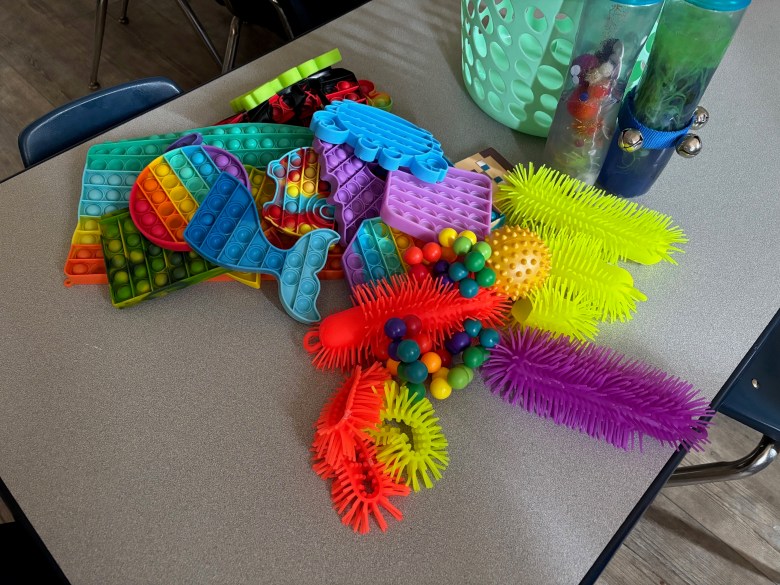
    Severance, whose son is now 8, works at the center these days, leading the 3-year-old room, which includes two children who are largely nonverbal. She’s made the classroom more inclusive, adding fidget toys for children with sensory issues, rearranging the classroom to create calming areas, providing communication books to nonverbal children so they can more easily express needs and wants, and teaching everyone some sign language. 

    “For a while there was segregation in the classroom” between the kids with disabilities and those without, Severance said. But that’s lessened with the changes. “Inclusion has been good for the kids who are verbal — and nonverbal,” she said.

    Related: Where do kids with disabilities go for child care?  

    As in Ohio, state officials in Vermont turned to online training to help ensure young children with disabilities aren’t denied quality care. The state should soon debut the first parts of a new training program, focusing on outreach to child care administrators and support for neurodivergent children. The state wanted to focus on center leaders first because “directors that are comfortable with inclusion lead programs that are comfortable with inclusion,” said Dawn Rouse, the director of statewide systems in Vermont’s Child Development Division.   

    One tool for supporting and calming children with sensory issues is keeping a healthy supply of fidget toys and Pop-Its on hand. Credit: Sarah Carr/The Hechinger Report

    Vermont also pumped millions of dollars into a separate program, known as the Special Accommodations Grant, that supports young children with disabilities. Since 2009 the state has set aside $300,000 a year that child care centers can tap to provide services for individual children with disabilities. It might help buy specialized equipment for a child with cerebral palsy, for instance, or be used to hire a full- or part-time aide.

    The $300,000 has been maxed out every year, Rouse said. And after the pandemic, the need — and the number of applications — surged.

    As a result, the state allocated some federal American Rescue Plan and Preschool Development Grant dollars to increase spending on the program by about sevenfold — to between $2 million and $2.5 million annually — an amount Rouse still describes as a “Band-Aid.” Without access to the grants, “we see a lot of children being asked to leave programs,” Rouse said. “That’s not good for any child, but for children with specialized developmental needs it’s particularly bad.” 

    Over time, Likely hopes, her Ohio center can play a small role in reducing that instability, although the center hasn’t yet been able to work with all such children it wants to. Likely recalls one toddler with a severe disability who climbed up anything he could. There wasn’t enough money to pay for what the child really needed: a full-time aide. “It’s hard when you know you’ve tried but still have to say no,” she said. “That breaks my heart more than anything.” 

    On one June morning, the center’s teachers acknowledged and celebrated several milestones in its work on inclusion, big and small. One child in the 3-year-old classroom with fine and gross motor challenges was drinking independently from a bottle. The preschool classroom held its first graduation ceremony, translated partly into sign language. All of the kids, no matter their challenges, were set to go on field trips to Dairy Queen and the zoo.

    Likely dreams of someday running a center where about half of the children have a disability or delay. It may be years off, she said, but as with the milestones she sees scores of children at the center reach every day, “There’s a way — if there’s a will.” 

    Sarah Carr is a fellow at New America, focused on reporting on early childhood issues. 

    Contact contributing editor Sarah Carr at [email protected].   

    This story about children with disabilities was produced by The Hechinger Report, a nonprofit, independent news organization focused on inequality and innovation in education. Sign up for the Hechinger newsletter.

    The Hechinger Report provides in-depth, fact-based, unbiased reporting on education that is free to all readers. But that doesn’t mean it’s free to produce. Our work keeps educators and the public informed about pressing issues at schools and on campuses throughout the country. We tell the whole story, even when the details are inconvenient. Help us keep doing that.

    Join us today.

    Source link

  • Speech therapy association proposes eliminating ‘DEI’ in its standards

    Speech therapy association proposes eliminating ‘DEI’ in its standards

    Scores of speech therapists across the country erupted last month when their leading professional association said it was considering dropping language calling for diversity, equity and inclusion and “cultural competence” in their certification standards. Those values could be replaced in some standards with a much more amorphous emphasis on “person-centered care.” 

    “The decision to propose these modifications was not made lightly,” wrote officials of the American Speech-Language-Hearing Association (ASHA) in a June letter to members. They noted that due to recent executive orders related to DEI, even terminology that “is lawfully applied and considered essential for clinical practice … could put ASHA’s certification programs at risk.” 

    Yet in the eyes of experts and some speech pathologists, the change would further imperil getting quality help to a group that’s long been grossly underserved: young children with speech delays who live in households where English is not the primary language spoken. 

    “This is going to have long-term impacts on communities who already struggle to get services for their needs,” said Joshuaa Allison-Burbank, a speech language pathologist and Navajo member who works on the Navajo Nation in New Mexico where the tribal language is dominant in many homes.

    In a written statement after this story published, a spokesperson for the association stressed that the proposed changes have not been finalized, and said that member feedback is currently under review.

    “ASHA remains steadfast in our belief that all health care services should be non-discriminatory and address the needs of every individual,” the spokesperson added. She characterized the proposed changes as “an evolution, not a retreat,” and noted that person-centered care aims to ensure “clinicians are equipped to deliver services tailored to each person’s context, including their lived experience, language background, cultural identity, and home environment.”

    Across the country, speech therapists have been in short supply for many years. Then, after the pandemic lockdown, the number of young children diagnosed annually with a speech delay more than doubled. Amid that broad crisis in capacity, multilingual learners are among those most at risk of falling through the cracks. Less than 10 percent of speech therapists are bilingual.

    A shift away from DEI and cultural competence — which involves understanding and trying to respond to differences in children’s language, culture and home environment — could have a devastating effect at a time when more of both are needed to reach and help multilingual learners, several experts and speech pathologists said. 

    They told me about a few promising strategies for strengthening speech services for multilingual infants, toddlers and preschool-age children with speech delays — each of which involves a heavy reliance on DEI and cultural competence.

    Embrace creative staffing. The Navajo Nation faces severe shortages of trained personnel to evaluate and work with young children with developmental delays, including speech. So in 2022, Allison-Burbank and his research team began providing training in speech evaluation and therapy to Native family coaches who are already working with families through a tribal home visiting program. The family coaches provide speech support until a more permanent solution can be found, said Allison-Burbank.

    Home visiting programs are “an untapped resource for people like me who are trying to have a wider reach to identify these kids and get interim services going,” he said. (The existence of both the home visiting program and speech therapy are under serious threat because of federal cuts, including to Medicaid.) 

    Use language tests that have been designed for multilingual populations. Decades ago, few if any of the exams used to diagnose speech delays had been “normed” — or pretested to establish expectations and benchmarks — on non-English-speaking populations.

    For example, early childhood intervention programs in Texas were required several years ago to use a single tool that relied on English norms to diagnose Spanish-speaking children, said Ellen Kester, the founder and president of Bilinguistics Speech and Language Services in Austin, which provides both direct services to families and training to school districts. “We saw a rise in diagnosis of very young (Spanish-speaking) kids,” she said. That isn’t because all of the kids had speech delays, but due to fundamental differences between the two languages that were not reflected in the test’s design and scoring. (In Spanish, for instance, the ‘z’ sound is pronounced like an English ‘s.’)

    There are now more options than ever before of screeners and tools normed on multilingual, diverse populations; states, agencies and school districts should be selective, and informed, in seeking them out, and pushing for continued refinement.

    Expand training — formal and self-initiated — for speech therapists in the best ways to work with diverse populations. In the long-term, the best way to help more bilingual children is to hire more bilingual speech therapists through robust DEI efforts. But in the short term, speech therapists can’t rely solely on interpreters — if one is even available — to connect with multilingual children.

    That means using resources that break down the major differences in structure, pronunciation and usage between English and the language spoken by the family, said Kester. “As therapists, we need to know the patterns of the languages and what’s to be expected and what’s not to be expected,” Kester said.

    It’s also crucial that therapists understand how cultural norms may vary, especially as they coach parents and caregivers in how best to support their kids, said Katharine Zuckerman, professor and associate division head of general pediatrics at Oregon Health & Science University. 

    “This idea that parents sit on the floor and play with the kid and teach them how to talk is a very American cultural idea,” she said. “In many communities, it doesn’t work quite that way.”

    In other words, to help the child, therapists have to embrace an idea that’s suddenly under siege: cultural competence,

    Quick take: Relevant research

    In recent years, several studies have homed in on how state early intervention systems, which serve children with developmental delays ages birth through 3, shortchange multilingual children with speech challenges. One study based out of Oregon, and co-authored by Zuckerman, found that speech diagnoses for Spanish-speaking children were often less specific than for English speakers. Instead of pinpointing a particular challenge, the Spanish speakers tended to get the general “language delay” designation. That made it harder to connect families to the most tailored and beneficial therapies. 

    A second study found that speech pathologists routinely miss critical steps when evaluating multilingual children for early intervention. That can lead to overdiagnosis, underdiagnosis and inappropriate help. “These findings point to the critical need for increased preparation at preprofessional levels and strong advocacy … to ensure evidence-based EI assessments and family-centered, culturally responsive intervention for children from all backgrounds,” the authors concluded. 

    Carr is a fellow at New America, focused on reporting on early childhood issues. 

    Contact the editor of this story, Christina Samuels, at 212-678-3635, via Signal at cas.37 or [email protected].

    This story about the speech therapists association was produced by The Hechinger Report, a nonprofit, independent news organization focused on inequality and innovation in education. Sign up for the Hechinger newsletter.

    The Hechinger Report provides in-depth, fact-based, unbiased reporting on education that is free to all readers. But that doesn’t mean it’s free to produce. Our work keeps educators and the public informed about pressing issues at schools and on campuses throughout the country. We tell the whole story, even when the details are inconvenient. Help us keep doing that.

    Join us today.

    Source link

  • Hundreds Waitlisted for Pre-K in South Carolina Despite Thousands of Open Seats – The 74

    Hundreds Waitlisted for Pre-K in South Carolina Despite Thousands of Open Seats – The 74


    Get stories like this delivered straight to your inbox. Sign up for The 74 Newsletter

    COLUMBIA — Hundreds of 4-year-olds across South Carolina are on waitlists to access state-funded preschool programs, even though there are thousands of open seats, according to a report presented Monday to the state Education Oversight Committee.

    The state funds a dual system of full-day kindergarten for 4-year-olds deemed “at risk.” Students are eligible under state law if they qualify for Medicaid or free or reduced-price meals, or if they are homeless, in foster care or show developmental delays. Many public school districts use local property tax dollars to expand that eligibility.

    The state Department of Education oversees programs in public schools, while First Steps, a separate state agency, oversees state-funded classes in approved private schools and child care centers.

    As of November, 400 4-year-olds were waiting for spots to open up to enroll at their local public school. At the same time, First Steps 4K reported more than 2,300 open seats, often in the same counties as the districts with the longest waitlists, according to the report.

    “It’s just a matter of finding an open seat for a child on a waitlist or finding an eligible child for the open seat,” said Jenny May, a committee researcher who presented the report.

    Because 4K is a one-year program, students who are on the waitlist are unlikely to end up in a preschool program before starting kindergarten. Children need at least 120 days of preschool to prepare, so even if a slot happens to open up toward the end of the school year, they will start kindergarten less ready than other 5-year-olds, according to the study.

    It’s not clear why some 4-year-olds are on a waiting list for a public school when vacancies exist in private programs, May said.

    In some cases, the issue could be that another preschool program isn’t available nearby. The four counties with the longest waitlists — Lexington, Anderson, Berkeley and Newberry — all have at least one First Steps 4K program with availability, according to the report. However, that doesn’t account for potential cross-county drives.

    Other parents may not know that other options are available, May said. Having a person designated to help direct parents to other preschool options, such as the nearest First Steps 4K program with open seats, could help reduce that waitlist, May said.

    “It’s likely that if we had a more efficient process, we could serve most of the 400 kids on a waitlist on one of the First Steps seats,” May said.

    The state already has several websites meant to help parents figure out what programs they’re eligible for and how to enroll. Palmetto Pre-K, launched in 2020, tells parents whether they’re eligible for state-funded preschool programs. First Five SC does the same but includes all early childhood programs with federal or state funding.

    But having a person parents can call, or who can reach out to families with children on waitlists, could help reach some parents who might not know about the websites or have other concerns, the study suggests. That person, who the committee dubbed a 4K navigator, could then talk parents through the differences in programs, find available seats and answer any other questions parents might have, researchers said.

    First Steps 4K has a similar program, in which applicants are directed to a central phone line or website that helps parents find the right fit for their child. That has helped prevent First Steps from having its own waitlist, May said. The 4K navigators, who the study suggested trying out in areas with the largest waitlists first, would have a broader knowledge of pre-K programs, the report said.

    If a school district has a persistent waitlist of more than 20 students, that suggests the population has risen in that area, and state officials should consider giving the district more funding to create enough slots for those students, the report suggested.

    The waitlisted students represent less than 1% of students who are eligible for the program but not enrolled. More than 18,000 4-year-olds, or about 55% of all eligible, are living in poverty but not enrolled in a 4K program, according to the report.

    That’s a decrease from the 2022-2024 school year, when 60% of eligible students were not enrolled in districts. Still, it’s not enough, May said.

    Even if every student on a waitlist enrolled in one of the available spots, programs would have space left over to take on at least 1,900 more students, according to the report. That suggests there are barriers other than program space keeping parents from enrolling their students in state-funded preschool, May said.

    In many cases, the problem might be that parents don’t know about 4K programs or their benefits, May said. The state should put more funding and effort into outreach to help those students, the report suggests.

    Data shows preschool programs are highly beneficial, helping students learn skills in reading, math and socialization, studies have found. According to the report, at-risk students who attended a state-funded pre-K program were more likely to be prepared for school than their counterparts who didn’t, according to the report.

    “So, we want those students who are eligible and not served to be able to access it, and we definitely want those students who are on a waitlist to be able to access the program,” said Dana Yow, executive director of the committee.

    SC Daily Gazette is part of States Newsroom, a nonprofit news network supported by grants and a coalition of donors as a 501c(3) public charity. SC Daily Gazette maintains editorial independence. Contact Editor Seanna Adcox for questions: [email protected].


    Get stories like these delivered straight to your inbox. Sign up for The 74 Newsletter

    Source link

  • States try to tackle child care shortages — by lowering standards

    States try to tackle child care shortages — by lowering standards

    When this year’s legislative session launched in Idaho, early childhood experts and advocates were hopeful that the state, which has a shortage of child care, would invest more in early learning programs. Instead, lawmakers proposed what may be the most extreme effort yet to deregulate child care in America: The bill called for eliminating state required staff-to-child ratios altogether, instead allowing child care providers to set their own.

    While the effort was met with fierce opposition in the state, it represents a trend gaining momentum in the country. Rather than investing in the struggling child care industry, more than a dozen states have proposed lowering the minimum age to work with children, easing education and training requirements, and raising group sizes and ratios. (Read my December story on this growing deregulation movement. I investigated such efforts in states including Kansas and Iowa.)

    The deregulation measures come at a time when many early childhood programs face federal funding and staffing cuts. Head Start programs were hit by a federal funding freeze and struggled to draw down payments even after the Trump administration announced Head Start was exempt from the freeze. Then, earlier this month, the Trump administration closed five of the Administration for Children and Families’ (ACF) regional offices and placed staff from those offices on leave, threatening support for Head Start, which is overseen by ACF, as well as programs that receive federal child care subsidies. Last week, USA Today reported that President Donald Trump is considering a budget proposal that would eliminate funding for Head Start altogether.

    At the state level, Idaho lawmakers are not the only ones to propose child care deregulation legislation this year. Minnesota lawmakers also issued similar proposals, including increasing family child care capacity limits and relaxing ratios in rural areas. Another bill in the state proposes lowering the age requirement of assistant teachers from 18 to 16. In Kansas, where a lawmaker proposed hiring 14-year-olds to help in child care classrooms in 2023, a new bill aims to reduce training requirements. An Indiana measure would loosen staff-to-child ratios based on the ratios set in neighboring states, and one in North Carolina would increase maximum group sizes for young children. And in Florida, lawmakers have called for an abbreviated inspection plan for some child care programs.

    While deregulation is more common in red states, there have also been some recent efforts to invest in early learning programs that transcend the red-blue divide. In Georgia, Gov. Brian Kemp proposed an additional $14 million aimed at reducing preschool class sizes and $5.5 million to address issues with the state’s child care subsidy program for lower-income families. Indiana Gov. Mike Braun called for more spending to eliminate the state’s waitlist for child care subsidies. And South Carolina Gov. Henry McMaster proposed $20 million to continue a program that provides wage supplements to child care workers.

    In Idaho, the deregulation legislation was eventually amended to loosen the state-mandated ratios — without eliminating them altogether. It also forbids municipalities from setting more stringent child care regulations than the state, something that was allowed in the past and allowed cities to set a “higher standard” for programs, said Martin Balben, director of strategic initiatives for the Idaho Association for the Education of Young Children.

    “I think municipalities are still kind of reeling with how to confront that reality,” he said. “It remains to be seen how [they] are going to handle their lack of local control in this area moving forward.”

    Experts say while deregulation is nothing new, the recent momentum is troubling. “We absolutely want to make sure that states are not rolling back their health and safety measures,” said Diane Girouard, state policy senior analyst at Child Care Aware of America. “We want to make sure that they’re not compromising children. … There are no quick fixes.”

    Contact staff writer Jackie Mader at 212-678-3562 or [email protected].

    This story about child care services was produced by The Hechinger Report, a nonprofit, independent news organization focused on inequality and innovation in education. Sign up for the Hechinger newsletter.

    The Hechinger Report provides in-depth, fact-based, unbiased reporting on education that is free to all readers. But that doesn’t mean it’s free to produce. Our work keeps educators and the public informed about pressing issues at schools and on campuses throughout the country. We tell the whole story, even when the details are inconvenient. Help us keep doing that.

    Join us today.

    Source link

  • Head Start is in turmoil

    Head Start is in turmoil

    In 1965, President Lyndon Johnson launched “Project Head Start,” a summer program intended to help children from low-income families prepare for school. Sixty years later, Head Start has expanded into a multi-billion program operating in all 50 states, serving preschoolers as well as infants, toddlers and pregnant women.

    But the program is facing serious challenges, such as recent disruptions in federal funding, and cuts among staffers who oversee the program. In a recent feature story for The Hechinger Report, reporter Anya Kamenetz delved into Head Start’s uncertain future. I asked Anya what she learned from her reporting. Her responses have been edited for length and clarity.

    Q: Head Start is celebrating its 60th anniversary this year, and has persevered through both Democratic and Republican presidential administrations. However, it seems to be uniquely vulnerable this year. What is happening that puts the program at risk?

    A: A lot of the federal staff has been fired. And Project 2025, which the Trump administration has been following closely, calls for eliminating the program altogether. (Editor’s note: this week, the Department of Health and Human Services, which oversees Head Start, placed staffers at five of Head Start’s 10 regional offices on administrative leave.)

    Q: Critics of Head Start say that the program is poorly run and that the money could be better spent at the local level. According to its supporters, why is Head Start still an important program?

    A: The program has always been severely underfunded, serving only a fraction of eligible children. The lapses in quality that we know about have come to light in part because the program has better oversight and higher quality standards than the existing patchwork of subsidized, nonprofit and for-profit programs otherwise available across the country. Head Start has been shown to improve long-term educational outcomes. In addition, lawmakers are threatening cuts to Head Start alongside cuts to programs that support families across the board, from food stamps to Medicaid

    Q: States and local communities are stepping in to expand their early childhood offerings. Did state officials share with you if they are ready to step in should Head Start be cut or if the funding shifts?

    A: Yes, a bright spot in my article was that in states like Vermont and New Mexico where they have been committed to expanding access to childcare, they are intending to keep this a priority even if federal funding shifts.

    Read the full story about the future of Head Start.

    This story about Head Start was produced by The Hechinger Report, a nonprofit, independent news organization focused on inequality and innovation in education. Sign up for the Hechinger newsletter.

    The Hechinger Report provides in-depth, fact-based, unbiased reporting on education that is free to all readers. But that doesn’t mean it’s free to produce. Our work keeps educators and the public informed about pressing issues at schools and on campuses throughout the country. We tell the whole story, even when the details are inconvenient. Help us keep doing that.

    Join us today.

    Source link