Tag: Predatory

  • Higher Education Inquirer : Divestment from Predatory Education Stocks: A Moral Imperative

    Higher Education Inquirer : Divestment from Predatory Education Stocks: A Moral Imperative

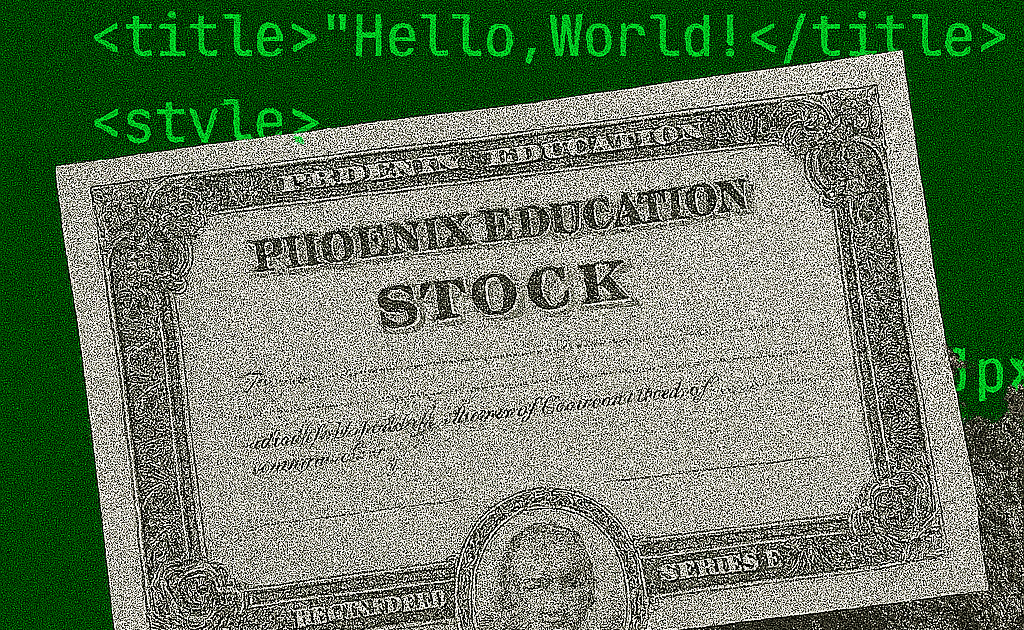
    Calls for divestment from exploitative industries have long been part of movements for social and economic justice—whether opposing apartheid, fossil fuels, or private prisons. Today, another sector demands moral scrutiny: the network of for-profit education corporations and student loan servicers that have turned higher learning into a site of mass indebtedness and despair. From predatory colleges to the companies that profit from collecting on student debt, the system functions as a pipeline of extraction. For those who believe education should serve the public good, the issue is not merely financial—it is moral.

    The Human Cost of Predatory Education

    For decades, for-profit college chains such as Corinthian Colleges, ITT Tech, the University of Phoenix, DeVry, and Capella targeted low-income students, veterans, single parents, and people of color with high-pressure marketing and promises of career advancement. These institutions, funded primarily through federal student aid, often charged premium tuition for substandard programs that left graduates worse off than when they began.

    When Corinthian and ITT Tech collapsed, they left hundreds of thousands of students with worthless credits and mountains of debt. But the collapse did not end the exploitation—it simply shifted it. The business model has re-emerged in online form through education technology and “online program management” (OPM) firms such as 2U, Coursera, and Academic Partnerships. These firms, in partnership with elite universities like Harvard, Yale, and USC, replicate the same dynamics of inflated costs, opaque contracts, and limited accountability.

    The Servicing of Debt as a Business Model

    Beyond the schools themselves, student loan servicers and collectors—Maximus, Sallie Mae, and Navient among them—have built immense profits from managing and pursuing student debt. Sallie Mae, once a government-sponsored enterprise, was privatized in the 2000s and evolved into a powerful lender and loan securitizer. Navient, its spinoff, became notorious for deceptive practices and aggressive collections that trapped borrowers in cycles of delinquency.

    Maximus, a major federal contractor, now services defaulted student loans on behalf of the U.S. Department of Education. These companies profit directly from the misery of borrowers—many of whom are victims of predatory schools or structural inequality. Their incentive is not to liberate students from debt, but to sustain and expand it.

    The Role of Institutional Investors

    The complicity of institutional investors cannot be ignored. Pension funds, endowments, and major asset managers have consistently financed both for-profit colleges and loan servicers, even after repeated scandals and lawsuits. Public sector pension funds—ironically funded by educators—have held stock in Navient, Maximus, and large for-profit college operators. Endowments that pride themselves on ethical or ESG investing have too often overlooked education profiteering.

    Investment firms like BlackRock, Vanguard, and State Street collectively hold billions of dollars in these companies, stabilizing an industry that thrives on the financial vulnerability of students. To profit from predatory education is to participate, however indirectly, in the commodification of aspiration.

    Divestment as a Moral and Educational Act

    Divesting from predatory education companies and loan servicers is not just an act of conscience—it is an educational statement in itself. It affirms that learning should be a vehicle for liberation, not a mechanism of debt servitude. When universities, pension boards, and faith-based investors divest from corporations like Maximus, Navient, and 2U, they are reclaiming education’s moral purpose.

    The divestment movement offers a broader civic lesson: that profit and progress are not synonymous, and that investment must align with justice. Faith communities, student debt activists, and labor unions have made similar stands before—against apartheid, tobacco, and fossil fuels. The same principle applies here. An enterprise that depends on deception, coercion, and financial harm has no place in a socially responsible portfolio.

    A Call to Action

    Transparency is essential. Pension boards, university endowments, and foundations must disclose their holdings in for-profit education and student loan servicing companies. Independent investigations should assess the human consequences of these investments, particularly their disproportionate impact on women, veterans, and people of color.

    The next step is moral divestment. Educational institutions, public pension systems, and religious organizations should commit to withdrawing investments from predatory education stocks and debt servicers. Funds should be redirected to debt relief, community college programs, and initiatives that restore trust in education as a public good.

    The corporate education complex—spanning recruitment, instruction, lending, and collection—has monetized both hope and hardship. The time has come to sever public and institutional complicity in this cycle. Education should empower, not impoverish. Divestment is not merely symbolic—it is a declaration of values, a demand for accountability, and a reaffirmation of education’s original promise: to serve humanity rather than exploit it.


    Sources:

    • U.S. Department of Education, Borrower Defense to Repayment Reports

    • Senate HELP Committee, For Profit Higher Education: The Failure to Safeguard the Federal Investment and Ensure Student Success (2012)

    • Consumer Financial Protection Bureau (CFPB) enforcement actions against Navient and Sallie Mae

    • The Century Foundation, Online Program Managers and the Public Interest

    • Student Borrower Protection Center, Profiting from Pain: The Financialization of the Student Debt Crisis

    • Higher Education Inquirer archives

    Source link

  • Selling Prestige in a Predatory Credential Market

    Selling Prestige in a Predatory Credential Market

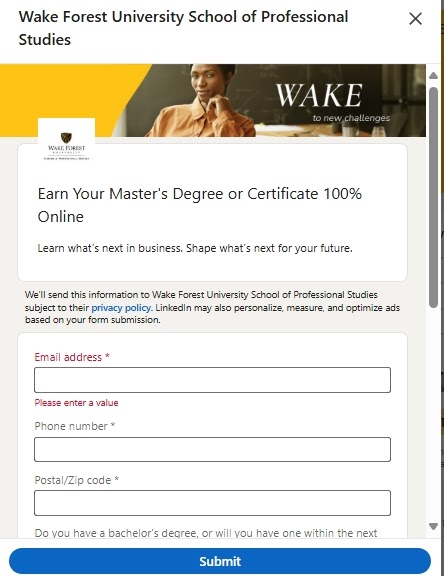
    Wake Forest’s online offerings, now delivered in collaboration with Kaplan, are dressed in glowing promotional language. Prospective students are promised access to “a global network of 80,000+ alumni,” “1-on-1 guidance from a dedicated Student Success Manager,” and a curriculum shaped by “a Program Advisory Board of diverse business leaders.” The university assures working professionals that they can “earn a 100% online master’s degree or graduate certificate” on their own terms, with a “streamlined admissions process” and “flexible courses.”

    But strip away the buzzwords and what’s left is a degree-granting operation outsourced to a for-profit education company with a controversial legacy. Kaplan, now owned by Graham Holdings (formerly the parent company of The Washington Post), has been at the center of lawsuits, regulatory scrutiny, and allegations of exploitative practices in its higher ed ventures—including its role in managing Purdue Global, formerly Kaplan University. The company has a long history of targeting vulnerable populations—especially working-class adults—with high-cost, low-value credentials that often don’t lead to the promised career outcomes.

    So why is Wake Forest—an elite university with a storied reputation—collaborating with Kaplan?

    The answer is simple: profit and scale.

    In an era when even wealthy private universities are looking to expand their revenue streams, online education has become a lucrative frontier. But building and managing online degree programs in-house requires serious investment, time, and expertise. Enter Kaplan, which provides the infrastructure, marketing, enrollment management, and student support—all in exchange for a share of the revenue.

    What does this mean for students?

    It means that Wake Forest’s name is now being used to sell online degrees to mid-career professionals under the promise of prestige, convenience, and upward mobility—without the full intellectual, cultural, or communal experience that Wake Forest once symbolized. The degrees may bear the Wake Forest seal, but they are increasingly indistinguishable from the mass-produced credentials churned out by dozens of other universities that have sold access to their brands through partnerships with Online Program Managers (OPMs) like Kaplan, 2U, Wiley, and Coursera.

    The “1-on-1 Student Success Manager” may sound supportive, but in practice these positions are often little more than call center roles staffed by Kaplan employees trained to ensure retention and upsell future courses—not to engage in meaningful academic mentorship.

    The curriculum may be “developed and led by recognized faculty and industry experts,” but in many cases these are adjunct instructors or contract workers who have limited interaction with students and little say in the structure or pedagogy of the courses. This model contributes to the broader exploitation of contingent academic labor—an issue Wake Forest, like many elite universities, prefers not to discuss.

    And the promise of becoming a leader “from anywhere” with a Wake Forest SPS degree? That too should be questioned. These degrees exist in an increasingly saturated credential market where employers are skeptical, return on investment is uncertain, and students often find themselves saddled with debt and disappointment.

    If Wake Forest were truly committed to ethical leadership, it would take a hard look at the implications of commodifying its brand through a partnership with a company like Kaplan. Instead, it has chosen to chase market share and tuition revenue at the expense of its academic credibility—and at the risk of misleading students who believe they’re buying into the full Wake Forest experience.

    The truth is this: Wake Forest is selling the illusion of prestige, wrapped in a glossy brochure of online convenience and corporate optimism. In reality, it’s another cog in a profit-driven machine that markets higher education as a product rather than a public good. And that’s not transformative change. That’s business as usual in the credential economy.

    Source link

  • Trump Team Weakens Bipartisan Law That Protects Students and Veterans From Predatory Colleges (David Halperin)

    Trump Team Weakens Bipartisan Law That Protects Students and Veterans From Predatory Colleges (David Halperin)

    On the eve of the 4th of July holiday, when they probably hoped no one was paying attention, the Trump Department of Education issued an Interpretive Rule that will make it easier for for-profit colleges to evade regulations aimed at protecting students, and especially student veterans and military service members, from low-quality schools.

    The Department’s 90-10 rule, created by Congress, requires for-profit colleges to obtain at least ten percent of their revenue from sources other than taxpayer-funded federal student grants and loans, or else — if they flunk two years in a row — lose eligibility for federal aid. The purpose is to remove from federal aid those schools of such poor quality that few students, employers, or scholarship programs would put their own money into them.

    For decades, low quality schools have been able to avoid accountability through a giant loophole: only Department of Education funding counted on the federal side of the 90-10 ledger, while other government funding, including GI Bill money from the VA, and tuition assistance for active duty troops and their families from the Pentagon, counted as non-federal. That situation was particularly bad because it motivated low-quality predatory schools, worried about their 90-10 ratios, to aggressively target U.S. veterans and service members for recruitment.

    After years of efforts by veterans organizations and other advocates to close the loophole, Congress in 2021 passed, on a bipartisan basis, and President Biden signed, legislation that appropriately put all federal education aid, including VA and Defense Department money, on the federal side of the ledger.

    The Department was required by the new law to issue regulations specifying in detail how this realignment would work, and the Department under the Biden administration did so in 2022, after engaging in a legally-mandated negotiated rulemaking that brought together representatives of relevant stakeholders. In an unusual development, that rulemaking actually achieved consensus among the groups at the table, from veterans organizations to the for-profit schools themselves, on what the final revised 90-10 rule should be.

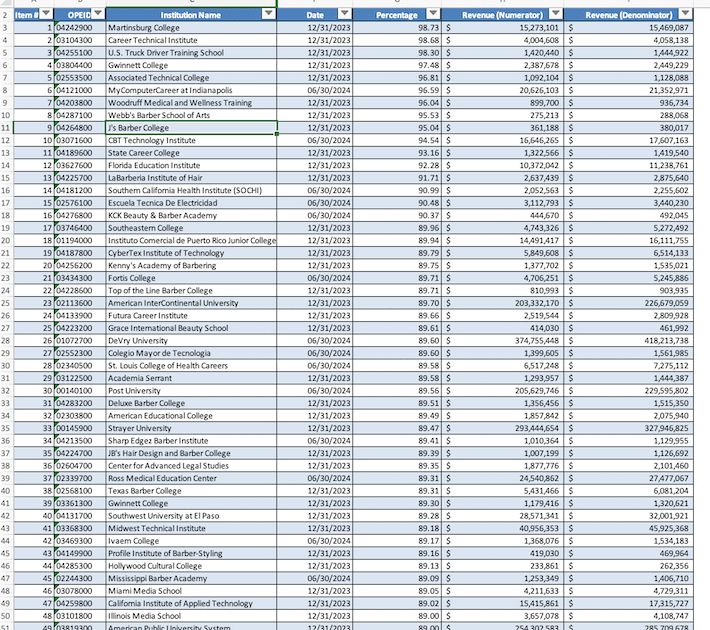
    The new rule took effect in 2023, and when the Department released the latest 90-10 calculations, for the 2023-24 academic year, sixteen for-profit colleges had flunked, compared with just five the previous year. These were mostly smaller schools, led by West Virginia’s Martinsburg College, which got 98.73 percent of its revenue from federal taxpayer dollars, and Washington DC’s Career Technical Institute, which reported 98.68 percent. Another 36 schools, including major institutions such as DeVry University, Strayer University, and American Public University, came perilously close to the line, at 89 percent or higher.

    The education department last week altered the calculation by effectively restoring an old loophole that allowed for-profit colleges to use revenue from programs that are ineligible for federal aid to count on the non-federal side. That loophole was expressly addressed, via a compromise agreement, after Department officials discussed the details with representatives of for-profit colleges, during the 2022 negotiated rulemaking meetings.

    All the flunking or near-flunking schools can now get a new, potentially more favorable, calculation of their 90-10 ratio under the Trump administration’s re-interpretation of the rule.

    In the lawless fashion of the Trump regime, the Department has now undermined a provision of its own regulation without going through the required negotiated rulemaking process. (The Department’s notice last week included a labored argument about why its action was lawful.)

    As it has done multiple times over its first six months, the Trump Department of Education, under Secretary Linda McMahon, has again taken a step that allows poor-quality predatory for-profit colleges to rip off students and taxpayers.

    Source link

  • (HR 1391). Restoring the GI Bill for Vets Ripped Off by Predatory Schools

    (HR 1391). Restoring the GI Bill for Vets Ripped Off by Predatory Schools

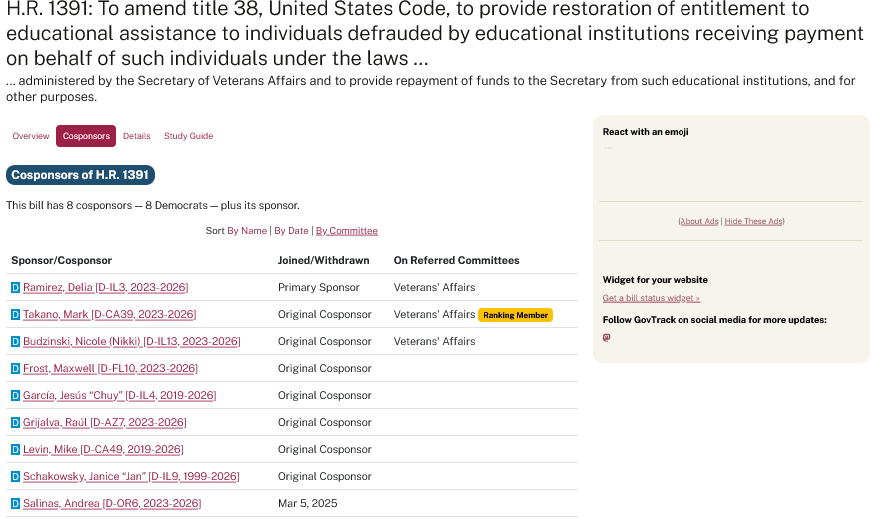
    The US House Bill to restore GI Bill funds to those who have been ripped off by predatory schools has had little traction so far.  While politicians like to say “thank you for your service,” only nine House members have signed on to the Bill, all Democrats. Both Republicans and Democrats have received funds by these schools, which also have lobbyists in DC to promote their agenda. 

    Source link