
Tag: PreK

  • Colorado’s 3rd year of Universal Pre-K Gets Off the Ground – The 74

    Colorado’s 3rd year of Universal Pre-K Gets Off the Ground – The 74


    Join our zero2eight Substack community for more discussion about the latest news in early care and education. Sign up now.

    Sign up for Chalkbeat Colorado’s free daily newsletter to get the latest reporting from us, plus curated news from other Colorado outlets, delivered to your inbox.

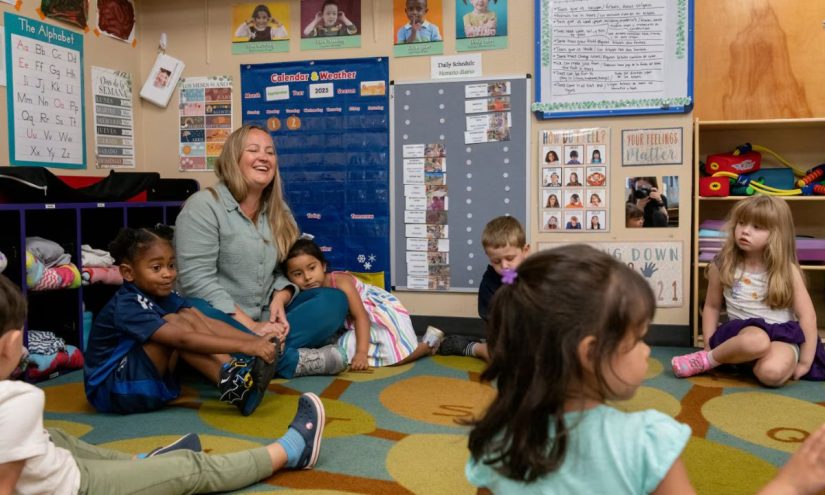
    The little boy clung to his mother as she carried him through the wooden half-door of the preschool classroom on Tuesday morning. Tears streamed down his face. It was going to be a tough drop-off.

    While other children finished bananas, raisin bagels, and milk, Vraja Johnson, the lead teacher, ushered the mother and son toward a cozy corner in the back of the classroom. She spoke softly in English and Spanish to the nervous preschooler. Several minutes later, when his mother had slipped away, the boy nestled into a large blue beanbag clutching Tucker the Turtle, a stuffed animal that helps preschoolers understand that it’s OK to retreat into your shell — and to come back out when you’re ready.

    It was the first day of preschool in the Otters classroom at El Nidito, a bilingual child care program at The Family Center in Fort Collins. The little boy and his 11 classmates are among 40,000 children enrolled in Colorado’s universal preschool program this year. The $349 million program offers tuition-free preschool — typically a half day — to all children in the year before kindergarten.

    Now entering its third year, Colorado’s preschool for all program has smoothed out since its rocky rollout in 2023. At the time, application system errors, glitches in the state’s preschool matching algorithm, and last-minute reductions in preschool hours for some children caused widespread confusion and frustration.

    A national early childhood group recently ranked Colorado third in the country for the share of children served by state-funded preschool. Around 70% of the state’s 4-year-olds are enrolled in the program, which generally covers about $6,000 a year in preschool costs per child.

    But wrinkles remain. The state is still fighting two lawsuits brought by religious preschools that objected to non-discrimination rules protecting LGBTQ children, families, and employees. Both suits are pending in federal appeals court. And the national early childhood group found that Colorado meets only two of 10 benchmarks meant to ensure that preschool classrooms are high quality.

    Currently, the “universal preschool” label doesn’t indicate anything about the caliber of classroom a child will join. Rather, it simply indicates the state is paying for 10 to 30 hours of class time. Of about 2,000 preschools participating in the program, some have the state’s lowest rating and meet only basic health and safety standards.

    Others, including El Nidito, which has been around for 25 years, have the state’s highest rating.

    A morning in Johnson’s classroom makes it easy to see why. She and her co-teacher, an experienced sub named Maria Chavira, are warm, cheerful, and organized. Their young charges are curious, silly, and always in motion.

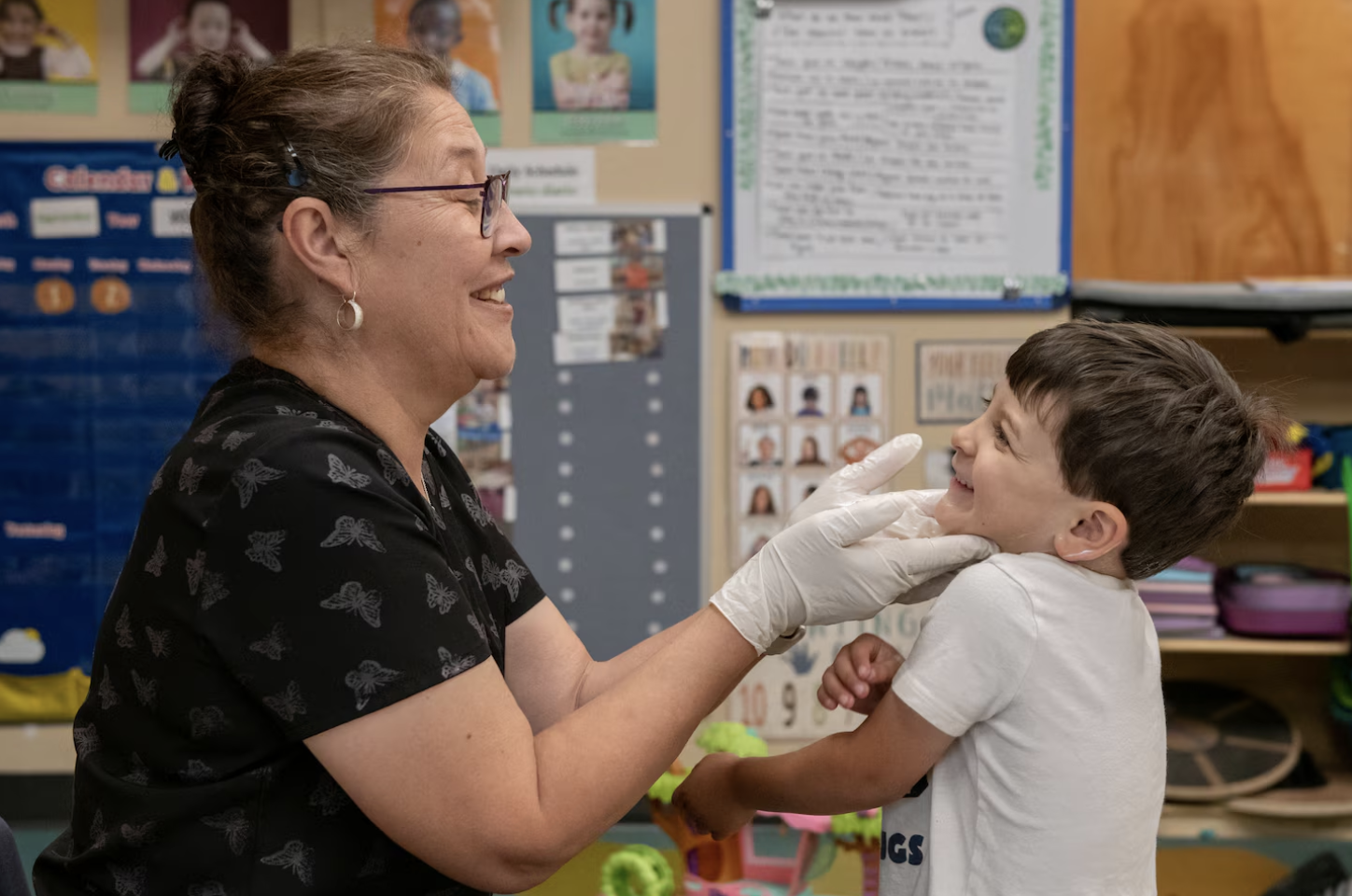
    Maria Chavira, a substitute teacher at the El Nidito child care program in Fort Collins, puts sunscreen on a preschool student before they go outside. (Rachel Woolf for Chalkbeat)

    During breakfast, two boys held bananas up to their ears like phones.

    “Ring, ring, ring. Hi, Henry,” one said as the other burst out laughing.

    Nearby at the sensory table, as one little boy poured dried pinto beans through a cardboard tube, he said, “Did you ever watch ‘Boss Baby?’ The baby is a bossssss. Babies can’t be bosses!”

    Meanwhile, the little boy who’d struggled to leave his mother was getting braver, slowly testing the waters of group play. One minute he crouched next to a little girl in front of a tree house play set. Later, he tried out bear and leopard hand puppets as the Boss Baby skeptic threw Tucker the Turtle up in the air next to him.

    Johnson, who switched from a sales and marketing career to early childhood education in 2007, seems to have a sixth sense for detecting imminent meltdowns, skirmishes, and rule-bending.

    She quickly peeled away from a conversation with a visitor when a little girl dressed in head-to-toe pink accidentally got a squiggle of red marker on her new cowboy boots.

    “Your mom can get that out. The markers are washable,” Johnson said as tears welled in the preschooler’s eyes.

    Then she averted the crisis with five words: “Do you want a hug?”

    Chalkbeat is a nonprofit news site covering educational change in public schools.


    Get stories like these delivered straight to your inbox. Sign up for The 74 Newsletter

    Source link

  • Hundreds Waitlisted for Pre-K in South Carolina Despite Thousands of Open Seats – The 74

    Hundreds Waitlisted for Pre-K in South Carolina Despite Thousands of Open Seats – The 74


    Get stories like this delivered straight to your inbox. Sign up for The 74 Newsletter
    COLUMBIA — Hundreds of 4-year-olds across South Carolina are on waitlists to access state-funded preschool programs, even though there are thousands of open seats, according to a report presented Monday to the state Education Oversight Committee.

    The state funds a dual system of full-day kindergarten for 4-year-olds deemed “at risk.” Students are eligible under state law if they qualify for Medicaid or free or reduced-price meals, or if they are homeless, in foster care or show developmental delays. Many public school districts use local property tax dollars to expand that eligibility.

    The state Department of Education oversees programs in public schools, while First Steps, a separate state agency, oversees state-funded classes in approved private schools and child care centers.

    As of November, 400 4-year-olds were waiting for spots to open up to enroll at their local public school. At the same time, First Steps 4K reported more than 2,300 open seats, often in the same counties as the districts with the longest waitlists, according to the report.

    “It’s just a matter of finding an open seat for a child on a waitlist or finding an eligible child for the open seat,” said Jenny May, a committee researcher who presented the report.

    Because 4K is a one-year program, students who are on the waitlist are unlikely to end up in a preschool program before starting kindergarten. Children need at least 120 days of preschool to prepare, so even if a slot happens to open up toward the end of the school year, they will start kindergarten less ready than other 5-year-olds, according to the study.

    It’s not clear why some 4-year-olds are on a waiting list for a public school when vacancies exist in private programs, May said.

    In some cases, the issue could be that another preschool program isn’t available nearby. The four counties with the longest waitlists — Lexington, Anderson, Berkeley and Newberry — all have at least one First Steps 4K program with availability, according to the report. However, that doesn’t account for potential cross-county drives.

    Other parents may not know that other options are available, May said. Having a person designated to help direct parents to other preschool options, such as the nearest First Steps 4K program with open seats, could help reduce that waitlist, May said.

    “It’s likely that if we had a more efficient process, we could serve most of the 400 kids on a waitlist on one of the First Steps seats,” May said.

    The state already has several websites meant to help parents figure out what programs they’re eligible for and how to enroll. Palmetto Pre-K, launched in 2020, tells parents whether they’re eligible for state-funded preschool programs. First Five SC does the same but includes all early childhood programs with federal or state funding.

    But having a person parents can call, or who can reach out to families with children on waitlists, could help reach some parents who might not know about the websites or have other concerns, the study suggests. That person, who the committee dubbed a 4K navigator, could then talk parents through the differences in programs, find available seats and answer any other questions parents might have, researchers said.

    First Steps 4K has a similar program, in which applicants are directed to a central phone line or website that helps parents find the right fit for their child. That has helped prevent First Steps from having its own waitlist, May said. The 4K navigators, who the study suggested trying out in areas with the largest waitlists first, would have a broader knowledge of pre-K programs, the report said.

    If a school district has a persistent waitlist of more than 20 students, that suggests the population has risen in that area, and state officials should consider giving the district more funding to create enough slots for those students, the report suggested.

    The waitlisted students represent less than 1% of students who are eligible for the program but not enrolled. More than 18,000 4-year-olds, or about 55% of all eligible, are living in poverty but not enrolled in a 4K program, according to the report.

    That’s a decrease from the 2022-2024 school year, when 60% of eligible students were not enrolled in districts. Still, it’s not enough, May said.

    Even if every student on a waitlist enrolled in one of the available spots, programs would have space left over to take on at least 1,900 more students, according to the report. That suggests there are barriers other than program space keeping parents from enrolling their students in state-funded preschool, May said.

    In many cases, the problem might be that parents don’t know about 4K programs or their benefits, May said. The state should put more funding and effort into outreach to help those students, the report suggests.

    Data shows preschool programs are highly beneficial, helping students learn skills in reading, math and socialization, studies have found. According to the report, at-risk students who attended a state-funded pre-K program were more likely to be prepared for school than their counterparts who didn’t, according to the report.

    “So, we want those students who are eligible and not served to be able to access it, and we definitely want those students who are on a waitlist to be able to access the program,” said Dana Yow, executive director of the committee.

    SC Daily Gazette is part of States Newsroom, a nonprofit news network supported by grants and a coalition of donors as a 501c(3) public charity. SC Daily Gazette maintains editorial independence. Contact Editor Seanna Adcox for questions: [email protected].


    Get stories like these delivered straight to your inbox. Sign up for The 74 Newsletter

    Source link