Tag: PrePandemic

  • SAT and ACT participation remains below pre-pandemic levels

    SAT and ACT participation remains below pre-pandemic levels

    This audio is auto-generated. Please let us know if you have feedback.

    Dive Brief:

    • Five years after COVID-19 shut down classrooms and shifted college admissions testing policies, the SAT and ACT are still drawing fewer students than during pre-pandemic years.
    • Some 1.38 million students took the ACT in 2025 compared to 1.78 million in 2019, and about 2 million students took the SAT this year versus 2.22 million in 2019, data released recently by the testing companies show. 
    • ​​​​​​​SAT scores, meanwhile, increased only slightly from the high school class of 2024 to the class of 2025, while ACT scores stayed about level. In both cases, scores fell below those from the pre-pandemic year of 2019. 

    Dive Insight:

    The slight uptick in SAT scores and level ACT scores for the high school graduating class of 2025 are still positive trends compared to last year, when average scores on both tests declined year-over-year compared to 2023.

    Still, SAT scores were still “substantially lower than average scores prior to the pandemic,” said College Board, the organization that publishes the test. In 2025, average SAT scores were 521 in reading and writing and 508 in math. In 2019, those averages were 10 points higher for reading and writing (531) and 20 points higher for math (528).

    The ACT average composite score, 19.4, also fell lower than the 2019 score of 20.7.

    For ACT test-takers, 30% met three or more of the four college readiness benchmarks in English, math, reading and science. The ACT benchmarks indicate that students have a 50% chance of earning a B or better in first-year college courses of the same subject and a 75% chance of a C or better. 

    Meanwhile, the dip in overall test takers for both exams continues a trend that dates to at least the pandemic, when colleges shifted toward test-optional policies. For the ACT, however, the numbers began declining much earlier. 

    While testing experts had expected the pandemic to trigger a shift away from K-12 standardized tests, ​​that didn’t materialize to a great degree and standardized and high-stakes testing are still core to K-12. 

    More than 90% of four-year colleges in the U.S. were not expected to require applicants for fall 2026 admission to submit ACT or SAT scores, according to data released in September by FairTest, a nonprofit that advocates for limiting college entrance exams. That’s over 2,000 of the nation’s bachelor-degree granting institutions. 

    Since fall 2020, the number of test-optional or test-free colleges have increased overall, the organization’s annual count shows.

    In the meantime, FairTest said the number of institutions requiring entrance exams minimally increased — from 154 for fall 2025 admissions to 160 for fall 2026 admissions.

    “While a handful of schools have reinstated testing requirements over the past two admissions cycles for a variety of institutional reasons and in response to external pressures, ACT/SAT-optional and test-blind/score-free policies remain the normal baseline in undergraduate admissions,” said FairTest Executive Director Harry Feder in a September statement. “Test-optional policies continue to dominate at national universities, state flagships, and selective liberal arts colleges.”


    Source link

  • Faculty salaries grow but still lag pre-pandemic era

    Faculty salaries grow but still lag pre-pandemic era

    This audio is auto-generated. Please let us know if you have feedback.

    Full-time faculty salaries rose for the second year in a row, even after adjusting for inflation, according to preliminary compensation data from the American Association of University Professors. 

    Fall 2024 salaries rose an average of 3.8% year over year, though inflation brought that growth down to an increase of 0.9%, according to the study.

    Even with two years of gains, faculty compensation has not fully recovered from the pandemic period, which brought a 7.5% effective drop in salaries from 2019 to 2022, AAUP said.

    Faculty’s inflation-adjusted salaries are still climbing out of their pandemic dip

    Year over year growth in nominal and real salaries from academic years 2017-18 to 2024-25.

    During an era of constrained budgets for many institutions — with job and program cuts making headlines — institutions are under a countervailing pressure to invest in their people and infrastructure after years of belt-tightening. Some colleges have given employees raises even as they make budget cuts in other areas.

    Preliminary data from AAUP’s latest faculty study shows salaries making some headway even in an era of slashed budgets. Fall’s salary increases for full-time faculty followed an inflation-adjusted 0.4% increase in 2023. 

    Those of course are averages, and figures varied across rank and job types. Associate professors’ salaries, for example, typically grew at a faster clip in the 2024-25 academic year than professors or assistant professors while lecturers’ salaries rose faster than all of those positions, with growth over 6% at the doctoral and master’s level institutions, according to AAUP’s study. 

    The survey also found continued gender disparities for professor compensation, with men earning nearly $26,000 more than women at doctoral institutions and about $8,000 more at master’s institutions. 

    College and university presidents typically made around four times or more than the average faculty member across most institution types, according to the study. 

    Part-time faculty made an average of $4,093 per class section in the 2023-24 academic year. But their compensation “varied widely” depending on where they worked, AAUP said.

    At private nonprofits, a part-time faculty member could make an average of $1,950 per section teaching at associate-granting institutions compared to $6,481 at bachelor’s-degree colleges. 

    Maximum payments could run into the tens of thousands of dollars across institution types. Meanwhile, some part-time faculty could earn as little as $700 per section teaching at a public university. 

    Just over one-third of colleges, 34.4%, made retirement plan contributions for at least some part-time faculty, and fewer than one-third, 32.5%, contributed to insurance premiums for at least some part-timers.

    The AAUP analysis is based on surveys of more than 800 U.S. institutions, with data on roughly 370,000 full-time and 90,000 part-time faculty members

    CUPA-HR also found annual salary growth across much of the sector in the 2024-25 academic year. 

    After factoring in inflation of 2.7%, salaries went up 1.2% for administrators, 1% for professional staff, 1.1% for general staff and 0.5% for nontenure-track faculty, according to CUPA-HR. Real salaries for tenure-track faculty fell 0.1%.

    As with AAUP, CUPA-HR noted that higher education salaries still fell short of pre-pandemic levels despite growth. The largest gaps are in salaries for tenure-track faculty — paid 10.2% less than in the pre-pandemic era after adjusting for inflation — and non-tenure-track teaching faculty, who are paid 7.6% less.

    Source link

  • Most Higher Ed Employees Received Raises This Year, but Salaries Still Fall Short of Pre-Pandemic Pay

    Most Higher Ed Employees Received Raises This Year, but Salaries Still Fall Short of Pre-Pandemic Pay

    by CUPA-HR | April 8, 2025

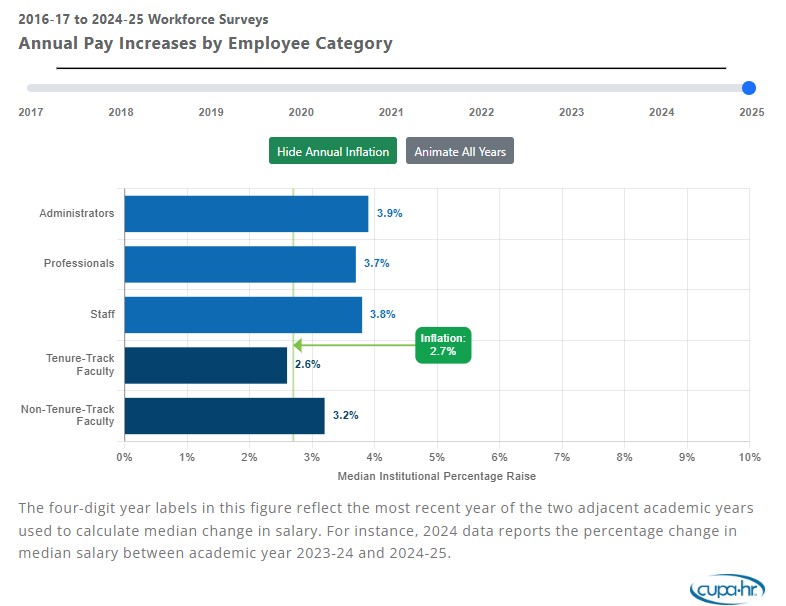
    New research from CUPA-HR shows that median pay increases for most higher education employees in 2024-25 remained strong, although they have dropped from the historically high increases seen in the previous two years. And although raises this past year for most employees outpaced inflation, they are still being paid less than they were in 2019-20 in inflation-adjusted dollars.

    The largest gap between pre-pandemic inflation-adjusted salaries and current salaries is for tenure-track faculty (who are paid 10.2% less), followed by non-tenure-track teaching faculty (paid 7.6% less). The smallest gap is for staff (paid 2.8% less).

    Some of the other key findings from an analysis of CUPA-HR’s higher ed workforce salary survey data from 2016-17 to 2024-25:

    • Staff employees continued to receive some of the highest pay increases compared to other workforce areas.
    • Non-tenure-track teaching faculty received a 3.2% salary increase, which is lower than last year’s high but still among the largest increases seen in recent years.
    • For the third consecutive year, tenure-track faculty received the lowest salary increase of all employee categories (2.6%). Across the nine years of data analyzed, tenure-track faculty salaries have not once exceeded the rate of inflation. This essentially means that — in real dollars — they have received salary decreases for the past decade.

    Explore this data and more in CUPA-HR’s newest interactive graphic.


    Source link