by Jim Ryan, The Hechinger Report January 19, 2026
The future of work will demand fluency in both science and technology. From addressing climate change to designing ethical AI systems, tomorrow’s challenges will require interdisciplinary thinkers who can navigate complex systems and harness the power of computation.
And that is why we can’t wait until high school or college to integrate computer science into general science.
The time to begin is during middle school, that formative period when students begin to shape their identities, interests and aspirations. If schools want to prepare young people for a future shaped by technology, they must act now to ensure that computer science is not a privilege for a few but a foundation for all.
One innovative way to close this gap is by integrating computer science into the general science curriculum at every middle school. This approach doesn’t require additional class periods or separate electives. Instead — by using computational thinking and digital tools to develop student understanding of real-world scientific phenomena — it reimagines how we teach science.
Science and computer science are already deeply interconnected in the real world. Scientists use computational models to simulate climate systems, analyze genetic data and design experiments. And computer scientists often draw inspiration from biology, physics and chemistry to develop algorithms and solve complex problems, such as by modeling neural networks after the brain’s architecture and simulating quantum systems for cryptography.
Teaching these disciplines together helps students see how both science and computer science are applicable and relevant to their lives and society.
Integrating computer science into middle school science instruction also addresses long-standing equity issues. When computer science is offered only as a separate elective, access often depends on prior exposure, school funding and parental advocacy. This creates barriers for students from underrepresented backgrounds, who may never get the chance to discover their interests or talents in computing.
Embedding computer science into core science classes helps to ensure that every student — regardless of zip code, race or gender — can build foundational skills in computing and see themselves as empowered problem-solvers.
Teachers must be provided the tools and support to make this a reality. Namely, schools should have access to middle school science curriculums that have computer science concepts directly embedded in the instruction. Such units don’t teach coding in isolation — they invite students to customize the sensors that collect data, simulate systems and design coded solutions to real-world problems.
For example, students can use computer science to investigate the question: “Why does contact between objects sometimes but not always cause damage, and how can we protect against damage?”
Students can also use sensors and programming to develop solutions to measure the forces of severe weather. In doing so, they’re not just learning science and computer science — they’re learning how to think like scientists and engineers.
Integrating general science with computer science doesn’t require more instructional time. It simply requires us to consider how we can use computer science to efficiently investigate the science all students already study.
Rather than treating computer science as an add-on, we can weave it into the fabric of how students investigate, analyze and design.
This approach will not only deepen their understanding of scientific concepts but also build transferable skills in logic, creativity and collaboration.
Students need to start learning computer science earlier in their education, and we need to start in the science classroom by teaching these skills in middle school. To ensure that today’s students grow into tomorrow’s innovators and problem-solvers, we must treat computer science as foundational, not optional.
This <a target=”_blank” href=”https://hechingerreport.org/high-school-college-computer-science-lessons/”>article</a> first appeared on <a target=”_blank” href=”https://hechingerreport.org”>The Hechinger Report</a> and is republished here under a <a target=”_blank” href=”https://creativecommons.org/licenses/by-nc-nd/4.0/”>Creative Commons Attribution-NonCommercial-NoDerivatives 4.0 International License</a>.<img src=”https://i0.wp.com/hechingerreport.org/wp-content/uploads/2018/06/cropped-favicon.jpg?fit=150%2C150&ssl=1″ style=”width:1em;height:1em;margin-left:10px;”>
There’s no denying climate change when a tornado rips through your town or a blizzard buries you in snow. So why blame the people who raise weather alarms?
One of the things that makes interviews stressful is their unpredictability, which is unfortunately also what makes them so hard to prepare for. In particular, it’s impossible to predict exactly what questions you will be asked. So, how do you get ready?
Scripting out answers for every possible question is a popular strategy but a losing battle. There are too many (maybe infinite?) possible questions and simply not enough time. In the end, you’ll spend all your time writing and you still won’t have answers to most of the questions you might face. And while it might make you feel briefly more confident, that confidence is unlikely to survive the stress and distress of the actual interview. You’ll be rigid rather than flexible, robotic rather than responsive.
This article outlines an interview-preparation strategy that is both easier and more effective than frantic answer scripting, one that will leave you able to answer just about any interview question smoothly.
Step 1: Themes
While you can’t know what questions you will get, you can pretty easily predict many of the topics your interviewers will be curious about. You can be pretty sure that an interviewer will be interested in talking about collaboration, for example, even if you can’t say for sure whether they’ll ask a standard question like “Tell us about a time when you worked with a team to achieve a goal” or something weirder like “What role do you usually play on a team?”
Your first step is to figure out the themes that their questions are most likely to touch on. Luckily, I can offer you a starter pack. Here are five topics that are likely to show up in an interview for just about any job, so it pays to prepare for them no matter what:
Communication
Collaboration (including conflict!)
Time and project management
Problem-solving and creativity
Failures and setbacks
But you also need to identify themes that are specific to the job or field you are interviewing for. For a research and development scientist position, for example, an interviewer might also be interested in innovation and scientific thinking. For a project or product manager position, they’ll probably want to know about stakeholder management. And so on.
To identify these specific themes, check the job ad. They may have already identified themes for you by categorizing the responsibilities or qualifications, or you can just look for patterns. What topics/ideas/words come up most often in the ad that aren’t already represented in the starter pack? What kinds of skills or experience are they expecting? If you get stuck, try throwing the ad into a word cloud generator and see what it spits out.
Ideally, try to end this step with at least three new themes, in addition to the starter pack.
Step 2: Stories
The strongest interview answers are anchored by a specific story from your experience, which provides a tangible demonstration about how you think and what you can do. But it’s incredibly difficult to come up with a good, relevant example in the heat of an interview, let alone to tell it effectively in a short amount of time. For that, you need some preparation and some practice.
So for each of your themes, identify two to three relevant stories. Stories can be big (a whole project from beginning to end), or they can be small (a single interaction with a student). They can be hugely consequential (a decision you made that changed the course of your career), or they can be minor but meaningful (a small disagreement you handled well). What is most important is that the stories demonstrate your skills, experiences and attitudes clearly and compellingly.
The point is to have a lot of material to work with, so aim for at least 10 stories total, and preferably more. The same story can apply to multiple themes, but try not to let double-dipping limit the number of stories you end up with.
Then, for each of your stories, write an outline that gives just enough context to understand the situation, describes your actions and thinking, and says what happened at the end. Use the STAR method, if it’s useful for keeping your stories tight and focused. Shaping your stories and deciding what to say (and not say) will help your audience see your skills in action with minimal distractions. This is one of the most important parts of your prep, so take your time with it.
Step 3: Approaches
As important as stories are in interviewing, you usually can’t just respond to a question with a story without any framing or explanation. So you’ll want to develop language to describe some of your usual strategies, orientations or approaches to situations that fall into each of the themes. That language will help you easily link each question to one of your stories.
So for each theme, do a little brainstorming to identify your core messaging: “What do I usually do when faced with a situation related to [THEME]?” Then write a few bullet points. (You can also reverse engineer this from the stories: Read the stories linked to a particular theme, then look for patterns in your thinking or behavior.)
These bullet points give you what you need to form connective tissue between the specific question they ask and the story you want to tell. So if they ask, “Tell me about a time when you worked with a team to achieve a goal,” you can respond with a story and close out by describing how that illustrates a particular approach. Or if they ask, “What role do you usually play on a team?” you can start by describing how you think about collaboration and your role in it and then tell a story that illustrates that approach.
Though we are focusing on thematic questions here, make sure to also prepare bullet points for some of the most common general interview questions, like “Why do you want this job?” and “Tell us about yourself.”
Step 4: Bring It All Together
You really, really, really need to practice out loud before your interview. Over the years, I’ve found that many of the graduate students and postdocs I work with spend a lot of time thinking about how they might answer questions and not nearly enough time actually trying to answer them. And so they miss the opportunity to develop the kind of fluency and flexibility that helps one navigate the unpredictable environment of an interview.
Here’s how to use the prep you did in Steps 1-3 to practice:
First, practice telling each of your 10-plus stories out loud, at least three times each. The goal here is to develop fluency in your storytelling, so you can keep things focused and flowing without needing to think about it.
Second, for each of the bullet points you created in Step 3, practice explaining it (out loud!) a few times, ideally in a couple of different ways.
Third, practice bringing it all together by answering some actual interview questions. Find a long list of interview questions (like this one), then pick questions at random to answer. The randomness is important, because the goal is to practice making smooth and effective connections between questions, stories and approaches. You need to figure out what to do when you run into a question that is challenging, unexpected or just confusing.
And once you’ve done that, do it all again.
In the end, you’ve created a set of building blocks that you can arrange and rearrange as needed in the moment. And it’s a set you can keep adding to with more stories and more themes, keep practicing with new questions, and keep adapting for your next interview.
Derek Attig is assistant dean for career and professional development in the Graduate College of the University of Illinois at Urbana-Champaign. Derek is a member of the Graduate Career Consortium, an organization providing an international voice for graduate-level career and professional development leaders.
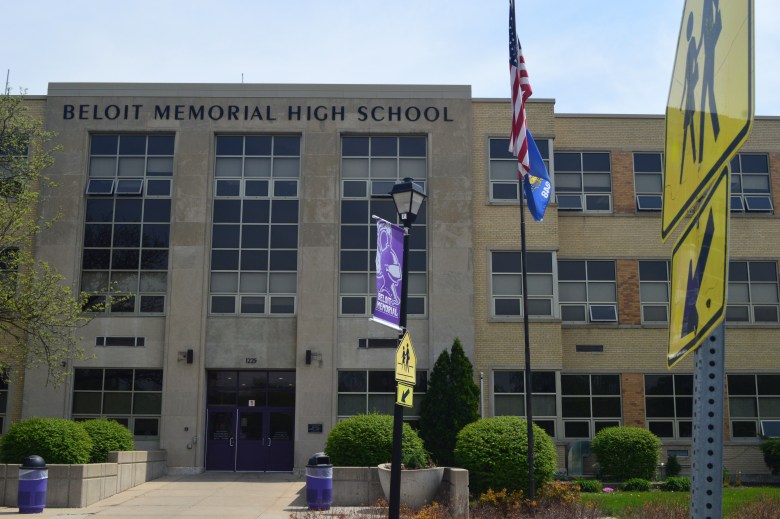
BELOIT, Wis. — As Chris Hooker eyed a newly built piece of ductwork inside Beloit Memorial High School, a wry smile crept over his face. “If you worked for me,” he told a student, considering the obviously crooked vent, “I might ask if your level was broken.”
Hooker, the HVAC manager of Lloyd’s Plumbing and Heating Corp. in nearby Janesville, was standing inside a hangar-sized classroom in the school’s advanced manufacturing academy, where students construct full-size rooms, hang drywall and learn the basics of masonry. His company sends him to the school twice a week for about two months a year to help teach general heating, venting and air conditioning concepts to students.
“I cover the mountaintop stuff,” he said, noting that at a minimum students will understand HVAC when they become homeowners.
But the bigger potential payoff is that these students could wind up working alongside Hooker after they graduate. If his firm has an opening, any student recommended by teacher Mike Wagner would be a “done deal,” Hooker said. “Plus, if they come through this class, I know them.”
Manufacturing and construction dominate the business needs inside Beloit, a small city of 36,000 just minutes from the Illinois border. Sitting at the nexus of two major highways, and within 100 miles of Chicago, Milwaukee and Madison, Beloit is home to a range of businesses that include a Frito-Lay production plant, an Amazon distribution center and a Navy subcontractor. In the next two years, a $500 million casino and hotel complex is scheduled to open.
But staffing these companies into the future is a major concern. Across the country, the average age of manufacturing workers is increasing, and one in four of these workers is age 55 or older, according to U.S. Bureau of Labor Statistics’ 2021 figures, the most recent available. In many other jobs the workforce is aging, too. Wisconsin is one of several states looking to boost career and technical education, or CTE, as a possible solution to the aging and shrinking workforce.
Having industry standard machines is a key part of Beloit Memorial High School’s manufacturing program; here a student uses a JET metalworking machine to create precise cuts for his project. Credit: Wayne D’Orio for The Hechinger Report
While the unemployment rate of Rock County, which includes Beloit, is 3.6 percent, only slightly higher than the state’s 3.2 percent, there’s a worker mismatch in the city, according to Drew Pennington, its economic development director.
Every day, 14,000 city residents travel outside of Beloit to work, while the same number commute into the city to fill mostly higher-paying jobs, said Pennington.
So when Beloit decided to revamp its public high school in 2018, CTE and work-based learning were at the forefront of the transformation.
The 1,225-student school now has three academies that cover 13 different career paths. After ninth grade, students choose to concentrate in an area, which means taking several courses in a specific field. Students also have the option to do work-based learning, which can mean internships, a youth apprenticeship or working at high-end simulated job sites inside the school.
“This creates not just a pipeline to jobs but also to career choices,” said Jeff Stenroos, the district’s director of CTE and alternative education.
“There are a lot of really good-paying jobs in this area. Students don’t need to leave, or go earn a four-year degree,” Stenroos said. An auto mechanic can “earn six figures by the age of 26 and that’s more than an educator with a master’s degree,” he said.
Beloit’s effort is a shift in high school emphasis similar to the extensive CTE programs being run in other places, notably Indiana, Kentucky and Alabama. In 2024, 40 states enacted 152 CTE-related policies, the biggest push in five years, according to Advance CTE, a nonprofit group that represents state CTE officials. Nationwide, about 20 percent of high school students take a concentration of CTE courses, it says, adding that the high school graduation rate for students who concentrate in CTE is 90 percent, 15 percentage points higher than the national average.
Three years ago, Wisconsin called for 7 percent of its high school students to be in workplace learning programs by 2026. Beloit’s progress puts it far ahead of that target. In Beloit Memorial, nearly 1 in 3 students meet this designation today, Stenroos said.
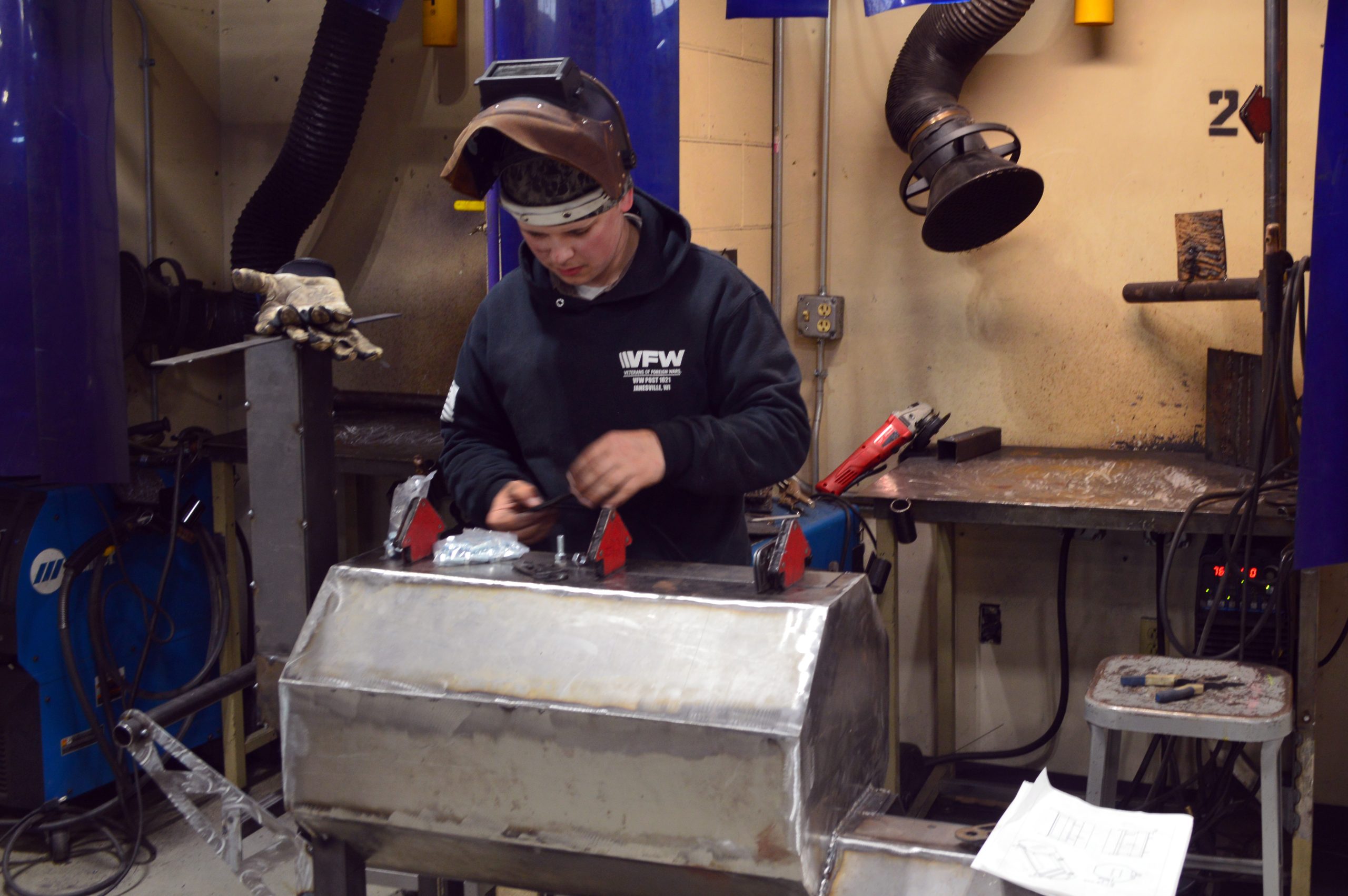
The high school features a cavernous construction area where students build full-scale rooms, learn masonry and complete plumbing and electrical wiring projects. The metal shop offers 16 welding stations and a die-cutter machine that allows students to create customized pieces to fit projects. Down the street, the school runs an eight-bay car repair center, a space it took over when a Sears autobody shop left town.
These spaces are “better than a lot of technical colleges,” Stenroos said.
In addition to their high school courses, Beloit Memorial students pile up industry-recognized certifications, Stenroos said. More than 40 percent of its students graduate with at least one certification, and 1 in 4 of them has multiple certifications.
While some simple certifications, such as OSHA Workplace Safety, can be accomplished in just 10 hours, others, such as those for the American Welding Society, require up to 500 hours of student work, he added. The state has called for 9 percent of graduating high school students to have earned at least one certification by next year. To incentivize schools to offer these opportunities, the state’s Department of Workforce Development pays schools for each student who earns a certification; in 2024, Beloit received $85,000 through this program, Stenroos said.
One of the school’s best automotive students, Geiry Lopez, graduated this year with five Automotive Service Excellence certifications. Standing less than 5 feet tall, Lopez said she is not bothered that she might not look like a typical mechanic. “I know I can do this,” she said, adding that she hopes to work on heavy machinery such as tractor trailers after she graduates.
She’s worked on her own car, with some fellow students, replacing the brakes, a front axle, rotors and wheel bearings at the school’s garage, she said, although she still hasn’t been able to drive it.
“My dad is taking forever to teach me how to drive,” she said.
The garage operates like an actual business, but the only customers are teachers and other Beloit staffers and students. Students estimate work costs, order parts and communicate with customers before any repairs take place. While oil changes and brake replacements are common, some students are totally rebuilding an engine in one car.
Over in the welding room, rising senior Cole Mellom was putting the finishing touches on a smoker he built in less than a month’s time. He said he loved the creativity of finding a plan, cutting the metal and building something that he could sell, all while in school. Plus, he knows that welding is a key skill needed for his dream job, race-car fabrication.
Officials revamped the Beloit Memorial High School in 2018 to funnel students into academies that are connected to jobs in the area and the state. Credit: Wayne D’Orio for The Hechinger Report
In the past, students created a custom-made protective plate that the city’s police use on a bomb squad vehicle.
The welding program has 125 students this year and had to turn away 65 more because of space limitations, Stenroos said; last year, 17 of the school’s welding academy graduates enlisted in the armed forces to specialize in welding.
These programs are designed to help meet the future needs of the state’s workforce. More than one-third of Wisconsin jobs will require education beyond high school but less than a bachelor’s degree by 2031, according to the Association for Career and Technical Education. For the last four years, the state has had more job openings than people on unemployment.
“There’s more jobs than there are people to fill them right now,” said Deb Prowse, a former career academy coach at Beloit Memorial who now works at Craftsman with Character, an area nonprofit that helps train students for careers in skilled trades.
Hooker, the Lloyd’s Plumbing HVAC manager, agreed. “Every project we work on has a delay, from a multimillion-dollar mansion to a three-bedroom spec,” he said. “There aren’t enough workers.”
The main reason Beloit Memorial has been able to zoom past state and national goals for both CTE and work-based learning is the school’s single-minded focus since 2018 on helping to ensure that its graduates will understand what businesses need and giving them a head start toward gaining those skills.
High school officials actually pared back the program from 44 pathways to 13, Stenroos said, part of an effort to tie each pathway to specific jobs. About 75 percent of pathways target area jobs, with the remaining quarter highlighting prominent professions within the state, he added.
Even though three straight budget referendum defeats have left the district with a $6.2 million funding gap, Stenroos said he’s been able to keep the CTE equipment modernized through donations and strategic allocation of the school’s federal Perkins grant and the state reimbursement for student certifications. In one instance, the school recently bought a $20,000 scanner for its automotive program; the machine can not only help diagnose a car problem, but also connect students to garages throughout the country that have successfully fixed the specified problem.
“It’s an expensive piece of equipment,” Stenroos said, “but it’s industry-certified and will give students real-life experience.”
Each of the three academies has an advisory board of teachers and industry professionals who work out how to embed practical lessons in classroom curriculum. “We ask business people, ‘What do you need, and how can we help our kids get there?’” said Stenroos.
“It’s really cool how receptive the school is to feedback,” said Heather Dobson, the business development manager at Corporate Contractors, Inc., a 200-person general contracting firm.
She explained that the district has incorporated small changes over the years, such as having students work in Microsoft programs instead of Google Classroom apps and teaching them how to write a professional email.
“Rarely is there an idea presented that they don’t embrace,” said Celestino Ruffini, the CEO of Visit Beloit, a nonprofit that promotes tourism of the city. The school is expanding its hospitality program because of the expected influx of jobs connected to the new casino and hotel, he said.
All the changes aren’t at the high school, however. In order to employ Beloit Memorial students, Frito-Lay had to alter its corporate policy of not allowing anyone under 18 to work in its plants, according to Angela Slagle, a supply chain manager there. The company now hires Beloit Memorial students for its career exploration youth apprenticeship program, she added.
The connection to area businesses goes beyond the school’s leaders. Each year, about 10 teachers complete an externship in which they spend one week of their summer at a local business. Teachers are paid $1,000 for the 20 hours, and they not only learn about what jobs a company may have but also find ways to incorporate real-world problems into their classroom lessons.
A few summers back, math teacher Michelle Kelly spent a week at Corporate Contractors. She was searching for different ways to use construction-based math problems with her students. In addition to using math to estimate a bid for a project or calculate the surface area of a job, she realized that complex math is needed to build a truss, the framework used to support a roof or bridge.
Because the triangular truss is supported by different lengths of wood inside its structure, Kelly said, building one requires the calculation of angles, total area, how much wood is needed and more. Since all her algebra students were in the school’s construction academy, she partnered with those teachers to go beyond blueprints and have the 10th graders build trusses, a collection of which sit in the back of her classroom.
A student’s detailed outline for creating a truss in Michelle Kelly’s 10th grade algebra class at Beloit Memorial High School, which is embracing career and technical education. Credit: Wayne D’Orio for The Hechinger Report
She sees this work as one way to help counter the chronic absenteeism that has existed since Covid. Teaching with this kind of hands-on work makes students see the relevance of algebra, she said. “Would it be easier to just have them take a test? Yes.”
Beloit Memorial Principal Emily Pelz said the school’s work is paying off. In the last four years, the school’s four-year graduation rate has ticked up slightly, from 83.4 percent in 2021-22 to 85.2 percent in 2024-25, while its attendance went from 78.5 percent to 84.8 percent in the same period, Pelz said.
Rik Thomas, a rising senior who already has his own business repairing and modifying cars, said this work has definitely made him more interested in school. While he thought the academy would merely explain what a construction career might include, “It’s nice to find out how to do the work.” His father works in construction and, Thomas added, “He loves that I take this program.”
Thomas and his classmates built a wooden shed earlier this year and were able to sell it for $2,500, with the money going to pay for more materials. Likewise, the first smoker created in the welding class was bought by Stenroos; the students are looking forward to posting the second one for sale after they determine how much they should charge.
While the school’s construction and other trade-related fields have drawn the most attention, its three academies also offer career paths in healthcare, education, business, the arts, hospitality and more.
For example, rising senior Tayvon Cates said he hopes to study pre-med at a historically Black college or university on his way to becoming a cardiology radiologist. Cates, who is in the school’s health and education academy, said, “If you want to do something, the school can help you do it.”
The Hechinger Report provides in-depth, fact-based, unbiased reporting on education that is free to all readers. But that doesn’t mean it’s free to produce. Our work keeps educators and the public informed about pressing issues at schools and on campuses throughout the country. We tell the whole story, even when the details are inconvenient. Help us keep doing that.
This audio is auto-generated. Please let us know if you have feedback.
As today’s college graduates struggle to start a steady career, 1 in 2 Americans say their college major didn’t prepare them for the job market, according to a June 18 report from Preply.
Beyond that, 1 in 6 Americans who went to college said they regret it. When thinking about their college experience, college graduates said their top regrets included taking out student loans, not networking more and not doing internships.
“One of the main concepts of seeking higher education after high school is that college will prepare you for the rest of your life. While some graduates leave their alma mater feeling prepared to enter the workforce and begin their career, others feel underprepared,” according to the report.
In a survey of more than 1,700 Americans with an undergraduate degree, 29% said they wished they picked a different major, and 18% said they regretted the institution they attended.
College graduates said they felt unprepared in numerous ways, especially finding a job after graduation and navigating student debt and personal finances.
Americans also said they don’t feel college gave them real-world work experience, practical or technical skills or a professional network. In fact, only 5% reported feeling “adequately prepared” for life and the workplace.
On the other side of the hiring table, more than half of hiring managers say recent graduates appear to be unprepared for the workforce, and 1 in 6 say they’re reluctant to hire them, according to a report from Resume.org. Their top complaints included excessive phone use, a lack of professionalism and poor time management skills.
Within the workplace, executives and workers alike say entry-level workers seem unprepared for their jobs, particularly compared to five years ago, according to a General Assembly report. Although leaders said workers don’t have enough training to be hired, employers also don’t offer adequate training, the report found.
Since the dawn of student feedback there’s been a debate about the link between module feedback and the National Student Survey (NSS).
Some institutions have historically doubled down on the idea that there is a read-across from the module learning experience to the student experience as captured by NSS and treated one as a kind of “dress rehearsal” for the other by asking the NSS questions in module feedback surveys.
This approach arguably has some merits in that it sears the NSS questions into students’ minds to the point that when they show up in the actual NSS it doesn’t make their brains explode. It also has the benefit of simplicity – there’s no institutional debate about what module feedback should include or who should have control of it. If there isn’t a deep bench of skills in survey design in an institution there could be a case for adopting NSS questions on the grounds they have been carefully developed and exhaustively tested with students. Some NSS questions have sufficient relevance in the module context to do the job, even if there isn’t much nuance there – a generic question about teaching quality or assessment might resonate at both levels, but it can’t tell you much about specific pedagogic innovations or challenges in a particular module.
However, there are good reasons not to take this “dress rehearsal” approach. NSS endeavours to capture the breadth of the student experience at a very high level, not the specific module experience. It’s debatable whether module feedback should even be trying to measure “experience” – there are other possible approaches, such as focusing on learning gains, or skills development, especially if the goal is to generate actionable feedback data about specific module elements. For both students and academics seeing the same set of questions repeated ad nauseam is really rather boring, and is as likely to create disengagement and alienation from the “experience” construct NSS proposes than a comforting sense of familiarity and predictability.
But separating out the two feedback mechanisms entirely doesn’t make total sense either. Though the totemic status of NSS has been tempered in recent years it remains strategically important as an annual temperature check, as a nationally comparable dataset, as an indicator of quality for the Teaching Excellence Framework and, unfortunately, as a driver of league table position. Securing consistently good NSS scores, alongside student continuation and employability, will feature in most institutions’ key performance indicators and, while vice chancellors and boards will frequently exercise their critical judgement about what the data is actually telling them, when it comes to the crunch no head of institution or board wants to see their institution slip.
Module feedback, therefore, offers an important “lead indicator” that can help institutions maximise the likelihood that students have the kind of experience that will prompt them to give positive NSS feedback – indeed, the ability to continually respond and adapt in light of feedback can often be a condition of simply sustaining existing performance. But if simply replicating the NSS questions at module level is not the answer, how can these links best be drawn? Wonkhe and evasys recently convened an exploratory Chatham House discussion with senior managers and leaders from across the sector to gather a range of perspectives on this complex issue. While success in NSS remains part of the picture for assigning value and meaning to module feedback in particular institutional contexts there is a lot else going on as well.
A question of purpose
Module feedback can serve multiple purposes, and it’s an open question whether some of those purposes are considered to be legitimate for different institutions. To give some examples, module feedback can:
Offer institutional leaders an institution-wide “snapshot” of comparable data that can indicate where there is a need for external intervention to tackle emerging problems in a course, module or department.
Test and evaluate the impact of education enhancement initiatives at module, subject or even institution level, or capture progress with implementing systems, policies or strategies
Give professional service teams feedback on patterns of student engagement with and opinions on specific provision such as estates, IT, careers or library services
Give insight to module leaders about specific pedagogic and curriculum choices and how these were received by students to inform future module design
Give students the opportunity to reflect on their own learning journey and engagement
Generate evidence of teaching quality that academic staff can use to support promotion or inform fellowship applications
Depending on the timing, capture student sentiment and engagement and indicate where students may need additional support or whether something needs to be changed mid-module
Needless to say, all of these purposes can be legitimate and worthwhile but not all of them can comfortably coexist. Leaders may prioritise comparability of data ie asking the same question across all modules to generate comparable data and generate priorities. Similarly, those operating across an institution may be keen to map patterns and capture differences across subjects – one example offered at the round table was whether students had met with their personal tutor. Such questions may be experienced at department or module level as intrusive and irrelevant to more immediately purposeful questions around students’ learning experience on the module. Module leaders may want to design their own student evaluation questions tailored to inform their pedagogic practice and future iterations of the module.
There are also a lot of pragmatic and cultural considerations to navigate. Everyone is mindful that students get asked to feed back on their experiences A LOT – sometimes even before they have had much of a chance to actually have an experience. As students’ lives become more complicated, institutions are increasingly wary of the potential for cognitive overload that comes with being constantly asked for feedback. Additionally, institutions need to make their processes of gathering and acting on feedback visible to students so that students can see there is an impact to sharing their views – and will confirm this when asked in the NSS. Some institutions are even building questions that test whether students can see the feedback loop being closed into their student surveys.
Similarly, there is also a strong appreciation of the need to adopt survey approaches that support and enable staff to take action and adapt their practice in response to feedback, affecting the design of the questions, the timing of the survey, how quickly staff can see the results and the degree to which data is presented in a way that is accessible and digestible. For some, trusting staff to evaluate their modules in the way they see fit is a key tenet of recognising their professionalism and competence – but there is a trade-off in terms of visibility of data institution-wide or even at department or subject level.
Frameworks and ecosystems
There are some examples in the sector of mature approaches to linking module evaluation data to NSS – it is possible to take a data-led approach that tests the correlation between particular module evaluation question responses and corresponding NSS question outcomes within particular thematic areas or categories, and builds a data model that proposes informed hypotheses about areas of priority for development or approaches that are most likely to drive NSS improvement. This approach does require strong data analysis capability, which not every institution has access to, but it certainly warrants further exploration where the skills are there. The use of a survey platform like evasys allows for the creation of large module evaluation datasets that could be mapped on to NSS results through business intelligence tools to look for trends and correlations that could indicate areas for further investigation.
Others take the view that maximising NSS performance is something of a red herring as a goal in and of itself – if the wider student feedback system is working well, then the result should be solid NSS performance, assuming that NSS is basically measuring the right things at a high level. Some go even further and express concern that over-focus on NSS as an indicator of quality can be to the detriment of designing more authentic student voice ecosystems.
But while thinking in terms of the whole system is clearly going to be more effective than a fragmented approach, given the various considerations and trade-offs discussed it is genuinely challenging for institutions to design such effective ecosystems. There is no “right way” to do it but there is an appetite to move module feedback beyond the simple assessment of what students like or don’t like, or the checking of straightforward hygiene factors, to become a meaningful tool for quality enhancement and pedagogic innovation. There is a sense that rather than drawing direct links between module feedback and NSS outcomes, institutions would value a framework-style approach that is able to accommodate the multiple actors and forms of value that are realised through student voice and feedback systems.
In the coming academic year Wonkhe and evasys are planning to work with institutional partners on co-developing a framework or toolkit to integrate module feedback systems into wider student success and academic quality strategies – contact us to express interest in being involved.
This article is published in association with evasys.
Does your campus fully utilize its student satisfaction scores at accreditation time? As a reminder, regular assessments of student satisfaction provide data for four key institutional activities:
• Retention/student success • Strategic planning • Recruiting new students • Accreditation documentation
The accreditation process can be time-demanding and stressful for your campus staff and leadership, yet it is essential to complete on the designated cycle. And while the official process is something you address once every decade, regularly gathering data from your students and maintaining proactive processes can make the official requirements go much more smoothly.
My colleague Charles Schroeder likes to say that during self-studies, people on campus begin running around gathering data and shouting, “The accreditors are coming! The accreditors are coming!” To avoid this reaction, our recommendation is don’t just assess student satisfaction as part of your self-study, but assess student satisfaction on a regular cycle, once every two or three years (if not annually).
4 ways to use student satisfaction scores to prepare for accreditors
How can you use data from student satisfaction surveys in your accreditation process? I have four suggestions for you.
1. Match the survey items to your accreditation requirements. As a resource for you, we have mapped the individual items on the Ruffalo Noel Levitz (RNL) Satisfaction-Priorities Surveys (including the Student Satisfaction Inventory, the Adult Student Priorities Survey, and the Priorities Survey for Online Learners) to the individual criteria for all of the regional accreditors across the United States. You can download the relevant mapping document for your survey version and region here. By seeing how the items on each survey are mapped to the regional accrediting agency requirements, you can take the guesswork out of determining how the student feedback lines up with the documentation you need to provide.
2. Respond to student-identified challenge items. The RNL Satisfaction-Priorities Surveys identify areas of high importance and low satisfaction as challenge items. These are priority areas for improvement based on the perceptions of your students. By actively working to improve the student experience in these areas, you can potentially improve overall student satisfaction, which studies have correlated with better individual student retention, higher institutional graduation rates, higher institutional alumni giving, and lower loan default rates. Improvements in these areas are going to look good for your accreditation.
3. Document your student-identified strengths. The RNL Satisfaction-Priorities Surveys also reflect student-identified strengths, which are items of high importance and high satisfaction. These are the areas that your students care about, and where they think you are doing a good job. Mentioning your strengths to your accreditors helps to position you in a positive light and to focus the conversation on where you are meeting or exceeding student expectations.
4. Show improvements over time. As indicated earlier, student satisfaction surveys should not be a “once and done” activity, or even an activity done just once every five to ten years. The institutions we work with which assess student satisfaction systematically every two or three years, and actively work to improve the student experience in the intervening years, are seeing student satisfaction levels increase year over year. This process shows your commitment to your students and to your accreditors, and reflects that continuous quality improvement is valued by your institution.
Ready to learn more?
Are you ready to regularly assess student satisfaction? Are you interested in connecting the results to your accreditation criteria? Do you want to learn more about moving forward with a satisfaction assessment? Contact RNL with any questions you have and we will look forward to assisting you.
Note: This blog was originally published in November 2016 and was updated with new content in May 2025.
In 2024, the Office for Students (OfS) launched a pilot survey asking UK students about sexual misconduct during their time in higher education.
For the first time, there is now a national attempt to capture data on how widespread such incidents are, and how effectively students are supported when they come forward.
The release of the survey’s results will be a moment that reflects a growing reckoning within the sector: one in which the old tools and quiet handling of disclosures are no longer fit for purpose, and the need for culture change is undeniable.
This new initiative – known as the Sexual Misconduct Survey (SMS) – ran as a supplement to the National Student Survey (NSS), which since 2005 has become a familiar, if evolving, feature of the higher education calendar.
While the NSS focuses on broad measures of the student experience, the SMS attempts to delve into one of its most difficult and often under-reported aspects – sexual harassment, violence, and misconduct.
Its arrival comes against the backdrop of high-profile criticisms of university handling of disclosures, including the misuse of non-disclosure agreements (NDAs), and a new OfS regulatory condition (E6) requiring institutions to take meaningful steps to tackle harassment.
Understanding the SMS
The Sexual Misconduct Survey collects both qualitative and quantitative data on students’ experiences. It examines the prevalence of misconduct, the extent to which students are aware of reporting mechanisms, and whether they feel able to use them. Its core aim is clear – to ensure students’ experiences are not just heard, but systematically understood.
Previous, disparate studies — many led by the National Union of Students and grassroots campaigners — have long indicated that sexual misconduct in higher education is significantly under-reported. This is especially true for marginalised groups, including LGBTQ+ students, Black and disabled students, and students engaged in sex work. The SMS marks an attempt to reach further, with standardised questions asked at scale, across providers.
Despite its intention, the SMS is not without issues. A key concern raised by student support professionals is the opt-out design. Students were automatically enrolled in the survey unless they actively declined – a move which risks retraumatising victim-survivors who may not have realised the nature of the questions until too late.
Timing has also drawn criticism. Coming immediately after the exhaustive NSS — with its 26 questions and optional free-text fields — the SMS may suffer from survey fatigue, especially during an already intense period in the academic calendar. Low response rates could undermine the richness or representativeness of the data gathered.
There are also complex ethical questions about the language used in the survey. In striving for clarity and precision, the SMS employs explicitly descriptive terminology. This can potentially open up difficult experiences unrelated to higher education itself, including childhood abuse or incidents beyond university campuses. Anonymous surveys, by nature, can surface trauma but cannot respond to it — and without parallel safeguarding or signposting mechanisms, the risk of harm increases.
Lastly, the handling of disclosures matters. While survey responses are anonymous, students need to trust that institutions — and regulators — will treat the findings with sensitivity and respect. Transparency about how data will be used, how institutions will be supported to act on it, and how students will see change as a result is essential to building that trust.
What to do next?
The data from the pilot survey will be shared with institutions where response rates and anonymity thresholds allow. But even before the results arrive, universities have an opportunity — and arguably a duty — to prepare.
Universities should start by preparing leadership and staff to anticipate that the results may reveal patterns or prevalence of sexual misconduct that are difficult to read or acknowledge. Institutional leaders must ensure they are ready to respond with compassion and commitment, not defensiveness or denial.
Universities should be prepared to review support systems and communication now. Are reporting tools easy to find, accessible, and trauma-informed? Is the student community confident that disclosures will be taken seriously? These questions are important and there is potential for the survey to act as a prompt to review what is already in place as well as what might need urgent attention.
Universities should also engage students meaningfully. Institutions must commit to involving students — especially survivor advocates and representative bodies — in analysing findings and shaping the response. The worst outcome would be seeing the SMS as a tick-box exercise. The best would be for it to spark co-produced action plans.
When data is released, institutions avoid the urge to benchmark or downplay. Instead, they should be ready to own the story the data tells and act on the issues it raises. A lower prevalence rate does not necessarily mean a safer campus; it may reflect barriers to disclosure or fear of speaking out. Each result will be different, and a patchwork of responses is no bad thing.
Finally, it is important to look beyond the numbers and see the person. Qualitative insights from the SMS will be just as important as the statistics. Stories of why students did not report, or how they were treated when they did, offer vital direction for reform and should be something which university leaders and policy makers take time to think about.
This is only the first year of the SMS, and it is not yet clear whether it will become a permanent feature alongside the NSS. That said, whether the pilot continues or evolves into something new, the challenge it presents is real and overdue.
The sector cannot afford to wait passively for data. If the SMS is to be more than a compliance exercise, it must be the beginning of a broader culture shift – one that faces up to what students have long known, listens without defensiveness, and builds environments where safety, dignity, and justice are non-negotiable.
Lasting change will not come from surveys alone. Asking the right questions — and acting with purpose on the answers — is a critical start.
Placement is a key part of many courses at the University of Worcester. It’s an opportunity to apply your knowledge in real-world settings, gain valuable experience, and develop as a professional.
But what should you expect before you go? How do you navigate an unfamiliar setting? Are you concerned about support and your PPAP form? Here’s a guide to help you through your placement journey.
Understanding the PPAP Form
Before starting placement, you may come across the PPAP (Practice Placement Adjustment Plan) form. This is a useful tool if you require additional support or have specific needs, such as caring responsibilities or transport requirements. You can complete this form with your Personal Academic Tutor (PAT) or the Disability and Dyslexia team if needed.
The PPAP is your document, meaning you can include as much or as little information as you feel comfortable with. While some may choose to disclose their needs, others may not, and that is entirely your choice. The PPAP exists to support you, and you decide when and how to share it.
Preparing for Placement
Once you receive your placement allocation, your mind will likely be filled with questions: What will it be like? What hours will I work? What should I bring? To help ease any anxiety, write down your questions and make a list. While you’ll receive some placement information, additional queries will naturally arise.
A pre-placement visit is highly recommended. Email your practice educator to arrange a visit or a call to discuss your questions. This shows initiative and enthusiasm—qualities that leave a great first impression. It also helps ease first-day nerves by allowing you to familiarise yourself with the location and key contacts. If an in-person visit isn’t possible, a phone call or Teams meeting can be just as helpful. This is also an excellent time to bring up your PPAP document if applicable.
First Day: What to Expect
First impressions matter, so arrive on time, wear an ironed uniform, and bring a positive attitude. The professionals you meet during your placement may be your future colleagues!
On the first day, you’ll have an initial interview and orientation. This is a great opportunity to:
Discuss your expectations and learning outcomes.
Understand the support available to you.
Ask any questions or address any concerns.
Establish clear communication with your practice educator.
Remember, your practice educator is there to help you succeed, so don’t hesitate to seek guidance.
Essential Tips for Placements
1. Keep a Notebook
A notebook is invaluable for jotting down key information, terminology, and reflections. Before using one, check with your practice educator regarding confidentiality and GDPR regulations.
2. Stay Hydrated and Energized
A refillable water bottle is a must—long days can make it easy to forget to drink enough water. Pack snacks and lunch to keep your energy up, as breaks may vary in timing and structure.
3. Use a Fob Watch
For healthcare placements, a fob watch is essential. You’ll be surprised how often you need to check the time! If your placement is non-clinical, check whether a regular wristwatch is acceptable.
4. Research Your Placement
A little preparation goes a long way. Reading up on your placement setting, its policies, and relevant topics beforehand will make you feel more confident and show that you are proactive and engaged.
5. Be Honest and Open
If a placement isn’t aligned with your strengths or interests, or if you need more guidance, be honest. Learning is a process, and you’re not expected to know everything. Speak up if you require additional support, prefer more independence, or learn better in a different way.
6. Start Your Evidence Collection Early
From day one, think about how you will evidence your learning outcomes. Planning ahead reduces stress and helps you stay on top of your placement requirements.
Final Thoughts
Placement has been one of the highlights of my course. It’s given me the chance to apply my knowledge, develop skills, and gain real-world experience in occupational therapy. Initially, I was nervous about one of my placements, but by approaching it with an open and positive mindset, I ended up having an incredible experience. I’ve been encouraged to learn from mistakes, apply theory to practice, and explore different areas of the profession.
If you have placement tips, share them with your cohort! If you’ve completed a placement that someone else is about to start, pass on your insights—it can make a huge difference.
During my five years working in postdoctoral affairs at two higher education institutions, current postdoctoral associates have often shared their frustrations with me.
Some feel they aren’t getting the credit they deserve in their research group. Others share they feel pressured to work long hours. And in terms of relationships with their mentors, some sense a lack of feedback and support from their faculty supervisor, while others feel they are micromanaged and lack autonomy.
When I hear these things, it strengthens my belief that many of the problems that emerge during the postdoctoral experience could be reduced by more proactive communication prior to an individual accepting a position. Talking through personality, leadership and communication styles can help both postdocs and mentors better understand the relational dynamics, as well as the expectations and needs each bring to the partnership.
So, while earlier “Carpe Careers” pieces have focused on the pragmatics of a postdoc job search and discovering postdoc opportunities, including those outside the traditional academic postdoc, I want to share the thought process late-stage Ph.D. students should be working their way through prior to and during a postdoc search, as well as advice on navigating the start of a postdoc position. My hope is that by carefully considering their own values and needs, graduate students can better understand if a postdoc position is the best career path for them, and if so, which postdoc position might be the right fit.
The Right People and the Right Questions
The first piece of advice I would give any prospective postdoc is that you must take ownership of your postdoc search. This includes talking to the right people and asking the right questions, which begins with asking yourself the most critical one: Why am I considering a postdoc position?
People pursue postdocs for a variety of reasons. None are necessarily more appropriate than others, but your motivations for engaging in a postdoc should be clear to you. Some motivations might include:
To gain training and increase metrics of scholarly productivity in order to be a more competitive candidate for positions at research-intensive universities.
To learn new skills or techniques that will increase marketability, perhaps outside academia.
For international trainees, a postdoc path may allow for continued work in the United States while pursuing a green card and citizenship.
To increase time to think about career paths.
To explore a geographic location that might seem ideal for one’s career prospects.
There is nothing wrong with any of these reasons, but understanding your reason will help you find the postdoc position that best fits your academic and professional journeys.
Understanding Expectations
Even if your goal is not to pursue an academic career and you don’t believe you will be in a postdoc position longer than a year, it is critical to take the postdoc experience seriously as professional experience, and accept and understand its responsibilities and deliverables.
I fully acknowledge that the postdoc role can be nuanced and, ideally, it is some hybrid of employment, extended training and apprenticeship under a more senior faculty member. In nearly all cases, however, an individual is hired into a postdoc role to help make progress on a funded research project. This may involve funding from federal agencies such as the National Institutes of Health or National Science Foundation, a nonprofit foundation, or the institution itself. Regardless, a postdoc is hired to help deliver important outputs associated with a project that’s being paid for. From this perspective, the postdoc’s job is to help move the project forward and ultimately produce data and findings for further dissemination. Successful postdocs understand what these deliverables are and their importance to their faculty mentor.
Of course, this does not mean postdocs should devote 100 percent of their time to producing research products. In fact, many years ago, the Office of Management and Budget made clear to federally funded U.S. agencies supporting graduate students and postdocs that such roles have dual functions of employee and trainee. The notice specifically states that postdocs “are expected to be actively engaged in their training and career development under their research appointments.” Additionally, the NIH is seeking to explicitly specify the percentage of time a postdoc should be devoting to their career and professional development through recommendations from a Working Group on Re-envisioning NIH-Supported Postdoctoral Training. In a report published in December 2023, the group suggests postdocs should have a minimum of 10 percent of their effort devoted to career and professional development activities.
It’s clear that the job of a postdoc is to both deliver on research products and invest in one’s own training and professional development. Given the need to effectively balance these two activities, it is critical that prospective postdocs seek to understand how the group they might work in, or the faculty member they might work with, understands the position. And likewise, it is important for the candidate to convey their expectations to the same parties.
A proactive conversation can be intimidating for some, but the Institute for Broadening Participation has created a list of questions taken from a National Academies report on enhancing the postdoc experience to get you started.
Exploring the Landscape
Potential postdocs should also consider speaking to current and/or past postdocs with experiences in groups and with people with whom they are interested in working. Past postdocs can often more freely enlighten others as to faculty members’ working and communications styles and their willingness to provide support.
Another important factor prospective postdocs should consider is the support and resources institutions provide. This can range from employee benefits and postdoc compensation to career and professional development opportunities.
A critical resource to help you understand the current institutional landscape for postdoc support in the United States is the National Postdoctoral Association’s Institutional Policy Report and Database. You can leverage this data by benchmarking the benefits of institutions you are considering for your postdoc. For example, in the most recently published report from 2023, 52 percent of responding U.S. institutions reported offering matching retirement benefits to their employee postdocs.
Considering the entire package around a postdoc position is yet another important step in evaluating if a potential position aligns with your academic, professional and personal goals.
Putting Together a Plan
Once you have decided to accept a postdoc position, I advise communicating proactively with your new faculty supervisor to ensure all expectations are aligned. A great document to help with framing your potential responsibilities is the Compact Between Postdoctoral Appointees and Their Mentors from the Association of American Medical Colleges.
Finally, I highly encourage any new postdoc to create an individual development plan to outline their project completion, skill development and career advancement goals. This can be shared with the supervisor to ensure both parties’ project completion goals match and the postdoc’s other goals will be supported. If faculty supervisors could benefit from additional resources that stress the importance of IDPs, I suggest this piece published in Molecular Celland this Inside Higher Ed essay.
Deciding whether to pursue a postdoc position, and how to pursue one proactively, is important to maximize your future prospects as a Ph.D. holder. Leveraging this advice, plus that of other online resources— such as the Strategic Postdoc online course from the Science Communication Lab and the Postdoc Academy’s Succeeding as a Postdoc online course and mentoring resources—will help you to choose a position with intention and engage in deliberate discussions prior to accepting it. This will increase the likelihood that your postdoc experience will align with your needs and help successfully launch the next stage in your career.
Chris Smith is Virginia Tech’s postdoctoral affairs program administrator. He serves on the National Postdoctoral Association’s Board of Directors and is a member of the Graduate Career Consortium—an organization providing a national voice for graduate-level career and professional development leaders.