Mississippi Valley State University, a historically Black institution, proudly announced last month that its marching band was invited to perform at Donald Trump’s upcoming inauguration. The university’s president, Jerryl Briggs, described the invitation as a chance to “showcase our legacy” and “celebrate our culture.” A GoFundMe campaign was started in hopes of raising enough money for the Mean Green Marching Machine Band to make its debut on the national stage.
Then the fighting started. Social media exploded with reactions to the move from within and outside of HBCU campus communities, with alumni coming down on both sides of the issue. Some condemned the university for participating in the celebration while others argued the band should embrace its moment in the spotlight. (The band is doing that, heading to the inauguration on Monday.)
The moment felt like déjà vu. During the first Trump administration, in 2017, a group of HBCU leaders spoke with Trump during an impromptu visit to the Oval Office after they met with other government officials. A photo of their interaction with the president went viral, prompting swift backlash and skepticism. “Is it a photo op, is it an opportunity for Trump to put himself next to Black people and smile?” Llewellyn Robinson, a Howard University sophomore at the time, asked The New York Times. “Is that the situation we’re dealing with? Or is it truly a seat at the table?”
The controversy speaks to a tension HBCU leaders face ahead of a second Trump administration, with Republicans controlling both chambers of Congress. On the one hand, they want to foster positive relationships with the powers that be and take advantage of whatever opportunities the new administration can offer their students and institutions. On the other hand, they’re serving communities with deep misgivings about the incoming president.
Most Black voters, 83 percent, voted for Kamala Harris, reported AP VoteCast. And while that’s fewer than the 91 percent who voted for President Biden in 2020, it’s still the vast majority at a time when many Black Americans, including HBCU students, are leery of anti-DEI rhetoric and state laws advanced by Trump supporters. Some have a more tangible worry: that Trump’s talk of abolishing the U.S. Department of Education may threaten the federal financial aid that gets many HBCU students to and through college and helps often cash-starved, tuition-dependent institutions meet their bottom lines.
HBCU leaders and scholars find themselves, once again, thinking through how to navigate a fraught political moment.
“It is sometimes a delicate dance,” said Walter Kimbrough, interim president of Talladega College and the former president of Philander Smith College and Dillard University. He expects some HBCU presidents will avoid “high-profile photo opportunities” with members of the new administration this time around. Even so, “we have to let our constituents know, we have to work with whoever is in the White House. That’s part of the job.”
He also, however, believes part of the job is pushing back on policies that could hurt the sector regardless of who’s in office.
“We need to be consistent on the things that are good for us, to be advocating,” he said, “and the things that we think are problematic, we need to be brave enough to speak up against those, too.”
But doing so can be precarious for HBCU presidents and their institutions, said Melanye Price, a political science professor and director of the Ruth J. Simmons Center for Race and Justice at Prairie View A&M University. “The question is always: Is it better to speak out with the potential of losing whatever ability you have to tend to and care for students, or figure out ways to maneuver within the context that you’re in now and still be able to help students?” Price said.
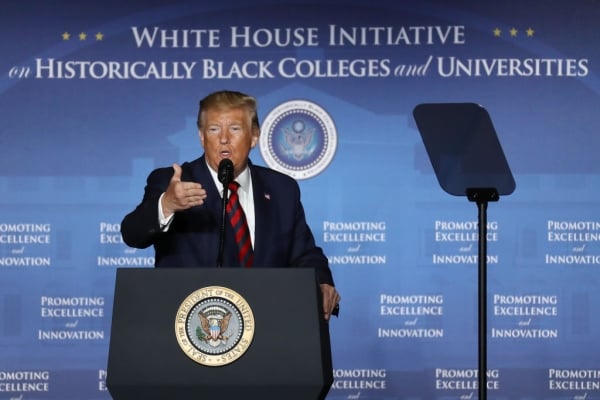
Efforts to partner with the new Trump administration have already begun. The Thurgood Marshall College Fund, an organization representing public HBCUs, congratulated Trump in a statement after he was elected. They also praised some of the wins HBCUs achieved under his first administration, including the FUTURE Act, which made permanent additional annual funding for minority-serving institutions, and the HBCU PARTNERS Act, which required some federal agencies to submit annual plans describing how they’d make grant programs more accessible to HBCUs.
Michael L. Lomax, president and CEO of the United Negro College Fund, which represents private HBCUs, met with Linda McMahon, Trump’s pick for education secretary, in December. He said in a press release that he found her to be a “good listener” and said they had a “productive discussion” about “issues of importance to HBCUs, HBCU students, the nation’s underserved students and how to improve the avenues of learning for all students.”
“We will continue to work with those elected, because the needs of our institutions and students are urgent,” Lomax added. “Our motto is ‘A mind is a terrible thing to waste,’ but so is an opportunity to advance our HBCU-related goals and objectives.”
Strategies and Priorities
Trump has often touted his support for HBCUs during his first term, arguing in a presidential debate last summer that he “got them all funded,” though HBCU leaders have pointed out that many of these successes were initially pushed forward by Congress and signed by the president. It’s also unclear whether support for HBCUs, a meaningful issue to Black voters, will be as much of an emphasis for Trump in his final term now that he’s no longer striving for re-election.
But HBCU leaders express optimism that they can secure some legislative wins in the next four years, given that support for the institutions has historically come from both sides of the aisle. And they plan to keep it that way.
“While I can’t say what the future may hold, I can say that our most recent interactions with the secretary-designate seemed as if we have reason to be positive about the next steps,” said Lodriguez Murray, UNCF’s vice president of public policy and government affairs.
HBCUs achieved some of their goals in partnership with the first Trump administration, Murray noted, including some loan forgiveness for institutions that received federal disaster relief loans as a result of Hurricane Katrina.
Harry Williams, president and CEO of the Thurgood Marshall College Fund, noted another reason for optimism heading into the new Trump term: Most HBCUs are located in red states, so they’ve always developed and relied on positive relationships with Republican lawmakers.
State-level challenges to DEI programming from Republican lawmakers have ramped up anxieties on HBCU campuses about the state and federal political climate for their institutions in the years ahead, Williams said. But “what we have seen, and we’re hoping to continue” is that those same states are still investing in HBCUs. For example, Tennessee recently coughed up funds to keep Tennessee State University afloat, and Florida has made some sizable investments in HBCUs in recent years, he added.
Williams hopes the incoming administration and Congress will echo those state lawmakers in their treatment of HBCUs. “Our strategy is to continue to partner with both sides and continue to forge relationships and create opportunities for our member schools to come and visit” government officials, he said.
Kimbrough said those visits from HBCU representatives are going to be particularly important in the years ahead. Trump had an HBCU graduate and advocate among the ranks of his first administration, he noted—his former aide Omarosa Manigault Newman. But “right now, he doesn’t have anybody who really knows HBCUs at a close [level],” he said, “so we’ve got to do a lot of teaching and educating them about what we do, what our value is to the country.”
With those ties reinforced, HBCU leaders plan to advocate for a long-held policy wish list: higher annual funding, improvements to campuses’ infrastructure, relief for institutions in debt and increases to the Pell Grant, federal financial aid for low-income students that helps the majority of HBCU students pay for college. HBCU leaders also want federal money for campus safety and security measures after a slew of bomb threats against HBCUs in 2022, which some campus leaders contend was inadequately handled by the Federal Bureau of Investigation.
“We don’t believe that a single student needs to have in their mind that something is happening to their institution simply because of what the institution is and who they are,” Murray said.
Murray noted one more priority: increased funding for the Education Department’s Strengthening Historically Black Colleges and Universities program, from about $400 million per year to at least $500 million, to keep pace with inflation.
Student Fears, Faculty Concerns
The day after the election, students in Price’s class on voting rights at Prairie View A&M discussed the results. The same worry came up over and over again: How will they pay for college if Trump abolishes the Department of Education?
According to data from TMCF, more than 75 percent of HBCU students rely on Pell Grants, federal financial aid for low-income students. Price said it’s natural that students are worried about any policy plans that could destabilize financial aid. “There is a palpable fear about what this new administration will bring and that there’s no one to stop them,” she said.
The students’ often tuition-dependent institutions are also vulnerable if changes in financial aid make it difficult for students to pay; most HBCUs don’t have large endowments or megadonors as a safety net.
University of the District of Columbia professors, worried themselves, described a particular kind of pall hanging over their students ahead of Inauguration Day as they prepare for the Trump administration and new members of Congress to settle into the deep-blue district. To acknowledge and address some of students’ fears and worries, two faculty members organized a pre-inauguration teach-in today. It will begin with mindfulness practices, followed by panel discussions and speakers on Washington, D.C., history and politics and how the transition of power could affect the district.
“Students are concerned about what the city will feel like in terms of its receptivity [and] tolerance around diversity,” said Michelle Chatman, associate professor of crime, justice and security studies and the founding director of the Mindful and Courageous Action Lab at UDC. Since Congress has more sway over D.C. than elsewhere, students also worry about programming and curriculum at the HBCU given restrictions on African American studies pushed by Republican lawmakers in other parts of the country. “We want them to feel empowered, and we want to normalize their feelings of concern.”
Amanda Huron, a professor of interdisciplinary social sciences and political science and the director of the D.C. History Lab at UDC, said a teach-in felt like the obvious move in this tense political moment.
“When we think, ‘well, what can we do in this moment, what can we as a university community do’—what we do is teach,” Huron said.
She acknowledged that HBCUs have a difficult balance to strike right now. “HBCUs in the country, we want to thrive, regardless of what’s going on politically, and we need to, because we need to serve our students,” Huron said. At the same time, “we need to make sure that we are always providing spaces for critical and honest and fact-based conversation, so I think it’s important that we’re able to do both things.”