For early-career researchers (ECRs), building a digital research space can feel like another burden piled onto an already demanding schedule. The idea of online professional networking often evokes images of overwhelming social media feeds and self-promoting influencers.
Yet ECRs face a significant risk by solely relying on institutional platforms for their digital footprint: information portability. While university websites offer high visibility as trusted sources, most ECRs on short-term contracts lose web and email access as soon as their contracts expire. This often forces a hasty rebuild of their online presence precisely when they need to navigate critical career transitions.
Having worked with doctoral and postdoctoral candidates across Europe, common initial hesitations to establishing a digital research space include: uncertainty about how and where to start, discouragement from senior researchers who dismiss digital networks as not “real” work, fears of appearing boastful and/or the paralyzing grip of impostor syndrome. Understanding these hesitations, I emphasize in my coaching the ways that building a digital research space is a natural extension of ECRs’ professional growth.
Why a Strategic Digital Research Space Matters
A proactive, professional digital strategy offers several key advantages.
Enhancing visibility and discoverability: A well-curated, current, consistent and coherent digital presence significantly improves discoverability for peers, potential collaborators, future employers, funders, journal editors and the media.
Networking: Strategically using digital platforms transcends institutional and geographical boundaries, enabling connections with specific individuals, research groups and relevant industry contacts globally.
Showcasing expertise and impact: Your digital space allows you to present a holistic view of your contributions beyond publications, including skills, ongoing projects, presentations, teaching, outreach and broader impacts.
Meeting communication expectations: As research advances, particularly with public funding, the demand to communicate findings beyond academic circles increases. Funders, institutions and the public expect researchers to demonstrate broader impact and societal relevance and a strategic digital presence provides effective channels for these crucial communications.
Controlling your narrative: Actively shape your professional identity and how your expertise is perceived, rather than relying on fragmented institutional profiles or database entries.
Ensuring information portability and longevity: Platforms like LinkedIn, ORCID, Google Scholar or a personal website ensure your professional identity, network and achievements remain consistent, accessible and under your control throughout your career.
Getting Started: Choosing Your Digital Network Combination
The goal isn’t to be online everywhere, but to be online strategically. Select a platform combination and engagement style aligned with your specific objectives and target audience, considering the time you have available.
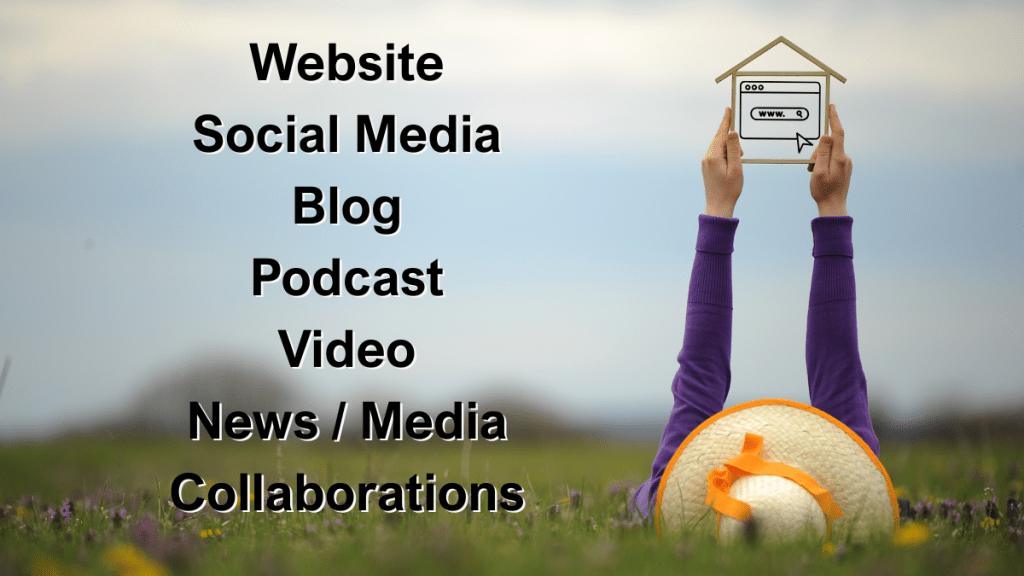
Different platforms serve distinct strategic aims and audiences at various research stages. Categorizing digital platforms into three subspaces helps map the landscape and can help you develop a more balanced presence across the research cycle.
First, identify the primary strategic goal(s): public dissemination, professional networking expansion or deeper engagement within your academic niche? Your answer will guide your platform selection, as you aim for eventual presence in each space.
Figure 1: Align your digital platform choices with your strategic goals and target audience.
Next, consider your audience spectrum. Effective research communication depends on understanding your target audience and their needs.
Scholarly discourse: At the outset of your career, specialized academic platforms like ResearchGate, Academia.edu, institutional repositories and reference managers with social features (e.g., Mendeley) are key for engaging directly with peers. Foundational permanent identifiers like ORCID are crucial for tracking outputs across systems.
Professional network: As you seek to develop your career, LinkedIn, Google (including Google Scholar) and X (formerly Twitter) are vital hubs across academia, industry and related sectors.
Share for impact: TikTok, Facebook and Instagram excel for broader dissemination. Do adjust style and tone: While academics can process jargon and complex concepts, a broader audience will engage more in plain English.
A strong, time-efficient and pragmatic starting point is to create a free and unique researcher identifier number like an ORCID, develop a professional LinkedIn profile and engage with a relevant academic platform (this would be in addition to your presence on a university or lab website). Because the ORCID requires no upkeep and a LinkedIn profile can leverage existing institutional and biographical information, with this combination ECRs can quickly establish a solid foundation for gradual digital expansion over the medium term.
Make It Manageable: Time, Engagement and Content
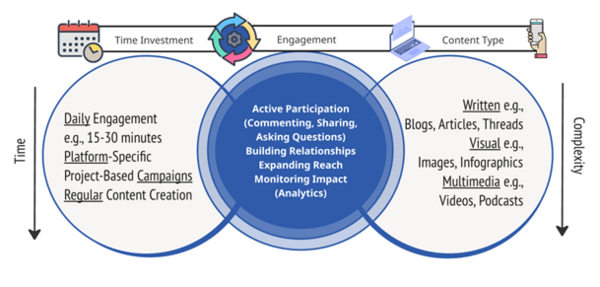
Once the platform combination is in place, effective digital management requires balancing three core elements: time, engagement and content.
Figure 2. Key considerations for a sustainable digital networking strategy: balancing realistic time investment, meaningful engagement and appropriate content types.
Time Investment
Key message: Prioritize consistency over quantity.
Focused engagement: Allocate short, regular blocks (e.g., 15 to 30 minutes weekly) for specific activities like checking discussions, sharing updates or thoughtful commenting between periods of focused research.
Platform nuance: Invest strategically, recognizing that platforms have different tempos and life spans (e.g., a LinkedIn post typically has a longer life span than an X post).
Campaign bursts: Plan ahead to strategically increase activity around key events like publications or conferences, utilizing scheduling tools for automated posting.
Content cadence: Consistency beats constant noise, so plan a realistic posting schedule such as once a month.
Engagement
Key message: Focus on short but regular efforts.
Active participation: Move beyond passive consumption by commenting, sharing relevant work and asking insightful questions.
Build relationships: Genuine interaction fosters trust and meaningful connections.
Monitor your impact (optional): Use platform analytics to understand what resonates and refine your strategy.
Content Type
Key message: Your hard work should work hard online.
Written: Summaries, insights, blog posts, threads, articles.
Visual: Infographics, diagrams, cleared research images, presentation slides.
Multimedia: Short explanatory videos, audio clips, recorded talks.
Cross-post: Share content across all relevant platforms (e.g., post your YouTube video on LinkedIn and ResearchGate).
Overcoming Reluctance
If you’re hesitant, consider these starting points:
Start small, stay focused: Choose one or two platforms aligned with your top priority. Master these before expanding.
Embrace learning: Your initial digital content may not be perfect, but consistent practice leads to significant improvement. Give yourself permission to progress.
Integrate, don’t isolate: Weave digital engagement into your research workflow. Share insights from webinars or interesting papers with your network.
Give and take: Focus on offering value by sharing insights, asking stimulating questions and amplifying others’ work. Reciprocity fuels networking.
Set boundaries: Protect your deep work time. Schedule dedicated slots for digital engagement during lower-energy periods and manage notifications wisely.
Be patient: Recognize that building meaningful networks and visibility is a long-term career investment.
Your Digital Research Space: A Career Asset
A strategic digital research space is essential for navigating and succeeding in a modern research career. A thoughtful approach empowers you to control your professional narrative, build lasting networks, meet communication expectations and ensure your valuable contributions are both visible and portable.
Maura Hannon is based in Switzerland and has more than two decades of expertise in strategic communication and thought leadership positioning. She has worked extensively for the last 10 years with doctoral and postdoctoral candidates across Europe to help them build strategies that harness digital networks to enhance their research visibility and impact.
What can academic writers do to have a digital presence that shares their writing and helps them connect with people online? Dr. Katy Peplin interviews The Social Academic podcast host, Jennifer van Alstyne in honor of Academic Writing Month (AcWriMo) in November.
Timestamps
0:00 Academic Writing Month (AcWriMo) with Dr. Katy Peplin and Jennifer van Alstyne 2:28 Your online presence is more than just social media 5:02 Cultivating authentic connections online for graduate students and faculty 10:18 Overcoming imposter syndrome and the lasting impact of sharing your story 14:56 Safety and community building online for academics and researchers 22:39 Jennifer van Alstyne’s tips for your personal academic website or research lab website 31:20 Did your university offer you a website? Yay. Keep this in mind 36:44 Aligning your online presence with your personal and professional goals 39:52 Your impact, your writing, your academic life matters 45:17 Build confidence by being intentional about how you show up online 49:09 Increase your impact with strategic approaches to your online presence
Academic Writing Month (AcWriMo)
Jennifer van Alstyne: Yay. I am so excited to talk about academic writing today because this is honestly a love of mine and I don’t do it anymore, but I help academic writers all the time with their online presence. I’m really focused on the digital side. Today I have Dr. Katy Peplin from Thrive PhD, and she’s going to ask me questions for academic writers because next month is academic writing month. Well, before we get to the questions, tell us a little bit about amo.
Katy Peplin, PhD: Okay, so I’m so excited here, but AcWriMo, which is so much more fun to write than it is to say, but is a National Novel Writing Month, which is a sort of longstanding decades old internet tradition at this point where people sign up and try and write 10,000 words of a novel draft in the month of November. There had long been sort of a community around novel writing in that way. Starting the origins of it now are sort of lost to the miss of internet time, but academics have been jumping onto it. I’ve been doing programming for this since 2018, which is quite a few years ago now. But I am really excited because the kind of way that we do it in the Thrive PhD universe, and now I have this great collaborator, Dr. Kate Henry, but we really believe in sort of building a writing practice.
Not necessarily belting yourself to your chair until you write that journal article or that chapter, but thinking about this as a month to intentionally touch in with your writing, touch in with your projects, experiment with things, and build some awareness around that writing practice. Let’s face it, November is the time where the end of the year looms closer and closer. All of these things that felt really far away in September or July when you’re like, “Sure, I’ll have that done by the end of the year,” suddenly become very real at the same time that semesters end and holiday stuff ramps up. Human things are so complicated. And, at least where I am in the northern hemisphere, the daylight goes away very suddenly. There’s just a lot of things that make writing in November even more challenging. I find that it’s been really fun and helpful to provide as much support as we possibly can for free that whole month.
Jennifer: I love it. This is one of the things that we’re creating to be a free resource for people. If you’re watching this and you are an academic writer, you’re friends with or supervise an academic writer, please share it with them. We’re going to be sharing tips, advice, and really the struggles that people sometimes go through when it comes to sharing their writing. So this video is for you. It really is.
Katy: Yes. I’m so excited to be asking you some questions because you’re such a leader and expert in this space.
I would love to just for the academics among us, how do you define an online presence? Because I know that’s one of those things that can feel bigger than it is, but also smaller than it is. What do you include under that umbrella?
Jennifer: I’m so glad you asked this question because I feel like people have a really limited view of what it is to the things that we create about ourselves. “If I don’t have a website, if I don’t have a social media, then I don’t have an online presence.” But that’s not true.
Your online presence is anything that people can find about you online, whether it’s intentionally created by you or not. So that’s Google Search results. Maybe if people ChatGPT get to learn a little bit more about you, what comes up? There’s a lot of ways that we can find what our online presence is, but there’s also a lot of ways that we can be intentional in creating and shaping how people find our story online.
Katy: That’s such a generous way to look at it because I know so many people who are like, I don’t want to be on LinkedIn or I don’t want to be on this platform. I don’t want to be here. I don’t want to be there. All of that makes sense to me. But it also can be what you want it to be. The kind of point is to be intentional about it.
Jennifer: When we think it’s only social media, or only websites, or sometimes even only faculty profile, the thing that we’re often missing is your academic bio. Your bio is ending up on conference websites for journals, for events, programming, maybe fellowships or associations that you’re involved with. There’s so many places where your bio can show up online that it really ends up becoming a massive part of your online presence. People don’t expect that.
Katy: As somebody who has to regularly produce bios about myself and almost always feels some tension about it. Yes. That it’s such a good point that it’s more information about us circulates beyond where we put it on purpose. Right, exactly. Okay.
Cultivating authentic connections online for graduate students and faculty
Katy: What are the benefits that you see of for academics or people in the scholarly space that really do take that step to be intentional and thoughtful about the way that they show up online? What are the benefits that people can see from that?
Jennifer: I think the benefits that people maybe assume that they’re going to see is a lot of reach or maybe a ton of reads on their writing. And that kind of myth is, I mean, it’s not inaccurate. If you share more, people will find you more.
But the truth is that the benefits are really about the more individual connections, the reader who reads your writing and not only understands it and relates to it, but is citing it and helping share it with a larger goal in mind of being part of the research community. When I think about the connections that people are sometimes hoping for online, it doesn’t always equate to the meaningful deep relationships that they really enjoy that have come out of it. So whether that’s research, collaborations, new friends in your field, learning about a new conference or association that maybe you hadn’t heard of before, there’s so many opportunities for connection that we miss because maybe we just don’t think there’s agency in doing that, especially if networking feels uncomfortable to you.
Katy: Yeah, absolutely. I love the sort of way that you’re framing that because I think that for so many of us who reads us or even our H-index or these kind of really concrete data things are the easiest to measure. So we measure them first. But often they not separate from, but not necessarily as meaningful as we might want them to be in terms of the results we’re actually looking for.
Jennifer: To give you an example, so to be honest, I don’t share my academic writing much. I haven’t done academic writing since grad school. When I think about my own academic writing and my experience of sharing it, it’s been very surprising. I shared I’m in medievalist literature, and so when I shared an article that I had published, I was very surprised by the people who were responding to me: people who were not in my field, people who were not academics, people who cared about the literature, but I didn’t know that they did because they weren’t in the kind of environment that I was used to having these discussions in. Even my own experience, even though it’s relatively old now, I think that it was so meaningful for me to see the kind of invitation that my post ended up being that I didn’t expect.
I wasn’t like, “Oh my gosh, eight people are going to go read this article now that I’ve posted it on my personal Facebook.” But that’s what happened. Not only did that happen, but someone was like, “Oh, after I read this article, I brought it back to the grad school class where we’re talking about this book.” So then everyone ended up reading it, and I really thought that I was just posting to brag to be like, “Hey, I got this article out.” Like, you did it. This is great. As a grad student, I was very proud of myself and I wanted to share that feeling with people. While sharing your article can be the intention of your post, it’s also okay if you know what you’re sharing is more like me, like a feeling or the kind of warmth that we feel about our article and about our writing. It’s okay to be open about that even if you think that the people aren’t going to read it.
Katy: I love that so much, and I think that it’s such a brave and kind of generous thing to share because so much of the academic discourse is like I have officially done this important thing and I talk about it with important people and in important stoic ways. And sometimes you really are just like, listen folks, I passed my exams. There’s something so important about sharing authentically. I think that that’s something that academics can miss because in a lot of spaces we have that authenticity gently guided out of us or sometimes with a lot more force than that.
Jennifer: That’s true. Sometimes when my faculty clients we’re working together on social media. It’s pretty rare, but sometimes we’re actually focused on sharing their book or a specific publication or report that they’ve written. When that happens, they think that I’m going to tell them what to do. They think that I’m going to give them: here’s the specific template, we’re going to do all the things. Instead oftentimes we’re just having a conversation. I’m taking notes while we’re talking.
The things that you think already? The things that you want to share about your book already? Are good enough. They don’t need someone else to come in and tell you how to do it. Or what to do or what to say. It’s just that sometimes there’s things that we can add, or tweak, or enhance, because the thing that comes right out of our mouth, sometimes it needs a little bit of revision to help more people understand it.
Overcoming imposter syndrome and the lasting impact of sharing your story
Katy: That leads so beautifully into this question that I have because I tend to work with a lot of early career scholars, so grad students, post-docs, people who are just getting their feet wet. There is this real anxiety about who am I to be sharing about this thing? To your mind, what counts as expertise? What makes this important enough to share? Or do you measure it with something else altogether?
Jennifer: That’s a good question. I don’t think that I measure it, which is maybe the most interesting part of that. I’ll give an example. I had Meg Mindlin, who is an amazing graduate student, here on The Social Academic podcast. She has a very large platform on social media. She shares video. She shares octopus art. She is so cool. And, she has that same kind of feeling like, is this good enough to share? It doesn’t matter how large your platform is. You can still have that imposter syndrome. And frankly, it doesn’t matter where in your career you are. Meg is feeling that as a recent master’s student graduate.
And my clients who are mid-career and senior faculty? Many of them also still feel that way. I would encourage you to recognize that feeling. But maybe still practice it anyway because it might not go away. But you know what always makes it go away?
When my clients and I are doing this live on a call, we have a post, we’re ready to post it, we put it up and they get engagement sometimes while we’re still live. They’re like, “Oh, that’s a relief.” That’s a relief because I was scared about posting it. I did it. I was on the call with you, but now it’s out there and people are seeing it. The act of actually doing it, even if it’s just once or twice for this, even if you feel uncomfortable, it’s good practice. And I would say it’s okay to sit with that discomfort a little bit if you’re talking about something sensitive.
If you’re attracting negative reactions, I think that’s a different consideration. But for the vast majority of the things that you post, there are ways to talk about it that are not necessarily going to invite that kind of negative reaction. I just want people to feel a little bit more open to exploring it.
If you draft a post, hit publish, if it’s about your publication. Hit publish even if you’re not sure. So many of the people that I chat with are like, “Oh yeah, I drafted it, but it didn’t end up published.” Yeah, my hope for you is that it ends up published.
Katy: Oh, what a generous hope. It really reminds me of some of my favorite pieces of writing advice, which almost all boiled down to doing the thing is doing the thing. Writing isn’t necessarily thinking about writing, learning about writing, strategizing about your writing, drafting your writing, writing is writing. I think what you’re saying is sharing and building your presence is about sharing and building your presence. That there’s so much benefit in practice and doing it and learning that way as opposed to trying to perfect it up here first.
Jennifer: The results are long-term. Especially if we’re thinking about, I guess to be specific like a social media platform like LinkedIn, your post goes out today, maybe tomorrow, but that post has potential to reach people next week, next month, next year.
I literally went into my LinkedIn analytics yesterday and was like, wow, some of these posts are from over a year ago and they’re still reaching people this week. It’s surprising, but I think that potential was missed on old Twitter. You could reach a lot of people fast, but when the relevant people missed it the first time, they’re not going to see it later. That potential is possible on a profile like LinkedIn. It means that maybe it’s okay, you put a little bit of energy into your LinkedIn profile, even if you’re not job searching, you’re not doing any of the things like I get it, but LinkedIn can still help you reach all those people when you have something you want to say. It doesn’t have to be all the time.
Katy: As somebody who’s trying to uplevel on LinkedIn at this exact moment, I’m really resonating with what you say because it is this kind of vulnerable. They make it so easy to measure things like likes and metrics and shares, and you’re chasing that dopamine hit. You forget that the post lives beyond that initial kind of chemical brain reaction. It’s helpful to know good or bad that there’s a long tail.
Safety and community building online for academics and researchers
Katy: So I now have as from where you’re sitting, say I’m a graduate student, I’m an early faculty member, I’m even a late faculty member. Goodness knows, we’re all busy. I only have a certain amount of time.
What’s your best pitch for investing some of my precious energy into building this presence when it might not necessarily be something that’s directly measured by my advisor, my chair, my tenure committee, my colleagues? Why do it?
Jennifer: That’s a good question. I think that the advice that I had even a year ago probably would have been different, but I’ve had a lot of graduate students reach out this year because they want a stronger online presence. They don’t have the time, especially mid-career people with family or folks that are in a transition of fields. If you don’t have the time, but you still want an online presence, there’s ways to have that happen. You don’t have to work with me, but just know that there’s people that can help you and that you don’t have to do it yourself. Or, you can do it with a friend. There’s different ways to take back or make better use of some of that time if doing it yourself is not ideal. When you are planning to stay in academia, when you’re planning to have the research thinking projects that you’re working on now, be something that people can engage with long-term.
It’s always a good investment of your time to create your online presence. I would never suggest someone not create an online presence unless personal safety was really at not just the forefront of their minds but could affect their mental health. I’m saying that as someone who has been there before, I’m a survivor of domestic violence. When I left my physically abusive ex-husband, I deleted all my socials. I didn’t have anything. I didn’t want to be found online by anyone. So I’ve been there. But I also know the power of taking that space back and being really intentional about what people find there. Do I literally still worry that my ex-husband is going to email my clients and harass them? Yes, I’m not going to lie. Honestly, that is possible. And so when I think about how I show up online, I am very intentional about who is going to see this, how they can engage with it, and what the potential ramifications are if something goes wrong.
I think about that also right now in terms of protecting my clients when things in America are politically quite volatile for freedom of speech. There’s a lot of things that we can take into consideration in terms of time and energy that are beyond just us, that are a part of the larger world. But when it’s your own time, it doesn’t all have to happen at once. Any small change that you can make for your online presence.
Whether you’re in grad school or early career researcher, or much later on in your academic career, that time and energy makes a difference. Maybe you’re only updating a sentence or two in your bio. Maybe you’re spending a day focusing on creating that LinkedIn profile that you really did not feel like you needed in the past.
There are things that you can do and you have agency in doing, but it doesn’t all have to happen at once. And, it doesn’t have to happen at all if it’s not a goal for you. But for most writers that I talk to, it is a goal at least sharing their writing, sharing their research is a goal. I encourage you to have that online presence, even if it’s not the personal online presence that maybe you see friends or colleagues having too.
Katy: That is such generous advice. I’m so happy to hear you talk about the sort of risk of this because I know that I personally am working with a lot of clients who are afraid not just for their own sort of reputation online, but for the funding of their labs, for the ability to get doxed if they’re studying a thing that somebody finds. I think what you said earlier in kind of our conversation that you have an online presence, whether you work on it or not, that being able to shape things like how I appear on my department website, how I appear in my bios in places that people can access and could potentially freedom of information actor get access to.
All of that information exists online for most of us through these old conference programs, through all of these other things that more and more are being ingested or searchable in maybe ways that weren’t even two years ago. It’s going to happen whether you are intentionally engaging with it or not. This is maybe a moment for people to say, okay, how can I think about these presences and show up in them in a way that accurately represents my research. But also takes into account that “I need to stay safe, my colleagues need to stay safe, my students need to stay safe, and if they’re going to write it, I might as well write it.”
Jennifer: There’s power when we show up online. There is also an invitation for folks who maybe look like us, or think like us, or worry about the same things as us, or care about the same things. There is potential for those people to see the space that you’ve taken online and feel that they can claim some of that too, that they can also create more storytelling, more openness, more connection through what they’re able to share online.
Katy: I think about that with sort of my own presence all of the time because I am pretty open about my mental health struggles on my blog. I am incredibly privileged to do that in a lot of ways because I’m my own boss, so nobody’s going to fire me if I say something. If I can be the one to take on some of that risk and say, “Hey, I had a really crappy mental health day, and here are six ways that I reset,” and knowing that I’m putting that information out for people to encounter it when they need it to? If I can take that risk, then that lets other people take some of that burden off. That’s one of the ways that communities can function really generously is to say, okay, I have this space to take some of this on. Why don’t I host the meeting point for this idea so that you can benefit from it and maybe not have to take that on yourself.
Jennifer: Yeah, I really like that. And for graduate students who are teaching, early career researchers who teaching, is not just a focus for you, but something that you care about your online presence can really help your students. I have a whole article on The Social Academic blog. I feel like there’s so many people who maybe they’re not going to make an online presence for themselves. They’re not going to make an online presence for their writing, even if they want more people to read it. But they will make an online presence if they understand ways in which it helps more people, especially the people they’re teaching or helping mentor. I encourage you, even if you’re not thinking about this for yourself, it’s okay to think about it for other people too. Because sometimes you’re doing it for other people, and it ends up helping all of you. I think that’s really beautiful.
Katy: Yes, please do link that for me and for everybody. I think that’s one of the important ways to sort of think about this is that this nourishes all the way down. Just to give a practical example, I work with a lot of people who are looking for labs to join, looking for advisors, or they’re looking for even job searches and they’re trying to figure out fit. There’s so much information intentionally there and not sometimes that lets people know this is a good fit for me. I would be safe to research here. If you think about it like that, these are secret love letters to help you find the grad students who would be really aligned for you, the collaborations that would be really helpful. Then that can give an incentive where you should make a LinkedIn so that you can have a LinkedIn might not have that same hit.
Jennifer van Alstyne’s tips for your personal academic website or research lab website
Jennifer: Could I give an example of that?
Katy: Yes, please do.
Jennifer: I was working with a PI. We were working on the content for her website pages for the teaching section, and she was kind of wondering, “Should I make this more for the students? Should it be more for people who are evaluating me? I’m not sure who the audience of this page was.” I was like, first of all, let’s make it for the students because I think that’s what’s going to be most helpful. But second, if we can provide a little bit more information for them about your lab, about what it’s like to work with you, it will help them in their future careers.
She had this light bulb moment, which was, “Oh, last time I was looking through applications for people who wanted to join my lab. I noticed that one of the candidates had a specific lab that I had no idea what it was listed in their resume.” And she was like, “I couldn’t find information about it online other than a quick mention on a university website. So I had no idea how the research from this lab related to mine, and I almost passed the graduate student up.” When they met, they actually talked about the lab and had opportunity to see the connection more clearly, but that hesitation that almost stopped her from reaching out to the student to schedule that interview. When I think about the potential that is missed because PIs haven’t taken the chance to have a little bit of a stronger online presence, it can harm your students. I don’t want that to happen. If you have the capacity, if you have the space to think about how you’re showing up online. Or, if you’re a student in that lab that doesn’t have an online presence, can you add a description of it to your LinkedIn profile so people can learn more about it? You have agency, whether that’s inviting or letting your PI know that you would love for them to have a stronger online presence, or trying to find ways to create space for that yourself. You have options.
Katy: Yeah. That makes me sort of lead into this next question, which is writing for an online audience is such a specific skill. Are there ways that you can suggest that people can? Because I know that personally, if somebody said, “Hey, make a website to describe your lab,” I might be like, “I don’t know how to do that,” and sort of push it off because it’s so much harder. What are your top tips for helping people build that skill of writing for this specific context?
Jennifer: Before we can write for the specific contents, we kind of have to know what we want to write. The best resources that I have for folks who are like, “I want to create a website and I’m not sure what goes on it” is: I have one for personal academic websites and one for research lab websites. So there’s an answer for both of you, but it is a long list, a descriptive list of page ideas for your website. There’s so much content that you could add. And, there’s only a handful of that content that probably is most relevant to you. Before you start writing, think about what’s most important for me to share? I will link those articles below as well because they are great resources for anyone who is creating a website, updating a website. If you’re an academic who has that kind of permanent space online, check out these resources because that’s definitely the first place that I would recommend going.
A lot of people get stuck in the writing process. It’s a reason the services that I create really take most of that away, off of the plate of the faculty who I’m working with. So, I end up doing a lot of writing for folks. Sometimes that’s bio writing, which is its own project. Oftentimes, it’s condensing the things that we talk about in interviews and the materials that they’ve sent to me into written website content. But I want you to know that if you are like, “I can design my own website and I don’t really want to do my own writing,” there are still people who can help you with that. So reach out to me and I’ll help connect you with someone who may be able to support you in that process if you’re not wanting to do it yourself.
You can be a very strong academic writer. You can be a very good public speaker. You can be very good at all of these things and still feel like your web writing isn’t where you want it to be. This is not an insult to you. This is not a lack of knowledge or skills or capacity. Oftentimes, it’s much harder to write about ourselves than it is to write about other things. Especially things where, yes, you’re in research, you’re getting all of these inputs, data, places that you can cite and source and organize and reorganize. You are used to spending a lot of time on that. And when you think about spending that same amount of time on writing about yourself? It probably doesn’t feel the same way as you feel about your research. That’s okay. One: it’s okay to seek help.
Two: it’s okay to do it in steps. You could do a one page website first and grow it over time. Three: it’s okay to just publish it. If you’re not sure about your web writing and you maybe want to improve it, but you still want your website up, please, please publish it. Writing can always change over time and your website will 100% change over time. There is almost no one that I’ve ever met that is like, “I made this website once and haven’t touched it since then.” Oftentimes, it’s not going to happen every year, but every once in a while you’re going to notice, “This doesn’t quite feel like me anymore.” Those are things that you can address and change because it’s your space, because it’s your website.
Katy: There’s so much good advice and strategy in there. One of the things that I’m really hearing that is one of the common phrases out of my mouth too is that as academics, we are sort of taught that “writing is forever.” Once it gets published, it’s a thing and it exists and it’s citable. The reality is both about anything that’s kind of online and also in a lot of ways your academic writing, there’s snapshots of your thinking and time. If time changes and your thinking changes, then you get a new snapshot.
Did your university offer you a website? Yay. Keep this in mind
Katy: So many of us carry this kind of really resistance to being like, “I’m not sure that this accurately captures everything.” I can’t tell you: I changed my website five, six times a month because I’m always catching typos or things that didn’t flow or things I want to change or things I want to tweak.
Those things are so much more visible to me than they are to anybody else. I have built a thriving web presence with zero capital letters and many typos everywhere all of the time. That’s just sort of the brain that I have and the way that I show up. I move a little bit faster and break more stuff and have to kind of redo it. There’s something to be said for learning to do a skill and building it in public. A lot of us as academics are really used to learning in private building, in private researching in private and then presenting publicly and having it be really big stakes. I’m so much better of an academic writer because I started publicly writing those skills feed each other in a way that I didn’t expect.
Jennifer: Now, one thing that I want to mention about that is a free tool, especially for graduate students, early career researchers. Owlstown is a free academic website builder. If you are wanting a website and you’re like, “I don’t have website skills, I don’t really want to develop them,” Owlstown can set up your website in like 15-30 minutes. You can have a website today for free that’s easy to update and keep with you and kind of personalize a little bit even over time. I just want you to know that that is an option for you. If you’re wanting a website, you’re not wanting to do it yourself or work with an academic website designer like me, that’s okay. There’s options for you to still have that space online.
Katy: Also to have another sort of low cost plug, I know that my first academic website was hosted through my library at my university. Oftentimes there is somebody in the kind of beautiful war in of resources in libraries that if they don’t know where to do it for free on campus, they can absolutely help you with almost all of those parts.
Jennifer: This is definitely true, but I am hesitant to recommend it to folks. That’s because I have met so many people whose websites just disappeared when their universities decided to stop offering that service.
Katy: Oh, wow, okay.
Jennifer: Sometimes there’s notice, but sometimes there’s not. And so, I just want to be a friend. If you are creating a space on a site that is internal, that’s hosted by your university, yay, I’m so excited for you. Save a copy of all of your text. Save a copy of all your photos just in case. Just in case something goes wrong, I want you to have that so it’s movable to another space if you ever need it.
Katy: Yes. Speaking from people who lose access to their emails all the time, there is real wisdom in being use the university if they’ve got it. But keep a copy for you.
Jennifer: Oh, I feel like when I was in grad student, so much of the advice that was given to me was always use your university email address. This is how people are going to know that you’re legit. But the truth is, I lost access to all of those emails. I have no idea of any of the conversations that were shared, and I did not save them in time in order to keep them. When I think about that loss, that loss of what feels like archive to me, it makes me sad. So when I think about the writing that you do, yes, academic writing is important, public writing is important, anything that you create is important, but so are the emails and conversations that you have if they’re meaningful for you to keep. Yeah, this is kind of all areas of your life. If it’s meaningful for you, try and find a way of saving it.
Katy: Wow. That’s such good writing and information. This is what I find with so many of my conversations with really brilliant people in the academic spaces that we all find the places where everything all connects. One of them is that it just is really important to keep hold of what’s yours, whether that is your data, your information, and if there are ways to keep it personally, then it almost always behooves you to do it because as much as we would like to trust that the Higher Ed institutions are eternal and that our web space and storage will always be there. Goodness knows that things really can shift.
Jennifer: They really can shift. I was actually just hosting for ContentEd Live. It was a 48-hour Higher Education conference. What I found was that there’s so many people who are making very large decisions about things like website, things like technology infrastructure. They’re coming from a top down approach of making decisions that help and improve things for the entire community. Oftentimes they’re making decisions that affect faculty without recognizing some of the loss that can happen when this kind of decision happens. One example (this is not from the conference), but last year I had a client who came to me because his faculty profile. All of a sudden they’d removed all the email addresses from faculty profiles. So the place that was the home for his online presence no longer helped connect media, journalists, or research collaborators with how to actually get in touch with him.
All of a sudden there was this new need for an online presence that allowed for those things. Sometimes when those decisions come down from the top, they really do help everyone. This university got 30+ million SPAM and phishing emails each month. I understand why decisions are sometimes made. But when we don’t have control over them, it means that we need to be aware of what our options are for taking up space outside of those structures. We’re all working towards helping students, helping research, helping facilitate the meaning of Higher Education in the world and how it impacts the real lives of the people who are in it. But if we’re losing access to the things that matter most to us, then sometimes we have to recreate those spaces ourselves.
Katy: Absolutely. There’s something so important as we think about this whole umbrella of an online presence is thinking through what are the most important things for you in this presence? If one of them is “I want outside collaborators to find me, I want to be available for media, I want to be public facing,” then probably where you’re going to spend your time and energy is completely different than “I’m a PI. I want a steady stream of people in my lab who are values aligned and project aligned. They might spend their two or three hours a month completely differently than somebody who has these other kind of options.
Aligning your online presence with your personal and professional goals
Katy: One of the things that I’m sure that you see as well as I do is that people kind of get the advice. You have to have a website, you have to have this, you have to have that. And they don’t really think through, okay, what do I want this project? Because it is a project to do for me. And the more clarity you can have about that, the easier it is to make that project fit the need as opposed to trying to collage seven or eight things because somebody told you they were important.
Jennifer: 100%. Oftentimes I found that actually it may be seven or eight things that are important to you, but there’s a hierarchy for what those things are in terms of your energy, your capacity, what actually fits into your life. Sometimes we’re designing a website that is going to be attractive for media, for podcast invitations, even if that’s not something you’re actively reaching out to. But, the vast majority of our energy is going into explaining the lab and inviting people to explore the projects that you’re doing. I want to encourage people to create intentional time for yourself to think about the people you want to come to your website or to come to visit your online presence. Maybe it’s a LinkedIn profile. Who do you want to come there? How do you hope that they can engage with you? I had one person be like, I just want a repository.
I don’t actually want to engage with people, but I want them to find my writing.” That’s okay too. We just published her website. It is out there and it’s going to be with her for, frankly, a lifetime. Websites can be there with you for your lifetime. They can grow and adapt with you as your goals and needs change. Maybe media, podcasting, is not a goal for you now. But when you’re running a lab in three years, actually it would be great to have your research on a research podcast in your field. How cool would that be to reach only people who are really into the thing that you’re talking about?
Katy: Exciting. That’s pretty cool too. Yeah, I think it just is. So with so many things, the intentionality is key. And a little bit of effort in the front to be like, what am I doing with this? And, why do I want it? Can just pay dividends.
Jennifer: If you don’t want to work through that on your own, reach out. I’m happy to help you with that process. Or, to design your website for you. Whatever feels supportive.
Your impact, your writing, your academic life matters
Katy: Awesome. Are there any other things? I guess my last final question is if you were to kind of sum up the very best thing about working with academics specifically on their online presences (as opposed to micro influencers or content house kids or, I taught digital media, so I’m always like, Ooh, the handlers of famous internet cats). What’s sort of so special about this group that keeps you coming back to this incredibly specific but pretty diverse niche?
Jennifer: I’m really glad you asked about this. This is a question I’ve been thinking of a lot this year. This is the first year in my business where people from outside Higher Education are really like, what are you doing in there? What are you doing? It seems like your industry is imploding. You should consider coming and working over here, go work over there. I’ve had referrals for very large projects that are outside of academia and I don’t want any of them. The people who refer them, they love that about me to be honest, but they keep trying. And when I think about that, it’s really because the researchers, academics, graduate students that I work with, they are each creating meaning in the world. They’re each creating really interesting thinking, writing, teaching. The things that they do are also really varied. So my brain that really likes to be creative in different ways gets to work with people in a lot of different fields.
I get to learn so much from the people that I work with. I get to hear their stories and experiences and I relate to them. Even though I’m not in academia, I only work with academics. I mostly work with individuals. I’m not part of the academic world entirely, but I am supportive of this world entirely. Actually, at the conference yesterday, someone said, “We’re all across universities all around the world. We’re all working towards this hope.” And I thought, oh my goodness. I’m not a Chief Marketing Officer at a university, but I am someone who’s working on the same problem, who’s working towards this same future where research, and education, and teaching, and mentoring, and the service work, and all the things that faculty do for their society, it’s meaningful. And it makes a difference. And it doesn’t have to stay hidden.
I help people make connections that make more meaning and matter in the world for the things that they care about. And yes, I could go do that for a big company. I could go do that for, I don’t know, celebrities if I wanted to. I remember the first time that I actually, I pitched a musician on bio writing and he said yes. And I was like, “Oh wait. I dunno.” I didn’t end up doing that project, but I remember feeling like I can do a lot more. And also I don’t want to explore that, because I love who I work with. I’ve had to build some things into that flexibility to reschedule things. And that does change how I work with people. But it also means that I get to work with exactly who I care about supporting and I love it.
Katy: I got choked up when you talked about the hope because I think that I know. I was on parental leave for about 18 months and I kind of came back to a completely different online landscape. But also a pretty different higher education landscape too. I work with people and I think that appeals to a lot of people who are like, listen, I wouldn’t do this work if I didn’t believe so strongly that someone needed it somewhere.
There’s something so important to me about being a tiny bit of the support that holds up the people who are doing that work. There’s so much. I think about it a lot. I am not the rock that goes in the pond that has the ripples that we can’t even track, but if I can help hold that hand up just long enough so that they can drop it, they did all of the work. But if I could be on the side of the pond cheering and be like, it’s okay to drop it, I love it. I think that that really goes because there’s such a misperception about what academics are or what we’re doing or what we spend our time on. The majority of people are deeply invested in their research because they believe it has the power to change something for someone oftentimes for the better. The more that we can do this important work of being like, this is what happens in this lab, this is why it’s important that we put shrimp on treadmills, and this is why it’s important that I go through these archives and I look at all of these things. The more visibility, I think the more options that we have to change that narrative that we’re all just spending money and brainwashing kids because that’s not it.
Build confidence by being intentional about how you show up online
Jennifer: I think that the hope that I am feeling that I’m working towards, I really felt it yesterday because, so I was hosting (moderating) four keynotes, seven breakout sessions, two Welcome to the Americas. It was two days back-to-back of being host and moderator and I loved it. But I realized at the very last session, the speaker who was so amazing, he was like, “I had recognized you from tv.” And I’m like, “Oh! TV. Am I on TV?” Have I been on TV? I was like, “Wait, ooooh, you mean the conference lobby screen.” And all of the sessions I introduced and led Q&A for. I literally forgot that I was on camera. Many people met me and got to know me over the last two days, even though I didn’t really get to know them as well because they were webinar attendees.
But I’m so proud of my online presence. I’m so proud of what I know they’ll find if they want to connect with me further. That feeling of relief for networking, for sharing something, for putting myself out there in some way is huge. As an introverted person, I dunno, that surprises some people, but I’m very introverted. I spend most of my time at home working from my office here in San Diego. I connect with people online. But part of that connection, I would not feel as comfortable with it if I didn’t feel confident in what people found about me. So if you’re feeling like networking, or sharing your writing, or just being more open about who you are is uncomfortable? Sometimes doing this work upfront is the key to making it feel [sigh of relief].
Katy: Yeah, I absolutely do know. I send out a newsletter every Thursday and I had published a pretty vulnerable one this week about how I had gotten this advice to write every day as a early PhD student, and I pretty much destroyed myself trying to follow it and all of the work that it’s taken me to be like, you know what? I’m an okay writer even though I’ve never had an unbroken writing streak and I’m an okay writer even though I’ve never done 30 days of writing. I woke up, my emails are scheduled to send out at 5:56 AM Eastern time, and I woke up out of a dead sleep at 5:45 and was like, “I should cancel that email. That feels vulnerable, that feels tender. I’m not going to do it.” And I was like: Go back to sleep. The baby is asleep. You should be sleeping.
Then sort of went about my morning and kind of forgot that I had put this thing out there and to thousands of people. When I came back from drop off and breakfast, there were three emails in there that were like, “Thank you for saying this.” This is something I didn’t know. I just remembered how I am never going to be the person who will say that to a stranger on a bus. I probably wouldn’t even have said it live to my students, but if I can take the time to craft it, if I can revise it, if I can think about it, if I can be intentional about it and send it out in this way, I can also connect, I can share, and it doesn’t have to be gate kept. I can do it. This is my email list. People can unsubscribe if they choose not to be interested in this kind of vulnerable share. I wish them well in that particular way. But there’s a power that I didn’t always feel as an academic trying to publish or go to conferences or be in those places that when I control the flow, I can show up in ways that are so much more intentional.
Increase your impact with strategic approaches to your online presence
Jennifer: One of the things you said really brought up something I want to be sure to add to this call, which is that there are so many people who feel like a social media post should be a 10 minute project or less. The truth is that if we’re talking about even your university, even your college, your department, if they have someone who’s in charge of this, they are probably putting a lot more effort, a lot more time into social media posts than you think. This is true for the vast majority of creators on the internet. If you’re seeing something, it’s possible 30 hours went into that one minute short video, like a short vertical video. So I just really want people to consider, yes, your time is precious. Yes, your time is limited. But your words are meaningful. It’s okay to give yourself more time for that social media posts, or revision time for that social media posts, if it’s something that you feel like will help you. You can take more time. You can take as much time as you want. But just don’t let it be so much time that you’re never hitting publish at all.
Katy: Yes. Well, and not to sing the praises of LinkedIn because it’s not really my particular jam, but there is something really beautiful about some of these other, X was so fast and things were so ephemeral. And now there have been sort of algorithm shifts in a lot of different places. But for better or for worse, LinkedIn is one of the places where you don’t necessarily get punished for publishing once every six months, once a year. Definitely not. They do kind of maintain this beautiful archive for you. If you are a person who likes to think about things and likes to be really deliberate and really intentional it, you don’t need to necessarily opt out of all of these things. You can find a project, a place in the sort of online umbrella that meets the tempo that makes you feel safe enough to do it
Jennifer: And meeting the tempo, it makes you feel safe. That’s a really good point. There are people who push themselves to be on social media platforms they think they should be on, but it really doesn’t work for their personalities. And it really doesn’t work for their lifestyle. And sometimes it makes them angry, and frustrated, and even guilty at not having done more of this. When people come to me and they’re feeling like that, I say, “Get rid of it. It’s okay. Stop.” It’s okay to stop. It’s okay to not do it. If you are going to have a platform that I still recommend you have a profile on but you’re not posting it, that’s not what you want to do. LinkedIn is that place. I have a free LinkedIn Profile course that’s great for grad students, researchers, faculty. I have lots of links to drop in the chat after this, but I want you to know that this LinkedIn Profile course exists. It will walk you through step-by-step making that profile because that profile is one of my favorite ways to have an online presence. If you are a graduate student, if you are an early career researcher, this will really help you get connected with people who can inform your career, who can help guide the decision making that you have, especially if you’re open to chatting with them.
Katy: Yeah. Well thank you. This has filled me up top to bottom, just this…
Jennifer: …Has been so good! This is the first time I’ve done this kind of Q&A. love it.
Katy: Okay, good. We’ll keep going. You’re a star at it. Just appreciate star in the making. Thank you so much for having me on and for being willing to spread a little bit of the word about AcWriMo out. If you’re looking for someplace where you want intention around your writing and not necessarily belt yourself to the chair and get it done, Dr. Kate Henry and I we’re your people
Jennifer: Thank you so much. Everyone. Be sure to like subscribe. Hit the notification bell if you want to let get an email next time we go live. Thank you everyone.
Dr. Katy Peplin is the founder of Thrive PhD, a business born out of her own journey through the PhD, and the joys and challenges of being a grad student and a human at the same time. She earned her doctorate at the University of Michigan, with a dissertation centered on animals on film and media. Throughout her degree, she also worked as a teaching consultant at the Center for Research on Learning and Teaching, practiced yoga regularly, and lived with chronic illness and anxiety. These days, she’s super into knitting, colorful water bottles, and helping graduate students around the world treat graduate school like part of their career and life, and not just the holding period before the real stuff begins.
Unveiled at the UK-Saudi Arabia GREAT Futures Leadership Summit in London, the announcement reflects the summit’s mission to drive cooperation across business, education, and innovation.
EP, part of the GEDU group, has already established campuses across the UK, Europe, North America, the Middle East, and Australia and now aims to support Saudi Arabia in fulfilling its future visions.
As EP operates under the Global Institute of Entrepreneurship Training Institute (GIE), which is licensed by Saudi Arabia’s Technical and Vocational Training Corporation (TVTC), this new venture will deliver internationally accredited English language programs with a focus on outstanding teaching and student support.
EP’s Riyadh campus offers a wide range of programs, from Classic English courses for adults and teens to more intensive study options designed to accelerate progress. The portfolio also includes business management and leadership training, IELTS preparation, classes that focus on speaking, and weekend clubs for younger learners.
Tom Buckley, CEO of EP, described the move as a pivotal milestone for the organisation, as it establishes EP in what is a high-growth global market.
“EP empowers learners with world-class language education, and we’re thrilled to be bringing this offering to Saudi Arabia” Tom Buckley, English Path
“EP empowers learners with world-class language education, and we’re thrilled to be bringing this offering to Saudi Arabia,” said Buckley.
Buckley stressed that the Kingdom represents one of the world’s rapidly growing education markets, highlighting the role of private sector investment in supporting the government’s 2030 Vision strategy, which places a strong emphasis on developing education and student mobility.
“We at EP and GEDU are also proud to be collaborating with leading Saudi private and government organisations, strengthening our mission to empower learners and contribute to the Vision 2030 goals. Vision 2030 places a strong emphasis on education, and we share this ambition to make Saudi Arabia a magnet for education at all levels, and global student mobility.”
“The strong collaboration we have seen at the UK-Saudi Arabia GREAT Futures Leadership Summit is critical to future developments across key sectors, and will bring mutual benefits to both the UK and the Kingdom in both the short and long term,” explained Buckley.
“Our ambition as a group extends beyond just ourselves – we want to partner with other institutions to help them bring their education offerings to the Kingdom, and offer pathway programmes to other universities around the world.”
What do you dream about your online presence that you’re not at now? Is there something you think you want in the future, but you just can’t see it happening? Feel like it will take more work than you have capacity for right now?
That’s how I felt about my blog/podcast/updating my website. At one point, I felt not good about each of these things. You see, website updates are something that can happen anytime. For professors that might include adding a new publication or speaking engagement.
But when there are substantive changes you dream about? Or a new project? Sometimes that list of to-do’s can add up. That makes it more than updating what you already have.
For your online presence, that might look like doing an overhaul of your LinkedIn profile. Writing a new academic bio or faculty profile. Doing a professional photoshoot for photos of you.
So what sparked taking action for me? Doing it for myself wasn’t enough. It’s when I thought about who this would help, the people who were involved. Which is you! The readers! And all the academics to come.
I was open about the fact that I was behind on this with my friends, Brittany Trinh and Jennifer Ho. They happened to need to update their websites too. I ended up hosting a coworking day for us. It was fun to do it together, each of us using our energy towards better communication. Sharing a clear representation of who we are on our websites is always a good use of time.
That’s true for clients I work with on their websites. We’re doing it together. The process of dreaming can make it beautiful. If you have a friend or colleague who is also interested in their online presence, I encourage you to do it together and cheer each other on too.
That’s one thing I love about websites: it allows me to create an open source trove of articles and interviews that people can find, and people do find, even years after they’ve been shared.
I’m sharing this story with you because of what came after my redesign, when there was no more to-do list and I had space to think and dream again. That’s when creative opportunity sparked.
I want to have more conversations with professors, grad students, researchers, the people who help them… because telling our own stories is really powerful.
When we can build community and share what we’re open about with people in ways that could help them, we have to make that work for our lives. It has to be doable within our creative constraints, equipment, budget, tech, skills, and time. There are all these things that might impact how we feel about our dreams.
For me, having my podcast has always been not consistent. I don’t release episodes on a set schedule. I don’t have the regular publishing schedule that I admire in other podcasters. But I love being able to share in these more accessible ways.
I love that you can experience an interview in written form, or watch it on YouTube, or check it out on Spotify. Creating in written, audio, and video format makes it interesting for me to create and it helps more people. I have the capacity to do that. Consistency is the only thing I sacrificed.
Actually, I remember my first time being open to being on video for my podcast (which had been audio only for 1+ year). I interviewed Dr. Ruth C. White about being on video and TV. She shared a story about pitching herself to the local TV station in the middle of the night. In the morning, she had an invitation to appear on their show that day as an expert on mental health.
I thought, ‘Wow! I’m so glad I was open to trying out putting myself out there when I didn’t know if I was going to stick with it.’ To be honest, I thought I’d go back to audio and leave YouTube. Nothing was set in stone, except my willingness to try.
When the spark came that I wanted to highlight more people on The Social Academic this year, I realized my current process of getting episodes out wasn’t going to be within my capacity.
I’d been teaming up with an audio engineer, Sir Nic, and my husband, Matthew, was doing the video editing. We had a process we were happy with that worked for a long time. But the time frame to get episodes out wouldn’t have allowed me to highlight all the people that I had dreamed about.
That’s why The Social Academic interview series is now a live-first format. And honestly? That kinda makes me laugh. It brings up a memory of a friend from college, Jose, who was a YouTuber. He was well known enough that some people recognized him. And he made it work, recording in his college dorm room. Jose used to livestream on a platform called YouNow, which is how I met one of my favorite DJs. And, where I first forayed into livestreaming.
At the time, I was deep into research for my creative thesis, a collection of poetry based on the pianist, Glenn Gould. Gould had a fascinating view of the relationship between audience and performer, and became reclusive later in life. I was a singer. And my own relationship with performance had shifted. It was like better understanding Gould helped me make a more informed decision for myself.
I no longer wanted to sing for people in person. But I was curious about how musicians were opening themselves up to performing virtually. It seemed like a different relationship, one that created distance while also sharing this more intimate personal side of the musician livestreaming. And the musicians? They seemed mostly relaxed.
I wanted to explore how I felt performing live to strangers. It touches me to think back to that moment of bravery because opening yourself up can be scary for many people. It certainly was for me. I tried livestreaming a few times. I even got a couple virtual tips. And while my livestreaming experience on YouNow was shortlived, it opened up my mind to what it meant to hold space for people. And, to create space for yourself too.
Sometimes, the things we try out aren’t your dreams. But they help other people. Maybe they build your capacity. Or, help you to better understand yourself.
While I never dreamed about being a livestreamer, it really works with the kind of openness I am hoping we can create for each other in that conversation when we are live on The Social Academic interview series.
LIVE ON THE SOCIAL ACADEMIC
P.S. There is another live on YouTube this evening! Dr. Lily Rosewater joins me to talk about what it means to be more visible as an expert.
When you want support to make your dream happen
What dreams do you have? What dreams have you been holding back? Is there something you’re open to, but you aren’t sure how to get there?
You don’t have to move forward with your dream now. I just love that you’re open to it for yourself in the future. If I’m more open to my dreams, if my guests are open to their dreams, if you the reader are more open to your dreams…we can better protect higher education in the ways that we care about it.
Research is important, teaching is important, faculty, and each person on campus has value.
I want people to be able to have a voice.
It’s ok if the way you dream about sharing your voice doesn’t feel accessible to you right now. There may be ways or opportunities for you in the future. Naming your dream now can be a gift to ourselves.
I want to wrap up with a personal story. My father-in-law, Bob Pincus, was one of my first clients back when I started The Academic Designer LLC in 2018. His online presence was not something he dreamed about. Social media in general was not a priority for him. He’s an art history professor, and a local celebrity here where he was art critic for the San Diego Union-Tribune for many years.
Whether social media was a priority for Bob or not, his audience of people who already care about and were connected with him, were on social media. Every time he posts on Facebook, people are excited to talk with him. Do you have a professor friend like that?
I’m sharing this story with you because Bob, who never loved social media, had a new dream recently. And actually this is funny, because none of us can remember what first sparked it. My mother-in-law, Georgie, says it was my idea. My husband, Matthew, says it was Bob’s. One day at the Costco in Carlsbad, California, we’re sitting at the outdoor bench having a slice of pizza. By the end of the slice, a plan for his YouTube channel was already in the works.
Someone who never dreamed about having a YouTube channel now has multiple episodes in progress. He’s sharing in meaningful ways with the public about art in America through video.
When Bob was laid off from paper, like many excellent journalists around the country were, people suggested he create something for himself. They said, “You should start a podcast!” or a blog. More recently he’s been encouraged to try Substack or a LinkedIn newsletter.
But you have to want it for yourself.
I’m so glad that when the spark for sharing on video came to Bob, he was open to the conversation. To turning the idea over in his head and seeing what we could make happen for him as a team. While you can totally start your YouTube channel on your own like I did, Bob knew he didn’t want to get there on his own. When you have an idea, it’s okay if you’re like Bob, thinking, “I need collaborators on this.” Maybe your idea is best solo, but it’s okay if you need a team to support each other too.
One professor I chatted with who dreams about a podcast to talk about her research field, shared that a reason she’s wanting to be more active on social media is in hopes of finding a co-host for that dream.
When we have a dream that feels like us and helps share our voice, it’s ok if you don’t know how to get there. These academics were all DIY for their YouTube. I’ve met podcasters who have started on their phone. I’ve met people whose university was able to support them in creating their podcast.
I want you to believe that if you don’t know how to do something, there’s an opportunity to explore your dream in the future when you’re ready.
What’s your dream, academics?
Here’s a few ideas for what you may dream about for yourself as a professor or researcher. You can help more people by being intentional about how you show up online. If it’s something you want for yourself? I’m excited for you. You’ve got this. Find resources on The Social Academic blog to help you.
The University of Sydney’s (USyd) new artificial intelligence (AI) learning and assessment policy is commonsense for both teachers and students, head of the uni’s AI group has said.
Please login below to view content or subscribe now.
Do you need an online presence yesterday? You may be wondering how can I improve my online presence as a professor, researcher, or scientist quick.
“I have a big talk coming up, it would be great tohave my website up by then.”
“My tenure review packet is due next month. Any chance we could have the website up?”
“The book comes out in X month, my publisher needs my bio soon.”
“It would be great to have this done before our grant proposal is submitted.”
You may want to be intentional about your online presence if you need it for a
Conference, talk, or event
Book
Job search
Funding application or annual review
Award
Application
Press release
Board meeting
I’m not always able to help academics who come to me with a short turnaround. But that doesn’t mean there aren’t ways for you to have a stronger online presence now. You have agency in how you show up online.
What should I do 1st?
Google yourself. What’s can people find about you and your research now? What makes up your digital footprint?
Gather what they need from you. We’re you asked for specific materials such as your bio, headshot, or social media handle? If yes, these may be items to consider improving. This is more for an event, media appearance, or announcement.
Here’s advice for writing your LinkedIn headline specifically.
Need new photos of you? It’s okay to ask for support. For instance, can your university provide a professional photographer for the event? If not, can they recommend someone local? You can seek approval for use of funds towards that or other things for your online presence. If you’re doing a media appearance or event, it’s okay to ask your host if there will be photos or video.
You can also ask a friend or family member to take photos of you. While selfie are a good option, a phone-camera savvy friend is ideal.
I did my 1st professional photo shoot this year. It was much more comfortable than I expected because I had a great team there to help me. You can hear all about it in an upcoming interview for The Social Academic with the photographer and makeup artist I’ll be recommending to my clients. I can’t wait to share our conversation with you. I’ll update this article when that interview goes live, so bookmark it if you’d find it useful.
If you have access to make updates yourself, your faculty profile is a great way to improve your online presence. For most academics, it can be a slow process to request an update be made. If you’re unsure how to make changes to your faculty profile, now is a great time to ask.
If you need your website today,Owlstown is a great option for you.
If you don’t want a website, but you still want something for people to view online, consider a Google Doc, Word Doc view only, PDF or other media with a public share link. If you need something more visual, consider a Canva presentation.
Need a social media graphic? Canva is my favorite option. I’ve helps professors around the world feel comfortable using Canva for their social media. I even went to Cava Create last year in Los Angeles. This year’s event is coming up on April 10.
Social media graphic ideas:
Introduce yourself
Share your research
Meet your team
Share a paper or publication
Talk or event info
Invite people to your course (okay this one isn’t as timely, but still a fun idea, I had to share it with you)
You don’t need to work with me to have a stronger online presence now. Find resources on The Social Academic blog (try searching by category). There are interviews you may find helpful on the podcast and on YouTube. You’ve got this! ✨
Work with me on your online presence
You don’t have to do it alone. I’m Jennifer van Alstyne. I help individual professors, research labs and groups communicate who you are and what you care about online. You can have your website designed for you. You can have set-up of their LinkedIn profile done for you. You don’t have to write your own bio (unless you want to). It’s okay to get support for your digital presence as a faculty or researcher.
Professors with a tight turnaround typically book a private 1-on-1 consultation with me on Zoom. That way we can work together in real time to make a difference for your online presence. Academics like having an expert to ask their questions. Most save significant time with ideas that just won’t work for their goals and needs. I’m happy to help you on a private consultation too.
But if your schedule is a bit more flexible, let’s meet on a no pressure Zoom call about working together so we can customize a service that fit your lifestyle, needs, and goals. Find a time on this online calendar.
While I can’t promise I’m able to work with you when it comes to a quick turnaround, I promise to help you in the right direction (even when it isn’t working with me).
Ideas for Your Online Presence Before, During, and After Your Talk or Presentation
The best time to share about your upcoming talk or presentation is before it happens. Some people find that their most engaged post on social media is announcing that you’ve submitted your abstract to speak (or your publication). People are excited by the possibility and what you care about. Telling your story of your upcoming speaking engagement is a great way to do that.
Sharing on social media can start early, but I don’t want you to think it’s the only way to help your online presence and the people coming to your talk. You’re going to explore many ideas today, but you don’t have to try all of them. I hope that there’s at least one idea that resonates with you and you’d feel comfortable trying it yourself.
When you submit an abstract for or are invited to speak
Add your website URL and social media handle to your bio. This will help people find you before, during, and after your presentation.
I’ve just submitted an abstract to speak at…
Announce that you’ve submitted – If you’ve been invited to speak, a good time to share on social media is when you’ve agreed or committed to that engagement. It’s great to add your social media handle and a link to your personal academic website if you have one, along with your bio. You might add that information to your CV.
Connect with people before you go
Once your talk is confirmed, you can add it to your website and you might take time to connect with your fellow panelists or event organizers before the event.
Conference Hashtag
If there is one, you can check out the conference hashtag and make plans with people who will also be at the event that you want to see, especially if you live in different cities or countries.
Business cards
If you have a business card, add your social media handle and website there is a good idea.
Share your talk on social media
When you’re sharing your talk on social media, people need more information than you expect. They need to know what your talk is about, when your talk is to know if they can attend, what the event is, and any link where they can learn more information. This is something you can share on any social media platform or across all your platforms.
Some professors hesitate to share their upcoming talk on Facebook where they may have a more personal audience, but these people are excited by what you care about when it comes to your research and how you choose to spend your energy. You might include , on all social media posts, any definition or story that helps people better understand why this talk or research matters to you.
Tag people or organizations that are related to your talk or event.
The conference hashtag can be added to your post about your talk but you can also add a hashtag that relates to the topic of what you are presenting on.
You can share the post about your talk before, during or after the event.
Create a graphic or infographic
If you create a graphic or share an image to go with your talk, a great resource is Writing image Descriptions on Accessible Social – which helps you create social media posts accessible for people with disabilities.
The next ideas are for things you can do while the event is happening.
Check out the conference hashtag, again
If you checked out the event hashtag, you might find that people weren’t using it. Once the event starts, you can start using the conference hashtag and check it out! See if there is a conversation you want to be part of, or an event you want to check out.
Be open about your online presence
The best thing you can do for your online presence while at an in person event, is to be open that you have a website or that you’re on social media.
Help people find and connect with you
You can make this easier for people by making a QR code that helps people go to your website, have this info on a business card, create a hand out with information or resource about your talk (that includes people need to your online presence) , or use an end slide in your presentation to help people connect with you after the event is over.
Resources to take home and share
When you create a resource like a handout or links /slides to share, that can go on your personal academic website. They can also be shared on social media using that conference hashtag to help people find this resource that you’ve already taken the time to gather.
Will this be recorded?
Ask if there is going to be a recording. Sometimes, there isn’t an official recording but you can ask if you can record yourself.
Stay connected once you’re gone
Connect with people you meet or you like and admire on social media, while at the conference. Helps others be more likely to learn about you.
It’s okay if you don’t do any of that too
I have never had time for any of that at conferences, personally. In person events can be overwhelming for me as an introvert. Because of that, I don’t have the brain capacity to remember things like take a photo, much less record some videos.
Anything I just talked about – some of those things can be prepped in advance others you don’t have to do live (you can do afterward)
Next are ideas you can do after your presentation or talk is over.
Whether there was a recording of your talk or not, you could always record your talk and slides using zoom, then post the video to your website or social media. There are options to share the full version of your talk, if you like to. You can just share the title slide, or full text version of the talk, or even the full slides.
Connect with people when you’re back at home
If you didn’t connect with people during the event, sometimes connecting AFTER the event is easier. You can look at the conference hashtag. Look through the business cards you collected. See the conference program and look at the bios to see who is on social media.
Create and/or share resources
If you didn’t have resources to share at your talk, if there are things you want people to know after the fact, you can create a graphic or handout that is shareable on social media or a page on your website.
Celebrate other people
While you can post about your own talk, you can also post about your panel and thank the conference and event organizers. If you want to participate in the conference community but not want to talk about your own talk, you can celebrate others instead. It’s a great opportunity for PIs to celebrate their lab members or grad students who are at the event. There are so many ways to celebrate people instead of yourself, if that feels comfortable or more exciting for you.
These don’t have to be professional shots. A messy desk shot or photo of you working on your slides or going over your notes on the plane. Something that feels quick or easy to you.
Take pictures during the event
Snap a photo of things you see, people you meet, friends you catch up with. Ask someone to take photos of you while you’re speaking or pose at the conference.
You could record a video of your talk
This can be before, during, or after the event.
You can record a video about your talk
Record a short video introducing your talk and the main takeaways. This video is especially for people who couldn’t be there live for your presentation.
Record some b-roll
If you like video, record b-roll video. Take a sip of coffee, getting ready to speak, short travel clips, video of fellow panelists or friends. These might be put into a longer video or Instagram reel.
But these might feel like too much – so even though they are fun ideas, don’t be stressed if you do none of them.
Ideas for Your Online Presence Before, During, and After Your Talk or Presentation
The best time to share about your upcoming talk or presentation is before it happens. Some people find that their most engaged post on social media is announcing that you’ve submitted your abstract to speak (or your publication). People are excited by the possibility and what you care about. Telling your story of your upcoming speaking engagement is a great way to do that.
Sharing on social media can start early, but I don’t want you to think it’s the only way to help your online presence and the people coming to your talk. You’re going to explore many ideas today, but you don’t have to try all of them. I hope that there’s at least one idea that resonates with you and you’d feel comfortable trying it yourself.
Before your speaking engagement
When you submit an abstract for or are invited to speak
Add your website URL and social media handle to your bio. This will help people find you before, during, and after your presentation.
I’ve just submitted an abstract to speak at…
Announce that you’ve submitted – If you’ve been invited to speak, a good time to share on social media is when you’ve agreed or committed to that engagement. It’s great to add your social media handle and a link to your personal academic website if you have one, along with your bio. You might add that information to your CV.
Connect with people before you go
Once your talk is confirmed, you can add it to your website and you might take time to connect with your fellow panelists or event organizers before the event.
Conference Hashtag
If there is one, you can check out the conference hashtag and make plans with people who will also be at the event that you want to see, especially if you live in different cities or countries.
Business cards
If you have a business card, add your social media handle and website there is a good idea.
Share your talk on social media
When you’re sharing your talk on social media, people need more information than you expect. They need to know what your talk is about, when your talk is to know if they can attend, what the event is, and any link where they can learn more information. This is something you can share on any social media platform or across all your platforms.
Some professors hesitate to share their upcoming talk on Facebook where they may have a more personal audience, but these people are excited by what you care about when it comes to your research and how you choose to spend your energy. You might include , on all social media posts, any definition or story that helps people better understand why this talk or research matters to you.
Tag people or organizations that are related to your talk or event.
The conference hashtag can be added to your post about your talk but you can also add a hashtag that relates to the topic of what you are presenting on.
You can share the post about your talk before, during or after the event.
Create a graphic or infographic
If you create a graphic or share an image to go with your talk, a great resource is Writing image Descriptions on Accessible Social – which helps you create social media posts accessible for people with disabilities.
These are ideas are for your online presence and networking while a conference or event is happening.
Check out the conference hashtag, again
If you checked out the event hashtag, you might find that people weren’t using it. Once the event starts, you can start using the conference hashtag and check it out! See if there is a conversation you want to be part of, or an event you want to check out.
Be open about your online presence
The best thing you can do for your online presence while at an in person event, is to be open that you have a website or that you’re on social media.
Help people find and connect with you
You can make this easier for people by making a QR code that helps people go to your website, have this info on a business card, create a hand out with information or resource about your talk (that includes people need to your online presence) , or use an end slide in your presentation to help people connect with you after the event is over.
Resources to take home and share
When you create a resource like a handout or links /slides to share, that can go on your personal academic website. They can also be shared on social media using that conference hashtag to help people find this resource that you’ve already taken the time to gather.
Will this be recorded?
Ask if there is going to be a recording. Sometimes, there isn’t an official recording but you can ask if you can record yourself.
Stay connected once you’re gone
Connect with people you meet or you like and admire on social media, while at the conference. Helps others be more likely to learn about you.
It’s okay if you don’t do any of that too
I have never had time for any of that at conferences, personally. In person events can be overwhelming for me as an introvert. Because of that, I don’t have the brain capacity to remember things like take a photo, much less record some videos.
Anything I just talked about – some of those things can be prepped in advance others you don’t have to do live (you can do afterward)
Next are ideas you can do after your presentation or talk is over.
After your talk is over
Record your talk
Whether there was a recording of your talk or not, you could always record your talk and slides using zoom, then post the video to your website or social media. There are options to share the full version of your talk, if you like to. You can just share the title slide, or full text version of the talk, or even the full slides.
Connect with people when you’re back at home
If you didn’t connect with people during the event, sometimes connecting AFTER the event is easier. You can look at the conference hashtag. Look through the business cards you collected. See the conference program and look at the bios to see who is on social media.
Create and/or share resources
If you didn’t have resources to share at your talk, if there are things you want people to know after the fact, you can create a graphic or handout that is shareable on social media or a page on your website.
Celebrate other people
While you can post about your own talk, you can also post about your panel and thank the conference and event organizers. If you want to participate in the conference community but not want to talk about your own talk, you can celebrate others instead. It’s a great opportunity for PIs to celebrate their lab members or grad students who are at the event. There are so many ways to celebrate people instead of yourself, if that feels comfortable or more exciting for you.
These don’t have to be professional shots. A messy desk shot or photo of you working on your slides or going over your notes on the plane. Something that feels quick or easy to you.
Take pictures during the event
Snap a photo of things you see, people you meet, friends you catch up with. Ask someone to take photos of you while you’re speaking or pose at the conference.
You could record a video of your talk
This can be before, during, or after the event.
You can record a video about your talk
Record a short video introducing your talk and the main takeaways. This video is especially for people who couldn’t be there live for your presentation.
Record some b-roll
If you like video, record b-roll video. Take a sip of coffee, getting ready to speak, short travel clips, video of fellow panelists or friends. These might be put into a longer video or Instagram reel.
But these might feel like too much – so even though they are fun ideas, don’t be stressed if you do none of them.
I love virtual events. Maybe you do too. But it’s okay if you don’t. As my guest on The Social Academic, Dr. Julia Barzyk said, “research is becoming virtual first.” Virtual events are here to stay when it comes to academics and researchers.
Your online presence can enhance how you experience and interact with people at conferences and events. This is true for both in person and virtual events. But today, I want to chat with you about what to do for your online presence when you’re attending or presenting virtually. In this blog post:
Tell people you’re attending the virtual conference or event
Sometimes, professors hesitate to tell people you’re going to a conference or event because it feels self-promotional.
But, actually, when you share you’re headed to an event (even when it’s virtual), you help a lot of people. You can help your
Colleagues
Students
event organizers
Speakers
There are also people who are anxious to join the conversation. Conference attendees sometimes wait for someone, anyone else to use the conference hashtag on social media first. I get that. It can be hard to start a conversation.
When you think about the people you have the potential to help? Thinking about those people helps the time I’ve put into crafting a post be a lot more meaningful. My professor clients have found that’s true for them too.
Here are a few places you can share you’re headed to a virtual event:
Social media
Your website
Mentioning in person
Tip: The most dynamic way you can improve your online presence and your presence at any event you’re presenting at is by improving your speaker bio.
Watch my video on speaker bios with Dr. Echo Rivera
Share about the specific talks you’re presenting or attending
When you share the talk you’re presenting specifically, it helps people know if they can attend. If they can attend (or even if they can’t), it helps people share the event with others who may be interested. Like their grad students.
Sometimes conference programs are hundreds of pages and multiple days, with concurrent sessions to choose from. I love that virtual events tend to come with options to plan your schedule in advance.
Let’s say you share your talk on social media too. And, you use the conference hashtag. Only a small percentage of the people presenting are using the conference hashtags (or posting about their talk at all). Already it’s more likely you’ll get eyes on your event.
When you share the details people need to know if the talk is right for them, things like
What your session is about
The time and date you’re presenting at
Where people can find more info
It makes a huge difference for people to have ease when learning about your particular event. Some professors make a graphic on Canva, but virtual events tend to create graphics for you. So it’s a good idea to log into the conference platform early to see if there’s a visual way for you to enhance your social media post about your talk. It’s also worth asking the conference hosts if that’s something they plan on having to avoid unnecessary labor (unless you love graphic design, in which case yay!).
I’ve also worked with a lot of professors who host or moderate events. Sometimes they have multiple events and presentations at the same conference over several days. There’s an inclination to not share their own thing, so it’s okay if you find comfort in sharing the thing you’re hosting instead. It makes a big difference for the panelists or speakers at your event.
The truth is, people often wait to share about themselves until the last minute (if they ever do). I think that’s often because of either imposter syndrome or time. As a host, you care about this. And you can help make it easy for the speakers at your event to share with ease when you tag them. It’s much easier to repost than to craft it themselves.
Tips for your social media post reach the right people
Use the conference hashtag using #CamelCase where you capitalize the first letters of each word
Use up to 1 other hashtag related to your field at the end of your post
When you have a link where people can learn more info about your talk or event, please know that most social media algorithms downgrade how many people it shows your post to when you include a link in your post. When you have a link to share, one way to do that is by including the link in the comments or replies of your post. For Twitter/X, you can include the link in a thread.
At virtual events, connecting with people in ways that are lasting can actually be easier. That’s because virtual events have virtual platforms where you can have a profile, get a link to click on to find someone’s social media or website, or download their slides/resources. Virtual events may have networking sessions, pre or post events, and ways for you to stay involved.
Most virtual events have a space for you to create a profile. Your profile helps people see you and get to know who you are. And when you update your profile early (like when access to them opens), you give people opportunity to learn about you as they’re updating their own profile.
One way to connect with people in advance is by adding an invitation in your bio. For example:
Adding a scheduling link and inviting people to meet you for coffee
Adding your email and inviting people to contact you if they are interesting in collaborating or networking
Some conferences have space for you to create your own virtual event (like a hangout with a shared topic of conversation).
There are also asynchronous ways to feel like you’re part of the community. For instance, the option to ask a Question to all attendees, or to create a poll. Some virtual conferences have games you can participate in. Or a scavenger hunt.
I love that virtual events can often create better environments to communicate with speakers as compared to in person conferences. When you’re in person, you have what, 10 minutes before your next session starts? Virtual allows for asynchronous options, giving you opportunity to ask questions to speakers before their session (even when you can’t make it live). There’s even space for speakers to upload resources and share links for you to take home.
When their session has ended, the chat space often stays so people can engage in conversations when watching the replay. And actually, don’t wait for someone else to do it first. If you’re at a virtual even and you see that no one has said anything in the chat (after the event has ended), you can start by thanking the speaker. You can build meaningful relationships with people virtually even when you don’t have a specific conversation or feel unsure of what to say at the moment. Every relationship doesn’t need to be built on something “big” or “deep” or “collaborative.” Do what feels natural.
Virtual events allow us to have more control, even when it comes to our schedule. I love the flexibility and accessibility they create for academics and researchers. And I know that for some people they’re maybe not your cup of tea. And that’s okay.
Whether you prefer virtual or in person events, there are ways for you to connect with people in meaningful ways online. And there are ways you can have agency with your online presence to help the people at that conference better know who you are and what you care about.
Your online presence is a great way to share your research, teaching, and academic life. To find collaborators and make lasting connections. And I want that for you, if it’s something you’re curious about for yourself.
There are a lot of misconceptions about what your online presence should look like as a professor. And it stops people from feeling confident or comfortable showing up online, even when you know a strong online presence aligns with your goals.
Your online presence creates a legacy for your work and supports your professional goals for your research, teaching, and leadership. And yes, you probably have been putting it at the bottom of your to-do list… Join us and let’s change that!
This Q&A was hosted by Ana Pineda, PhD, of I Focus And Write on October 10, 2024.
Introduction
Ana: This happens a lot to me too. Just quickly for the rest of us watching the recording. I started the recording a bit late, but I was introducing you to Jennifer Van Alstyne, and she’s the expert on having an online presence, not only academic, but personal branding, especially for academics. Although I think your profile goes much further and you all should start following her, and I will send you some links later for her social media, her channels, her website.
I discovered [Jennifer] very early on in this business and something that I hope we are going to speak more about it, I was struggling with my, my online presence as an academic and also as a business. I thought, “Ah, Jennifer one day she, she should come and tell us more. I teach you, this is something I encourage you all when you want to connect with someone, send them an email, send them a message in social media, tell them what you would like to maybe have a coffee with them or organize something with them. And that’s it. This is how Jennifer and I contacted and now she’s here talking with all of you and I’m super excited. Thank you. Jennifer, do you want to tell us a bit about you to start?
Jennifer: Hi everyone. I’m so happy to be here and to talk with you all. Let’s see, I have been helping professors one-on-one with their online presence since 2018. And it really started off as, as thinking that I would help with websites specifically, but most of my clients needed help with more than just their website because being online isn’t just about having a website. You can actually be online without a website, too. And so really figuring out online presence wasn’t a one size fits all solution. A website wasn’t going to be the answer for everyone helped me evolve my business over time.
Now, it’s been like, what, six and a half years and I help people with websites, social media, and bio writing. And really I’d say our work is about confidence. Our work is about the confidence to be able to show up and to feel like you’re worthy enough, and that you deserve space online. I love getting to help people with that.
Ana: Oh, so nice. And I love that you linked to, to this, to the aspect of feeling confident because I was telling to Jennifer like, I think 90% of my audience, of you here, of our students suffer severe imposter syndrome, and this feeling that we are not good enough. And I see that for me, but also probably for many of you that here, this stops us from showing up online and sharing our words. We always feel, I sent an email today with some of those thoughts. The, “who am I to say this on LinkedIn,” or, “am I bragging if I’m sharing this paper that got published.” Something also like, “What is this person going to think when it says that I post this,” right? Something some of my students say is I think on that teacher I had once or something a supervisor said that you had 10 years ago. Sometimes you still have these thoughts of, “What is this specific person going to think? And this stops us. It truly stops us. I hope that also for all of you that you live with some ideas of how to stop these imposter thoughts when it comes to your online presence today. Love it. So for today, it’s a, Jennifer told me, I love interactive sessions and we need your help. Please, we need your help for the, of course I have questions here ready for Jennifer, but we would love to hear your questions.
Jennifer: I have a question if that’s okay for everyone who’s listening. This is one of the questions that I, I like to ask people when we start working together because it really is different for everyone, no matter where you are on feeling imposter syndrome, no matter where you are in your career.
How you feel about your online presence is, is very internal. It’s very personal. So I’m curious if 0 is like, “I don’t have an online presence at all,” and 10 is like, “I have a great online presence, I’m really confident in it. It’s the exact online presence I want.” Where are you on that range? From like zero of no online presence at all to 10, amazing online presence.
How would you rate yourself? 4, 2, 3. Yeah. Quite low. Good. This is very, very normal. Very normal to feel like maybe there’s a lot more you could do or maybe want to do to have a stronger online presence.
I’m curious, those of you who feel like you’re on the really lower end of the scale, 0, 1, 2, 3, I’m curious, have you done something for your online presence already or is this like, “There’s a bunch of things that I want to do that I know I’m not doing and I really don’t have an online presence at all.”
Where are you thinking when you’re at the lower numbers? Is it more about actions that I haven’t taken or actions that I’ve taken that don’t feel like enough?
‘I think I’ve tried a lot.’ Yeah. Oh my, ‘the university forces me to,’ I love that answer. For a lot of people that is perfect. Yeah. Okay.
I just wanted to show even though we’re all here and we’re all here together and there is a range for where people feel for your online presence, my hope is that by the end of this workshop you’ll feel like there’s at least one small step that you can take to improve that in a way that’s really meaningful to your life. If not more. My hope is for more, but at least one.
‘I haven’t done anything because I thought why do I have to be online?’ Well, we’ll chat about that. It’s different for different people. So, saying that you have to be online for your research, you have to be online for a job market or you have to be online for, you know, any specific reason. It’s not going to work for everyone. And finding the true reason (or reasons), it’s going to be helpful for you. Hopefully we can get closer to that today as well.
What are reasons scientists and academics should have an online presence?
Ana: Oh, I love that. And actually that is how I would like to start. So what are the main reasons, Jennifer, that you say why you should, everyone have an online presence? Maybe there are a few things that you think, oh this situation, these moments, you really need to, to work on this.
Jennifer: Well, I’ll tell you why I thought when I started people should have a stronger online presence. I really thought that if you put your publications online and you create a way to help people find them, that more people from your potentially really niche topic would be able to read them, engage with them, and share them.
And that’s true, but that’s not actually a motivating reason for the majority of people that I work with. I would say for most of the professors that I work with, they want to help more people.
They want to help more people. They want to invite opportunity for themselves, but not just any opportunity. They want to invite aligned opportunities aligned with their research, aligned with their values, aligned with what they want to be focusing their time on.
Attracting opportunities is all about finding the right people. It’s about making sure that people can see and engage with what you share. That can potentially lead to greater connection, collaboration, or a long-term working relationship. I would say it’s mostly about people and making sure that that connection is possible even when you’re not in the same space.
Ana: Oh, I love this. And actually, you know, I mainly started using as online presence, let’s say Twitter, on social media. And I don’t know if you, you also said this, but in the past there was some, they did some study and they saw that the more people tweeted about papers, than the more citations they have.
Jennifer: Yes, that is definitely true. It’s also a bit limited in how we think about it.
Ana: Yes.
Jennifer: Yes, more people will see your paper when you share it online. The question is, is it the right people? Is it the right timing? Are they still going to see it after your one post?
There’s so many ways that we can share publications, really thinking about who we want it to reach and how we want to be able to help people with the hard work we’ve already done makes a really big difference for how we show up online.
So yes, always sharing your work gets more citations, gets more readers, which is great. My hope is that it’s really engaged readers, aligned readers. Readers who could potentially cite and use your work.
Jennifer: So I’ve actually gotten more narrow in my focus for who I’m hoping to reach in my work with professors.
Ana: Yes, I love that. And actually, it was later on that I think there was another paper that also, like you said, it was like, “more citations, really, but what was then the impact of this effect?” But what they saw is that the big impact in the end, like you said in people, in networking, in collaborations, in relationships. And this is really beautiful.
Lenny says here, ‘they trying to build multidisciplinary approach of a problem, building a network is the only way and networks are so important, right?’ Networks of the right people, like you said. I love that. Yeah. So good.
Why do professors want a website, social media, or blog?
Ana: And continue with the why Jennifer. I would also like to know why your clients come to you. So do they come, do they want a website? Do they want social media? Do they want blog? What is it? Tell us more please.
Jennifer: I would say most people come to me because they want, or are thinking about a website. Oftentimes it’s something that they’ve wanted for a long time. Maybe they tried to do themselves or did do themselves, but it isn’t meeting their needs.
My most popular service is like a big website plan where we either redesign or create a website that really meets their long-term needs. That takes in-depth interviews, I mean we spent about five hours talking before I even start planning the website. That’s because for a lot of people, their needs are are so nuanced. And we really get to understand what’s going to be exciting for them, what’s going to be engaging for the people that they hope their research or their teaching research reaches.
And then some people also have different areas of their life that they want to be able to share on their website. A lot of people also come to me because they want to bring together multiple identities into one personal academic website.
Or, occasionally a website that works for both your personal website and your lab website.
The website that’s right for you doesn’t necessarily look like the website that was right for someone else. That’s why professors like to work with me, cause we find that together. They feel like they don’t have to do it alone and if they don’t want to. They don’t have to touch the website themselves, they can just have it done for them.
So especially the people a bit later in their career, like to be a little bit hands off. People who are early career researchers, we get more involved and do more things together. So yeah, it’s really fun. We customize it to what best meets the professors need.
Ana: Yes, I love that also that you said it. Every need will be different, right? And I think that’s the problem with university websites, that they are very standard first and you don’t have much there to say. So actually, if you have any questions about websites right now, please share it in the chat. So maybe we can go through there.
Holly has posted a a question, Jennifer. Maybe you can read it.
Professional website vs. Academic website vs. Lab website
Jennifer: [Holly]: ‘What are the main differences between a professional website vs. an academic website?’
I’d say there, there’s not really one. I mean it’s just the label that we’ve called the website that is meant to represent you. So, if you as a person feel like your professional identity is different from your academic identity, which is true for many people, sometimes those people actually prefer two websites.
Or they prefer to focus their website on just their professional identity vs. their academic identity. When I say that, it’s more about the audience that you hope comes to the website. If you’re hoping to mostly focus on other academics and researchers, you might have academic content there even if you have a separate professional life and maybe you’re picking and choosing what goes on there. But overall, they could be the exact same website. You could have the same label for it. It’s more how you think about your own identity, if that makes sense.
Ana: And yes, jumping in the to the effort example, I find something really useful of websites that you can attract like stakeholders, right? Like people more like maybe policy makers or companies who might be interested in applying what you are working on or, or the press, right? More for science communication. Do you then recommend to have like one single website but maybe with different sections or apps? How, how do you recommend people to deal with that?
Jennifer: I always recommend one website when possible. The websites I recommend separating out are if you have a research lab where you’re going to be highlighting your team, oftentimes the professional/academic website, the personal website version of that. It makes better sense when it’s separate.
That’s not to say that a research lab website can’t support a personal identity. It’s just that the website that you may want to build out for yourself, maybe as extensive as the research lab website, but highlighting different things. I often, often recommend separate personal website and research lab website.
In terms of consulting or like a professional identity that is separate from an academic one, I often don’t recommend dividing it. Now, if you have a business that is like officially registered, you may have to divide it for like legal reasons for. Maybe for a Terms and Conditions page or a Privacy Policy that is specific to your country.
But for most people I would say that that one website works. You can have two in one. Adding a Consulting page, adding a Services page to your academic website can really enhance how people who are at NGOs, at corporations, at other universities, at federal and foundation funders. All sorts of people like publishers, people that are outside of academia, or outside of your institution will be able to better understand you and your services and your consulting. How you approach those things from the academic pages on your website as well. I don’t typically recommend splitting your identities when possible.
It’s also easier to manage one website. So less less work overall.
Stories about opportunities from your online presence
Ana: Yeah. That’s great. And actually I was wondering, do you have any win story of people after making their websites for us? We love those.
Jennifer: I’ll be really honest and say that I’m bad at keeping up with professors that I’ve worked with after the fact. But when I have, I get really delightful stories. So one of them, this is just like a few weeks after we’d launched his website and we were adding something in. We were meeting again live. He told me this funny story that he was just at a conference in his field. This was someone who was on sabbatical this year, so he wasn’t engaging as much with the research community. He was working for the federal government at the time for the year so he hadn’t been super engaged in the research community.
When he was at this conference and someone came up to him, they recognized him, like they’d seen his photo. They said, ‘I’ve explored your whole website, I learned all about you. I would like to talk with you about a job offer.’ Now my client was not job searching, he was very happy in his position. He had his next few years very planned out. But just the fact that someone knew so much about him, about the things that he cared about and brought this actually quite aligned conversation into an actual meeting space in person so soon after the website was launched was shocking.
Also, a PhD student whose dissertation was requested by a national publication. Like they wanted them to do a writeup for a national publication just a week after launch. That’s another example of opportunities that can just come essentially as soon as you have a stronger online presence.
But those are really kind of short-term things. And the long-term things that I care more about are really about how you feel about sharing what you do.
Most of the professors that come to me, no matter where they are in their career, I wouldn’t say it’s necessarily imposter syndrome, but there is a feeling that people might not care. Like, you can know that your research is really good, you can know that you’re respected, you can know that you have people who care about you and still feel like there’s not someone who will care when you celebrate something that might feel small in comparison to other things. Or, that might feel big but almost too overwhelming to share.
What I like about working with professors is that by the end of our work together, there is this transformation of, “I deserve to have this space.” Like, “I deserve to take up this space and when I take up this space, it helps more people. It helps more of the people that I’m already trying to reach with my research. It helps more people and more students that I’m teaching,” find maybe the network or connection that they’re hoping to. There are ways to help far more people than just yourself with your website or with your online presence.
Ana: Yes. This is so nice. Connecting how you can help others is a big thing. And you just pointed also to the students, it is said that many of my colleagues, especially those that have websites, they’re also very popular with students who want to do their master thesis with them.
Jennifer: Yeah.
You can have a website for your teaching (even when research isn’t your focus)
Ana: And and that’s really nice, right? That you are also sharing your work and students can find their passions thanks to that too. Eh, love it. Oh, there are some questions.
Jennifer: Before we jump into questions, I just wanted to say that I’ve had clients who are very research focused with their website and I’ve had clients who are very teaching focused with their website.
And you can be both, but some people who are more teaching focused in life sometimes feel like they don’t deserve that same space online. But teaching resources are so valuable for students, for other faculty, for other graduate students or PhD students who might be starting to teach in your field.
Oftentimes when we get into those interviews about: What can we create with your website? How can it change and impact your life? We find really nuanced ways that it’s going to be meaningful for you. Whether it’s creating a Recruiting page or sharing a Student Internships list. There’s just so many options for how to talk with and connect with your students through your online presence. If you want to.
Having an online presence when your research is about sensitive topics
Ana: Yes. So nice. Yes. So there are some questions coming in. So, something that was asked, “How can we deal with being out there online when we research sensitive topics such as police violence?”
Jennifer: Ah, that’s a great question. Actually, one of the examples that we can look at today with Dr. Cheryl L. Johnson, she’s an early career researcher who works with violence and weapons and guns, especially juveniles who carry weapons.
Sensitive topics is something that makes a lot of people stop in whatever actions they’re taking to have a stronger online presence. Part of that is for self-protection. Part of that is also knowing the reactions that people might have based on what you share.
Whenever you have a sensitive topic, I really want you to think about the people that you want to help. Think about the people who really you do need to reach rather than thinking about all the people you want to avoid focusing on who needs to see your research to make that difference. That’s the introspective part that I recommend starting with.
For many of the professors I work with who have a sensitive topic, I would say that is another reason why people come to me to work together. We have found that sometimes posting on social media feels less safe. There are some spaces online that feel less safe and that maybe they don’t want to explore at this time.
Whereas having a stronger online presence, it doesn’t mean that it’s necessary to be on social media. And so we found what they felt and we felt together were safer options was through having their personal website and through having a LinkedIn profile that was filled out to a point where it would show up in Google quite easily and people would be able to find them based on that particular research topic online. But, they wouldn’t feel like they had to post about their topic specifically inviting potential negative reactions in order to help people find them.
If you’re someone who has a sensitive topic and you’d like to be talking about that online, I also want you to consider your safety, your personal safety, but also your emotional and mental safety and think about how you’d like to respond to things and come up with kind of like worse, like what you’re going to do in a worst case scenario. Like, let’s say you do post about a sensitive topic and it goes viral and you know, this is really bad. You’re getting, you know, messages and comments and it just feels so overwhelming. What are the steps you’re going to take at that time to make yourself feel safe to, to help yourself move past this hopefully momentary situation? Yeah.
Ana: Yes. And just for everyone also to realize that indeed in social media, people comment, but on your website you don’t need to activate any comments, eh?
Jennifer: Yes.
Ana: So that is, it’s a way of keeping yourself safe and it, so social media platforms, you can deactivate comments too, right? That nobody can comment on your posts.
Jennifer: You can, but I do want to say that deactivating comments, having, having a website, like not inviting comments doesn’t mean that you won’t get comments. People who feel really strongly about things may still email you.
Ana: Yes.
Jennifer: People will report you to your university. I just want you to know that anything you do or say online, it can be screenshotted, it can be shared, it may be reported.
This isn’t to create fear in you. It’s to let you know that universities typically do not do anything on the other end of that. They get reported to all the time and oftentimes, there’s not a lot that happens.
Ana: Okay, thank you. Thank you for that Jennifer.
When social media doesn’t feel authentic to your personal values
Ana: Now actually, you are making recommendations about social media. So indeed we have another question from Vidal: “What to do when our online presence does not feel authentic to our personal values, especially in social media, but our field is very much dependent on that?” Do you have any advice for this?
Jennifer: I wouldn’t recommend anyone be on social media unless they want to. There have been scientists and researchers for decades who have not used social media and still found connection.
But then you’d want to potentially be intentional about how you are connecting with people and keeping those long-term relationships in some other way.
I like social media because it means I can connect with those people and I can still message them or communicate with them at some point in the future, even if we haven’t talked in years. And so if you’re someone who’s open to being on social media but not posting, that could be a good way to still get that kind of interaction online.
But if it goes against your values, like I’m not going to ask you to change your values and your university shouldn’t ask you that either. In fact, universities sometimes come and ask me to do workshops and I have said no depending on what they’re asking because I won’t force any professor to accept the terms and conditions of a social media platform. You know, there are, there are some things that they just don’t agree with.
I’m also not going to force any professor to have a website if they don’t want one. I really think that it is a personal choice and there are other ways to create connection lasting networking in your field beyond social media, even if that’s the norm in your field.
Ana: Yes, thank you so much. And actually a couple of comments about that that I only realized later, right? That social media is a type of marketing, social media marketing, but it’s not the only one. Actually something very common with scientists is to do PR, public relations and speaking and going to conferences. This is also a powerful way of marketing that you are doing. I don’t know if in, if it is required for social media, but maybe what is required is to do more of this marketing. So you could also consider to, well go to conferences which are more scientific, but maybe also work more with the press in journals, interviews with the radio, maybe block platforms that publish blog posts. There are indeed, definitely there are other ways.
What is your online presence for professors and scientists?
Jennifer: Now when I say online presence, what I mean is that when someone goes to Google or another search engine, if they put in your name (or maybe your name + the area of your research), are you going to come up?
And when you do appear in search results, can they find what you hope for them to find quickly? What you hope for them to find is probably a bit about you, potentially a photo of you, contact information, your areas of research.
Now when you’re hoping to communicate with journalists in the press, you want to come up pretty high. Like you want to come up high in those search results. You want to make sure that they’re able to find you for topics that you actually want to speak about. You don’t have to have a website, you don’t have to have social media profiles in order to attract media attention. But you do have to, if you go to Google, you have to be findable with your name and also with your areas of research.
Ana: And actually I want to drop there a little tip for everyone. If you don’t have Google Scholar, activate it. Please do so because Google Scholar is from Google. So if you search your name in Google and you have a Google Scholar account, that will pop up, often quite high. And when we do this, actually if you, I hope you all know how to add Incognito window in your browser. Maybe just now do this exercise. Open an Incognito window if you know how to do it. Otherwise just open a browser window and Google your name and research and see where do you appear.
Tell us in the chat, I’m curious. Count the number of position and are you the number one, are you the number 10, you are not on the first page. We’d love to see how that is because if-
Jennifer: Yeah, let’s do that.
Ana: Yeah, if you are not high, definitely there is more there to do. But if not, indeed Google Scholar, please be sure everyone has it with a picture, it’s really with the papers that are yours because otherwise Google Scholar puts random papers. So have a, an updated Google Scholar profile. We would love to see that.
Ana: In the meantime Jennifer, we can see more of the questions that came in. Jacqueline asks, ‘Are there specific website hosts domain you can recommend? I’m always a bit concerned about hidden costs with publishing a website.’
Jennifer: Yeah. Easiest way to make a website for free or very low cost is Owlstown.
Ana: Love that.
Jennifer: Owlstown is run by my friend Dr. Ian Li. He wanted to help more professors and scientists be able to create a website with ease.
And when I tell you it can go up in as little as 15 minutes, like if you start it now, it could be done by the end of our workshop. That is true. We have done it together live on a demo. So I really recommend that for a lot of people.
If you don’t care deeply about how your website looks and feels in terms of having control over all of the parts of it, Owlstown is an excellent option for you. I recommend it to a lot of people.
For professors who do want more control over the look and feel of your website, you want to be able to change all of the colors and have different types of pages and formats and layouts. I love WordPress.com.
WordPress.com has great customer service. It’s more affordable than some of the other hosts and it has built-in security and protection. If something goes wrong with your website because someone’s trying to attack it, they have a whole office that will deal with that.
If your website goes down like mine has twice, they have resolved that for me within an hour. I really like WordPress.com. That’s what I set up most of my clients on.
I also like Squarespace.
I do not like Wix. Wix is very buggy and glitchy. In fact, most of the people who’ve come to me for website redesigns have been quite unhappy with their experience on Wix. And so we’re migrating their site to typically WordPress.com.
If you like WordPress, but you don’t want WordPress.com, you want more control over your WordPress, Reclaim Hosting has really great prices for academics and they focus on the academic community. Yeah, Reclaim Hosting is my recommendation for a managed WordPress host where you have full control.
WordPress.com is my number one recommendation.
No Wix, no Weebly.Does that answer your questions?
Oh, Google Sites. I should mention that because my friend Brittany Trinh, who does websites for scientists, she likes Google Sites for people who are just starting out.
But if you like that personalization, WordPress.com or Squarespace is probably going to be a better fit.
Oh, for people who are trying to decide between WordPress.com and Squarespace ’cause they’re both very trusted, highly recommended companies? Squarespace is a little bit more sleek, but its features are a little bit more geared towards ecommerce and selling products. So, in the future you’ll see that some of the changes are more geared towards that.
Whereas WordPress has been a blogging platform for so long that it’s never going to lose all of those capabilities and it’s going to continue to improve them. I like WordPress if you ever plan to have a blog, podcast, or YouTube channel in the future ’cause it’ll give you more, like backend options for the structure of your website that helps Google better understand it. So if you think, “I don’t want to blog now, but I want one in like six years,” start your website on a WordPress site.
Ana: I just want to add something really funny. I have your worst recommendation that is Wix.
Jennifer: Sorry, sorry, If you have a Wix website and you like it, please keep it. Don’t worry.
Ana: No, but I recognize if I were to start over for what I do, which indeed I need much more capabilities, I would definitely do WordPress.
But I always recommend also Owlstown for academics who wants a simple solution because you can also do quite a lot and they show examples and they are really nice actually. Maria Jose, yes. Did hers and really enjoyed the process. Yeah, she was very fast in making it. It was amazing. This also is great. How funny. Okay, so I see Jennifer a lot of people are ranking number one. Amazing! But they had a very nice point, which links to another question we had.
Website, LinkedIn, X, or ResearchGate for scientists?
Ana: Natalia actually was asking also, “What is the difference between the website being active in LinkedIn, X, or ResearchGate? Do they have similar impacts? What’s your opinion?
Jennifer: Academic social media platforms are mostly for academics. And by that I mean that if you’re hoping to reach people in policy, if you’re hoping to reach practitioners, if you’re hoping to reach maybe researchers outside of the academy, if you’re hoping to reach nonprofits, NGOs or foundation or fellowship funding, all of these people like may not have access to or may not regularly use those academic social media platforms.
And that’s one of the reasons why having Google Scholar set up, making sure that when you Google yourself people can find you is really beneficial because there’s so many people beyond the researchers who like to read peer reviewed research who would benefit from finding and connecting with you and who you would benefit from finding and connecting with as well.
Because of that, I really like LinkedIn profiles because it’s where most of those professionals outside of academia do at least have a presence, even if they’re not actively spending time there. Google Scholar because it helps you better show up in Google search results.
And having any of the places that show up at the top of those search results. So maybe your faculty profile, maybe you have a bio on another website of some kind. Making sure those places that do show up at the top of Google search results are updated when possible. That’s going to help.
Anything else you do is going to enhance that. So like if you create a website that’s then going to show up at the top of search results, so it’s going to be an even better and more engaging experience where people can learn even more. But if, when you Google your name, you’re finding the search results that you want, you probably don’t need to increase your online presence in that kind of way unless it’s something that you want for yourself. Did that make sense?
Ana: Yes. We have Natalia there. I also always recommend, in terms of social media, for those of you who want to do social media, to do either LinkedIn or X, Twitter, is through, you hear and see in Twitter and X that there’s quite some haters, but at least in my experience in the academic world, no. And again, not in my academic world, but maybe indeed if you work in sensitive topics, you might get more of these haters. In my world, not really.
Jennifer: I would also say if you are a minority, if you are a person of color, again, yeah, sensitive topics, if you identify as LGBTQ+, there are haters on every platform.
So it’s not like if you go to Instagram over X, it’s going to drastically improve your experience. The people that I’ve interviewed on The Social Academic who’ve experienced really negative reactions experience them everywhere they go.
So I just want you to know that it’s not like you can avoid everything just by being on one, you know, the, the one platform where that doesn’t happen. People thought that Mastodon was going to be like that and it wasn’t. There was just as much hate people thought that Bluesky was going to be like that and it wasn’t.
There’s just as much negative reaction everywhere you go. I just want to put that out there. Like if you are feeling unsafe, it may not be the platform. It may be how you’re interacting with it. It may be that how you feel means that you shouldn’t be there at all.
And as someone who survived domestic violence and had to escape an abusive ex-husband, there have been points in my life where being online was not the safe choice. Where I really wanted to hide. And so I just want to put that out there if something happens that makes you feel unsafe online, it’s okay to remove yourself.
Ana: Yes. Thank you so much for sharing Jennifer. Because there might be people here who also feel like that. And you shouldn’t feel like also guilty for not being online.
Jennifer: Right, that’s what I wanted.
Ana: Yeah. Yes, exactly. I love that you pointed to that. So good. Just to add something to this conversation that adds something that I also recommend when you’re trying to choose like, “Okay, I cannot be doing everything. What should I choose?”
I always say like, what do you enjoy the most? Right? Yeah, some people really have fun on Twitter, others is on LinkedIn, others is maybe in ResearchGate. So just also maybe put more effort on that platform that you enjoy the most.
You also said the key word that I always tell my students, like updated, that’s the key word. I wonder whatever you choose is updated. Not with that. The last paper that you are showing is from four years ago. Have that profile updated and be where you also enjoy it.
I don’t know if I told you all this story, but I started, I just wanted to be a lurker. I just wanted to be there and not interact with anyone and just see what people were doing. So first a colleague told me, ‘but you can create a fake account so nobody knows it’s you, nobody’s going to follow you.’ And I say, ‘oh great.’ But my fake account had a name that was a little bit similar to mine. So of course once I started following the people I knew, they started following me back and this was like, okay, this fake account is not working.
But for years I would not do anything, just look at post. And this was great to stay updated about research, new papers. And then later I did my next step, which was liking and reposting. That would be it. I would never write a comment, I would never write a post, that was it.
And then came the next level which will be commenting to things of my friends, right? Like celebrating with them, they got a new job, you know, they got this grant, this paper and that will be it. There was all these levels that for me at least, each level was more and more challenging. So you also gotta decide what is your level that you feel comfortable with.
Jennifer: Yeah, I’ve actually had professors come to me because maybe they were on Twitter and they’re like, I don’t want to be be on Twitter anymore. Like, ‘I don’t like Elon’ or something like that. And they want to learn Instagram. So then we talk about Instagram, we talk about what that might look like. There’s so many features on Instagram. How you use Instagram isn’t going to be the same way someone else uses Instagram.
But when we talk about it, like they’re like, “Oh, I don’t like that.” They’re like, “I don’t like images.” or “I don’t want to do video.” And, and you know, realizing that actually they like writing text, they like thinking about things in text.
Thinking about what you like, thinking about what you don’t like, thinking about what you want to try, or what you don’t want to explore. Do that before you start a platform or do it as you’re starting a platform.
Don’t feel like once you create your account you’re going to have to have that forever. You can delete anything that you’re feeling like isn’t really a good fit.
Ana: Yeah, so good. And, and actually people also were asking like also alternatives for example to X or Twitter. Well I think we covered this. Probably LinkedIn is a good idea in that case.
Do I have enough publications to set up my faculty profile?
Ana: And Sabrina also had a very nice question. “Hey, my university has a website where I can set up a profile yet I’m hesitant to set up a profile because I don’t have any publications yet. Any advice?”
Jennifer: If your university let’s you set up a profile, you should, even if you don’t have any publications. Having one or two sentences in that area that just says what your research is focused on and who you’re hoping to connect with about that research is going to be just as effective as listing publications.
I have seen thousands of faculty profiles and a huge portion of those wherever they are in their academic career don’t have publications listed. Oftentimes that’s because the person who the profile is about hasn’t updated it or hasn’t provided information. Or, the process to update it or provide information just doesn’t exist or isn’t being managed in a way that can actually facilitate updates happening on the website.
I just want to say if you feel the publications or what’s been holding you back, you don’t have to wait because there’s so many faculty profiles out there that don’t have any publications on them. So I really encourage you to do, make that profile.
Whereas if your university offers you a website space, I would actually recommend not using it and making an external website yourself. So profiles, definitely have on your university website. Websites, I don’t recommend quite as much and we can talk about that if you want. But yeah, generally WordPress.com, Squarespace is a better option, or Owlstown. Better options for you.
Ana: Yes, I love that. And I also always recommend that too because yeah, at the end of the day you might leave that university, right? And your, I see your web website, like your home-
Jennifer: Yeah, but also your university may just decide to stop posting websites, which I’ve seen happen at like six universities before. So your website could just be gone next week and you’ll get an email that’s like, “Oh, we’re discontinuing this service,” and it disappears. I don’t want that to happen to you. And that’s why I’m saying it more so than the potential of you moving universities.
Sometimes if you move universities, you can actually keep that website space. I’ve seen that from people too. So it’s not like if you have a space already that like you should delete it. I’m just saying if you’re starting a website project, I would recommend it being on WordPress.com or Squarespace or somewhere outside of your university server when possible.
Do I have to be online every day as an academic?
Ana: Yes. Lovely. And we have here a question also from Elaine. “Can an academic build an online presence by not being online every day?” And this, I love this because we can also connect be with the how what, what would you recommend, and I guess this means more for social media because of course once you have the website, there it is. So what would you say about, about being online in social media?
Jennifer: That’s a good question. So actually I have a question for you, [Elaine]. When you say you don’t want to be online, does that mean you don’t want to post on social media or does that mean you don’t want to check social media at all for an extended period of time? Both answers are totally fine. I’m just curious how using it less looks like for you, if you don’t mind answering in the in the channel, I would love that.
Ana: Maybe Elaine can answer that.
Jennifer: Yeah, or or unmute yourself if you prefer.
Elaine: I meant that I don’t want to post every day. You know, I don’t want spend so much of time there.
Jennifer: That’s totally, that totally makes sense.
Elaine: I think that the algorithm forget you.
Jennifer: Ah, the algorithm.
So yeah, a lot of people feel like the algorithm forgets you. But the people that you’ve connected with do not.
When you think about who you’re connecting with, it’s actually more important than you posting because when people decide to connect with you, it means that they’re choosing to potentially see your post in the future.
Now with Twitter, it makes it really feel like the algorithm is kind of like working against you because you only get that kind of 10 minute window to reach potential people. Maybe they have you in the For You section, so you show up towards the top. But Twitter is the one platform that sometimes feels like you might be more beholden to that. I would just say, post the same thing twice and call it a day.
But other platforms like LinkedIn, if you post once, that post could continue to show up for people for not days, but weeks and months. I want you to think about your content that you share out there in any capacity as something that can last, something that can be useful for people beyond the time that you’re posting it.
Because of that, you do not need to post every day. Not only do you not need to post every day, you don’t need to post every week. In fact, for most of the professors that I work with, I recommend if you can consider, you don’t have to commit to it, but like if you can consider sharing one post per month that can really impact your online presence. Just one post per month. So people know when they visit your profile, you’re still somewhat active. That makes a really big difference.
You don’t have to post every day, definitely don’t have to post every week. And if you want to take extended months off from social media, but you have that stronger online presence when people Google you, you could do that. You could delete all your social media if people are finding you in those Google Search results with ease and they’re finding what you want them to see.
If you don’t want to be on social media at all or you just want to lurk, that’s an option too. I just want you to have that other side of being findable for the things that you’d like people to find you for that that also be something that supports you.
Ana: Yes, thank you. Okay, we’re going to then start moving into the section of the, the how. I think we indeed covered the, the why, the where.
Would you give us Jennifer some ideas of post that people can access easily I could post about this or about this other topic. Content pillars. Or type of post that they could work on.
Jennifer: There, there’s so many things that you can post about. It really depends on what your personal needs are. So like, I mean, if you have a new publication, there’s a ton of posts that we like, you want to do, we could talk about that for a sec?
Ana: Please, yes.
Jennifer: Yeah, so let’s say you have a a new thing. It doesn’t need to be a publication. Like let’s say a new publication, an upcoming conference talk, an event that you’re attending. There’s a thing that you can share.
That is something that can and probably should be shared more than once. So the first, easiest content pillar is sharing things multiple times.
Let’s say you have a publication. One way to start sharing it is actually before you have the publication, I really recommend talking about research in advance. I’m not saying to give away like all of the secrets that you feel like are really new research on Twitter, but what I am saying is sharing that you’re working on something in a particular topic is a great way to clue people in that there may be something to engage with or read in the future. And honestly, depending on where you’re at, if you’re in like the data collection stage, it might help shape and inform your research. So talking about publications even before their publications is great.
When you submit a publication is probably the most popular time for people to celebrate you. When your publication is accepted is the second most popular time for people to celebrate you. People are actually more excited by the process of publication than they are from the publication itself. And that’s not that your publication isn’t important. It’s that what people care about when they connect with you is you. And the publication itself is just the outcome of what you personally have done.
I’m not trying to downplay your publication at all. It’s amazing and there’s a ton of ways to share it once it’s out in the world, but I just wanted to encourage you to consider sharing it early and those kinds of mindsets about sharing things early is true for events, conferences, things that you care about.
If you’re on a committee, if you’re on any kind of service type thing that you’re doing that is important to you, share it while it’s in process, share it while it’s happening because people love that behind the scenes stuff. They love hearing a little bit more about what you’re doing.
If that feels uncomfortable for you and you’re someone who wants to wait until your publication is out, that’s absolutely fine.
We want to share the things that people really need to know. So that’s what is the publication about? Where can I find more information about it? Who should read this? Should I share it with any particular type of people? Answer questions for people who are unfamiliar with your research area and subject because far more people are going to see your tweet or your post about your publication then are going to be excited to read it.
And that’s not a bad thing, but we have to trust that those people have the potential to share it with someone else who might care, even if they personally do not benefit from reading your research themselves. I think that that’s something the scientists and professors that I’ve worked with have struggled with. There is even a feeling that like if I share this with my friends and family members, like they won’t care. Or like, ‘I celebrate this with my husband, but like my friends on Facebook, no one’s going to care about this.’
And that’s actually an assumption that I think a lot of people have. But when we take those extra steps to invite people into why it’s important to us, why it’s something that we spent that time on, who we want to help, it makes a really big difference. And it can really open your eyes to how much people care about you and the things that you’re doing.
Ana: Yeah, I love, I love that.
Jennifer: Sometimes we’re actually doing this like live on the call because the professor that I’m working with is so anxious about sharing this particular publication or sharing with this particular audience that it feels uncomfortable for them.
One time we were sharing a client’s new book. Their book had come out years before, but it was being released as paperback. And she was like, ‘No one is going to care about this book from 2012. This is so old.’
But when we did it together, she had such a response, not just from people who had read the book the first time, but people who were excited to share it with their students, excited to share it with other people, people who said and felt like it was relevant today. That’s the kind of engagement we can invite when we’re more open about what we do and why we care about it. Even if it’s years after the fact, it can still help people. And because of that you still have an opportunity to share it.
Ana: Whoa, this was so nice, Jennifer, because actually I want to share with all of you also that one of my biggest things was like I thought that we could never share anything again.
Jennifer: Yeah, right. So many people feel that way.
Ana: Like, I already did the post about this paper, I cannot talk about it. Yeah, never again. Right? And then indeed that’s not the game of social media. The game is that first, like for I have here the data for, for Twitter, only 5% of your followers are going to see that post, not to start. So yes, keep sharing even the same post.
But then what Jennifer said, all these ideas like before, before when you see me, right when it’s published, I always say when it’s online first, when it’s the final version. So out of one paper you can write different 10 different posts.
Jennifer: Oh at least. Not saying you have to. If you just like the one post, that’s fine. Try to include your why, like why this is important to me, why I want to help people.
But if you are open to posting more, I want you to know that there are many natural ways to do that. In fact, some, one of the exercises that I’ve done with professors is we take a larger piece of content, maybe it’s their article or a book or like a talk something, something that is quite long and figuring out all the ways we can take this one long piece and break it into different social media posts.
And before we do that, before we do this, like sharing, like lots of sharing things, that’s like a lot of time, right? We really think about who we want to help with that. So for instance, if your scientific paper is aimed at helping other researchers in a particular field, maybe all of your focus is reaching those researchers at different times of day so that someone who’s over in Europe and someone who’s in Australia and someone who’s in South America can see it has the possibility to see it. So just posting that same tweet three times at different times of day might make it easier for a variety of people globally to be able to see it.
Now thinking about the who and how we want to help them is what motivates us to then do the work of sharing it. And if you don’t have a good answer to that who and how it’s going to help them or me, it’s probably not going to be worth the time. And that’s okay.
It’s okay when things aren’t worth the time because that’s helping us better focus on other things. It’s helping us better prioritize. So before you start writing things just to write them, think about you know, who you want to talk with and how you want to help them because that’s, that’s going to help you feel like it’s a good use of your time.
Ana: Yes, that’s good. And then still something that helped me was batching. So although indeed it might take time, but for me it was also that moment of saying, okay, now the paper is coming out, let me write four or five posts thinking yeah, for different purposes and then scheduling. And then you have pause for a couple of months. You don’t need to worry about that anymore, eh. And the same, eh. And I love also the perspective again that Jennifer is giving us about the people.
Talking with some of our students, they were telling me, ‘I hate to talk about my own research but they were saying, okay, what about celebrating the people in your team?’ And then their face was like, ‘yeah, that’s fun.’ So they were very excited to, yes, make posts then about their students either like presenting in a conference or a paper of their student or whatever the student did and that motivated them to do this type of post.
So that’s also something that if some of you struggle to talk about your own work, you could start getting this practice talking about your students in your team, your favorite colleagues, why not, and other people that is not you.
Can you share your struggles and challenges on social media?
Ana: And thinking about that, there is a very nice question from S- now. “So what about sharing about challenges? I do like those posts that are very real and natural, but I be hesitant myself to share those like perfection is kicking in, right now.”
What about sharing about challenges, like personal challenges, that we go through?
Jennifer: Ooh, personal challenges really engage people. It really can actually shift someone else’s mindset or perspective and help them with what they’re going through too. So I love when people are open about posting their struggles or a problem that they’re having.
It’s great if you invite your network to get involved with that. If you find that you want support from people beyond your institution or your colleagues, you can ask social media for support. There’s also ways to ask for support anonymously, depending on what your situation is, there may be another account that can post it for you. I love that there are ways to be more open about your struggles.
I did an interview on The Social Academic on my podcast with Dr. Monica Cox, where she talked about her workplace struggles on social media and how actually posting things helped protect her in legal issues with the university. It actually made a big difference that she had posted these things and shared them in something that was admissible in court. I don’t think that that is a likelihood for everyone, but I do want people to know that posting about your struggles for whatever reason, may be beneficial for you. But it also may be beneficial for other people.
Ana: Yes, thanks for sharing. And here of course, it depends the style, your style, what you want to share, what you don’t want to share. Sometimes you might feel also more comfortable to share that struggle once you have overcome. Sometimes we say we don’t speak from the books anymore.
Jennifer: That’s true.
Ana: So that’s something that maybe some of you feel better or, I love personally, this is part of storytelling, right? The, the problem. And, and seeing, seeing you overcoming this problem. For example, when you, when we are talking about publications, if you tell us also something that was hard for that paper, right? Because we have this bias, bias image of paper finish everything successful while there is behind all those struggles that we all go through. So if you share something about that, that’s also a great way of, of connecting.
We are coming to the end. So I just wanted to show quickly. So Jennifer, I know you love examples and I wanted to show you also some examples of the websites that Jennifer has done. Let me see.
I pulled examples from two early career researchers. You’re going to see three websites. One is a personal website, one is a research lab website from the same person. And then another one is a personal website. So I hope that you find them hopeful, inspirational, and you get some ideas from them.
You do not need to work with me to have your own website. You can definitely make it yourself. And if not, you can hire support locally. You don’t have to work with me (but you can if you want my support). So there’s many ways to create your website and I would love if you shared it with me, if you have one, or if you’re thinking about creating one when it’s live, please email me. I always get excited when people have created websites.
Ana: Oh, this is so nice, Jennifer. Thanks for sharing. Let me drop them then here. And as I have a look, I have a look at them indeed. And we have at least one example of, of something that can be sensitive topic, eh? So you can have a look there also for inspiration.
Jennifer: They may be both sensitive topics to be honest ’cause one is sexual health including transgender people, and the other one is juvenile weapons and gun violence.
Ana: Oh, okay. So actually that the two you mentioned. This is amazing. So good. We are going to close trying to stay on time. I want to thank Jennifer for this super interesting talk. I hope all of you enjoyed. And if you have questions, send them over to me, to Jennifer also on social media. You can please all follow her, interact.
Jennifer: Oh yeah! Let’s get in touch.
Ana: Yes. And I’m going to send the replay tomorrow. We’ll send a replay of this talk in an email and also the links so you can also learn more about Jennifer.
And please, if you have the budget and you want help with this, here you have an amazing person to hire because it’s something important and something that more and more we are giving more attention of also ways of, there is so much time and effort and energy going into your research.
And I always say having this only presence, yes, it takes work, but it can boost that many times. And, and the hard work that you have done is a pity when we just give all that power to the journals to let know about your papers, right?
Jennifer: Yeah.
Ana: That’s it. When you can also boost all that, all that visibility.
Can I use research or professional development funding for my online presence?
Jennifer: Whether you work with me or not, you don’t have to always pay for this out of pocket.
Universities are becoming more and more open to the idea of funding this kind of professional development for PhD students, postdoctoral researchers, professors, other people who work at universities. So I want you to know that there are options that you can explore on campus or through your funders who may be able to support your work on your website or social media.
Ana: Yes, totally. And linking to that, I also work with a lot of people who are grant writing grant proposals. And I, this is also where we basically speak about how the importance of having a, a personal website. Scientists, these people, they don’t have yet a website.
Through that process, they use part of that money to build that website and boost that, that online presence. Because yeah, when you want, especially when you want to go to big funding and big, big funding calls, having a website, it can be quite helpful.
Jennifer: Yeah, funders love when you have an online presence ’cause it means you’re more likely to share the research that you’re doing, that they’re funding and helping the people that, that research ultimately supports. So they are very excited if you have a stronger online presence, whether it’s your LinkedIn or your website, they’re really happy.
Ana: Yes. So totally a moment for you also to, to work on this. Thank you! Thank you so much. Thank you to all of you here. Also those who stay till the end.
Jennifer: Thank you! So nice to meet you all.
Ana: So good. Stay in touch and see you all very soon. Bye bye.