Tag: Present

  • A Christmas present or a nightmare before Christmas? Assessing the Curriculum and Assessment Review

    A Christmas present or a nightmare before Christmas? Assessing the Curriculum and Assessment Review

    • HEPI Director, Nick Hillman, takes a first look at today’s Final Report from the Curriculum and Assessment Review.

    It feels like Christmas has come early for policy nerds. At 6.01am this morning, we finally got sight of Building a world-class curriculum for all, the long-awaited report from the Government’s independent Curriculum and Assessment Review (CAR).

    Overseen by Professor Becky Francis, who is an experienced educational leader and researcher and someone who also has a background in policy, it was commissioned when the Labour Government was facing brighter days back in their first flush.

    The first thing to note about the report is that, in truth, independent reports commissioned by governments are only half independent. For example, the lead reviewer is usually keen to ensure their report lands on fertile soil (and, indeed, is usually chosen because they have some affinity to the people in charge). In addition, independent reviews are supported by established civil servants inside the machine and there is usually a conversation behind the scenes between the independent review team and those closest to ministers as the work progresses. (In higher education, for example, both the Browne and Augar reviews fit this model.) So it is no great surprise that the Government has accepted most of what Becky’s largely evidence-led team has said.

    Yet anyone reading the press coverage of the CAR while it has been underway, or anyone who has seen the front page of today’s Daily Mail, which screams ‘LABOUR DUMBS DOWN SCHOOLS’, may wonder if the report that has landed today is the nightmare before Christmas rather than a welcome festive present. There is lots to like but the document also feels incomplete, especially – for example – for people with an interest in higher education. So it is perhaps best thought of as a present for which the batteries have yet to arrive.

    Nonetheless, this morning I spoke at the always excellent University Admissions Conference hosted annually by the Headmasters’ and Headmistresses’ Conference (HMC) and the Girls’ School Association (GSA) and I could not help wondering aloud whether any new restraints on state-maintained schools might give our leading independent schools, who are much freer to teach what they like, an additional edge – especially as academy schools are already, even before today, having freedoms ripped from them.

    What does the CAR say (and what does it not say)

    But what does the review, which had a team of 11 beneath Becky (including one Vice-Chancellor in Professor Nic Beech and also Jo-Anne Baird from the Oxford University Centre for Educational Assessment) actually say?

    The first thing to note is that it is much better than the Interim Report, which said little, sought to be all things to all people and read like it had been written by one of the better generative AI tools.

    In terms of hard proposals, the Final Report starts and ends with older pupils, those aged 16 to 19, for whom we are told there should be ’a new third pathway at level 3 to sit alongside A-Levels and T Levels.’ If this feels familiar, it is because the Curriculum and Assessment Review’s emerging findings helped shape the recent Post-16 Education and Skills white paper and, more importantly, because there is already such a pathway populated by qualifications like BTECs.

    So there is a sense of reinventing the wheel here, with (to mix my metaphors) politicians putting a new coat of paint on the current system. In many respects, the material on 16-to-19 pupils is the least interesting part of the report – especially as there is next to nothing at all on A-Levels. The review team starkly states, ‘we heard very little concern regarding A Levels in our Call for Evidence and our sector engagement’, so they basically ignore them – in a world of change, A Levels continue to sail steadfastly on.

    As trailed in the newspapers, there is a recommendation for new ‘diagnostic Maths and English tests to be taken in Year 8.’ This would obviously help track progress between the tests taken at the end of primary school (in Year 6) and the public exams taken at age 16. But the idea has already prompted anger from trade unionists, almost guaranteeing that the benefits and downsides will be overegged in the inevitable political rows to come.

    There are also numerous scattergun subject-by-subject recommendations. These are largely sensible (see, for example, the iideas on improving English GCSEs or the section on Science) but also a little unsatisfying. Some of the subject-specific changes are a little trite or inconsequential (like tweaks to the name of individual GCSEs) while others need much more detail than a general review of everything that happens between the ages of 11 and 19 is able to offer. Any material changes will need to be at a wholly different level of detail to what we have got today, and they will be some years away, so may make no difference to anyone already at secondary school.

    Other points to note include that the Review is Gove-ian in its love of exams, which it stresses are a protection against the negatives of AI, over coursework. (I suspect Dennis Sherwood, the campaigner against grading inaccuracy will be incandescent about how the report appears to skate over some of the imperfections of how exams currently operate.) However, despite the support for exams, one of the crunchiest recommendations in the review is the proposal of a 10% reduction in ‘overall GCSE exam volume’, which we are told can happen without any significant downsides, though the tricky details are palmed off to Ofqual and others. 

    The English Baccalaureate and Progress 8

    The one really clear place where Professor Francis’s review team and the Government, who have generally accepted the recommendations, are out of kilter with one another is on Progress 8.

    Progress 8 is a school accountability measure that assesses how much ‘value-added’ progress occurs between primary school (SATs) and GCSEs. It is such a favoured measure that the Government has recently proposed a new Progress 8 measure for universities (which is a mad idea that wrongly assumes universities are just big schools – in reality, it is a defining feature of universities that they set their own curricula and are their own awarding body).

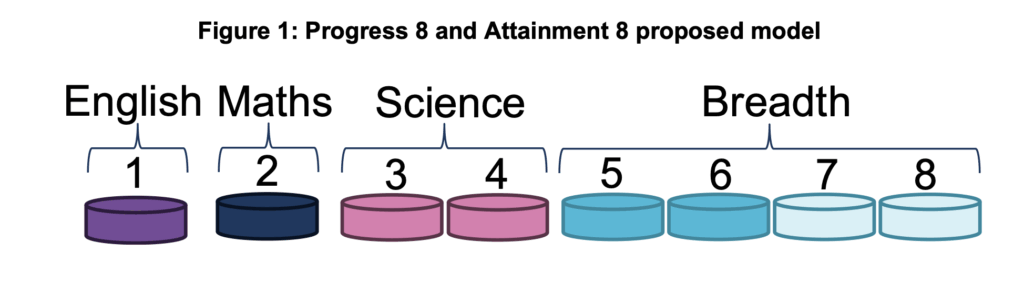
    Becky Francis opposes the EBacc, which is a metric related to, but separate, from Progress 8, yet she wishes to maintain some vestiges of the EBacc within Progress 8. While the EBacc focuses specifically on how many students achieve qualifications in a list of specially favoured subject areas (English Lang and Lit, Maths, Sciences, Geography or History plus a language), the CAR recommends ‘the removal of the EBacc measures but the retention of the EBacc “bucket” in Progress 8 under the new title of “Academic Breadth”.’

    This is something the Government is not running with, favouring less restrictions on Progress 8 instead, which may or may not reinvigorate some creative subjects. Yes, it is all exceptionally complicated but Schools Week have an excellent guide and the two pictures below (from Government sources) might help: the first shows the status quo on Progress 8 and is what Becky Francis wishes to maintain (though pillars 3, 4 and 5 would be renamed if she got her way); the second shows the Government’s proposal.
    How does it fare?

    Call me simple, but I was always going to judge the Curriculum and Assessment Review partly on the extent to which it tackled specific challenges that we have looked at closely at HEPI In recent years. Here the CAR is a mixed bag. On the positive side of the ledger, the review recommends more financial education, reflecting the polling we conducted to help inform the CAR’s work: when we asked undergraduates how well prepared they felt for higher education, 59% said they felt they should have had more education on finances and budgeting.

    The most obvious problem that the CAR insufficiently addresses is the huge underperformance of boys. This issue usually gets a namecheck in Bridget Phillipson’s interviews but it was entirely ignored in the recent Post-16 white paper; in the CAR, it does at least receive a quick nod and just maybe some of the proposed curriculum changes will benefit boys more than girls. But there is more focus on class and other personal characteristics than sex and in the end the brief acknowledgement of boys’ underperformance does not lead to anything properly focused on the problem.

    This is very strange for we simply cannot fix the inequalities in outcomes until we give the gaps in the attainment of boys and girls the attention they deserve. I am beginning to think I was wrong to be so hopeful that a female Secretary of State was more likely to focus on this issue than a male one (on the grounds that it would be less sensitive politically).

    Another area where we at HEPI have been mildly obsessed is the catastrophic decline in language learning, as tracked for us by the Oxonian Megan Bowler. Here, as with boys, the new review is disappointing. In the section looking at welcome subject-by-subject changes, the recommendations on languages are both relatively tentative and relatively weak. As one linguist emailed me first thing this morning, ‘It is pretty remarkable that the CAR’s decision on languages runs exactly contrary to the best and consistent advice of the key language advisers on the issue’. However, the Government’s response goes a little further and Ministers promise to ‘explore the feasibility of developing a new qualification for languages that enables all pupils to have their achievements acknowledged when they are ready rather than at fixed points.’ We might not want languages always to be treated so differently from other subjects but I am still chalking that up as a win.

    The CAR also ignores entirely one issue that is currently filling some MPs’ postbags – the defunding of the International Baccalaureate (IB). The IB delivers a broad curriculum for sixth-formers, is liked by highly selective universities and tackles the early specialisation which marks out our education system from those in many competitor nations. Back in the heady Blair years, Labour politicians loved the qualification and promised to bring it within touching distance of most young people.

    As HEPI is a higher education body, it also feels incumbent upon me to point out that higher education is largely notable by its absence in the CAR, with universities being mentioned just nine times across the (almost) 200 pages and despite schools and colleges obviously being the main pipeline for new students. It is rather different from the days when universities were regarded as having a key direct role to play in designing what goes on in schools. Indeed, our exam boards tended to originate within universities.

    The odd references to universities that do make it in to the CAR report are not especially illuminating. For example, more selective universities appear as part of the rationale for killing the EBacc ‘the evidence does not suggest that taking the EBacc combination of subjects increases the likelihood that students attend Russell Group universities.’ Universities also appear in the section on bolstering T Levels, with the review proposing ‘The Government should continue to promote awareness and understanding of T Levels to the HE sector.’ But that is about it.

    Incidentally, there is also less in the report on extracurricular activities than the pre-publication press coverage might have led you to believe, even if the Government’s response to the review does focus on improving the offer here.

    Trade-offs

    Becky Francis used to head up the UCL Institute of Education (IoE), which is an institution that has always wrestled with excellence versus opportunity. Years ago, I sat in a learnèd IoE seminar on why university league tables are supposedly pernicious – but I had to walk past multiple banners boasting that the IoE was ‘Number 1’ in the world for studying education to get to the seminar and, while I was in the room, news came through that the IoE was going to cement its reputation and position by merging with UCL.

    Such tension is a reminder that educational changes generally have trade-offs and the Executive Summary of the main CAR document admits: ‘All potential reforms to curriculum and assessment come with trade-offs’. Abolishing the EBacc as the CAR team want and watering down Progress 8 as the Department for Education want, might help some pupils and some disciplines while making the numbers we produce about ourselves look better – though the numbers produced by others about us (at places like the OECD) could come to tell a different story in time.

    In the end, we have to recognise that there are only so many hours in the school day, only so many (ie not enough) teachers and only so much room in pupils’ lives, not to mention huge diversity among pupils, schools and staff, which together ensure there can be no perfect curriculum. More of one subject or more extracurricular activities are likely to mean less of other things because the school day is not infinitely expandable (and there is nothing here to free up teachers’ time or fill in all those teacher vacancies). Yet the school curriculum does need to be revised over time to ensure it remains fit for purpose.

    The question now is whether the CAR report matters. Will we still be talking about it in 20 years time? Can a Government buffeted by all sides, facing a huge fiscal crisis and with a Secretary of State for Education who sometimes seems more focused on political battles (like the recent Deputy Leadership election of the Labour Party) than on engaging with the latest educational evidence really deliver Becky Francis’s vision? Or will the CAR’s proposals wilt as quickly as the last really big proposal for curriculum reform: Rishi Sunak’s British Baccalaureate? In all honesty, I am not certain but there are, in theory at least, four years of this Parliament left whereas Rishi Sunak spent more like four months pushing his idea.

    My parting thought, however, is different. It is that, while the trade-offs in the CAR report partly just represent the facts of life in education, they do not entirely do so. Trade-offs are much trickier to deal with when you are also seeking to root out diversity of provision. And in the end, if there is one thing that marks this Government’s mixed approach to schooling out above all, it is the desire to make all schools more alike, whether that is reducing academy freedoms, micromanaging the rules on school uniforms, defunding the IB, forcing state schools to stop offering classical languages or pushing independent schools to the wall. Would it be better, and also make politicians’ lives easier, if we stopped pretending that the 700,000 kids in each school year group are more like one another than they really are?

    Postscript: While the CAR paper is infinitely more digestible than the interim document, there is still some wonderful eduspeak, my favourite of which is:

    A vocational qualification is aligned to a sector and is usually taught and assessed in an applied way.  A technical qualification meanwhile has a direct alignment with an occupational standard. Despite the name ‘Technical Awards’, these qualifications are therefore vocational rather than technical.


    Source link

  • Clear and Present Danger – A history of free speech

    Clear and Present Danger – A history of free speech

    Why have kings, emperors, and governments killed and imprisoned people to shut them up? And why have countless people risked death and imprisonment to express their beliefs? Jacob Mchangama guides you through the history of free speech from the trial of Socrates to the Great Firewall.
    Stay up to date with Clear and Present Danger on the show’s website at freespeechhistory.com

    Source link

  • Graduate outcomes should present a bigger picture

    Graduate outcomes should present a bigger picture

    September marks the start of the next round of Graduate Outcomes data collection.

    For universities, that means weeks of phone calls, follow-up emails, and dashboards that will soon be populated with the data that underpins OfS regulation and league tables.

    For graduates, it means answering questions about where they are, what they’re doing, and how they see their work and study 15 months on.

    A snapshot

    Graduate Outcomes matters. It gives the sector a consistent data set, helps us understand broad labour market trends, and (whether we like it or not) has become one of the defining measures of “quality” in higher education. But it also risks narrowing our view of graduate success to a single snapshot. And by the time universities receive the data, it is closer to two years after a student graduates.

    In a sector that can feel slow to change, two years is still a long time. Whole programmes can be redesigned, new employability initiatives launched, employer engagement structures reshaped. Judging a university on what its graduates were doing two years ago is like judging a family on how it treated the eldest sibling – the rules may well have changed by the time the younger one comes along. Applicants are, in effect, applying to a university in the past, not to the one they will actually experience.

    The problem with 15 months

    The design of Graduate Outcomes reflects a balance between timeliness and comparability. Fifteen months was chosen to give graduates time to settle into work or further study, but not so long that recall bias takes over. The problem is that 15 months is still very early in most careers, and by the time results are published, almost two years have passed.

    For some graduates, that means they are captured at their most precarious: still interning, trying out different sectors, or working in roles that are a stepping stone rather than a destination. For others, it means they are invisible altogether, portfolio workers, freelancers, or those in international labour markets where the survey struggles to track them.

    And then there is the simple reality that universities cannot fully control the labour market. If vacancies are not there because of a recession, hiring freezes, or sector-specific shocks, outcomes data inevitably dips, no matter how much careers support is offered. To read Graduate Outcomes as a pure reflection of provider performance is to miss the economic context it sits within.

    The invisible graduates

    Graduate Outcomes also tells us little about some of the fastest-growing areas of provision. Apprentices, CPD learners, and in future those engaging through the Lifelong Learning Entitlement (LLE), all sit outside its remit. These learners are central to the way government imagines the future of higher education (and in many cases to how universities diversify their own provision) yet their outcomes are largely invisible in official datasets.

    At the same time, Graduate Outcomes remains prominent in league tables, where it can have reputational consequences far beyond its actual coverage. The risk is that universities are judged on an increasingly narrow slice of their student population while other important work goes unrecognised.

    Looking beyond the survey

    The good news is that we are not short of other measures.

    • Longitudinal Education Outcomes (LEO) data shows long-term earnings trajectories, reminding us that graduates often see their biggest salary uplift years into their careers, not at the start. An Institute for Fiscal Studies report highlighted how the biggest benefits of a degree are realised well beyond the first few years.
    • The Resolution Foundation’s Class of 2020 study argued that short-term measures risk masking the lifetime value of higher education.
    • Alumni engagement gives a richer picture of where graduates go, especially internationally. Universities that invest in tracer studies or ongoing alumni networks often uncover more diverse and positive stories than the survey can capture.
    • Skills data (whether through Careers Registration or employer feedback) highlights what students can do and how they can articulate it. That matters as much as a job title, particularly in a labour market where roles evolve quickly.
    • Case studies, student voice, and narratives of career confidence help us understand outcomes in ways metrics cannot.

    Together, these provide a more balanced picture: not to replace Graduate Outcomes, but to sit alongside it.

    Why it matters

    For universities, an over-reliance on Graduate Outcomes risks skewing resources. So much energy goes into chasing responses and optimising for a compliance metric, rather than supporting long-term student success.

    For policymakers, it risks reinforcing a short-term view of higher education. If the measure of quality is fixed at 15 months, providers will inevitably be incentivised to produce quick wins rather than lifelong skills.

    For applicants, it risks misrepresenting the real offer of a university. They make choices on a picture that is not just partial, but out of date.

    Graduate Outcomes is not the enemy. It provides valuable insights, especially at sector level. But it needs to be placed in an ecosystem of measures that includes long-term earnings (LEO), alumni networks, labour market intelligence, skills data, and qualitative student voice.

    That would allow universities to demonstrate their value across the full diversity of provision, from undergraduates to apprentices to CPD learners. It would also allow policymakers and applicants to see beyond a two-year-old snapshot of a 15-month window.

    Until we find ways to measure what success looks like five, ten or twenty years on, Graduate Outcomes risks telling us more about the past than the future of higher education.

    Source link

  • National Junior College Athletic Association Head Coaches Reveal Athletic Equity is Present

    National Junior College Athletic Association Head Coaches Reveal Athletic Equity is Present

    Dr. Riann MullisImagine going through a typical work week without a colleague or coworker inserting an analogy or anecdote from sports into the conversation. Regardless of the reason, from comparison to training, or overcoming adversity, “Collegiate athletics have been a part of the American culture since the 1800s” (Lewis, 2013). Sports significantly influence colleges and universities nationwide, acting as a driving force for institutional culture. The National Junior College Athletic Association (NJCAA) is no stranger to cultivating a positive environment for student-athletes. The association has been providing student-athletes with opportunities to compete in collegiate athletics since 1938 (NJCAA, 2025). Community college athletics traditionally have not received the majority of attention from national media; however, discussion is crucial at this foundational level, especially for the more than 45,000 NJCAA student-athletes pursuing academic and athletic opportunities each year.

    Mainstream media’s focus on ticket sales, influential athletes, and comparisons of athletic experience have contributed to a heightened sense of awareness of athletics at all levels. A significant change for athletics occurred more than 50 years when President Richard Nixon signed Title IX of the Education Amendment (Title IX) into law in 1972 (Valentin, 1997). “Implementing Title IX requires institutions to provide equal athletic opportunities for members of both sexes and to accommodate students’ athletic interests and abilities effectively” (U.S. Department of Education [USDE], 2020b).

    Dr. Jennifer SpielvogelDr. Jennifer Spielvogel The ability to conceptualize the similarities and differences of sports becomes critical to recognize what is considered fair opportunities and experiences for student-athletes. This informs the concept of athletic equity. Though major progress has been made since the enactment of this law, questions remain as to what equity looks like in athletics (Jensen, 2022).

    In a recently published study, “The Assessment of Athletic Equity by Head Men’s and Women’s Coaches in the National Junior College Athletic Association”, (Mullis, 2024) head coaches from a variety of NJCAA sports at Division I (DI) and Division II (DII) institutions were surveyed and interviewed to glean their opinions pertaining to implementation and best practices of athletic equity. Questions focused on observations, opportunities, and experiences.

    The NJCAA head coaches’ opinions about athletic equity initially focused on facilities, scholarships, and travel provided for teams. They were asked to assess the level of agreement on a 4-point Likert (1932) scale ranging from 4 (strongly agree) to 1 (strongly disagree) and the mean (M) was calculated for each question. The head coaches assessed facility equity (M = 2.8), scholarship equity (M = 2.8) and travel equity (M = 3.2) at prominent levels, indicating equity is present. The survey data also were disaggregated by team, with no significant differences found from head coaches of men’s and women’s teams in any sport. Further, the coaches agreed that equity is present for all teams at their institutions.

    In the study, head coaches also rank ordered the importance of six distinct coaching roles: advisor, advocate, fundraiser, leader, mentor, and role model. All 192 survey respondents were consistent in ranking leader as the most significant role. The coaches were confident about their relationships and impact on the student-athletes. Most impressively, when interviewed, none of the coaches mentioned wins and losses. Rather, their focus, shared with enthusiasm, highlighted the importance of each of their identified roles and their overwhelming responsibility to advance athletic equity through fair experiences and opportunities for their student-athletes.

    Collectively, the head coaches conveyed enhanced advocacy accountability for their athletes and teams. Case in point, when coaches were asked in the interviews if they had a responsibility to advocate for athletic equity, an NJCAA DII women’s basketball coach confidently expressed:

    Yes. Absolutely. If I do not advocate for my kids [women’s basketball student-athletes], who is going to do that? That is my job. My goal is to make sure they are getting the same treatment the same opportunities that every other sport, whether it be male or female, is getting on campus.

    With similar conviction, when posed the question if he considered himself responsible for advocating for athletic equity, a DII softball coach sharply stated, “No question.” In the interviews many coaches indicated that campus athletic directors and presidents should be involved and aware of athletic needs. From their perspective, there is a need for effective collaboration and communication, as the administration’s decisions can significantly impact the advancement of athletic equity.

    The assessments and opinions from NJCAA DI and DII head coaches offer a never-before-seen insight into athletic equity implementation at the NJCAA level. Continuing the conversations around the best practices of athletic equity through the voice of the coaches is imperative for the future of collegiate athletics. Implementing progressive ideas such as campus forums, shared documentation, and open discussion around the student-athlete and how to best provide equitable experiences for everyone involved will lead to the continuation of athletic equity at the two-year college level.

    Dr. Riann Mullis serves as Athletic Director and Title IX Coordinator at Neosho County Community College (KS).

    Dr. Jennifer Spielvogel serves as Professor of Practice, Community College Leadership Program, Department of Educational Leadership, at Kansas State University.

    The Roueche Center Forum is co-edited by Drs. John E. Roueche and Margaretta B. Mathis of the John E. Roueche Center for Community College Leadership, Department of Educational Leadership, College of Education, Kansas State University.

    References: 

    Jensen, M. (2022, June 23). What would starting Title IX from scratch look like? Philadelphia Inquirer. https://www.inquirer.com/college- sports/title-ix-anniversary-polls-issues 20220623.html 

    Lewis, G. (2013). The beginning of organized sport. American Quarterly, 22(2), 222–229. https://history.msu.edu/hst329/files/2015/05/ LewisGuy-TheBeginning.pdf 

    Likert, R (1932). A technique for the measurement of attitudes. Retrieved May 4, 2025 from https://archive.org/details/likert-1932/ page/14/mode/2up

    Mullis, R. (2024). The assessment of athletic equity by head Men’s and Women’s coaches in the national junior college athletic association (Order No. 31489530). Available from Dissertations & Theses @ Kansas State University; ProQuest One Academic. (3097398397). Retrieved from https://er.lib.k-state.edu/ login?url=https://www.proquest.com/dissertations- theses/assessment-athletic-equity- head-men-s-women/docview/3097398397/ se-2

    National Junior College Athletic Association. (2025). About. History. Retrieved May 4, 2025 from https://www.njcaa.org/about/history/ index 

    U.S. Department of Education. (2020b). Intercollegiate athletics policy: Three part test – part three. https://www2.ed.gov/about/offices/ list/ocr/docs/title9-qa-20100420.html 

    Valentin, I. (1997). Title IX: A brief history. 25 years of Title IX. WEEA Digest. Women’s Educational Equity Act Resource Center at EDC. https://eric.ed.gov/?id=ED414271


    Source link

  • Teaching Public Speaking Skills for Our Remote Age With MindTap Bongo Present Activities

    Teaching Public Speaking Skills for Our Remote Age With MindTap Bongo Present Activities

    Reading Time: 4 minutes

    I remember that fateful day clearly, back in March 2020, when we were first told “Go home. We’re going remote.” On the way out the door, one of my colleagues said, “This changes everything.”  At the time, I thought they were overreacting. My focus was on health and safety. Naively, I thought the COVID-19 pandemic would pass quickly, and we would soon return to normal.

    Rarely have I been so wrong about so many things.

    As a communication professor for more than thirty years, I assumed public speaking meant speaking in-person, in public. At the beginning of remote learning, I instructed students to present speeches on Zoom in much the same way I had when our classroom was live, in-person. However, after several semesters of trial and error, I finally appreciated the truth of my colleague’s statement. Everything had changed. While many of the skills required for effective public speaking remotely were the same as public speaking in person, teaching additional skills was necessary.

    Public speaking skills: critical for career success

    Happily, I discovered learning these remote public speaking skills would not only support students’ academic success but would also support their long-term workplace success. According to research in Cengage’s Career Readiness eBook, 98.5% of employers think communication skills are very important. Additionally, LinkedIn ranked communication as No. 1 on their 2024 list of overall most in-demand skills. Ultimately, this is a skill that will only benefit students in the long run. So, how can students hone this skill?

    When it comes to public speaking in any environment, practice is always key. Experts often suggest students give practice presentations, paying close attention to things like their body language, tone of voice and breath control. Practicing in front of others can also be tremendously helpful when preparing.

    The challenge of incorporating peer feedback skills in remote teaching

    Providing constructive feedback is an essential skill for remote public speaking. Teaching my students how to provide constructive feedback had always been an integral part of my in-person public speaking curriculum.

    First, I would offer a lesson with guidelines on how to offer constructive feedback. Then, students would be responsible for completing a speech critique form of another student’s presentation. And finally, students would reflect on ways they could improve their performance based on the feedback they received. Research suggests this type of peer review process helps students to develop lifelong skills in assessing and providing feedback to others, while simultaneously equipping them with skills to self-assess and improve their own speeches.

    When I had a full class of face-to-face students, integrating these types of peer review experiences into my public speaking curriculum was relatively easy. However, I quickly learned that the remote learning environment presented a new set of peer review challenges. Just recording speeches to a viewing platform wasn’t enough to replicate the learning opportunities of the in-person experience. Ideally, students needed to be able to record their speeches for asynchronous viewing by the instructor and the assigned students, who would then offer written constructive feedback for the presenter and other peer reviewers to consider. These requirements seemed like a tall order but, amazingly, MindTap, Cengage’s online learning platform, provided me with exactly what I needed.

    Using MindTap to teach remote public speaking skills

    Prior to my public speaking courses shifting to remote learning, I had already been using online MindTap activities to supplement the print versions of my textbooks. After the pandemic, I began to rely more heavily on MindTap activities. I found using MindTap filled in some of what was lost from my students’ in-person experience, keeping them more engaged. Additionally, using the MindTap Bongo Present activities, which are available with many of the Communication Studies eBooks, solved a number of practical dilemmas including how to systematically evaluate their performance.

    Present Bongo activities, found in the MindTap learning path, help students become more comfortable with the act of speaking to a camera while being recorded to a screen through a variety of topic-specific, impromptu-style, low-stakes public speaking opportunities.

    Present activities can also be used as an effective delivery and evaluation system for more formal public speaking presentations, such as pre-planned informative or persuasive speeches. When students record their speech, in addition to receiving feedback and a grade from me, they can also receive feedback from other class members, either by a rubric-based peer review or live, real-time comments.

    Having the option to assign three or more reviewers for each speech provides additional benefits, for both the reviewer and the speaker. As reviewers, students get to see a wider range of work, and as speakers, they get more feedback on their presentations. If multiple reviewers make the same suggestion, a speaker may be more likely to take that suggestion to heart.


    The pathway to public speaking success in a remote setting includes setting aside time to rehearse and record presentations and asking colleagues for constructive feedback. In much the same way, MindTap Bongo activities provide students the opportunity to practice their speaking skills, learn from the review/feedback process  and, ultimately, to succeed in our remote age.

    Written by Sheryll Reichwein, MA, Adjunct Professor of Communication at Cape Cod Community College

    Interested in exploring how MindTap Bongo Activities can help your students develop remote public speaking skills effectively?

    The post Teaching Public Speaking Skills for Our Remote Age With MindTap Bongo Present Activities appeared first on The Cengage Blog.

    Source link

  • National Women’s History Month: Past and Present Higher Ed HR Trailblazers – CUPA-HR

    National Women’s History Month: Past and Present Higher Ed HR Trailblazers – CUPA-HR

    by CUPA-HR | March 2, 2022

    National Women’s History Month celebrates the contributions and achievements women have made throughout U.S. history. CUPA-HR is fortunate to have had many smart and dedicated women serve on its national, regional and chapter boards and on various committees. In addition to providing leadership at work, they have volunteered their time and shared their know-how — lighting the way for other women in the field.

    To celebrate the month, we’re spotlighting some of the many leaders who have transformed higher ed HR and CUPA-HR. Sure to inspire, these articles and podcast episodes offer unique perspectives of higher ed HR, career journeys, struggles, successes and everything in between.

    Looking Back to Move Forward

    Blazing a Trail: Women Who Paved the Way in Higher Ed HR, from a 2014 issue of Higher Ed HR Magazine, features five CUPA-HR leaders who began their higher ed HR careers in a very different era — when HR was still “personnel,” men dominated the profession and the nature of the work was strictly focused on policies and procedures. These women rose to leadership positions, not only in their departments, but across their institutions. Read about their challenges, their regrets, their successes and a few war stories to boot.

    More Stories That Inspire

    CUPA-HR Conversations: Higher Ed HR Turns 75 Podcast features higher ed HR leaders and past CUPA-HR national board chairs who have left their mark on both the association and the profession.

    • In Episode 2: Growing Through Change, Allison Vaillancourt reflects on some professional advice she received from a CUPA-HR peer that changed her entire approach to HR and helped advance her career and secure several leadership positions.
    • Lynn Bynum shares how CUPA-HR helped her make the transition from the corporate world to higher ed HR, and Lauren Turner offers insights into how HR can become a recognized leader within the institution and help others become better leaders in Episode 4: Model Behavior.
    • Jane Federowicz reflects on her unexpected path to HR, starting out as her institution’s accountant and ending up being asked to create an HR department, in Episode 6: When Opportunity Knocks.
    • In Episode 7: Lifelong Learning, Barbara Carroll dives into some experiences she never thought she would have as an HR leader, including serving on CUPA-HR’s Public Policy Committee and providing a higher ed perspective to a room full of senators and congressional representatives, and Linda Lulli discusses the importance of being a lifelong learner in the HR profession and how to be adaptable and resilient.

    Time-Out With Tammi & Tyler is a podcast that explores how higher ed HR careers evolve by interviewing professionals at the top of their HR game, sharing advice they would give professionals climbing the higher ed HR ladder.

    • In Episode 1, Donna Popovich offers advice for early-career professionals.
    • Sheraine Gilliam walks through her story of persistence, networking and how to turn negative situations into opportunities for growth in Episode 3.
    • In Episode 5, Clarity White describes how her Wildfire program experience helped advance her HR career.

    Related resources:

    21-Day Challenge: Focus on Women (First two weeks of the challenge)


    Source link