
Tag: Preserve

  • Higher ed groups ask Supreme Court to preserve lower court order to restore NIH grants

    Higher ed groups ask Supreme Court to preserve lower court order to restore NIH grants

    This audio is auto-generated. Please let us know if you have feedback.

    Dive Brief: 

    • The American Council on Education and other major higher education associations are urging the U.S. Supreme Court to preserve a lower court’s ruling that ordered the National Institutes of Health to reinstate funding for hundreds of canceled grants. 
    • In June, a federal judge vacated NIH directives to nix grant funding for research related to diversity, equity and inclusion. The Trump administration quickly appealed the decision and asked the Supreme Court in July to pause the lower court’s order while an appeals court considers the case. 
    • Eight higher ed groups — including ACE, the Association of American Universities and the Association of American Medical Colleges — argued in legal filings Friday that allowing NIH to cancel the grants again would destabilize the nation’s biomedical research and waste government funding on projects forced to stop midstream. 

    Dive Insight: 

    President Donald Trump signed several executive orders shortly after beginning his second term that prompted the NIH cancellations. One ordered federal agencies to terminate all “equity-related” grants “to the maximum extent allowed by law,” and another directed them to end federal funding for “gender ideology,” which the administration defined as the idea that gender exists on a spectrum. 

    Civil rights groups have noted that anti-LGBT groups use the term “gender ideology” to cast being transgender as a political movement rather than a fundamental identity. And the American Medical Association has said that “trans and non-binary gender identities are normal variations of human identity and expression.”

    The Trump administration canceled vast sums of scientific research funding following those orders. In NIH’s case, the agency often informed researchers of the terminations by saying their work “no longer effectuates agency priorities.”

    The moves quickly drew legal challenges. 

    Researchers and unions argued in an April lawsuit that the move was “a reckless and illegal purge to stamp out NIH-funded research that addresses topics and populations that they disfavor.” A coalition of states also filed a lawsuit that month challenging the terminations. 

    U.S. District Judge William Young agreed with their arguments, ordering NIH in June to restore the plaintiff’s canceled grants. According to a Monday press release from ACE, the order impacted roughly 1,200 grants — though that is only a fraction of the awards that the agency has terminated.

    Since the order only covered the plaintiffs’ grants, ACE and other higher ed groups have also asked NIH Director Jay Bhattacharya, in a July 29 letter, to reinstate the other awards canceled under the anti-DEI directives —  “in the spirit of fairness and consistency.” 

    The Trump administration has appealed Young’s decision. So far, federal officials have asked both Young and the appellate court to block the order to reinstate the grants while the appeals process plays out. Both rejected that request. 

    Then last month, the Trump administration took it to the Supreme Court. 

    The higher education groups noted in their legal filings that grant applications undergo rigorous scientific review before NIH accepts them. 

    In recent months, however, the Executive Branch has jettisoned NIH’s scientific decisionmaking via agencywide directives that mandated the termination en masse of NIH grants deemed related to disfavored political topics,” their Friday filing argued. 

    If those terminations are allowed to stand during the appeals process, critical medical research into diseases like Alzheimer’s and diabetes will be ground to a halt, they said. The groups noted some researchers have had to abandon projects halfway through and lay off staff and students with knowledge of the work. 

    The Trump administration, meanwhile, has argued to the Supreme Court that Young didn’t have jurisdiction to order NIH to reinstate the grants, arguing instead that the matter should proceed in the Court of Federal Claims. In its emergency request, it pointed to the Supreme Court’s April ruling that allowed the U.S. Department of Education to maintain a freeze on $65 million in canceled grant funding for teacher training. 

    In that ruling, the court’s unsigned majority opinion said the government likely wouldn’t be able to recover the funding once disbursed and added that the grant recipients would not “suffer irreparable harm” if a lower court’s order to reinstate the grants was put on hold during the appeals process. 

    The Trump administration urged the Supreme Court to make a similar ruling in the NIH case.
    Source link

  • A New Project to Preserve HBCU History

    A New Project to Preserve HBCU History

    A group of Claflin University students were perusing old campus photos when one image caught a student’s eye—it was a picture of his grandmother from her college days. He knew they attended the same historically Black university in South Carolina, but he had never seen a picture of her in her younger years.

    For Cassandra Illidge, vice president of global partnerships and executive director of the HBCU Grants Program at Getty Images, such moments both drive and affirm the company’s expanding work with HBCUs to preserve photos, documents and records in partnership with the genealogy website Ancestry.

    Identifying his grandmother gave that student “a deeper connection with that institution, with the history and that legacy,” Illidge said, “and that’s what we’re hoping everyone will enjoy with this relationship and this partnership.”

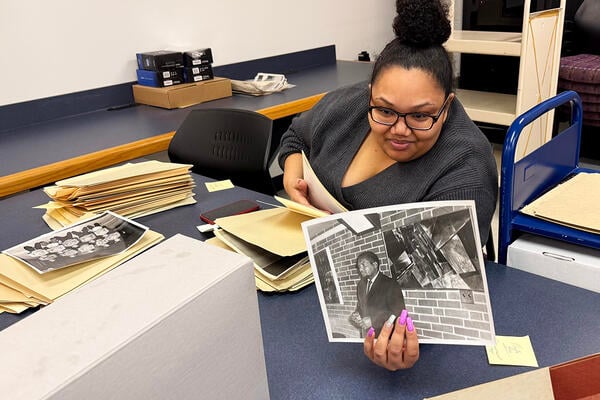
    Funded by Getty Images’ HBCU Grants Program, which started in 2021 with four institutions, the new partnership aims to digitize HBCU archival materials ranging from photos to student newspapers to course catalogs. Getty and Ancestry are working with 10 HBCUs—and counting—to create searchable digital archives for each institution, accessible to students and staff on Ancestry’s website. HBCUs maintain full copyright ownership of all their materials, and any money made from licensing the photos goes back into the digitization project. Meanwhile, students on each campus, who can receive stipends provided by the restaurant chain Denny’s, help to identify documents and photos to preserve and digitize them using scanners donated by Epson.

    The companies are also preserving current documents and records for students and alumni of the future.

    “You’ll see campus queens from the1950s and campus queens from 2025,” Illidge said, referencing a time-honored HBCU tradition of crowning royal courts.

    The project is an expansion of Getty Images’ ongoing work to preserve HBCU photography through its HBCU Grants Program. Illidge had long wanted to put HBCUs’ archival materials on Getty but found the institutions didn’t necessarily have the resources or technology to digitize their rich photography collections. The grant supported that work, but she soon realized that HBCUs needed resources to immortalize pieces of their histories beyond imagery, and Ancestry seemed like the right partner.

    “There were so many stories that needed to be told,” she said. “There’s so much material that still needs to be uncovered for research purposes, for licensing, for storytelling.”

    ‘History Coming to Life’

    Lincoln University in Pennsylvania, the first degree-granting HBCU in the country, was also the first to participate in the joint project. So far, about 700 of its archival photos have been digitized, with plans to add documents and records, dating back to its charter in 1854.

    Harry Stinson III, interim vice president of institutional advancement at Lincoln and the executive director of the university’s foundation, said prior to 1910, U.S. Census records for African Americans weren’t well-kept, but Lincoln has “impeccable records” of its students dating back to 11 years before Emancipation. So, the university is now digging up documents and information about people’s ancestors they’d be hard-pressed to find elsewhere, and making those materials available to students, employees and Ancestry users outside of campus.

    Lincoln University students and staff edit an edition of the campus newspaper, The Lincolnian, in 1954. 

    Lincoln University/Getty Images

    Stinson hopes people use Lincoln’s digital archive to “find their own story of themselves. That’s what college is for,” he said. The archive can “help you connect the dots of your family and your history, your heritage. We want people to learn more about themselves.”

    Meanwhile, students working on the project get to try their hand at archival work, photography restoration and other skills and learn about potential career paths.

    Already, people are uncovering their families’ stories. When Maryland governor Wes Moore came to campus recently to speak at commencement, for example, he was able to see his grandfather’s writing in Lincoln’s student newspaper, as well as his grades and photos.

    Stinson has also been excited to uncover photos of well-known Lincoln alumni and visitors to campus, including U.S. Supreme Court Justice Thurgood Marshall studying and actor Paul Robeson, whose father and grandfather attended Lincoln, coaching football.

    “It’s just seeing history coming to life,” he said.

    The Political Moment

    The project comes at a time when preserving and sharing Black history, and American history more broadly, has become a contentious political issue.

    President Donald Trump signed an executive order in March, titled “Restoring Truth and Sanity to American History,” which took issue with portrayals of the country as “inherently racist, sexist, oppressive, or otherwise irredeemably flawed.” The order accuses the Smithsonian museums of adopting a “divisive, race-centered ideology” and calls to “remove improper ideology” from these institutions—including the National Museum of African American History and Culture.

    A January executive order aimed at K-12 schools also demanded children be provided a “patriotic education” and included guidelines for the teaching of history. Further, the administration recently fired the librarian of Congress, in part for doing “concerning things” in “pursuit of DEI,” according to White House press secretary Karoline Leavitt.

    Meanwhile, many companies and academic institutions have backed off initiatives or projects focused on Black communities and perspectives amid a broader federal backlash to any initiatives officials perceive as DEI-related.

    Lincoln University Professor Willie Williams teaches students in a classroom.

    Lincoln University professor Willie Williams teaches students, 1970.

    Lincoln University/Getty Images

    Some civil rights groups have adopted a fighting stance against federal attempts to dictate how history is remembered and taught. For example, a coalition of groups, including the African American Policy Forum, the National Urban League and the National Action Network, signed an “affirmation in defense of Black history, texts and art” and held a demonstration earlier this month in support of the National Museum of African American History and Culture.

    “We must protect our history not just in books, schools, libraries, and universities, but also in museums, memorials, and remembrances that are sites of our national memory,” the affirmation reads. “Racial inequality remains real; if we are not able to understand it, tell its history, and honor those who have risked everything to solve it, then we lose our capacity to carry the legacy, brilliance and resilience of these freedom fighters in our lives and to future generations.”

    Stinson said it feels “fulfilling” to collect and digitize Lincoln’s history right now, and it’s “ideal timing.” He believes the documents and photos being preserved through Getty Images and Ancestry are of value to all Americans. He highlighted the fact that Thurgood Marshall and other Lincoln alumni are historical figures not just for Black Americans but for the country at large.

    “We’re not just talking about Black history, we’re talking about American history,” he said. The images and records collected show “what African Americans have been able to achieve when given the space and the opportunity to learn and to thrive.”

    Illidge emphasized that Getty Images is working to “preserve history … Black history, all history.”

    “This amazing material that’s coming from HBCUs is just another line of history that we can share with the world,” she said. “Regardless of administration, or any other changes, we’re not changing our goals and mission.”

    (This story has been updated to correct the sport Robeson coached.)

    Source link