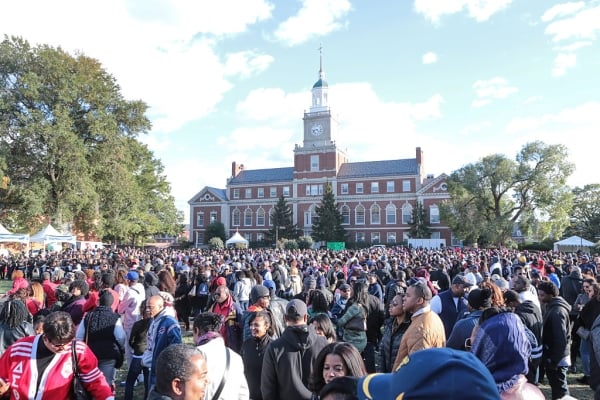
Vinson has led the Washington, D.C., HBCU since 2023.
Cheriss May/NurPhoto via Getty Images
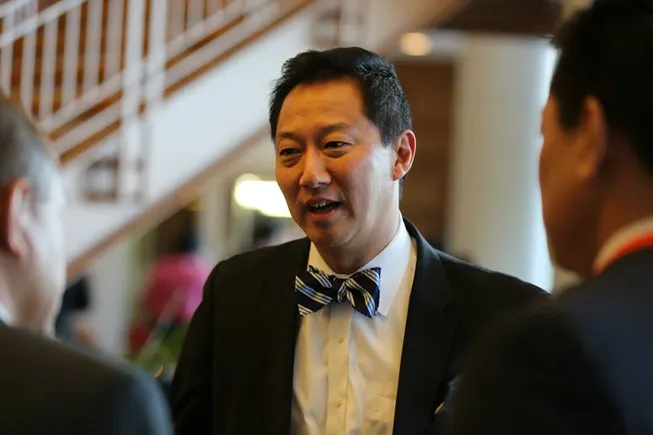
Howard University president Ben Vinson III will step down Aug. 31, two years after assuming the role and two weeks after the start of fall classes, university officials announced Friday. Former Howard president Wayne A. I. Frederick will serve as interim president.
“It has been an honor to serve Howard,” Vinson said in a statement. “At this point, I will be taking some time to be with my family and continue my research activities. I look forward to using my experiences as president to continue to serve higher education in the future.”
University officials declined to comment about why Vinson is leaving only two years after he took up the helm. During his tenure, the Washington, D.C.–based HBCU became an R-1 research institution and brought on several high-profile faculty, including journalist Nikole Hannah-Jones, author Ta-Nehisi Coates and historian Ibram X. Kendi. The university also hosted Kamala Harris’s election night watch party.
But the past year has also brought its share of challenges. In May, the Trump administration proposed cutting Howard’s federal funding by $64 million in fiscal year 2026, bringing it back to its 2021 funding level. Over the summer, the administration took heat from students over surprise bills that appeared on their accounts when the university transitioned to a new student financial platform, and some students turned to crowdfunding to pay those bills.
“On behalf of the Howard University Board of Trustees, we extend our sincere gratitude to Dr. Vinson for his service and leadership as president,” board chair Leslie Hale said in a statement. “We extend our very best wishes to him in his future endeavors.”
Frederick, who served as president of Howard from 2014 to 2023, will remain interim president while the board conducts a nationwide search for a permanent replacement.
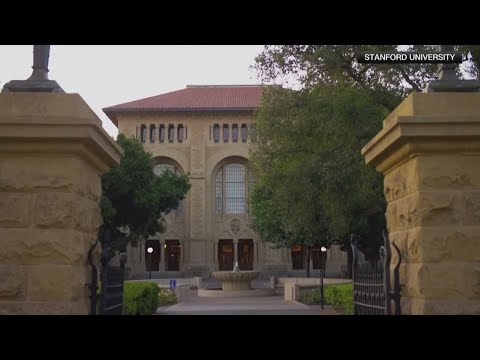
The Stanford Daily has filed a federal lawsuit against former President Donald Trump, marking a bold legal move from one of the country’s most prominent student newspapers. Editors at the Daily argue that Trump-era immigration policies targeting international students for political speech violated constitutional protections and created a climate of fear on campus.
Student journalists now find themselves confronting the same administration that reshaped higher education financing, gutted transparency, and targeted dissent. Their lawsuit challenges the chilling effect of visa threats against noncitizen students, particularly those who criticize U.S. or Israeli policy. Two international students joined the case anonymously, citing fear of deportation for expressing political views.
Stanford holds one of the largest university endowments in the world, valued between $37 and $40 billion. Despite this immense wealth, hundreds of staff—including research support, technical workers, and student service roles—face termination. The disconnect between administrative austerity and executive influence speaks to a larger crisis in higher education governance.
The Daily’s lawsuit cuts to the core of that crisis. Student reporters are asking not only for legal accountability, but also for transparency around how universities respond to political pressure—and who gets silenced in the process.
HEI’s Commitment to Student-Led Accountability
The Higher Education Inquirer is elevating this story as part of an ongoing effort to highlight courageous journalism from student-run newsrooms. Editorial boards like The Stanford Daily’s are producing investigative work that professional media often overlook. These journalists aren’t waiting for permission. They’re filing FOIA requests, confronting billion-dollar institutions, and—when necessary—taking their cases to court.
HEI will continue amplifying these efforts. Student reporters are already reshaping the media conversation around academic freedom, labor justice, and the political economy of higher education. Their work deserves broader attention and support.
Embattled George Mason University president Gregory Washington remains on the job despite concerns that GMU’s Board of Visitors would fire him amid multiple federal investigations into alleged racial discrimination, antisemitism and other matters, which he has publicly pushed back on.
GMU’s Board of Visitors met Friday to review Washington’s performance and to consult with legal counsel on “actual or probable litigation,” according to the board agenda. While specific legal matters were not detailed in the agenda, GMU is facing investigations from both the U.S. Department of Education and the Department of Justice over alleged discrimination in hiring practices and antisemitism. The DOJ also launched a highly unusual investigation into GMU’s Faculty Senate after it approved a resolution in support of Washington’s leadership.
The Trump administration seized on remarks made by Washington following the 2020 murder of George Floyd. Washington, as noted in a letter from the DOJ to the university, expressed the need to hire diverse faculty members, promised to advance an antiracist agenda and threw his support behind GMU’s diversity, equity and inclusion initiatives.
Washington denied engaging in what the Trump administration labeled “illegal DEI” efforts.
On Friday, he defended both GMU and his own performance, noting he arrived on campus in 2020 when tensions were high and racial strife was still simmering over Floyd’s murder. Adding to the pressure, students, faculty members and others demanded he tear down a statue of university founder George Mason, who was a slave owner.
“Despite the commentary that you might hear, this institution is doing extraordinarily well,” Washington told board members on Friday in the open session portion of the meeting, during which he touted GMU’s rise in various university rankings as well as an increase in state funding.
But many community members feared that Washington, GMU’s first Black president, would lose this job as a result of the investigations. They worried that the inquiries give the Board of Visitors—which is stocked with conservative political activists and former GOP officials—the pretext to remove him. Multiple speakers and attendees at a Friday rally held in support of Washington pointed to other campus leaders recently pushed out. That includes Jim Ryan at the University of Virginia, who resigned under pressure from the DOJ over DEI programs, and Cedric Wins, superintendent of Virginia Military Institute, whose contract was not renewed this spring amid alumni complaints about DEI. One rally organizer had referred to the Friday meeting as “high noon at the OK Corral.”
Instead, after roughly three hours in closed session, the board emerged with one action item: approval of a 1.5 percent raise for Washington, which members unanimously signed off on. Board members did not discuss their review of his performance conducted behind closed doors.
That means despite faculty concerns Washington will keep his job—at least for now.
Support for Washington
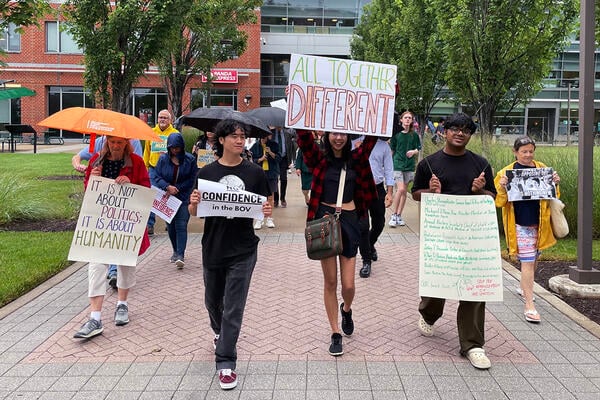
As faculty, students and local lawmakers gathered Friday, they had a clear message for the Board of Visitors: Support Washington and push back on federal investigations they deemed both illegitimate and a broadside against academic freedom at GMU. They also called on the board to protect DEI at GMU, which is Virginia’s most diverse university. However, the board defied that demand by passing a resolution Friday to end race-conscious hiring, scholarships, graduation ceremonies and other initiatives.
While Washington’s fate was unknown during the rally, speakers urged attendees to push on.
“We’ve got to keep fighting. No matter what happens today, this is still our university,” said Bethany Letiecq, chair of GMU’s chapter of the American Association of University Professors. Letiecq also referenced personal safety concerns, arguing, “Faculty are being harassed and threatened.” (She previously told Inside Higher Ed she has been subject to two death threats.)
Bethany Letiecq was one of several speakers to voice support for GMU president Gregory Washington at a Friday rally.
Former Board of Visitors member Bob Witeck, who served on the search committee that hired Washington in 2020, said he “could not believe our luck” in selecting the president from a pool of nearly 200 candidates and praised his “character, intellect and honesty.” Witeck also warned about threats to both academic freedom and the inclusive nature of GMU, stating, “Discrimination cannot find a home here, nor should political interference or baseless investigations.”
Another speaker was supportive of Washington while also critical.
Ellie Fox, a GMU student and president of its Jewish Voices for Peace chapter, was critical of Washington for allegedly repressing “pro-Palestinian speech in the name of Jewish safety.” Fox added that he was “reluctant to resist Trump and conservatives and their attack” on GMU but urged Washington to defy calls to resign from his position and work “toward a better future.”
Other rally speakers included Fairfax mayor Catherine Read and State Senator Saddam Salim, both GMU graduates and Democrats, who threw their support behind the university and Washington and expressed concerns about the investigations and other attacks on higher education.
Board-Faculty Tensions
Although the board did not make any public announcement about the items they discussed in closed session, beyond approving a raise for Washington, an exchange between one member and a GMU professor highlighted the tensions at play.
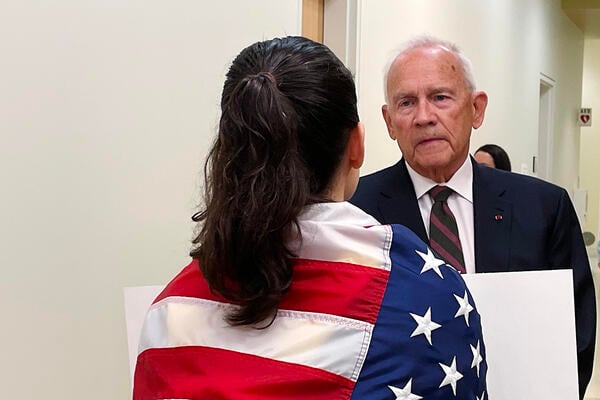
Robert Pence, a former ambassador to Finland appointed during President Donald Trump’s first term, took issue with a faculty member’s protest sign when he encountered her in a hallway outside the board’s meeting room during a break. Tehama Lopez, a professor in the Jimmy and Rosalynn Carter School for Peace and Conflict Resolution, held a sign calling on the board to support Washington and uphold the First Amendment, academic freedom and due process.
“You’re suggesting that Bob Pence—Robert Pence—does not support the First Amendment,” he told Lopez before shifting his attention to her call for board members to support Washington.
Pence then asked Lopez, “If you got a lot of facts and you became convinced that he was engaged in conduct that is deleterious to the university, would you then fire [Washington]? If he meets the standard—whatever the standard is for discharge—would you be willing to fire him?”
Lopez responded, “Who is being deleterious to the university?” Pence fired back, “You won’t answer the question” and “I’m not playing that game” before walking away from the exchange to return to the meeting.
Board member Robert Pence clashed with a faculty member outside of Friday’s meeting.
In a brief interview following that conversation, Lopez said that she wanted to see the board uphold its fiduciary duties as GMU faces multiple investigations, which she called “politically motivated.” Given the stakes, she wants to make sure the Board of Visitors protects the universityrather than enacting a political agenda pushed by the Trump administration.
But Lopez appeared uncertain of which path the board will take.
“Their job on the Board of Visitors is to do the work of protecting the school and the school’s interest, and it’s very unclear whose bidding they’re doing,” Lopez said.
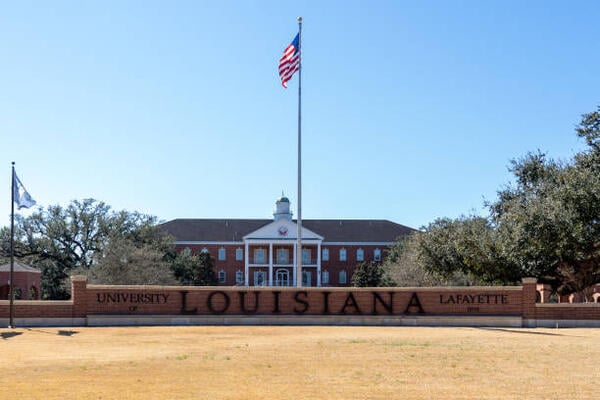
University of Louisiana at Lafayette president Joseph Savoie is retiring suddenly after 17 years in the top job at the public research institution, The Louisiana Illuminator reported.
His retirement, announced Wednesday, is effective today.
Savoie, who earned both undergraduate and graduate degrees from UL Lafayette, served in multiple administrative roles at the university from 1978 to 1996, when he stepped down to serve as Louisiana’s commissioner of higher education. Savoie returned as president in 2008.
Altogether, Savoie spent more than 35 years at UL Lafayette.
“I reached the decision to transition to this new position after months of careful consideration,” Savoie said in a university news release about his retirement. “Higher education has changed immensely in the past two decades. The expectations on colleges and universities are as great as they have ever been and meeting those responsibilities to our community today—and to generations that follow—requires new ideas and fresh approaches. I owe it to this institution that has given me so much, personally and professionally, to make way for the future.”
Savoie will become emeritus president and ULL provost Jaimie Hebert will serve as interim leader while the University of Louisiana system Board of Supervisors seeks a permanent hire.
While Savoie is credited with various accomplishments, including overseeing Lafayette’s rise to R-1 status in the Carnegie Classifications of Institutions, the university has also faced criticism from board members and state officials over inadequate financial controls in two consecutive audits.
Savoie is the second public university leader in Louisiana to step down abruptly in recent weeks. Southern University New Orleans chancellor James Ammons announced that he was departing last month and has already been replaced by Democratic lawmaker Joe Bouie, who held the job from 2000 to 2002 before he was fired over what he said was a political matter.
Elsewhere in the state, Louisiana State University president William F. Tate IV also stepped down in June after he was hired to lead Rutgers University.
This audio is auto-generated. Please let us know if you have feedback.
In early June, the governing board of Florida’s university system surprised the higher education sector when it rejected Santa Ono as the sole finalist for the presidency of the University of Florida.Ono had faced backlash — led by conservative activist Christopher Rufo — over his past embrace of diversity, equity and inclusion efforts while head of the University of Michigan.
Later that month, University of Virginia President Jim Ryan abruptly stepped down after the U.S. Department of Justice pressured him to resign over the institution’s diversity efforts.Ryan said he wouldn’t fight to keep his job when staying would have cost the institution research funding and student aid and hurt international students.
The duties of the modern college president extend far beyond keeping their institutions viable. For decades, how the head of a college is selected and who fills the position has been steadily shifting. Now, whoever assumes the role will likely take vitriol from both the public and policymakers.
James Finkelstein, professor emeritus at George Mason University’s public policy school, researches leadership in higher education. We spoke with him about the changing role of the college president, the increased influence a presidency faces from both the political and private sectors and what that means for higher ed in the long run.
This interview has been edited for length and clarity.
HIGHER ED DIVE: How does one become a college president? And has that changed in recent decades?
James Finkelstein, professor emeritus at George Mason University
Permission granted by Judith Wilde
JAMES FINKELSTEIN:The traditional route would start with becoming an assistant professor. You get tenure next, and then you may start to move up the administrative ranks. The most common path was to go from provost to president. For now, that’s still the most common path, but it’s on the decline.
The problem is, provosts don’t fundraise. Deans do. And the No. 1 qualification that a board now looks for in a university president is their ability to raise money.
Given that shift in priorities, how do college boards pick their institution’s next presidents?
My colleague, Judith Wilde, and I have studied this process extensively, and boards are increasingly relying on executive search firms.
We found that only 2% or 3% of presidential classified ads mentioned a search firm in 1975. Today, it’s almost 100%. And based on the data, that change has also correlated with the beginning of the decline in the length of university presidents’ tenure.
Search firms do the initial screening and determine for the board which candidates are really viable. But very few of the search firm senior executives have any real experience in higher education and their No. 1 responsibility as fiduciaries is to return profit to investors.
From there, the board picks from the candidates highlighted by the search firm? What do they look for?
Yes. People tend to look for candidates who look like them. And boards are not primarily made up of academics — the only thing most board members know about a university is that they got a degree from one. You’re seeing a lot more political types on the boards, as is the case in Virginia, or corporate types.
It’s interesting, corporations don’t turn to universities for their leadership. They don’t select a college president to run them. The former president of TIAA [Clifton Wharton Jr.] was the only university president to become a CEO of a Fortune 500 company — and he led a company designed to serve universities.
But many universities, at least 10% or so, will select a corporate executive to lead them.
If boards expect university presidents to behave more like corporate executives than leaders of an educational, social and cultural institution — someone who serves the public — then the next generation of university leadership is going to look very different. You’re going to see a different kind of person be not only sought after but interested in these jobs because they think they can take their private sector skill set directly into higher ed.
In recent years, the presidential compensation packages at some colleges have mirrored those of Fortune 500 CEOs. In 2022, Ben Sasse received a notably lucrative package when he was hired to lead the University of Florida, as you and Judith have discussed. What effect does that shift have on colleges?
When I was an undergraduate, the university president probably wore a tweed sport coat with leather patches on the elbows. And the patches weren’t there to make a style statement; it’s because the elbows were worn out. If he had a car — and it was far and away “he” when I was in school — it was a car from the university’s car pool that was several years old.
And in the past, presidents maintained some academic interests. They taught. They were visible on campus.
Now, university presidents drive expensive cars and are more likely to associate with people outside the university than faculty inside the university.
Our sector does not enjoy the reputation with the public that it used to. There are all sorts of questions now about the value of a college degree. People generally think faculty get paid a lot of money and don’t do very much.
More than anything, presidents today are facing the question of if there is a way to win back that trust.
While college presidents are grappling with that question, though, they are also watching their positions become increasingly precarious. One recent example is Santa Ono, who had been set up as Sasse’s replacement. Traditionally, the vote from the Florida universities’ governing board would have been pro forma. What shifted the tides and left Ono out of a job?
Ono was targeted by the Chris Rufo machine. You can go back and read Rufo’s interview with Politico and listen to his interview with The New York Times — he’s very public about his strategy to delegitimize leaders in higher ed. His team made a decision early on that they wanted one of their own in Florida. And Ono wasn’t it.
Having watched the entire governing board meeting in Florida, my professional assessment is that I’ve never seen a president or someone of Ono’s stature so ill-prepared and give so poor a performance on every level.
Whoever prepared him, didn’t. And if they did, they weren’t preparing him for the right thing. It was much like what happened to the college presidents who testified at congressional committee hearings. Ono wasn’t completely prepared that he was going to be essentially cross-examined by a former state legislator.
By that point, Ono had already announced his departure from the University of Michigan, leaving a highly debated track record on diversity efforts and the handling of student protests in his wake. Does he stand a chance of getting another job heading a university?
About 75% of presidents are what we call one-and-done — they report they’ll hold one presidency, and that’s more than enough. The Gordon Gees of the world are the exception, not the rule.
Ono was, in my view, the modern-day equivalent of [former West Virginia University President] Gordon Gee. He’s the professional president who developed a public persona. He developed it at the University of Cincinnati, refined it at the University of British Columbia, and then brought it to Michigan.
But I’ve talked to people at Cincinnati and Michigan. The truth of the matter is, he wasn’t well-thought of by the faculty. And he burned out very quickly in Michigan.
Ono shouldn’t be the model for the modern university president. Personally, I don’t think that he’s going to get another presidency after the Florida situation, at least not for a while.
Is the role of president still a consequential one? Do the heads of colleges wield influence in the same way they have in the past?
Who the president is makes a difference. They set the tone of the institution in many ways. But presidents today can exercise less independent leadership than they did in the past — they’re being put on a shorter and shorter leash.
There are so many different constituencies that they’re having to serve, and a lot of those constituencies are in conflict with each other.
Some presidents are engaging in what people call anticipatory compliance.
“In order to avoid these conflicts,” the thinking goes, “I’m going to get one step ahead.” Sadly, what that means is that when the board intervenes, they want even more.
Is there a world where that kind of interference becomes so unpleasant that it renders the job unpalatable?
I think for many serious potential candidates, the answer is yes. It doesn’t matter whether you’re being paid $1 million. Or if you have two country club memberships, a big car, a big house and staff, and all of that. These jobs have always been 24/7, 365. And the scrutiny is exponentially worse now.
The real question is: Who’s going to want these jobs? That’s part of the plan of critics of higher education. They want to drive people out so they can replicate what they’re doing in Florida and appoint political loyalists who have no experience in higher education.
Even though conservatives are critical of what they see as judicial activism, they have been extraordinarily active on college boards, working to influence curriculum and promotions and tenure.
The current climate changes things for all trustees, even those who don’t align with this thinking. Regardless of their backgrounds, no board will want to appoint a president who is going to put at risk all of their research funding. And the Trump administration has shown that it is willing to use any lever it has to bring these institutions under its thumb. Look how quickly Jim Ryan was gone from UVA.
As you mentioned, presidents are serving increasingly shorter tenures, instead of holding the position for life, or at least until retirement. Beyond a loss of leadership consistency, does this turnover hurt colleges?
Take Jim Ryan as an example. He’s 58 years old.
I assume the terms of his contract were renegotiated when he left, but based on my analysis of his 2022 contract, the university has a future liability of almost $17 million to him. He would actuarially retire from teaching in 15 years, and in 2038, his base salary would be over $1 million a year for teaching at most two courses a semester.
The people who are actually doing most of the teaching at UVA in 2038 won’t be tenured or tenure track. They will be contingent faculty who are barely able to scrape together a living.
If you put $10 million in a scholarship fund at UVA, would that be a better investment than keeping Ryan on the faculty? The answer is a no-brainer.
The University of Virginia is searching for an interim leader.
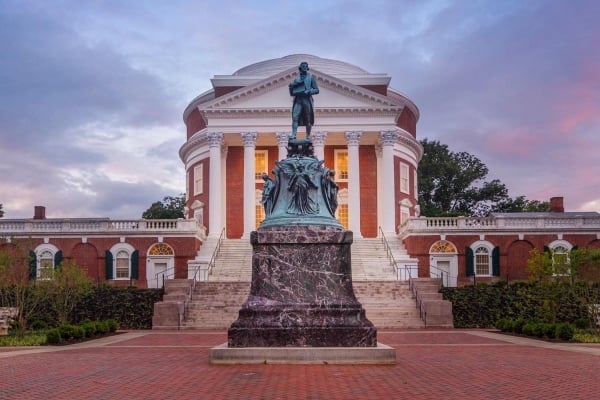
The University of Virginia is accepting nominations for an interim president to replace former executive James Ryan, who announced his resignation late last month under pressure from the Department of Justice. Ryan officially stepped down last Friday.
The nomination form will remain open to all members of the university community through July 25. Then the board will conduct a series of listening sessions with faculty, staff, division leaders and students.
“The Board of Visitors is committed to working closely with members of our community to hear their perspectives and ensure stability and continuity going forward,” board rector Rachel Sheridan said in a news release. “Shared governance is a core value of this institution and we will uphold it as we pursue the selection of an interim president, as well as our 10th university president after that.”
In the meantime, Jennifer Wagner Davis, the university’s chief operating officer, is serving as acting president.
The Justice Department had accused Ryan and the flagship institution of failing to eliminate all DEI programs on campus, violating Title VI of the Civil Rights Act, which prohibits discrimination based on race, color and national origin. The letters said that Ryan and his “proxies” had made “little attempt to disguise their contempt and intent to defy these fundamental civil rights.” But the Trump administration has said multiple times that it did not demand Ryan’s resignation verbally or via the letters.
In a pointed letter to the George Mason University community Wednesday, President Gregory Washington defended his institution against the Trump administration, which launched an investigation last week into the university’s alleged violations of Title VI.
In his letter, Washington vowed to “cooperate fully” with the Office for Civil Rights.
“I can assure you that George Mason has always operated with a commitment to equality under the law, ever since our inception,” he wrote. ”It is simply the Mason way, and in my experience, it has not discriminated based on race, color, national origin, or otherwise. Our diversity efforts are designed to expand opportunity and build inclusive excellence—not to exclude or advantage any group unlawfully.”
He offered a brief history of Title VI—which prohibits discrimination on the basis of race, color and national origin in federally funded programs—and the rest of the Civil Rights Act of 1964. Then, without naming any names, he essentially accused the Trump administration of willfully misinterpreting the law.
“Today, we are seeing a profound shift in how Title VI is being applied,” he wrote. “Longstanding efforts to address inequality—such as mentoring programs, inclusive hiring practices, and support for historically underrepresented groups—are in many cases being reinterpreted as presumptively unlawful. Broad terms like ‘illegal DEI’ are now used without definition, allowing virtually any initiative that touches on identity or inclusion to be painted as discriminatory.
“This shift represents a stark departure from the spirit in which civil rights law was written: not to erase difference, but to protect individuals from exclusion and to enable equal opportunity for all.”
He noted that GMU—which enrolls roughly 40,000 students—admits 90 percent of applicants and has more Pell-eligible students than any other institution in Virginia.
The university’s mission “includes the belief that diversity includes thought, background, and circumstance and any attempt to artificially redefine our diversity, as one of race-based exclusivity, is doomed to fail no matter who ends up being excluded,” he wrote.
Shipman has been Columbia University’s acting president since March.
Claire Shipman, acting president of Columbia University, apologized Wednesday for writing messages in 2023 and 2024 that House Republicans say “appear to downplay and even mock the pervasive culture of antisemitism on Columbia’s campus,” Jewish Insider reported.
“The things I said in a moment of frustration and stress were wrong. They do not reflect how I feel,” Shipman wrote in a private email the outlet obtained Wednesday. Shipman said she was addressing “some trusted groups of friends and colleagues, with whom I’ve talked regularly over the last few months.”
The apology comes one day after the House Committee on Education and Workforce sent Shipman a letter asking her to explain the intent of internal messages she wrote about antisemitism on the Manhattan campus following the start of Israel’s war in Gaza and the Oct. 7, 2023, Hamas attack. During the time frame in question, Shipman, who became acting president in March, was co-chair of the university’s Board of Trustees.
In its letter, the committee, which has subpoenaed numerous documents related to antisemitism at Columbia, cited a message Shipman wrote to now-resigned president Minouche Shafik on Oct. 20, 2023, that said, “People are really frustrated and scared about antisemitism on our campus and they feel somehow betrayed by it. Which is not necessarily a rational feeling but it’s deep and it is quite threatening.” The committee told Shipman her statement was “perplexing, considering the violence and harassment against Jewish and Israeli students already occurring on Columbia’s campus at the time.”
The committee, which has already compelled Columbia and numerous other universities to testify about their responses to campus antisemitism, also cited in its letter several messages from Shipman that convey alleged “distrust and dislike” for Shoshana Shendelman, a Jewish member of the university’s board who has been outspoken about perceived inadequacies of Columbia’s antisemitism response. “I just don’t think she should be on the board,” Shipman said in a January 2024 message. In April 2024, Shipman wrote that she was “so, so tired” of Shendelman.
In addition to ongoing scrutiny from Republican members of Congress, the Trump administration has attacked Columbia for months, accusing the university of not protecting Jewish students sufficiently and cutting off more than $400 million in federal funds. Although Columbia agreed to the administration’s demands, including overhauling disciplinary processes, Trump hasn’t yet restored the university’s funding. Instead, the Education Department reported Columbia to its accreditor, which has since issued a warning to the university.
The University of Virginia president James Ryan said Friday he was resigning after the Justice Department demanded he step down.
“To make a long story short, I am inclined to fight for what I believe in, and I believe deeply in this university,” Ryan wrote in a letter to the campus community. “But I cannot make a unilateral decision to fight the federal government in order to save my own job. To do so would not only be quixotic but appear selfish and self-centered to the hundreds of employees who would lose their jobs, the researchers who would lose their funding, and the hundreds of students who could lose financial aid or have their visas withheld.”
The Justice Department has for months been quietly investigating whether the Virginia flagship complied with President Donald Trump’s order banning diversity, equity and inclusion programs. The university’s Board of Visitors voted to dissolve its DEI office in March, but multiple conservative alumni groups and legal entities complained that Ryan failed to eliminate DEI from all corners of campus. In many cases, critics argue that the university simply changed the names of programs but maintained their core function.
The New York Timesfirst reported on the resignation and the Justice Department’s demand Thursday evening.
Ryan wrote that he had planned to step down next spring for reasons separate from the investigation; he didn’t say when his resignation would take effect.
“While there are very important principles at play here, I would at a very practical level be fighting to keep my job for one more year while knowingly and willingly sacrificing others in this community,” he wrote.
Ryan took over at UVA in August 2018, steering the institution through the aftermath of the deadly white supremacist rally in August 2017, the pandemic and the racial reckoning in 2020. He also cracked down on pro-Palestinian protesters last spring—a move that Republicans in the state backed but students and faculty condemned. Ryan also embraced institutional neutrality and sought to make UVA a leader in the study of democracy.
Assistant Attorney General Harmeet Dhillon said in a statement Friday that the Justice Department welcomes “leadership changes in higher education that signal institutional commitment to our nation’s venerable federal civil rights laws.”
DOJ hasn’t said publicly what laws UVA allegedly violated, though Dhillon’s statement noted that the agency “has a zero-tolerance policy toward illegal discrimination in publicly-funded universities.”
From the early days of his second term, Trump has made a point of dragging elite, largely Ivy League institutions like Columbia and Harvard Universities into the national spotlight and berating them for their supposed liberal ideologies and alleged antisemitism. But this investigation of UVA, a public institution in a state led by a Republican, represents a new front in the administration’s war against higher education—and so far Trump is succeeding.
Brendan Cantwell, a higher education professor at Michigan State University, said Ryan’s resignation is a “major blow” to the independence of American institutions.
“It is a sign that major public research universities are substantially controlled by a political party whose primary goal is to further its partisan agenda and will stop at nothing to bring the independence of higher education to heel,” he told Inside Higher Ed. “It undercuts both the integrity of academic communities as self-governing based on the judgment of expert professionals and the traditional accountability that public universities have to their states via formal and established governance mechanisms.”
Legal experts who spoke with the Times struggled to recall other instances when the federal government has demanded a university board fire the chief official, saying it has only been done in the past when concerning corporate criminal cases.
Robert Kelchen, an education policy professor at the University of Tennessee, noted that Ryan’s resignation portends a future in which all public university presidents must conform to the political views of their state’s leadership or be kicked out of office.
“Trump pushing James Ryan to resign at UVA is important, but it happened in part because VA’s governor is also Republican,” Kelchen wrote on BlueSky.
Virginia’s two senators, who are both Democrats, said in a joint statement that the demand for Ryan to resign “is a mistake that hurts Virginia’s future.”
“It is outrageous that officials in the Trump Department of Justice demanded the Commonwealth’s globally recognized university remove President Ryan—a strong leader who has served UVA honorably and moved the university forward—over ridiculous ‘culture war’ traps,” said Sens. Tim Kaine and Mark Warner. “Decisions about UVA’s leadership belong solely to its Board of Visitors, in keeping with Virginia’s well-established and respected system of higher education governance.”
Virginia governor Glenn Youngkin thanked Ryan for his service to UVA in a statement Friday afternoon. Youngkin, a Republican, has appointed a majority of the university’s board members.
“The Board of Visitors has my complete confidence as they swiftly appoint a strong interim steward, and undertake the national search for a transformational leader that can take Mr. Jefferson’s university into the next decade and beyond,” he said in the statement.
A Quiet Inquiry
While the administration’s campaign against Harvard and Columbia mostly played out in public, the UVA investigation was more quiet. The DOJ didn’t send press releases about UVA or make public hay about its demands. Instead it sent letters to the university about its inquiry and findings.
On April 28, DOJ cited complaints about how the university was handling its DEI programs, according to the Times and the Charlottesville Daily Progress. Initially the letter set a compliance deadline of May 2. That was then extended to May 30.
After that, the DOJ received multiple complaint letters from groups like American First Legal, a legal advocacy group founded by Trump’s deputy chief of staff Stephen Miller, suggesting the university had yet to comply.
In a final letter, dated June 17, the department laid out its demands yet again, this time noting the complaints it had received from groups like AFL and saying that the university needed to make swift changes or pay the price, the Times reported. The government’s lawyers, which include several UVA alumni, found that UVA considered race in its admissions and in deciding other student benefits, according to the Times.
“Time is running short, and the department’s patience is wearing thin,” the letter said.
Neither the White House nor the DOJ have released a public statement about their demands of UVA or Ryan’s resignation.
The university said in a statement Friday morning that it is “committed to complying with all federal laws and has been cooperating with the Department of Justice in the ongoing inquiries.” But it has not said anything further since Ryan announced his departure.
Shalini Randeria, president and rector of the Central European University, has warned that the Trump administration is working from the “playbook” of Hungarian prime minister Viktor Orbán, describing the legal uncertainty faced by U.S. universities as the government’s “intended outcome.”
Now based in Vienna, CEU was forced out of Budapest after Orbán’s Fidesz government implemented a series of legal measures in 2017, which the European Court of Justice later ruled were “incompatible with E.U. law.”
The 2020 ruling came too late for CEU, however, which had relocated to Austria the previous year. “That’s one of the problems of using law courts to stop the machinations of soft authoritarian regimes,” Randeria told Times Higher Education. “Courts are slow and unpredictable, even though we had a very strong case.”
“There was a lot of legal uncertainty created by Orbán, and this is exactly the same playbook which is being used by the Trump administration,” she said, pointing to the court battle between Harvard University and the government as an example.
“They introduce a flurry of laws and administrative measures that universities can then go to court against. It’s unclear what will happen at the end, and this chaos and unpredictability is really the intended outcome.”
Randeria described legal uncertainty as particularly problematic for organizations that work on “long-term cycles,” such as universities. “It makes any rational decision-making, any financial planning or academic planning, impossible,” she said.
“When we admit students now, we admit them to complete a four-year degree, or a two-year master’s, or a doctoral degree in five or six years. We are thinking and planning way ahead,” she said. “If you don’t know what the legal status of your institution will be in two years, you cannot in good faith advertise to and recruit students.”
Attracting faculty, too, requires long-term certainty, Randeria continued: “When you have this sword of Damocles hanging over your head, not knowing whether you’ll be able to run the university efficiently and fairly on a consistent basis, it’s very, very difficult to recruit faculty.”
After the “traumatic period” of forced relocation, CEU has “performed really well academically,” Randeria said, securing “competitive research funding both within Austria and, as usual, within Europe.”
Obtaining consortium grants, such as those awarded by the Austrian Science Fund, has “allowed us to anchor ourselves in Austria, not in competition with the very vibrant academic scene here and its research institutions and universities, but in partnership with them.” The university did not lose any faculty in the move, she noted, and “recruitment and admission numbers didn’t fall.”
Nevertheless, Orbán’s pursuit of the CEU—part of a larger campaign against its philanthropist founder, George Soros—has yet to run its course, Randeria said. Fidesz’s proposed “national sovereignty” law, which would allow the government to penalize or shut down organizations receiving “foreign funding,” “could be used against CEU’s continuing activities” in Budapest, she warned, namely, research conducted at the CEU Democracy Institute.
U.S. vice president JD Vance has expressed explicit admiration for Orbán’s higher education policy, calling his approach, which has also seen control of state universities transferred to government-aligned foundations, “the closest that conservatives have ever gotten to successfully dealing with left-wing domination of universities.”
“What right-wing populists all over have done is stamp universities as ivory towers of elite privilege, and this is not true,” Randeria said. In response, “we need to mobilize public support on a very large scale.”
“As institutions, we need to put a lot more focus on outreach and communication,” she told THE, with the goal of ensuring the public “really understand what universities do, and why they are the backbone of a functioning liberal democracy.”
U.S. universities must “not let themselves be divided one against the other,” Randeria advised. “I don’t think you can protect yourself as an institution on your own. It has to be a collective resistance against this kind of intervention into university autonomy and academic freedom.”
“One should be prepared for some very, very strong institutional solidarity of universities across the board.”