
Tag: prioritize

  • 3 College Student Retention Strategies to Prioritize at This Time of Year

    3 College Student Retention Strategies to Prioritize at This Time of Year

    Retention is not what you do. It is the outcome of what you do.

    It’s that time of year when retention committees, student success professionals, and leadership teams across the country calculate the retention rate for the fall 2024 cohort and compare it with their previous years’ outcomes. Some campuses have undoubtedly stayed the same, others decreased, and some increased, but the overall conversation is usually about how “it” can be done better for the fall 2025 class. 

    Let’s talk about “it” for a minute. Many of you have heard the message that two of our founders, Lee Noel and Randi Levitz, and the student success professionals who have followed in their footsteps, have shared for several decades: Retention is not what you do. “It” is the outcome of what you do. “It” is the result of quality faculty, staff, programs and services. As you consider improvements to your efforts which will impact the fall 2025 entering class and beyond, keep in mind the following three student retention strategies and practices. 

    1. Assess college student retention outcomes completely

    The first strategy RNL recommends is a comprehensive outcomes assessment. All colleges and universities compute a retention rate at this time of year because it has to be submitted via the IPEDS system as part of the federal requirements. But many schools go above and beyond what is required and compute other retention rates to inform planning purposes. For example, at what rates did you retain special populations or students enrolled in programs designed to improve student success? In order to best understand what contributed to the overall retention rate, other outcomes have to be assessed as well. For instance, how many students persisted but didn’t progress (successfully completed their courses)? Before you finalize the college student retention strategies for your fall 2025 students, be sure you know how your 2024 students persisted and progressed so that strategies can be developed for the year ahead. 

    2. Know what worked and what didn’t

    The second strategy we recommend is to consider what worked well during the previous year and what didn’t. Many of us have been in situations where we continue to do the same thing and expect different results, which has been called insanity! (Fun fact, this quote is often attributed to Einstein, but according to Google, was not actually said by him!) A common example would be the academic advising model.  RNL has many years of data which show that academic advising is one of the most important college student retention strategies. But just doing what you have always done may not still be working with today’s college students. Advising is an area which needs constant attention for appropriate improvements. Here are a few questions for you to consider: Does your academic advising model, its standards of practice, and outcomes assessment reveal that your students are academically progressing by taking the courses needed for completion? Can you identify for each of your advisees an expected graduation date (which is one of the expected outcomes of advising)? Establishing rich relationships between advisors and advisees, providing a quality academic advising experience, can ultimately manage and improve the institution’s graduation rate. 

    3. Don’t limit your scope of activity

    Once you have assessed the 2024 class outcomes and the quality of your programs and services, RNL encourages you to think differently about how you will develop college student retention strategies that will impact the 2025 class. Each college has an attrition curve, or a distribution of students with their likelihood of being retained. The attrition curve, like any normal distribution, will show which students are least and most likely to retain and will reveal the majority of students under the curve. See the example below:
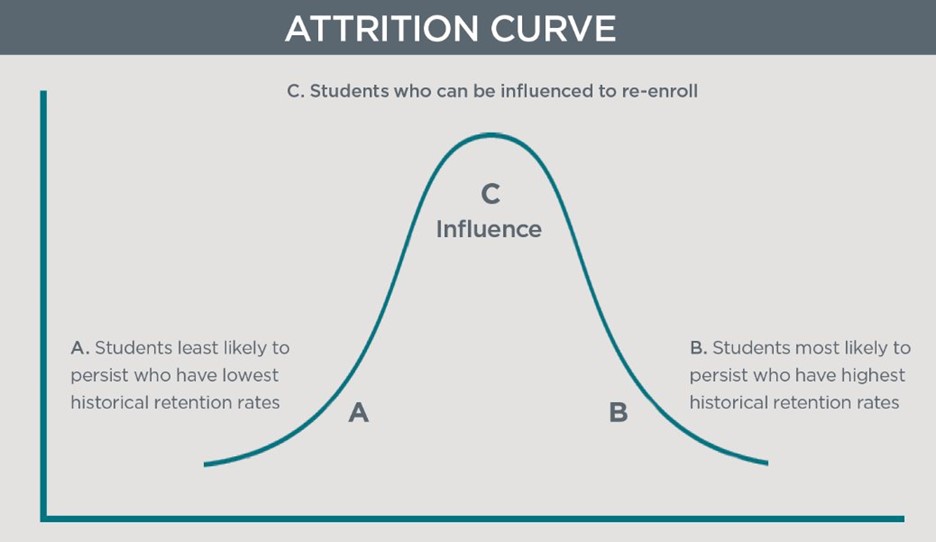
    The Retention Attrition Curve showing that campuses should focus retention efforts on students who can be influenced to re-enroll. The Retention Attrition Curve showing that campuses should focus retention efforts on students who can be influenced to re-enroll.

    As you consider your current activities, you may find that many of your programs are designed for the students at the tail end of the curve (section A above) or to further support the students who are already likely to persist (section B). Institutions set goals to increase retention rates but then limit the scope of students they are impacting. To have the best return on retention strategies, consider how you can target support to the largest group of students in the middle (section C) who are open to influence on whether they stay or leave, based on what you do or don’t do for them, especially during their first term and their first year at your school. 

    Onward for the year ahead

    RNL congratulates those of you who have achieved your retention goals for the 2024 cohort. You certainly must have done some things right and must have had student retention strategies that were effective. For those of you who are looking for new directions in planning, consider the three practices outlined above. 

    And if you aren’t currently one of the hundreds of institutions already working with RNL, you may want to implement one or more of the RNL student success tools to support your efforts: the RNL motivational survey instruments to identify those students who are most dropout prone and most receptive to assistance, the RNL student retention data analytics to identify the unique factors that contribute to persistence at your institution, and the RNL satisfaction-priorities surveys that inform decision making and resource allocation across your campus population. RNL can provide support in all of these areas along with on-going consulting services to further direct and guide retention practices that can make a difference in your enrollment numbers and the success of both your students and your institution.  Contact me to learn more in any of these areas. 

    Note: Thanks to my former colleague Tim Culver for the original development of this content.

    Ask for a complimentary consultation with our student success experts

    What is your best approach to increasing student retention and completion? Our experts can help you identify roadblocks to student persistence and maximize student progression. Reach out to set up a time to talk.

    Request now

    Source link

  • Despite Skepticism, Parents Still Prioritize Four-Year College for Their Kids – The 74

    Despite Skepticism, Parents Still Prioritize Four-Year College for Their Kids – The 74


    Get stories like this delivered straight to your inbox. Sign up for The 74 Newsletter

    Six out of 10 parents hope their child will attend college, according to a new survey by Gallup and the Lumina Foundation.

    The survey, conducted in June, comes out at a time when the value of a college degree is the subject of public debate.

    “We hear all this skepticism of higher education,” said Courtney Brown, vice president of impact and planning for the Lumina Foundation, which advocates for opportunities for learning beyond high school available to all. “We hear the narrative that people don’t value it.” 

    Just last month, the results of a Gallup poll showed that confidence in higher education among Americans has been falling over the last decade.

    But the results of actually asking what parents want for their own children, Brown said, are striking. This is the first survey that Gallup has specifically asked parents for their views on the topic.

    “When it comes down to it, it’s pretty clear that parents hope their children get a college degree,” Brown said.

    Brown has found that parents’ biggest concerns about higher education tend to be the cost, whether it leads to a job, or increasingly, whether it is political.

    This may explain why community colleges were a popular option among parents who responded. Community colleges tend to have a much lower sticker price than four-year colleges, and there is a greater emphasis on job credentials. Roughly 1 out of 5 parents of varying backgrounds said that they would like to see their child enroll at a community college. 

    But there were some notable differences in the survey among parents, depending on their own level of education, but especially their political orientation.

    The strongest narratives against higher education come from the Republican Party. That is reflected in the responses, Brown noted.

    Greater differences emerged around whether students should enroll in a four-year college immediately after high school; 58% of college graduates and 53% of Democrats preferred sending their children straight to a four-year college, compared to 27% of Republicans and 30% of parents without a college degree.

    Republicans are more likely to say that their children should go straight into the workforce or job training or certification, followed by independents and those without a college degree. Other options include taking time off or joining the military. 

    But overall, 4 out of 10 parents want to see their child attend a four-year college or university, making it the most popular option by far. This is something that comes up repeatedly in surveys about higher education.

    “We see that people value four-year [degrees],” Brown said. “We see that people have trouble accessing it and have some concerns about the system, but they do greatly value it.”

    The survey also measured the preferences of non-parents. It asked respondents to think about a child in their life, whether a nephew or niece, grandchild or family friend under 18 who has not graduated from high school. Responses were remarkably similar: 55% said they wanted this child to attend either a four-year or two-year college, compared to 59% of parents.

    This story was originally published by EdSource.


    Get stories like these delivered straight to your inbox. Sign up for The 74 Newsletter

    Source link

  • Higher Education Needs to Prioritize for Impact

    Higher Education Needs to Prioritize for Impact

    Last month, a few of our Collegis leaders attended the Google Public Sector Leaders Connect summit in Chicago. This event brought together technology, education, and government leaders to address one major question: How can public institutions unlock the true value of AI?

    Institutions are grappling with a fast-changing AI landscape

    The summit served up plenty of insight, data, and dialogue about the promises and pitfalls of artificial intelligence in higher ed. One stat that hit home: 80% of students think universities are falling short when it comes to integrating AI.

    That’s not just a tech gap, it’s a relevance gap. Today’s students are living in an AI-powered world, and if institutions can’t keep pace, they risk losing credibility and connection.

    They are also failing to prepare students for a new job market, where AI is “attacking” entry-level jobs that their graduates would previously fill. With many entry-level jobs being fulfilled by AI, what are schools doing to help their graduates get the skills they need to thrive in this new world?

    Fragmented priorities are holding higher ed back

    As we listened to leaders at the summit and reflected on our partner conversations, it became clear that the challenges institutions face go beyond AI adoption.

    Other concerns surfaced as well:

    • 71% of institutions say their top priority is attracting and retaining students.
    • 56% are worried about data security threats like phishing, ransomware, and breaches.
    • 42% cite operational pressures as a major barrier, from business model constraints to process inefficiencies.

    On their own, these numbers signal urgency. But together, they reveal something deeper:

    Institutions aren’t just overwhelmed by change, they’re unsure where to focus and where to invest.

    Competing priorities and limited resources make it hard to know what matters most. These three statistics may look unrelated, but they are all very much related and impact each other. Operational pressure can heighten data security risks, which can trigger breaches that erode student trust and enrollment. Those same pressures often stem from — and lead to — inefficient processes that hurt the student experience and, ultimately, retention.

    Throughout the day, multiple speakers kept reinforcing the importance of “prioritizing for impact.” Because while AI offers enormous potential, the technology itself won’t drive transformation — leadership will.

    It’s not about adopting more tech — it’s about focusing on impact

    Now this struck a chord with me, especially given how we approach partner onboarding at Collegis. Even during early conversations with potential partners, our first question is always the same: “What are you trying to impact?”

    It’s a simple question, but the answers we hear are very telling, and can drastically vary depending on who at the institution is answering. What I like about this question is that it helps focus the conversation on a desired end result, providing an immediate opportunity to pressure test strategies, tactics, and competing priorities.

    Is this getting you closer to, or further away from, your desired impact? If the latter, perhaps it’s time to consider reallocating resources and budget to what gets you toward the finish line faster.

    How to prioritize for impact in higher ed

    Take the AI example. Instead of asking, “What AI tools should we adopt?” instead ask, “Where can AI meaningfully move the needle for our institution AND our students?” That shift from solution-first to strategy-first is everything.

    Here are a few guideposts we recommend:

    1. Start with your outcomes. Whether it’s student success, operational efficiency, or enrollment growth, define what success looks like before introducing any new technology.
    2. Connect C-suite ambition with frontline reality. Consider forgoing a top-down approach that prioritizes selling to leadership. To enable real change, your strategies must reflect on-the-ground needs. Build from the bottom up and bring the insight and intel back to your cabinet leaders to help inform prioritization conversations.
    3. Break down the silos. So many institutions are decentralized and highly matrixed, which means that critical data, digital infrastructure, and internal departments are often disconnected. Aligning them is essential to enable AI to operate at scale. Consider cloud platforms like Connected Core®, which extract, clean, and connect data across systems, applications, and third-party tools. This enables actionable institutional intelligence across the student lifecycle.
    4. Build AI literacy, institution-wide. Google shared that only 14% of campuses have adopted AI literacy as a learning outcome. That’s a missed opportunity to empower both staff and students to engage with AI responsibly and effectively.
    5. Don’t go it alone. With 62% of institutions lacking the internal expertise to fully leverage AI, choosing the right partner matters. Not someone just trying to sell you tech, but to help you translate it into impact. This is the talent component of Collegis Education’s data, tech, and talent approach. It does you no good to own a plane if you don’t have a pilot, crew, and maintenance team. When you align your data, tech, and talent, you’ve enabled impact, and sustainable impact at that.

    The Google event confirmed what we see every day: Higher ed has a prioritization problem. Leaders have been sold more tech tools than they can use; what they truly need is help implementing them for impact.

    A smarter path forward for institutional leaders

    Institutional leaders know their schools better than anyone and have a clear vision of where they need to go to thrive.  Building a strategic plan focused on the areas that will drive the greatest impact to that vision is the next critical step.  A great way to start is by finding a partner who understands that progress isn’t about doing more, it’s about doing what matters.

    Prioritize for impact. We’ll help you make it happen.

    Innovation Starts Here

    Higher ed is evolving — don’t get left behind. Explore how Collegis can help your institution thrive.

    Source link

  • Why grad students should prioritize friendships (opinion)

    Why grad students should prioritize friendships (opinion)

    How important is friendship to you? According to a Pew Research Center study in 2023, 61 percent of U.S. adults said having close friends is extremely or very important for people to live a fulfilling life, which is much higher than the share who said the same about being married (23 percent), having children (26 percent) or having a lot of money (24 percent). Meanwhile, almost one in three Americans feel lonely every week.

    In this context, perceptions of workplace friendships are evolving as the world of work transforms. Working professionals consider having a best friend at work to be even more important since the start of the pandemic and the dramatic increase in remote and hybrid work. Younger generations, such as millennials and Gen Zers, want to curate authenticity and set boundaries. They may prioritize job satisfaction and mental health over other traditional factors. How do those new priorities relate to friendship?

    In addition to well-being benefits, having friends at work can contribute to an individual’s professional development and workplace performance. Working in an environment that fosters vulnerability, as friendships often do, enables individuals to challenge themselves in ways they may otherwise avoid.

    The topic of friendship at work often focuses on the postgraduate workforce. We argue for the importance of applying the same principles to the graduate student and postdoctoral experience. We discuss ways in which graduate students and postdoctoral scholars can benefit from prioritizing friendships and essential interpersonal skills, which can lead to a more robust academic experience and support network.

    Navigating Challenges and Life After Graduate School

    Studies show that strong relationships at work are linked to a lower risk of burnout, better mental health and fewer traumatic experiences. Having peer friendships helps graduate students and postdoctoral scholars cope with the rigorous nature of their academic training. Although the demands of this training can make it difficult to prioritize one’s social life, intense work environments in group settings also provide many opportunities for like-minded individuals to get to know each other beyond the immediate tasks at hand.

    Cultivating such relationships helps students and scholars to navigate the challenges of graduate school and/or their postdoctoral training and work with the benefit of a support system. Sometimes people struggle to comprehend the unique and specific nature of graduate training. Having peers in the same environment allows one to work through challenges and problems with someone who knows firsthand the context of what they are experiencing.

    As graduate students and postdoctoral scholars face points of transition, either at the beginning or end of their training, many will leave their current support network and find themselves in need of building new connections. Yet, fulfilling friendships can take time and effort to build. Friendships formed in graduate school can provide an incredible form of support for any moment in life and can have lifelong implications for personal and professional careers. In fact, many of us in the workplace still talk to friends we made during our graduate school years and cherish the memories we built based on understanding and trust.

    Strengthening Academic Research and Performance

    A significant portion of the research on workplace friendships highlights the increase in performance and productivity that results from the presence of such relationships. Happiness leads to increased performance across the board. Developing friendships among peers can result in an increase in potential collaborators for opportunities such as co-authorships, conference presentations or interdisciplinary research. It can also happen the other way around—connections that begin as professional collaborations may turn into friendships.

    The two of us writing this article are real examples of how developing friendships within the workplace can provide benefits to one’s career growth. We met as colleagues and quickly found commonalities in our personal interests and professional goals. While our jobs took us to different institutions, a robust co-writing dynamic emerged from the foundations of our friendship. Our story is similar to that of many scholars who write with their friends.

    Developing Transferable Skills

    Creating meaningful connections also helps graduate students and postdoctoral scholars strengthen key transferable skills that are relevant in preparing for diverse career paths. Consider three that come to mind:

    • Communication: For many friendships, there is a sense of comfort that develops over time. This bond encourages an ease in conversations lacking in other types of interactions. Friends can be a sounding board when you are attempting to process your thoughts and put them into words for an external audience.
    • Collaboration: Some graduate students and postdoctoral scholars may conduct solitary research with little opportunity to work within a team or group setting, especially in the humanities. Identifying opportunities to collaborate with friends helps to develop the ability to contextualize one’s responsibilities within a broader project. This cultivates a skill that employers often prioritize in the hiring process: collaboration or teamwork.
    • Cultural competency: Another benefit to fostering workplace friendships is becoming more aware of different lived experiences from your own. While it is possible to do this through less personal interactions, friendships allow you to share life stories and perspectives and build deeper connections. Expanding your perspective will allow you to become a stronger scholar (during your time in graduate school or postdoctoral training) and professional (whatever your postgraduation plans may be) in an increasingly diverse world.

    Implications for Career Development

    Of course, there are some challenges to keep in mind with workplace friendships. These may include: trusting someone too soon and oversharing, participating in gossip and rumors, and in-group pressure to fit in, which ultimately leads to exclusion of some through group homogeneity and barriers to opportunities. Other challenges exist for individuals with marginalized backgrounds. The lack of diversity or representation in certain disciplines can further feelings of isolation and take a greater toll on one’s well-being.

    Those of us working with this unique population can make an intentional effort to facilitate meaningful relationship-building and address the challenges above through educational programming. Professional development events for marginalized populations often provide a “third space” for individuals to connect in a critical mass, breathe and celebrate, and identify role models and peer collaborators. The University of Maryland system’s Alliance for Graduate Education and the Professoriate is a great example of community-building.

    Another viable option for educators and institutions to consider is to leverage the power of peer or near-peer mentoring. Research highlights the importance of mentoring constellations, which acknowledge the varying needs of a mentee and how mentoring relationships differ in structure or intensity. While a “vertical mentor” may be more senior in an organization and offer guidance to mentees based on career progression or life stages, a “horizontal mentor” refers to a peer at a similar career level who shares the mentee’s experiences and challenges. At the University of Maryland, College Park, the Graduate School has created a near-peer mentoring program that focuses on interdisciplinary knowledge-sharing between a doctoral student and a postdoctoral scholar over a year. This program promotes a culture of mentoring where both parties can develop self-awareness and build skills critical to their respective careers.

    Finally, how can graduate students and postdoctoral scholars go about making friends at work? Begin by prioritizing relationships in the spaces you occupy, especially during moments of uncertainty. Then, attend and leverage university programming around well-being, professional development and mentoring, to meet people with similar interests and values. Next, look carefully within your high-touch professional relationships, and consider how proximity, similarity, and reciprocity can help you facilitate the initiation and development of a friendship.

    Yi Hao is the program director of career and professional development at the Graduate School of the University of Maryland, College Park, and a member of the Graduate Career Consortium—an organization providing an international voice for graduate-level career and professional development leaders.

    Mallory Neil is the director of industry partnerships for the College of Science at Clemson University.

    Source link