In response to Joshua Bay’s recently published Inside Higher Ed article, the Consortium for Catholic Higher Education in Prison, a coalition of partnerships between Catholic universities and departments of corrections in 15 states across the country, is adding its voice to those of other leaders in the field alarmed by the piece’s misleading framing: a framing that flies in the face not just of decades of established literature on the subject, but of the study (as yet unpublished and unreviewed) itself.
Since misleading titles and leads can have very real effects on people not versed in the field, it feels important to identify what exactly is misrepresentative in the article, and to invite a fuller discussion on the known and proven benefits of higher education in prison and the important questions around supervision policy and technical violations the study raises.
The data analysis therefore provides important information on the challenges of work release for students in prison education programs but not arguments against prison education programs—if anything, calling for the release of these alumni “free and clear.” That is an issue for DOC re-entry and work-release programs, not education, and should be taken as such.
The national evidence remains unequivocal: A RAND meta‑analysis still shows a 43 percent reduction in recidivism for those who participate in prison education, which remains the most comprehensive study in the field. Facilities with education programs report up to a 75 percent reduction in violence among participants, improving safety for staff, educators and incarcerated people alike. Campbell and Lee also confirm improved employment outcomes for program participants. Employment is one of the strongest predictors of long‑term desistance, so this alone is a key success indicator.
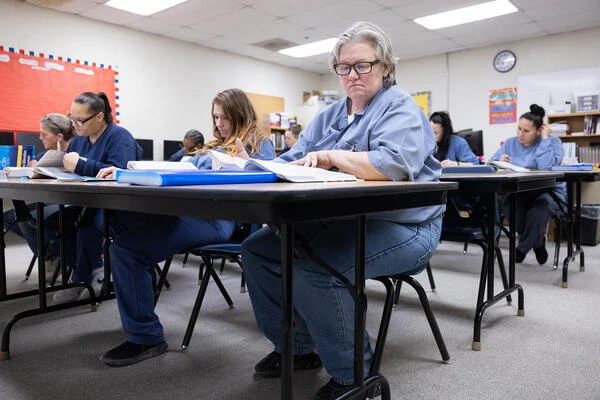
It seems likely that not just the study’s authors, but Joshua Bay and the IHE editors, are aware of all this. The title’s amendment suggests as much, and the caption beneath the article’s lead photo reads like that of an article urging greater freedoms for formerly incarcerated students: “Incarcerated individuals who enroll in college courses are less likely to be released free and clear and more likely to be assigned to work release.” These points show that the Grinnell finding is not evidence of a flawed model—it is evidence of a local anomaly shaped by supervision practices, not by the educational intervention itself.
Decades of research, Grinnell’s own admissions and the lived outcomes of our students and graduates across the country all affirm that the work of higher education in prison is effective, restorative and socially transformative. Thus, as the field draws attention to the tensions between the article’s substance and its misleading title, the study’s findings and the way those findings are framed, and as this working paper undergoes peer review and revision, we hope that fruitful conversations may grow from this around the obstacles that students face and the possibility for transformative changes to supervision policy that sets formerly incarcerated students up for failure rather than success.
Thomas Curran, SJ, Jesuit Prison Education Network
Michael Hebbeler, Institute for Social Concerns, University of Notre Dame
The Consortium for Catholic Higher Education in Prison
As the national organization for higher education in prison in the United States, we at the Alliance for Higher Education in Prison feel it our responsibility to challenge the framing and conclusions of the Jan. 12 article “Prison Education May Raise Risk of Reincarceration for Technical Violations,” as well as the study it references. The article uses a misleading and sensationalist headline, elevates an unpublished study relying on limited data, and omits crucial context, all of which have very real implications for incarcerated learners and the field.
Despite the claim made in the article title, the cited study by Romaine Campbell and Logan Lee—“A Second Chance at Schooling? Unintended Consequences of Prison Education” (July 1, 2025), which is an unpublished working paper—does not find that prison education causes an increase in reincarceration. In fact, as stated in the study’s abstract, there is “no relationship between education and reincarceration after we control for release type.” Instead, the observed increase in reincarceration in the study is related to work-release and technical violations.
The study authors themselves caution against interpreting the findings as evidence that education is harmful (p. 20, Campbell & Lee, 2025), and identify systemic supervision and release practices as the key drivers of observed outcomes. They also find evidence that education may improve postrelease employment outcomes (p. 31, Campbell & Lee, 2025).
The underlying framework of the study around the “unintended consequences” of prison education is nevertheless problematic. The study’s findings do not demonstrate “unintended consequences” of higher education in prison. Rather, they reflect outcomes of release placement and supervision level that are associated with increased risk of technical violations and reincarceration. These outcomes are not caused by participation in educational programming; they result from the structuring of re-entry and supervision systems.
Connecting the findings in this working paper to outcomes of higher education programs is misleading. Doing so perpetuates negative public narratives that many within the field (including students and alumni) work hard to combat and fails to capture the potential policy implications of the study. The study authors themselves emphasize that the policy focus should be around how education is considered in release decisions and how supervision intensity increases risk of recidivism (p. 5, Campbell & Lee, 2025). The study does raise important questions about how education affects release placement, supervision level and technical violation risk. Thus, the appropriate provocation of the study is to rethink technical violations as well as supervision and release decision-making, which so often sets people who are re-entering society up for failure rather than success.
The editorial decision to elevate unpublished research in such a way that it contradicts an established body of evidence is additionally concerning. Decades of research across multiple states have demonstrated that participation in higher education–in–prison programming is associated with improved outcomes. It is noteworthy that the study uses administrative data from a single state (Iowa) to draw its broad conclusions. Presenting early-stage research without thorough evidentiary framing has the potential to distort public understanding with misleading conclusions.
Indeed, a large body of research has consistently shown that participation in higher education while incarcerated is directly correlated with positive outcomes, including significantly lower recidivism rates. It is also important to note that recidivism alone is a flawed and incomplete metric for evaluating the success of higher education in prison programs. Recidivism is often shaped by supervision level, conditions of release and enforcement practices that vary from region to region. Overreliance on recidivism as a performance metric can obscure other, potentially more important outcomes (and also, critical gaps in service) such as employment, educational attainment, civic engagement, family reunification and financial stability. Higher education in prison can and should be evaluated using a broad dataset to reflect the real landscape of opportunity and well-being possible after people have access to these opportunities. The article omits all of this context, which is crucial to understanding the body of research and the study’s place within it.
How research findings are framed matters, especially when research enters public discourse. Headlines circulate widely and are often consumed without context. The framing of this article could very well have unintended consequences of its own. This article reinforces the problematic narrative that educational opportunities for people in prison are risky and that system-impacted people are to blame rather than overly punitive supervision and release practices. Sensationalist articles with misleading headlines like this one prioritize clicks and undermine decades of hard-won progress expanding access to college in prison.
We write from a Big 10 Prison Education Program, where we’ve worked for a decade to increase access to higher education for incarcerated individuals. We found the framing of the article,“Prison Education May Raise Risk of Reincarceration for Technical Violations” (Jan. 12, 2026) to be misleading and have deep concerns for its potential impact on incarcerated students and prison education programming.
The article fails to acknowledge decades of evidence about the benefits of prison education. The title and framing deceptively imply that college programs increase criminal activity post-release at a national scale. The Grinnell study—an unpublished working paper—is only informed by data collected in Iowa. Of most impact to incarcerated students, the title and introductory paragraphs mislead the reader by implying that the blame for technical violations and reincarceration should be placed on the justice-impacted individuals themselves. Buried in the article is a nuanced, accurate, structural interpretation of the data: per Iowa-based data, incarcerated individuals who pursue college may be unfairly targeted by parole boards and other decision-making bodies in the corrections system, thus leading to a higher rate of technical violations.
The impact of the article’s misleading framing could be devastating for incarcerated college students, especially in a climate where legislators often value being “tough on crime.”
We understand the importance for journalism to tell the full story, and many of the Grinnell study’s findings may be useful for understanding programmatic challenges; however, this particular framing could lead to its own unintended consequences. The 1994 repeal of Pell funding collapsed prison education for nearly thirty years; as a result, the US went from having 772 Prison Ed Programs to eight. Blaming incarcerated individuals for a structural failure could cause colleges and universities to pull support from their programs. We’ve already seen programs (e.g.,Georgia State University) collapse without institutional support, leaving incarcerated students without any access to college. This material threat is further amplified by the article’s premature conclusions about a field that has only recently—as of 2022 with the reintegration of Pell—begun to rebuild.
In a world where incarcerated students are denied their humanity on a daily basis, it is our collective societal obligation to responsibly and fairly represent information about humanizing programming. Otherwise, we risk harming students’ still emerging—and still fragile—access to higher education.
Liana Cole is the assistant director of the education at the Restorative Justice Initiative at Pennsylvania State University.
Efraín Marimón is an associate teaching professor of education; director, of the Restorative Justice Initiative; and director of the Social Justice Fellowship at Pennsylvania State University.
Elizabeth Siegelman is the executive director for Center for Alternatives in Community Justice.
Prison education programs are designed to help people succeed after release, but new research suggests they may actually increase participants’ chances of reincarceration.
An analysis from Grinnell College found that participation in prison education increases an individual’s likelihood of returning to prison within three years of release by 3.4 percentage points—a roughly 10 percent increase compared to those who did not participate. That increase is driven largely by revocations, such as technical violations of release conditions, rather than by new crimes.
“The takeaway from this should not be that prison education is bad,” said Logan Lee, an associate professor of economics at Grinnell and the study’s author. “Instead, what seems to be happening is that there are these unintended consequences.”
The analysis examined more than 22,000 prisoner stints in Iowa, drawing on data from the Iowa Department of Corrections, the Iowa Department of Education, Iowa Workforce Development and Grinnell College to create a comprehensive, individual-level dataset of people released from Iowa prisons between 2014 and 2018.
The research found that participation in prison education programs affects how individuals are released. Those who enroll in college courses are less likely to be released free and clear and more likely to be assigned to work release, which allows eligible inmates to leave prison during the day to work in the community and return at night.
In Iowa, work release often takes place in a halfway house, a structured living environment intended to support people as they transition back into the community. But work release also exposes individuals to more intensive postrelease supervision, which dramatically increases the likelihood of revocation, or being reincarcerated for violating supervision terms, Lee said.
“Work release programs are quite ineffective at achieving their goals, [and] they’re driving a significant increase in people returning to prison,” Lee said. “It’s being assigned far too often at the margins, and some [incarcerated individuals] would be better off on parole or even released free and clear.”
Lee said anecdotal evidence suggests that some correctional officers may resent the idea of “free” education for incarcerated people, pointing out that the requirements for their job are a high school diploma and a clean criminal record. As a result, he said, there is “the potential for some animosity,” with research finding “an increase in misconduct for people who are participating in education programs.”
“Correctional officers are very difficult, high-stress, low-pay jobs,” Lee said. “So you can imagine that that sort of person might go, ‘Look, I kept my nose clean and I didn’t commit any crimes, so why are these people given opportunities that I wasn’t given?’”
However, Lee said case managers, who often recommend how incarcerated individuals are released, don’t share the same resentment. He noted they are “much more likely to have college degrees and interact with prisoners in a different way.”
The background: The U.S. has one of the world’s largest incarcerated populations, with nearly two million people in prison in 2024. This population recidivates at high rates: 46 percent of released prisoners are rearrested within five years, research shows.
U.S. prisons disproportionately house economically vulnerable individuals, many of whom have limited education. Despite historically limited access, prison education programs consistently draw strong interest from incarcerated people. A survey from the National Center for Education Statistics found that 70 percent of incarcerated individuals wanted to enroll in educational programs, and that a majority were academically eligible for college-level courses.
In Iowa, all prison education is offered through local colleges, primarily community colleges. The state funds all GED preparation courses and some postsecondary and vocational programs. Lee said programs offered through some institutions, including Grinnell College and the University of Iowa, are funded by donations.
Across the country, nearly all state and federal prisons provide some form of educational programming. The expectation in both Iowa and nationally is that courses offered inside prisons resemble, as closely as prison guidelines allow, their nonprison counterparts.
“The reality on the ground in most [prisons] is that [incarcerated individuals] only take a couple of courses and then they get released and move on,” Lee said. “You can certainly look at national statistics and see that most people who participate in education in prison are not earning any sort of degree.”
The implications: In addition to his work at Grinnell College, Lee said he previously taught at a women’s prison in Mitchellville, Iowa. He led a “how-to-do-college course,” where he taught writing, critical reading and academic honesty.
Lee described the experience as “eye-opening,” adding that the incarcerated women he taught were highly engaged and deeply interested in the material.
“I saw a real hunger for education, and I do think they got a lot out of the class,” Lee said, noting that he taught 16 students, six of whom were released from prison during the course and 10 of whom eventually completed it.
Providing education in prisons, however, can be challenging. Limited access to technology and learning materials, restrictions on participation times, and situations like lockdowns can interrupt learning opportunities.
“There are just some real challenges with balancing the educational mission with the security demands of the setting,” Lee said. “It’s much more difficult to write a research paper if you can’t get on the internet and start googling stuff.”
Ultimately, Lee emphasized that policymakers, prison administrators and educators need to think “holistically” about the entire system for incarcerated individuals.
“I thought [prison education] might be positive, I thought it might have no effect, but I really did not expect it to increase reincarceration,” Lee said. “If you’re thinking about offering prison education or expanding it, you need to be really aware of the whole system that’s in place and the implications it’s going to have for the people who are participating.”
Get more content like this directly to your inbox. Subscribe here.
Title: Policymakers Role in Expanding Prison Education Access
Authors: Jennifer Thomsen and Shytance Wren
Source: Education Commission of the States
A June 2025 report from the Education Commission of the States outlined ways in which state policy actors can expand access to prison education and therefore reduce likelihood for recidivism and incarceration costs.
Policymakers’ Role in Expanding Prison Education Access summarized findings from an 18-month long community of practice which included stakeholders representing state education policy leaders, leaders from corrections departments, higher education prison program directors, policy leaders, and researchers. The community of practice highlighted key barriers faced by incarcerated learners and produced policy suggestions to remediate these barriers to education.
Among the report’s key findings:
Prison education is a cost-saving measure. Every one dollar spent on prison education saves four to five dollars in incarceration costs.
Inefficient governance in prison education programs creates a lack of access for incarcerated learners and a lack of data for policymakers to improve programs. A key consideration in addressing this issue is to review what level of governance the best policies would come from (i.e.: from the governor by executive order).
Access to financial aid is often limited for incarcerated individuals. One way to mitigate this barrier is to review existing state financial aid programs that prohibit incarcerated individuals from receiving aid.
Inconsistency in access to student support prevents continued learning. A consideration for state leaders to address this inconsistency is to strengthen partnerships with community colleges and job training programs to ensure adequate reentry guidance for incarcerated learners.
The report concludes that expanding access to prison education is most efficient when state policymakers address governance, financial aid access, and student supports for incarcerated learners.
When people hear that I teach sociology in a maximum-security prison, they often ask if I’m afraid. Then they assume I enter the prison, share knowledge and transform incarcerated students. That’s not the story I’m telling. The real transformation isn’t theirs. It’s mine.
For more than a decade, I have facilitated prison programs and worked with individuals who have been impacted by the justice system. For the past three years, I have made the hour-long drive, passed barbed-wire fences, walked through metal detectors and taken the escorted journey to the education wing of a Connecticut state prison to teach college-level sociology.
My desire to work with people in prison honors those who protected me, allowing me to survive, thrive and give something back. I grew up in Harlem during the height of the crack cocaine epidemic. Public housing was my home. The stench of urine in the elevators, the hunger-inducing aroma of fried food wafting through the hallways, the ever-present sound of sirens and the fear of dying young all shaped my early years. Yet, amid these challenges, I also experienced love and protection.
Many of the older guys on my block were deeply involved in street life. However, they saw something in me. They never attempted to pull me into their activities. Instead, they ensured I stayed away. They often said, “Nah, you’re smart. You’re gonna do something with your life.” That kind of protection and love doesn’t appear in statistics or stories about the hood, but it saved me.
I didn’t make it out because I was exceptional. I made it because people believed in me. They helped me imagine a different life. I carry their love with me when I step into that prison classroom. I teach because I owe a debt—not in a way that burdens me, but in a way that allows me to walk in my purpose and see people through the same lens of possibility that allowed me to live my dreams.
Entering the prison each week requires mental preparation. Before the lesson begins, I go through multiple security checks. Doors buzz open and lock behind me. I never get comfortable with the experience, even though I know I will leave at the end of class. I often describe teaching in prison as a beautiful-sad experience. It’s beautiful because of the energy and connection in the classroom. It’s sad because many of my students may never see life beyond the gates.
These men, some of whom have already served decades, come ready to engage. We break down theories of race, class, power, socialization, patriarchy and other related concepts. We analyze films, question systems and interrogate assumptions. But what stays with me most are the unscripted moments, like when someone connects a sociological theory to their own story and says, “This sounds like what happened to me.”
One of the most unforgettable moments came during a group debate assignment. I divided the class into small groups and asked them to analyze a text using different sociological theories. I stepped back and simply observed. I saw a group of 15 men serving long sentences, passionately debating whether structural strain theory, social learning theory or a Marxist conflict perspective was the best lens for analysis. These weren’t surface-level conversations. They were sharp, layered and theoretically rigorous. At that moment, I told them, “This is what the world doesn’t get to see.”
People carry assumptions about incarcerated individuals and what they are capable of. But they don’t see these men breaking down theories, challenging one another and demonstrating intellectual brilliance. We cannot record inside the prison, so moments like this remain confined to the room. But they are real. And they matter.
Another day, I asked students to reflect on the last time they cried or heard someone say, “I love you.” One student responded, “I don’t cry. Crying doesn’t change anything.” A week later, after completing an assignment to write a letter to his younger self, that same student began reading aloud to his 8-year-old self and broke down in tears. No one laughed. No one turned away. The other men gave him their attention, encouragement and support. In that room, we created a space where his vulnerability was met with care, even inside the walls of a prison.
These experiences forced me to confront my purpose. I stopped seeing myself solely as a professor or administrator. I reflected on what it means to serve and show up for people who’ve been pushed to the edges of society. I began to question the boundaries we draw between campus and community. Universities, especially those with the most resources, need to be more than institutions of learning for those lucky enough to be admitted. We are called to be and do more.
Throughout my career, I’ve worked to ensure my spheres of influence extend beyond the edge of campus. I’ve leveraged my position to build bridges by connecting faculty and students to re-entry programs, supporting formerly incarcerated scholars and creating opportunities for others to teach inside. Teaching in prison has made me more grounded. As a sociologist, I am keenly aware of how little separates my students’ lives from mine and how my path could have easily been theirs.
The United States leads the world in incarceration, holding more than 20 percent of the world’s prisoners despite representing less than 5 percent of the world’s population. According to the Prison Policy Initiative and the American Civil Liberties Union, many incarcerated people come from overpoliced, underresourced communities like the one I grew up in.
Yet even with this reality, some argue that people in prison don’t deserve education—that offering college courses to incarcerated individuals is a misuse of resources. I’ve heard those arguments, and I reject them. Education in prison isn’t special treatment. It’s human dignity. It’s recognizing that people can and do change when given the tools to reflect, grow and imagine a life beyond a perpetual existence in survival mode.
If higher education is serious about equity and access, we cannot limit our classrooms to students with perfect transcripts and traditional résumés. The men I teach do not need saving. They need space to grow, question and contribute. And our institutions need them, because any university that claims to care about justice, resilience or humanity cannot ignore the people our country has locked away.
Every day, I am reminded that none of my accomplishments happened in isolation. I think about what it means to repay a debt on which you cannot put a dollar amount. I think about honoring those who believed in me before I believed in myself. I’ve stood on the shoulders of people who never had the opportunities I did. I carry their investment into every space I enter, especially those where others have been forgotten.
One of the lessons I’ve held onto is this: The gifts we have are not for us to keep. They’re meant to be shared. Teaching in prison is my way of honoring that truth.
Don C. Sawyer III is an associate professor of sociology and vice president of diversity, inclusion and belonging at Fairfield University.
Wayne State University will offer incarcerated people the opportunity to enroll in a bachelor’s of sociology starting this fall.
Wayne State University
With the reinstatement of Pell Grant eligibility for incarcerated individuals in 2023, more colleges have launched or restarted prison education programs. Wayne State University in Michigan will join their ranks this fall, offering a bachelor’s degree to incarcerated individuals for the first time.
Twenty-five students will join the inaugural cohort in August, and the university is forging ahead with program plans despite looming Pell Grant cuts.
What’s the need: Twenty-five percent of formerly incarcerated people have no high school diploma, and 20 percent have only a high school diploma, compared to the 91 percent of Americans who have attained at least that credential. “We know that today’s workforce, much of it requires a college education, so it’s almost a necessary criterion to earn a living wage in today’s society,” said Michelle Jacobs, a professor of sociology and Wayne State’s Prison Education Program lead.
While many incarcerated individuals express an interest in postsecondary education, college often gets placed on the back burner after they leave prison as they focus on more pressing challenges, such as meeting basic needs and providing for themselves, Jacobs said. Higher education–in–prison programs help students get a head start on reclaiming their lives after they are released.
The initiative also ties into Wayne State president Kimberly Andrews Espy’s Prosperity Agenda for the Detroit area, which includes supporting economic mobility for students, improving the health of urban neighborhoods and fostering innovation in the local economy.
Individuals who participate in postsecondary education programs while in prison are 48 percent less likely to be reincarcerated than those who don’t, and they are more likely to get a job after their release. Research also shows that education-in-prison programs not only benefit the individual but also increase safety in prison settings and can improve families’ socioeconomic mobility.
“One of our goals for the program is to empower families in low-income communities that have been disproportionately impacted [by mass incarceration],” Jacobs said.
How it works: Wayne State’s Prison Education Program will enroll 25 incarcerated men at the Macomb Correctional Facility in Lenox, Mich., about 35 miles northeast of the university.
To be considered, applicants have to be at least five years from their earliest release date, giving them time to finish the program, and they must complete an essay outlining why they want to participate.
All courses will be delivered in person and the university will provide any school supplies or resources the students need for their coursework, including pens, paper and dictionaries. Students have to complete paper applications and FAFSA forms, so staff will assist with that process.
Program participants will complete a degree in sociology, as well as a range of general education courses, similar to their on-campus peers. Students can also opt in to an entrepreneurship and innovation minor.
Both programs are designed to support the unique experiences of incarcerated people, Jacobs said.
“I’m extremely biased towards sociology, and I think that benefits everyone,” Jacobs said. “I think that incarcerated individuals can benefit so much, not only in terms of understanding the broader structures that have impacted their own realities, but also on that interactional level … I think that’ll be really helpful for them as they’re navigating their lives postrelease.”
Faculty members from across the university will serve as instructors.
Facing headwinds: Since beginning the project, Wayne State has encountered various challenges.
The initial plan was to use donor funding to kick off the program, but officials had to pivot to relying on Pell dollars and money from the Michigan Department of Corrections to cover student tuition. Then, reorganization at the federal Department of Education and a lack of staff stalled approval of the program. Changes to the Pell Grant may further impede the program’s future.
Despite the obstacles, Jacobs and her team are pushing on.
“Once we started working on it, I couldn’t let it go,” Jacobs said. “I deeply believe in the transformative power of education, and I also deeply believe that there is an amazing among of talent and wit and love and humor and expertise already in carceral settings … I just made a decision that we will forge ahead regardless of what is happening at the federal level—while, of course, paying attention to it.”
Wayne State staff received advice and support in establishing the program from the Michigan Consortium for Higher Education in Prison. “It’s very collaborative instead of competitive, which is unique for academic spaces, and I appreciate it so much,” Jacobs said.
Next steps: Jacobs and her team are currently reviewing student applications to select the inaugural cohort, with plans to enroll another cohort in fall 2026.
Before classes start this August, participating faculty and students will both complete an orientation. The faculty orientation will provide instructors with professional development that helps prepare them to teach inside a prison, supported by a student organization on campus focused on criminal justice reform.
Students will be given college-readiness support, as well as access to academic and support resources similar to those offered on campus.
If your student success program has a unique feature or twist, we’d like to know about it. Click here to submit.
Hancy Maxis spent 17 years incarcerated in New York prisons. He knew that he needed to have a plan for when he got out.
“Once I am back in New York City, once I am back in the economy, how will I be marketable?” he said. “For me, math was that pathway.”
In 2015, Maxis completed a bachelor’s degree in math through the Bard Prison Initiative, an accredited college-in-prison program. He wrote his senior project about how to use game theory to advance health care equity, after observing the disjointed care his mom received when she was diagnosed with breast cancer. (She’s now recovered.)
When he was released in 2018, Maxis immediately applied for a master’s program at Columbia University’s Mailman School of Public Health. He graduated and now works as the assistant director of operations at Montefiore Medical Center in the Bronx. He helped guide the hospital’s response to Covid.
Maxis is one of many people I’ve spoken to in recent years while reporting on the role that learning math can play in the lives of those who are incarcerated. Math literacy often contributes to economic success: A 2021 study of more than 5,500 adults found that participants made $4,062 more per year for each correct answer on an eight-question math test.
While there don’t appear to be any studies specifically on the effect of math education for people in prison, a pile of research shows that prison education programs lower recidivism rates among participants and increase their chances of employment after they’re released.
Hancy Maxis spent 17 years incarcerated in New York prisons. He now works as the assistant director of operations at Montefiore Medical Center in the Bronx. Credit: Yunuen Bonaparte for The Hechinger Report
Plus, math — and education in general — can be empowering. A 2022 study found that women in prison education programs reported higher self-esteem, a greater sense of belonging and more hope for the future than women who had never been incarcerated and had not completed post-secondary education.
Yet many people who enter prison have limited math skills and have had poor relationships with math in school. More than half (52 percent) of those incarcerated in U.S. prisons lack basic numeracy skills, such as the ability to do multiplication with larger numbers, long division or interpret simple graphs, according to the most recent numbers from the National Center for Educational Statistics. The absence of these basic skills is even more pronounced among Black and Hispanic people in prison, who make up more than half of those incarcerated in federal prisons.
In my reporting, I discovered that there are few programs offering math instruction in prison, and those that do exist typically include few participants. Bard’s highly competitive program, for example, is supported primarily through private donations, and is limited to seven of New York’s 42 prisons. The recent expansion of federal Pell Grants to individuals who are incarcerated presents an opportunity for more people in prison to get these basic skills and better their chances for employment after release.
Alyssa Knight, executive director of the Freedom Education Project Puget Sound, which she co-founded while incarcerated, said that for years, educational opportunities in prison were created primarily by people who were incarcerated, who wrote to professors and educators to ask if they might send materials or teach inside the prison. But public recognition of the value of prison education, including math, is rising, and the Pell Grant expansion and state-level legislationhave made it easier for colleges to set up programs for people serving time. Now, Knight said, “Colleges are seeking prisons.”
Related: Interested in innovations in higher education? Subscribe to our free biweekly higher education newsletter.
Jeffrey Abramowitz understands firsthand how math can help someone after prison. After completing a five-year stint in a federal prison, his first post-prison job was teaching math to adults who were preparing to take the GED exam.
Fast forward nearly a decade, and Abramowitz is now the CEO of The Petey Greene Program, an organization that provides one-on-one tutoring, educational supports and programs in reading, writing and now math, to help people in prison and who have left prison receive the necessary education requirements for a high school diploma, college acceptance or career credentials.
The average Petey Greene student’s math skills are at a fourth- or fifth-grade level, according to Abramowitz, which is in line with the average for “justice-impacted” learners; the students tend to struggle with basic math such as addition and multiplication.
“You can’t be successful within most industries without being able to read, write and do basic math,” Abramowitz said. “We’re starting to see more blended programs that help people find a career pathway when they come home — and the center of all this is math and reading.”
Abramowitz and his team noticed this lack of math skills particularly among students in vocational training programs, such as carpentry, heating and cooling and commercial driving. To qualify to work in these fields, these students often need to pass a licensing test, requiring math and reading knowledge.
The nonprofit offers “integrated education training” to help students learn the relevant math for their professions. For instance, a carpentry teacher will teach students how to use a saw in or near a classroom where a math teacher explains fractions and how they relate to the measurements needed to cut a piece of wood.
“They may be able to do the task fine, but they can’t pass the test because they don’t know the math,” Abramowitz said.
Math helped Paul Morton after he left prison, he told me. When he began his 10.5 years in prison, he only could do GED-level math. After coming across an introductory physics book in the third year of his time in prison, he realized he didn’t have the math skills needed for the science described in it.
He asked his family to send him math textbooks and, over the seven years until his release, taught himself algebra and calculus.
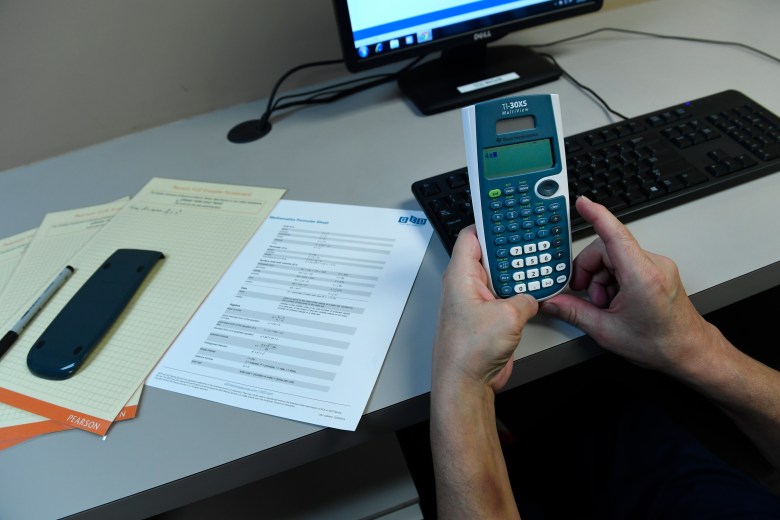
The recent expansion of federal Pell Grants to individuals who are incarcerated presents an opportunity for more people in prison to get these basic skills and better their chances for employment after release. Credit: Helen H. Richardson/The Denver Post via Getty Images
“I relentlessly spent six hours on one problem one day,” he said. “I was determined to do it, to get it right.”
I met Morton through the organization the Prison Mathematics Project, which helped him develop his math knowledge inside prison by connecting him with an outside mathematician. After his release from a New York prison in 2023, he moved to Rochester, New York, and is hoping to take the actuarial exam, which requires a lot of math. He continues to study differential equations on his own.
The Prison Mathematics Project delivers math materials and programs to people in prison, and connects them with mathematicians as mentors. (It also brings math professors, educators and enthusiasts to meet program participants through “Pi Day” events; I attended one such event in 2023 when I produced a podcast episode about the program, and the organization paid for my travel and accommodations.)
The organization was started in 2015 by Christopher Havens, who was then incarcerated at Washington State Penitentiary in Walla Walla. Havens’ interest in math puzzles, and then in algebra, calculus and other areas of mathematics, was ignited early in his 25-year- term when a prison volunteer slid some sudoku puzzles under his door.
“I had noticed all these changes happening inside of me,” Havens told me. “My whole life, I was searching for that beauty through drugs and social acceptance … When I found real beauty [in math], it got me to practice introspection.”
As he fell in love with math, he started corresponding with mathematicians to help him solve problems, and talking to other men at the prison to get them interested too. He created a network of math resources for people in prisons, which became the Prison Mathematics Project.
The group’s website says it helps people in prison use math to help with “rebuilding their lives both during and after their incarceration.”
But Ben Jeffers, its executive director, has noticed that the message doesn’t connect with everyone in prison. Among the 299 Prison Mathematics Project participants on whom the program has data, the majority — 56 percent — are white, he told me, while 25 percent are Black, 10 percent are Hispanic, 2 percent are Asian and 6 percent are another race or identity. Ninety-three percent of project participants are male.
Yet just 30 percent of the U.S. prison population is white, while 35 percent of those incarcerated are Black, 31 percent are Hispanic and 4 percent are of other races, according to the United State Sentencing Commission. (The racial makeup of the program’s 18 female participants at women’s facilities is much more in line with that of the prison population at large.)
“[It’s] the same issues that you have like in any classroom in higher education,” said Jeffers, who is finishing his master’s in math in Italy. “At the university level and beyond, every single class is majority white male.”
He noted that anxiety about math tends to be more acute among women and people of any gender who are Black, Hispanic, or from other underrepresented groups, and may keep them from signing up for the program.
Sherry Smith understands that kind of anxiety. She didn’t even want to step foot into a math class. When she arrived at Southern Maine Women’s Reentry Center in December 2021, she was 51, had left high school when she was 16, and had only attended two weeks of a ninth grade math class.
“I was embarrassed that I had dropped out,” she said. “I hated to disclose that to people.”
Smith decided to enroll in the prison’s GED program because she could do the classes one-on-one with a friendly and patient teacher. “It was my time,” she said. “Nobody else was listening, I could ask any question I needed.”
In just five months, Smith completed her GED math class. She said she cried on her last day. Since 2022, she’s been pursuing an associate’s degree in human services — from prison — through a remote program with Washington County Community College.
In Washington, Prison Mathematics Project founder Havens is finishing his sentence and continuing to study math. (Havens has been granted a clemency hearing and may be released as early as this year.) Since 2020, he has published four academic papers: three in math and one in sociology. He works remotely from prison as a staff research associate in cryptography at the University of California, Los Angeles, and wrote a math textbook about continued fractions.
Havens is still involved in the Prison Mathematics Project, but handed leadership of the program over to Jeffers in October 2023. Now run from outside the prison, it is easier for the program to bring resources and mentorship to incarcerated students.
“For 25 years of my life, I can learn something that I wouldn’t have the opportunity to learn in any other circumstances,” Havens said. “So I decided that I would, for the rest of my life, study mathematics.”
Contact editor Caroline Preston at 212-870-8965 or [email protected].
The Hechinger Report provides in-depth, fact-based, unbiased reporting on education that is free to all readers. But that doesn’t mean it’s free to produce. Our work keeps educators and the public informed about pressing issues at schools and on campuses throughout the country. We tell the whole story, even when the details are inconvenient. Help us keep doing that.