Tag: Prize

  • 2 U.S. Academics Among Winners of Nobel Prize in Economics

    2 U.S. Academics Among Winners of Nobel Prize in Economics

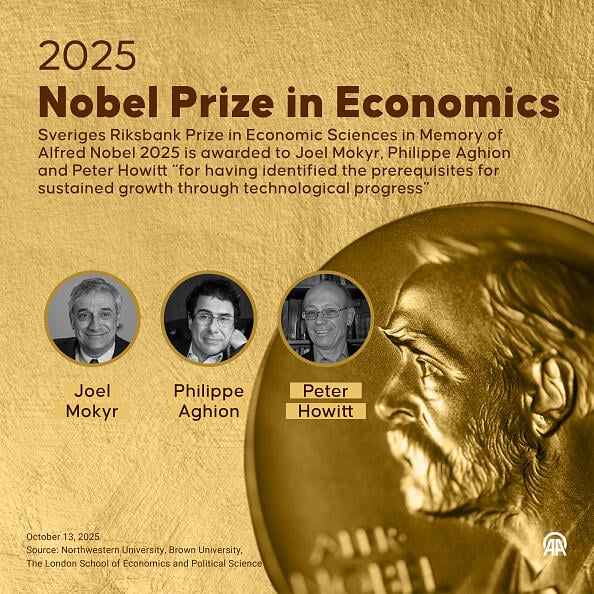
    Two American academics were among the three winners of this year’s Sveriges Riksbank Prize in Economic Sciences in Memory of Alfred Nobel. They were given the prestigious award “for having explained innovation-driven economic growth,” the Royal Swedish Academy of Sciences announced Monday morning.

    Joel Mokyr, the Robert H. Strotz Professor of Economics at Northwestern University, will receive half the roughly $1.6 million prize “for having identified the prerequisites for sustained growth through technological progress,” according to the announcement.

    Peter Howitt, a professor emeritus of economics at Brown University, will split the other half of the award money with Philippe Aghion of Collège de France and INSEAD and the London School of Economics and Political Science, “for the theory of sustained growth through creative destruction.”

    “The laureates’ work shows that economic growth cannot be taken for granted,” said John Hassler, chair of the committee for the Prize in Economic Sciences. “We must uphold the mechanisms that underlie creative destruction, so that we do not fall back into stagnation.”

    Source link

  • UC Berkeley Scientist Wins Nobel Prize for Chemistry

    UC Berkeley Scientist Wins Nobel Prize for Chemistry

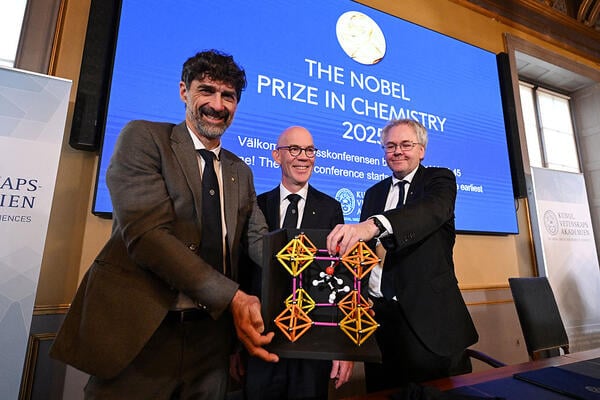
    A chemist from the University of California, Berkeley, was among the trio of scientists awarded the Nobel Prize for Chemistry on Wednesday.

    Omar Yaghi, the Berkeley professor; Susumu Kitagawa from Kyoto University in Japan; and Richard Robson from the University of Melbourne in Australia were recognized for their work since the 1990s to develop a new form of molecular architecture that combines metal ions and carbon-based molecules, according to a release from the Royal Swedish Academy of Sciences, which administers the Nobel Prize.

    The metal-organic frameworks can harvest water or store toxic gases. The release noted that the frameworks “may contribute to solving some of humankind’s greatest challenges.”

    The release says the frameworks are essentially “rooms” because of the large spaces that form in the structure. A Nobel committee member compared it to Hermione Granger’s magical bag in the seventh Harry Potter book, the Associated Press reported. Her small bag eventually contained a tent, books and other provisions. Likewise, the frameworks look small but can hold a lot.

    Since the trio’s discoveries, more than 100,000 metal-organic frameworks have been created, according to a news release from Berkeley.

    Source link

  • 3 Academics Share Nobel Prize in Physics

    3 Academics Share Nobel Prize in Physics

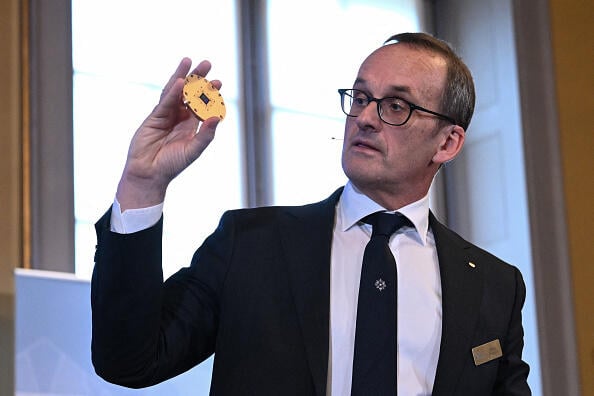
    Three academics affiliated with U.S. universities have been awarded the 2025 Nobel Prize in Physics “for the discovery of macroscopic quantum mechanical tunnelling and energy quantisation in an electric circuit,” the Royal Swedish Academy of Sciences announced Tuesday morning.

    British physicist John Clarke, a professor of experimental physics at the University of California, Berkeley; French physicist Michel Devoret, professor emeritus of applied physics at Yale and a professor at the University of California, Santa Barbara; and John Martinis, also a physics professor at UCSB, will share the nearly $1.2 million prize.

    They won for performing a series of experiments using an electronic circuit made of superconductors, which can conduct a current with no electrical resistance, demonstrating “that quantum mechanical properties can be made concrete on a macroscopic scale,” according to the announcement.

    “It is wonderful to be able to celebrate the way that century-old quantum mechanics continually offers new surprises. It is also enormously useful, as quantum mechanics is the foundation of all digital technology,” said Olle Eriksson, chair of the Nobel Committee for Physics.

    Source link

  • How prize named in honour of Tracey Bretag shows academic integrity is changing

    How prize named in honour of Tracey Bretag shows academic integrity is changing

    ***HEPI and the UPP Foundation will host a free webinar on 4 June at 1pm on service learning, how universities can integrate community service with academic studies. Register for your place here.***

    • This HEPI blog was authored by Isabelle Bristow, Managing Director UK and Europe at Studiosity. Studiosity is AI-for-Learning, not corrections – to scale student success, empower educators, and improve retention with a proven 4.4x ROI, while ensuring integrity and reducing institutional risk.

    During September 2020, Studiosity launched the Professor Tracey Bretag Prize for Academic Integrity – an annual commitment to those who are advancing the understanding and implementation of academic integrity in the higher education sector, in honour of Tracey’s work as a researcher in the field of educational integrity.

    Tracey was one of the world’s leading experts on academic integrity, founding the International Journal for Educational Integrity and serving as Editor-in-Chief of the Handbook of Academic Integrity. She spoke widely and publicly on the importance of universities taking a strong stand on educating their students about academic integrity and enforcing the rules with vigour and strong sanctions.

    Tracey also came to work alongside the team at Studiosity, providing advice, guidance, and sharing her research at events. When asked for her permission to create an annual Academic Integrity award named in her honour, this was Tracey’s response:

    I am so deeply honoured by your suggestion that I am almost speechless. Thank you so much for coming up with such a fabulous idea, and especially for putting it in my name. … Thank you again for this incredible recognition of my very small contribution to the field of academic integrity. As I work hard every day to try to demonstrate the type of bravery I’ve always advocated, this certainly gives me a great deal of comfort.

    Tracey prematurely passed away on 7 October 2020. In February 2021, she was honoured posthumously with a Career Achievement Award from the Australian Awards for University Teaching.

    Entrants over time – a five-year overview

    Looking at the Award’s previous entries, we can see a clear shift in how institutions approach educational integrity:

    • from a more broad-based education about what constitutes misconduct in 2020;
    • towards more specialised training of large student groups;
    • to a significant pivot in 2023 towards integrity projects that address the challenge of AI – specifically led by assessment redesign and the use of whole-institution frameworks.

    Another change over time is certainly who and where integrity nominations are coming from – there are more dedicated institutional units for managing educational integrity now in 2025 than we saw in 2020-2021.

    Tracey earned a great deal of respect globally for her evidence-based, systemic, and students-first approaches to educational integrity. It is fitting that these approaches are gaining interest and momentum in higher education at this moment. We look forward to seeing another year of evidence-based nominations, and thank our Academic Advisory Board for their time and energy once again in judging.

    Feeling inspired?

    As senior leadership look for ways to ethically embed generative AI within their institutions, academic integrity – the original owner of the AI acronym – is paramount. And so for this year’s prize submissions, the expectation is that the 2025 shortlist will acknowledge gen-AI as part of the challenge, show evidence of impact, and help answer the question: How can the sector keep educational integrity, humanity, and learning at the heart of the student experience?

    Last year, the University of Greenwich won the UK prize for their initiative ‘Integrity Matters: Nurturing a culture of integrity through situational learning and play’. Staff there designed an interactive e-learning module (available to all education institutions under licence) designed to raise awareness of academic integrity. You can learn more here

    Sharon Perera, Head of Academic and Digital Sills who led the initiative said:

    We are thrilled to have been awarded the Tracey Bretag prize for advancing best practice and the impact of academic integrity in higher education. Thank you Studiosity for championing this in the sector.

    At the University of Greenwich our goal is to raise awareness of the academic conventions in research and writing and to create a culture of integrity. We are doing this through our student communities – by sharing best practice and learning about the challenges we face in the GenAI era.

    Academic integrity is at greater risk than ever in the age we live in, and we need to work together to celebrate integrity and authenticity.

    While sharing your initiative is for the good of the sector and a personal recognition of your tireless efforts to protect and nurture academic integrity – the prize also comprises a financial reward! You can enter this year’s prize here – nominations close 30 May. Evidence might be at the level of policy, implementation, measured student or staff participation, and/or other evidence of behaviour.

    Source link

  • Southwest Wisconsin Tech Wins Aspen Prize

    Southwest Wisconsin Tech Wins Aspen Prize

    The Aspen Institute announced Thursday that Southwest Wisconsin Technical College has won this year’s Aspen Prize for Community College Excellence, an honor bestowed on high-achieving community colleges that have made strides in their academic outcomes.

    The Aspen Institute commended the college for its high completion rates and wage outcomes. Southwest Wisconsin Tech’s 54 percent graduation rate exceeds the national average for community colleges by nearly 20 percentage points. The college also set a goal to reach 70 percent through various strategies, including creating career-aligned success plans for every student. Additionally, five years after graduation, alumni of Southwest Wisconsin Tech earn almost $14,000 more than new hires in the region on average.

    “Southwest Wisconsin Technical College inspires the field with how they connect every program to a good-paying job that regional employers need to fill,” Aspen Prize co-chair Tim O’Shaughnessy, CEO of Graham Holdings Company, said in a news release. “Their emphasis on work-based learning and hands-on training in every program shows how an engaging, high-quality education can change lives while strengthening a regional economy.”

    The college won $700,000 as a part of the prize. Two other institutions were recognized as finalists with distinction—San Jacinto College in Texas and South Puget Sound Community College in Washington State—for their transfer and workforce practices. Wallace State Community College–Hanceville in Alabama also earned Aspen’s Rising Star award for meaningful improvements in its student outcomes. These institutions will each receive $100,000.

    Source link