Tag: problem

  • The Black Box Problem: Why Cameras Matter in the Online Classroom – Faculty Focus

    The Black Box Problem: Why Cameras Matter in the Online Classroom – Faculty Focus

    Source link

  • Visa oversubscription at UCL may be more than just a PR problem

    Visa oversubscription at UCL may be more than just a PR problem

    Richard Adams’ reporting for the Guardian sets out the immediate fallout.

    Hundreds of international students, including around 200 from China, are stranded after UCL admitted it had run out of Confirmation of Acceptance for Studies (CAS) allocations.

    The Guardian reports that many have already spent thousands on flights and accommodation – others are already in the UK and now face deportation.

    Comments like this one on Reddit illustrate the issue:

    On September 22nd, I suddenly received a notice from UCL, telling me that the issuance of CAS had been suspended… the only option they’ve given is to defer my enrolment to 2026. I’ve already rented a flat and the money is non-refundable.

    The reputational damage may spread from UCL. A YouTube video entitled “UK university cancels CAS letters” lists causes like overbooking and compliance checks without actually mentioning UCL. And a look at Chinese-language spaces suggests that story has gone semi viral – re-told and amplified with screenshots said to be from affected cohorts.

    UCL told us that it’s urgently working with the Home Office to secure additional CAS numbers and is doing everything it can to resolve this as quickly as possible:

    In the meantime, we are contacting affected students directly to explain the situation, offer our sincere apologies, and provide support including the option to defer their place to next year.

    The short-term picture is reputational damage and urgent negotiations with the Home Office. But potentially, the longer-term problem is consumer law – and the conflicting risks and incentives that our immigration regime and the consumer protection regime creates.

    Push me pull you

    Universities, of course, have to apply to the Home Office for CAS (Confirmation of Acceptance for Study) numbers. The number allocated is based on how many international students each university expects to admit.

    They have to aim to be as accurate as possible – they’re not permitted to significantly over-estimate these figures as a precaution.  The problem this year for UCL is as follows:

    We’ve experienced significantly more applications and acceptances of offers than anticipated, and as a result, we have exceeded the number of Confirmation of Acceptance for Studies (CAS) numbers allocated to us by the Home Office. Our planning is based on historical data and expected trends which take account of attrition rates and other factors.

    For all universities, the numbers are always estimates. This is because, in any one year, more offer holders than expected may accept their place, or more students may meet the academic requirements than in previous years – both of which increase demand for CAS allocations.

    The question then is how to manage the risks – not least because as well as worries about over-recruiting, as per the Legal Migration white paper, UKVI will soon be demanding a visa refusal rate of less than 10 per cent and a course enrolment rate of at least 90 per cent of CASs issued.

    UUKi’s advice on that looks like this:

    Universities may wish to consider reviewing their deposit requirements alongside their diversification plans to help ensure applicants are genuine students and intent on studying. This could include introducing or increasing deposits or introducing earlier deposit deadlines.

    It’s not hard to see how immigration policy pushes universities towards locking students in once they apply, and then having to take steps to limit the impact if a surprising number then accept and/or meet any offer made.

    The problem is that those steps may not be compatible with protections students are supposed to have. In other words, it may not be quite as simple as it looks to transfer the risks being loaded onto universities onto students.

    CMA’s earlier warnings

    You may remember that after the pandemic admissions crunch caused by those mutant algorithms, the CMA issued specific advice reminding universities that:

    Universities and colleges should not make binding offers which they know they may not be able to honour, and should avoid terms which allow them wide discretion to withdraw offers once accepted.

    Then in updated CMA guidance to universities in 2023, the same themes recur:

    Institutions must provide prospective students with clear, accurate, comprehensive, unambiguous and timely information about courses, teaching, teaching locations and any limiting conditions.

    And echoing its Statement on Admissions, the guidance stresses that terms allowing a university excessive discretion to withdraw or change the service must be fair:

    HE providers should not use terms which allow wide discretion to vary or cancel aspects of the educational service after an offer has been accepted, or to limit or exclude liability for failure to provide what was promised.

    Non-refundable deposits

    Like most universities, UCL’s Tuition Fee Deposits Policy 2025 says deposits are:

    …typically non-refundable if the offer-holder simply chooses not to enrol or is unable to enrol for reasons within their control.

    Refund routes are narrow – visa refusal, academic failure, programme cancellation, scholarship funding – and discretionary. Refunds may also be reduced by bank charges or currency fluctuations.

    The CMA’s unfair terms guidance (CMA37) says that deposits must reflect a trader’s pre-estimate of the loss, not operate as punitive lock-ins.

    Paragraph 5.14 warns that forcing consumers to forfeit prepayments:

    …is open to serious objection where it bears no relation to the business’s actual costs.

    Where universities use deposits to insure against under-recruitment, the price is often borne by students – in ways consumer law regards as unfair.

    UCL told us that:

    Tuition Fee Deposits are not intended to deter withdrawals and represent a genuine estimate of the loss suffered where an individual doesn’t enrol. UCL specifically sets out that Tuition Fee Deposits aren’t non-refundable in all circumstances.

    Acts of god

    Meanwhile, UCL’s terms and conditions allow it to cancel programmes and treat “under or over demand for courses or modules” as an “event outside our control.”

    In the undergraduate version, Section 15 lists over or under-subscription alongside things like government restrictions and industrial action as circumstances for which UCL “will not be responsible or liable for failure to perform.”

    And under Section 5, UCL may withdraw or cancel a programme and will then “use commercially reasonable endeavours” to offer a suitable alternative or permit withdrawal.

    The CMA’s HE consumer law advice is explicit that providers must not draft broad discretionary rights to withdraw courses after offers have been accepted. Terms must be narrow, transparent, and balanced – and force majeure cannot be used to cover risks the provider should reasonably plan for.

    In what appears to be the CMA’s view, oversubscription is not an act of God – it’s a business choice.

    UCL’s terms also cap its liability for breach of contract at twice the tuition fee, and exclude responsibility for consequential losses – including travel, accommodation, and visa fees.

    But under the Consumer Rights Act 2015, suppliers can’t exclude liability for foreseeable losses arising from their own breach – and the CMA warns against blanket exclusions of precisely these losses.

    If students have rented expensive private halls or bought non-refundable flights on the strength of UCL’s assurances, those look potentially like foreseeable losses. Trying to exclude them may not survive scrutiny under the fairness test.

    The university told us that:

    UCL does not seek to limit or exclude liability that it cannot lawfully limit or exclude and accepts a fair and reasonable allocation of liability in the terms.

    The exacerbating issue is that evidence on student forums appears to show that UCL knew weeks before the term that there could be a capacity issue.

    UCL states that first-year undergraduates who meet the published criteria – such as applying by the deadline and firmly accepting their offer – are “guaranteed” a place in UCL accommodation.

    But posts on student forums suggest that by early September some applicants were being told the guarantee had effectively become a “priority” allocation because of high demand, leaving students scrambling for private halls after cheaper options had gone.

    It means that many are now locked into costly private housing contracts, without a contractual route to compensation because the contract expressly excludes accommodation losses.

    The university’s UG terms say:

    UCL does not accept any liability for loss that does not flow naturally from a breach of its obligations under these Terms. This is often referred to as indirect or consequential loss. In addition, particular types of loss that UCL does not accept liability for, whether direct or indirect and whether considered a possibility at the time the contractual relationship came into effect, are loss of earnings (including delay in receipt of potential earnings), loss of opportunity, loss of profit and loss of your data.

    That could also be a classic example of an unfair exclusion clause under the Consumer Rights Act.

    All of this lands at a time when UCL is, as a first target in a likely series of claims, already preparing to defend itself in the High Court against claims from students over pandemic and strike disruption. That trial, due to begin in early 2026, may test amongst other things whether the “force majeure” clauses that universities have relied on to exclude liability are enforceable at all.

    The CMA has long said that force majeure clauses covering a university’s own staff strikes are likely unlawful, and OfS has echoed concerns in its guidance. In UCL’s case, the test claims may explore whether something truly uncontrollable in March 2020 became predictable – and therefore compensable – over time.

    That context matters because UCL’s oversubscription response leans on similar legal logic – that over-demand is “outside its control” and liability for students’ losses is capped. Regulators, adjudicators and courts could now be asked whether these contract clauses are actually fair.

    A risky model

    Recruiting large numbers of international students is inherently volatile. Visa policies change, attrition rates fluctuate, and global demand can surge unexpectedly. But while the business model may be risky, in theory the law prevents the transfer of that risk onto students via hefty deposits, discretionary refunds, cancellation rights or liability caps.

    In other words, an airline can take the risk of overbooking a flight – but if it does, you have the right to compensation – as well as a choice between a refund or an alternative flight.

    In many ways, UKVI and Home Office policy pushes universities towards the sorts of risk management practices that consumer law was designed to rule out.

    But the problem may not only be universities sometimes over-recruit. It may be that they do so on terms that attempt to ensure they are protected, while students are not.

    It’s not yet clear whether UCL is committing to compensation – or seeking to rely on the terms that would, on the face of it, allow it to avoid compensating.

    But if the pandemic/strikes litigation establishes that universities cannot contract away responsibility with sweeping force majeure clauses, oversubscription could become the next flashpoint in regulation and the courts – with real implications across the sector.

    ======

    A UCL spokesperson said:

    This year, UCL has seen an extraordinary surge in demand from international students, a reflection of our global reputation and the value students place on a UCL education.

    We’ve experienced significantly more applications and acceptances of offers than anticipated, and as a result, we have exceeded the number of Confirmation of Acceptance for Studies (CAS) numbers allocated to us by the Home Office. Our planning is based on historical data and expected trends which take account of attrition rates and other factors.

    We are urgently working with the Home Office to secure additional CAS numbers and are doing everything we can to resolve this as quickly as possible. In the meantime, we are contacting affected students directly to explain the situation, offer our sincere apologies, and provide support including the option to defer their place to next year.

    We also recognise that some of our recent communications have caused confusion and uncertainty, and we are sincerely sorry for that. We are committed to supporting every student impacted by this and are grateful for their patience and understanding as we work to find a solution.

    An Office for Students spokesperson said:

    All registered universities and colleges must show that they’ve given due regard to CMA guidance about how to comply with consumer protection law in developing and implementing their policies, procedures, and terms and conditions. Students invest a significant amount of time and money in their studies and it’s important that their consumer rights are protected when making this investment.

    Source link

  • The Growing Problem of Scientific Research Fraud

    The Growing Problem of Scientific Research Fraud

    When a group of researchers at Northwestern University uncovered evidence of widespread—and growing—research fraud in scientific publishing, editors at some academic journals weren’t exactly rushing to publish the findings.

    “Some journals did not even want to send it for review because they didn’t want to call attention to these issues in science, especially in the U.S. right now with the Trump administration’s attacks on science,” said Luís A. Nunes Amaral, an engineering professor at Northwestern and one of the researchers on the project. “But if we don’t, we’ll end up with a corrupt system.”

    Last week Amaral and his colleagues published their findings in the Proceedings of the National Academy of Sciences of the United States of America. They estimate that they were able to detect anywhere between 1 and 10 percent of fraudulent papers circulating in the literature and that the actual rate of fraud may be 10 to 100 times more. Some subfields, such as those related to the study of microRNA in cancer, have particularly high rates of fraud.

    While dishonest scientists may be driven by pressure to publish, their actions have broad implications for the scientific research enterprise.

    “Scientists build on each other’s work. Other people are not going to repeat my study. They are going to believe that I was very responsible and careful and that my findings were verified,” Amaral said. “But If I cannot trust anything, I cannot build on others’ work. So, if this trend goes unchecked, science will be ruined and misinformation is going to dominate the literature.”

    Luís A. Nunes Amaral

    Numerous media outlets, including The New York Times, have already written about the study. And Amaral said he’s heard that some members of the scientific community have reacted by downplaying the findings, which is why he wants to draw as much public attention to the issue of research fraud as possible.

    “Sometimes it gets detected, but instead of the matter being publicized, these things can get hidden. The person involved in fraud at one journal may get kicked out of one journal but then goes to do the same thing on another journal,” he said. “We need to take a serious look at ourselves as scientists and the structures under which we work and avoid this kind of corruption. We need to face these problems and tackle them with the seriousness that they deserve.”

    Inside Higher Ed interviewed Amaral about how research fraud became such a big problem and what he believes the academic community can do to address it.

    (This interview has been edited for length and clarity.)

    Q: It’s no secret that research fraud has been happening to some degree for decades, but what inspired you and your colleagues to investigate the scale of it?

    A: The work started about three years ago, and it was something that a few of my co-authors who work in my lab started doing without me. One of them, Jennifer Byrne, had done a study that showed that in some papers there were reports of using chemical reagents that would have made the reported results impossible, so the information had to be incorrect. She recognized that there was fraud going on and it was likely the work of paper mills.

    So, she started working with other people in my lab to find other ways to identify fraud at scale that would make it easier to uncover these problematic papers. Then, I wanted to know how big this problem is. With all of the information that my colleagues had already gathered, it was relatively straightforward to plot it out and try to measure the rate at which problematic publications are growing over time.

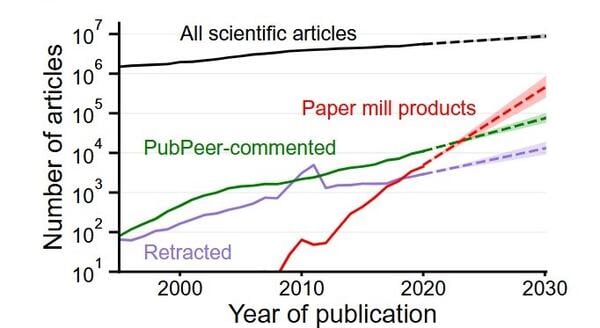
    It’s been an exponential increase. Every one and a half years, the number of paper mill products that have been discovered is doubling. And if you extrapolate these lines into the future, it shows that in the not-so-distant future these kinds of fraudulent papers would be the overwhelming majority within the scientific literature.

    A line graph showing all scientific articles, paper mill products, PubPeer-commented, and retracted papers. The Y axis is number of articles and the X axis is year of publication. All the lines are going up, but the red line for paper mill products is rising fastest.

    Proceedings of the National Academy of Sciences of the United States of America

    Q: What are the mechanisms that have allowed—and incentivized—such widespread research fraud?

    A: There are paper mills that produce large amounts of fake papers by reusing language and figures in different papers that then get published. There are people who act as brokers between those that create these fake papers, people who are putting their name on the paper and those who ensure that the paper gets published in some journal.

    Our paper showed that there are editors—even for legitimate scientific journals—that help to get fraudulent papers through the publishing process. A lot of papers that end up being retracted were handled and accepted by a small number of individuals responsible for allowing this fraud. It’s enough to have just a few editors—around 30 out of thousands—who accept fraudulent papers to create this widespread problem. A lot of those papers were being supplied to these editors by these corrupt paper mill networks. The editors were making money from it, receiving citations to their own papers and getting their own papers accepted by their collaborators. It’s a machine.

    Science has become a numbers game, where people are paying more attention to metrics than the actual work. So, if a researcher can appear to be this incredibly productive person that publishes 100 papers a year, edits 100 papers a year and reviews 100 papers a year, academia seems to accept this as natural as opposed to recognizing that there aren’t enough hours in the day to actually do all of these things properly.

    If these defectors don’t get detected, they have a huge advantage because they get the benefits of being productive scientists—tenure, prestige and grants—without putting in any of the effort. If the number of defectors starts growing, at some point everybody has to become a defector, because otherwise they are not going to survive.

    Q: [Your] paper found a surge in the number of fraudulent research papers produced by paper mills that started around 2010. What are the conditions of the past 15 years that have made this trend possible?

    A: There were two things that happened. One of them is that journals started worrying about their presence online. It used to be that people would read physical copies of a journal. But then, only looking at the paper online—and not printing it—became acceptable. The other thing that became acceptable is that instead of subscribing to a journal, researchers can pay to make their article accessible to everyone.

    These two trends enabled organizations that were already selling essays to college students or theses to Ph.D. students to start selling papers. They could create their own journals and just post the papers there; fraudulent scientists pay them and the organizations make nice money from that. But then these organizations realized that they could make more money by infiltrating legitimate journals, which is what’s happening now.

    It’s hard for legitimate publishers to put an end to it. On the one hand, they want to publish good research to maintain their reputation, but every paper they publish makes them money.

    Q: Could the rise of generative AI accelerate research fraud even more?

    A: Yes. Generative AI is going to make all of these problems worse. The data we analyzed was before generative AI became a concern. If we repeat this analysis in one year, I would imagine that we’ll see an even greater acceleration of these problematic papers.

    With generative AI in the picture, you don’t actually need another person to make fake papers—you can just ask ChatGPT or another large language model. And it will enable many more people to defect from doing actual science.

    Q: How can the academic community address this problem?

    A: We need collective action to resist this trend. We need to prevent these things from even getting into the system, and we need to punish the people that are contributing to it.

    We need to make people accountable for the papers that they claim to be authors of, and if someone is bound to engage in unethical behavior, they should be forbidden from publishing for a period of time commensurate with the seriousness of what they did. We need to enable detection, consequences and implementation of those consequences. Universities, funding agencies and journals should not hide, saying they can’t do anything about this.

    This is about demonstrating integrity and honesty and looking at how we are failing with clear eyes and deciding to take action. I’m hoping that the scientific enterprise and scientific stakeholders rise to that challenge.

    Source link

  • The Problem with Capitulating to Fascism in Higher Education

    The Problem with Capitulating to Fascism in Higher Education

    Higher education serves different purposes for different people. For some, it represents transformation and expanded horizons. For others, it remains a site of oppression—a place where white supremacy and anti-Blackness flourish while administrations proclaim commitments to diversity even as their actions contradict these stated values. The commitments to diversity, equity, and inclusion (DEI) have long been performative at most predominantly white institutions (PWIs). Now, institutions no longer need to maintain even this pretense.

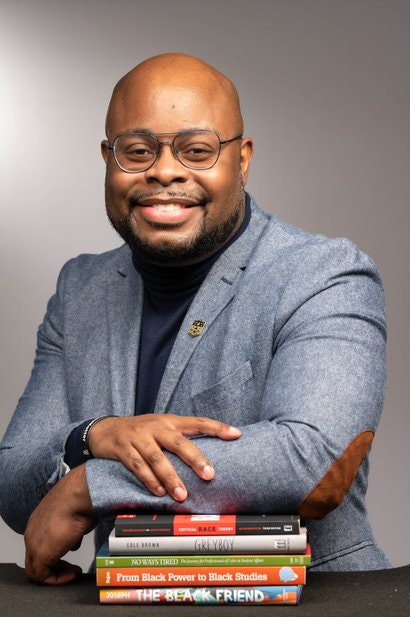
    Dr. Frederick Engram JrThe current presidential administration has made anti-Black, anti-immigrant, anti-LGBTQ+, and anti-women policies central to its agenda. We are not approaching fascism—we are immersed in it. The fundamental problem with higher education and liberal politics more broadly is that while we all recognized the warning signs, no substantive preventative measures were taken to counter the impending assault.

    When the previous Trump administration targeted K-12 education—falsely claiming that critical race theory was being taught in elementary schools and suspending administrators in states like Texas—higher education watched passively, believing itself safe from similar attacks. Instead of mounting resistance and uniting against authoritarian overreach, higher education capitulated. Institutions cancelled classes and programs designed to educate students about historical injustices, prioritizing the comfort of white students and families while disregarding everyone else.

    As Professor Emeritus Dr. John R. Thelin documents in his seminal work A History of American Higher Education, the system was designed from its inception to serve wealthy, white, cisgender, able-bodied men. Higher education was never intended to include marginalized people of color or women. The argument that white men are now being excluded from spaces where they have always been centered would be absurd if it weren’t so dangerous.

    Anti-discrimination DEI initiatives became necessary precisely because white men were not voluntarily making space for others—supported by white women who were themselves fighting for inclusion. The notion that white men feel excluded from higher education reflects a false sense of entitlement and the sting of having their mediocrity exposed. This wounded sense of supremacy drives them to destroy institutions rather than share them.

    Fascism is not approaching—it has arrived.

    The targeted attacks on Harvard, UCLA, University of Pennsylvania, minority-serving institutions (MSIs), and historically Black colleges and universities (HBCUs) are rooted in anti-Black rhetoric that was explicitly outlined in Project 2025. This blueprint seeks to create a dystopian America where marginalized voices are silenced and governance is built around white anxieties and grievances.

    The worst possible response from higher education institutions is capitulation. Instead of forming coalitions, deploying legal resources, and mobilizing their extensive alumni networks, institutions are either confronting this administration in isolation or retreating into silence. Someone should inform higher education that fascism doesn’t reward compliance. It seeks total destruction and will not protect those who failed to oppose it simply because they remained quiet.

    Our institutions and academic disciplines face existential threats. Regardless of how compliant we choose to be, when the destruction is complete, nothing will remain standing. We cannot measure progressive politics by white comfort levels, nor should white feelings determine whether we defend the most vulnerable among us.

    Understanding liberation and resistance in this moment requires recognizing that active opposition is our only viable option. Millions have died, millions are dying, and millions more await death—all to satisfy the bloodlust of mediocre leaders drunk on power. Our resistance must be meaningful and sustained.

    What purpose will silence serve when we lose everything anyway?

    The time for half-measures and performative gestures has passed. Higher education must choose between principled resistance and institutional suicide. The stakes could not be higher, and history will judge our response.

    _________

    Dr. Frederick Engram Jr. is an assistant professor of higher education at at Fairleigh Dickinson University.

    Source link

  • Antisemitism Is Not a Problem at George Mason (opinion)

    Antisemitism Is Not a Problem at George Mason (opinion)

    Ages ago, in the 1970s Soviet Union, a Jewish stand-up comedian, Mikhail Zhvanetski, remarked in one of his skits that if you want to argue about the taste of coconuts (not available in the Soviet Union at that time), it’s better to talk to those who’ve actually tried them.

    If you want to argue about antisemitism in academia, better ask those who have actually experienced it. Ask me.

    I was 16 years old when I graduated from high school in Moscow in 1971. My ethnic heritage—Jewish—was written on my state ID by the authorities. I couldn’t change it. I applied to the “Moscow MIT”: Moscow Institute of Physics and Technology. I passed the entrance tests with flying colors: 18 points out of 20, higher than 85 percent of those admitted. I was denied entry. I knew why. The unwritten but strict quota was that Jews could make up no more than 2 percent of freshmen.

    I did get my education, at another university less closely observed by the party authority. But six years later, looking for a job, I could not find one. In part, this was because institute directors knew they could be disciplined if they hired Jews who then applied to emigrate to Israel. I later learned that I was hired only when my future boss and close friend gave his word of honor that I would never try to emigrate.

    Two years later, I applied for Ph.D. study at the renowned Lebedev Physical Institute of the Russian Academy of Sciences (home to seven Nobel laureates). It was common knowledge at that time that one of the officials at Lebedev who had to approve admissions was a notorious antisemite. My gentile adviser also knew that, made sure that the official would never see either my characteristically Jewish face or my state ID, and took over all paperwork communications himself under various pretexts. When I was officially admitted and walked into the official’s office, they looked like they were going to have a heart attack. This was antisemitism.

    In 1994, 10 years after graduating, I moved to the United States, where, eventually, I devoted more than 20 years of service to the Naval Research Laboratory. Then, in 2019, I joined the faculty at George Mason University, one of the most ethnically diverse universities in the country. In my time here, I have never seen any sign of antisemitism, not a shred. I graduated a Muslim student, who—in his own words—felt honored to have me as his adviser (he even invited me to his sister’s wedding, which was restricted, due to the pandemic, to just 20 guests). I taught several more Muslim students and did research with some others. We openly discussed our religions, and I found these students to be good and compassionate listeners if I chose to share one or another story from my Jewish experience.

    Now, however, the U.S. Department of Education is taking seriously a charge of “a pervasive hostile environment for Jewish students and faculty” at George Mason. This is as shocking to me (and to many of my Jewish colleagues at GMU) as hearing that I have broken two legs and never noticed it. In fact, during the trying months after Oct. 7 and amid growing pro-Palestinian protests on campuses, I often praised Mason president Gregory Washington’s handing of this sensitive issue. While paying full respect to respectful protests, freedom of speech and the First Amendment, he fully avoided disruption of the educational process and university business.

    To this point, I can again dig into my experience under a totalitarian regime. When I came to America in 1994, I was fascinated by the famous case of Yates v. U.S., in which the Supreme Court issued a decision that offered a powerful contrast to Soviet rule. In that 1957 case, the court reversed the convictions of 14 Communist leaders in California who had been charged with advocating for the overthrow of the U.S. government by force. As Justice Black wrote, they “were tried upon the charge that they believe in and want to foist upon this country a different, and, to us, a despicable, form of authoritarian government in which voices criticizing the existing order are summarily silenced. I fear that the present type of prosecutions are more in line with the philosophy of authoritarian government than with that expressed by our First Amendment.”

    To me, this case reflected a quintessential characteristic of American democracy: rephrasing Voltaire, “We may find your view despicable, but will defend to the death your right to say it.”

    Though the details of the antisemitism complaint against George Mason have not been made public, it appears that Washington’s leadership is coming under attack based on just two cases involving three students; only one of those cases involved an alleged incident (vandalism) that occurred on campus. In both cases, the university administration, in collaboration with law enforcement, took immediate and harsh steps to resolve the situations: As Washington noted in a recent message to campus, the university was applauded by the Jewish Community Relations Council of Greater Washington for “deploying the full weight of the university’s security and disciplinary measures to prevent these students from perpetrating harm on campus.”

    And these incidents are outliers. Just as three thieves who may be GMU students wouldn’t attest to “pervasive thievery” on campus, three students alleged to have violent anti-Israeli agendas do not constitute a “pervasive hostile environment for Jewish students and faculty.” On the contrary, I feel safer and more assured knowing that three miscreants out of a student body of 40,000 were immediately and efficiently dealt with.

    What does make me feel uncomfortable—and what I do find antisemitic— is the implicit suggestion that I, an American Jew who does not have Israeli citizenship, must feel offended and defensive in the face of any criticism of any action of the Israeli government. I find such beliefs reprehensible, and they encroach on my freedom to have my own opinion about international affairs.

    Gregory Washington is my president, and I am confident that he is doing an excellent job protecting all faculty and students, including Jews, from bigotry and harassment. It is false allegations of antisemitism on campus under the pretext of “defending” Jews like myself that really threatens my well-being as a GMU professor.

    Igor Mazin is a professor of physics at George Mason University.

    Source link

  • The crisis in the youth sector is a big problem for universities

    The crisis in the youth sector is a big problem for universities

    It is hard for universities to see beyond their own sector crisis right now, but the crisis facing the youth sector today will be the problem of universities tomorrow.

    The youth sector in the UK greatly contributes towards supporting students and graduates of the future, but it is currently under threat and the deepest impact will come for those young people who face the highest barriers to accessing higher education.

    The youth sector engages young people to develop their critical skills for life, including how to build relationships with peers; resilience and developing social and emotional skills; and how to integrate into a community. Many within the higher education sector will recognise these as areas which students and graduates are also struggling with.

    At a time where universities are being called upon to widen access for young people, the reality is young people are facing narrower opportunities than ever. The challenge for widening participation teams will be multifaceted, including supporting attainment raising in schools; tackling entrenched views from schools and families of expectations of what their children can achieve; and providing the support needed for widening participation students to progress well once in higher education.

    So how can the higher education sector help ensure that the challenges the youth sector are facing today don’t become a nightmare for widening participation teams to tackle in the future?

    What is happening in the youth sector?

    The youth sector includes large organisations such as UK Youth, Scouts and Girlguiding, to smaller grassroots organisations who run clubs and activities in and out of schools and community centres across the country.

    There are many similarities between the crises facing the higher education sector and that of the youth sector. Much like universities, the youth sector has faced years of substantial defunding. A YMCA England and Wales report on The state of funding for youth services found that “local authority expenditure on youth services has fallen 73% in England and 27% in Wales since 2010-11” which “represents a real-term cut of £1.2bn to youth services between 2010-11 to 2023-24 in England, and £16.6m in Wales.”

    At the same time as these cuts, the rate of young people who are NEET (not in education, employment or training) is growing, with 13.2 per cent of 16-24 year olds reported as NEET in 2024, and 15.6 per cent of 18-24 year olds NEET. Both figures have increased compared to previous years, particularly in young men. These young people need support and youth services are increasingly unable to provide it.

    Organisations and charities who have been supporting the youth sector are closing at a rapid rate. The National Citizen Service (NCS), a national youth social action programme which has been running since 2009, has been cut by the Labour Government. Student Hubs, the social action charity I worked with which supported students to engage in social and environmental action, has closed. YMCA George Williams College, an organisation which supported the youth sector to improve monitoring, evaluation and impact of their activities closed on 31 March 2025 to the shock of many across the youth sector.

    Whilst the Government’s National Youth Strategy announced in November 2024 is welcome, it will not fix years of systematic underfunding of youth sector services.

    How will this crisis impact universities?

    David Kernohan’s analysis of the UCAS 2025 application figures shows that applications are down, with only applicants from the most advantaged quintile, IMD quintile 5, having improved. We are in the midst of what could be a big decline in the rate of students coming from disadvantaged backgrounds entering higher education, despite the transformative opportunities it provides.

    This comes at a time where there is greater expectation by the government and the regulator for universities to be proactive in supporting students’ and young people’s skills, learning and access to opportunity. In February the Office for Students announced successful providers in their latest funding round to deliver projects which tackle Equality of Opportunity Risk Register areas. The register supports universities to consider barriers in the student life cycle and how they might mitigate against these.

    Seeing the range of projects which have been awarded funding, it is clear that universities are being pushed to go further in imagining what their role is in shaping the lives of the students they engage, and it starts significantly earlier than freshers’ week. This funding shows that more emphasis is being put on universities to address barriers to participation by the Office for Students, and with the youth sector in crisis, this may need to become even wider if universities are to fulfil their access missions.

    Thankfully, there are actions universities can take now which will make a difference both to young people and widening participation teams.

    Tackling the problems together

    The youth sector cannot afford to wait. If universities want to be ready to meet the challenges of tomorrow, they need to build strong collaborative relationships with organisations already situated in communities whilst they are still here. Partnership with the youth sector offers an opportunity to enhance university strategic activity whilst making genuine social and economic impact.

    Universities could be doing more to provide expertise on monitoring and evaluation of youth activities, enhancing quality of local activities, and conducting research to support future outcomes. There’s an opportunity for universities to learn from these partnerships too, particularly because the youth sector has a range of expertise which is highly applicable to the work the sector is doing in broadening their widening participation and civic strategies. These partnerships will sometimes be informal and sometimes they might be formalised through knowledge exchange programmes like student consultancy.

    Students can play a big role in linking universities and youth services. Research conducted by the National Youth Agency in 2024 found “that fewer than seven per cent of respondents to a national survey of youth workers are under 26 years old”. There is a desperate need for youth workers and particularly under-30s to support the sector. Student Hubs’ legacy resources detail the approach we took to supporting students to volunteer in local schools, libraries and community centres to provide free support to young people as part of place-based programmes with universities.

    Universities and students’ unions have spaces they are looking to commercialise, whilst also trying to give students jobs on campus. Universities and students’ unions could work collaboratively with community groups to use spaces on campus, provide student work through staffing them, and in turn support young people and families to access campus facilities.

    The time is now

    One of the hallmarks of a crisis is communities coming together to meet challenges head on, and universities shouldn’t wait to be invited. Trust will need to be built and relationships take time to forge.

    The best time to start is now. Universities should mobilise whilst there is still a youth sector left to support, or the void left by the lack of youth services means universities’ involvement in young people’s lives is going to become even larger.

    Source link

  • Higher Education franchising is not the problem. Rogue providers and regulatory gaps are

    Higher Education franchising is not the problem. Rogue providers and regulatory gaps are

    • By Charlie Tennant, Vice Principal at the London School of Science & Technology.

    Higher education franchising is once more in the limelight for the wrong reasons, as many in the sector again question its benefits, the risks it poses to public funds and the use of it by niche, emerging and/or for-profit higher education providers. However, the stories and discourse miss the key factors that have allowed for abuse of the franchise model. It is gaps in higher education regulation that have led to franchising being scapegoated for what is, at its core, abuse by rogue providers that do not represent the vast majority of those engaged in franchising.

    Franchising is a model through which UK universities have delivered higher education for over two decades. Internationally, this forms part of many forms of Transnational Education (TNE), that as seen in Universities UK International (UUKi)’s Scale of UK Higher Education Transnational Education reports, continues to grow in scale. Locally, providers have adopted the franchise model since the mid-2000s, although since then, the market for many of those providers has changed from international students to local students. This change meant the number of students at these providers who were eligible for Student Loans Company (SLC) funding has grown. The model allows institutions that have found new approaches, differentiated courses, or cold spots of higher education to develop and expand their provision, with a significant portion of them hoping to one day gain their own Degree Awarding Powers (DAPs).

    However, the regulation of domestic franchise provision has not been as robust as it could be. The onus has rightly been put on the universities that are franchising their courses to ensure academic quality and standards of the franchise delivery, although there is currently no direct regulation of higher education franchise providers. Therefore, while some blame can be apportioned to universities engaged in franchising, it can be argued that the Department for Education (DfE) and policymakers’ approach to regulating higher education franchises has led to gaps open to abuse by rogue providers. Furthermore, routes for franchise providers to gain DAPs have been prolonged and made complex by the pause in processing of registration applications by the Office for Students (OfS). Now, the abuse of SLC funding by particular providers of the franchise model, reported by the Sunday Times in an article on 22nd March 2025 and in several articles since then, has brought the reputation of all franchise providers into disrepute, and connected the abuse to use of recruitment agents and the settled Romanian population in the UK.

    In a January 2025 press release for their consultation on franchise provision regulations, the Government outlined the benefits of franchising when done right, and its intention to crack down on rogue higher education providers. Professor Nick Braisby’s HEPI blog published in response to the consultation, rightly welcomes the Government’s new proposals, but asks for the sector to remain critical. This blog therefore proposes three ways in which to ensure the Government and the OfS achieve what they hope to through the crackdown.

    Firstly, the DfE, policymakers and the OfS need to enable quicker routes for franchise providers to join the regulator’s Register. This will allow greater scrutiny at an earlier stage in the lifecycle of an emerging higher education provider (which make up the majority of providers delivering franchised courses) and introduce a focus on their governance structures. Since the set-up of the OfS Register, providers have experienced long lead times for joining the Register, and on top of this, from December 2024, the regulator paused applications for the Register, DAPs and changes of registration category, thus exacerbating the issue of missing opportunities to directly regulate more franchise providers. This is counterintuitive given the OfS’s remarks around the risks associated with an over-reliance by both universities and franchise providers on partnership provision in their Insight Brief regarding subcontractual arrangements in higher education published just two months prior to the pause. The OfS’ Register of providers has the potential to be a great tool for transparency, but the current lead times and design of the approach lead to gaps in regulation that can be exploited by rogue providers.

    Secondly, instead of considering an outright ban, the DfE should implement a robust quality framework for domestic student recruitment agents. As a blueprint, they should draw from the established Agent Quality Framework (AQF) developed by the British Council, Universities UK International (UUKi), and the UK Council for International Student Affairs (UKCISA). As with international student recruitment, the unregulated use of agents for domestic recruitment presents significant risks. By adopting a structured quality framework, the DfE and OfS can mitigate these risks and foster greater transparency and accountability. Agents, when operating under clear ethical guidelines and quality standards, can play a crucial role in widening participation, particularly by reaching communities historically underserved by traditional university outreach, for example, the UK’s settled Romanian population. A tailored framework can help to ensure transparency, effective governance and the establishment of professional standards of agents.

    Finally, the DfE, policymakers and the OfS need to engage more with franchise providers and their university partners jointly. So far, engagements have been disjointed, with either a university or one of their partner franchise providers engaged separately. This creates barriers to collaboration, which would otherwise aid in the pursuit of greater transparency, oversight and the maintenance of academic quality and standards. Bringing both universities and franchise providers together when engaging will enable the Government to find ways to both demonstrate the benefits of franchise provision, as well as develop regulatory approaches and guidance collaboratively with stakeholders. This joint engagement with universities and their partner franchise provider could pave the early steps towards a sector-wide code of practice, an idea discussed in HEPI and Buckinghamshire New University’s Debate Paper on franchising. This could then sit alongside collaboratively developed regulations that would ensure rogue providers cannot abuse regulatory gaps. It will also help to establish a more balanced burden of regulation between universities and their franchise provider partners, and safeguard the reputation of franchise provision.

    Ultimately, effective regulation of the broader higher education student journey, streamlined registration, and collaborative engagement are crucial. By addressing these systemic gaps and promoting transparency, the policymakers, DfE, OfS, and the higher education sector can restore faith in franchising and ensure its legitimate benefits are realised.

    Source link

  • The franchise problem may not have a quick answer

    The franchise problem may not have a quick answer

    So everyone is (still, after more than a decade) agreed that student loan fraud and poor quality provision is a huge mark against the practice of franchise provision.

    Moreover, we’ve generally come to the conclusion that something needs to be done – and although an investigation will be helpful, that something needs to be fairly swift and concrete action.

    Most people are assuming that this will take the form of a requirement to regulate franchise partners, via compulsory registration by the OfS, or some other regulatory change.

    Didn’t we try something like that before?

    The government is currently consulting on whether all institutions in England delivering higher education to more than 300 students should register, at some level, with the regulator.

    This in itself is far from a new idea. When the Department for Education first consulted on what became the Office for Students regulatory framework, providers had the option to register in the “Registered basic” category – a third category that simply recognised that an institution was providing higher education in England.

    This category will provide a degree of confidence for students that is not present in the current system with providers in the Registered basic category being able to let students and other bodies know that they are recognised by the OfS as offering higher education courses.

    As registration in this category was intended to be optional there would need to have been a benefit to registration, and there would be no way of assuming that all England’s higher education provision was covered. On franchise arrangements in particular, the initial proposals suggested that:

    the delivery provider [in a franchise arrangement] will not normally be required to register. If it chooses to register, the Registered basic category will normally be the most suitable category because the lead provider is responsible for compliance with all required registration conditions for the Approved and Approved (fee cap) categories.

    For many in the sector responding to these ideas, these assumptions offered little to protect students or the system as a whole. In summarising the consultation responses, the government reported that

    there were widespread calls for the Registered (basic) category to carry additional conditions to protect students’ interests, such as transparency, student protection plans, student transfer and electoral registration conditions. Respondents were concerned that students at those providers in the Registered (basic) category would be at risk of assuming greater protection than will be provided in that category

    The combination of the limited oversight offered to those in the “Registered basic” category (which was configured pretty much as a list of people who had paid OfS £1,000), and the additional burden that that any more active requirement would place on smaller providers, meant that OfS concluded that:

    we have decided to remove the Registered (basic) category from the published regulatory framework. The effect of this decision is to avoid misleading students about the protections available at Registered (basic) providers

    But that wasn’t the end of it. OfS also noted (and this is worth setting out in full):

    we recognise that unregulated providers will continue to operate, as they would have done even if the Registered (basic) category had been included (albeit, possibly, in lesser numbers). We are concerned with all students, not only those at registered providers, and remain committed to the policy intention set out in the regulatory framework consultation – to improve transparency and student protection at those higher education providers that are currently unregulated. We shall therefore give priority to developing our understanding of providers and students in the unregulated parts of the sector, to determine how we can most effectively have a role in protecting the interests of students at these providers

    At the time, when franchise arrangements were considered at all by ministers, they were painted as an unnecessary rigmarole for exciting new entrants to the market. Speaking to Universities UK in 2015, then higher education minister Jo Johnson famously said:

    Many of you validate degree courses at alternative providers. Many choose not to do so. I know some validation relationships work well, but the requirement for new providers to seek out a suitable validating body from amongst the pool of incumbents is quite frankly anti-competitive. It’s akin to Byron Burger having to ask permission of McDonald’s to open up a new restaurant.

    So how’s all that going, then?

    Byron Burger, of course, entered administration twice in three years. In contrast, the franchise model in higher education never looked short of cash or interest. The Office for Students never used its own “validation powers” (section 51 of the Higher Education and Research Act allowed the OfS to get involved in academic partnerships directly, as kind of a response to the argument that delivering courses on behalf of a competitor in order to enter the sector was anti-competitive). Instead, it commissioned the Open University to be (effectively) a validator of last resort for FE colleges on others seeking to enter the HE market (this arrangement is set to conclude in July 2025).

    When the Higher Education Funding Council for England closed in March 2018, it directly funded 313 higher education providers, while having at least an awareness of 816 places in England where higher education was being delivered. The Office for Students currently has a funding and regulatory arrangement with 425 providers – for the current regulator, there is no regulation without funding. The impact assessment published alongside HERA implied that in 2024-25 there would be 631 in either the Approved or Approved (Fee Cap) registration category – postulating 1,131 institutions delivering higher education in England in total.

    The postulated rush to register did not happen, even when DfE closed the old “specific course designation” route to regulated and funded provision for alternative providers in August 2019. As sector interest group Independent HE has documented, the Office for Student registration process was generally experienced as expensive and cumbersome: where providers have been actively seeking regulation and oversight, it has been very difficult to obtain. Indeed, when OfS faced pressure to get more actively involved in securing sector finances, it was able to unlock significant internal resources by “pausing” registration.

    By closing the “specific course designation” route, and making full registration slow and difficult, OfS has incentivised smaller providers to enter the least regulated (and riskiest, for students and public funds) part of the higher education sector. If that constitutes “developing an understanding” of the unregulated part of the sector, one has to question what this “understanding” actually is.

    The other end

    The financial pressures currently engulfing the sector has encouraged many established providers to get involved in franchising arrangements – they get to keep a portion of the fee income related to students involved in such arrangements. In return, they are expected to provide oversight of quality and standards on courses leading to awards bearing their names, and handle all of the regulatory requirements relating to those students.

    The numeric threshold approach to regulation (wherein a provider faces further investigation if the proportion of students continuing on their course, completing their course, and progressing into employment or further study, falls below a minimum) does mean that such provision is regulated, after a fashion. There is an open investigation on franchising at Leeds Trinity University, and we understand that current quality-related investigations are focused in part on franchise provision.

    Where the Student Loans Company spots evidence of potential fraud (or when OfS is notified of a concern) usually but not always involving a franchise arrangement, both OfS and DfE may become involved in an investigation. A recent uptick in such cases has led OfS to set out expectations in more detail.

    For these reasons most providers that franchise out provision are assiduous in ensuring what is being delivered is of a decent quality. However, the market incentives – at least in the short term – are stacked in the other direction. Some larger providers are increasingly reliant on income relating to students studying within franchise arrangements, and the demand for such relationships gives franchise providers the ability to shop around. Where an awarding organisation has attempted to impose more stringent quality requirements, there have been instances where the delivery partner has simply ended the partnership and entered a new relationship that offers less work and/or more cash.

    What regulatory tools are actually workable?

    So when something bad is identified, there’s always a subset of the population who think that there should be a law (or at least, regulation) to stop it happening. It’s an attractive idea, until you start to think about implementation. There are many trade offs.

    Option one: ban all franchise provision

    In other words, you would decree that unless you have degree awarding powers, you shouldn’t be delivering higher education. You would, in practice, have to ban all new recruitment to franchised courses and allow for some form of teach-out, unless you want to face a mass legal action. On a teach out, with no likelihood of any new students, the quality of provision would fall even further as providers withdraw funding and interest.

    Meanwhile, a fair number of large providers rely on franchise income to make ends meet. So factor in the closure of a few universities – with further pressure on other providers to offer teach out – as that part of the sector slowly becomes unviable. Which would be a shame for all those students working hard at FE colleges (franchising pretty much started as a way to support FE colleges delivering HE in hard-to-reach areas), and at the quality and specialist end of franchise provision, and for on campus students at providers heavily involved in franchise provision.

    To be clear – you may not value some of the providers involved, or some of the courses students are enrolled on. But if either disappeared you would need to come up with a way to look after the interests of the legitimate students involved.

    Option two: selectively ban some franchise provision

    Take all the drawbacks of option one, but also add in the difficulty of reliably and consistently distinguishing the kinds of provision you want to see supported in this way from that which you want rid of. You could use metric thresholds in a B3-esque way, you could attempt to do something clever with subject areas, or even base the ban directly on your suspicions of fraudulent activity. You’d have to be absolutely certain, mind – such decisions will almost certainly end up in court (you are dealing with a lot of higher education income, and it is unlikely you will get it dead right every time). Even something as straightforward as a subject area (“business studies”) is notoriously tricky to define when you get down to actual course content.

    Option three: require all providers involved to register with OfS

    Even assuming OfS has the capacity to quickly register a load of providers currently delivering franchise provision, there has to be a question as to how quickly and how well the regulator can then act where there is low quality provision. Back in 2024 we got a promise that the next round of OfS quality investigations would have a particular focus on franchise provision (from last time this story cropped up) – as yet we’ve not even seen reports, much less regulatory action.

    It’s looks like this has been one of many casualties of the regulator, at the urging of the government, throwing as much effort as possible behind addressing the financial issues the sector has been facing (we’re also expecting findings from the investigation into the academic partners of Leeds Trinity University that kicked off more than a year ago)

    Option 4: continue with tripartite enforcement

    OfS, DfE, and SLC already work together (increasingly regularly) to act on evidence and information relating to student finance fraud. One approach to address the problems as reported – which encompass value for taxpayer funding in the wider sense of good quality provision as well as the more specific fraudulent and criminal examples – would be to continue to reinforce and prioritise this collaboration and data sharing. There have been some steps taken to ensure that OfS is gathering and using the appropriate data, and that the three organisations are able to work together in using regulatory or financial sanctions to deal with concerning situations.

    However, this is what we are doing currently, and it would appear that the rate of success is not yet high enough. There were recommendations in the NAO report that cover stuff like risk management, drawing on evidence, and agreeing responsibilities: all of which are examples of basic stuff that is not being done consistently or well. That’s a worry.

    Option 5: number controls

    There is a case for number controls for franchised provision, linked to a regular (ideally cyclical rather than risk based) quality engagement. Where there is good and useful franchise provision we should be happy to let it expand, where there are even mild concerns we should be happy to constrain recruitment. And there is no way that the kind of rapid scale up of activity we’ve seen at some providers can be done without compromising quality – there should be an absolute proportional limit on expansion.

    Last time this story did the rounds, Jim made a compelling case for a 25 per cent of total provision cap similar to that used by the ESFA to regulate franchise FE provision in 2020. There’s not a lot of the current HE sector that would be hit by such a rule, but there are a handful of prominent examples for whom a higher ratio is pretty much existential (yes, you could argue that such institutions may not be viable anyway, but how does that help students or the wider sector?). There would need to be a time delay on full implementation, and support and guidance for those that need to rapidly downsize existing operations. Again, you might need to consider teach out arrangements as well.

    So where next?

    If you’ve set up, as the government in England has over the last decade, a fairly open market for higher education provision based on students as consumers having enough information, you need to regulate in the interests of the consumer (in this case both the individual students and the taxpayer). It’s neither unexpected or unprecedented for schemes with incomplete safeguards and developing approaches to regulation to be at risk of fraud – and it is essential to be able to quickly identify and act where it is happening.

    For me, the speedier collection and use of data around franchise provision – regarding the student experience, student outcomes, and the financial and operational approaches involved – is essential. There should be specific and regular data submission points for lead providers involved in franchise provision – this should be assessed quickly and action taken where there are causes for concern. OfS already has a notification system, which should be better promoted – it should also work with other bodies who collect information about the student experience. As much data as possible should be published: transparency is a valuable tool in avoiding murkier practices.

    I’m not convinced of the benefit of a full regulatory relationship with franchise providers. OfS does need to know who they are and keep some records as to which delivery providers have been problematic in the past – but in terms of incentives it makes more sense to regulate the lead partner. And number controls, while far from universally popular, would help in this case.

    You’ll note that none of this requires new legislation – we should take with a grain of salt the claim that OfS does not have the powers to act in these situations, it absolutely does. However the regulator may not have the capacity to act as quickly or as decisively as it may like – so there may need to be additional money available from DfE to build these capabilities.

    Source link

  • Food insecurity is a problem on campuses: How can we fix it?

    Food insecurity is a problem on campuses: How can we fix it?


    Food insecurity is not just a growing issue at a societal level, it’s an urgent crisis for students at Australian universities.

    Please login below to view content or subscribe now.

    Membership Login

    Source link