Tag: Professor

  • ‘What the hell just happened?’ Australia’s flirtation with a levy on international students – By Professor Andrew Norton

    ‘What the hell just happened?’ Australia’s flirtation with a levy on international students – By Professor Andrew Norton

    • This blog has been kindly written for HEPI by Andrew Norton, Professor of Higher Education Policy at Monash Business School, Monash University.
    • The thoughts of Nick Hillman, HEPI’s Director, on the levy can be read on the Research Professional News website here.

    For an Australian reader the UK immigration white paper’s proposal for a levy on international student fee revenue sounds familiar. In mid-2023 just such a levy was suggested for Australia by the interim report of a major higher education policy review. Like its UK version, the idea was to reinvest levy revenue in education. While the interim report lacked white paper status, education minister Jason Clare liked the idea enough to mention it in his report launch speech

    But now the levy has vanished from the Australian policy agenda. When the Universities Accord final report was released in February 2024 the levy idea was there but postponed, shunted off until after other major funding reforms that will start in 2027 at the earliest. So far as I can find, the Minister – newly reappointed this week after Labor’s election victory on 3 May – has not mentioned the idea in public for 18 months.

    So what happened? Predictably, the universities that stood to lose the most from the levy opposed it. But the bigger reason was that between mid-2023 and late 2023 the politics of international education in Australia were turned upside down. In a few months international education went from a valuable export industry to a cause of Australia’s housing shortages. International student numbers had to be cut. 

    As originally proposed in Australia the international student levy was not linked to migration policy. Some reduction in student demand was predicted, as levy costs were passed on through higher fees. But this was a policy side-effect, not its goal. If too many international students were deterred the levy would not raise enough money to achieve its domestic objectives. The Government needed more effective ways of bringing international student numbers back down. 

    Between October 2023 and July 2024 the Australian Government introduced, on my count, nine measures to block or discourage would-be international students. 

    Among the Government’s nine measures was one that delivered it international student revenue much more quickly than the proposed levy. The Government more than doubled student visa application fees from A$710 (~£330) to A$1,600 (~£745), claiming that the money would be spent on policies benefiting domestic students. During the 2025 election campaign Labor said it would increase visa fees again, to A$2,000 (~£930). The UK’s £524 fee looks cheap by comparison. 

    Higher visa fees and other migration measures had two big advantages over the once-proposed levy from the perspective of the Australian Government – legal ease and speed in delivering on migration goals. In Australia, many migration changes can be made by ministerial determination without parliamentary review. The levy required legislation. Australia’s system of sending controversial legislation to often-bruising Senate inquiries increases political costs, even when the bill ultimately passes.

    What visa fees lack is the Robin Hood element of the Australian levy as proposed. In 2023 the University of Sydney alone earned 14% of all university international student fee revenue. The top six universities received more than half of the total. Levy advocates argue that these gains are built on past taxpayer subsidies and prime real estate. Profits built on these foundations can legitimately be taxed for the wider benefit of Australian higher education. 

    In Australia generally, and under Labor governments especially, an egalitarian political culture gives these levy arguments some resonance. But for the foreseeable future migration is a bigger issue than university funding, and visa policies a more straightforward way of bringing down international student numbers than levies. Perhaps the levy idea will return, but the government’s long silence on the subject suggests that this will not happen anytime soon.

    Source link

  • A Michigan research professor explains how NIH funding works − and what it means to suddenly lose a grant – Campus Review

    A Michigan research professor explains how NIH funding works − and what it means to suddenly lose a grant – Campus Review

    In its first 100 days, the Trump administration has terminated more than US$2 billion in federal grants, according to a public source database compiled by the scientific community, and it is proposing additional cuts that would reduce the $47 billion budget of the US National Institutes of Health, also known as the NIH, by nearly half.

    Please login below to view content or subscribe now.

    Membership Login

    Source link

  • In memoriam: Professor Claire Callender OBE

    In memoriam: Professor Claire Callender OBE

    OBITUARY

    Claire Sorrel Callender

    By Simon Marginson *

    Professor Claire Callender OBE, who held joint professorships at UCL Institute of Education and Birkbeck, University of London, died at home amid her family on Tuesday, 15 April, after the cancer which developed in one lung and was in remission had moved to the other. She dealt with her illness and the rollercoaster of treatments, tests and diagnoses with exceptional strength, characteristic realism and eventually, open acceptance, making the best of her remaining time. Claire’s life and contributions will now be celebrated, but her passing at a relatively young age has sent a wave of sadness through UK and world higher education. She touched the lives of many as a scholar, colleague and mentor; played a central role in policy and public discussion for three decades; and had much respect and friendship in the sector. She was awarded an OBE for services to higher education in 2017. 

    Claire attended Notting Hill and Ealing High School between 1961 and 1972, completed a BSc in Social Administration and Sociology at Bristol in 1979, after a period as a community worker in the Beit She’an Community Centre in Israel, and a PhD in Gender and Social Policy at the University of Wales in 1988. Her thesis topic was ‘Women’s employment, redundancy and unemployment’: both gender and the labour market for graduates were to become lifelong research preoccupations. She worked successively at University College Cardiff, and the Universities of Leeds, Bradford and Sussex (in the Institute of Employment Studies), before becoming head of the Family Finances Research Group at the Policy Studies Institute in London (1994-1998). Her first chair appointment was at London South Bank University as Professor of Social Policy (1998-2008). Claire’s social research star was rising and early in the Blair years (1999-2000) she spent time in the Cabinet Office on secondment as Head of Research in the Women’s Unit and a member of the Senior Management Team.  

    In 2006 and 2007, Claire was a visiting scholar successively at the Center for the Study of Higher Education at Pennsylvania State University, and the Graduate School of Education at Harvard, and was also a Fulbright New Century Scholar in 2007/08, forging productive research collaborations in the United States that continued throughout her career. Her post as Professor of Higher Education Policy commenced at Birbeck in 2008, followed by the Professorship of Higher Education Studies at the Institute of Education (which merged with UCL in 2015) in 2010. She juggled the respective cultures, needs and demands of the two rather different neighbouring institutions with aplomb. Her heart might have been with Birkbeck, and there her policy focus on part-time, adult and evening students had its natural home, while UCL IoE placed her squarely in the centre of the university-policy interface and brought multiple opportunities for fruitful collaborations and ongoing academic friendships. 

    In 2012, she worked with Peter Scott to develop a bid to the Economic and Social Research Council (ESRC) for a five-year centre with a multi-project focus on higher education. The bid was unsuccessful but the theme caught the attention of the ESRC and the Higher Education Funding Council of England (HEFCE), and in the next ESRC centre round in 2014 there was a specific call for bids focused on the future of higher education, with HEFCE underwriting part of the cost. A team headed by myself was successful, establishing what became the ESRC Centre for Global Higher Education (CGHE) with £5.9 million for 2015 to 2020. Claire was named as a Deputy Director alongside a formidable group of England-based researcher-scholars including Peter Scott, Mike Shattock, Gareth Parry, William Locke, Lorraine Dearden, Gill Wyness and Paul Ashwin, as well as Ellen Hazelkorn at Technological University Dublin in Ireland and researchers from seven other international partner universities. 

    Claire convened five CGHE research projects under the heading ‘Social and Economic Impact of Higher Education’. Appropriately, given Claire’s own interests and skillset, these projects were all sharply focused on UK policy issues, while mindful also of global comparisons and relevance. The researchers on her list included the leading economists Bruce Chapman and Lorraine Dearden who together modelled income-contingent loans systems of tuition funding in a dozen countries. They achieved a major breakthrough in Columbia in 2022 where their blueprint was adopted by the ministry. Bruce and Lorraine were awarded the ESRC prize for policy impact and paid tribute to Claire’s role in supporting their work. 

    CGHE received a further tranche of £1.5 million in ESRC funding for 2020 to 2024 before entering its present phase as a largely self-funded operation. Claire continued as Deputy Director, central to CGHE research management and in public forums, and an appreciated mentor to junior researchers. Her own quantitative and qualitative CGHE inquiry into ‘The effects of student loan debt on graduates’ financial and life decisions’, working primarily with Ariane de Gayardon, led to successive papers on the human and social costs for diverse populations associated with the uniform system of student-user charges in England. From 1998 onwards, after fees were introduced into what had been a free higher education system, Claire had been concerned about student financing and its impact, including comparisons between England and Scotland where free education was maintained. She was frequently and eloquently public on those issues. Uncomfortable with debt financing as a deterrent, a long burden and a source of inequalities, like many in higher education she was a staunch advocate of maintenance grants. Her concern that the 2012 full fee system would discriminate against part-timers proved wholly justified when full-time enrolments held up while part-time numbers plummeted. The then Minister for Higher Education, now David (now Lord) Willetts, acknowledged that Claire’s work on the issue was unique and crucial. 

    As this suggests, perhaps the key aspect of Claire’s scholarly work was her eye for policy relevance. During her career she was commissioned to undertake research and/or invited to present evidence to the OECD, the European Commission and governments in Germany, Finland (where she was appointed by the Ministry of Culture and Education to the peer-review panel for the assessment of the Finnish Higher Education System in 2015), Poland, and Malaysia. She reported to numerous Parliamentary Select Committees in UK, and all the major reviews of student funding that took place in the UK after 1997 – including the most recent review, the Augar Report of 2019, where she was extensively cited. Claire’s contributions to research scholarship included more than 125 books, reports and chapters, more than 30 peer reviewed journal papers and numerous conference and seminar presentations. Some of her very best scholarly work was done in the final years. The last journal paper, with Ariane de Gayardon, was published in Policy Reviews in Higher Education earlier this year. Claire became a Fellow of the Academy of Social Sciences in 2003 and her standing in Europe was recognised in 2023 by her elevation to Academia Europaea. The OBE acknowledged her UK policy work. 

    The formal honours were and are appropriate, but they do not capture the essence of Claire Callender in the world: the way she focused her formidable capacity for rational thought on matters to which she was committed, her gravitas that held the room when speaking, and the warmth that she evoked without fail in old and new acquaintances. Claire leaves her partner Annette and a large circle of family and friends. She is much missed.

    * Simon Marginson is Professor of Higher Education at the University of Bristol, Professor of Higher Education (emeritus) at the University of Oxford, and Joint Editor in Chief of the journal Higher Education. He was director of the ESRC Centre for Global Higher Education from 2015 to 2024. 

    _____________________________

    The HEPI staff team were grateful to have known Claire and to have had the honour of publishing some of her critically important work. We learnt a huge amount from her and will be among the very large number of people who will sorely miss her.

    Source link

  • Colonialism-Defending Professor Settles With U of Oregon

    Colonialism-Defending Professor Settles With U of Oregon

    A professor who’s long been controversial for defending colonialism has settled the lawsuit he filed more than two years ago against a former communication manager at the University of Oregon who blocked him from interacting with a university account on Twitter.

    Bruce Gilley—a Portland State University politics and global affairs professor currently serving a stint as A Presidential Scholar in Residence at New College of Florida—filed the lawsuit in August 2022 a former communication manager for the University of Oregon’s Division of Equity and Inclusion.

    Gilley alleged that the Equity and Inclusion Twitter account published a post urging people to “interrupt racism,” suggesting they use this line: “It sounded like you just said [blank]. Is that really what you meant?” Gilley said he was blocked by the account after retweeting the post with the caption “My entry: … you just said ‘all men are created equal.’”

    Gilley and the University of Oregon reached a settlement agreement last week in which the institution admitted the communication manager blocked Gilley. The university agreed in the settlement that its insurer would pay from $95,000 to $382,000 in attorneys’ fees to Gilley’s representatives—the Institute for Free Speech and the Angus Lee Law Firm—and the institution further agreed to a detailed process to clarify its social media policies and train social media managers on them. There will be an email address for people to complain about being blocked, and the whole plan will have a 180-day supervision period for implementation.

    “The guidelines will more clearly state that third parties and the content they post must not be blocked or deleted based on viewpoint, even if that viewpoint can be viewed by some as ‘offensive,’ ‘racist’ or ‘hateful,’” the settlement agreement says.

    In a statement, the university said it “does not agree that it committed any of the violations alleged in Bruce Gilley’s complaint. The agreement reached between the university and Mr. Gilley ended the lawsuit without admission of liability or fault.”

    Source link

  • “Portrayed as a place that isn’t what I know it to be”: Professor Bell on ANU’s public perception

    “Portrayed as a place that isn’t what I know it to be”: Professor Bell on ANU’s public perception

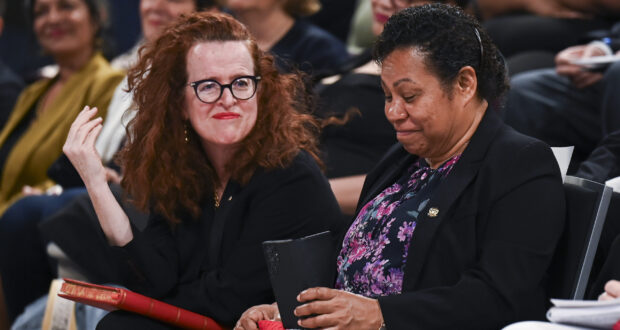
    ANU vice-chancellor Genevieve Bell with Rachel Marape at James Marape, the Prime Minister of Papua New Guinea’s address to the ANU in February, 2024. Picture: Martin Ollman

    Australian National University’s (ANU) vice-chancellor Genevieve Bell has made a statement confirming she plans to stand by her university after a “four-month negative media campaign.”

    Please login below to view content or subscribe now.

    Membership Login

    Source link

  • Pro-Palestinian Journalism Professor Denied Tenure

    Pro-Palestinian Journalism Professor Denied Tenure

    Steven Thrasher, an assistant journalism professor who tried to block police from breaking up a pro-Palestinian encampment at Northwestern University last spring, announced he was denied tenure and will lose his job in August 2026, the end of the next academic year.

    “This has nothing to do with my scholarship or teaching,” Thrasher wrote in a statement he shared on Bluesky. “It is a political hit job over my support for Palestine and for trying to protect our student protesters last year from physical attack, by nonviolently subjecting my own body to assault by the Northwestern Police instead of our students.”

    The incident between Thrasher and campus police came up when Northwestern president Michael Schill went before Congress during a hearing on campus antisemitism. In a June 2024 letter, the House Committee on Education and the Workforce accused Schill of not fully answering members’ questions at the hearing, including about Thrasher.

    Thrasher was suspended from teaching last summer. According to an email from Medill School of Journalism dean Charles F. Whitaker, which Thrasher’s lawyer provided to Inside Higher Ed, the dean initiated disciplinary proceedings in response to complaints about Thrasher’s social media activity and allegedly sexist comments to students, as well as his failure to disclose major course changes and his comments about journalism standards that were “antithetical to our profession.”

    According to Thrasher’s statement, posted Thursday, Whitaker wrote in an explanation of the tenure denial that Thrasher’s teaching was “inadequate with serious concerns reported by some students.” Thrasher said he previously received a “glowing” mid-tenure review in 2023. He also said a university-wide ad hoc faculty committee “exonerated” him after a four-month investigation into issues, including student concerns.

    “I read the situation as a Plan B by Northwestern after Dean Whitaker tried (and failed) to exclude me through the disciplinary process,” Thrasher wrote. “I will appeal this decision at Northwestern and have much more to say.”

    In a statement to Inside Higher Ed, a university spokesperson wrote, “As policy, Northwestern does not comment on personnel matters. The University takes the tenure process very seriously and has adhered to the rules that govern that process. The University has full confidence in the decision-making process of our Medill faculty and dean.”

    Source link

  • VICTORY! 9th Circuit rules in favor of professor punished for criticizing college for lowering academic standards

    VICTORY! 9th Circuit rules in favor of professor punished for criticizing college for lowering academic standards

    SAN FRANCISCO, March 10, 2025 — Today, the U.S. Court of Appeals for the Ninth Circuit ruled in favor of Lars Jensen, a math professor unconstitutionally punished for criticizing what he believed was his college’s decision to water down its math standards.

    Reversing a federal district court, the Ninth Circuit held Jensen suffered wrongful dismissal of his claims against Truckee Meadows Community College in Reno, Nevada, and that he should have his day in court to prove college administrators violated his First Amendment rights. The court also held Jensen’s right to speak out about the math standards was so clearly established that the administrators were not entitled to dismissal on qualified immunity grounds.

    “This decision is a major victory for the free speech rights of academics,” said Foundation for Individual Rights and Expression attorney Daniel Ortner, who argued the case before a Ninth Circuit panel in November 2024. “This decision will protect professors from investigation or threats of termination for their speech, and promote accountability for administrators who violate the First Amendment.”

    The dispute began in 2020, when Jensen planned to comment at a TMCC conference about what he perceived to be diminishing academic standards at the college. After administrators prohibited Jensen from sharing his views at a Q&A session, he printed out his planned comments critiquing the college for allowing for “a student graduating from college” while only being “ready for middle school math,” and handed them out to his colleagues during the break. TMCC Dean Julie Ellsworth told Jensen not to circulate his fliers during the break, but he continued to do so without interrupting the session.

    Ellsworth then accused Jensen of “disobeying” her and warned him he had “made an error” defying her. Following through on her veiled threats, Ellsworth sent Jensen an official reprimand. Over the next two performance reviews, Jensen’s department chair suggested he receive an “excellent” rating, but Ellsworth retaliated by giving him “unsatisfactory” ratings for “insubordination.” As a result, Jensen automatically had to undergo review for possible termination.

    “The college’s actions tarnished my reputation and chilled my speech,” said Jensen. “The Ninth Circuit’s decision vindicates my First Amendment rights and allows me to have my day in court.” 

    COURTESY PHOTOS OF PROFESSOR JENSEN AND HIS ATTORNEYS

    TMCC might have fired Jensen if not for the speedy intervention of FIRE, which wrote a letter objecting that the administrators were violating the First Amendment, which protects faculty at public colleges in commenting as citizens on matters of public concern. TMCC announced that Jensen would not be fired, but the damage to his First Amendment rights was already done, especially with the negative performance evaluations remaining on his file.

    Jensen sued Ellsworth and other TMCC administrators in 2022, arguing the college’s retaliatory actions violated his First Amendment rights as well as his right to due process and equal protection. A district court dismissed the case in 2023. 

    The Ninth Circuit ruled today that the district court erred in dismissing Jensen’s First Amendment claim, because his speech about the college’s academic standards involved a matter of public concern related to scholarship or teaching, and thus receives First Amendment protection. 

    The Court also held the university’s retaliatory actions were likely to chill Jensen’s speech, and that a university’s “interest in punishing a disobedient employee for speaking in violation of their supervisor’s orders cannot automatically trump the employee’s interest in speaking.” The Court warned, in fact, that if an employer could fire an employee solely for refusing to obey an order to stop speaking, a university could unconstitutionally enjoy “carte blanche to stifle legitimate speech.”

    The Court further held the district court erred when it held that claims against the college administrators were barred by qualified immunity, a doctrine that requires plaintiffs to show a government official violated their “clearly established right” before they can hold those officials accountable for damages. The Ninth Circuit held that at the time Jensen spoke out, “it was clearly established that a professor has a right to speak about a school’s curriculum without being reprimanded, given negative performance reviews, and put through an investigation and termination hearing.”

    The ruling remands the case back to the District Court of Nevada, where Jensen’s First Amendment claims can proceed. He may also choose to amend his other claims as necessary to proceed alongside them. Jensen is also represented by Nevada attorney John Nolan, who brought the lawsuit and wrote the briefs filed with the Ninth Circuit. 


    The Foundation for Individual Rights and Expression (FIRE) is a nonpartisan, nonprofit organization dedicated to defending and sustaining the individual rights of all Americans to free speech and free thought — the most essential qualities of liberty. FIRE educates Americans about the importance of these inalienable rights, promotes a culture of respect for these rights, and provides the means to preserve them.

    CONTACT:

    Alex Griswold, Communications Campaign Manager, FIRE: 215-717-3473; [email protected]

    Source link

  • University of Hawai‘i dean sues law professor who criticized diversity event

    University of Hawai‘i dean sues law professor who criticized diversity event

    When the University of Hawai‘i at Manoa planned a Black History Month event in February 2023 that lacked any black facilitators, law professor Kenneth Lawson publicly challenged a dean about it at a faculty meeting. Nearly two years later, and shortly after clashing with administrators over their decision to doctor one of his class presentations,  Lawson suddenly must defend himself against a defamation lawsuit over his remarks — one filed by that same dean. 

    On Feb. 20, Lawson’s legal team filed an anti-SLAPP motion to dismiss the dean’s lawsuit, in which she alleged that Lawson’s heated arguments with her concerning the Black History Month event, as well as Lawson’s call to boycott the event, were defamatory. Lawson’s legal team argues that the defamation suit is “an attempt to chill and silence Professor Lawson’s constitutionally protected speech.” And the fact that it came fast on the heels of a curriculum dispute raises further questions of retaliation.

    2023: Lawson files First Amendment lawsuit against university following imbroglio over Black History Month event 

    The threats to Lawson’s expressive freedoms date to a faculty meeting back in February 2023, where he voiced vehement objections to a scheduled Black History Month event that was to feature a panel with no black facilitators. (Lawson is black.) 

    At the meeting, UH Dean Camille Nelson clashed with Lawson over the issue. Lawson claimed Nelson (who is also black) didn’t have sufficient experience in or understanding of the Civil Rights Movement. Nelson retorted that her experience as a black woman gave her perspective to understand racism, but that she did not want to litigate that issue during the meeting. In a follow-up email, Lawson accused Nelson of being “highly dismissive” of his objections, and a few days later, he called for a boycott of the panel via a university listserv. 

    Law professor challenges university after campus ‘shooting’ hypothetical changed in lesson plan

    News

    The University of Hawai’i violated academic freedom and set a dangerous precedent with unilateral revisions to a law professor’s presentation on a legal concept.


    Read More

    UH banned Lawson from campus and launched an investigation to determine whether he had created a “hostile work environment” for his colleagues. The university also issued no-contact orders barring Lawson from contacting certain administrators and restricting his use of university listservs. 

    Lawson, in turn, sued UH for violating his First Amendment rights to speak on a matter of public concern: racism and inclusion at the university. 

    The university eventually sanctioned Lawson for the February 2023 incident, requiring him to complete mandatory training and serve a one-month suspension without pay. Lawson returned to teaching in August of 2024, after completing the university’s sanctions under protest as his legal case proceeded.

    2025: Lawson becomes locked in conflict over academic freedom violations

    Last month, we told readers about Lawson’s clash with the university over an in-class PowerPoint presentation. Last September, Lawson used a hypothetical involving himself and two deans — one of whom shoots at the other, misses, and hits Lawson accidentally — to teach his law students the legal concept of transferred intent. The accompanying slide included website portraits of himself and the two deans to illustrate the example. 

    When an anonymous student filed a complaint about the example, the university’s response to the complaint presented a master class in how to violate academic freedom. The university ordered Lawson to change the hypothetical because it could be “disturbing and harmful,” despite the fact that he had not violated any policy. When Lawson rightfully demurred, the university unilaterally changed Lawson’s slides, removing images of the two deans—but leaving Lawson as the victim of the shooting. (Why students would be less disturbed by a hypothetical that still depicted their professor as a shooting victim was not explained.)

    Slide with an image of law professor Ken Lawson alongside generic man/woman icons

    FIRE sent two letters to the university urging it to restore the hypothetical to its original state. We argued that unilaterally changing a faculty member’s teaching materials raised serious concerns about the university’s fealty to the basic tenets of academic freedom. Those tenets protect the right of faculty members to determine how best to teach their subjects. This freedom is even more important when those topics are complicated, difficult, or potentially upsetting to students. Going over Lawson’s head to change the hypothetical without his consent also raises serious concerns for future academic freedom issues. Would UH consistently bypass faculty rights to change instruction until the teaching satisfied administrators?

    UH dean files defamation lawsuit

    Shortly after Lawson filed his censorship grievance, and nearly two years after the case’s original filing, Nelson hit Lawson with a lawsuit of her own: She alleged that Lawson’s behavior at the meeting nearly two years earlier, and his subsequent email to the university listserv, had defamed her. 

    She suffered significant emotional distress and reputational harm, she says, because of Lawson’s alleged accusations of her of being a silent “Intellectual Negro.” 

    Yet defamation claims require proof that the targeted person made false statements of fact, not just heated statements of opinion. There is no way to read Lawson’s remarks as anything but opinion. Furthermore, the First Amendment offers a “wide latitude” for faculty members to express themselves “on political issues in vigorous, argumentative, unmeasured, and even distinctly unpleasant terms.” 

    Baseless SLAPP suits threaten the speech rights of all Americans

    News

    FIRE President Greg Lukianoff explains why we are defending Iowa pollster J. Ann Selzer against Donald Trump.


    Read More

    SLAPP lawsuits — strategic lawsuits against public participation — are often used to silence expression by bringing legal claims about others’ speech. Lawson’s legal team filed his anti-SLAPP motion seeking the dean’s suit’s dismissal on Feb. 20. 

    We hope this motion will give UH the sharp reminder it needs that faculty members have a right to speak on matters of public concern. Faculty members also have the right to determine how to approach their courses. And faculty members shouldn’t have to fear retaliation — in the university setting or in the court of law — for exercising their First Amendment rights.

    We’ll continue to keep readers apprised of Lawson’s battle against his university.

    Source link

  • James Madison psychology professor cleared of wrongdoing after extensive probe into classroom comments

    James Madison psychology professor cleared of wrongdoing after extensive probe into classroom comments

    As anyone who has taken a psychology course likely knows, discussing parts of human psychology can inevitably lead to some uncomfortable places. Whether it’s discussing sensitive topics like the psychology of psychopathic violence, the ethics of human experimentation, or the sex-based roots of the concept of “hysteria,” psychology courses are often unavoidably provocative. That is especially so for doctoral courses. 

    For Gregg Henriques, a faculty member in James Madison University’s Clinical and School Psychology Doctoral program, these sorts of uncomfortable topics were a fundamental part of understanding the full range of human psychology. Henriques had taught in the program for more than 20 years, where he established his bona fides as a passionate, if colorful, professor.

    That career longevity is part of the reason why Henriques was shocked to learn that a Title IX complaint had been filed against him by an anonymous student in April 2023. The complaint alleged that over the course of three classes and four months in early 2022, Henriques made two dozen harassing comments that created a hostile environment in his doctoral courses. 

    Among the objectionable comments were phrases like “emotions are like orgasms,” which was meant to analogize the experience of human emotion to the sexual response cycle, and “pinky dick” as a way of referring to inferiority complexes and overcompensation in a class on psychodynamic theory. Henriques also landed in hot water  for acknowledging his own fundamental human desire to have sex during a lecture on Sigmund Freud. 

    Yes, Henriques often had a colorful way of describing psychological concepts. But he only used such phrases to convey concepts to his students in memorable ways. Faculty members enjoy wide protections regarding their pedagogical speech in the classroom because the First Amendment protects speech “related to scholarship or teaching.” That’s especially so when they approach difficult or controversial issues in the classroom, since even offensive speech that is “germane to the classroom subject matter” — including Henriques’s provocative descriptions of psychological concepts here — is protected.

    We live in an age where heterodoxy is often called ‘harm’ and where every word out of a professor’s mouth is uttered beneath the brooding and Orwellian omnipresence of the Title IX Office. 

    Despite Henriques’ stellar reputation established over decades of teaching, James Madison plowed forward with the investigation. Henriques reached out to FIRE’s Faculty Legal Defense Fund, which provides faculty members at public universities with experienced First Amendment attorneys, free of charge. FLDF quickly set Henriques up with Justin Dillon, an accomplished attorney who helped Henriques navigate the investigatory process. 

    Over the course of nearly a year, JMU called Henriques into several meetings with investigators about the complaint. With the help of his FLDF attorney, Henriques was eventually cleared of all wrongdoing in January 2024, as the university determined that his comments were pedagogically relevant and did not constitute sexual harassment. 

    “I owe Justin and FIRE a tremendous debt of gratitude,” Henriques said. “As soon as he took the case, he homed in on the key issues, grasped the logic of why I taught the way I did and saw its value and legitimacy, and started to effectively game plan our approach. He was a tremendous help in navigating the system, understanding the procedures, and ensuring my rights were protected.”

    “It’s hard to overstate the difference that I have seen the FLDF make in the lives of terrific professors like Gregg Henriques,” Dillon said. “We live in an age where heterodoxy is often called ‘harm’ and where every word out of a professor’s mouth is uttered beneath the brooding and Orwellian omnipresence of the Title IX Office. The FLDF helps keep the world safe for ideas, and I am so honored to be a part of it.”

    With his pedagogical rights vindicated, Henriques is now back in the classroom, able to teach knowing that FLDF and FIRE have his back. But he is just one of the hundreds of scholars punished for their speech

    If you are a public university or college professor facing investigations or punishment for your speech, contact the Faculty Legal Defense Fund: Submit a case or call the 24-hour hotline at 254-500-FLDF (3533).

    Source link