The U.S. Department of Education announced it will no longer allow federal funds to support career, technical, and adult education programs for undocumented students, rescinding a nearly three-decade-old policy that permitted such access.
The department said it is rescinding a 1997 “Dear Colleague Letter” from the Clinton administration that allowed undocumented immigrants to receive federal aid for career, technical, and adult education programs. The interpretive rule, published in the Federal Register, clarifies that federal programs under the Carl D. Perkins Career and Technical Education Act and the Adult Education and Family Literacy Act are “federal public benefits” subject to the Personal Responsibility and Work Opportunity Reconciliation Act of 1996.
Education Secretary Linda McMahon stated that “under President Trump’s leadership, hardworking American taxpayers will no longer foot the bill for illegal aliens to participate in our career, technical, or adult education programs or activities”.
The policy change affects access to dual enrollment programs, postsecondary career and technical education, and adult education programs. The department said it will send letters to postsecondary schools and adult education programs clarifying that undocumented immigrants cannot receive federal aid and may take enforcement actions against schools that do not comply by August 9.
Augustus Mays, vice president of partnerships and engagement at EdTrust, a Washington-based education equity advocacy organization, condemned the decision.
“This move is part of a broader, deeply disturbing trend,” Mays said. “Across the country, we’re seeing migrant communities targeted with sweeping raids, amplified surveillance, and fear-based rhetoric designed to divide and dehumanize.”
Mays argued the change “derails individual aspirations and undercuts workforce development at a time when our nation is facing labor shortages in critical fields like healthcare, education, and skilled trades”. He noted the decision compounds existing barriers, as undocumented students are already prohibited from accessing federal financial aid including Pell Grants and student loans.
The department maintains that the Clinton-era interpretation “mischaracterized the law by creating artificial distinctions between federal benefit programs based upon the method of assistance,” a distinction the department says Congress did not make in the 1996 welfare reform law.
The change comes as President Trump proclaimed February 2025 as Career and Technical Education Month, stating his administration will “invest in the next generation and expand access to high-quality career and technical education for all Americans”.
Career and technical education programs served approximately 11 million students in 2019-20, with about $1.3 billion in federal funds supporting such programs through the Department of Education in fiscal year 2021.
The interpretive rule represents the department’s current enforcement position, though officials indicated they do not currently plan enforcement actions against programs serving undocumented students before August 9.
EdTrust called on policymakers, education leaders, and community advocates to oppose the change.
“We must fight for a country where every student, regardless of where they were born, has access to the promise of education and the dignity of opportunity,” Mays said.
A bipartisan House bill introduced last Thursday aims to reshape college athletics by limiting how universities can fund sports programs while offering the NCAA limited antitrust protections—changes that could significantly affect institutional priorities and student access.
The SCORE Act, backed by seven Republicans and two Democrats, faces uncertain prospects despite bipartisan support. While the House appears receptive, the bill would require at least seven Democratic votes in the Senate, where passage remains unlikely.
The legislation addresses three key NCAA priorities: antitrust protections, federal preemption of state name-image-likeness (NIL) laws, and provisions preventing student-athletes from becoming university employees. These changes come as colleges navigate the fallout from a $2.78 billion settlement requiring institutions to compensate athletes directly.
The bill’s prohibition on using student fees to support athletics could force difficult budget decisions at universities nationwide. This restriction strikes at proposed funding mechanisms as schools scramble to find up to $20.5 million annually for athlete compensation.
Several institutions have already announced fee increases that would be affected. Clemson University implemented a $150 per-semester “athletic fee” this fall, while Fresno State approved $495 in additional yearly fees, with half designated for athletics. Such fees disproportionately impact students from lower-income backgrounds who already face rising educational costs.
The financial pressures extend beyond student fees. Tennessee has introduced “talent fees” for season-ticket holders, Arkansas has raised concession prices, and numerous schools are seeking increased booster contributions—all reflecting the growing financial demands of competitive athletics.
The legislation includes provisions aimed at protecting Olympic sports programs, which some fear could be eliminated as resources shift toward revenue-generating football and basketball. Schools with coaches earning over $250,000 would be required to offer at least 16 sports programs, mirroring existing NCAA Division I FBS requirements.
This mandate could help preserve opportunities for student-athletes in traditionally underrepresented sports, many of which provide crucial scholarship pathways for diverse student populations. However, critics question whether this protection is sufficient given the magnitude of financial pressures facing athletic departments.
The bill’s broader implications for Title IX compliance and gender equity in athletics remain unclear, as institutions balance new athlete compensation requirements with existing obligations to provide equal opportunities for male and female student-athletes.
This audio is auto-generated. Please let us know if you have feedback.
Dive Brief:
Six of Indiana’s higher education institutions are moving to collectively cut or consolidate over 400 programs in the face of a state law taking effect Tuesday that aims to end academic offerings that award low numbers of degrees.
The programs on the chopping block account for 19% of all degree offerings at the state’s public higher education institutions.The colleges opted to consolidate 232 programs, suspend 101 and eliminate 75.
Under the new state law, public colleges must seek approval from the Indiana Higher Education Commission to continue degree programs that don’t graduate enough students to meet certain thresholds. If the commission doesn’t grant approval, colleges must eliminate those programs.
Dive Insight:
The new quotas are a part of a slate of last-minute provisions that Indiana lawmakers added to the state’s budget plan, which was signed into law in early May, to reshape college governance. Along with the quotas, lawmakers also implemented post-tenure reviews for faculty and gave Republican Gov. Mike Braun full control over selecting Indiana University’s governing board.
Braun praised the degree cuts and consolidations in a statement Monday, casting them as a way to ensure public colleges prepare students for in-demand fields and streamline their offerings.
“This will help students make more informed decisions about the degree they want to pursue and ensure there is a direct connection between the skills students are gaining through higher education and the skills they need most,” Braun said.
Under the new law, associate degree programs are on the chopping block if the average number of students they graduate falls under 10 students over the past three years, while bachelor’s programs are at risk if they graduate fewer than an average of 15 students. Master’s and doctoral programs have slightly lower thresholds — an average of seven and three students, respectively.
Indiana University is moving to cut or consolidate 249 programs across its campuses, the most out of the six institutions. Of those, the university is immediately eliminating 43, suspending another 83 and consolidating 123.
Indiana University Bloomington, the flagship campus, will see 116 degree cuts or consolidations.
The cuts and consolidations at Bloomington heavily impact programs in education, humanities and foreign languages, including bachelor’s programs in Spanish, French, Italian and Portuguese. However, they also include STEM programs, such as bachelor’s in statistics and atmospheric science.
Ahead of the news, some faculty members expressed concern they could lose their jobs due to the state law, Heather Akou, president-elect of the Bloomington Faculty Council, recently told WFYI.
“Even tenured faculty are wondering, am I going to have a job in two months?” Akou told the station. “We’re scheduled to teach classes. Will I be allowed to teach the classes I’m scheduled to teach this fall? I don’t know. That’s really the level of chaos and confusion that’s going on right now.”
An Indiana University spokesperson on Tuesday said that 27 programs would be created through consolidating other programs.The spokesperson did not answer questions about how the cuts and consolidations would impact faculty, but referred Higher Ed Dive to a university announcement detailing the changes.
Purdue University is moving to cut or consolidate 83 programs, followed by Ball State University (51 programs), Indiana State University (11 programs), Ivy Tech Community College (10 programs) and University of Southern Indiana (4 programs).
Before a federal judge blocked its plans, the Education Department reached a deal with the Department of Labor to hand over some of its career, technical and adult education grants, according to court records.
Under the agreement, reached May 21, the Labor Department would administer about $2.7 billion in grants, including the Perkins Grant program, which funds career and technical education at K–12 schools and community colleges, Politicofirst reported. But that plan is now on hold, as is an agreement with the Treasury Department regarding student loan collections, according to a status update in New York’s lawsuit challenging mass layoffs at the agency and President Donald Trump’s executive order to dismantle the department.
The Trump administration has asked the Supreme Court to overturn the lower court’s injunction so officials can proceed with the layoffs and other plans.
The department didn’t publicly announce the handover, which appears to be a first step toward Trump’s endgame of shutting down the agency. Education Secretary Linda McMahon has acknowledgedrepeatedly that only Congress can legally shutter the department, but she’s also made clear that she can transfer some responsibilities to other agencies. In addition to administering the funds, Labor officials agreed to oversee the implementation of career education programs and to monitor grant recipients for compliance.
Advance CTE and the Association for Career and Technical Education criticized the plan, saying the agreement “directly circumvents existing statutory requirements” related to the Perkins program and would cause confusion.
“We strongly oppose any efforts to move CTE administration away from the U.S. Department of Education given the disruption this would cause to the legislation’s implementation and services to students in schools across the country,” they said in a statement released Wednesday evening.
I know this all too well. As a former military police officer who trained as a truck driver in 2016 under a VA-approved program, I was exposed to dangerous, poorly maintained equipment that ultimately caused me to lose the use of my right arm for over a year, a disability I will carry for life.
Despite repeated complaints to the program staff and the assigned State Approving Agency (SAA), the official body responsible for oversight, my concerns were dismissed, and no corrective action was taken until years later — and only after significant evidence surfaced.
Unsafe Equipment Ignored
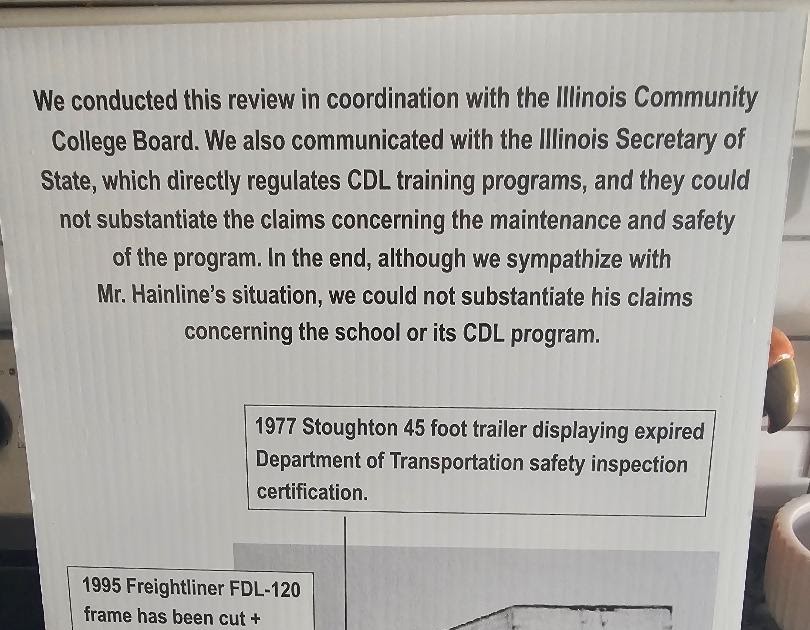
During my class, veteran student Mike and I, and non-veteran students Dustin & Richard, discovered that the landing gear on the 1977 Stoughton trailer assigned for training was missing an axle and four wheels. I reported this to the staff, who admitted the equipment was faulty but took no timely corrective action. A veteran student later informed me that the school replaced the landing gear on a similar 1987 Great Dane trailer sometime after our class ended, contradicting official reports submitted to the VA and state approving agencies that claimed no issues existed.
To confirm these claims, I located the trailer used in program advertising and compared photos taken during and after our training. The landing gear had indeed been replaced—freshly painted and altered, as confirmed by Great Dane Trailers’ manufacturer.
The trucks used for training showed similar problems. According to Vehicle Identification Numbers, three trucks had modifications—such as frame cutting between tandem axles—that Daimler Trucks North America (the manufacturer) neither recommended nor approved. Federal Motor Carrier Safety Administration guidelines were not followed, creating additional safety concerns, per conversations with the Federal Motor Carrier Safety Administration.
Systemic Oversight Failures
These issues highlight a broader problem: the State Approving Agencies, under contract with the VA, are failing to provide adequate oversight and ensure program quality. The VA Office of Inspector General’s 2018 report (OIG Report #16-00862-179) found that 86% of SAAs did not sufficiently oversee educational programs to ensure only eligible, high-quality programs were approved. The report estimated that without reforms, the VA could improperly pay out $2.3 billion over five years to subpar or fraudulent institutions.
Alarmingly, the VA Veterans Benefits Administration (VBA) is restricted in its ability to question or audit the reports submitted by SAAs. There is no mechanism for veterans to challenge or appeal SAA findings, effectively leaving veterans powerless within a system that is supposed to protect them.
Veteran Service Organizations’ Silence
I sought help from veteran service organizations but found little interest in addressing these critical problems. The American Legion initially responded to my outreach in 2017, engaging in conversations and phone calls. However, within months, communication ceased without explanation. Attempts to meet with American Legion leadership and their legislative contacts, including Dr. Joe Wescott—an influential consultant on veterans’ education—were unsuccessful. Dr. Wescott dismissed concerns about the integrity of the SAA’s targeted risk-based reviews, citing that schools typically fix problems before SAAs visit, and failed to investigate conflicts of interest between report authors and SAA officials.
At the 2024 American Legion convention, a planned meeting between a fellow veteran and Legion leadership was abruptly canceled. Meanwhile, other veteran groups such as Veterans of Foreign Wars (VFW), Disabled American Veterans (DAV), and Veterans Education Success (VES) showed engagement, but the American Legion and Student Veterans of America remained unresponsive.
The American Legion’s own 2016 Resolution #304 warned of the exact issues I and countless other veterans have endured: deceptive practices by some education providers, poor accreditation standards, and underfunded and understaffed SAAs unable to enforce proper oversight.
A Cycle of Scandal
Congressional staff admitted privately that veterans’ education legislation rarely progresses without support from key players like Dr. Wescott and the National Association of State Approving Agencies (NASAA), whose leaders have repeatedly declined to meet with veterans raising concerns. These complex relationships between SAAs, VA officials, veteran groups, and legislators perpetuate a “cycle of scandal” that leaves veterans vulnerable and taxpayers footing the bill.
In 2023, a combat veteran attending the same program I did reported similar frustrations: only one of three trucks was roadworthy, severely limiting practical training time for a full class of students. Despite numerous documented complaints, the NASAA president refused to meet or discuss these issues.
The Human Cost
Beyond financial waste and bureaucratic failures, real human harm occurs. My injury, caused by training on unsafe equipment, robbed me of a year of mobility and continues to affect my life. Thousands of veterans have lost their G.I. Bill benefits, incurred debt for worthless or limited degrees, or been misled about their job prospects after completing programs approved by the very agencies meant to protect them.
The internet is rife with investigative reports exposing waste, fraud, and abuse in VA-approved programs. Headlines like “School Scammers Are Robbing Veterans and the Government Blind” and “For-Profit Colleges Exploit Veterans’ G.I. Bill Benefits” are far too common.
A Call for Reform
Despite these glaring failures, meaningful reform remains elusive. The VA OIG report and numerous investigations call for increased accountability, transparency, and cooperation between the VBA, SAAs, veteran service organizations, and Congress. Veterans deserve a system that genuinely safeguards their education and wellbeing.
My fellow former veteran students and I have organized online and turned to media outlets to break the silence. It’s time for the public and policymakers to hear our stories—not just slogans and “catchy” legislative titles that fail to restore lost benefits or improve program quality.
We veterans demand change—because we have earned more than empty promises and a broken system that leaves us behind.
Michael S. Hainline is a veteran and advocate living in Pensacola, Florida. He served in active duty and reserve military components and now works to expose the failures of oversight in VA-approved education and job training programs. He can be reached at [email protected].
The Alliant Credit Union Foundation has awarded a $108,000 grant to Digital Leaders Now, the nonprofit that powers the Digital Leaders Academy at Ridgewood Community High School District 234, to support the implementation of innovative digital opportunity programs.
The initiative will begin rolling out in Spring 2025, with full program implementation for the 2025-2026 school year. The grant will help students gain critical digital skills, enhance career preparation opportunities at Ridgewood and beyond, and ensure teachers have the necessary resources to integrate technology into the classroom effectively.
“The Alliant Credit Union Foundation is committed to fostering educational opportunities that prepare students for the future,” said Meredith Ritchie, President of The Alliant Credit Union Foundation. “By partnering with the Digital Leaders Academy, we are helping to bridge the digital divide and ensure that students in Ridgewood Community High School District 234 are equipped with the skills and knowledge they need to succeed in the evolving workforce.”
The grant will support key initiatives, including:
Integration of AI Tools: Students will gain hands-on experience using AI and emerging technologies to enhance their learning and problem-solving skills.
Teacher Training & Development: Supporting professional development programs that empower educators with the tools and knowledge to incorporate digital learning strategies into their curriculum.
Digital Fluency Expansion: Enhancing student digital literacy and technology-based learning experiences to build a foundation for future careers.
Career Readiness Programs: Preparing students for high-demand technology roles by connecting them with industry experts, mentorship opportunities, and real-world applications of digital skills.
Through this initiative, the Alliant Credit Union Foundation continues its mission of driving positive change in education by expanding access to technology and professional development resources.
“The Digital Leaders Academy is a testament to the power of partnership and community. With the support of Alliant, we’re equipping students, teachers, and parents with the tools to thrive in the digital age, because when we invest in digital fluency, we unlock limitless potential,” said Caroline Sanchez Crozier, Founder of Digital Leaders Now, an Illinois-based nonprofit, and creator of Digital Leaders Academy.
Ridgewood Community High School District 234 students will benefit from enhanced learning experiences, giving them a competitive edge in today’s digital economy.
Kevin is a forward-thinking media executive with more than 25 years of experience building brands and audiences online, in print, and face to face. He is an acclaimed writer, editor, and commentator covering the intersection of society and technology, especially education technology. You can reach Kevin at [email protected]
About three in five college students experienced some level of basic needs insecurity during the 2024 calendar year, according to survey data from Trellis Strategies. Over half (58 percent) of respondents said they experienced one or more forms of basic needs insecurity in the past 12 months.
Student financial challenges can negatively impact academic achievement and students’ ability to remain enrolled. About 57 percent of students said they’ve had to choose between college expenses and basic needs, according to a 2024 report from Ellucian.
While a growing number of colleges and universities are expanding support for basic needs resource centers—driven in part by state legislation that requires more accommodations for students in peril—not every campus dedicates funds to the centers. A 2024 survey by Swipe Out Hunger found that of 300-plus campus pantries, two in five were funded primarily through donations. Only 5 percent of food pantries had a dedicated budget from their institution as a primary source of funding.
Inside Higher Ed compiled four examples of institutions that are considering new or innovative ways to address students’ financial wellbeing and basic needs on campus.
Penn State University—School Supplies for Student Success
Previous research shows that when students have their relevant course materials provided on day one, they are more likely to pass their classes and succeed. Penn State’s Chaiken Center for Student Success launched a School Supplies for Student Success program that offers learners access to free supplies, including notebooks, writing utensils and headphones, to help them stay on track academically.
Students are able to visit the student success center on the University Park campus every two weeks to acquire items, which are also available at two other locations on campus. Learners attending Penn State Altoona and Penn State Hazleton can visit their respective student success center for supplies, as well.
The program is funded by a Barnes & Noble College Grant program and is sustained through physical and monetary donations from the university community.
Massachusetts College of Liberal Arts—Essential Needs Center
The Essential Needs Center was developed from a Service Leadership Capstone course, which required students to complete a community-based service project. One group of students explored rates of basic needs insecurity and established a food pantry to remedy hunger on campus.
“The program started as a drawer at my desk,” said Spencer Moser, assistant dean for Student Growth and Wellbeing, who taught the course. “Then it grew to fill a shelving unit, a closet and eventually its own space on campus.”
The center, now a one-stop shop for basic needs support on campus, provides students with small appliances, storage containers, personal care items and seasonal clothing, as well as resources to address housing and transportation needs, including emergency funding grants. Students can also apply for a “basic needs bundle” to select specific items they may require.
Paid student employees maintain the center but it’s also left “unstaffed” at some hours to address the stigma of seeking help for basic supplies. Between November 2023 and January 2025, over 1,300 students engaged with the center.
University of New Hampshire—Financial Wellness
A lack of financial stability can also have a negative impact on student thriving and success. To support students’ learning and financial wellbeing, the University of New Hampshire created an online digital hub that provides links to a budget worksheet, financial wellness self-evaluation, college cost calculator and loan simulator.
Students can also schedule an appointment to talk with an educator to discuss financial wellness or engage in a financial wellness workshop.
Roxbury Community College—the Rox Box
Most colleges operate on an academic calendar, with available hours and resources falling when class is in session. Roxbury Community College in Massachusetts launched a new initiative in winter 2023 to ensure students who were off campus for winter break didn’t experience food insecurity.
Before the break, staff at the college’s food pantry, the Rox Box, handed out Stop & Shop gift cards and grab-and-go meals, as well as a list of local places students could visit for meals over break.
Do you have a wellness intervention that might help others promote student success? Tell us about it.
April brought deep cuts to universities in Florida, Michigan and elsewhere.
Although changes driven by the Trump administration that have included cutting grant funding and capping research reimbursement costs have driven hiring freezes and other changes, the cuts below are not directly tied to Trump. However, Trump’s agenda has directly prompted some job losses. For example, the University of Montana eliminated 42 positions after Congress excluded the Defense Critical Language and Culture Program from a government funding bill.
But most of the below job cuts, program eliminations and other changes are instead tied to declining enrollment, rising operating costs and other factors challenging the sector.
Jacksonville University
Some of the deepest cuts in April were at Jacksonville University, which slashed 40 faculty jobs.
Officials also announced plans to shutter JU’s music and theater programs in a cost-cutting effort, which, coupled with faculty layoffs, is expected to save the private university $10 million.
President Tim Cost called the move “the most robust strategic review of our academic offerings we have ever done” in an April 15 video posted to Facebook where he cast the cuts as “strategic recalibration.” Cost argued that the move would improve academics and “streamline” expenses.
Cost argued that higher education as a sector is beset with challenges and referenced hard choices at the Massachusetts Institute of Technology, Cornell University, Harvard University, Johns Hopkins University and Pennsylvania State University. However, with the exception of Penn State, hiring freezes and other changes at those institutions have been driven by changes to federal research funding. (Jacksonville is not a research university, while those institutions are.)
Unmentioned in Cost’s video were concerns that the university could close, which were raised in JU’s most recent audit. Specifically, auditors noted that the university fell out of compliance with its debt agreements. Violations of such covenants can result in debt becoming due immediately. Jacksonville had nearly $144 million in debt at the end of fiscal year 2024.
Despite the university’s financial challenges, enrollment is up. In fall 2015, JU enrolled 4,048 students, federal data shows. This spring, that number was 4,601, according to a bond filing.
JU’s deep cuts have been met with anger and a sense of betrayal from faculty members.
“I really believed that this was a place that believed in its mission,” an anonymous faculty member who was laid off told local media. “And now it is so completely changing that mission. And what’s worse is they are gaslighting us into pretending like this has always been the plan.”
Although faculty voted no confidence in Cost, college officials have argued that changes at JU have followed its shared governance processes, which included faculty input, and that such changes are necessary to drop low-performing programs and prioritize other academic offerings.
Concordia University
The private Christian university plans to lay off 46 employees across two states.
Concordia University—which has its primary campus in Wisconsin—informed the Michigan Department of Labor and Economic Opportunity in a letter it would move forward with plans to lay off 41 employees at its Ann Arbor campus on May 31 or “during the 14-day period thereafter.” Another five employees will be laid off in Wisconsin, according to a similar filing there.
Concordia announced last summer that most Ann Arbor academic programs would go online.
Concordia has navigated financial struggles in recent years and closed three campuses it operated in Wisconsin in 2023. However, officials have sought to reassure community members that there are no immediate plans to close the Ann Arbor campus.
“Concordia Ann Arbor will continue to offer a variety of degree options in 2025 and beyond,” reads a university page on frequently asked questions. The page added that “Concordia can no longer sustain multi-million-dollar operational losses at the Ann Arbor campus.”
California State University, Sacramento
Facing state budget cuts, the public university in California made a series of personnel changes in April.
“Due to the severe state budget cuts and the escalating labor costs we are facing for the upcoming fiscal year, 28 management (MPP) positions have been eliminated, merged, or not retained. These actions included 15 MPP employees who were released from their positions today,” Sacramento State president Luke Wood wrote to the campus community April 7.
More changes are on the horizon as Sac State navigates a $37 million budget deficit, amid cuts to state appropriations that will ultimately hit all 23 California State University system members.
The private Pennsylvania institution laid off staff members in the library, as well as areas such as facilities and event services, but appeared to spare faculty, according to a list obtained by the news outlet. Officials told LancasterOnline that F&M was exercising “responsible management” by “reducing the number of our employees to better match the size of our student body.” (Like many other colleges, Franklin & Marshall’s enrollment has slipped in recent years from 2,209 students in fall 2014, according to federal data, to around 1,900 currently.)
Some other jobs were also changed from a 12-month to a 10-month schedule.
University of Akron
Amid efforts to trim $22 million from its budget by the end of fiscal year 2026, the University of Akron is eliminating its physics and anthropology departments, Cleveland.com reported.
Approximately 20 full-time faculty members across the university have also accepted voluntary separation agreements, the news outlet confirmed. An advisory committee to help steer faculty cuts and ideas for generating revenue has pitched buyouts as a possible alternative to layoffs.
University of Toledo
Elsewhere in Ohio, the University of Toledo is suspending nine programs due to a state politics and policies.
The public university announced last month that it’s pausing admission to the Africana studies, Asian studies, data analytics, disability studies, Middle East studies, philosophy, religious studies, Spanish and women’s and gender studies programs, to comply with legislation, Senate Bill 1, that recently passed and became law.
All affected programs will remain available as minors, according to the university website.
SB 1—controversial and sweeping legislation that affects both program offerings and campus speech—bans diversity efforts in higher education and requires colleges to drop undergraduate programs that yield fewer than five degrees annually, on average, over a three-year period.
Unrelated to SB 1, Toledo also announced it was suspending admissions to a dozen other undergraduate and graduate programs, following a recent review of academic offerings.
Portland Community College
More than a dozen programs could be cut at Oregon’s largest community college.
Portland Community College is currently weighing a plan to eliminate as many as 14 programs in a cost-cutting effort, local CBS affiliate KOIN reported. So far, PCC has identified two programs that will be eliminated within two years: music and sonic arts, and gerontology.
Other potential programs on the chopping block at PCC are anthropology, art, Chinese, criminal justice, electronic engineering technology, English for speakers of other languages, general science, German, machine manufacturing technology, Russian, theater arts and welding.
Middlebury College
Officials at the private liberal arts college in Vermont announced a series of cost-cutting moves last month, including employee buyouts, in an effort to plug a projected $14 million budget hole.
Middlebury officials blamed the deficit on declining enrollment and increased operating costs.
Other fiscal moves include reducing Middlebury’s retirement matching contributions, shedding rental property leases and evaluating health insurance plans for possible changes. Altogether, officials said initial efforts are expected “to realize more than $10 million” in savings.
Canisius University
The private Jesuit university in Buffalo, N.Y., is offering buyouts to staff as part of a plan to identify $15 million in savings across the next two fiscal years, NBC affiliate WGRZ reported.
This audio is auto-generated. Please let us know if you have feedback.
President Donald Trump on Friday proposed wide-ranging cuts to federal higher education spending in his fiscal 2026 budget request, calling to eliminate some grant programs altogether and for states to take over others like Federal Work-Study.
The budget request offers a broad look at Trump’s priorities, which include shaving 15.3% off the U.S. Department of Education’s budget, a move in line with his broader plan to shutter the agency. Across the federal government, Trump’s request would eliminate some $163 billion in nondefense domestic spending, including the dramatic cuts to education programs.
U.S. Education Secretary Linda McMahon said in a statement Friday that the budget reflects “funding levels for an agency that is responsibly winding down, shifting some responsibilities to the states, and thoughtfully preparing a plan to delegate other critical functions to more appropriate entities.”
Presidential budget proposals are akin to executive wishlists and are never enacted as introduced. And Trump’s budget request for the 2026 fiscal year, which begins Oct. 1, faces key obstacles before it could be approved. Even though Republicans control both the House and Senate, at least one GOP lawmaker has already objected to some of Trump’s proposed cuts.
But other party leaders signaled a willingness to embrace Trump’s proposals.
“The American people sent Republicans to Washington to lower costs and rein in wasteful government spending,” Tim Walberg, chair of the House Committee on Education and Workforce, said in a Friday statement. “The budget proposal President Trump released today not only gives us a blueprint but shows us it is possible to deliver on this promise.”
Student aid takes a blow
The budget takes aim at Federal Work-Study, which provides part-time jobs to students who need help paying for college. Under the program, the federal government covers up to 75% of students’ wages.
Trump’s proposal calls for a $980 million reduction in funding for the program, which was appropriated $1.2 billion in fiscal year 2024.
In his budget plan, the president called for Federal Work-Study to be run by the states and the colleges “that financially benefit from it.”
“Reform of this poorly targeted program should redistribute remaining funding to institutions that serve the most low-income students and provide a wage subsidy to gain career-oriented opportunities to improve long-term employment outcomes of students,” it says.
Trump’s proposal would also eliminate funding for Supplemental Educational Opportunity Grants, which assist undergraduate students who have “exceptional financial need.” The program was allocated $910 million in fiscal 2024 — all of which would be cut under Trump’s budget.
The budget document accuses the grants of contributing “to rising college costs” that colleges have used to pay for a “radical leftist ideology.” Colleges that receive these grants pass the money onto students, and the institutions must contribute 25% of their own money for those awards.
Two other programs are on the chopping block: TRIO, which provides support for middle school through college students from disadvantaged backgrounds, and Gear Up, which helps low-income students prepare for postsecondary education. Trump’s budget called these programs a “relic of the past when financial incentives were needed to motivate” colleges to increase access to low-income students.
“Today, the pendulum has swung and access to college is not the obstacle it was for students of limited means,” the budget document claims, saying higher education institutions should use their own resources to recruit students.
Together, the programs received nearly $1.6 billion in fiscal 2024, all of which would be cut under Trump’s plan.
The budget documents released Friday did not address funding for Pell Grants, the largest student aid program.
Department services and college grants also targeted
The proposal would also cut $49 million from the Education Department’s Office for Civil Rights, a 35% reduction from fiscal 2024 levels, according to the budget. The agency recently cut OCR’s workforce in half as part of mass layoffs.
In his budget plan, Trump accused colleges of misusing the Fund for the Improvement of Postsecondary Education, which awards grants for projects aimed at improving postsecondary educational opportunities. The budget claims they used the program to “fund ideologies instead of students.”
Trump proposed cutting $195 million from FIPSE and said colleges and states should be responsible for funding innovative programs themselves.
He also proposed sending responsibility for the Strengthening Institutions initiative to states and colleges. Under this program, the Education Department provides grants to help colleges expand their ability to serve low-income students, bolster their academic quality and become more financially stable, according to the agency’s website.
The program was allocated $112 million in fiscal 2024 — and Trump’s plan calls for zeroing that amount out.
The budget would also slash $64 million from Howard University, the only historically Black institution in the country that is federally chartered. The Trump administration said the move would bring the university’s funding back to 2021 levels and “more sustainably support” the institution.
A large number of college students experience housing insecurity or homelessness, and finding suitable accommodations can be a challenge, particularly for those who attend colleges and universities that do not provide on-campus housing.
The fall 2024 Student Financial Wellness Survey by Trellis Strategies found that 43 percent of all respondents experienced housing insecurity and 14 percent were homeless during the prior 12 months. Among two-year college respondents, 46 percent were housing insecure and 16 percent experienced homelessness in the previous year.
Community colleges often lack the resources to directly address housing insecurity, so they rely on outside partnerships or housing assistance programs to accommodate students. For example, LaGuardia Community College partners with Airbnb to offer vouchers for short-term housing support for students. Tacoma Community College and the Tacoma Housing Authority co-created the College Housing Assistance Program, which subsidized housing costs for students experiencing homelessness until 2022.
These programs often come with red tape that can make it difficult for a student to enroll in the program; for example, GPA or credit requirements can push vulnerable students out if the institution doesn’t think they’re making adequate progress.
Alena A. Hairston, a professor at Fresno City College and doctoral student at Alliant International University, conducted a qualitative research project that evaluated student experience and engagement with housing assistance programs. Hairston found that while many students did not meet benchmarks for student success in the classroom, the experience contributed to their improved self-actualization, which can be a meaningful metric in student development.
The background: To ensure students are persisting and making progress toward a degree, college-led assistance programs often require learners to meet baseline educational checkpoints, including being enrolled, achieving a certain GPA or meeting regularly with a staff member. Community partners may institute their own requirements, including drug- and alcohol-free living or payment of a deposit.
If students don’t meet these requirements, they’re dropped, often without another option to continue their housing, which can be detrimental to their health and well-being. While failing to meet requirements can be a sign of student disinterest or lack of appreciation for the offerings, Hairston views stable housing as a foundational piece in student achievement and tied to the mission of community colleges.
“If a student shows up to attend [and] to be a part of the collegiate process, that says desire, right?” Hairston said. “And the only requirement for admission [at community colleges] is a desire to learn, so we need to go with that as our mandate [to serve students].”
Hairston wanted to understand how students accessed resources and the impact it had on their psychosocial development.
The study: Hairston interviewed nine students who participated in housing assistance programs, led either by the college or an off-campus entity, in 2021. Students were between the ages of 18 and 47 and represented a variety of racial, ethnic and gender categories. All learners were enrolled at least part-time at a community college.
Most respondents said they learned about housing programs through specific contacts, such as academic counselors for special programs including Extended Opportunity Programs, TRIO and the Puente Project, while others used the internet or other partners.
While students appreciated the services, they faced logistical challenges that made the experience frustrating, such as a lack of notification or timely communication from staff members. One was in an unsafe area and roomed with an individual who used methamphetamine.
Students said program requirements to maintain academic standing or health conditions (such as sobriety) were perceived as helpful, but in practice sometimes harmful and led to loss of housing. “As soon as you drop [below] a 2.0 or you drop nine units, they literally evict you,” one student shared. “Then you have an eviction on your record as well.”
A few students said they gained personal life skills or were motivated to continue working toward academic and career goals. Others felt their citizenship status or racial and ethnic backgrounds impeded their housing placements or ability to access resources.
In addition to finding secure housing, most participants utilized other campus, public and private services to pay for additional resources, including furniture, phone bills, laptops, bikes and mental health support.
The COVID-19 pandemic created additional challenges for participants, such as job losses, the decline of support networks, moves, educational disruption and relapses into substance use.
In conversations, students commented on how housing assistance motivated them to stay enrolled and allowed them to prioritize other elements of their lives, including mental health care and caregiving responsibilities.
“The program [helped me with] a lot of psychological things like digging into yourself and figuring out the root problems that keep causing me to drink,” a study participant shared. “So I got to unburden a lot of my little demons.”
Lessons learned: Based on her conversations with students, Hairston recommends policymakers tie self-actualization and personal growth to efficacy metrics to understand the value of these programs and improve students’ self-reflection on their progress and achievement.
One possibility would be to measure student success on a yearlong basis, rather than term by term. Some learners returning to higher education may need counseling or struggle with the rigor of their coursework, resulting in poor academic performance in their first term back.
Instead of weighing GPA or credits completed as the most important factors for student eligibility, Hairston advocates for a greater emphasis on self-efficacy and personal growth, perhaps delivered through a self-diagnostic at the start and end of the term or a regular self-study to track learning and the challenging circumstances they encountered. This also creates opportunities for checking in on students during the term to ensure that they’re not falling behind without support, Hairston said.
Program participants should also be paired with counselors who are trained in trauma-informed care and academic counseling, Hairston said. Ensuring a welcoming atmosphere for services, program information and resources can reduce barriers to access and promote thriving.
If your student success program has a unique feature or twist, we’d like to know about it. Click here to submit.