The Department of Education is ordering an end to all spending and programs that “promote gender ideology,” according to an internal email sent to all department employees and obtained by Inside Higher Ed.
The email lays out steps the department will take to uphold President Trump’s executive order “Defending Women from Gender Ideology Extremism and Restoring Biological Truth to the Federal Government.” Those steps include a “thorough review and subsequent termination of Departmental programs, contracts, policies, outward-facing media, regulations and internal practices that fail to affirm the reality of biological sex.”
The email also prohibits employee resource groups that “promote gender ideology” from meeting on government property or during work hours.
The email appears to be targeted primarily at internal department activities and spending, as opposed to schools and universities that receive federal funding. But the Trump administration has in recent days launched investigations into colleges over the participation of trans athletes in women’s sports, and Trump’s executive order attacking diversity, equity and inclusion could have wide-reaching effects on college programs and curricula.
A spokesperson for the department did not respond to Inside Higher Ed’s request for clarification or comment in time for publication.
Alumni-in-residence programs provide career insight and professional skill-building to students.
SDI Productions/E+/Getty Images
A May 2024 Student Voice survey found 29 percent of students believe their college or university should prioritize or focus more on connecting students to alumni and other potential mentors.
Colleges and universities often have connections to a wide range of successful graduates who can provide insight and support to current students, but creating organic relationships between the two groups can be a challenge.
One initiative institutions have undertaken is establishing alumni-in-residence programs to offer career development opportunities for current students.
How it works: Similar to a formal mentoring program, alumni in residence hold one-on-one conversations with learners to address the student’s career goals and answer questions related to work or life after college.
The alumni-in-residence program, however, asks alums to serve in a variety of functions, including panel presentations, etiquette dinners and a networking reception, as needed.
What’s the value: Alumni can offer specific insights into career pathways from their alma mater into their current role, helping highlight the student journey in a unique way. Involving former students in career services can also increase funding and support for the institution. A 2024 survey by Gravyty found alumni who have participated in a mentoring program say they are 200 percent more likely to donate in the future.
Effective career services can also impact a student’s perception of their institution after graduation; 19 percent of alumni reported receiving strong career support from their institution, and those alumni are 2.8 times more likely to say their degree is worth the tuition, according to the 2023 National Alumni Career Mobility Annual Report.
A 2025 analysis by Gravyty also found 46 percent of alumni rank career support and networking as the most valuable services their alma mater can provide, yet only 40 percent of engagement programs at universities include mentoring opportunities.
Who’s doing it: Some of the institutions hosting an alumni-in-residence program include:
Howard University’s School of Business, which has an alumni-in-residence program that describes volunteers as career counselors. Alumni, representative of a broad range of careers, help students with interview prep, résumé reviews and answering industry questions.
Clark University in Massachusetts, where the alumni-in-residence program, established in 2004, asks alumni to engage in roundtable discussions, campus tours, networking receptions and a dinner with the president.
On January 22, President Trump signed an executive order (EO) titled “Ending Illegal Discrimination and Restoring Merit-Based Opportunity.” The EO directs all federal agencies to “terminate all discriminatory and illegal preferences, mandates, policies, programs, activities, guidance, regulations, enforcement actions, consent orders, and requirements,” to enforce “longstanding civil rights laws,” and to “combat illegal private-sector DEI preferences, mandates, policies, programs, and activities.” The White House also published a fact sheet to supplement the order.
The EO lists several other executive orders that the Trump administration is revoking. Notably, the Trump EO revokes executive order 11246, titled “Equal Employment Opportunity,” which has required federal contractors to have affirmative action plans since 1965. Additionally, the EO orders the Office of Federal Contract Compliance Programs (OFCCP) at the Department of Labor (DOL) to immediately cease “promoting diversity,” “holding federal contractors and subcontractors responsible for taking ‘affirmative action,’” and “allowing or encouraging federal contractors or subcontractors to engage in workforce balancing based on race, color, sex, sexual preference, religion, or national origin.” Both of these actions are explained by the EO to streamline the federal contracting process “to enhance speed and efficiency, reduce costs, and require federal contractors and subcontractors to comply with our civil rights laws.”
The EO also directs each federal agency to include in every federal contract or grant award a term requiring a contractual counterparty or grant recipient to agree that it is in compliance with all applicable federal anti-discrimination laws and a term requiring the counterparty or recipient to certify that it does not operate “any programs promoting DEI that violate any applicable federal antidiscrimination laws.”
The EO also includes orders to encourage the private sector to cease DEI programs and initiatives. Specifically, the EO directs the attorney general, in consultation with other relevant agencies, to promulgate a report with recommendations to enforce civil rights laws and encourage the private sector to end DEI practices. The report is required to identify “the most egregious and discriminatory DEI practitioners in each sector of concern.” It also requires each agency to identify up to nine potential civil compliance investigations as a way to deter DEI programs or principles. The EO lists institutions of higher education with endowments over $1 billion as potential targets for the civil compliance investigations.
Finally, the EO directs the attorney general and secretary of education to issue guidance to state and local educational agencies and institutions of higher education that receive federal dollars or participate in the Title IV federal student loan assistance program regarding “the measures and practices required to comply with Students for Fair Admissions, Inc. v. President and Fellows of Harvard College.”
The EO will have widespread implications for federal contractors in the higher education community. CUPA-HR will share further developments on this EO as they are released.
On January 22, President Trump signed an executive order (EO) titled “Ending Illegal Discrimination and Restoring Merit-Based Opportunity.” The EO directs all federal agencies to “terminate all discriminatory and illegal preferences, mandates, policies, programs, activities, guidance, regulations, enforcement actions, consent orders, and requirements,” to enforce “longstanding civil rights laws,” and to “combat illegal private-sector DEI preferences, mandates, policies, programs, and activities.” The White House also published a fact sheet to supplement the order.
The EO lists several other executive orders that the Trump administration is revoking. Notably, the Trump EO revokes executive order 11246, titled “Equal Employment Opportunity,” which has required federal contractors to have affirmative action plans since 1965. Additionally, the EO orders the Office of Federal Contract Compliance Programs (OFCCP) at the Department of Labor (DOL) to immediately cease “promoting diversity,” “holding federal contractors and subcontractors responsible for taking ‘affirmative action,’” and “allowing or encouraging federal contractors or subcontractors to engage in workforce balancing based on race, color, sex, sexual preference, religion, or national origin.” Both of these actions are explained by the EO to streamline the federal contracting process “to enhance speed and efficiency, reduce costs, and require federal contractors and subcontractors to comply with our civil rights laws.”
The EO also directs each federal agency to include in every federal contract or grant award a term requiring a contractual counterparty or grant recipient to agree that it is in compliance with all applicable federal anti-discrimination laws and a term requiring the counterparty or recipient to certify that it does not operate “any programs promoting DEI that violate any applicable federal antidiscrimination laws.”
The EO also includes orders to encourage the private sector to cease DEI programs and initiatives. Specifically, the EO directs the attorney general, in consultation with other relevant agencies, to promulgate a report with recommendations to enforce civil rights laws and encourage the private sector to end DEI practices. The report is required to identify “the most egregious and discriminatory DEI practitioners in each sector of concern.” It also requires each agency to identify up to nine potential civil compliance investigations as a way to deter DEI programs or principles. The EO lists institutions of higher education with endowments over $1 billion as potential targets for the civil compliance investigations.
Finally, the EO directs the attorney general and secretary of education to issue guidance to state and local educational agencies and institutions of higher education that receive federal dollars or participate in the Title IV federal student loan assistance program regarding “the measures and practices required to comply with Students for Fair Admissions, Inc. v. President and Fellows of Harvard College.”
The EO will have widespread implications for federal contractors in the higher education community. CUPA-HR will share further developments on this EO as they are released.
Language learning institution’s growth is projected to increase in the coming years. From 2024 to 2030, the global language learning market is predicted to expand at a compound annual growth rate of 20%. Due to the globalization of the labor market, language learning is likely to be in high demand.
Though language learning is growing in popularity, for lasting success, your school must find effective ways to stand out among other language academies looking to boost their enrollment. Digital advertising offers a broad spectrum of tools to attract students, but knowing how to maximize the impact of these strategies is key to success. At Higher Education Marketing, we’ve spent years refining approaches that yield measurable results for schools offering language learning programs. The following strategies offer actionable steps to elevate your ads targeting language students and attract the right prospects to your programs. Let’s explore!
Want to create successful ad campaigns?
Request a Free paid advertising consultation.
Understanding the Unique Needs of Language Learners
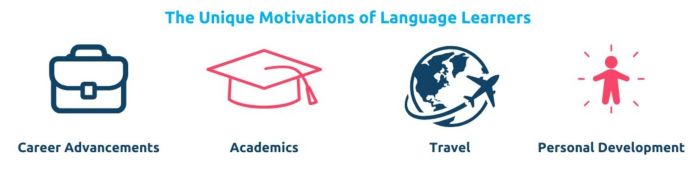
Language learners are a distinct group with varied motivations, backgrounds, and learning goals. Some are looking to learn a language for career advancement, while others may seek language acquisition for academic, travel, or personal reasons. Advertising that speaks directly to these needs requires a keen understanding of the diverse audience you aim to reach. One of the first ways to maximize the impact of digital advertising is through careful audience segmentation. Instead of promoting the same message across all channels, consider the specific motivations that drive different groups of learners and tailor your messaging accordingly.
Segmenting audiences by factors such as age, occupation, location, and even language proficiency allows schools to create highly targeted campaigns. How does language impact advertising for schools?Simply put,it depends heavily on your organizational goals. If you’re looking to target professionals wanting to learn English for business purposes, the language in your ad copy should reflect the vocational value of your programs. On the other hand, copy-targeting students hoping to improve their French skills before an international exchange can be more casual and experience-focused. This approach ensures the content resonates more deeply with potential students, increasing the chances of conversion.
Do you need help launching your language school’s latest ad campaign? Reach out to discover how we can support you.
Leveraging Social Media Platforms to Build Authentic Engagement
Social media is a powerful tool for language learning programs, offering an opportunity to create ongoing engagement with potential students. However, simply posting ads isn’t enough. The most successful social media campaigns foster a sense of community and engagement, which encourages followers to take the next step toward enrollment.
For language schools, showcasing success stories is one way to build trust. Highlighting testimonials from former students, sharing video snippets of language immersion experiences, and offering short, valuable language tips can increase authenticity. Interactive content, such as live Q&A sessions or virtual language exchange events, can draw in potential students who want to see what learning at your institution feels like before they commit.
Schools can also encourage user-generated content by asking current students to share their experiences online, providing social proof that can be far more persuasive than traditional ads. When students are shown engaging and relevant ad content on their social media feeds and in your school’s stories, they are much more likely to visit your site and perhaps even take the first step in your enrollment process.
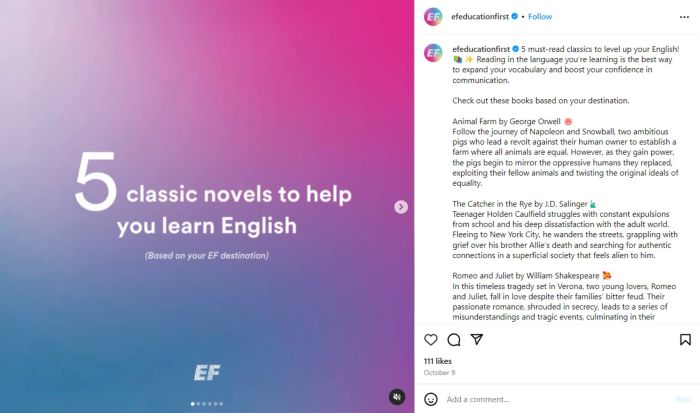
Example: Here, a leading language school, EF Education First uses Instagram to drive their organic traffic. In their post, they share valuable language acquisition tips, providing an English reading list for their students. Try using social media to share actionable language tips with your audience. This will drive engagement, boost your follower count, and broaden your digital reach.
Source: Instagram | EF Education First
Creating Culturally Relevant Ads to Reach Global Audiences
Language learning programs often attract an international audience, which means your digital ads must resonate across cultures. One way to do this is by crafting culturally relevant ads that speak directly to the experience of international students. The language and imagery used in ads should align with the cultural values of the target audience. For example, an ad targeting language students in the Asian market might highlight the importance of family and education, while an ad aimed at Latin American students might focus on community and connectivity.
Schools should also consider creating ads in multiple languages to appeal to global audiences. You may be wondering how to go about this. For example, Can you target by language on Google Ads? Yes! Google Ads allows advertisers to create campaigns that specifically target users based on the language settings of their browser or device. You can set up your ads to appear in multiple languages, ensuring that they reach potential students who speak those languages. Additionally, you can create language-specific ad copy and landing pages, enhancing the relevance of your campaigns.
Optimizing Paid Search Ads for Long-Tail Keywords
One of the most effective ways to drive qualified traffic to your website is through paid search advertising. Language schools can take advantage of this by focusing on long-tail keywords that are specific to language learning. While broad keywords like “learn English” may have high competition, phrases like “intensive French courses for business professionals in Paris” or “Spanish language classes for travelers” are more targeted and tend to attract a highly motivated audience.
Long-tail keywords may have lower search volumes, but they often result in higher conversion rates because they target users who already have a clear intent. This approach not only helps you to maximize your ad budgets but also ensures that the clicks you receive are more likely to turn into enrollments.
Source: Hutong School
Example: Here, Hutong School uses the long-tail keyword: Global Chinese language school in their metadata. This targeted keyword is designed to attract students who not only want to learn Chinese but also want to do so at a global institution that welcomes students from all over the world. Specificity in keywords ensures higher quality leads who are specifically looking for you.
Crafting Compelling Ad Copy That Speaks to Pain Points
Effective ads for language learning and education go beyond promotion and address the specific challenges that potential students face. Whether it’s the fear of not being left behind in class or the worry about balancing language learning with other responsibilities, successful ads speak directly to these concerns.
To craft compelling ad copy, start by identifying the pain points that your target audience experiences. Are they professionals concerned about fitting language classes into their busy schedules? Are they international students worried about mastering a new language before moving abroad? Once you’ve identified these challenges, your ads should provide solutions. Highlight the flexibility of your class schedules, emphasize the support systems you have in place for struggling students, or showcase how your programs help learners achieve fluency quickly.
Source: KCP International Japanese Language School
Example: Here, KCP addresses a very common pain point for language learners in their ad copy. Many fear that it’s ‘too late’ to learn a new language as the experience can be expensive and time-consuming. KCP positions itself as the solution to this barrier, ensuring its audience that as long as they meet four basic criteria, learning Japanese is within reach for them.
Using Retargeting to Capture Warm Leads
Retargeting is one of the most powerful tools in digital advertising, particularly for language schools where prospective students may need time before making an enrollment decision. Retargeting campaigns allow schools to stay top-of-mind by showing ads to users who have already visited the school’s website or engaged with its content.
Retargeting works particularly well for language learning programs because it targets individuals who are already interested in the subject but may not have been ready to commit when they first encountered the program. Your school can use this strategy to provide reminders about upcoming enrollment deadlines, promote special offers, or share new content that highlights the benefits of your courses.
For instance, if a visitor left your site after viewing the course offerings but didn’t sign up, retargeting ads can remind them of the benefits of joining your program. This approach can be particularly effective when combined with personalized messaging, such as offering tailored suggestions based on the courses they viewed.
Incorporating Video Content to Showcase Language Learning in Action
Video ads offer a dynamic and authentic way to showcase your school’s programs. HEM’s tailored video ad services help you stand out, whether promoting a specific course or building brand awareness. From high-energy hype videos to authentic student interviews, we create compelling visuals that maximize visibility and generate results. How does that affect you as a language learning institution?
Video content is a particularly effective tool for language schools, offering prospective students a glimpse into the real-life experience of learning a new language. Whether it’s a classroom setting, a student testimonial, or a tutorial on language pronunciation, videos create an emotional connection that static ads often lack.
To maximize the impact of your video content, ensure that it highlights the immersive, interactive nature of your language programs. Videos should showcase the benefits of learning in a dynamic environment where students can practice speaking in real-life scenarios. This builds excitement and helps prospective students visualize themselves succeeding in your program.
Additionally, video ads on platforms like YouTube or social media can target specific audience segments. Language schools can use these platforms to create ads tailored to different learner types, such as professionals looking to learn a language for work or students hoping to study abroad.
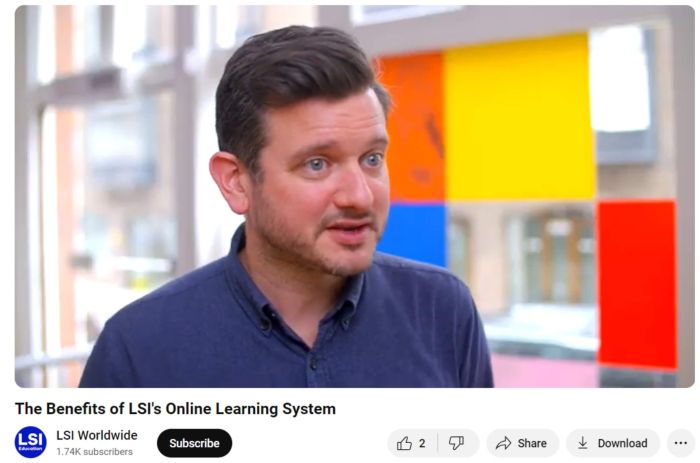
Source: LSI Worldwide | YouTube
Example: This promotional video presented by a school director highlights the unique selling points of their online learning system. The unique academic benefits of your programs are an excellent topic for your promotional videos – particularly when presented by a language expert within your faculty. What makes your instruction style unique?
Harnessing the Power of Influencer Marketing
Language schools can also benefit from partnering with influencers, especially those passionate about language learning or travel. Influencers offer access to a built-in audience that already trusts their recommendations. By working with influencers who align with your institution’s values, language schools can reach potential students who may not have been aware of your programs.
An effective influencer marketing campaign for a language school might include sponsored posts where the influencer shares their language learning journey, highlighting the value of enrolling in formal programs. Schools can also consider offering affiliate programs, allowing influencers to earn commissions for every student who enrolls through their recommendation.
Utilizing Data Analytics to Refine Advertising Campaigns
Data-driven decision-making is at the heart of successful digital advertising. Language schools must continually analyze their campaign’s performance to ensure they’re reaching the right audience and achieving optimal results. Tools like Google Analytics and Facebook Insights can provide valuable insights into which ads are performing well and which need to be adjusted.
For example, schools can track metrics like click-through rates, conversion rates, and the cost per lead to determine the effectiveness of their campaigns. By continuously monitoring these metrics, schools can make data-driven decisions that maximize their return on investment. Adjustments might include refining audience targeting, improving ad copy, or reallocating the budget to the platforms that yield the highest returns.
Offering Free Trials or Sample Lessons to Convert Prospects
One of the most effective ways to convince prospective students to enroll in your language learning program is by offering a free trial or sample lesson. Language learning can be an intimidating prospect, and many students may hesitate to commit without knowing what to expect. By offering a no-obligation sample lesson, schools give potential students a taste of the learning experience, which can be enough to convert them into paying students.
This strategy works particularly well in digital advertising campaigns where schools can drive traffic to a landing page offering the free trial. Ads promoting a “try before you buy” approach can alleviate apprehension about committing to a full program.
Source: WuKong Education Online | YouTube
Example: WuKong Education Online offers a trial class to attract their prospects. Trials are an excellent way to convert leads and are particularly effective for online academies.
By implementing these language learning advertising strategies, your school can significantly enhance the effectiveness of your digital advertising campaigns. At Higher Education Marketing, we believe that understanding the unique needs of language learners, leveraging innovative tools, and continuously refining your approach is key to driving enrollment and building lasting connections with students.
Want to create successful ad campaigns?
Request a Free paid advertising consultation.
Frequently Asked Questions
Question: Can you target by language on Google Ads?
Answer: Yes! Google Ads allows advertisers to create campaigns that specifically target users based on the language settings of their browser or device. You can set up your ads to appear in multiple languages, ensuring that they reach potential students who speak those languages. Additionally, you can create language-specific ad copy and landing pages, enhancing the relevance of your campaigns.
Question: How does language impact advertising?
Answer: Simply put,An ad aimed at professionals wanting to learn English for business purposes should be crafted differently from one targeting students hoping to improve their French skills before an international exchange. This approach ensures the content resonates more deeply with potential students, increasing the chances of conversion.
Dublin is a unique, quirky city which is very walkable and full of interesting buildings and architecture. Here are my top five things to do in Dublin (although there are a lot more!).
Dublin Castle
Located in the heart of Dublin, the Castle is believed to have originally been an early Gaelic Ring Fort. Although the Castle is now used for State functions and presidential inaugurations, visitors can explore much of the Castle, including parts of the original 13th-century fortress. The rich history of the Castle gives a lot of insight into Dublin, and the grounds are absolutely gorgeous.
Cliffs of Moher
Lying outside Dublin’s walls, The Cliffs of Moher are a must-see and were a major highlight of my semester aboard. The Cliffs span for five miles, and the views are incredible. This natural attraction is a popular tourist destination but is one that should not be missed. I recommend using a tour guide company to visit the Cliffs (like “Paddywagon Tours”), as the prices are very reasonable and you get to see some cool stops along the way. The wind can be a bit chilling so make sure to bring a jacket and, of course, a camera to take pictures of the breathtaking landscape.
St. Patrick’s Cathedral
St. Patrick’s Cathedral has a rich history that dates back over 800 years. One of the few buildings remaining from medieval Dublin, the Cathedral has a gorgeous interior and the many burial sites including that of Jonathan Swift, author of “Gulliver’s Travels”. After visiting the Cathedral, make your way to St. Stephens Green and take a stroll through the public park, which houses the Yeats Memorial Garden as well as many festivals throughout the year.
Trinity College
Visiting Trinity College while in Dublin is a must! Walk on the cobblestone paths through the grounds, buildings and dining areas to see what a selective college looks like abroad. Afterward, make sure to drop by the Book of Kells Exhibit to walk through the Old Library and other works from the 18th century, including the Book of Kells.
ABOUT THE AUTHOR: Jolie Blair is a rising senior at Emory University from Sun Valley, Idaho. She is double majoring in Theater Studies and Public Health and has a passion for the arts, writing, and traveling. She studied abroad for the 2016 fall semester in Rome, Italy and had an experience of a lifetime, which she loves to share with those who want to listen (and even those who don’t like her 140lb Great Dane!).
While studying abroad in Rome, I not only experienced the super touristy spots, but I also had the opportunity to live like a local and explore the hidden gems of Rome. Here are my top five things to do in Rome (although there are a lot more!).
Source: https://tinyurl.com/y7837cce
Explore The Monuments
A trip to Rome isn’t complete without visiting all of the historical Roman landmarks, no matter how touristy – and crowded – they can get. From the Pantheon to the Colosseum, the Roman Forums, and the Spanish steps, there is an abundance of sights to see in Rome, and it never gets old experiencing ancient, Roman history. Make sure to watch your belongings carefully, however, as pickpockets are abundant in crowded, touristy areas.
Source: https://tinyurl.com/ydf2jb6t
Bike Around Villa Borghese
A hidden, Roman gem I learned about – although it is still a bit touristy – is biking in Villa Borghese. You can bike around the gardens, stop for a picnic lunch in the grass, and walking through numerous museums and buildings. It is also close to many of the other monuments in Rome, making it easily accessible.
Source: https://tinyurl.com/yd6l273b
Visit Trastevere
One of my favorite places in Rome is the neighborhood of Trastevere. From the cute little shops to the amazing restaurants, this area of a Rome is a must. Although there are many cool, and hidden, neighborhoods in Rome, I am biased as I lived in Trastevere and fell in love. I would highly recommend starting in la Piazza di Santa Maria – which is located right by the famous Santa Maria church – and walk around the area from there. This is a place you don’t want to miss!
Source: https://tinyurl.com/kwrwqbb
Travel around the Street Markets
Another highlight of Rome is the street markets. Food, produce, gifts, and other goods are sold during weekday mornings and on the weekends. One of the most popular tourist markets is in Campo dei Fiori, which has food, any kind of pasta you could think of, and local, fresh produce. It is open every morning except on Sundays. Another amazing market – for fresh veggies, fruit, fish, and meat – is the Piazza San Cosimato market, which is open every morning except on Sundays. My personal market favorite, however, is the flea market located around the Via Portuense area in Trastevere. This market has EVERYTHING you could ever need at great prices! Clothing, toiletries, sunglasses, and other goods are sold here every Sunday morning-afternoon. Again, make sure to keep your belongings close at the markets, as the high volume of people brings out the pickpockets and other petty thieves.
Source: https://tinyurl.com/ya85rk5k
EAT, EAT AND EAT!!
Of course, when in Rome you must eat! Here is a – very condensed – list of my favorite restaurants in Rome:
La Gelateria Frigidarium – a touristy, but AMAZING, gelato place (near Campo dei Fiori)
Dar Poeta – the BEST pizza I have ever had and I still dream about it (located in Trastevere)
Pimms – a great place for cheap salads and good risotto (in Trastevere)
Donkey Punch – a casual sandwich joint for a quick bite (in Trastevere)
Capa Toast – slightly touristy panini place (located in Trastevere)
Ristorante Maccheroni – a casual dinner place with some of the best pasta at great prices (in the Piazza delle Coppelle near the Pantheon)
ABOUT THE AUTHOR: Jolie Blair is a rising senior at Emory University from Sun Valley, Idaho. She is double majoring in Theater Studies and Public Health and has a passion for the arts, writing, and traveling. She studied abroad for the 2016 fall semester in Rome, Italy and had an experience of a lifetime, which she loves to share with those who want to listen (and even those who don’t like her 140lb Great Dane!).
With little fanfare and in the face of strong educator opposition, the New Mexico Public Education Department has repealed a rule designed to foster leadership opportunities for teachers while keeping them in the classroom, a program widely praised for its impact on professional development and teacher retention.
The written repeal of Rule 6.65.4, dated Sept. 9, came during a brief period when the state had no secretary of education. Arsenio Romero resigned on Aug. 28, and Mariana Padilla was named as his successor on Sept. 10.
The repeal order was signed by Candice Castillo, deputy cabinet secretary.
“The department notes that the program is still supported by PED guidance, and PED remains committed to maintaining the Teacher Leader Network and Advisory Committee and the Teacher Liaison programs,” a PED document announcing the decision says.
The rule was introduced by PED in 2018.
A public hearing on the proposed repeal held on August 20 at the Jerry Apodaca Education Building in Santa Fe, attracted significant attention, with more than 200 educators voicing their opposition to the repeal.
Rachael Sewards, Founder and Head of School at Solare Collegiate Charter School, described the potential repeal as a “strong negative message” to the education sector. “Removing teacher leadership from rule communicates that PED doesn’t believe there’s a seat for teacher leaders at decision-making tables, nor does it see value in building up our field with young and aspiring leaders.” Sewards wrote.
Sewards, along with many other educators, credited the Teacher Leader Development Framework with having a profound impact on her career. Her journey from participating in the inaugural Teacher Leader Network to founding her own school is a testament to the program’s influence, she said.
During the public comment period leading up to the hearing, the NMPED received a flood of responses, totaling 80 pages of complaints, from educators who said they have benefited from the program.
Joe Lovato, a teacher involved in PED’s past leadership initiatives, expressed his concerns: “The repeal of these programs will be viewed by us as educators as the devaluing of our input and leadership potential,” Lovato stated in his written comments.
Kelly Pearce, a former teacher ambassador, echoed these sentiments, emphasizing the personal and professional growth she experienced thanks to the program. Now working in a national education role, Pearce said she is concerned about the message the repeal sends to future educators.
Some educators went beyond opposing the repeal, offering suggestions to modernize the framework to better align with current educational goals. These suggestions include focusing on literacy, supporting students impacted by the Yazzie-Martinez lawsuit, and ensuring consistent and relevant data collection.
As of now, the PED has not provided detailed reasons for the repeal. However, officials have hinted that certain elements of the Teacher Leader Development Framework may continue in some form on the department’s website, though they will no longer be codified in state rules.
With the hearing concluded, the decision now lies with the Public Education Department, which is now without a Secretary. Educators across New Mexico are left in suspense, hoping their voices have been heard and that the state will reconsider the repeal.
New CUPA-HR data show some improvement in turnover in the higher ed workforce, but staffing hasn’t fully bounced back to pre-pandemic levels. Managers still face challenges filling positions and maintaining morale, while employees are seeking jobs where their satisfaction and well-being are prioritized.
Professional development programs driven by employees’ interests
Effective supervisor-employee communication, including stay interviews
Actionable campus climate surveys using liaisons
Mentoring programs and leadership pipelines
Recognition programs and community-building events
Employee Resource Groups to enhance belonging
Here are some of the highlights from their programs.
Stay Interviews at Drake University
A stay interview is a structured, informal conversation between an employee and a trained supervisor — and can be key to retaining top talent. Maureen De Armond, executive director of human resources at Drake, considers stay interviews to be a critical tool that nevertheless go underused in higher ed. Overall, only 8% of employees stated that they participated in a stay interview in the past year, according to The CUPA-HR 2023 Higher Education Employee Retention Survey.
De Armond stresses that stay interviews can build trust, increase communication, and show that you care about employees as people, not just their job performance. If you’re looking to get started, De Armond recommends checking out the Stay Interviews Toolkit.
Actionable Climate Surveys at the University of Texas Rio Grande Valley
What’s worse than not conducting a climate survey? Not doing anything with the answers employees have taken the time to provide, says Nicole Englitsch, organizational development manager at UTRGV. To make surveys actionable, they’ve enlisted campus climate liaisons.
These liaisons, who are mostly HR professionals, are assigned to specific departments. The liaisons have been trained by their external survey partners to help their departments understand the results and engage in action planning, guided by a three-year timeline. This network of partners helps ensure that UTRGV’s goals of making survey results both transparent and actionable are achieved.
Recognition and Community-Building at Rollins College
How can institutions create a culture of belonging and valuing employees? David Zajchowski, director of human resources at Rollins, explains how their high-impact recognition and community-building programs range from informal coffee-and-doughnuts gatherings to special awards ceremonies for employees.
Probably the most popular way of valuing employees while increasing connection is Rollins’s annual Fox Day. On a random day in spring, the president surprises employees and students with a day off from work and class to participate in community-building college traditions.
Despite the effectiveness of employee recognition, many employers may be leaving this low-cost retention incentive on the table, as only 59% of higher ed employees said they received regular verbal recognition for their work in the Employee Retention Survey. Wondering how your employee recognition program stacks up? See a comparison of recognition programs and take a self-assessment here.
On February 17, the Department of Education’s Office for Civil Rights (OCR) issued three resource documents on Title IX compliance for school athletic programs. The first resource document covers support for equal opportunity in school athletic programs generally, while the other two cover Title IX and athletic opportunities at K-12 schools and colleges and universities separately.
According to the OCR, these documents were designed “to help students, parents, coaches, athletic directors and school officials evaluate whether a school is meeting its legal duty to provide equal athletic opportunity regardless of sex,” and they provide examples of situations that may mean a school is not complying with Title IX requirements. The guidance does not make any changes to existing enforcement procedures for the OCR, rather, it is intended to be used by institutions to ensure that their existing protocols and programs are compliant with Title IX.
Supporting Equal Opportunity in School Athletic Programs
The first resource document reiterates Title IX’s prohibition of discrimination on the basis of sex in education programs and activities, including athletic programs, that receive federal funds. It states that Title IX requires schools to effectively accommodate the athletic interests and abilities of their students regardless of sex, and provide equal opportunity in the benefits, opportunities and treatment provided for their athletic teams. It also clarifies that Title IX requires colleges and universities to not discriminate on the basis of sex in the provision of any athletic scholarships or financial assistance to students.
The resource document included four examples of situations that may surface Title IX concerns at colleges and universities, which are listed below:
The men’s teams at a college receives new athletic apparel and gear each year, while the women’s teams must use old apparel and purchase some of their own equipment.
Across its entire athletic program, a college awards disproportionately more athletic financial assistance to men than women.
A university provides funds for its coaches to recruit athletes for its men’s football and basketball teams because it considers those teams to be “flagship sports.” It provides no funds for coaches to recruit women athletes. As a result, the school has difficulty attracting women to participate in its athletic program.
Women are underrepresented in a university’s athletic program compared to their representation in the student body. The university would have to offer 54 additional spots for its women students on existing or new teams for women to have substantially proportionate athletic participation opportunities. Women have expressed an interest in having more teams, and there are women students participating in club sports for which there are no varsity teams. Those club sports include lacrosse, water polo, ice hockey and bowling — all of which have intercollegiate competitions available and are sanctioned by the athletic governing body the university belongs to. Yet, the university has not added a women’s team for many years.
Title IX and Athletic Opportunities in Colleges and Universities
The resource document designed specifically for institutions of higher education dives deeper into background information on Title IX, as well as ways that students, coaches, athletic directors and school officials can evaluate a school’s athletic program and whether it’s meeting its legal requirements to provide equal athletic opportunity. With respect to the evaluation, the document guides readers with questions and examples of Title IX compliance with respect to the benefits, opportunities and treatment for men’s and women’s teams; athletic scholarships and financial assistance, and meeting students’ athletics interests and abilities.
Benefits, Opportunities and Treatment for Men’s and Women’s Teams
With respect to equivalent benefits, opportunities and treatment for men’s and women’s teams, the resource document lists several questions about an institution’s attempts to provide equal opportunities to both men and women student-athletes. These questions surround the following topics:
Equipment and supplies
Scheduling games and practice time
Travel and daily allowances
Coaching
Academic tutors
Locker rooms, fields, courts and other facilities for practice and competition
Medical and training facilities and services
Housing and dining services
Publicity
Recruitment
The resource document explicitly states that if any of the questions listed under these topics is answered as a “no,” it may indicate a possible Title IX violation.
Athletic Scholarships and Financial Assistance
The document also creates questions that may be used to assess a school’s provision of scholarships and athletic financial assistance. The questions help guide users to measure the percentage of women and men participants at their institution and the percentage of scholarship awards provided to women and men, and it lists questions and examples to help compare these percentages. These questions may again point to disparities among programs that could be potential violations of Title IX, but the OCR states that it “will take into account all legitimate, non-discriminatory reasons for disparities provided by the school” if there are disparities present between percentages awarded to men’s and women’s programs.
Meeting Students’ Athletic Interests and Capabilities
The resource document refers to the “three-part test” that institutions may use to demonstrate that all Title IX legal requirements are being fulfilled. Schools are only required to use one of three options to show compliance with Title IX, which are detailed in the document and briefly listed below:
Option 1: Substantial Proportionality — This option looks to whether the percentage of women and men participants on athletic teams are about the same as, or “substantially proportionate” to, the percentage of women and men enrolled as full-time undergraduates at your school.
Option 2: History and Continuing Practice — This option looks to whether your school can show it has a history and continuing (i.e. present) practice of expanding its athletic program to respond to the interests and abilities of women, if women have been underrepresented, or if men have been underrepresented.
Option 3: Interests and Abilities of Students — This option asks whether your school can show that — despite the disproportionality — it is otherwise meeting the interests and abilities of the underrepresented sex.
The resource document states that following longstanding practice for showing Title IX compliance — if an institution is unable to use any of the three options to show compliance with Title IX — may not be meeting legal requirements to provide equal opportunity to participate in athletics based on sex under Title IX.
Options for Filing Complaints for Title IX Violations
Both the general support and higher education-specific documents end their guidance with ways in which students, parents, employees and others in the school community may file Title IX complaints through their school’s grievance procedures if they believe their institution is not providing equal athletic opportunity based on sex. The documents first turn readers to their institution’s Title IX coordinator, but also provides the option to file a complaint online with the OCR. It also clarifies that anyone is able to file complaints with the OCR, which may include individuals outside of the school community.
CUPA-HR will continue to monitor for any updates to Title IX compliance and will keep members apprised of any updates with respect to Title IX law and regulations.