by Christina A. Samuels, The Hechinger Report December 18, 2025
Last year, Project 2025 was a conservative wish list: a grab bag of proposals large and small that would transform the federal government, including in education.
Months later, many of those wishes have become reality. That includes, at least in part, Project 2025’s ultimate goal of doing away with the Education Department.
The department still exists — getting rid of it completely would require congressional action— but it is greatly diminished: Much of the department’s work is being farmed out to other federal agencies. Half of its workforce of about 4,100 people have left or been fired. And Education Secretary Linda McMahon wrote after her confirmation that she was leading the department’s “final mission.”
Eliminating the Education Department was just one of many goals, however. While the administration did not meet all the other tasks in this “to-do” list below, compiled by The Hechinger Report and taken directly from Project 2025, there’s still three more years to go.
Early childhood
Eliminate Head Start: NO. Head Start, which provides free preschool for low-income children, still exists, though some individual centers had problems accessing their money because of temporary freezes from the Department of Government Efficiency and the prolonged government shutdown. The federal government also closed five of 10 Head Start regional offices, which collectively served 22 states.
Pay for in-home child care instead of universal (center-based) daycare: NO. Project 2025 states that “funding should go to parents either to offset the cost of staying home with a child or to pay for familial, in-home childcare.” There have been no moves to fulfill this goal, but the budget reconciliation bill the president signed in July increased the child tax credit and introduced “Trump Accounts” for children under age 18.
Expand child care for military families:YES. The National Defense Authorization Act, passed on Dec. 17 and sent to the president for his signature, authorizes over $491 million to design and build new child care centers for these families, among other provisions. The Department of Defense provides child care to military families on a sliding scale based on income. However, about 20 percent of military families who need child care can’t get it because there is not enough space.
Give businesses an incentive to provide “on-site” child care: NO. Project 2025 states that “across the spectrum of professionalized child care options, on-site care puts the least stress on the parent-child bond.”
K-12 education
Move the National Center for Education Statistics to the Census Bureau; transfer higher education statistics to the Labor Department: NO. Education data collection remains at the Education Department. However, the agency’s capacity has been sharply reduced following mass firings and the termination of key contracts — a development not envisioned in Project 2025. At the same time, Donald Trump directed the center to launch a major new data collection on college admissions to verify that colleges are no longer giving preferences based on race, ethnicity or gender.
Expand choice for families by making federal funding portable to many school options: PARTIAL. In January, the president signed an executive order encouraging “educational freedom.” One of the order’s provisions requires the departments of Defense and Interior — which run K-12 schools for military families and tribal communities, respectively — to allow parents to use some federal funding meant for their children’s education at private, religious and charter schools. However, that initiative for Indian schools ended up being scaled back after tribes protested. The “big, beautiful” spending bill signed in July created a national voucher program, but states have to opt in to participate.
Send money now controlled by the federal government, such as Title I and special education funding, to the states as block grants: NO. In the current fiscal year, about $18.5 billion in Title I money flowed to districts to support low-income students. States received about $14 billion to support educating children with disabilities. Project 2025 envisions giving states that money with no strings attached, which it says would allow more flexibility. While the administration has not lifted requirements for all states, it is considering requests from Indiana, Iowa and Oklahoma that would allow those states to spend their federal money with less government oversight. Also, in his fiscal 2026 budget proposal, Trump floated the idea of consolidating several smaller education programs, such as those supporting rural students, homeless students and after-school activities, into one $2 billion block grant. That would be far less than the combined $6.5 billion set aside for these programs in the current budget.
Reject “radical gender ideology” and “critical race theory,” and eliminate requirements to accept such ideology as a condition of receiving federal funds:YES. Immediately after Trump was sworn into office, he reversed a Biden administration rule that included protection of LGBTQ+ students under Title IX, which bans sex-based discrimination in education programs and activities that receive federal money. Trump also signed an executive order threatening to withhold federal dollars from schools over what the order called “gender ideology extremism” and “critical race theory.” In the months since, the administration launched Title IX investigations in school districts where transgender students are allowed to participate on sports teams and use bathrooms that align with their gender identity. It sent letters to schools across the country threatening to pull funding unless they agree to its interpretation of civil rights laws, to include banning diversity, equity and inclusion (DEI) policies and initiatives. The Education Department also pulled federal research grants and investigated schools and colleges over DEI policies it calls discriminatory.
Pass a federal “parents’ bill of rights,” modeled after similar bills passed at the state level: NO. House Republicans passed a Parents’ Bill of Rights Act two years ago, which would have required districts to post all curricula and reading materials, require schools receiving Title I money to notify parents of any speakers visiting a school, and mandate at least two teacher-parent conferences each year, among other provisions. The Senate did not take it up, and lawmakers have not reintroduced the bill in this session of Congress. About half of the states have their own version of a parentsʼ bill of rights.
Shrink the pool of students eligible for free school meals by ending the “community eligibility provision” and reject universal school meal efforts: NO. Under current rules, schools are allowed to provide free lunch to all students, regardless of their family’s income, if the school or district is in a low-income area. That provision remains in place. The Trump administration has not changed income eligibility requirements for free and reduced-price lunch at schools: Families that earn within 185 percent of the federal poverty line still qualify for reduced lunch and those within 130 percent of the poverty line qualify for free lunch.
Higher education
Roll back student loan forgiveness and income-driven repayment plans: PARTIAL.Three income-driven repayment plans will be phased out next year and a new one — the Repayment Assistance Plan — will be added. RAP requires borrowers to make payments for 30 years before they qualify for loan forgiveness. The administration also reached a proposed agreement to end even earlier the most controversial repayment plan known as SAVE (Saving on a Valuable Education). Trump officials have referred to the SAVE plan as illegal loan forgiveness. Under the plan, some borrowers were eligible to have their loans cleared after only 10 years, while making minimal payments.
End Parent PLUS loans: PARTIAL. These loans, which parents take out to help their children, had no limit. They still exist, but as of July 2026, there will be an annual cap of $20,000 and a lifetime limit of $65,000 per child. Grad PLUS loans, which allow graduate students to borrow directly on behalf of themselves, are being phased out. Under the Repayment Assistance Plan, graduates in certain fields, such as medicine, can borrow no more than $50,000 a year, or $200,000 over four years.
Privatize the federal student loan portfolio: NO. The Trump administration reportedly has been shopping a portion of the federal student loan portfolio to private buyers, but no bids have been made public. Project 2025 also called for eliminating the Federal Student Aid office, which is now housed in the Education Department and oversees student loan programs. Education Secretary Linda McMahon said the Treasury Department would be a better home for the office, but no plans for a move have been announced.
End public service loan forgiveness: NO. PSLF allows borrowers to have part of their debt erased if they work for the government or in nonprofit public service jobs and make at least 120 monthly payments. The structure remains, but a new rule could narrow the definition of the kinds of jobs that qualify for loan forgiveness. The proposed rule raises concerns that borrowers working for groups that assist immigrants, transgender youth or provide humanitarian aid to Palestinians, for example, could be disqualified from loan forgiveness. The new rule would go into effect in July.
Rescind Biden-era rules around sexual assault and discrimination: YES. The Department of Education almost immediately jettisoned changes that the Biden administration had made in 2024 to Title IX, which governs how universities and colleges handle cases of sexual assault and discrimination. Under the Biden rules, blocked by a federal judge days before Trump’s inauguration, accused students were no longer guaranteed the right to in-person hearings or to cross-examine their accusers. The Trump Education Department then returned to a policy from the president’s first term, under which students accused of sexual assault will be entitled to confront their accusers, through a designee, which the administration says restores due process but advocates say will discourage alleged victims from coming forward.
Reform higher education accreditation: YES. In an executive order, Trump made it easier for accreditors to be stripped of their authority and new ones to be approved, saying the existing bodies — which, under federal law, oversee the quality of colleges and universities — have ignored poor student outcomes while pushing diversity, equity and inclusion. Florida and Texas have started setting up their own accreditors and said the administration has agreed to expedite the typically yearslong approval process. The Department of Education has earmarked $7 million to support this work and help colleges and universities switch accreditors.
Dismantle DEI programs and efforts: PARTIAL. Though the administration called for eliminating college DEI programs and efforts, most of the colleges that have shut down their DEI offices have done so in response to state-level legislation. Around 400 books removed from the Naval Academy library because of concerns that they contained messages of diversity or inclusion, but most of the books were ultimately returned. The National Science Foundation canceled more than 400 grants related to several topics, including DEI.
Jill Barshay, Ariel Gilreath, Meredith Kolodner, Jon Marcus, Neal Morton and Olivia Sanchez contributed to this report.
This <a target=”_blank” href=”https://hechingerreport.org/trump-administration-makes-good-on-many-project-2025-education-goals/”>article</a> first appeared on <a target=”_blank” href=”https://hechingerreport.org”>The Hechinger Report</a> and is republished here under a <a target=”_blank” href=”https://creativecommons.org/licenses/by-nc-nd/4.0/”>Creative Commons Attribution-NonCommercial-NoDerivatives 4.0 International License</a>.<img src=”https://i0.wp.com/hechingerreport.org/wp-content/uploads/2018/06/cropped-favicon.jpg?fit=150%2C150&ssl=1″ style=”width:1em;height:1em;margin-left:10px;”>
The Public Health Resonance Project at the University of Hawaiʻi at Mānoa collaborated with a talented artist to create illustrations to better share their research. Have you incorporated art into your research communications?
The Public Health Resonance Project at the University of Hawai‘i at Mānoa “amplifies unique attributes and deep connections across regionally and culturally relevant physical activities for health promotion and community wellness, locally and globally.”
Art and illustration can enhance how you share your research. Collaboration between the Public Health Resonance Project and a talented artist included feedback from the whole team to ensure the illustrations were culturally relevant to the research. “It was necessary.”
This episode features
Dr. Tetine Sentell, co-lead of the Project and Chin Sik & Hyun Sook Chung Endowed Chair in Public Health Studies at the University of Hawaiʻi Mānoa
Esme Yokooji, a graduate student in Public Health and social media coordinator for the Project
The episode on Art and Design to Share Your Research Story felt so special. It’s the 1st time these collaborators have all come together on video 🎧🎙️✨
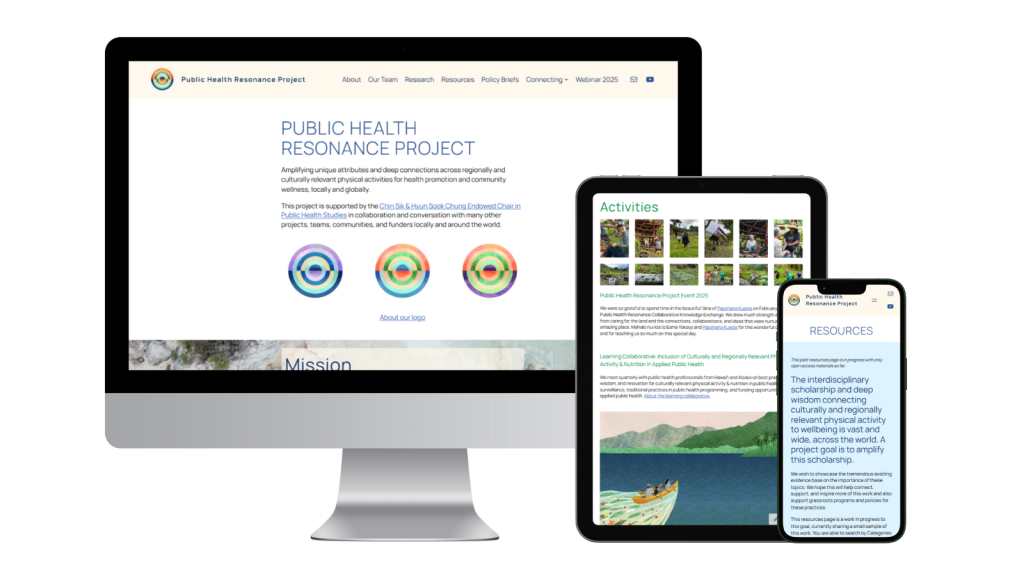
I love that I got to design their website and bring us together for this conversation. We talk about the research, art, and share 3 beautiful new illustrations with you.
There’s many ways to be more visual with your research such as data visualization, illustration, comics, science art, photography, video. I love that the PH Resonance Project found an artistic partner in Sunnu Rebecca Choi.
I hope this video inspires you. Save this post for later. You may not have 32m 5s to watch or listen today. But save it even if you just have a hint of ‘I want art for my research’ and you’re unsure how you’ll get there.
A dream I have is that more research groups, labs, and centers invest in collaborating with talented artists like Rebecca. These partnerships can help people around the world engage with (and share) research that’s meaningful to them. And also I love art.
Omg if this post (or the video) inspires you to reach out to an artist about working together? Please share it with me, I would love that! 🥹
Behind-the-scenes
Before we dive into the interview, I have a quick story to share with you about recording. Or, you can skip right to the interview.
My computer crashed right in the middle of our recording 💻😱
I’m freaking out. My desktop computer light is blinking red at me like a danger sign. When I try to cycle the computer on the fan goes crazy.
The podcast episode going live today? There was a moment there I thought it wasn’t gonna happen. When I finally made it back on, maybe 10 minutes later, I was delighted to find my guest happily chatting away. When I went back to watch the recording, they were so cute. “Oops! Looks like our host has dropped off,” and then right back to their conversation about art and research.
We were able to complete our recording. But this episode needed a bit more.
We had high resolution art to share. There was a story in there that needed attention to bring out 🎨✨️
And thank goodness I sought help. I soon learned my own audio/video? Parts of my solo video were unusable. Super lagged.
Luckily, I have a talented husband I’ve been teaming up with for his professor dad’s art focused YouTube channel. I love that Matthew can help.
The video is finally ready for you. Thank you!
Technical problems may happen 💯
Have you worried about something going wrong with your computer too? Things may go wrong with tech, but I hope it doesn’t for you! 🫶
Every time something goes wrong, I get anxious about my own unsurity of what comes next. People are often kind and understanding. When I’m the one experiencing technical issues, it feels like a huge deal and inconvenience to people. I have to remind myself: When I’m on the other side of that? I always understand. It’s super relatable. I can’t envision myself getting mad, angry, or hurt but someone else’s technical glitch. If your computer crashes in the middle of our meeting, I’ll totally get it too.
I wanted to share this story with you because for a moment there? It felt like this podcast episode may not happen. But it did. We made it happen. I’m so happy / relieved. I’m proud to share it with you 👋😄
The special 2024 logo was designed by Sunnu Rebecca Choi.
Tetine: Rebecca, we love you so much. I’m so excited to meet you in real life.
Rebecca: Thank you. I was really looking forward to meet you guys, all.
Tetine: You’re like our artistic hero, so it’s so fun to have an opportunity to do this. Thank you, Jennifer for making it happen.
Jennifer: Wait, Tetine. How did you first find Rebecca? How did you first connect?
Tetine: Oh yeah, so I have it in my slides.
Jennifer: Oh, you do? Okay. Show me your slides.
Yeah, yeah yeah! As a team, this is kind of our first time all meeting live and I’m so excited that we’re all here together. Tetine, why don’t you start us off. Would you please introduce yourself and tell people a little bit about your research?
Tetine: Sure. Aloha. I’m Tetine Sentell. I’m a Professor here at the University of Hawaiʻi at Mānoa in Public Health. I’m the department chair of public health and I am one of the co-founders of the Public Health Resonance Project, which is a really exciting, interdisciplinary, collaborative synthesis of literature, engagement with literature, dissemination of literature project we’ve been doing now for several years that this team has assembled as part of, and I’m just been so grateful to be part of that. And it’s really about sharing opportunities for strength-based public health promotion, especially around culturally and regionally relevant physical activity and how that’s meaningful to people as individuals, as families, as communities, and as collectives.
Jennifer: What are some examples of those culturally relevant activities? Just so people have an idea.
Tetine: So in Hawaiʻi, some examples would be hula, spearfishing, outrigger canoe paddling, for instance. And then of course, in many other places there are resonance and activities from culturally relevant dance, folk dances, regional relevant dances, practices in the water, practices in the land.
Jennifer: Esme, would you introduce yourself?
Esme: Sure. My name is Esme Yokooji. I’m a Master’s of Public Health student at UH Mānoa, and I am the graduate research assistant on this project. I’m in the NHIH or Native Hawaiian and Indigenous Health specialty at UH. And, in my free time, I am someone who participates in these activities. I do Okinawan dance. I like to volunteer in ʻĀina doing things like Kalo planting and just conservation and restoration work in our natural habitats here in Hawaiʻi. That’s what initially drew me to this project is just the real life connection and seeing how community engages with these things. So mahalo for having us.
Jennifer: Rebecca, you are coming here from London. This is fun. London, Hawaiʻi, and I’m in San Diego. Rebecca, tell me a little about your journey as an artist.
Rebecca: Hi, my name is Sunnu Rebecca Choi. I’m an illustrator and printmaker based in London, but I’m originally from South Korea, lived in Canada and United States and now ended up in London somehow. And then I used to be a fashion designer in New York and Toronto, but then I decided to change my career, become an illustrator. Right now I’m specializing in editorial illustration as well as children’s book illustration, mostly focusing editorial illustration wise, mostly focusing on medical scientific as well as psychologies. And I work with a lot of different university magazines as well.
Jennifer: Thank you. So everyone listening knows, I did design the website [for the Public Health Resonance Project]. I had so much fun doing this project because there are so many visual elements to all of those activities and to the people who are engaging with them. This is about people.
Tetine: I am so happy to be here because we’ve been working on this international, collaborative project for so many years, and one of the things we really wanted to do was make it so beautiful and really make it so it could be disseminated and shared in ways that inspire and engage and delight people. And so I developed this logo as we began consolidating and thinking about disseminating in collaboration with some partners, and in particular with my husband and all who helped build it. So thank you, Craig. It was a meaningful logo. We felt it was really important. I have this slide here to really show we were inspired by the Hawaiian colors and the deep ocean from the shore to the sunset, and really thinking about the levels of influence and the social ecological model, which is our theoretical influence in the background from a public health perspective and thinking about the ripple effects and the waves that grow and build and move across. And really thinking about the place to connect the project and the connections and the links, the ripples, the reflections.
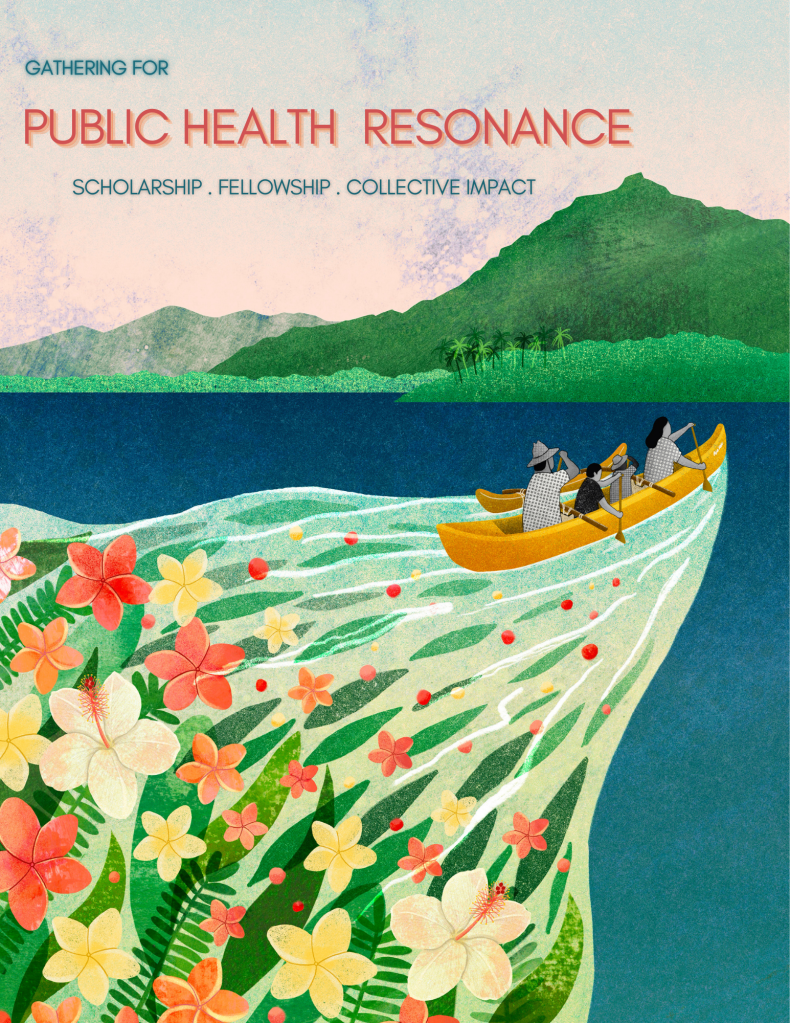
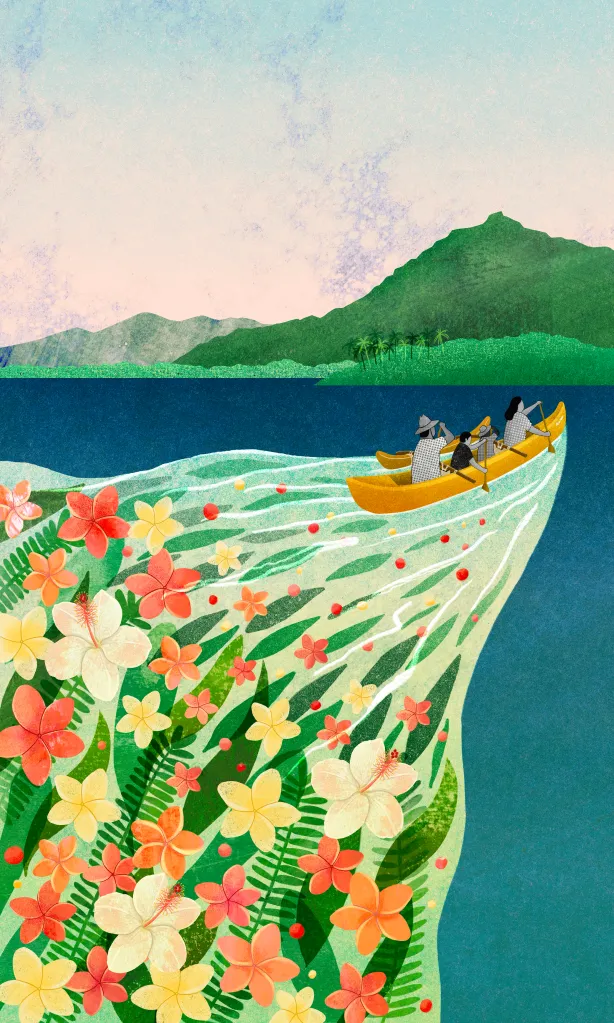
We had this endowed chair and this opportunity, and so I was really reflecting and thinking about this and this absolutely beautiful art came in my alumni magazine. Can you see how beautiful that is? It’s so pretty. I even have the one I pulled out of my alumni magazine and it was Rebecca’s artwork and it was so beautiful and it really had the feeling of what we were thinking about of these reflections, of these perspectives. You can see it has a lot of depth and story to the artwork as well as just being so peaceful and beautiful and meaningful. And so that’s how I found the artwork and had no idea how to engage with artwork or what to do in this particular way if it was contractable through a university through our funds. But anyway, just cold emailed through the link in the website and she has a beautiful website if you’ve seen it. And through that started a conversation that has just been really so fruitful and so exciting and just I’m so honored to be part of this. And in collaboration also with Esme and others who’ve really helped support and build the artwork into spaces that we can use it for all the things we wanted to do.
Jennifer: That is amazing. I’m so happy that we had a chance to hear that kind of origin story because I feel like there’s so many possibilities that we just don’t know exist as researchers, as academics, even as artists. What can we do to better connect and help shape our ideas together? Rebecca, how did you feel when Tetine first reached out? Is this a kind of project that you’ve done in the past?
Rebecca: No, actually it was really interesting because I haven’t really worked with other universities before. So was it, what university?
Tetine: Middlebury.
Rebecca: Yeah, Middlebury Magazine. That was my first alumni magazine that I worked with, university. And then when Tetine emailed me I was like, “Oh, I actually didn’t know it was released already.” That’s how I knew that magazine has been issued. Yeah, so that was really interesting. And then since then I’ve been working with a lot of universities in United States, so that opened a new opportunity for me as well.
Jennifer: And so I’m curious Tetine, what about art helps bring the community together? Why invest in this kind of visual element?
Tetine: Of course, art inspires us, engages us, pulls us in, makes us think, is important to us as humans, as people in the world. But I also think in academia we do a lot of intricate, thoughtful, engaged practices and activities that often are not accessible because they’re deep inside words and publications, sometimes even behind paywalls. And I think there is a lot of intricacy and story in even peer-reviewed academic journal papers, much less the smaller summaries of them. View open access resources from the PH Resonance Project.
And so it just felt like this was such an opportunity relative to the work, work now, to disseminate and to share it, to think about how it’s helpful, how it’s good for mental health, how it’s engaging, how it’s good for physical health, how it’s good for strength. All that was sort of built in the background of how to share out, this was so important to disseminate in communities and to people. And then with that joy, right. This is a strength-based activity. It’s a thing that brings people together, makes them happy, makes them joyful, connect with each other. And I think that’s one of the things art can do. It felt like such a nice synergy and such an amazing opportunity to really tie all those things together.
Jennifer: You brought up joy, and that’s something that I really get not just from the beautiful illustrations that have been customized to represent different activities that the project is researching, but also in the new version of the logo, in the thoughtfulness of how it all comes together through, you have created brochures, event flyers, like physical things and materials to help people engage in person. And that artwork also creates that same warmth and feeling online. Rebecca, I’m curious about your process working on what feels like something really representative of community. What was that process like for creating the artwork for this project?
Rebecca: The process-wise, whenever I receive a brief, I start with the research. Understanding how each activity is carried out, what equipment is used, and learning about the cultural context, from coding to landscapes. And that process helped me make the imagery as accurate and respectful as possible. Also, every time I create the illustration, my goal was to highlight public health at the community level, showcasing people coming together, whether it’s a mother and a child, a family, or a wider community group. I wanted the artwork to capture the moment and that sense of connection and shared care. I believe illustration has the power to bring people closer and help them resonate more deeply with the subject matter. And I think that was my main goal in creating those illustrations. Usually, when I’m working on the brief, I come up with three different concepts or ideas for each illustration.
Whenever, if I’m working on the canoe activity, I come up with three different composition or concept or focusing on something different for each illustration for the client to choose from. And that’s how I start creating the art. And then once we decide which concept we are going to go with and then I go render the illustration, my rendering process is quite interesting because I’m a printmaker as well. I create all the textures using printmaking techniques, either monoprinting, etching, or any kind of things that I can get hands on and I scan them in. And then in terms of the final illustration, I use Procreate on iPad and then bring all the textures together on iPad. So it’s a mix of digital and analog process.
Tetine: That’s why it’s so tactile. It’s like you can really feel it even through the internet. It’s really beautiful that way.
Esme: I felt the same way though. When I first saw the illustrations, I was like, “Oh, it’s almost like it’s painted on washi paper.” Like watercolor on washi. It’s so beautiful.
Rebecca: I will sometimes use the watercolor and washi or, accurate. So in my studio I have bunch of papers with all different kinds of textures and colors, which I can just use on any kind of illustration.
Esme: That’s so cool.
Tetine: It is. It’s so beautiful. I just love how it all works together and it really has such a feeling about it. Your work is so specifically you, but then you’re also using it so collaboratively to share other people’s vision, which is not an easy thing to do, I think as an artist, and I really appreciate the collaborativeness with which you’ve approached this, these. The first one as the initial one, as thinking about how to share and showcase what we were trying to do. And then very specifically in a regional context and an actual, it’s a specific way, it’s a specific bay you’re coming into and the landscape like you mentioned, and the practice and the movement and the arms, and then really thinking about who is in the canoe and what they’re wearing. And then as we have thought about it for the other resonating activities, to be willing and offer the opportunity for us to really be in collaborative conversation, even as the artwork is pretty far along to be like, “Oh no, we’ve gotten comments from our community members that this isn’t correct or we need to fix this.” I’m just so grateful for that.
Rebecca: Yeah, it was really, really interesting learning process for me as well because I knew about, briefly know about samba or Tongan, but I didn’t really specifically know about their clothing or how it works and how the body moves, things like that. So for me, it was a really, really good opportunity to learn about different activities as well.
Tetine: And I think that’s actually, exactly the project. In the sense that each one has not only resonance across, but these unique, very specific pieces of engagement, the land with the ocean with movements particular, with stories and songs and clothing from the community and care. And so the opportunity to showcase that and to showcase that very specifically about, in place for people doing it with each other as families and as communities, not specifically as, not as a show, but as a practice in community. And that has been really important. And as we share and tell the story of the artwork, that’s a really important piece of the, of our sharing of what you’ve been doing as well. Aloha.
Esme: I also want to say, Rebecca. I used to work in Heʻeia at the fish pond that kind of portrays that bay. And it was so funny because when we had the first kind of in-person activity, it actually took place in Heʻeia, but in the back of the valley. And it was so wonderful because when we showed the work to the people that are participating, they’re like, “Oh, that’s, Heʻeia, that’s here. They were able to instantly recognize from the art. And I think that, even people that weren’t affiliated with the project, were interested and curious. And I think the art was a big draw, seeing a place, recognizing it, feeling properly represented. So I just wanted to say thank you for that. That was so wonderful.
Rebecca: Yeah, also thank you for all the feedback that Tetine gives. Also, all our illustrations were reviewed by experts and that’s how we can actually get a correct imagery and then representative of the place as well.
Tetine: Yeah, and I’ll just say the funders of this, the endowed chair that I hold that has allowed this opportunity, it’s from a family enterprise and it’s all been in the background. I mentioned my husband helping with this. There’s a lot of family connections because Mele [Look], my beloved colleague who has done this project with me, certainly has helped connect to some of the cultural and regional experts, but in particular on the Heʻeia ridgeline, her husband Scott is a geologist, and he was like, “This ridge line is not correct. You have to go down. It happens like this, not like that.” And he drew a line for the ridge line so it was proper. That’s the level of detail and actually cultural consultation and regional consultation that’s been possible through this collaborative project.
Jennifer: It sounds like a lot of people were involved in the art making, and that’s something that’s probably really unexpected for folks who are listening to this. So it was the two of you as well as it sounds like experts?
Tetine: Yeah, yeah yeah. As Rebecca mentioned, we had the brief, we have a conversation, and then she would send three sort of options of things. And then those three options we would run by people who practice those activities, who work in the region, who engage in the practice. That certainly included my colleague Mele, who’s been part of this all along in every way, but also, exactly, people who paddle for the paddling one, people who participate in wild skating for the ones you’ll see in a minute we’ll talk about, and people who do samba, people who do Tongan dance. And so exactly this. So out of the three that we’ve chosen one to go with, and that one is really prioritized. Community, that it’s about being with family or being with others to do practices that bring people joy together, collaboratively in their real lives. That this is about, sometimes they are ceremonies at a wedding or at a party with a community, but they’re not about a show. They’re about a practice together in community.
And so that’s always been the background of the activities we’ve been showcasing. But then from those and from the one we’ve chosen, then she does a more developed artwork. And then from that more developed artwork, that’s where we really are like, okay, well this color or this clothes or this line or this is not how the arm would be, or this is not the exact proper direction of the canoe relative to the shoreline. That level of detail has been really important and part of the iterative conversation. And then we go back to consult and come back. So it’s a very iterative process.
Jennifer: When you started the project, did you know how long it would take to produce art using all of this feedback?
Tetine: For me, that is kind of how the process of most of the work that I do works, where there’s a lot of, we work a lot with community and in practice and public health is about that. I would say for me, not a surprise, but I did feel really bad for Rebecca. I felt it was a lot to ask the artist to engage in sort of the academic consultation process at that level of detail. But she was a really good sport about it.
Rebecca: It was very interesting because I also, I do longer projects or shorter projects. Usually the book projects are very long. Sometimes it lasts from three months minimum to one year or more than one year. But then editorial projects usually ends within two weeks. I think this project was in between, I guess.
Jennifer: I appreciate that. And for folks who are listening, if you’re considering working with an artist asking about their timeline, but also considering who you need to bring into the conversation for that art is helpful upfront so that you can talk about it together.
Tetine: Could I just add to that exact thing, which is that because of this project being so specific about culture and place and about those practices, it was vital and we couldn’t have done it otherwise. Because if the artwork for the practice doesn’t make sense to the people participating, we shouldn’t do that artwork at all, right? And so that was built into this. I could imagine other scenarios where you wouldn’t need quite such level of detail because maybe you’d be talking about just a feeling or something to connect with this, but this was so vital that we have that level of detail
Jennifer: Esme, as someone who is using the art to create flyers and other kinds of, I would say marketing materials, but is it marketing materials?
Esme: Well, I would say my background is also in organizing, and that was where I had most of my social media, video editing experiences actually in making, for lack of a better word, propaganda. But kind of trying to inculcate people and inform them, somewhat a combination of educational materials. And I think the goal of this project is, Tetine spoke on, is just to shine a light and a spotlight on these different activities, on these different researchers, on the work that they’re doing and its value. I think for me, what I’ve really enjoyed about being a part of this team is how much Tetine specifically stresses the importance of cultural competence and humility. And I think that understanding how specific everything is, understanding how tailored it is, really conceptualizing who our audience is, who’s going to be benefited by our materials, is something that’s really important to me, specifically being in Native Hawaiian and Indigenous Health. Because I think having more culturally tailored interventions or even having more culturally tailored messaging, having artwork that is accurate that people can recognize, that immediately draws them in I think is really valuable and important. It’s been truly really fun, honestly, to make materials and just experiment with the different kinds of things, whether it’s making a video intro or editing a logo for a flyer or collaborating on a poster or any manner of things. It’s been a joy.
Jennifer: Tetine, what would you like folks to know about, okay, there’s so many people out there who are like, “I do want a website. I do want to have beautiful artwork for my events. I do want these things, but I don’t know if it’s worth my time as the PI [Principal Investigator].” You are the decision maker here. And so I’m curious, what made you know that this was worth it for you in terms of your energy?
Tetine: Yeah, I mean, I think it is a conundrum of academic practice these days actually. This how we engage in the PR of the work we do in a sort of dissemination campaign. Generally, people do so much valuable work that they don’t [promote] because of their own demands of academia. They don’t have the time, capacity, support system to help be sharing that out. I guess I would advocate not for this to be something that individuals need to do only because it isn’t something an individual can do only. I was able to pull this together by the amazing collaboration, by being fortunate to have, hold this endowed chair and being senior enough in my own career that the publication process or grant making process was not the only thing I really needed to prioritize relative to my own goals of my academic, what I wanted to do with my career.
And so it has been actually a joy and an honor to be part of this collaboration, to keep building it, to keep growing it, to engage in sharing it out. Like as Esme is saying and dissemination materials might be one of the terms I might want to use for some of the things we’re doing to think about how we’re sharing out and why. What we want to do is think about how to build in the opportunity for innovative ways in which we showcase the work we do in academia and in art being one of the fundamental ways in which we can share out. And then the art being collateral, like Esme is mentioning and we’ve talked about. And that, Jennifer, is one of the great skills that you hold is how we share out the beautiful work that an artist achieves in collaboration with us, like Rebecca is doing. Then in YouTube and LinkedIn, or in community, and handouts and flyers. How do we do that? That’s certainly not something we learn in graduate school, but in the background is all this important work that deserves to be showcased.
Jennifer: Ah, wonderful. Are there slides that you did not share that you want to be sure to get into the video? Is there anything else that we should be sure to talk about today?
Esme: Only that I think from what I’ve experienced, because a lot of what I do specifically focuses on Indigenous Health and what did this Project was specifically trying to reach and elevate and focus on communities that have historically been marginalized, experienced disparity. But coming from the perspective of how is culture a source of strength, how is connectivity to land and to heritage a source of strength? And I think that using art is something that reinforces that message because a lot of times Indigenous Arts and Traditions, whether it’s storytelling or even hula, is considered an art form as well as a physical activity has been marginalized. So using art as a means to tell these stories and amplify these messages feels so right and is a source of resonance for me anyway. And engaging in this work.
Rebecca: So much of this project, the process was about discovery for me as well. Through this collaboration, I learned so much about the diverse cultural backgrounds behind each brief. And also me as a Korean Canadian based in London, I have so much different cultural diversity within me as well. So it was really valuable experience for me to work on those illustrations and artistically it also encouraged me to explore new colors and compositions that I never used before as well. So finding ways to express not just the activities itself, but the joy and vitality that shines through them while highlighting the connection between people, community and nature, was really, really enjoyable working on this brief.
Jennifer: Well, I’m very excited for the art to come. I’ve never had such beautiful art packaged, ready for me to consider for a website design. I felt really honored to be able to work with the thoughtfulness that I could tell everyone who was involved with this project put into the creation of these art pieces. And there’s new ones that I guess they’re maybe going to be premiered on this video if they’re not on the website first, and I’m very excited to share them with all of you. So Tetine, let’s do your slides.
Tetine: This was the beautiful artwork we talked about before that I was inspired by. And then this is exactly like, to showcase both the artwork itself and then the artwork, the initial one we’ve been talking about so much, the one, the paddling, the outrigger canoe paddling one, you can see the family, you can see Heʻeia in the background. And then you can also see how we used the artwork as a piece of the story we were telling, which was that we were doing various gatherings over the world, essentially, last year. And that we were thinking about, this was something, we had note cards, we had a poster, we had small business card size handouts to really share and tell the story about what we were doing. So the new artwork includes resonances specifically with this one. This is based in Hawaiʻi and our community here. And then we wanted to really think about how this resonated in other places.
So this is wild skating in Scandinavian lands. And we had feedback, for instance, specifically here in this one about the trees that actually from our Swedish colleagues said no one would ever go out without a helmet. And so we put a helmet on the child because we were like, that makes sense. That’s the cultural practice. Same with the backpack and the way she’s holding her poles. That the backpack, they were like, we’d never go out into the wilderness without some sort of backpack or something to be safe. So again, really thinking about how communities engage in these practices in real life versus what you might see on a tourist brochure. That was really important to us. Again, you can see the mom and her child. And then really, dance is a really important culturally and regionally relevant community, relevant practice, again, all over the world.
And so dance, a lot of the research is in dance specifically for so many different pieces of staving off dementia, Parkinson’s, community wellness, mental health. And so here we have our Tongan dance example we talked about earlier, and the samba dance example with input, in collaboration from colleagues from Tonga and Brazil, specifically talking about what this might look like in practice and what this might be like. And so for instance, in the samba one, at first we had these very elaborate headdresses and activities and our colleagues said, well, certainly we do that in Carnival and something, but that’s not what you would see in a community. That’s a special event for a different type of piece. And so if you want to think about how people would do these practices in real life, in community, it would be more casual like this. And same, we talked a lot about in the Tongan example about the clothes, what that might look like, how people would be engaged, what would be respectful, what would be expected, that this is a bit of a dressy event, but also a family event and what that might look like and how the arms are, the stories being told with the hands and the arms and the motions and what music would be relevant.
You can see in the background a lot of those conversations. The last thing I just wanted to highlight is, as we talked about earlier, we have different logos to go with each one. Because the resonance is across, and the first one really started with the Hawaiian sunset and colors. And then you can see these colors in the background are from some of these other places as well. So highlighting that resonance across that, we really want to think about the colors and the schemes, in terms of people’s communities and specific places. Which is to share, we really talked about this, and I know I think Jennifer, you have an example, but just how we’ve been able to engage in our own activities and practices using this artwork because of Esme’s skillset as well. And because of the capacities and the conversations, including with you, Jennifer, and the website. How to share out and showcase the conversations we’ve had with so many wonderful experts across the globe. And this really is just such a tremendously collaborative project. And so that’s really been a great joy of this project as well, is how to all the strengths and experiences and skillsets that people bring to the table together, really thinking about where we showcase that and how to do that in the most beautiful, respectful, exciting, engaging way possible.
Jennifer: Yay. Thank you so much for recording this with me. I feel like you were all so excited to talk that it really is going to make for an engaging episode for people, and I really hope that it inspires other folks to consider collaborating with an artist or even reaching out to Rebecca because you’re such a valuable resource for people. I love how much attention that you give to not just what needs to be communicated, but who it’s communicating with and who needs to be involved in the process. It’s just beautiful. Thank you all for being here today. Yeah. Anything else before we wrap up?
Tetine: No, but thank you, Jennifer. You’re a great visual communicator also, and I’m just really grateful for all the expertise you’ve brought to the story of the Public Health Resonance Project and the capacity to share it out as well. Those are skillsets I didn’t have and didn’t have access to either, and really have been grateful for that as well. Just thank you and again, for bringing us all together for this great opportunity. This is a great joy. It’s been a great joy to meet and a great joy to meet Rebecca, to have Esme here, who’s just been a joy as well. And Jennifer, thank you for all that you do for us as well. You also are a great joy!
A special thank you to my husband, Dr. Matthew M. Pincus, for his editing and storytelling support with this episode. If you need help with a video, reach out to him at [email protected]
Berenschot (2017) Van toezicht naar verantwoording: rapportage hoger onderwijs [From Supervision to Accountability: Higher Education Report]. Utrecht: Berenschot.
Commissie Behoorlijk Bestuur (2013) Een lastig gesprek: rapport van de Commissie Behoorlijk Bestuur [A Difficult Conversation: Report of the Committee on Proper Governance]. The Hague: Commissie Behoorlijk Bestuur.
Commissie Behoorlijk Bestuur (2013) Een lastig gesprek. Over de (interne) dialoog in semipublieke instellingen [A Difficult Conversation: On the (Internal) Dialogue in Semi-Public Institutions]. Den Haag: Ministerie van Binnenlandse Zaken en Koninkrijksrelaties.
Commissie onderzoek financiële problematiek Amarantis (2012) Autonomie verplicht: Rapport onderzoek financiële problematiek Amarantis [Autonomy required: Report on the financial problems at Amarantis]. Den Haag: Commissie onderzoek financiële problematiek Amarantis.
Department for Education, Department for Work and Pensions and Department for Science, Innovation and Technology (2025) Post-16 Education and Skills. White Paper CP 1412. London: HM Government.
Ministerie van Onderwijs, Cultuur en Wetenschap (2021) Evaluatie wet versterking bestuurskracht [Evaluation of the Law to Strengthen Governance]. Brief regering, Kamerstuk 34 251, Nr. 95. Den Haag: Ministerie van Onderwijs, Cultuur en Wetenschap.
Rijksoverheid (2013) Toezien op publieke belangen: Naar een verantwoorde invulling van rijksinspecties [Safeguarding Public Interests: Towards a Responsible Role for National Inspectorates]. Den Haag: Rijksoverheid.
Wetenschappelijke Raad voor het Regeringsbeleid (WRR) (2013) Toezien op publieke belangen: Naar een verantwoorde invulling van rijksinspecties [Safeguarding Public Interests: Towards a Responsible Role for National Inspectorates]. The Hague: WRR.
Wetenschappelijke Raad voor het Regeringsbeleid (WRR) (2013) Toezien op publieke belangen: Naar een verruimd perspectief op rijkstoezicht [Safeguarding Public Interests: Towards a Broadened Perspective on National Oversight]. Den Haag: Amsterdam University Press.
Wetenschappelijke Raad voor het Regeringsbeleid (WRR) (2014) Van tweeluik naar driehoeken: Versterking van interne checks and balances bij semipublieke organisaties [From Diptychs to Triangles: Strengthening Internal Checks and Balances in Semi-Public Organisations]. Amsterdam: Amsterdam University Press.
Wetenschappelijke Raad voor het Regeringsbeleid (WRR) (2015) Improving internal checks and balances in semi-public organisations: synopsis of WRR report no. 91 [Van tweeluik naar driehoeken]. The Hague: WRR.
Q: What is the university’s mandate behind this role? How does it help align with and advance the university’s strategic priorities?
A: Put simply, the IT innovation and research team’s futurEDlab is on a mission to unite faculty, staff and students to spark innovation and help shape the future of education. At Grand Valley State University, our Reach Higher Strategic Plan highlights the value of innovation as well as the university’s commitment to empowering learners and enriching society. Specifically, this role contributes to enhancing education through incubating ideas and facilitating project management in our work to design, develop and deliver innovative immersive experiences leveraging emerging technologies.
Q: Where does the role sit within the university structure? How will the person in this role engage with other units and leaders across campus?
A: The innovation project experience designer at GVSU will serve on the information technology division’s innovation and research team, engaging across the university through partnerships and interdisciplinary partnerships.
Q: What would success look like in one year? Three years? Beyond?
A: In year one, success includes catalyzing our project intake and management operational procedures within the futurEDlab, building momentum, capacity, efficiency and effectiveness as we deliver high-impact innovation experiences at Grand Valley State University. In three years, this role will be pivotal as we increase the value of digital transformation in teaching and learning as part of the innovation pipeline with the Blue Dot Lab ecosystem.
Q: What kinds of future roles would someone who took this position be prepared for?
A: Future roles for this position include coordination, management, leadership and innovation pathways in higher education, such as innovation strategy, digital transformation and senior level innovation program and project management.
Please get in touch if you are conducting a job search at the intersection of learning, technology and organizational change. Featuring your gig on Featured Gigs is free.
This guest blog was kindly authored by Imran Mir, Campus Head and Programme Lead, Apex College Leicester
Leadership in higher education is often measured by indicators such as retention rates, research outputs and league table positions. These are important, but leadership is far deeper than numbers. Growing up with autism and then becoming a leader in higher education has shaped how I approach leadership. Being neurodiverse means I see situations differently, notice patterns others may miss, and feel deep empathy with students and colleagues who are often invisible in our systems.
This is why neurodiverse leadership must be treated as a quality issue. Universities are rightly talking more about inclusive curriculum design and student support, but these conversations rarely extend to who sits at the decision-making table. Representation in leadership is not about tokenism. It is about ensuring the sector benefits from different ways of thinking, which is vital for quality, resilience and innovation.
Why neurodiverse leadership matters
According to the University of Edinburgh 2024, in the UK, one in seven people are neurodiverse. Advance HE 2024 report shows leadership teams in higher education remain overwhelmingly homogenous. This lack of representation is not just an issue of fairness, it is also a missed opportunity for innovation. Research by Deloitte 2017 shows that neurodiverse teams can be up to 30 per cent more productive in tasks requiring creativity and pattern recognition. Universities are currently facing challenges in relation to funding and digital disruption, and they will need this kind of productivity and resilience more than ever.
Further, Made By Dyslexia 2023 claims that one in five people are dyslexic, many of whom bring excellent problem-solving and communication skills. These strengths align with what is expected in leadership roles, where complex challenges and clear communication are requirements. Yet recruitment and promotion processes can often filter out people who think or communicate differently.
Austin & Pisano, 2017 adds that neurodiverse leaders frequently demonstrate empathy and adaptability. These qualities are imperative in higher education as institutions are trying their best to meet diverse student needs, respond to rapid change and rebuild trust in their systems. Without neurodiverse leadership, universities risk reinforcing the very barriers which they are trying to eradicate.
Lessons for higher education leaders
From my own experience, I have learned three lessons that apply directly to leadership in higher education.
The first lesson is the power of clarity. Neurodiverse staff and students excel when expectations are clear. As a leader, I have seen first-hand that communicating with clarity in strategy documents, policies and day-to-day interactions builds trust in the academic institution. Research on organisational effectiveness suggests that clear communication consistently improves outcomes across diverse teams
The second lesson is valuing flexibility. Traditional recruitment, professional development and promotion systems seem to reward conformity. This is a missed opportunity because neurodiverse teams will bring innovation and productivity benefits. Strong leaders can change this by adopting flexible approaches such as task-based interviews, blended assessments that combine written, oral and practical elements, and CPD which takes into consideration various communication styles.
The third lesson is role modelling openness. For years I believed that revealing my autism would be seen as a weakness. In reality, sharing my story has made me a stronger leader. It has encouraged colleagues to be open about their own experiences and helped students feel less isolated. Austin & Pisano 2017 show that when leaders model vulnerability and authenticity, it strengthens organisational culture and increases trust across teams.
A quality issue, not a side project
These lessons outline why neurodiverse leadership should not be viewed as a side project. Quality frameworks such as the Office for Students’ conditions and the QAA Quality Code are built on assumptions of fairness, reliability and inclusivity. If leadership itself is not inclusive, then the credibility of these frameworks is undermined. If the voices of the one-in-seven neurodiverse people are not present in leadership, then universities are failing to reflect the diversity of the communities they are trying to serve.
Neurodiverse leadership will strengthen governance, enhances decision-making and ensures policies reflect the diversity of the student body. It is a direct contributor to educational quality, not an optional extra.
Conclusion
As someone working in higher education, I know these lessons are transferable across the sector. But they feel especially urgent now, as universities face funding pressures, digital disruption and growing student expectations. In such times, leaders who think differently are not optional. They are essential.
Neurodiverse leadership is not about meeting quotas. It is about strengthening quality. The sector cannot afford to waste talent or exclude perspectives that could help it adapt and thrive. If universities want to remain resilient, they must recognise that diversity of thought at the leadership table is just as important as diversity in the classroom. At its heart, this is about shaping the future of higher education in a way that is inclusive, innovative and sustainable.
Q: What is the university’s mandate behind this role? How does it help align with and advance the university’s strategic priorities?
A: Excellence in undergraduate education is essential to how Notre Dame envisions itself fulfilling its institutional mission. The digital learning project manager will contribute directly to the educational experience of our undergraduate students, working with faculty, learning designers, a media team and other project management professionals to create cutting-edge digital offerings meant to enhance Notre Dame’s signature residential learning environment.
In addition, the person in this role will manage initiatives that bring elements of Notre Dame’s academic life to learners beyond our campus. These range from online courses open to the general public to online pathway programs for current high school students exploring college opportunities and incoming first-year Notre Dame students prepping for the rigors of a university curriculum.
Q: Where does the role sit within the university structure? How will the person in this role engage with other units and leaders across campus?
A: The digital learning project manager is a member of the Office of Digital Learning, which is part of a larger unit, reporting to the Office of the Provost, called Notre Dame Learning. Housing the ODL and the Kaneb Center for Teaching Excellence, Notre Dame Learning brings together their teaching and learning expertise along with that of the Office of Information Technology’s Teaching and Learning Technologies group to serve as the hub of learning excellence and innovation at Notre Dame.
Working in the ODL will give the person in this position the chance to collaborate directly with instructors, the university’s academic departments and colleges, and colleagues across the Notre Dame Learning organization. They will work closely with the ND Learning leadership team to advance the organization’s strategic priorities.
Q: What would success look like in one year? Three years? Beyond?
A: From day one, building relationships will be paramount in this position. The Notre Dame family embodies a strong sense of community, and successful project managers on our campus are those who embrace the human component of their work, recognizing that shepherding a project from initiation to completion requires personal connection as much as it does the ability to keep a group on task. The importance of being able to understand faculty priorities and concerns, interface with administrators both internal and external to Notre Dame, and partner with colleagues across the ODL and Notre Dame Learning more generally cannot be overstated. As these relationships deepen over time, the digital learning project manager will become a go-to member of the Notre Dame Learning team and assume a larger role in driving its initiatives.
Q: What kinds of future roles would someone who took this position be prepared for?
A: Given all the different skill sets someone in this position will draw on and/or develop—e.g., project management, client/stakeholder relations, written and verbal communication, familiarity with media production and learning design processes, knowledge of higher education and organizational dynamics more broadly—it is a role that can serve as a springboard into opportunities with expanded leadership components. This might be within a unit like the Office of Digital Learning, in other areas of higher ed such as student services or information technology, or in fields outside academia altogether. Named as America’s Best Large Employer by Forbes earlier this year, Notre Dame is a great place both to work and build toward future career success.
Please get in touch if you are conducting a job search at the intersection of learning, technology and organizational change. If your gig is a good fit, featuring your gig on Featured Gigs is free.
Machine learning is the new trend which is transforming how the business world makes decisions. For MBA students, who are integrating the machine learning projects with source code into final year project work would be adding a real value and to differentiate their profile in placements or higher studies.
Why MBA Students Should Explore Machine Learning Projects?
Unlike computer science students, MBA students mainly focus on solving business problems. Still, machine learning opens doors to:
Working on machine learning projects for final year, MBA students would be bridging their gap between management and technology.
Where to Find Machine Learning Projects with Source Code?
1. Machine Learning Projects Kaggle
Kaggle offers real-world datasets and pre-built models. For MBA projects, students can explore:
Sales forecasting
Retail Customer churn
Social media analysis and Brand sentiment.
2. Machine Learning Projects GitHub
GitHub repositories contain ready-to-use machine learning projects with source code. Mba Final year students can download them, customize datasets, and align them with their final year project theme.
Best Machine Learning Project Ideas for MBA Final Year
Marketing Analytics
Customer segmentation using K-Means on Fitness Centre
Customer Churn on local restaurant
Sentiment analysis of customer churn prediction in Banks
Finance Analytics
Comparative study of Loan approval prediction using machine learning Methods.
Machine learning prediction on Stock price trend forecasting.
HR & Operations
Comparative study of employee attrition prediction of an organization
Utilization of Machine learning in Demand and inventory forecasting.
Get more machine leaning titles in this link.Click here
How MBA Students Can Use These Projects
Students should choose the relevant topics (Marketing, Finance, HR, or operations).
They have to Download machine learning projects with source code from Kaggle or GitHub.
Modifying the datasetsas per the project context.
Should be focussing on business insights and not just algorithms.
Check out this video for more indepth knowledge on Machine Learning
Conclusion
For MBA students, machine learning projects with source code are not about becoming data scientists—it’s about using data intelligently to make right business decisions.
By leveraging Kaggle and GitHub, students can transform their final year project into a powerful showcase of management plus analytics skills.
The main intent of the blog is to help students understand how to find the right mentor who can guide mba students to provide hands-on experience with ml code base.
This content will help gain more knowledge for capstone projects,thesis work or mba project by applying customer analytics, finance strategy to complement theoretical business knowledge in machine learning and build portfolio for job interviews or internships.
Indianapolis, IN — Project POTUS, a national middle school history initiative from the Benjamin Harrison Presidential Site, has named winners for this year’s competition.
Since the founding of our nation, there have been nearly half a billion American citizens. Of those, over 12,000 of us have served in Congress. Just 115 have become Supreme Court Justices. Only 45 citizens have become President of the United States. There’s something exceptional about each POTUS — good, bad, or otherwise. Project POTUS? challenges students in middle school to research an American president and create a video, 60 seconds or less, representing the POTUS chosen in a way that is creative, supported by good history research, and fun. A Citizen Jury made up of nearly 100 people reviewed all qualifying submissions and selected this year’s winners.
Grand Jury’s Grand Prize and Spotlight Award Selections
Grand Prize Winner ($500 award)
6th grader Peter Gestwicki from Muncie, Indiana won grand prize for his video about Theodore Roosevelt. Watch his winning video here.
Spotlight Award Winners ($400 award winners)
8th grader Grace Whitworth from St. Richard’s Episcopal School in Indianapolis, Indiana won for her video about President Thomas Jefferson. Watch her winning video here.
8th grader Izzy Abraham from Sycamore School in Indianapolis, Indiana for her video about President Calvin Coolidge. Watch his winning video here.
8th grader Clara Haley from St. Richards Episcopal School in Indianapolis, Indiana for her video about President George W. Bush. Watch his winning video here.
8th graders Delaney Guy and Nora Steinhauser from Cooperative Middle School in Stratham, New Hampshire for their video about President James Polk. Watch their winning video here.
37 students throughout the country each won their Presidential Category and received $100 awards. Check out all of their videos here.
The 2026 Project POTUS competition begins Election Day, November 4, 2025 and all submissions must be entered by Presidents Day, February 16, 2026. Learn more here.
Project POTUS is made possible by the generous support from Russell & Penny Fortune.
About the Benjamin Harrison Presidential Site
The Benjamin Harrison Presidential Site is the former home of the 23rd U.S. President. Now celebrating its 150th anniversary, it is a stunningly restored National Historic Landmark that shares the legacy of Indiana’s only President and First Lady with tens of thousands of people annually through guided tours, educational programs, special events and cultural programs. Rated “Top 5 Stately Presidential Homes You Can Visit” by Architectural Digest, the Harrison’s 10,000 square foot Italianate residence in downtown Indianapolis houses nearly 11,000 curated artifacts spanning more than two centuries of American and presidential history. Recently expanded and restored through a $6 million campaign, the Benjamin Harrison Presidential Site is also consistently ranked a Top 5 Thing To Do in Indianapolis by TripAdvisor. Signature programs and initiatives include: Future Presidents of America; Project POTUS, Candlelight Theatre; Juneteenth Foodways Festival; Wicket World of Croquet; and Off the Record. Founded in 1966 as a private 501c(3) that receives no direct federal support, the Benjamin Harrison Presidential Site is dedicated to increasing public participation in the American system of self-government through the life stories, arts and culture of an American President. Find out more at PresidentBenjaminHarrison.org.
eSchool Media staff cover education technology in all its aspects–from legislation and litigation, to best practices, to lessons learned and new products. First published in March of 1998 as a monthly print and digital newspaper, eSchool Media provides the news and information necessary to help K-20 decision-makers successfully use technology and innovation to transform schools and colleges and achieve their educational goals.
I work at Marquette University. As a Roman Catholic, Jesuit university, we’re called to be an academic community that, as Pope John Paul II wrote, “scrutinize[s] reality with the methods proper to each academic discipline.” That’s a tall order, and I remain in the academy, for all its problems, because I find that job description to be the best one on offer, particularly as we have the honor of practicing this scrutinizing along with ever-renewing groups of students.
This bedrock assumption of what a university is continues to give me hope for the liberal educational project despite the ongoing neoliberalization of higher education and some administrators’ and educators’ willingness to either look the other way regarding or uncritically celebrate the generative software (commonly referred to as “generative artificial intelligence”) explosion over the last two years.
In the time since my last essay in Inside Higher Ed, and as Marquette’s director of academic integrity, I’ve had plenty of time to think about this and to observe praxis. In contrast to the earlier essay, which was more philosophical, let’s get more practical here about how access to generative software is impacting higher education and our students and what we might do differently.
At the academic integrity office, we recently had a case in which a student “found an academic article” by prompting ChatGPT to find one for them. The chat bot obeyed, as mechanisms do, and generated a couple pages of text with a title. This was not from any actual example of academic writing but instead was a statistically probable string of text having no basis in the real world of knowledge and experience. The student made a short summary of that text and submitted it. They were, in the end, not found in violation of Marquette’s honor code, since what they submitted was not plagiarized. It was a complex situation to analyze and interpret, done by thoughtful people who care about the integrity of our academic community: The system works.
In some ways, though, such activity is more concerning than plagiarism, for, at least when students plagiarize, they tend to know the ways they are contravening social and professional codes of conduct—the formalizations of our principles of working together honestly. In this case, the student didn’t see the difference between a peer-reviewed essay published by an academic journal and a string of probabilistically generated text in a chat bot’s dialogue box. To not see the difference between these two things—or to not care about that difference—is more disconcerting and concerning to me than straightforward breaches of an honor code, however harmful and sad such breaches are.
I already hear folks saying: “That’s why we need AI literacy!” We do need to educate our students (and our colleagues) on what generative software is and is not. But that’s not enough. Because one also needs to want to understand and, as is central to the Ignatian Pedagogical Paradigm that we draw upon at Marquette, one must understand in context.
Another case this spring term involved a student whom I had spent several months last fall teaching in a writing course that took “critical AI” as its subject matter. Yet this spring term the student still used a chat bot to “find a quote in a YouTube video” for an assignment and then commented briefly on that quote. The problem was that the quote used in the assignment does not appear in the selected video. It was a simulacrum of a quote; it was a string of probabilistically generated text, which is all generative software can produce. It did not accurately reflect reality, and the student did not cite the chat bot they’d copied and pasted from, so they were found in violation of the honor code.
Another student last term in the Critical AI class prompted Microsoft Copilot to give them quotations from an essay, which it mechanically and probabilistically did. They proceeded to base their three-page argument on these quotations, none of which said anything like what the author in question actually said (not even the same topic); their argument was based in irreality. We cannot scrutinize reality together if we cannot see reality. And many of our students (and colleagues) are, at least at times, not seeing reality right now. They’re seeing probabilistic text as “good enough” as, or conflated with, reality.
Let me point more precisely to the problem I’m trying to put my finger on. The student who had a chat bot “find” a quote from a video sent an email to me, which I take to be completely in earnest and much of which I appreciated. They ended the email by letting me know that they still think that “AI” is a really powerful and helpful tool, especially as it “continues to improve.” The cognitive dissonance between the situation and the student’s assertion took me aback.
Again: the problem with the “We just need AI literacy” argument. People tend not to learn what they do not want to learn. If our students (and people generally) do not particularly want to do work, and they have been conditioned by the use of computing and their society’s habits to see computing as an intrinsic good, “AI” must be a powerful and helpful tool. It must be able to do all the things that all the rich and powerful people say it does. It must not need discipline or critical acumen to employ, because it will “supercharge” your productivity or give you “10x efficiency” (whatever that actually means). And if that’s the case, all these educators telling you not to offload your cognition must be behind the curve, or reactionaries. At the moment, we can teach at least some people all about “AI literacy” and it will not matter, because such knowledge refuses to jibe with the mythology concerning digital technology so pervasive in our society right now.
If we still believe in the value of humanistic, liberal education, we cannot be quiet about these larger social systems and problems that shape our pupils, our selves and our institutions. We cannot be quiet about these limits of vision and questioning. Because not only do universities exist for the scrutinizing of reality with the various methods of the disciplines as noted at the outset of this essay, but liberal education also assumes a view of the human person that does not see education as instrumental but as formative.
The long tradition of liberal education, for all its complicity in social stratification down the centuries, assumes that our highest calling is not to make money, to live in comfort, to be entertained. (All three are all right in their place, though we must be aware of how our moneymaking, comfort and entertainment derive from the exploitation of the most vulnerable humans and the other creatures with whom we share the earth, and how they impact our own spiritual health.)
We are called to growth and wisdom, to caring for the common good of the societies in which we live—which at this juncture certainly involves caring for our common home, the Earth, and the other creatures living with us on it. As Antiqua et nova, the note released from the Vatican’s Dicastery for Culture and Education earlier this year (cited commendingly by secular ed-tech critics like Audrey Watters) reiterates, education plays its role in this by contributing “to the person’s holistic formation in its various aspects (intellectual, cultural, spiritual, etc.) … in keeping with the nature and dignity of the human person.”
These objectives of education are not being served by students using generative software to satisfy their instructors’ prompts. And no amount of “literacy” is going to ameliorate the situation on its own. People have to want to change, or to see through the neoliberal, machine-obsessed myth, for literacy to matter.
I do believe that the students I’ve referred to are generally striving for the good as they know how. On a practical level, I am confident they’ll go on to lead modestly successful lives as our society defines that term with regard to material well-being. I assume their motivation is not to cause harm or dupe their instructors; they’re taking part in “hustle” culture, “doing school” and possibly overwhelmed by all their commitments. Even if all this is indeed the case, liberal education calls us to more, and it’s the role of instructors and administrators to invite our students into that larger vision again and again.
If we refuse to give up on humanistic, liberal education, then what do we do? The answer is becoming clearer by the day, with plenty of folks all over the internet weighing in, though it is one many of us do not really want to hear. Because at least one major part of the answer is that we need to make an education genuinely oriented toward our students. A human-scale education, not an industrial-scale education (let’s recall over and over that computers are industrial technology). The grand irony of the generative software moment for education in neoliberal, late-capitalist society is that it is revealing so many of the limits we’ve been putting on education in the first place.
If we can’t “AI literacy” our educational problems away, we have to change our pedagogy. We have to change the ways we interact with our students inside the classroom and out: to cultivate personal relationships with them whenever possible, to model the intellectual life as something that is indeed lived out with the whole person in a many-partied dialogue stretching over millennia, decidedly not as the mere ability to move information around. This is not a time for dismay or defeat but an incitement to do the experimenting, questioning, joyful intellectual work many of us have likely wanted to do all along but have not had a reason to go off script for.
This probably means getting creative. Part of getting creative in our day probably means de-computing (as Dan McQuillan at the University of London labels it). To de-compute is to ask ourselves—given our ambient maximalist computing habits of the last couple decades—what is of value in this situation? What is important here? And then: Does a computer add value to this that it is not detracting from in some other way? Computers may help educators collect assignments neatly and read them clearly, but if that convenience is outweighed by constantly having to wonder if a student has simply copied and pasted or patch-written text with generative software, is the value of the convenience worth the problems?
Likewise, getting creative in our day probably means looking at the forms of our assessments. If the highly structured student essay makes it easier for instructors to assess because of its regularity and predictability, yet that very regularity and predictability make it a form that chat bots can produce fairly readily, well: 1) the value for assessing may not be worth the problems of teeing up chat bot–ifiable assignments and 2) maybe that wasn’t the best form for inviting genuinely insightful and exciting intellectual engagement with our disciplines’ materials in the first place.
I’ve experimented with research journals rather than papers, with oral exams as structured conversations, with essays that focus intently on one detail of a text and do not need introductions and conclusions and that privilege the student’s own voice, and other in-person, handmade, leaving-the-classroom kinds of assessments over the last academic year. Not everything succeeded the way I wanted, but it was a lively, interactive year. A convivial year. A year in which mostly I did not have to worry about whether students were automating their educations.
We have a chance as educators to rethink everything in light of what we want for our societies and for our students; let’s not miss it because it’s hard to redesign assignments and courses. (And it is hard.) Let’s experiment, for our own sakes and for our students’ sakes. Let’s experiment for the sakes of our institutions that, though they are often scoffed at in our popular discourse, I hope we believe in as vibrant communities in which we have the immense privilege of scrutinizing reality together.
Jacob Riyeff is a teaching associate professor and director of academic integrity at Marquette University.