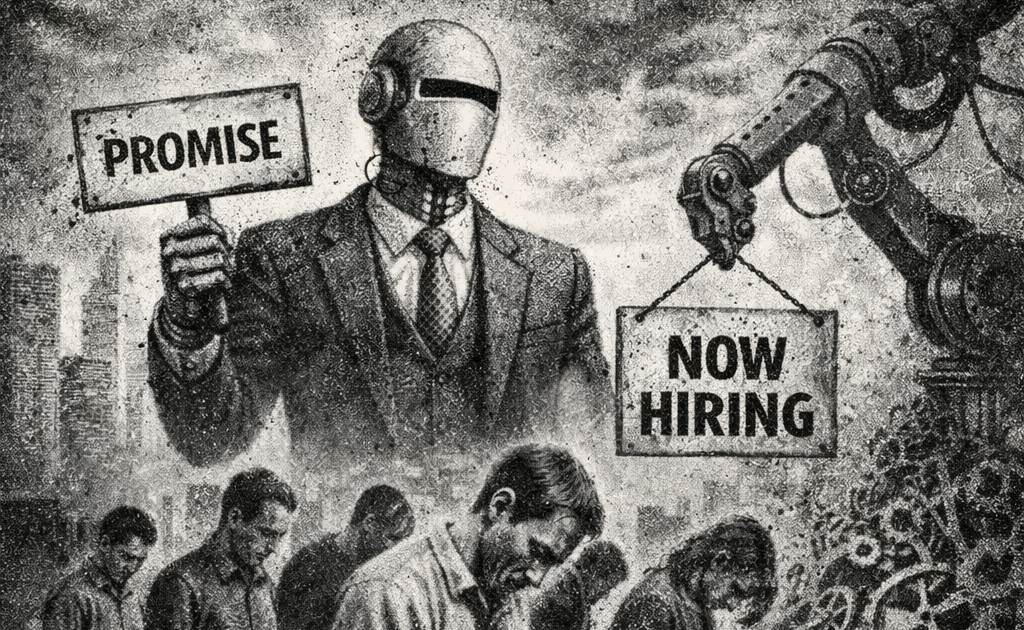
When HEI published “Guild Education: Enablers of Anti‑Union Corporations and Subprime College Programs” in April 2021, the piece raised serious concerns about Guild’s business model, its corporate clients, and the value of its touted “education as a benefit” for working-class employees. That early reporting highlighted the risk that Guild’s platform — while appearing to offer opportunity — might deliver little meaningful upward mobility while embedding workers more deeply in corporate control.
Almost five years later, the unfolding story of Guild reveals a deeper crisis: repeated layoffs, leadership instability, and employee dissatisfaction have compounded internal challenges, creating a disconnect between the company’s outward mission and the lived realities of its workforce.
In 2021, HEI documented Guild’s extensive client network, which included major employers such as Walmart, Lowe’s, and Chipotle. Its partnerships with both for-profit and nonprofit education providers raised questions about the quality of credentials and long-term outcomes. HEI noted that only a small percentage of eligible employees at these companies accessed Guild’s tuition benefits, highlighting limits in the platform’s reach. At the time, Guild was framed as part of a broader “robocollege” ecosystem, where corporate-sponsored online programs risked low completion rates and limited returns for learners.
The subsequent years have underscored these concerns. After a reported peak valuation of $4.4 billion in 2022, Guild’s value declined sharply by 2024, with secondary market activity placing it around $1.3 billion. The company experienced multiple rounds of layoffs, including a 25 percent workforce reduction in May 2024, adding to prior cuts and heightening employee insecurity. Under new leadership following the departure of founder CEO Rachel Romer Carlson, Guild pivoted strategically, rebranding itself from “Guild Education” to simply “Guild” and acquiring Nomadic Learning to expand its corporate learning offerings.
While the company reports significant growth metrics — including expanded access to nearly 500,000 new employees and over $1 billion saved in tuition — employee reviews reveal a starkly different internal reality. Former and current staff describe high stress, frequent goal-post shifts, and a demoralizing culture marked by favoritism and inequity. Coaching, once central to Guild’s mission, is now characterized by rigid metrics, performance improvement plans, and limited room for meaningful mentorship. Burnout, extended medical leaves, and frustration with stalled internal mobility are widespread. Many employees report that the company’s original social justice mission has been hollowed out in practice, leaving staff disconnected from the work they once found meaningful.
Guild’s pivot toward corporate learning reflects broader trends in workforce development, skills-based hiring, and talent management. While the shift may offer employers measurable returns in retention and internal mobility, it also signals a departure from the promise of genuine educational uplift. For employees drawn to Guild for its original mission, the change raises questions about whose needs are being prioritized and at what cost.
The story of Guild underscores several pressing concerns. Credibility gaps between marketing and internal realities leave workers vulnerable to exploitation. Corporate priorities have overtaken educational mission, demonstrating how profit motives can override commitments to social equity. The devaluation of coaching and credentials as meaningful education risks normalizing lower-quality programs tied primarily to employer needs. For other corporate-sponsored education and edtech ventures, Guild’s trajectory offers a cautionary tale: scaling and investor demands can quickly erode mission and employee well-being.
Guild’s rise was once seen as a model of opportunity creation for working adults, but the experiences of its employees reveal the fragility of that promise. By 2025, the company is less a beacon of social mobility than a case study in what can happen when education becomes a tool for corporate talent management. For readers committed to equity, accountability, and lifelong learning, Guild’s story serves as a warning: marketing and good intentions are insufficient protections when leadership and corporate priorities fail.
It is tempting to regard AI as a panacea for addressing our most urgent global challenges, from climate change to resource scarcity. Yet the truth is more complex: unless we pair innovation with responsibility, the very tools designed to accelerate sustainability may exacerbate its contradictions.
A transformative potential
Let us first acknowledge how AI is already reshaping sustainable development. By mapping patterns in vast datasets, AI enables us to anticipate environmental risks, optimise resource flows and strengthen supply chains. Evidence suggests that by 2030, AI systems will touch the lives of more than 8.5 billion people and influence the health of both human and natural ecosystems in ways we have never seen before. Research published in Nature indicates that AI could support progress towards 79% of the Sustainable Development Goals (SDGs), helping advance 134 specific targets. Yet the same research also cautions that AI may impede 59 of those targets if deployed without care or control.
In practice, this means smarter energy grids that balance load and demand, precision agriculture that reduces fertiliser waste and environmental monitoring systems that detect deforestation or pollution in real time. For a planet under pressure, these scenarios offer hope to do less harm and build more resilience.
The hidden costs
Even so, we must confront the shadows cast by AI’s advancements. An investigation published earlier this year warns that AI systems could account for nearly half of global data-centre power consumption before the decade’s end. Consider the sheer scale: vast server arrays, intensive cooling systems, rare-earth mining and water-consuming infrastructure all underpin generative AI’s ubiquity. Worse still, indirect carbon emissions tied to major AI-capable firms reportedly rose by 150% between 2020 and 2023. In short, innovation meant to serve sustainability imposes a growing ecological burden.
Navigating trade-offs
This tension presents an essential question: how can we reconcile AI’s promise with its cost? Scholars warn that we must move beyond the assumption that ‘AI for good’ is always good enough. The moment demands a new discipline of ‘sustainable AI’: a framework that treats resource use, algorithmic bias, lifecycle impact and societal equity as first-order concerns.
Practitioners must ask not only what AI can do, but how it is built, powered, governed and retired. Efficiency gains that drive consumption higher will not deliver sustainability; they may merely escalate resource demands in disguise.
A moral and strategic imperative
For educators, policymakers and business leaders, this is more than a technical issue; it is a moral and strategic one. To realise AI’s true potential in advancing sustainable development, we must commit to three priorities:
Energy and resource transparency: Organisations must measure and report the footprint of their AI models, including data-centre use, water cooling, e-waste and supply-chain impacts. Transparency is foundational to accountability.
Ethical alignment and fairness: AI must be trained and deployed with due regard to bias, social impact and inclusivity. Its benefits must not reinforce inequality or externalise environmental harms onto vulnerable communities.
Integrative education and collaboration: We need multidisciplinary expertise, engineers fluent in ecology, ethicists fluent in algorithms and managers fluent in sustainability. Institutions must upskill young learners and working professionals to orient AI within the broader context of planetary boundaries and human flourishing.
MLA College’s focus and contribution
At MLA College, we recognise our role in equipping professionals at this exact intersection. Our programs emphasise the interrelationship between technology, sustainability and leadership. Graduates of distance-learning and part-time formats engage with the complexities of AI, maritime operations, global sustainable development and marine engineering by bringing insight to sectors vital to the planet’s future.
When responsibly guided, AI becomes an amplifier of purpose rather than a contraption of risk. Our challenge is to ensure that every algorithm, model and deployment contributes to regenerative systems, not extractive ones.
The promise of AI is compelling: more accurate climate modelling, smarter cities, adaptive infrastructure and just-in-time supply chains. But the challenge is equally formidable: rising energy demands, resource-intensive infrastructures and ungoverned expansion.
When responsibly guided, AI becomes an amplifier of purpose rather than a contraption of risk
Our collective role, as educators and practitioners, is to shape the ethical architecture of this era. We must ask whether our technologies will serve humanity and the environment or simply accelerate old dynamics under new wrappers.
The verdict will not be written on lines of code or boardroom decisions alone. It will be inscribed in the fields that fail to regenerate, in the communities excluded from progress, in the data centres humming with waste and in the next generation seeking meaning in technology’s promise.
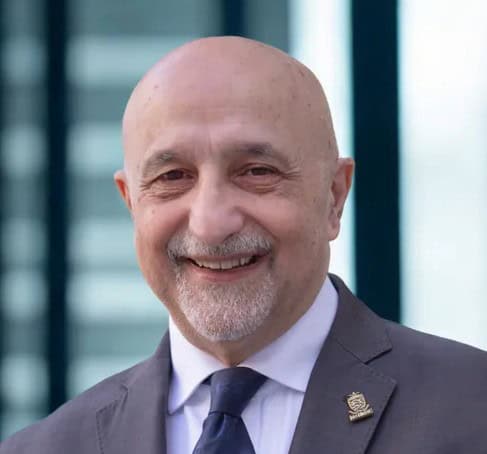
About the author: Professor Mohammad Dastbaz is the principal and CEO of MLA College, an international leader in distance and sustainability-focused higher education. With over three decades in academia, he has held senior positions including deputy vice-chancellor at the University of Suffolk and pro vice-chancellor at Leeds Beckett University.
A Fellow of the British Computer Society, the Higher Education Academy, and the Royal Society of Arts, Professor Dastbaz is a prominent researcher and author in the fields of sustainable development, smart cities, and digital innovation in education.
His latest publication, Decarbonization or Demise – Sustainable Solutions for Resilient Communities (Springer, 2025), brings together cutting-edge global research on sustainability, climate resilience, and the urgent need for decarbonisation. The book builds on his ongoing commitment to advancing the UN Sustainable Development Goals through education and research.
At MLA College, Professor Dastbaz continues to lead transformative learning initiatives that combine academic excellence with real-world impact, empowering students to shape a sustainable future.
With the dawn of a new year ahead, anyone looking for new opportunities can find one in nursing, with a wealth of job openings currently available.
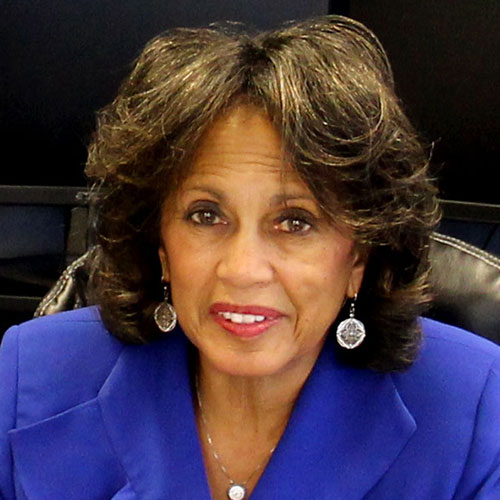
Beverly Malone, Ph.D., RN, FAAN
President and CEO, National League for Nursing
A persistent shortage of registered nurses (RNs) and licensed practical nurses (LPNs) is at the root of nursing jobs going unfilled, caused by:
An aging nursing workforce, prompting a wave of retirements accelerated by the COVID-19 pandemic
The increased demand for healthcare by the aging Baby Boomer generation
Job stress and burnout precipitating workforce exits, particularly by nurses with less than two years of experience
A shortage of nurse educators, limiting the capacity of nursing programs to admit more qualified applicants
Among the additional effects of too few nurses are higher levels of medication, safety, and other clinical errors, and potential hospital closures in regions with the lowest ratio of nurses to patients. For example, in June 2023, there were nearly 300 rural hospitals at risk of immediate closure. Texas and Kansas led this trend, with 29 of their hospitals facing imminent shutdown.
Both states’ widely dispersed populations meant that the loss of vital healthcare infrastructure would have a devastating ripple effect on local economies, in addition to threatening healthcare access for some of society’s most vulnerable. So, how to address these multiple challenges?
Encouraging more nurse educators
One obvious approach to expand the nursing workforce is to hire more nurse educators to prepare a greater number of nurses for practice. While this goal may sound simple, in reality, it is hard to achieve, given budget constraints and the lack of state, federal, and local funding to support clinical nurses desiring to transition into education.
Still, there are so many rewards that come with a career in nursing or nursing education — or both. Yes, it’s more than possible to combine the daily satisfactions of clinical practice with the long-term fulfillment inherent in teaching, mentoring, and preparing outstanding practice-ready practitioners. That remains true whether you become an instructor in academia exclusively or a clinical nurse educator, supplementing your own nursing practice in an academic medical center.
Nursing itself has become a multi-dimensional field with a number of career pathways, including advanced practice roles. Specialties like nurse-anesthetist or doctor of nursing practice (D.N.P.) often come with welcome higher paychecks and professional status.
Plus, with nurses now providing more of the frontline preventative care and chronic disease management in community clinics and through non-traditional healthcare settings, a variety of job opportunities may provide scheduling flexibility that’s compatible with family responsibilities.
Nursing education offers an incredible opportunity to engage in research that has the potential to transform the educational landscape for generations. Nurse educators, with their scholarly expertise, are also often at the forefront of nursing and community leadership, tapped to consult in the highest circles of government, public policy, nonprofits, and industry.
The sky is the limit. Consider exploring the possibilities of nursing and nursing education, while helping resolve one of today’s most urgent crises: too few healers to provide the healing.
When Jake Winston began looking at colleges in fall 2019, he was primarily looking at public colleges in his home state of North Carolina, as he felt those would be the only institutions he could afford. He was interested in Washington & Lee University, in Virginia, due to its location—far enough for a change of scenery, but not so far he couldn’t visit home—and its rich and complex history. But he didn’t think he could afford the high price tag.
At a presentation by admissions officials, though, he learned about the W&L Promise, which covers the full cost of tuition for all students whose families fall into a specific income bracket. Once he got his aid offers back from colleges, WLU was the obvious choice, costing him just $5,000 annually, a sum that he paid out of pocket using money he made from summer research jobs.
“Being able to know I was going to graduate debt-free from the start allowed me to pick what I was passionate in, and that’s teaching, which is not the highest-paying role in the country,” said Winston, who now teaches seventh-grade history in Northern Virginia. “But it is what I wanted to do with my life.”
WLU has one of the oldest tuition-guarantee programs in the country. It launched in 2014, offering free tuition to students whose families make less than $75,000 each year; now, that number has surged up to $150,000, and students whose family income is less than $75,000 also get free room and board.
Since then, more and more colleges—especially, but not only, selective private institutions—are offering completely free tuition to students whose families fall under a certain income threshold. Nowadays, that maximum is typically $100,000 annually, an income bracket that includes about 57 percent of U.S. families as of 2024, according to an analysis by the Motley Fool. But some have expanded the offer of free tuition to those whose families make as much as $200,000, encompassing all but 16 percent of American households. (Most programs also require the families to have typical assets, and some are only open to in-state students.)
Administrators at more than half a dozen institutions with promise programs told Inside Higher Ed that they hope that the move will attract low-income students who didn’t realize how financially accessible higher education, even at expensive institutions, can be. It’s also an effort to improve cost transparency—an area that has frequently come under scrutiny as the actual cost of college has become increasingly obscured by scholarships, aid, fees and books and other indirect costs.
Breaking the Cost Barrier
For many institutions offering tuition guarantees—also called promise programs—it’s more of a change in rhetoric than in actual financial aid policy.
Carnegie Mellon University in Pittsburgh, for example, announced a program last November guaranteeing free tuition for students with family incomes under $75,000 and promising those with incomes under $100,000 wouldn’t have to take out any student loans to access a CMU education, beginning with the incoming class in fall 2025. But according to Brian Hill, the university’s associate vice provost for student financials and enrollment systems, that’s how the university had already been quietly operating since 2016.
“In truth, it was to make sure that prospective students knew that CMU was an affordable option for them. That was the primary reason,” he said. “We’ve been saying that we met full demonstrated financial need for our students … [but] a barrier we don’t know if we’d gotten through or not is students that would look at the sticker price [of $67,020 per year] and just completely write CMU off before they even explored it.”
At the same time, experts argue that the price of higher education has actually gone down when accounting for inflation and the high rate of aid students generally receive. For several decades, higher education has followed a model in which institutions advertise a high cost of attendance but a significant number of students receive large scholarships. This approach helps to make higher education look like a luxury product while students and families feel like they’re getting a good deal. But that strategy has come to bite institutions in the butt, according to W. Joseph King, former president of Lyon College and a higher education consultant, as many low- and middle-income students now feel the high cost of college makes an education unattainable.
“What this led to was almost like an arms race of rising stated tuition numbers and a fall in net tuition numbers. All sorts of groups, including the federal government, have been trying to get to numbers that are more reflective of the actual cost,” he said.
Promise programs aim to change that narrative by showing low- and middle-income families that getting an education even at a seemingly pricey school can be achievable.
Colleges have made other attempts to communicate that message to students and parents. That includes developing net price calculators, which often show that low-income students would be paying just a fraction of the sticker price, or announcing that their institution is able to meet all of a student’s demonstrated financial need—a number based on a federal student aid formula that determines how much a family is able to pay.
But many families have no idea what demonstrated financial need means or are unaware of net price calculators, enrollment professionals say. Simply saying that an institution offers free tuition can be the ultimate tool for price transparency, according to Milyon Trulove, vice president and dean of admission and financial aid at Reed College, which announced plans to expand its regional promise program—currently available only to students in Oregon and Washington—to all students with family incomes under $100,000 in 2026.
The institution also has a net price calculator, he said. But if presented with both that calculator and the promise of free tuition, the latter will immediately be meaningful to students, whereas the former won’t.
“[Students] say, ‘This makes sense to me, today, right now … and now I can listen to all the other stuff about fit and anxiety about money is no longer in the way of me fully participating in the college admission process,’” he said.
Along with institutions offering free tuition to any student who fits within a certain income bracket, even more institutions offer tuition guarantees to students based on grade point average or for transferring from a local community college system.
‘Rigorous Financial Planning’
Most of the university officials who spoke with Inside Higher Ed said that their institution was in a very strong financial position and able to afford to support so many students because of large endowments and generous donations, including fundraising specifically aimed at increasing student aid.
From 2016 to 2024, Carnegie Mellon, for example, increased its undergraduate financial aid budget 86 percent.
“We truly made a massive commitment to making affordability a real thing at CMU,” said Hill. “I think we’re in a very positive position in terms of finances, but it took a lot of commitment from … executive leadership to make this a priority.”
Wake Forest, which announced last week that it will offer free tuition to all North Carolina students with family incomes below $200,000, is one of the few schools that said that its promise program, called the North Carolina Gateway, would substantially increase the total amount of aid it gives out. President Susan Wente said that, similarly to CMU, the funds for the initiative come in large part from a massive fundraising effort that has raised over $150 million for financial aid since 2022.
“This involved rigorous financial planning and analysis and knowing we could meet the commitment, should we announce it,” she said.
But not every university with a promise program is leaning on massive donation campaigns. Radford University, a public institution in Virginia, was able to begin offering free tuition to all students from Virginia with incomes below $100,000 simply because of the ample amount of funding it gets from the state, according to Dannette Gomez Beane, vice president for enrollment management and strategic communication.
Virginia tends to be generous toward higher education, Beane said, but the two regional public universities in southwest Virginia, which has the lowest college-going rate of higher education of any area in the state, receive the most funding. That’s what allowed Radford to begin its promise program, which the institution promoted heavily in the 60-mile radius around its campus, in 2024.
“With all things higher ed and higher ed financial aid, not everything is sure, and we’re learning that this year more than ever,” she said. “I think that state funding, federal funding—if you have models that are dependent on those, you have to constantly be adjusting your models … there is that vulnerability, but we’re just gracious that we’ve had favor with the state.”
Boosting Low-Income Enrollment
Although many of these programs are new, those that have been around for multiple years have seen positive results. At Washington & Lee, Sally Richmond, vice president for admissions and financial aid, said that there have been massive jumps in enrollment of rural students, first-generation students and Pell-eligible students since she joined the university in 2016.
It’s impossible to say whether those changes can be attributed specifically to the university’s promise program, she noted. But, she said, “our financial aid office, who is certainly on the front line of having these conversations along with our admissions team, speaks to the fact that this concept of the promise is the one that resonates most with our prospective students and families.”
Reed College, similarly, saw a 25 percent increase in middle-income students in its program’s first year, during which it was only available to students from Oregon and Washington.
Wente, Wake Forest’s president, said she is eager to see how the university’s newly announced tuition guarantee program will impact low- and middle-income enrollment.
“As a scientist myself, we’re going to pilot this, look at its impact, look at how we can ensure that it’s really achieving what we hope in terms of offering students greater access,” she said. “In terms of the middle and lower income bands, those are the students who often don’t have as many options. So, how do we give them as many options as possible?”
For some students, enrolling in college can feel like a gamble due to the high cost and lack of a clear career at the end of the program. But a growing number of colleges and universities are guaranteeing students will land a job or graduate program slot within months of graduation.
Bethel University in St. Paul is the latest to make such a promise; Bethel’s Career Commitment provides students in the College of Arts & Sciences with additional assistance if they are still unemployed or not enrolled in graduate school six months after graduation—including by offering a tuition-free spot in a graduate-level Bethel course or a staff job at the university.
The trend indicates a growing awareness among institutions of their responsibility to provide students with career-development opportunities, as well as their recognition that a lack of institutional support can impact the college’s perceived value.
A recent survey by Tyton Partners found that among students who believe college is worth the cost, 95 percent think higher education is preparing them well for jobs and careers.
In general, students give fair ratings to the work campuses are currently doing to prepare them for their professional lives. A 2024 Student Voice survey by Inside Higher Ed and Generation Lab found that the plurality of students rate their institution’s efforts in career development as “average” (34 percent), 44.6 percent combined consider their college “good” or “excellent,” and 18 percent said poor or below average.
How it works: A key piece of the Bethel Career Commitment is that students must undertake significant measures to advance their own career before the university will open additional doors of support.
Students must complete four “phases” of career preparation prior to graduation to be eligible for a spot in Bethel’s career commitment plan. The elements include creating a Handshake profile, meeting with a career-development coach and participating in an internship. And after they earn their degree, students must meet with a career coach monthly and apply for at least 20 jobs per month to complete the final phase.
In addition, students must have a minimum 3.0 GPA, be in good financial standing with the university and be willing to relocate.
For students who don’t meet all the eligibility requirements, the university provides postgraduation career support in the form of coaching, Bethel University president Ross Allen told Inside Higher Ed.
“Today, 99 percent of Bethel graduates are employed or in graduate school within a year, so we expect a small number of graduates will need the additional postgraduation support,” Allen said.
He anticipates that graduate-level credits will often be “the most helpful next step vocationally,” but the university may offer short-term employment opportunities to students based on staffing needs, Allen said.
A national picture: Other institutions, including Thomas College in Maine, Davenport University in Michigan, Curry College in Massachusetts and the University of Tulsa, guarantee their graduates employment, also on the condition that students participate in career development while enrolled.
At Davenport, for example, students in select majors who earn a 3.0 GPA, complete an internship or experiential learning opportunity, and participate in extracurricular activities are supported by the DU Employment Guarantee. The plan allows students to enroll in 48 additional credits tuition-free in a graduate, undergraduate or professional program at the university, as well as participate in career coaching and recruitment efforts.
At Curry College, students who opt into the Curry Commitment receive assistance with federal student loans for up to 12 months. They are also given a paid internship or a tuition waiver for six credits of graduate studies at the institution. To be eligible, a student must participate in career advising, workshops and résumé development; earn at least a 2.8 GPA; and graduate within four years.
None of these institutions differentiates among the types of job a student may secure—making no distinction between a part-time role or one that doesn’t require a bachelor’s degree—leaving some questions about the underemployment of college graduates.
If your student success program has a unique feature or twist, we’d like to know about it. Click here to submit.
As a college president, I see the promise of higher education fulfilled every day. Many students at my institution, Whittier College, are the first in their families to attend a university. Some are parents or military veterans who have already served in the workforce and are returning to school to gain new skills, widen their perspectives and improve their job prospects.
These students are the future of our communities. We will rely on them to fill critical roles in health care, education, science, entrepreneurship and public service. They are also the students who stand to lose the most under the proposed fiscal year 2026 federal budget, and those who were already bracing for impact from the “One Big Beautiful Bill” cuts, including to the health care coverage many of them count on.
The drive with which these extraordinary students — both traditionally college-aged and older — pursue their degrees, often while juggling caregiving commitments or other responsibilities, never fails to inspire me.
Related: Interested in innovations in higher education? Subscribe to our free biweekly higher education newsletter.
We do not yet know the precise contours of the spending provisions Congress will consider once funding from a continuing resolution expires at the end of September. Yet we expect they will take their cues from the president’s proposed budget, which slashes support for students and parents and especially hammers those already struggling to improve their lives by earning a college degree, with cuts to education, health and housing that could take effect as early as October 1.
That budget would mean lowering the maximum Pell Grant award from $7,395 to $5,710, reversing a decade of progress. For the nearly half of Whittier students who received Pell Grants last year, this rollback would profoundly jeopardize their chances of finishing school.
So would the proposal to severely restrict Federal Work-Study, which supports a third of Whittier students according to our most recent internal analysis, and to eliminate the Supplemental Educational Opportunity Grant, which more than 16 percent of our student body relies upon. In addition, this budget would impose a cap on Direct PLUS Loans for Parents, which would impact roughly 60 percent of our parent borrowers. It would also do away with the Direct PLUS Loans for Graduates program.
These programs are lifelines, not just for our students but for students all across the country. They fuel social mobility and prosperity by making education a force for advancement through personal work ethic rather than a way to rack up debt.
If enacted, these proposed cuts would gut the support system that has enabled millions of low-income students to earn a college degree.
Higher education is a bridge. To cross it and achieve their full potential, students from all walks of life must have access to the support and resources colleges provide, whether through partnerships with local high schools or with professional gateway programs in engineering, accounting, business, nursing, physical therapy and more. Yet, to access these invaluable programs, they must be enrolled. How will they reach such heights if they suddenly can’t afford to advance their studies?
The harm I’ve described doesn’t stop with cuts to financial aid, loans and services. Proposed reductions also target research funding for NASA, NIH and the National Science Foundation. One frozen NASA grant has already led to the loss of paid student research fellowships at Whittier, a setback not just in dollars but in momentum for students building real-world skills, networks and résumés.
These research opportunities often enable talented first-generation students to connect their classroom learning to career pathways, opening the door to graduate school, lab technician roles and futures in STEM fields. We’ve seen how federal funding has supported student projects in everything from climate data analysis to environmental health.
Stripping away support for hands-on research undermines the federal government’s own calls for colleges like ours to better prepare students for the workforce by dismantling the very mechanisms that make such preparation possible.
It’s particularly disheartening that these changes will disproportionately hurt those students who are working the hardest to achieve their objectives, who have done everything right and have the most to lose from this lack of investment in the future.
The preservation and strengthening of Pell, Work-Study, Supplemental Educational Opportunity grants and federal loan programs is not a partisan issue. It is a moral and economic imperative for a nation that has long been proud to be a land of opportunity.
Let’s build a system for strivers that opens doors instead of slamming them shut.
Let’s recommit to higher education as a public good. Today’s students are willing to work hard to deserve our continuing belief in them.
Kristine E. Dillon is the president of Whittier College in California.
The Hechinger Report provides in-depth, fact-based, unbiased reporting on education that is free to all readers. But that doesn’t mean it’s free to produce. Our work keeps educators and the public informed about pressing issues at schools and on campuses throughout the country. We tell the whole story, even when the details are inconvenient. Help us keep doing that.
Health and aged care opposition spokeswoman Anne Ruston debating Health and Aged Care Minister Mark Butler at the National Press Club of Australia in Canberra. Picture: Martin Ollman
Regional and rural Australia’s doctor shortage is being targeted as an election issue by the Coalition, which is promising to fund an extra 200 students to train as general practitioners to work in the bush.
Please login below to view content or subscribe now.
Open universities have long symbolised a radical departure from the exclusivity of conventional universities. Conceived as institutions of access, intellectual emancipation, and social transformation, they promised to disrupt rigid academic hierarchies and democratise knowledge. Yet, as higher education is increasingly reshaped by market logics, can open universities still claim to be engines of social progress, or have they become institutions that now reproduce the very inequalities they sought to dismantle?
This question is not merely academic; it is profoundly political. Across the globe, democratic institutions are under siege, and the erosion of democracy is no longer an abstraction – it is unfolding in real time (cfEIU, 2024; Jones, 2025). The rise of far-right ideologies, resurgent racism, intensified attacks on women’s and LGBTQ+ rights, and the erosion of protections for migrants and marginalised communities all point to a crisis of democracy that cannot be separated from the crisis of education (Giroux, 2025). As Giroux (1984) argues, education is never neutral; it can operate as both a potential site for fostering critical consciousness and resistance and a mechanism for reproducing systems of social control and domination. Similarly, Butler (2005) reminds us that the very categories of who counts as human, who is deemed grievable, and whose knowledge is legitimised are deeply political struggles.
Open universities, once heralded as radical interventions in knowledge production, now find themselves entangled in these struggles. Increasingly, they are forced to reconcile their egalitarian aspirations with the ruthless pressures of neoliberalism and market-driven reforms. The challenge they face is no less than existential: to what extent can they uphold their role as spaces of intellectual and social transformation, or will they become further absorbed into the logics of commodification and control?
My article (Filippakou, 2025) in Policy Reviews in Higher Education, ‘Two ideologies of openness: a comparative analysis of the Open Universities in the UK and Greece’,foregrounds a crucial but often overlooked dimension: the ideological battles that have shaped open universities over time. The UK Open University (OU) and the Hellenic Open University (HOU) exemplify two distinct yet converging trajectories. The UK OU, founded in the 1960s as part of a broader post-war commitment to social mobility, was a political project – an experiment in making university education available to those long excluded from elite institutions. The HOU, by contrast, emerged in the late 1990s within the European Union’s push for a knowledge economy, where lifelong learning was increasingly framed primarily in terms of workforce development. While both institutions embraced ‘openness’ as a defining principle, the meaning of that openness has shifted – from an egalitarian vision of education as a public good to a model struggling to reconcile social inclusion with neoliberal imperatives.
A key insight of this analysis is that open universities do not merely widen participation; they reflect deeper contestations over the purpose of higher education itself. The UK OU’s early success inspired similar models worldwide, but today, relentless marketisation – rising tuition fees, budget cuts, and the growing encroachment of corporate interests – threatens to erode its founding ethos.
Meanwhile, the HOU was shaped by a European policy landscape that framed openness not merely as intellectual emancipation but as economic necessity. Both cases illustrate the paradox of open universities: they continue to expand access, yet their structural constraints increasingly align them with the logic of precarity, credentialism, and market-driven efficiency.
This struggle over education is central to the survival of democracy. Arendt (1961, 2005) warned that democracy is not self-sustaining; it depends on an informed citizenry capable of judgment, debate, and resistance. Higher education, in this sense, is not simply about skills or employability – it is about cultivating the capacity to think critically, to challenge authority, and to hold power to account (Giroux, 2019). Open universities were once at the forefront of this democratic mission. But as universities in general, and open universities in particular, become increasingly instrumentalised – shaped by political forces intent on suppressing dissent, commodifying learning, and hollowing out universities’ transformative potential – their role in sustaining democratic publics is under threat.
The real question, then, is not simply whether open universities remain ‘open’ but how they define and enact this openness. To what extent do they serve as institutions of intellectual and civic transformation, or have they primarily been reduced to flexible degree factories, catering to market demands under the guise of accessibility? By comparing the UK and Greek experiences, this article aims to challenge readers to rethink the ideological stakes of openness in higher education today. The implications extend far beyond open universities themselves. The broader appeal of this analysis lies in its relevance to anyone interested in universities as sites of social change. Open universities are not just alternatives to conventional universities – they represent larger struggles over knowledge, democracy, and economic power. The creeping normalisation of authoritarian politics, the suppression of academic freedom, and the assault on marginalised voices in public discourse demand that we reclaim higher education as a site of resistance.
Can open universities reclaim their radical promise? If higher education is to resist the encroachment of neoliberalism and reactionary politics, we must actively defend institutions that prioritise intellectual freedom, civic literacy, and higher education for the public good. The future of open universities – and higher education itself – depends not only on institutional policies but on whether scholars, educators, and students collectively resist these forces. The battle for openness is not just about access; it is about the kind of society we choose to build – for ourselves and the generations to come.
Ourania Filippakou is a Professor of Education at Brunel University of London. Her research interrogates the politics of higher education, examining universities as contested spaces where power, inequality, and resistance intersect. Rooted in critical traditions, she explores how higher education can foster social justice, equity, and transformative change.
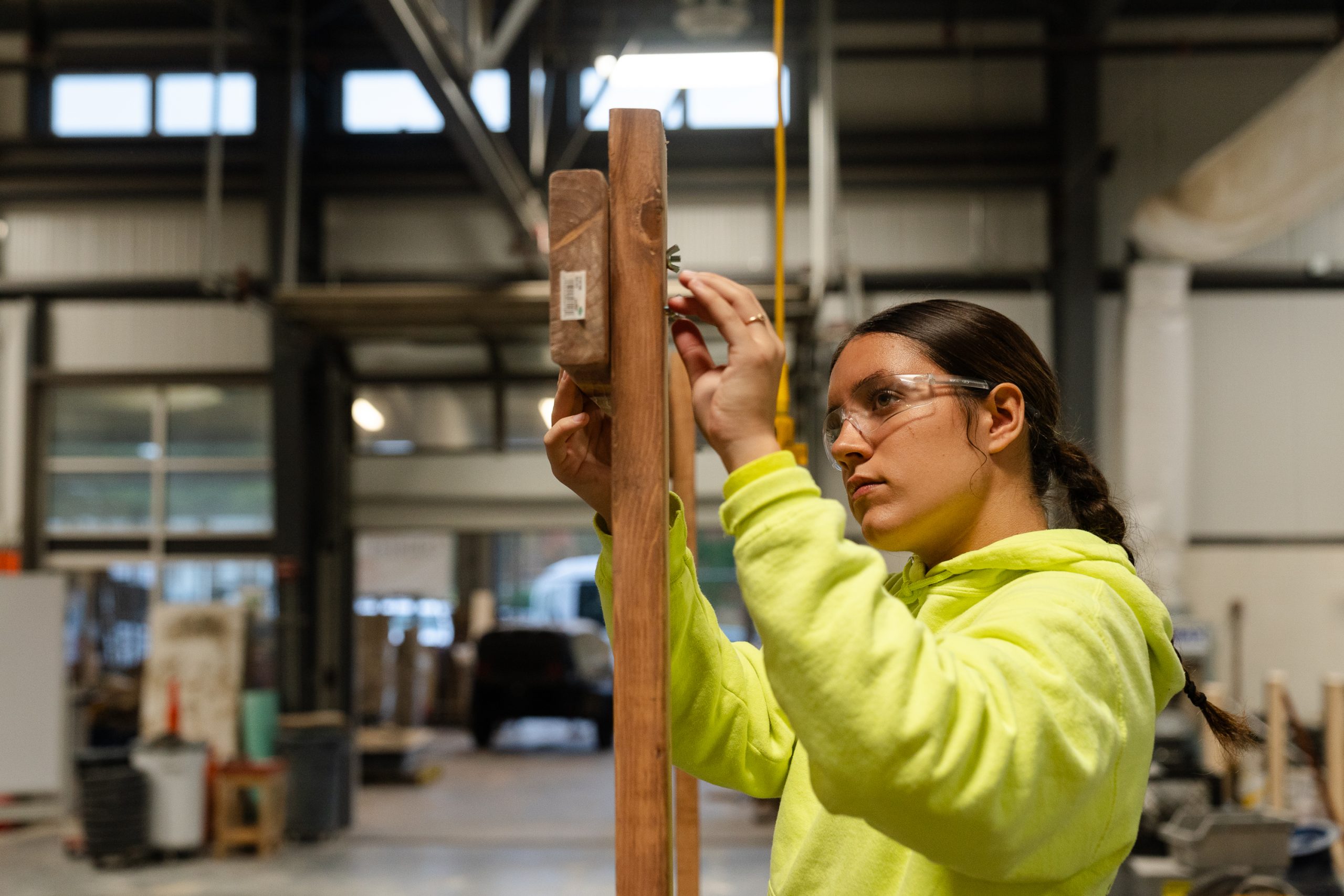
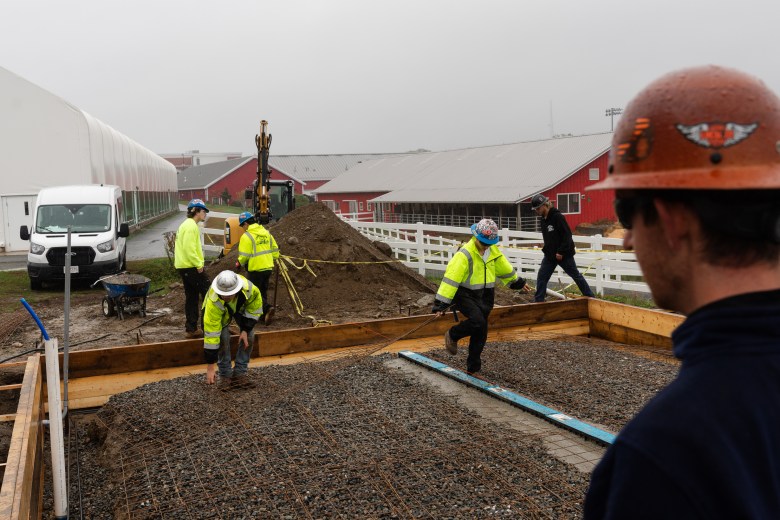
DANVERS, Mass. — It’s a rainy fall day in New England, but that doesn’t stop a group of students at Essex Tech North Shore Agricultural & Technical High School from donning work boots and hard hats and getting to work building a vegetable wash station on campus. This afternoon, they are installing wire mesh and prepping for a concrete pour under the watchful eye of Laborers’ Local 22 member Chris Moore, their teacher. “Hard hat hair don’t care,” reads the sticker on the hat worn by a young woman in the program.
The construction craft laborers track at Essex Tech, which Moore helps lead, is one of only a few high school-based programs in Massachusetts co-sponsored by a trade union. Students are initiated in union norms and expectations early on. Two Essex Tech teachers in the program are Local 22 members, with the New England Laborers’ Training Academy, which runs the laborers’ apprenticeship, paying Moore’s salary. As seniors, students can attend union meetings. And after graduation, many of them go straight into a union apprenticeship, fast tracked to a journeyman’s license. For all these reasons, Owen Paniagua, a 16-year-old junior, described the program as “a golden ticket to job security,” noting that he has learned everything from carpentry and concrete work to excavation and masonry.
“We feel as laborers that we should be in the schools,” said Lou Mandarini Jr., the retired business manager of Local 22 who now helps run the union’s school partnerships. “This is where your workforce is … If you treat young kids with respect, once they buy into your program, they are dead loyal.”
Students in the construction craft laborer program gather around Dave Collins, masonry head, before leaving to work on a project at Essex North Shore Agricultural & Technical High School in Danvers, Mass. Credit: Sophie Park for The Hechinger Report
In several states, including Massachusetts, Maryland and Louisiana, trade union leaders have forged similar, groundbreaking partnerships with high school CTE programs in recent years, ponying up their own resources for the efforts. There’s also been an uptick in training alliances between trade unions and community colleges. In a 2023 brief, AFL-CIO leadership encouraged these partnerships. “No one knows better how to do a job than someone who does the job,” the brief stated.
Whether more unions decide to embrace this advice likely will play a large role in determining the long-term health and vibrancy of both career and technical high schools, and the trades themselves.
Yet progress has been piecemeal and halting. And it’s too early to tell whether isolated partnerships across the country will translate into widespread change, said Taylor White, the director of postsecondary pathways for youth at the Center on Education and Labor at the think tank New America. “Schools and unions speak very different languages,” she noted. The same, she added, is true of employers and schools.
The longstanding dearth of partnerships says a lot about the history of America’s trade unions, which traditionally have operated as insular, sometimes parochial institutions, preferring to maintain tight control over their membership pipeline, and their training. In some communities, such as Milwaukee, that insularity kept unions predominantly white and male for generations. “Historically a lot of the high-paying skilled trades were handed down from father to son,” said Lauren Baker, a former education director in the printers’ union who also led Milwaukee Public Schools’ career and technical education program between 2002 and 2012. “That kept the trades looking a certain way.”
Mandarini, the retired union leader, said that in the past, “old timers didn’t help the young people.” But increasingly, he said, he hopes that mentality will become an anomaly.
Owen Paniagua, 16, and Isabella Gonzalez, 17, both juniors in the Construction Craft Laborer program at Essex North Shore Agricultural & Technical High School, pose for a portrait at Essex Tech in Danvers, Mass. The Essex Tech program’s partnership with the laborers’ union helps to foster job prospects for graduating students. Credit: Sophie Park for The Hechinger Report
For decades, many vocational school students have been held back by a lack of meaningful partnerships with both unions and employers at their schools, often leaving them without relevant training or clear pathways into jobs. “There’s skepticism from unions and employers that high school kids are ready for real training and real work,” said White, of New America.
There’s also been a longstanding desire on the part of many unions to maintain tight control over who can access often coveted apprentice slots.
Until recent years, most trade union apprenticeships in the Milwaukee area had admissions criteria that shut out many women, low-income, and Black and Hispanic city residents. “They were such closed communities, and it was a long process of breaking down some of those walls,” Baker said.
Back in the mid-1990s, Baker was the first woman to run a printing apprenticeship program for the union. In part to open up the field to as diverse a pool as possible, Baker abolished a requirement that apprentices had to be high school graduates. “Pretty much all a high school diploma told me was that they sat in a chair for four years,” she said, pointing out that many of the apprentices came from the academic bottom of their graduation classes. “I caught holy hell from the apprenticeship community for doing that,” she said.
While the SATs and other college entrance exams have at times been accused of being biased toward privileged white students, Baker said some of the apprenticeship admissions exams were challenging for anyone who hadn’t grown up in the home of someone already working in a specific trade. A question might presume that an applicant had experience helping fix their family’s car, for instance, something that young men were far more likely to have done — and those growing up in urban areas, where fewer households own cars, were far less likely to have done.
For decades, those tests contributed to keeping the construction trade unions, in particular, predominantly white and male. Only two of 16 Milwaukee area construction unions enrolled at least 20 percent Black apprentices in 2007, according to a report from researchers at the University of Wisconsin-Milwaukee. Two of the unions, glazing and tile setters, had no Black apprentices in a city where, at that time, nearly 40 percent of the residents were Black.
Much of that bias and insularity continues in some Boston-area construction trade unions, said Travis Watson, who serves as a commissioner of the Boston Employment Commission and has critiqued some of the unions for their lack of racial diversity, citing specific practices that make it harder for prospective Black members to get a foothold. “If you look at every big downtown project in Boston, there are very few Black people who are working on union construction projects,” he said.
Some of the local unions have made changes to their admissions process to become more accessible to applicants from diverse backgrounds, said Danyson Tavares, who worked for several years in leadership positions at YouthBuild Boston, a pre-apprenticeship program that helps prepare young people of color in the city for jobs in the construction and design industries. But other unions might take applications only once a year or remain secretive about their standards and curriculum. “The electrical union is the one we really want to have more relationships with, there’s such a demand for that workforce,” Tavares said. “We’ve slowly started to penetrate but it’s a lot more work than I expected.”
One 25-year-old who recently finished his pre-apprenticeship in carpentry at YouthBuild said he got an interview with the union but was turned down for an apprenticeship for reasons that he said weren’t entirely clear. “I kind of felt like I wouldn’t get in,” said Keyshawn Kavanaugh. He found a non-union job easily at a company that he likes a lot, but he acknowledges that “the union is the best place to work,” at least from the standpoint of benefits and pension.
In Milwaukee, Baker said she’s seen some positive changes since she ran the printers apprenticeship, with more local unions developing inclusive and transparent admissions. “The trades themselves began to realize that they needed to look beyond their natural base in order to fill jobs,” she said. “It became more apparent that there is a vast opportunity out there with women and people of color.”
The idea that Massachusetts laborers should invest time and money in local schools originated over 20 years ago, when Mandarini and other Local 22 leaders decided they were neglecting a potential asset: kids. Mandarini proposed a pilot partnership to the vocational school in Medford, Massachusetts, just outside of Boston, which started in 2002. It wasn’t easy at first. “How do you adapt to a public school?” he said. “There was a lot of learning that we had to do on both ends.”
The union had to fight against a perception that a four-year college degree was the only path to a stable, rewarding career, Mandarini said. It helped with recruiting to explain to prospective students that, at that time, union laborers could expect to retire with an annuity of about $1.2 million, he added. (In Massachusetts, laborers typically earn between $90,000 and $100,000 annually, and that annuity is now more than $2 million, Mandarini said.)
A school bus sits in a parking lot at Essex North Shore Agricultural & Technical High School in Danvers, Mass. Credit: Sophie Park for The Hechinger Report
Over the years, the partnership model has spread to eight career and technical schools in Massachusetts. At some, the union pays a teacher’s salary, and at others it does not, Mandarini said. “We want to be in every vocational school in Massachusetts,” he said, “and hopefully every vocational school in New England. That’s where our workforce is coming from.”
In rural western Louisiana, it was a private company that encouraged a local trade union to partner with public high schools. The company, CapturePoint, which sells carbon storage services, reached out in March 2023 to the local branch of the United Association of Journeymen and Apprentices of the Plumbing and Pipefitting Industry, asking if the union would help build out a new career and technical track at the Vernon Parish School District.
To make it happen, the company paid for the electricity, classroom equipment and furniture to help turn an old woodworking shop at one of the district’s high schools into an updated welding shop. CapturePoint also took on several ongoing costs, paying for student transportation — the students can come from nine different high schools — and some administrative expenses. The union paid for some reconstruction and all the tools, and provided an instructor. The school offers the space and enrolls 30 students, who can skip their first year of apprenticeship if they join the union after graduating, thereby starting at a higher pay rate. “All of us have skin in the game,” said Lance Albin, who led the partnership for the union.
At high schools with trade union partnerships, there’s no shortage of interested students. Isabella Gonzalez, 17, creator of the “hard hat hair don’t care” sticker, said she hopes to move straight into an apprenticeship with Local 22 when she graduates in a year and a half. Aspiring laborers learn more diverse skills than students in related tracks like plumbing and electrical, she said, opening up the possibility of a greater variety of work.
That day last fall, juniors in the program practiced using a compactor to prep the ground for installation of a patio floor, part of the final stages in rebuilding a large cottage on campus. The construction students have been involved in the project since they poured the cement for the foundation in the summer of 2020, wearing masks during the pandemic’s early days, even outdoors.
By afternoon, the students had transitioned to another work in progress: the vegetable wash station by the greenhouse, where they needed to install enough wire mesh and rebar to do the concrete pour early the next week. “Put your hard hat on and help out,” their teacher Moore reminded a group of students holding back as the rain hardened. “No … statues here.”
Students in the Construction Craft Laborers program at Essex North Shore Agricultural & Technical High School lay mesh while working on a greenhouse washing station at Essex Tech in Danvers, Mass. Credit: Sophie Park for The Hechinger Report
Students say the partnership with Local 22 provides them increased career security and the confidence that they are learning relevant, up-to-date skills: Moore until recently worked part time in the field, including on Boston’s project to restore the tunnel to the city’s Logan Airport.
Paniagua, the 16-year-old student in the program, said he can command a higher pay rate than most of his peers at a part-time carpentry and landscaping job because of the expertise he has gained in the Essex Tech program. He’s used the extra money to buy two new trucks. The union partnership has also allowed him to make more thoughtful, informed choices about career steps, he added. Leaning on his teachers as mentors, Paniagua said he decided to continue studying at a specialized welding school in Wyoming after graduation to maximize his future earning potential. “We know what we want to do here and get on it,” Paniagua said, noting that it’s a stark contrast to some of his friends who are conflicted about the value of a four-year college degree. “We’re not lost,” he said, “or wasting money.”
Former President Joe Biden was exceptionally supportive of the labor movement, and specifically of partnerships between unions and schools. Some labor experts expect some of that support might continue in the new Trump administration. “We’re seeing indications of a Trump administration that might not be as hostile to unions as you might think,” said Shalin Jyotishi, founder and managing director of the Future of Work and Innovation Economy Initiative at New America. He cited Trump nominee Lori Chavez-DeRemer, opposed by many in the business community, for Labor secretary, and the president’s support of the longshoremen’s union over their anti-automation stance.
In any event, “these bottoms-up innovations are already happening locally,” Jyotishi said. “Federal decisions can help or hurt … odds of success, but the proof-of-concept is already out of the bag.”
A bigger question mark may be whether there is the will to expand capacity significantly on the ground. Some of the existing programs have not yet reached students in the most underserved communities who could potentially benefit most from a fast track into a union apprenticeship.
In Massachusetts, for instance, many of the high schools the laborers work with have become increasingly selective in admissions. Students from low-income homes were 30 percent less likely to be accepted at the state’s vocational schools in 2023 and 2024 than those from wealthier households, according to an analysis by the Boston Globe. Similar disparities existed for students receiving special education services and English learners.
The laborers have yet to expand their partnership model to Boston’s Madison Park Technical Vocational High School, where nearly all of the students are Black or Hispanic, about 85 percent come from low-income households, and 92 percent are identified as “high needs” — an umbrella term in Massachusetts that includes students with disabilities, English learners and low-income students, among other groups.
Madison Park, part of the city’s public school district, has some partnerships and many strong programs and instructors, said Bobby Jenkins, an alum and long-time advocate of the school. But the chronic turnover of both superintendents and school leaders in recent years has hindered progress in undertaking some more ambitious partnerships.
Isabella Gonzalez, 17, a junior in the Construction Craft Laborers program at Essex North Shore Agricultural & Technical High School, compacts gravel at the Larkin Cottage, a project site at Essex Tech in Danvers, Mass. Credit: Sophie Park for The Hechinger Report
Mandarini agreed that political and bureaucratic obstacles have made it more challenging to partner with Madison Park. But the union has made it a priority and is in promising talks with city officials about partnering with the school when a proposed new facility might be completed.
“When I was part of the building trades, I used to say, ‘I don’t understand why you aren’t taking more kids, especially in the city of Boston,’” Mandarini said. “Every single trade should be in (Madison Park).’”
For now, that attitude has not spread to all union leaders. It will take a cultural shift from trade union groups to expand their school partnerships beyond scattered, boutique programs. Among other things, they will need to prioritize flexibility and the learning and growth of young people more than they are accustomed to, said White, of New America.
She noted that many union leaders seem aware that they have a pipeline and recruitment issue but remain unsure what to do about it. More school-based partnerships could help not only with that challenge but also with reenergizing and selling unions to future generations of workers — and voters, White added. “All of the polling suggests that young people are pretty pro-union,” she said. “There’s a missed opportunity on the part of unions if they don’t capitalize on that.”
Reporting on this story was supported by the Higher Ed Media Fellowship, where Carr was a fellow in 2024. This year, Carr has a fellowship from New America to report on early childhood issues.
The Hechinger Report provides in-depth, fact-based, unbiased reporting on education that is free to all readers. But that doesn’t mean it’s free to produce. Our work keeps educators and the public informed about pressing issues at schools and on campuses throughout the country. We tell the whole story, even when the details are inconvenient. Help us keep doing that.
Let’s begin with President Donald Trump’s second inaugural address (Jan. 20), if only to contrast it with last week’s condemnation of his lawsuit against J. Ann Selzer, the Des Moines Register, and its parent company Gannett (see also FAN 451, 449 and 436).
Ready? Here it goes:
After years and years of illegal and unconstitutional federal efforts to restrict free expression, I will also sign an executive order to immediately stop all government censorship and bring back free speech to America.
Never again will the immense power of the state be weaponized to persecute political opponents, something I know something about. We will not allow that to happen. It will not happen again. Under my leadership, we will restore fair, equal, and impartial justice under the constitutional rule of law.
Never again! It will not happen again! Stop all government censorship!
And there’s more: When it comes to free speech, all views will be treated with “impartial justice.” Against that promissory note, let us turn to his unprecedented executive order as discussed below.
Executive Order: Jan. 20, 2025
By the authority vested in me as President by the Constitution and the laws of the United States of America, and section 301 of title 3, United States Code, it is hereby ordered as follows:
What follows is a brief description of the Executive Order along with some preliminary comments.
Section 1. Purpose
This section opens with an attack on the Biden administration’s alleged “trampl[ing of] free speech rights” when it comes to “online platforms.” Such abridgments, it is asserted, were done in the name of combating “misinformation,” “disinformation,” and “malinformation” in order to advance the Biden administration’s “preferred narrative.”
Note at the outset that this section is primarily addressed to reversing the Biden administration’s apparent censorship of online expression. Even so, there is a generalized statement: “Government censorship of speech is intolerable in a free society.”
Keep that in mind when it comes to what is set out in Section 4 below.
Section 2. Policy
This section focuses on four commitments: (i) securing free speech rights of all “American[s]”; (ii) mandating that “no [federal] agent engages in or facilitates” abridgments of free speech; (iii) ensuring that no “taxpayer resources” are used to abridge free speech; and (iv) identify and correct any past federal abridgments of free speech.
Unlike Section 1, the explicit focus of this section is not confined to any free speech abridgments committed by the previous administration. The focus is on securing free speech rights of “citizens.” Hence, the policy is directed to an affirmative obligation of the Executive branch to protect free speech rights. The operative action words are “secur[ing],” “ensur[ing],”and“identify[ing].”
Thus, there is a duty to ensure that no federal officers are used or taxpayer dollars expended in violation of the Speech Clause of the First Amendment. Also, unlike Section 1, much of Section 2 applies to all free speech rights and not those confined to social media. There is also a promise to investigate for any and all existing abridgments of free speech committed by “past misconduct by the Federal Government.”
Section 3. Ending Censorship of Protected Speech
Like Section 1, this section focuses on the actions of the past administration (i.e., abridgments committed “over the past four years”). This section, unlike section 2, explicitly applies to federal departments and agencies, though it also applies to federal officers, agents and employees. Such agencies and departments must comply with the requirements of Section 2.
The second portion of this section deals with the investigative powers of the attorney general working “in consultation with the heads of executive departments and agencies.” Again, this investigation is confined to wrongs committed by the past administration. Following such investigations, a “report” shall be submitted to the President suggesting “remedial actions.”
Much of this section seems repetitive of what is set out in Section 2, save for the references to federal departments and agencies and the need for investigation followed by a report to the President. Note that under Section 3, remedial action is suggested, whereas under Section 4, per this Executive Order, remedial action against the United States and its officers is prohibited.
Section 4. General Provisions
In order to appreciate the import of this clause, it is best to quote the final provision (sub-section (c) it in its entirety (with emphasis added):
This order is not intended to, and does not, create any right or benefit, substantive or procedural, enforceable at law or in equity by any party against the United States, its departments, agencies, or entities, its officers, employees, or agents, or any other person.
The opening provisions of this Section refer to authorizations of grants of executive power. The Order is to be implemented consistent with the “applicable law and subject to the availability of appropriations.”
Importantly, While the First Amendment is a prohibition against the federal government and all its officers, this Executive Order:
applies to free speech wrongs committed during “the last 4 years” or “past misconduct by the Federal Government” or abridgments occurring “over the last 4 years,” though there is a passing mention of securing the free speech rights of all “American[s].”
Yet even as against such past alleged free speech wrongs, the sole remedy is by way of corrective action taken by the Executive Branch.
If such corrective action, or any other actions taken by Executive officials in pursuance of this Executive Order, themselves abridge First Amendment rights, there is no independent remedy secured by the Order.
FIRE weighs in with its own free speech recommendations to the President
Below are the four general categories of recommendations made (see link above for specifics):
Support the Respecting the First Amendment on Campus Act
Address the abuse of campus anti-harassment policies
Rein in government jawboning
Protect First Amendment rights when it comes to AI
“As president, Trump inherits the privilege and the obligation to defend the First Amendment rights of all Americans, regardless of their viewpoint — and FIRE stands ready to help in that effort.”
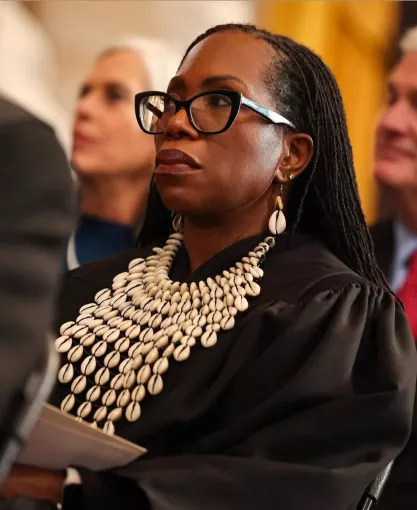
Justice Ketanji Brown Jackson in free expression mode at the Inauguration?
Justice Ketanji Brown Jackson at the inauguration of Donald Trump on Jan. 20, 2024. (Imagn Images)
Excerpts from Virginia Court of Appeals decision in Patel v. CNN, Inc.
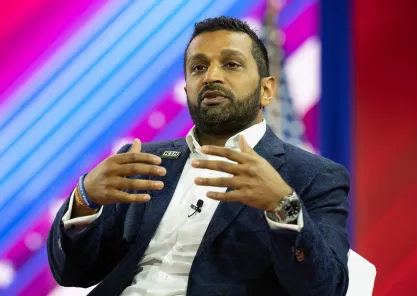
Kash Patel, seen here at the 2023 Conservative Political Action Conference, is President Donald Trump’s nominee to head the FBI. (Consolidated News Photos / Shutterstock.com)
An excerpt from today’s Virginia Court of Appeals decision in Patel v. CNN, Inc., decided by Judge Rosemarie Annunziata, joined by Judge Vernida Chaney (the opinions weigh in at over 12,000 words, so I only excerpt some key passages).
Abortion picketing case lingers on docket
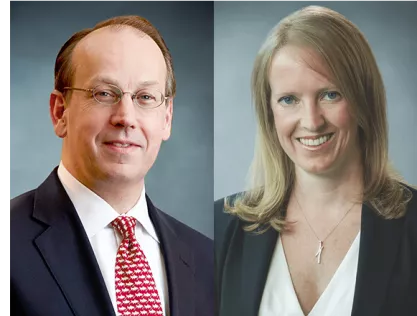
The cert. petition in the abortion picketing case, with Paul Clement as lead counsel, has been on the Court’s docket since July 16 of last year. It has been distributed for conferences seven times, the last being Jan. 21. In his petition, Mr. Clement (joined by Erin Murphy) explicitly called on the Court to “overrule Hill v. Colorado.” (See FAN 433, July 31, 2024))
Paul Clements and Erin Murphy
More in the News
2024-2025 SCOTUS term: Free expression and related cases
Cases decided
Villarreal v. Alaniz(Petition granted. Judgment vacated and case remanded for further consideration in light of Gonzalez v. Trevino, 602 U. S. ___ (2024) (per curiam))
Murphy v. Schmitt (“The petition for a writ of certiorari is granted. The judgment is vacated, and the case is remanded to the United States Court of Appeals for the Eighth Circuit for further consideration in light of Gonzalez v. Trevino, 602 U. S. ___ (2024) (per curiam).”)
TikTok Inc. and ByteDance Ltd v. Garland (The challenged provisions of the Protecting Americans from Foreign Adversary Controlled Applications Act do not violate petitioners’ First Amendment rights.)
This article is part of First Amendment News, an editorially independent publication edited by Ronald K. L. Collins and hosted by FIRE as part of our mission to educate the public about First Amendment issues. The opinions expressed are those of the article’s author(s) and may not reflect the opinions of FIRE or Mr. Collins.