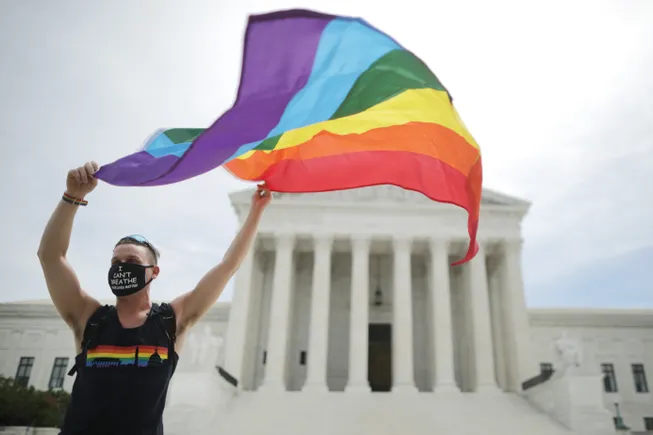
Employees at Angelo State University in Texas could be fired for displaying a pride flag or discussing any topic that suggests there are more gender identities than male and female.
Spokespeople for Angelo State have not confirmed or denied details of the policies reportedly discussed at meetings Monday between faculty, staff and institutional leaders. But, local news magazine the Concho Observer reported that the policies would ban discussion of transgender topics or any topics that suggest there are more than two genders.
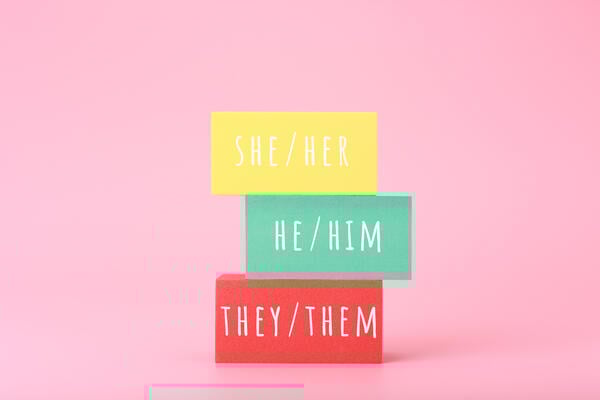
The policies would also require instructors to remove information about transgender topics on syllabi and refer to students by their given names only, not any alternative names. Safe space stickers and LGBTQ+ flags would be banned and employees wouldn’t be allowed to include their pronouns in their email signatures.
News of the policies comes just as Gov. Greg Abbott signed a bill on Monday that prohibits people from using the bathroom that differs from their sex assigned at birth in state buildings, including public universities, NBC reported. Institutions that violate this law face fines of up to $125,000.
The Angelo State policies are the latest in a string of attacks on academic freedom at Texas public universities in recent weeks. Texas A&M University officials terminated a professor, demoted two other faculty members and, as of Thursday, accepted the president’s resignation in response to a viral video that showed a student challenging a professor in class for teaching about gender identity.
Texas State University fired a newly tenured history professor over comments he made at a socialism conference about a hypothetical overthrow of the government by activists (he has already sued the university in response). And as of this month, faculty senates at some public universities are abolished.
“What is happening at ASU is part of a larger assault on higher education and marginalized communities across Texas and the nation,” Brian Evans, president of the Texas Conference of the American Association of University Professors, said in a statement. “Moreover, it is an overt attempt to erase individuals of diverse backgrounds and experiences by limiting not only what can be taught but also what ideas students can explore. These policies and this extremist push to censor open inquiry, debate, and discovery is an affront to the U.S. and Texas Constitutions and an assault on the very foundations of our colleges and universities.”
It is unclear exactly whom the new policies at Angelo State will apply to, and whether there are exceptions, particularly for displays and conversations held in private offices or for conversations outside of the classroom.
Angelo State spokespeople did not answer any of the questions Inside Higher Ed asked about the new policies, and instead provided the following statement: “Angelo State University is a public institute of higher education and is therefore subject to both state and federal law, executive orders and directives from the President of the United States, and executive orders and directives from the Governor of Texas,” spokesperson Brittney Miller wrote. “As such, Angelo State fully complies with the letter of the law.”
Miller also sent a link to a Jan. 30 letter from Abbott that said, “All Texas agencies must ensure that agency rules, internal policies, employment practices, and other actions comply with the law and the biological reality that there are only two sexes—male and female,” as well as President Donald Trump’s Jan. 20 executive order stating that the United States only recognizes two genders, male and female.
What type of legal case faculty could bring in response—and whether they may have a case at all—will depend largely on the policy details, said Eugene Volokh, a professor of law emeritus at the University of California, Los Angeles, School of Law.
There are no Texas state laws that explicitly prohibit faculty members from discussing LGBTQ+ topics in classrooms. Even Brian Harrison, the Texas state representative who is largely responsible for making the Texas A&M video go viral, said as much during an interview Sept. 13 on a conservative radio show.
“The governor and lieutenant governor and speaker have been telling everybody for two years now that we passed bans on DEI and transgender indoctrination in public universities,” Harrison said. “The only little problem with that? It’s a complete lie. The bill that was passed to ban DEI explicitly authorizes DEI in the classroom—same thing with transgender indoctrination.” Harrison has introduced several bills to ban these topics, but so far none have been passed.
The legislation Harrison referred to is Texas Senate Bill 17, which bans diversity, equity and inclusion efforts by public institutions. It was signed into law in 2023 and includes carve-outs for academic instruction, scholarly research and campus guest speakers. Meanwhile, House Bill 229 took effect on Sept. 1 and specifies that the state recognizes two genders. It applies to data collection by government entities only and does not restrict academic instruction or speech.
Public employers, because they only speak through their employees, can generally tell people what to say as part of their job, Volokh said. “A police department may order police officers to talk in certain ways to their citizens and to not talk in other ways to citizens, right? In fact, we expect the police department to do that,” he said. “The question is whether there’s a specific, special rule that protects the rights of college or university professors.”
The courts are largely undecided on that, he added. “It’s being litigated right now in other federal courts. It’s been raised in past cases, and there isn’t really a clear answer,” he said.
“It’s certainly possible that [professors] may have First Amendment rights to choose to teach what they want to teach, but it’s also possible that boards will also say, ‘No, when you’re on the job and talking to a captive audience of students that the university provided for you … we, the university, get to tell you what to teach.’”
Other state university systems have implemented similar policies with the opposite effect. For example, the University of California system requires university-issued documents to offer three gender identity options—male, female and nonbinary—and for all university documents and IT systems to include an individual’s “lived name” instead of their legal name. If an individual’s lived name is different from their legal name, their legal name must be kept confidential.
This article has been updated to correct the Texas Senate bill number.