Last week, I was talking with a young man, Pinot, during my time in another country. He told me that he really wants to visit America, but one thing seriously frightens him: the possibility of police officers stopping, harassing and potentially inflicting violence on him. He asked me if these situations really happen as often as it seems. Pinot is Black. That conversation made me wonder how many talented, Black prospective international students share the same fears and ultimately opt out of applying to U.S. universities.
Yesterday, I was scrolling one of my social media timelines and saw this CBS News video of police officers in Jacksonville, Fla., terrorizing William McNeil Jr. I felt my blood pressure and anxiety rising as I watched. I had not previously seen it, but maybe Pinot had. It is plausible that others around the world have as well. Videos like these teach young people across the U.S. and abroad a set of heartbreaking, inexcusable truths about crimes committed against Black men in America.
As was the case in last week’s conversation with Pinot, I would not be able to tell a talented young Black male prospective college applicant from Africa, Jamaica, London, Paris or anyplace else that what he has seen on television or social media are rare, isolated occurrences. I would be lying. Truth is, racial profiling and police brutality happen far too often. As I said to Pinot, “What you see and hear about this is not not true.” There is far too much evidence that it remains pervasive.
I have often told a personal story to audiences comprised of hundreds (sometimes thousands) in the U.S. that I decided against sharing with Pinot because I did not want to deepen his fears about what could happen to him if he ever visited America. I am recapping the incident here.
In July 2007, I became an Ivy League professor. I also purchased my first home. I was a 31-year-old Black man with a Ph.D. Three friends and I went out to a nightclub to celebrate my new job at the University of Pennsylvania and my home purchase. Bars and clubs close at 2:00 a.m. in Philadelphia. My friends and I were hanging on a corner saying our goodbyes after the nightclub closed. Several other nearby establishments also had just shut down. Hence, there were lots of people on the other three corners and along the streets.
A cop drove past my friends and me and said something that we did not hear because it was very crowded and noisy around us. We were doing nothing wrong and therefore had no reason to believe he was talking directly to the four of us. Seconds later, he jumped out of his patrol car, put his hands on his baton and yelled to us, “I said get off the fucking corner!” We were shocked and scared. The situation also hurt and angered us, but we were collectively powerless in the moment. We put our hands up and peacefully walked away. I cried uncontrollably during my drive home.
I mentioned that I was an Ivy League professor with a Ph.D. My three friends also worked in higher education at the time (and still do). They also are Black men. Each of them has a Ph.D. No one, regardless of educational attainment, socioeconomic status or professional accomplishments, deserves to be treated like we were that night. Nevertheless, it is noteworthy that our doctorates and university affiliations afforded us no immunity from police misconduct. To that cop, we were just four harassable Black men standing on a street corner.
I wanted to tell Pinot that being stopped, undeservingly terrorized and potentially murdered by police officers in America for no reason would be unlikely to happen to him. But I could not. Upon reflection, I wonder how many other young Black men from other countries say “no, thanks” to visiting the U.S. or applying for admission to our universities because of the fears that Pinot articulated to me. If they saw the McNeil video and others like it on social media, YouTube or elsewhere, they would be right to doubt my or anyone else’s insistence that interactions with American law enforcement agents are generally safe for citizens, visitors or international students who are Black.
By the way, perhaps it is good that Pinot did not ask me how the police officer who smashed McNeil’s car window, punched him in the face, threw him to the ground and attacked him was ultimately held accountable. According to an NPR article published this week, that cop was recently cleared of excessive force charges. Surely I would have lost all credibility with Pinot had I attempted to convince him that he would somehow be absolutely safe from similar acts of police brutality as a Black man in America.
Shaun Harper is University Professor and Provost Professor of Education, Business and Public Policy at the University of Southern California, where he holds the Clifford and Betty Allen Chair in Urban Leadership. His most recent book is titled Let’s Talk About DEI: Productive Disagreements About America’s Most Polarizing Topics.
For many young Americans, the Reserve Officers’ Training Corps (ROTC) or other military‑linked opportunities can look like a ticket to education, steady income, and a chance to “see the world.” But the allure of scholarships, structure, and economic opportunity often hides a deeper reality — one that includes moral danger, personal risk, and long-term uncertainty.
Recent events underscore this. On November 24, 2025, the United States Department of Defense (DoD) announced it was opening a formal investigation into Mark Kelly — retired Navy captain, former astronaut, and current U.S. Senator — after he appeared in a video alongside other lawmakers urging U.S. troops to disobey “illegal orders.” The DoD’s justification: as a retired officer, Kelly remains subject to the Uniform Code of Military Justice (UCMJ), and the department said his statements may have “interfered with the loyalty, morale, or good order and discipline of the armed forces.”
This episode is striking not only because of Kelly’s prominence, but because it shows how even after leaving active service, a veteran’s speech and actions can be subject to military law — a stark reminder that joining the military (or training through ROTC) can carry obligations and consequences long after “service” ends.
Moral, Legal & Personal Risks Behind the Promise
When you consider military service — through ROTC or otherwise — it’s important to weigh the full scope of what you may be signing up for:
Potential involvement in illegal or immoral wars: ROTC graduates may eventually be deployed in foreign conflicts — possibly ones controversial or condemned internationally (for example, interventions in places like Venezuela). Participation in such wars raises real moral questions about complicity in human rights abuses, “regime-change,” or other interventions that may lack democratic or legal legitimacy.
Domestic deployment and policing: Military obligations are increasingly stretching beyond foreign wars. Service members — even reservists — can be called in to deal with domestic “disputes,” civil unrest, or internal security operations. This raises ethical concerns about policing one’s own communities, and potential coercion or suppression of civil and political rights.
Long-term oversight and limited freedom: The investigation of Senator Kelly shows that veterans and officers remain under DoD jurisdiction even after service ends. That oversight can restrict free speech, dissent, or political engagement. Those seeking to escape economic hardship or limited opportunities may overlook how binding and enduring those obligations can be — even decades later.
Psychological and bodily danger: Military service often involves exposure to combat, trauma, physical injury — not to mention risks such as sexual assault, racism, sexism, and institutional abuse. Mental health consequences like PTSD are common, and the support systems for dealing with them are widely criticized as inadequate.
Institutional racism, sexism, and inequality: The military is an institution with historic and ongoing patterns of discrimination — which can exacerbate systemic injustices rather than alleviate them. For individuals coming from marginalized communities, the promise of “a way out” can come with new forms of structural violence, exploitation, or marginalization.
Career precarity and institutional control: Even after completing education or training, the reality of “limited choices” looms large. Military obligations — contractual, legal, social — can bind individuals long-term, affecting not just their mobility but their agency, conscience, and ability to critique the system.
Why Economic Incentives Often Mask the Real Costs
For many, the draw of ROTC is economic: scholarships, stable income, a way out of challenging socioeconomic circumstances, or a ticket out of a hometown with limited opportunity. These incentives are real. But as the recent case with Mark Kelly makes clear, the costs — legal, moral, social — can be far greater and more enduring than advertised. What looks like an escape route can become a lifetime of obligations, constraints, and potential complicity in questionable policies.
A Call for Caution, Conscience, and Awareness
Prospective enlistees deserve full transparency. The decision to join ROTC or the military should not be sold merely as an educational contract or a job opportunity — it is an entrance into a deeply entrenched institution, one with power, obligations, and potential for harm. The new controversy around Mark Kelly ought to serve as a wake-up call: if even a decorated former officer and sitting U.S. senator can be threatened decades after service, young people should consider carefully what they may be signing up for.
If you — or someone you care about — is thinking of joining, ask: What kind of wars might I be asked to fight? What does “service” really cost — and who pays?
College recruitment is a bit like hosting a dinner party. You might set the table beautifully, prep your best dish, and send out invitations. But if you forget dessert or serve something your guests did not actually want, you will still leave people hungry.
Email is king, but do not ignore texts and portals
Email is still king, and on this, families and colleges are totally in sync. Nearly all institutions rely on it to connect with prospective students and their families (98–100%), and approximately 90% of families consider it their top way to receive college updates (RNL, 2025; RNL et al., 2025). But that is not the end of the story: lower-income and first-generation families are more likely to prefer text messages, with about 30% say getting updates on their phones suits them best. And when it comes to college portals? Most families are not shy about their feelings. Seventy-seven percent call these hubs “invaluable” for keeping track of deadlines and details.
Here is the practical takeaway. If your family portal is still in beta, you are late. The portal is the digital front porch. Families want to step in. They do not want to just peer through a window.
However, this is where institutions often fall short.
Lower-income families:They may not have unlimited data plans or reliable Wi-Fi. For them, text updates are not just convenient. They are a lifeline. Use SMS for deadlines, aid reminders, and quick check-ins.
Multilingual families: A portal that exists only in English is a locked door. Translation tools, multilingual FAQs, or videos with subtitles are not extras. They are necessities.
Busy working families: They may read email at odd hours. Keep messages concise. Make them mobile-friendly. Pack them with links that get families directly to what they need. No scavenger hunt.
Email may be the king, but texts and portals are the court. Together, they make families feel included, informed, and respected. Income, language, and schedule should not become barriers to access.
Cost clarity: The non-negotiable
Families shout this from the rooftops. Show me the money.
Ninety-nine percent say tuition and cost details are essential. Seventy-two percent have already ruled out institutions based on the sticker shock (RNL et al., 2025).
Meanwhile, many institutions are still burying their net price calculators three clicks deep or waiting until after application to share the real numbers (RNL, 2025). That delay does not just frustrate. It eliminates your campus from consideration.
Here is the practical takeaway. Put cost and aid at the forefront. Homepage, emails, campus events. If families cannot find your numbers, they will assume they are bad.
Widen the lens for a moment.
Lower-income families:They do not just compare sticker prices. They seek reassurance that aid is real, accessible, and does not come with hidden strings.
First-generation families: Jargon like “COA” and “EFC” confuses them. Use plain explanations, visuals, or short videos to demystify the process.
Multilingual families: Cost info in English-only PDFs will not cut it. Translations, bilingual webinars, and multiple-language calculators build trust.
Busy working families:Parents reading on a break or late at night do not want to hunt. Make your cost breakdowns mobile-friendly. Spell it out: “Here is the average monthly payment after aid.” No guesswork.
Clarity is equity. Make costs easy to find, easy to understand, and easy to compare. If you do, you keep your institution in the game.
Portals: High demand, low supply
Only 45% of private and 38% of public institutions offer family portals (RNL, 2025). Seventy-seven percent of families consider portals “invaluable” during the planning process (RNL et al., 2025). That is not a gap. It is a canyon.
Here is the practical takeaway. Stop debating whether you need a portal. You do. Build one. Promote it. Keep it fresh. A portal is not just another login. It is a family’s command center.
Here is why the design matters:
Lower-income families: If they juggle multiple jobs or devices, the portal must be mobile-first. No exceptions.
First-generation families: Use the portal as a step-by-step guide through the admissions maze. Clear checklists and “what comes next” nudges make all the difference.
Multilingual families: A portal only in English is a locked gate. Multilingual menus, downloadable resources, and translated FAQs turn it into a real access point.
Busy working families: On-demand matters. Record sessions, post how-to videos, and archive key communications. Parents can catch up after a late shift.
Think of your family portal as the ultimate cheat sheet. If it answers questions before families even think to ask them, you have built trust.
Campus visits still rule the court
Institutions know visits are powerful. Families confirm it. Ninety-seven percent say seeing campus in person shapes their decision (RNL, 2025; RNL et al., 2025). First-generation families value them even more.
Here is the practical takeaway. Do not just host cookie-cutter tours. Offer tailored experiences for first-generation families, local students, or academic interest groups. If your best tour story is still “this is the library,” you are missing the emotional connection.
And do not forget the families outside the “traditional tour” box.
Commuter students:Show them where they will spend their days. Lounges, commuter lockers, meal plan hacks, parking solutions. These matter.
Students working 20 hours a week to pay tuition: Highlight flexible scheduling, evening classes, and campus jobs.
Busy working families: Are you offering evening and weekend options? Can families join virtual sessions during a lunch break? If not, you are leaving them out.
The real question: Are your campus experiences built for everyone, or just for the students who can spend a sunny Thursday afternoon strolling through your quad?
Families want in, not just students
Three out of four families want at least weekly updates or timely news when it matters (RNL et al., 2025). Institutions are trying, but too often, communication still feels like a one-size-fits-all t-shirt. Technically wearable. Not flattering.
Here is the practical takeaway. Treat families as partners, not sidekicks. Share updates in plain language. Offer Spanish-language options. Spotlight ways families can support their students. Yield is not just about students. It is about family buy-in.
And remember:
Lower-income families:They may not have time to comb through long emails. Keep communication concise. Highlight financial deadlines.
First-generation families:Spell out key milestones. Provide clear “what comes next” instructions.
Multilingual families: Translate emails, texts, and portal content.
Busy working families:Send reminders multiple times of day. Record webinars. Make resources on demand.
When communication feels clear, inclusive, and personal, families lean in. When it does not, they check out. Sometimes, they cross your institution off the list.
Mind the gaps: Equity and information access
Families across the board say cost, aid, program details, and outcomes are critical. Lower-income and first-generation families face significantly larger “information deserts” when searching for them (RNL et al., 2025). Yet institutions often double down on generic email campaigns or broad digital ads. They assume everyone is starting from the same place (RNL, 2025).
Here is the practical takeaway. Equity in outreach is not just a value statement. It is a recruitment strategy. Translate materials. Send proactive aid guides. Partner with community groups to get info where it is needed most.
And remember:
Lower-income families:Scholarships and payment plan info should not be three clicks deep. Put them front and center.
First-generation families:A one-page roadmap with plain-language admissions and aid steps can level the field.
Multilingual families: One brochure in Spanish is not enough. Provide translated FAQs, videos, and multilingual staff at info sessions.
Busy working families:Host virtual Q&As in the evenings. Record them. Make sure materials are mobile-friendly.
If families cannot find or understand what they need, they will assume you do not have it. Or worse, that you do not care.
Digital tools are only as good as the content behind them
Institutions love their toys. Chatbots, SEO, and retargeted ads. These tools can be powerful (RNL, 2025). But families are not impressed by bells and whistles if the basics are missing. They want clear, easily accessible information about costs, aid, programs, and outcomes. Too often, they click into a chatbot or portal and leave frustrated because the answers are not there (RNL et al., 2025).
Here is the practical takeaway. Do not let technology become window dressing. Audit your site from a family’s perspective. Can they find costs, aid, majors, and career outcomes in under two clicks? If not, no chatbot in the world can fix it. No amount of flash will.
Think beyond the default user.
Lower-income families: Spotty internet access means your site needs to be mobile-first, fast-loading, and crystal clear.
First-generation families: Chatbots must speak plain language, not acronym soup.
Multilingual families: Add multilingual chatbot capabilities or direct them quickly to translated resources.
Busy working families: On-demand support matters. Chatbots at midnight. Video explainers that can be paused and replayed. Not just a nine-to-five phone line.
Digital tools are not about looking modern. They are about making life easier. If your tech feels like another hoop to jump through, families will bounce. If it feels like a helpful hand, families will lean in.
The big picture
The alignment is clear on some fronts. Families want email, visits, and cost clarity, and institutions largely deliver. But the gaps, portals, aid communication, and equity in outreach are where recruitment wins or loses.
Families are not just support systems. They are decision-makers. Right now, they are asking colleges to meet them with transparency, respect, and practical tools that make a complicated journey a little simpler.
In other words, if institutions want families to stay at the table, they will need to stop serving what is easiest to cook and start serving what families ordered.
Talk with our marketing and recruitment experts
RNL works with colleges and universities across the country to ensure their marketing and recruitment efforts are optimized and aligned with how student search for colleges. Reach out today for a complimentary consultation to discuss:
Graduate student enrollment is increasingly critical to the overall enrollment health for universities. As demographic changes make it harder to grow traditional undergraduate enrollment, institutions will need graduate student population growth to fill in those gaps.
The good news is that the graduate student market is growing. According to National Student Clearinghouse data, graduate enrollment reached an all-time high of 3.2 million in fall 2024, with a 3.3% increase over the year before.
However, in order to compete for these students, you need to understand their motivations, influences, and concerns when it comes to their selection of a higher educational institution. To dig into these issues, RNL surveyed 1,400 prospective and enrolled graduate students on a wide range of issues that relate to their decision to pursue graduate study. Here are some of the key findings that enrollment managers need to know.
What is their primary motivation to study?
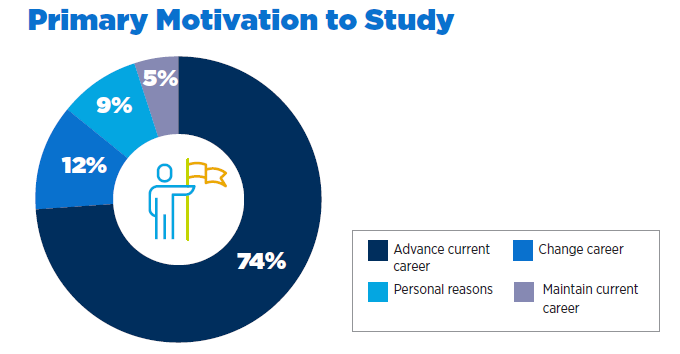
It’s no surprise that today’s students are career-oriented, but it’s clear that advancing their current career is the top driver, with 74% of our participants listing that as their primary motivation to study.
What does this mean for us as practitioners in higher education? It’s critical to not only highlight career-related information, but also to make sure that information and outcomes are very easy to find. In another finding from our report, 90% of respondents indicated that it’s important for program pages to provide specific and easy-to-access information on careers related to their field.
What influences graduate students to consider graduate study?
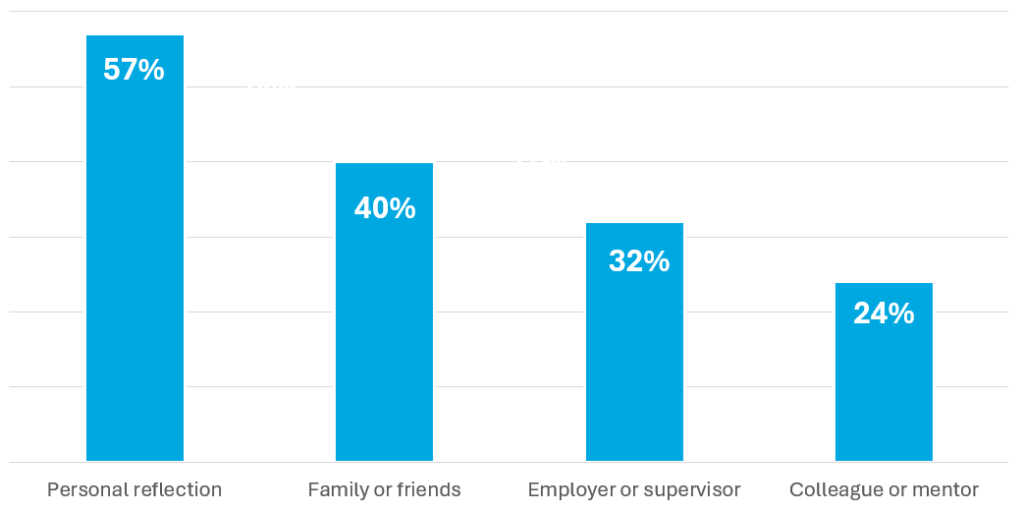
As you can see here, these decisions are largely self-motivated even if the reasons to pursue grad study are career-oriented. I find it interesting that these are not more employer-driven, especially when it comes to continuing degrees. However, it still shows that the majority of graduate students are self-motivated, intrinsic learners who see graduate study as a way to improve their lives.
What are the most important program features to prospective graduate students?
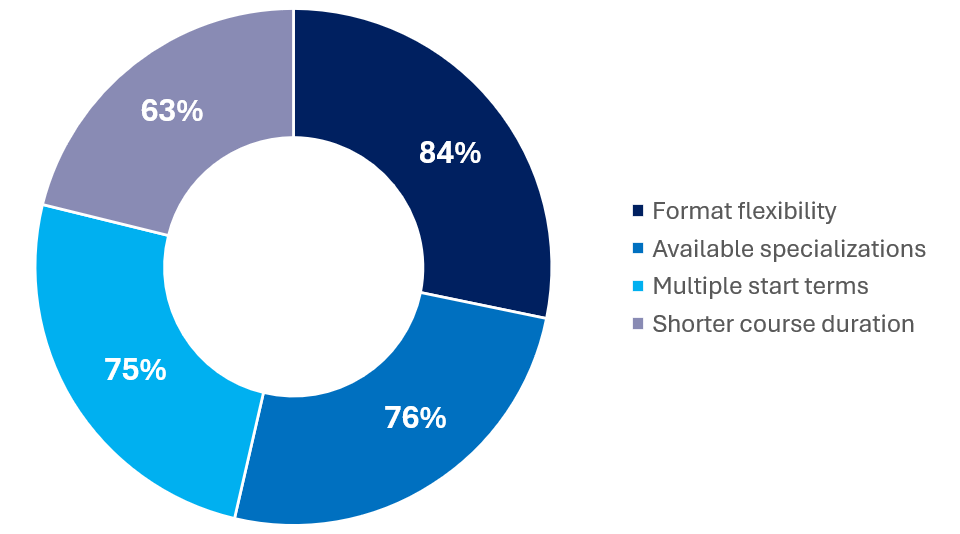
For our survey respondents, format flexibility was the feature that was cited as most important, followed closely by available specializations. This is interesting, as the respondents cited modality, course format, and specializations, and then flexible scheduling. This could be a reflection of the growing number of Gen Z students (those under 29) who make up 56% of the graduate student population according to the fall 2023 IPEDS snapshot. This change in student age demographic emphasizes the importance of offering and designing those programs for multiple delivery types and really meeting those students where they are.
What are the main concerns of graduate students?
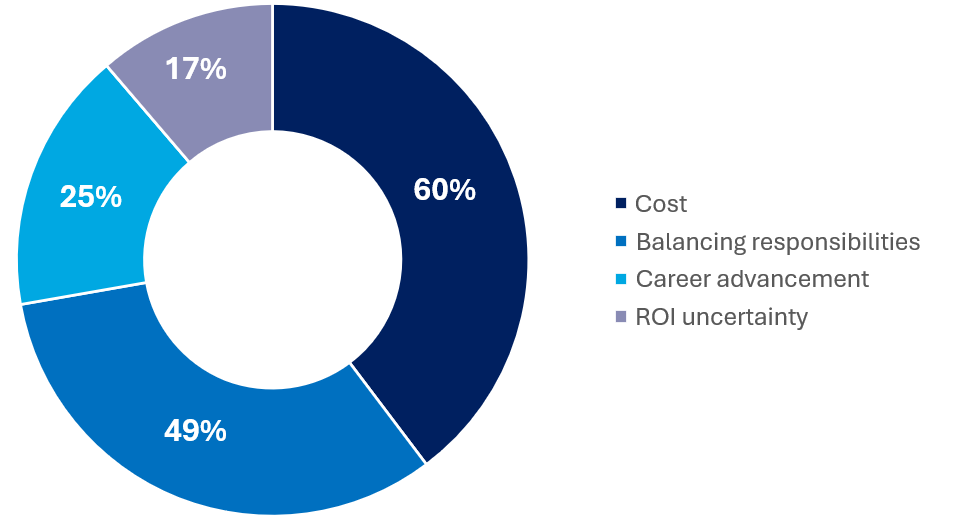
I don’t think anyone will be shocked that cost is a concern for 60% of graduate students. But half of our respondents also cited balancing responsibilities as a primary concern. This is again, not shocking considering the vast majority of our participants said they worked full-time. While fewer than 20% cited ROI uncertainty, that still represents 1 in 5 of our survey takers. The bottom line is that institutions need to directly address these pain points when they conduct outreach with students. Mitigating some of those concerns right away can help students feel more comfortable in the process and be more likely to enroll in, and ultimately complete their programs.
What will inhibit a graduate student from applying to a program?
Finally, we asked our survey respondents which common requirements would potentially dissuade them from applying to a program.
As you can see, 1 in 3 students cited letters of recommendation and essays/personal statements. This is not to say that institutions should remove these requirements, but be mindful if your program really needs them in the evaluation process. Similarly, for items such as transcripts, look for ways to make it easier for transcripts to be submitted or gathered to remove the burden from students—and a potential barrier from applying to your program.
Read the full report for even more insights
These findings represent a fraction of what you will find in the 2025 Graduate Student Recruitment Report. It’s packed with findings on the channels graduate students use to search for schools, how they use search engines for research, which digital ads they click on, and much more.
Talk with our graduate and online enrollment experts
Ask for a free consultation with us. We’ll help you assess your market and develop the optimal strategies for your prospective graduate students and online learners.
Nearly half of all students worldwide have engaged in online learning.
Online and hybrid education have shifted from emergency responses during the COVID-19 pandemic to permanent, influential forces reshaping education from kindergarten to high school to higher education. Once seen as supplemental, these models play a central role in how students, families, and institutions approach learning, access, and opportunity.
Full online enrollment remains rare in grades K-12, with just 0.6% of U.S. public school students fully online. However, hybrid learning is widespread, with 63% of students using online tools daily (National Center for Education Statistics, 2023). Globally, nearly half of all students have engaged in online learning, fueling a K–12 online education market valued at more than 171 billion U.S. dollars (Devlin Peck, n.d.; Yellow Bus ABA, n.d.).
In higher education, the shift is even more pronounced. By 2023, over half of U.S. college students had taken at least one online course, and over one-quarter were enrolled exclusively online (National Center for Education Statistics, 2023; BestColleges, 2023). Adult learners and graduate students have been especially drawn to online programs, attracted by the flexibility and accessibility they offer (Arizton Advisory & Intelligence, 2023).
But the numbers alone do not tell the whole story. To understand the future of online and hybrid learning, we need to listen to families, not as bystanders, but as essential decision-makers, advocates, and partners in shaping students’ educational journeys.
What families and students think, and why it matters
Across education levels, families appreciate the flexibility of online and hybrid models but consistently voice concerns about academic rigor, social connection, and equitable access.
In K–12, parents generally prefer in-person schooling but want schools to improve the quality of online options (Barnum, 2020; Dong, Cao, & Li, 2020; Garbe, Ogurlu, Logan, & Cook, 2020). Adult and international students in higher education often rely on online programs to balance work and family demands. However, they face barriers such as isolation, inconsistent internet access, and limited interaction with peers and faculty (Kibelloh & Bao, 2014).
Research underscores that strong course design is essential for satisfaction and success (Babb, Stewart, & Johnson, 2010; Detyna & Koch, 2023) and that social connection is not a luxury but a critical factor in persistence and well-being (Tayebinik & Puteh, 2012). Equity gaps also loom large: students without access to reliable devices, broadband, or support networks face steeper challenges (Eduljee, Murphy, Emigh-Guy, & Croteau, 2023; Neece, McIntyre, & Fenning, 2020).
Families’ pandemic experiences reinforce these themes. Many described overwhelming stress and inequities that left them skeptical of online learning without stronger support and communication (Dong et al., 2020; Garbe et al., 2020; Neece et al., 2020).
Key findings: What families want, and what budget cuts threaten
1. Families are cautious about fully online. Only 11% said they would consider a fully online experience for their student. In contrast, about 60% were open to hybrid models, which they saw as the “best of both worlds,” combining affordability, flexibility, and connection.
2. First-generation families are more open. Nearly one in five said they would consider fully online, and 60% were open to hybrid options. These pathways can be lifelines, but cuts to advising, technology, or aid risk undermining that promise.
3. Income divides are stark. Families earning under $60,000 were twice as likely to express interest in fully online compared to higher-income families. Yet as state funding declines, public colleges may raise tuition or online fees, making even “affordable” pathways harder to access.
4. Race and ethnicity matter. Black and Hispanic families showed greater openness to online and hybrid formats than Asian or White families. That opportunity will only expand if institutions sustain culturally responsive communication, peer representation, and targeted support.
5. Generational and gender differences are shifting demand. Younger parents and female caregivers are more comfortable with online and hybrid learning. Demand will keep growing, but families may see online options as second-class without continued investments in quality and communication.
6. Region matters, too. Families in the Great Lakes and Far West regions were more receptive to online learning, while New England families leaned more traditional. These cultural and infrastructural differences should shape institutional strategies.
These findings show that online and hybrid education hold real promise, especially for families seeking flexibility, affordability, and access. But that promise rests on a fragile foundation. Budget cuts threaten the very investments that make these models credible: faculty development, instructional design, technology, and support services. Without them, families’ trust could erode.
What this means for colleges: Practical implications
The research points to clear takeaways for colleges and universities:
Flexibility matters, but only if paired with quality. Families want flexible options backed by evidence of rigor, outcomes, and strong faculty engagement.
Hybrid is a strength, not a compromise. Market it as a high-quality “best of both worlds,” not a fallback option.
Equity-focused support is critical. Expand device loan programs, connectivity grants, and first-generation mentoring to close gaps.
Culturally tailored communication builds trust. Engage families with inclusive outreach and visible peer representation.
Generational shifts mean rising demand. Younger parents are more open to online and hybrid; invest now to meet tomorrow’s expectations.
Regional strategy matters. Align program design and marketing with local cultures, broadband realities, and institutional density.
Ultimately, this is about listening. For some families, online pathways may be the only way higher education is possible. For others, a hybrid model that blends connection with convenience is the right fit. Institutions that understand these diverse perspectives and invest in the structures that support them will be best positioned to earn families’ trust and help students thrive.
Babb, S., Stewart, C., & Johnson, R. (2010). Constructing communication in blended learning environments. Journal of Online Learning and Teaching, 6(2), 365–374.
Tayebinik, M., & Puteh, M. (2012). Sense of community: How important is this quality in blended courses? In Proceedings of the International Conference on Education and Management Innovation (Vol. 30, pp. 606–609). IACSIT Press. Yellow Bus ABA. (n.d.). Online education market size. YellowBusABA.com.
This September when classes started, it wasn’t the first time I had met with the students who walked through the door. That’s because during the week before they arrived on campus, I had conducted online group interviews with students who expressed an interest in taking my courses. All the students had to do was show up at one of the times I had set aside to meet with them.
The interviews are a tradition at Sarah Lawrence College, where I teach, and they are designed to let students get to know more about us as individual faculty in order for them to see if they want to take one of our courses. It’s a practice other colleges should try.
The interviews, which typically last about 30 minutes, are not a substitute for the descriptions of my courses or the syllabi I post. They are best described as the academic equivalent of a movie trailer.
The difference in this case is that the students, unlike moviegoers, are not asked to sit quietly in their seats. They are invited to ask questions after I have conducted a short presentation of what I hope will happen in my class. In these precourse interviews the students are the ones with the decision-making power. When an interview ends, they can simply decide my class is not for them and go off to another interview.
Some of the questions I get are of the nuts-and-bolts variety. How much reading do I assign a week? How many papers do I require over a term? But many of the questions are substantive. Why Book X rather than Book Y? What was the most interesting essay I got back last year?
If there is enough time, I will ask the students interviewing me to say why my course might interest them and how it fits in with the other courses they are contemplating. Students are welcome to stay after the group interview is formally over and have a one-on-one conversation.
During the interviews, I also try to explain my thinking about teaching. I don’t, for example, subscribe to the tonnage theory of assigned reading. A course in which a student races through 500 pages a week is not, I believe, better than a course in which a student closely reads 200 pages a week.
Equally important, I don’t think students should be strictly on their own when it comes to writing their papers. In the so-called real world, my editors don’t wait until I have published a book or an essay to offer up their advice. They do it before I publish, and I try to apply that practice in my classes. I see myself as my students’ editor before I ever become their judge and jury.
When it comes to AI and ChatGPT, I don’t have a lot to say these days. I think the subject has been talked to death. I tell my students to stay away from AI and ChatGPT as much as possible. Why, I ask, pay good money for an education, then turn to software that limits your critical thinking and research? The writing assignments I give are, I hope, sufficiently thoughtful that AI and ChatGPT can only be of minimal value. When it comes to long-form essays, I want my students to think about the material they are analyzing with a depth that is impossible on a timed test.
Looking back on a week of interviews, I often worry that I have imposed too much of myself on students. But in the end that is, I think, a risk worth taking. What precourse interviews offer is a chance for students to see that a course is more than a rote plan. It’s an undertaking that depends on mutual engagement that resists easy prediction.
Nicolaus Mills is chair of the literature department at Sarah Lawrence College and author of Winning the Peace: The Marshall Plan and America’s Coming of Age as a Superpower (John Wiley & Sons, 2008).